

Key Takeaways
- Bonaire, Sint Eustatius, and Saba's low-tax fiscal framework, administered within the Dutch Caribbean tax regime, reduces the corporate tax burden relative to many onshore jurisdictions while remaining anchored to enforceable Dutch constitutional law.
- The complete absence of capital gains tax means investment returns and asset disposals are not eroded at the point of exit, a structural advantage that directly affects holding and investment structures.
- Oversight by the RCN (Rijksdienst Caribisch Nederland) and alignment with Dutch Kingdom governance standards gives incorporated entities a level of regulatory credibility that informal or loosely supervised Caribbean regimes cannot match.
- Conducting business in US dollars as the official currency eliminates the foreign exchange conversion costs and currency risk that typically accompany operations in jurisdictions running their own monetary systems.
Bonaire, Sint Eustatius, and Saba are three Caribbean islands that form a group of special municipalities within the Kingdom of the Netherlands, operating under Dutch constitutional law rather than as an autonomous country. This political structure gives the territory a distinct regulatory character among Caribbean jurisdictions. The RCN (Rijksdienst Caribisch Nederland) oversees public administration across the islands, while company registration falls under the Dutch Caribbean legal and civil law framework.
Foreign businesses typically incorporate through a BV or NV structure. The territory operates under a low-tax posture, with rates and conditions set within the broader Dutch Caribbean fiscal framework. Foreign ownership is generally permitted without restrictive local shareholding requirements, making it accessible to international investors and entrepreneurs. This article covers the key advantages of incorporating a company in Bonaire, Sint Eustatius, and Saba across areas that range from tax policy to regulatory stability.
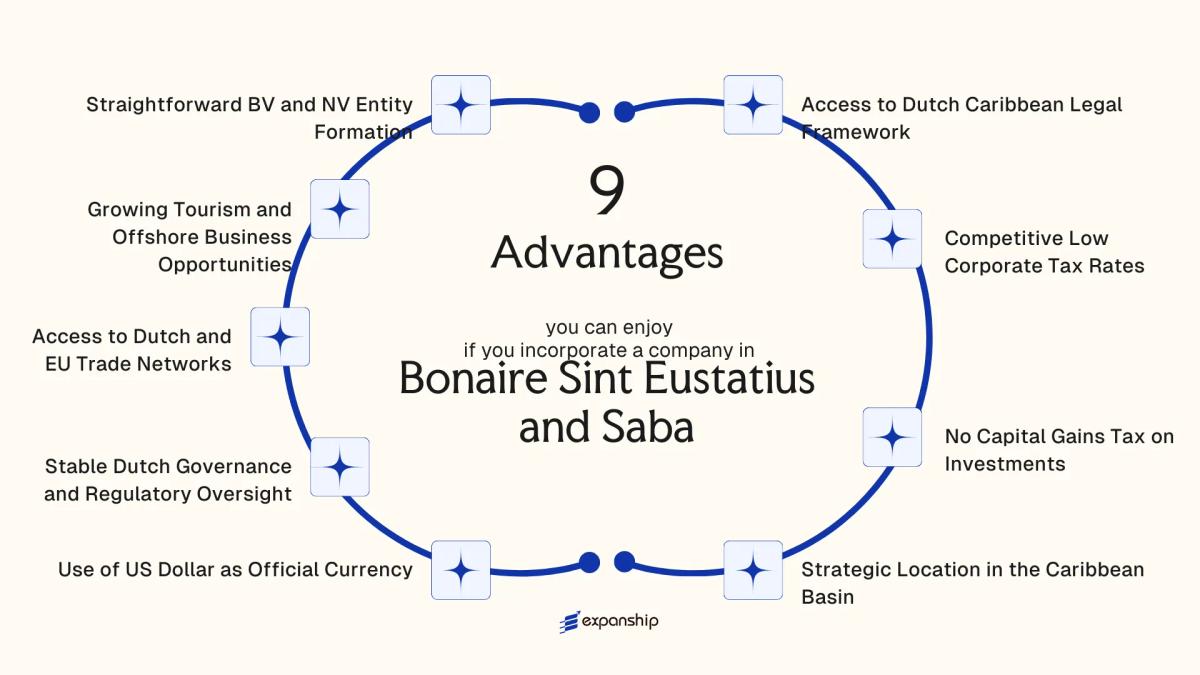
Access to Dutch Caribbean Legal Framework
Businesses incorporating in Bonaire Sint Eustatius and Saba operate under a legal system derived directly from Dutch civil law, one of the most codified and predictable frameworks in the world. This affiliation gives your company a degree of legal certainty that most Caribbean jurisdictions cannot replicate.
Civil Law Foundation Grounded in Dutch Statute
The BES islands follow the Dutch Civil Code as adapted for the Caribbean Netherlands, which governs contract enforcement, corporate obligations, and property rights. For a foreign business owner, this means your agreements and corporate structures rest on statutes with decades of judicial interpretation behind them, not on untested local legislation.
Oversight by Established Dutch Institutions
Regulatory supervision is conducted by bodies including De Nederlandsche Bank (DNB), which oversees financial institutions operating in the Caribbean Netherlands. Because these are the same institutions governing the European Netherlands, the standards applied to your firm are consistent, documented, and internationally recognized.
Your contracts, corporate rights, and financial compliance obligations are governed by Dutch statutory law, giving foreign counterparties and institutions a familiar legal reference point when engaging with your entity.
Competitive Low Corporate Tax Rates
Corporate profit tax in the BES islands is levied at a flat rate of 25.8% under the Wet op de vennootschapsbelasting as applied to the islands, but the effective burden on many businesses falls considerably lower. Entities operating within the BES fiscal regime benefit from a tax-exempt profit threshold of USD 15,000, and certain qualifying activities attract a reduced rate. For a foreign business owner, this means smaller firms or newly established entities can retain more early-stage earnings before the standard rate applies.
The fiscal framework governing the BES islands is distinct from both the Netherlands and the former Netherlands Antilles. This separation gives the islands their own tax ordinances, which are administered locally rather than through The Hague. Your company is therefore taxed under BES-specific rules rather than the broader Dutch corporate tax regime, which carries higher headline rates.
Several structural features make the BES corporate tax position practical for foreign-owned entities:
- The USD 15,000 profit exemption reduces the tax base for smaller or early-stage operations without requiring any special application
- Local administration means your entity interacts with a single, clearly defined authority rather than overlapping regulatory layers
- The absence of withholding tax on dividends paid to non-resident shareholders preserves distributions at the entity level
- Flat-rate taxation simplifies profit forecasting across fiscal years
Eligibility for reduced rates depends on the nature of the business activity and whether the entity maintains genuine substance on the islands.

Company Incorporation in Bonaire, Sint Eustatius and Saba
Establish your BES-registered entity under the local fiscal framework with guidance from Expanship's corporate services team.
No Capital Gains Tax on Investments
Under the fiscal framework governing the BES islands (Bonaire, Sint Eustatius, and Saba), capital gains derived from the sale of shares, investments, or business assets are not subject to a separate capital gains tax. This absence of no capital gains tax in BES islands applies at the local level under the Belastingwet BES, the primary tax legislation that governs these public entities of the Netherlands.
| Investment Type | Capital Gains Tax | Applicable Framework |
|---|---|---|
| Share disposals | None | Belastingwet BES |
| Business asset sales | None at capital gains level | Belastingwet BES |
| Passive investment returns | None at capital gains level | Belastingwet BES |
For a foreign business owner, this has a direct effect on after-exit returns. Profits realized from divesting a shareholding or selling a BES-registered entity are not eroded by a dedicated capital gains charge, which preserves the full economic value of an investment at the point of exit.
Income tax and profit tax obligations still apply to ordinary business income under the Belastingwet BES, so the capital gains exemption does not eliminate all tax exposure. The distinction matters: trading profits remain taxable, while appreciation realized on qualifying investment disposals does not attract an additional layer of taxation.
For holding structures or investment vehicles incorporated in the BES islands, this treatment can meaningfully improve net returns compared to jurisdictions where capital gains are taxed at rates between 20% and 30%.
Strategic Location in the Caribbean Basin
Bonaire's position in the southern Caribbean, just 86 kilometers off the Venezuelan coast, places it outside the Atlantic hurricane belt — a geographic fact that directly reduces operational risk for businesses requiring year-round physical access to facilities.
The BES islands sit at a geographic crossroads between North America, South America, and Europe. This translates into practical time-zone compatibility: business hours overlap with both US East Coast markets and Western European trading partners without the extreme offsets that complicate operations from Southeast Asian or Pacific jurisdictions.
Port and air connectivity reinforce this. Flamingo Airport on Bonaire handles direct connections to Amsterdam via KLM, and cargo infrastructure supports trade links across the Caribbean Basin. For businesses in logistics, import/export, or regional distribution, physical proximity to both CARICOM markets and the South American continent shortens supply chains in ways that a purely offshore paper company cannot replicate.
As a Dutch public entity under the Kingdom Charter, the BES islands operate under a stable jurisdiction while maintaining Caribbean Basin geographic business advantages unavailable from European-domiciled entities.
Keep the following in mind:
- Hurricane belt exclusion reduces insurance and continuity planning costs
- Proximity to Venezuela and Colombia creates regional distribution relevance
- KLM Amsterdam route supports direct European operational oversight
- Physical presence requirements vary by entity type and activity
Bonaire Sint Eustatius and Saba are not part of the European Union, yet they fall under the Kingdom of the Netherlands — meaning your entity sits outside EU VAT obligations while retaining Dutch legal backing.
Use of US Dollar as Official Currency
The US dollar official currency advantage BES islands businesses gain is immediate and structural. Since the Netherlands Antilles dissolved in 2010 and the three islands became special municipalities of the Netherlands, the USD has served as the official legal tender across the BES islands under the Dutch Caribbean financial order, eliminating any exposure to a local currency for your operations.
No Exchange Rate Risk on Core Transactions
Pricing contracts, settling invoices, and holding reserves in USD means your business avoids the conversion costs and volatility that affect entities operating in jurisdictions with weaker or fluctuating local currencies. For companies whose revenues, supplier agreements, or financing arrangements are already denominated in dollars, this alignment removes a layer of financial friction that would otherwise require active hedging or currency management.
Practical Fit for US-Facing and International Operations
The Caribbean Basin is heavily dollar-denominated in trade and commerce. A firm incorporated here transacts in the same currency as its US counterparties without triggering cross-currency settlement complications. Dutch financial oversight through De Nederlandsche Bank (DNB) and the Dutch Authority for the Financial Markets (AFM) applies to regulated entities in the BES islands, meaning dollar-denominated business benefits from a regulated, institutionally supervised environment rather than a loosely governed offshore one.
Your accounts, financial statements, and statutory filings all operate in USD, which reduces administrative overhead for businesses with US-based shareholders, auditors, or reporting obligations.
Maximize Your USD Advantage in Bonaire, Sint Eustatius and Saba
Speak with an Expanship specialist about structuring your BES incorporation to make full use of the USD operating environment and Dutch regulatory framework.
Stable Dutch Governance and Regulatory Oversight
As a set of public bodies under direct Dutch constitutional authority, the BES islands operate within a governance structure that removes much of the institutional uncertainty common in smaller Caribbean jurisdictions. The stable Dutch governance benefits in BES islands stem directly from the islands' status as special municipalities of the Netherlands under the Public Bodies (BES) Act of 2010. Your business is not subject to an independent local government with unchecked discretionary powers; instead, the framework sits within a Dutch constitutional order.
- The Dutch Central Government maintains supervisory authority over local public bodies, meaning legislative and administrative decisions on the islands must remain consistent with Netherlands national law where applicable.
- The Financial Supervision (BES) Act places fiscal oversight under the College financieel toezicht (Cft), an independent body that monitors public finances across all three islands, which signals fiscal discipline to creditors and counterparties.
- Dutch anti-corruption and administrative law standards apply, reducing the risk of arbitrary regulatory changes that can affect business planning in less supervised territories.
- Court proceedings fall under the jurisdiction of the Court of First Instance in the Caribbean Netherlands, with appeals handled by the Joint Court of Justice of Aruba, Curaçao, Sint Maarten and the BES Islands, connecting your firm to an established, multi-jurisdictional appellate structure rather than a single local bench.
Access to Dutch and EU Trade Networks
As a special municipality of the Netherlands, Bonaire Sint Eustatius and Saba holds a constitutional status that gives businesses incorporated there a direct institutional connection to the Dutch state. The Netherlands is a founding EU member with one of Europe's largest trade volumes, and that relationship carries practical weight for firms operating out of the BES islands.
The BES islands are classified as Overseas Countries and Territories (OCTs) of the European Union under Part Four of the Treaty on the Functioning of the European Union (TFEU). This status means goods originating in the territory can enter EU markets under the OCT association framework, which includes preferential trade provisions not available to fully independent Caribbean jurisdictions.
For distribution or trading companies, access to Dutch EU trade networks via BES islands means working within a framework that is recognized by European customs authorities. Dutch diplomatic and consular networks also extend to BES-incorporated entities, which can simplify correspondence with European counterparties and financial institutions.
A hypothetical scenario: A trading firm incorporated in Bonaire that sources goods regionally and re-exports to the Netherlands operates under the OCT-EU association arrangement rather than standard third-country tariff schedules, potentially eliminating duties that a comparable entity incorporated in an independent Caribbean state would face on the same shipment.
Growing Tourism and Offshore Business Opportunities
Tourism across the BES islands has expanded steadily, driven by Bonaire's protected marine environment, Sint Eustatius's historical heritage sites, and Saba's ecotourism draw. Each island attracts a distinct visitor profile, which creates parallel demand for hospitality services, tour operations, and retail entities at different price points.
Bonaire offshore business opportunities for investors are not confined to financial services. The islands' designation as special municipalities of the Netherlands means they fall outside the EU's standard customs territory, a structural feature that gives businesses operating here tariff flexibility that EU-incorporated firms do not have.
Offshore holding and operating companies registered in the BES islands can serve both tourism-adjacent industries and international trade activities from the same legal structure. Dutch Caribbean law governs corporate conduct, providing a recognizable legal baseline that reduces due diligence costs for counterparties in Europe and North America.
- Tourism-related permits are administered locally through the public bodies (openbare lichamen) of each island
- Offshore entities may hold real estate, intellectual property, or trading contracts within the same corporate vehicle
- Dollar-denominated operations reduce currency conversion friction for US-market-facing businesses
Businesses in the tourism sector may require additional local operating licenses issued by the relevant island's openbaar lichaam, separate from corporate registration.
Straightforward BV and NV Entity Formation
BV NV entity formation benefits in BES islands come down, in large part, to structural simplicity. Both the Besloten Vennootschap (BV) and Naamloze Vennootschap (NV) are governed under the civil law framework applicable to the BES islands, derived from Dutch corporate law principles. For a foreign business owner, this means working within a well-documented legal tradition rather than an untested or opaque system.
Low Minimum Capital Requirements
The BV is a private limited liability company that does not require a statutory minimum share capital under current BES rules. Your liability exposure as a shareholder is confined to the amount contributed, which directly reduces financial risk when entering a new market. This structure suits smaller foreign operations that do not require public financing.
NV for Broader Capital Access
The NV, as a public limited liability company, allows for the issuance of shares to the public and supports more complex ownership arrangements. Foreign investors structuring a holding company or anticipating future capital raises benefit from this flexibility without relocating to a higher-cost jurisdiction. The legal distinction between the two entity types is clear, which reduces ambiguity during registration.
Registration Process and Notarial Requirements
Incorporation of either entity requires a notarial deed of incorporation executed before a civil law notary in the BES islands. The deed must align with the applicable BES civil code provisions. Once registered with the relevant local trade register, the entity acquires full legal personality, allowing it to contract, hold assets, and operate independently of its shareholders.
Why Bonaire Sint Eustatius and Saba Outpaces Rival Caribbean Jurisdictions
Comparing the BES islands against rival Caribbean jurisdictions reveals a structural profile that few comparable offshore destinations can match. The most realistic alternatives a foreign investor would evaluate include the Cayman Islands, the British Virgin Islands, and Curaçao, each of which targets a similar corporate audience. What the comparison shows is not simply a difference in rates, but a difference in the underlying legal and monetary architecture that supports those rates.
Curaçao shares Dutch constitutional ties but operates under the separate Kingdom of the Netherlands framework established after the 2010 dissolution of the Netherlands Antilles, meaning the two jurisdictions carry meaningfully different tax regimes and regulatory structures. The Cayman Islands and BVI, while well-established, operate without an official currency tied to the US dollar as a matter of statutory monetary policy, and neither carries the same direct administrative continuity with a G7 member state. For businesses where currency stability, legal predictability under Dutch civil law, and a low flat corporate tax rate matter simultaneously, the BES islands competitive advantages over Caribbean rivals become structurally apparent rather than merely comparative.
| Parameter | BES Islands | Cayman Islands | British Virgin Islands | Curaçao |
|---|---|---|---|---|
| Corporate Tax Rate | 0% – 5% (flat, activity-dependent) | 0% (no corporate tax, but limited substance rules) | 0% (no corporate tax) | 22% standard rate |
| Official Currency | US Dollar (statutory) | Cayman Islands Dollar (pegged to USD) | US Dollar (de facto) | Netherlands Antillean Guilder |
| Governing Legal System | Dutch Civil Law | English Common Law | English Common Law | Dutch Civil Law |
| Constitutional Link to EU Member State | Yes (Netherlands) | No (UK Crown Dependency) | No (UK Overseas Territory) | Yes (Netherlands), separate framework |
| Primary Corporate Entity | BV / NV | Exempted Company | BVI Business Company | NV / BV |
| Supervisory Authority | RCN / DNB oversight applies | Cayman Islands Monetary Authority | BVI Financial Services Commission | Central Bank of Curaçao and Sint Maarten |
Compliance Services for Companies in Bonaire, Sint Eustatius and Saba
Stay current with BES regulatory requirements, from annual filing obligations to Dutch civil law compliance, supported by specialists in the BES legal framework.
Conclusion
The benefits of incorporating in Bonaire Sint Eustatius and Saba rest on a convergence of structural advantages that few Caribbean jurisdictions can replicate through a single legal framework. Dutch Kingdom oversight brings regulatory credibility, the absence of capital gains tax removes a common friction point for investment returns, and the US dollar as the official currency eliminates foreign exchange exposure from the outset.
Not every business will extract equal value from these features. A firm oriented toward regional trade will weight the Caribbean Basin positioning differently than one focused on holding structures or financial services. Your specific entity type, whether a BV or NV, and the nature of your commercial activity will determine which regulatory and tax provisions apply most directly.
What does hold broadly is that BQ Caribbean company formation advantages are underpinned by enforceable Dutch law rather than informal policy. That legal durability, combined with the tax framework administered under Dutch Caribbean fiscal rules, gives your business a foundation that scales alongside changing regulatory environments. The next step is translating that framework into a formation structure matched to your exact circumstances.
Start Your Caribbean Incorporation Journey with Expanship
Expanship's Caribbean company incorporation services for BES islands cover the full formation lifecycle for both BV and NV structures registered under the Dutch Caribbean civil law framework. From preparing notarial deed documentation to liaising directly with the Kamer van Koophandel (Chamber of Commerce) for BES, Expanship handles the procedural requirements that apply in all three special municipalities. The service scope is calibrated to the specific compliance obligations that foreign directors and shareholders face under Dutch Caribbean corporate law.
Across the formation and maintenance process, Expanship provides the following:
- Document preparation, notarization, and legalization for BV and NV formation
- Registered agent and registered office address provision in the BES islands
- Government filing and direct liaison with the Kamer van Koophandel BES
- Post-incorporation compliance management, including annual filing obligations
- Director and UBO registration support under applicable Dutch transparency requirements
- Banking introduction assistance for corporate account opening in the region
For direct inquiries about forming a company in the BES islands, contact Expanship BQ to discuss your specific structure and requirements.
Frequently Asked Questions (FAQ)
Companies operating within the BES islands are subject to a profit tax rate that is considerably lower than the standard Dutch rate applicable in the European Netherlands. The BES fiscal framework, governed by the Wet fiscaal stelsel BES, applies specific reduced rates designed to reflect the economic conditions of these special municipalities. The exact applicable rate can vary based on the nature and structure of the business activity.
Incorporation timelines for a BV in the BES islands generally range from a few days to several weeks, depending on notarial availability, document preparation, and registration with the relevant chamber of commerce. The process requires a notarial deed of incorporation executed under Dutch Caribbean law. Delays most commonly arise from incomplete due diligence documentation rather than from the registration process itself.
For businesses that operate primarily in US dollars, conducting transactions and maintaining accounts in the BES islands removes the currency conversion layer that would otherwise apply in euro-denominated jurisdictions. The US dollar was adopted as the official currency in 2011 following the dissolution of the Netherlands Antilles. This arrangement is particularly relevant for companies transacting with North American or Latin American counterparties.
No capital gains tax applies to qualifying investment disposals under the BES fiscal framework, which distinguishes this jurisdiction from several other Caribbean and European structures. This treatment is governed by the Wet fiscaal stelsel BES rather than the European Dutch tax code. The absence of this tax can affect structuring decisions for holding companies and investment vehicles, though the specific application depends on the nature of the assets and the residency status of the beneficial owner.
The Wet fiscaal stelsel BES is a separate and distinct fiscal regime enacted specifically for Bonaire, Sint Eustatius, and Saba following their reclassification as special municipalities of the Netherlands in 2010. It does not apply the standard Dutch corporate income tax rates or the Dutch VAT system; instead, it uses a turnover-based tax called the general expenditure tax alongside its own profit tax structure. Businesses incorporated in these islands are therefore assessed under entirely different rules than those governing a Dutch BV registered in Amsterdam or Rotterdam.
Corporate registration in the BES islands falls under the administrative oversight of the Kamer van Koophandel, the local chamber of commerce responsible for maintaining the commercial register. Ongoing compliance obligations, including financial reporting and tax filings, are administered through local government bodies operating under the framework established by Dutch national legislation for the special municipalities. Non-compliance with registration or reporting requirements can result in administrative penalties under applicable BES regulations.
Legal Disclaimer
The information provided in this article is for general informational purposes only and does not constitute legal, tax, or professional advice. While we strive to ensure the accuracy and timeliness of the content, laws and regulations are subject to change, and the application of laws can vary widely based on specific facts and circumstances.
Readers should not act upon this information without seeking professional counsel tailored to their individual situation. Expanship and its authors disclaim any liability for actions taken or not taken based on the content of this article.
For specific advice regarding your business setup, compliance requirements, or any legal matters, please consult with qualified legal and tax professionals in the relevant jurisdiction.