

Key Takeaways
- Foreign investors operating in sectors such as banking, retail, and certain professional services face ownership ceilings that structurally limit equity control, reducing the commercial flexibility available to wholly foreign-owned entities.
- Under the Companies Act (Cap. 39), incorporating in Brunei requires compliance with both common law corporate obligations and Islamic legal principles, creating a dual regulatory burden that increases the cost and complexity of ongoing compliance.
- The absence of a domestic public stock exchange means companies incorporated in Brunei cannot access local equity capital markets for fundraising, pushing businesses toward a narrow set of private financing alternatives.
- With a national population of under 500,000, the domestic consumer base is too small to support scale for most consumer-facing business models, making local revenue generation an unreliable foundation for commercial viability.
Brunei operates under a tightly regulated corporate environment, governed primarily by the Companies Act and overseen by the Registry of Companies and Business Names (ROCBN) under the Ministry of Finance and Economy. The regulatory framework draws from both common law traditions and Islamic legal principles, creating a dual compliance structure that foreign businesses must account for from the outset.
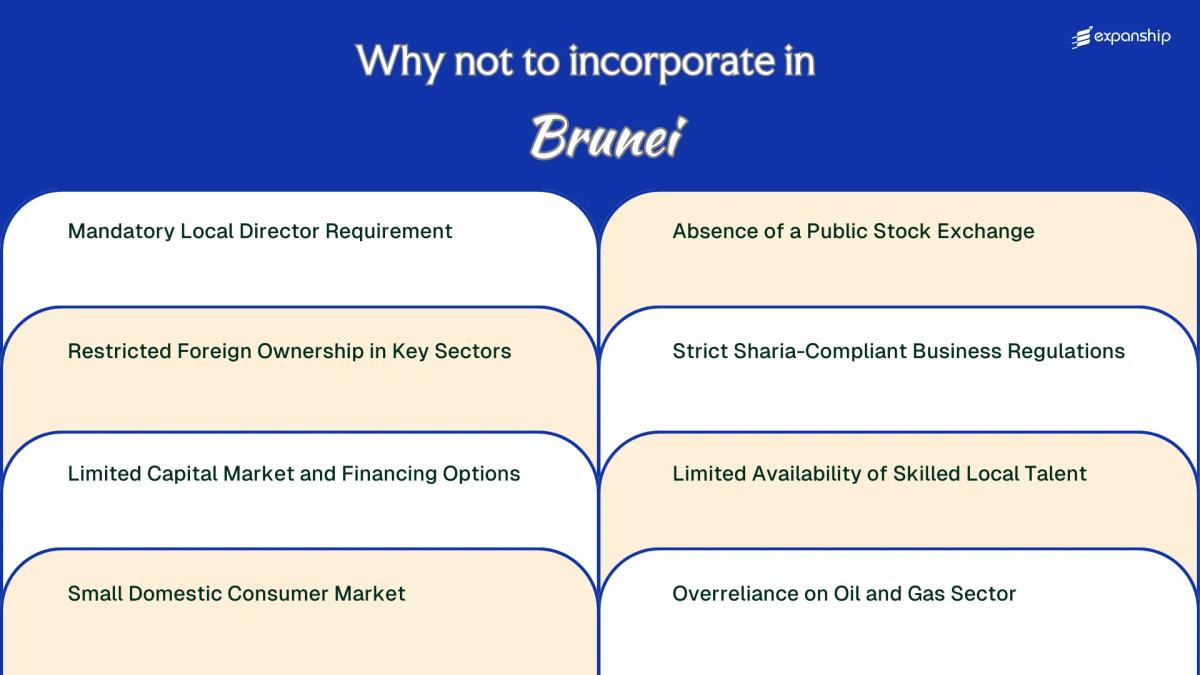
The disadvantages of incorporating in Brunei span several distinct categories, from ownership restrictions to financing constraints and sector-specific limitations.
How significantly these drawbacks affect your business depends on the industry you operate in, the corporate structure you choose, and the degree of local market engagement your model requires. A purely export-oriented firm faces a different set of constraints than one targeting domestic consumers.
This article is most relevant to foreign entrepreneurs, multinational subsidiaries, and offshore holding company operators considering the cons of setting up a company in Brunei for the first time.
Mandatory Local Director Requirement
The Brunei local director requirement restrictions present a structural compliance obligation that foreign founders often underestimate before incorporation.
Statutory Basis and Appointment Obligation
Under the Companies Act (Cap. 39), every company incorporated in Brunei must have at least one director who is ordinarily resident in the country. This residency condition is not satisfied by citizenship alone; the director must be physically domiciled there, which narrows the available pool significantly for foreign-owned entities.
Finding a qualifying individual adds both cost and dependency to your corporate structure from day one.
Practical Control and Liability Exposure
A mandatory resident director Brunei company structures require is not a passive formality. Because that director holds statutory signing authority and bears legal liability under the Companies Act, your business becomes operationally dependent on a third party whose interests may not align with yours.
This arrangement also creates reputational and financial exposure if the appointed director becomes non-cooperative or exits without notice.
A resident director holds statutory liability under Cap. 39, meaning any compliance failure by your company can directly implicate an individual you may have limited contractual control over.
Restricted Foreign Ownership in Key Sectors
Foreign ownership restrictions in Brunei sectors are encoded in law, not just policy guidelines. Under the Companies Act (Cap. 39) and sector-specific regulations, certain industries impose hard equity ceilings on foreign participation, meaning your ownership stake is capped regardless of investment size.
Retail trade is one of the most directly affected areas. Foreign firms are generally required to partner with a Brunei citizen or permanent resident to conduct retail operations, which introduces a structurally dependent relationship that carries both financial and operational consequences.
These restrictions create measurable friction for foreign business owners in practice:
- Mandatory local equity partners gain profit-sharing rights you cannot contractually avoid, reducing your effective return on capital
- Sourcing a qualified local partner adds timeline delays before your firm can legally commence operations
- Brunei FDI ownership constraints in licensed sectors require regulatory pre-approval, adding a formal application layer that increases setup costs
- Restricted industries for foreigners in Brunei may require ongoing compliance reporting tied to the local partner's continued involvement
Some sectors with strategic national interest, including upstream oil and gas activities, impose even stricter controls under the Petroleum Mining Act.

Company Incorporation in Brunei
Understand how equity restrictions and local partnership requirements affect your incorporation structure before you commit.
Limited Capital Market and Financing Options
Brunei limited business financing options are structurally constrained in ways that directly affect how a foreign-owned company can fund its operations and growth. There is no public stock exchange, which means equity capital markets are inaccessible as a funding mechanism for incorporated entities.
Bank financing is the dominant channel, and it is concentrated among a small number of institutions, including Baiduri Bank, Bank Islam Brunei Darussalam (BIBD), and a handful of foreign bank branches. This concentration limits competitive lending conditions and gives lenders significant leverage in setting terms.
| Financing Channel | Practical Restriction | Impact on Foreign Business |
|---|---|---|
| Equity capital markets | No public stock exchange exists | No IPO or listed fundraising path |
| Bank credit | Limited number of active commercial lenders | Restricted loan competition; tighter terms |
| Islamic finance | Products structured under Sharia compliance | Conventional debt instruments may be unavailable |
| Venture capital | Minimal formal VC ecosystem | Early-stage funding largely unavailable |
| Foreign borrowing | Subject to exchange control considerations | Cross-border capital injection can be complex |
Most financing products available through local banks follow Islamic finance principles governed by the Autoriti Monetari Brunei Darussalam (AMBD). If your firm requires conventional interest-based credit facilities, you will find the product range significantly narrower than in most regional financial centres.
Access to capital problems facing businesses here are compounded by the modest size of the private sector itself. Without a deep pool of institutional investors or an active bond market, foreign companies typically depend on retained earnings or parent-company funding rather than locally sourced capital.
Small Domestic Consumer Market
Brunei's total population sits at approximately 450,000 people. For a foreign business targeting consumer revenue, that figure imposes a structural ceiling on addressable demand that no operational efficiency can overcome.
With such a limited consumer base, achieving the sales volumes needed to justify incorporation costs, staffing, and ongoing compliance obligations becomes a genuine financial challenge. Most product categories simply do not have enough local buyers to sustain a standalone commercial operation.
Per capita income is relatively high due to government subsidies, yet purchasing patterns are concentrated in a narrow range of goods and services. The Department of Statistics under the Ministry of Finance and Economy publishes household expenditure data that illustrates just how constrained domestic consumption actually is across most non-essential sectors.
Brunei market size drawbacks are especially pronounced for businesses in fast-moving consumer goods, retail, or technology products, where minimum viable scale requires a customer base far larger than what the country can supply.
- Revenue projections must account for a population ceiling of under 500,000 consumers
- Market saturation risk is high in retail, food and beverage, and consumer tech
- Export dependency becomes structurally necessary for most product-oriented firms
- Business registration under the Companies Act (Cap. 39) does not exempt your entity from commercial viability constraints tied to market size
Despite high average household income, domestic retail spending per capita in Brunei is significantly suppressed by state subsidies on fuel and food, making consumers less likely to spend on imported or premium-category goods than income figures alone would suggest.
Absence of a Public Stock Exchange
Brunei's absence of a public stock exchange is a structural limitation that directly affects how companies raise capital and exit investments. For businesses seeking equity financing or a public listing, the Brunei no stock exchange limitations become a decisive constraint on growth strategy.
No Domestic Listing Venue
No domestic securities exchange exists under Brunei's regulatory framework, meaning companies incorporated under the Companies Act (Cap. 39) have no local venue through which to issue publicly traded shares. This removes a conventional mechanism for raising large-scale equity capital from retail and institutional investors.
The Autoriti Monetari Brunei Darussalam (AMBD), which oversees financial services, has not licensed a formal stock exchange as of the current regulatory environment. Any firm seeking a public listing must pursue foreign exchanges, incurring the compliance costs and disclosure obligations of an overseas jurisdiction.
Consequences for Investor Exit and Capital Access
Without a public exchange, early-stage investors and venture backers face a narrower exit path, since secondary market liquidity is effectively unavailable domestically. This absence of capital market infrastructure makes equity-based fundraising structurally harder to execute compared to jurisdictions with active bourses, such as Singapore's SGX.
Private placements remain possible but are subject to AMBD oversight and reach a limited investor pool.
Addressing Structural Limitations for Your Brunei Entity
Speak with Expanship's incorporation specialists about financing structures and cross-border strategies for companies operating within Brunei's regulatory framework.
Strict Sharia-Compliant Business Regulations
Brunei Sharia law business restrictions extend well beyond finance into daily commercial operations, creating compliance obligations that foreign firms rarely encounter in other jurisdictions.
- Under the Syariah Penal Code Order 2013 and related civil statutes, businesses operating in sectors touching food, entertainment, hospitality, or retail must obtain halal certification and adhere to conduct standards enforced by the Brunei Islamic Religious Council (MUIB), adding a recurring administrative and cost burden.
- Alcohol cannot be sold commercially, which eliminates entire product categories and revenue streams for companies in hospitality, retail, or events.
- Syariah compliance challenges for foreign firms include restructuring standard contracts, financial instruments, and employment terms to satisfy Islamic business regulations, often requiring specialist legal counsel with dual competency in civil and Syariah law.
- Non-Muslim foreign employees must observe public conduct rules under civil-Syariah parallel enforcement, which can complicate talent deployment and HR policy alignment for multinational entities.
Limited Availability of Skilled Local Talent
Brunei skilled labour shortage risks are a direct consequence of the country's small population, which sits at approximately 450,000. The national workforce simply cannot supply the specialist depth that technology, financial services, or advanced manufacturing firms require.
The government's Bruneianisation policy, enforced through the Labour Department under the Ministry of Home Affairs, requires companies to demonstrate active efforts to hire local workers before foreign work permits are approved. This creates a sequential hiring burden that delays team formation, particularly for roles requiring niche technical or professional expertise.
Workforce challenges incorporating in Brunei are compounded by the concentration of educated locals in public sector employment, which absorbs a disproportionate share of qualified graduates. Private firms end up competing against government salaries and job security that they structurally cannot match.
- Expatriate hiring requires work permit approval through the Immigration and National Registration Department
- Permit-dependent headcount raises operational lead times and introduces renewal uncertainty
- Roles in sectors like fintech, engineering, and life sciences face the sharpest local supply gaps
A foreign technology firm needing five mid-level software engineers could face a 3-to-6-month permit processing timeline per hire, assuming local candidate shortlists are cleared first, translating to direct delayed-revenue costs before the team is fully operational.
Overreliance on Oil and Gas Sector
Brunei oil and gas dependency risks are structural, not cyclical. Hydrocarbons account for roughly 60% of GDP and over 90% of export revenues, meaning your business operates in an economy where a sustained drop in oil prices or a depletion of reserves directly compresses government spending, contract opportunities, and consumer purchasing power.
The sector is dominated by Brunei Shell Petroleum, a joint venture between the government and Shell, which controls upstream production. Foreign firms outside this supply chain have limited access to the volume of activity that drives most commercial transactions in the country.
Wawasan Brunei 2035, the national long-term development plan, targets economic diversification, but progress has been gradual. Downstream industries and non-oil services remain underdeveloped, which narrows the addressable market for businesses in manufacturing, retail, or professional services.
Hydrocarbon sector concentration in the local economy also creates fiscal unpredictability. Government procurement and infrastructure spending, which are significant sources of commercial revenue for foreign entities, fluctuate with oil revenues rather than following a stable budgetary cycle.
If your business model depends on government contracts or serves industries funded by public expenditure, revenue projections can shift materially with commodity price movements, regardless of your firm's direct exposure to oil and gas.
Strategies to Overcome These Hurdles
Overcoming Brunei incorporation challenges requires a structural approach, not adjustments made after problems arise. The restrictions discussed across this blog stem from deliberate policy choices embedded in legislation and sectoral regulation.
- Appoint a qualifying resident director who meets the residency criteria under the Companies Act (Cap. 39) before submitting incorporation documents to the Registry of Companies and Business Names (ROCBN).
- Conduct a sector-by-sector ownership review against the Foreign Business Restrictions Order to confirm permissible foreign equity thresholds before structuring your entity.
- Plan external financing through international banks or parent-company capital injection, given the absence of a local public exchange and shallow domestic credit market.
- Structure employment and training obligations in compliance with the Bruneiisation policy to address local talent constraints from the outset.
- Ensure all commercial activities are reviewed against the Syariah Financial Supervisory Board's guidelines where Islamic finance or retail operations are involved.
These steps sit within a regulatory framework overseen by the Ministry of Finance and enforced through multiple statutory bodies. Addressing each constraint at the pre-incorporation stage reduces the likelihood of structural rework after the entity is registered.
Brunei's Overall Investment Viability
Brunei investment viability cons and risks are real and measurable, but they do not automatically disqualify the jurisdiction as an incorporation destination. For businesses operating in halal industries, Islamic finance, or energy services, the regulatory environment and tax structure present a defensible case for establishing a legal presence here.
| Pros | Cons |
|---|---|
| Zero personal income tax and a low corporate tax rate of 18.5% | No public stock exchange limits exit options and capital-raising mechanisms |
| Strong sovereign wealth and political stability under a single governing authority | The domestic consumer market is too small to sustain most B2C business models |
| No dividend withholding tax improves after-tax returns for foreign shareholders | Foreign ownership is restricted or capped in sectors including retail, construction, and certain services |
| Brunei's halal certification framework supports access to regional Islamic markets | Skilled local talent is limited, creating dependency on expatriate hiring and work pass approvals |
| Strategic location within ASEAN with access to regional trade networks | The economy's heavy dependence on oil and gas creates vulnerability to commodity price cycles |
A credible assessment of whether Brunei is worth incorporating in depends heavily on your business model's compatibility with the jurisdiction's structural constraints.
Corporate Compliance Services in Brunei
Maintain good standing with the Registry of Companies and Business Names (ROCBN) and meet your ongoing statutory obligations under the Companies Act, Cap. 39.
Conclusion
Forming a company here carries a Brunei company formation disadvantages summary that reflects a jurisdiction with genuine structural constraints. Foreign ownership restrictions under the Investment Incentives Order and the mandatory local director requirement together limit operational autonomy for international businesses. The absence of a domestic stock exchange further narrows exit options and long-term capital planning. These are not minor procedural friction points — they affect core business decisions. Structural support from advisors familiar with the Registrar of Companies and Companies Act (Cap. 39) processes can reduce the compliance burden considerably.
Expanship's Brunei Incorporation Support
Brunei incorporation support from Expanship is structured around the real friction points businesses encounter when setting up under the Companies Act (Cap. 39) and engaging with the Registry of Companies and Business Names (ROCBN). From satisfying the mandatory local director requirement to managing Syariah-sensitive operational restrictions, the compliance burden is specific and ongoing. Expanship's role is to reduce that operational load, not to sidestep what the regulations require.
Our services cover the full formation and maintenance cycle:
- Your company registration and corporate document preparation are handled in accordance with ROCBN requirements.
- A registered agent and local office address are provided to meet statutory presence obligations.
- Government filings and direct liaison with relevant regulatory authorities are managed on your behalf.
- Post-incorporation compliance, including annual returns and record-keeping, is tracked and maintained.
- Banking introduction assistance is offered to support your account-opening process with local institutions.
- Tax registration and coordination with the Revenue Division are included as part of the setup process.
Reach out through Expanship Brunei to discuss your incorporation requirements directly.
Frequently Asked Questions (FAQ)
The restriction applies to specific sectors rather than the entire economy. Under Brunei's Foreign Business Ownership guidelines, industries such as retail trade, certain food and beverage businesses, and services tied to national resources impose local equity requirements, often requiring a Bruneian citizen or permanent resident to hold a majority stake. If your intended business falls outside the restricted list, full foreign ownership may be permissible, but you must verify sector classification with the Registry of Companies and Business Names (ROCBN) before proceeding.
Violations of Brunei's Syariah Penal Code Order 2013 can result in criminal prosecution, fines, or imprisonment depending on the nature and severity of the breach. For corporate entities, regulatory infractions related to prohibited goods or services can lead to business licence revocation by the Ministry of Finance and Economy. Foreign businesses operating in sectors where halal compliance or Islamic finance rules apply face stricter scrutiny than in most other Southeast Asian jurisdictions.
Yes, the lack of a domestic stock exchange places Brunei at a meaningful disadvantage compared to Singapore, Malaysia, and Thailand, all of which have established capital markets where businesses can raise equity publicly. Brunei-incorporated companies cannot list locally, which effectively limits exit strategies and restricts institutional investment appetite. Accessing growth capital typically requires seeking private equity, relying on bank financing through institutions such as Baiduri Bank or Bank Islam Brunei Darussalam, or listing on a foreign exchange, each of which involves significant additional cost and complexity.
Using a Brunei entity as a holding vehicle rather than an operating company is a legitimate approach and does reduce exposure to the domestic market's size constraints. However, substance requirements mean the entity must demonstrate genuine economic activity in Brunei to access treaty benefits and avoid being treated as a shell structure by foreign tax authorities. Simply registering an address without local operations, staff, or decision-making is unlikely to satisfy either Brunei's own regulatory expectations or the tax rules of your home jurisdiction.
Government revenue dependency on hydrocarbons means that public spending, infrastructure development, and economic diversification initiatives are all subject to oil price volatility. When revenues contract, downstream investment in sectors like tourism, manufacturing, and logistics tends to slow, which directly affects the commercial environment for non-energy businesses. Brunei's Vision 2035 plan aims to address this, but structural diversification remains a long-term work in progress rather than a current reality.
Foreign worker hiring in Brunei is regulated through the Labour Department and requires work permit approvals that are subject to quotas and sector-specific conditions. Employers must typically demonstrate that no suitable local candidate was available before a foreign hire is approved, and the process can be slow relative to neighbouring jurisdictions. Brunei's relatively small labour pool of around 200,000 people makes workforce planning a recurring operational challenge, particularly for technical or specialist roles.
Legal Disclaimer
The information provided in this article is for general informational purposes only and does not constitute legal, tax, or professional advice. While we strive to ensure the accuracy and timeliness of the content, laws and regulations are subject to change, and the application of laws can vary widely based on specific facts and circumstances.
Readers should not act upon this information without seeking professional counsel tailored to their individual situation. Expanship and its authors disclaim any liability for actions taken or not taken based on the content of this article.
For specific advice regarding your business setup, compliance requirements, or any legal matters, please consult with qualified legal and tax professionals in the relevant jurisdiction.