

Key Takeaways
- Brunei's territorial tax framework exempts qualifying offshore income from corporate tax, allowing foreign-owned entities to retain earnings that would otherwise be reduced by rates common across regional peers.
- Companies registered through the Registry of Companies and Business Names (ROCBN) under the Sendirian Berhad structure benefit from a formation process that accommodates full foreign ownership in key sectors without the equity caps imposed in many ASEAN jurisdictions.
- Operating under a legal system rooted in English common law gives incorporated entities a predictable, rules-based environment for enforcing contracts and resolving disputes — a structural advantage for businesses managing cross-border transactions or regional asset holdings.
- Brunei's double tax treaty network, combined with its ASEAN membership, positions a locally incorporated entity to reduce withholding tax exposure across multiple trade and investment corridors simultaneously.
Brunei Darussalam is a sovereign nation on the northwestern coast of Borneo, bordered by the Malaysian state of Sarawak and fronting the South China Sea. Company registration falls under the authority of the Registry of Companies, which operates under the Ministry of Finance and Economy. Foreign businesses looking to establish a local presence most commonly do so through a Sendirian Berhad.
The country's tax posture is territorial in orientation, with qualifying offshore income subject to favorable treatment that distinguishes it from many regional peers. Foreign direct investment is actively accommodated across a broad range of sectors, and the regulatory framework does not impose blanket restrictions on foreign ownership.
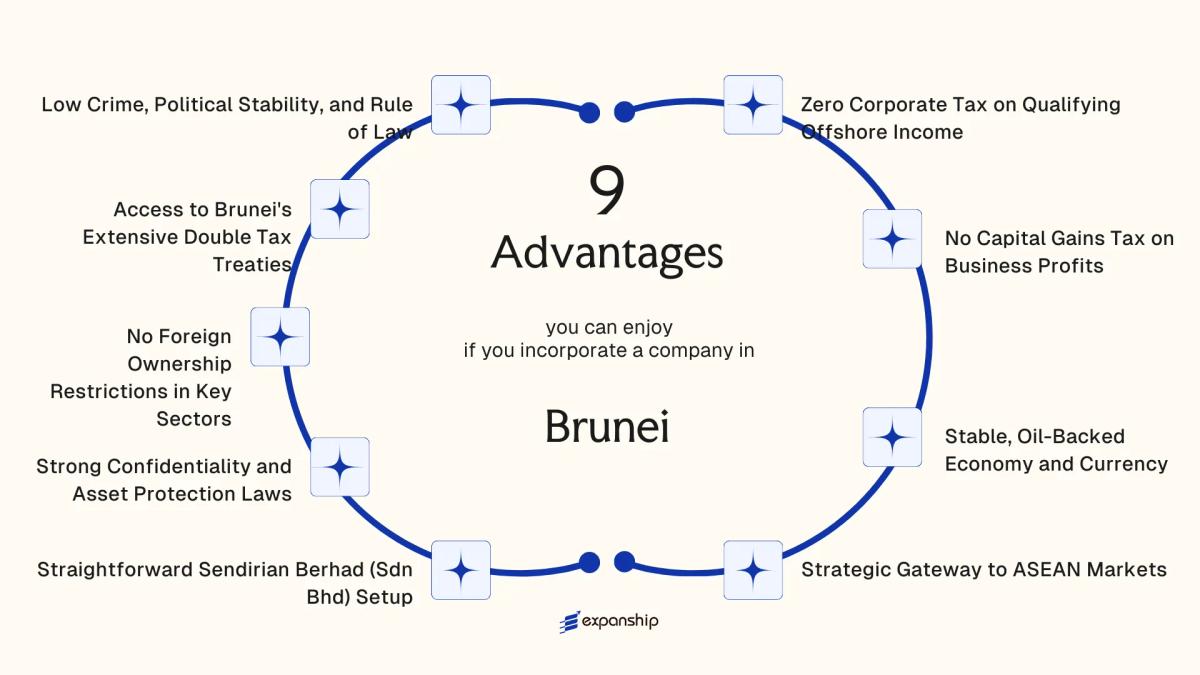
Understanding the benefits of incorporating in Brunei requires examining several distinct factors — tax treatment, legal infrastructure, market access, and structural flexibility among them. This article covers the principal advantages your business may gain by forming a company here.
Zero Corporate Tax on Qualifying Offshore Income
Brunei imposes a standard corporate tax rate of 18.5% on income sourced within its borders, but offshore income that meets specific qualifying criteria is exempt from that charge entirely. This is the structural feature that makes Brunei zero tax on offshore income a material advantage, not simply a headline figure.
What Qualifies as Offshore Income
Under the Income Tax Act (Cap. 35), income derived from sources outside Brunei and received by a qualifying entity is not subject to corporate income tax. For foreign business owners using a locally incorporated firm primarily to conduct international operations, this means profits generated from overseas contracts, foreign clients, or cross-border services are effectively untaxed at the entity level.
Why the Exemption Matters in Practice
The Brunei offshore company tax exemption applies at the point of income sourcing, which is structurally different from a territorial exemption that requires repatriation conditions or holding thresholds. Your business retains full offshore profits without restructuring dividend flows to achieve a tax-efficient outcome.
Offshore profits earned by your qualifying entity are not subject to the 18.5% corporate rate, preserving the full margin on international revenue at the company level.
No Capital Gains Tax on Business Profits
There is no capital gains tax in Brunei. Under the Income Tax Act (Chapter 35), gains derived from the disposal of capital assets are not treated as taxable income. For a foreign business owner, this means that profits realized from selling shares, divesting a subsidiary, or disposing of property held as a capital asset are retained in full, with no statutory mechanism to erode them at the point of exit.
This treatment applies broadly across asset classes. Gains from equity disposals, real property sales outside trading activity, and investment portfolio exits fall outside the charge to income tax, provided the transaction is genuinely capital in nature rather than an income-generating trade. The distinction between capital and revenue receipts follows general common law principles inherited from English tax jurisprudence, which underpins the legal framework.
For an investor structuring a regional holding company or a private equity vehicle through a Sendirian Berhad, the practical effect is meaningful:
- Exit proceeds from share sales are not reduced by a capital gains charge at the corporate level
- Reinvestment of disposal proceeds within the same entity carries no tax drag on the original gain
- Asset restructuring within a group does not trigger an automatic tax liability on unrealized appreciation
The Brunei Darussalam Revenue Division, which administers income tax, has no published capital gains tax regime, and no legislative proposals to introduce one are currently in force.

Incorporate a Company in Brunei Darussalam
Set up a Brunei Sendirian Berhad with full compliance support, from name reservation through to post-incorporation filing obligations.
Stable, Oil-Backed Economy and Currency
Brunei's status as a Brunei stable oil-backed economy for investors stems from a straightforward fiscal reality: oil and gas revenues account for the majority of government income, allowing the state to operate without personal income tax, public debt pressures, or the fiscal volatility common in commodity-dependent nations that lack sovereign wealth buffers. The Brunei Investment Agency, the government body managing the sultanate's sovereign wealth, channels hydrocarbon revenues into reserves that stabilise public finances across commodity cycles.
| Indicator | Detail |
|---|---|
| Currency | Brunei Dollar (BND) |
| Peg Arrangement | 1:1 parity with Singapore Dollar (SGD) since 1967 |
| Legal Basis | Currency Interchangeability Agreement between Brunei and Singapore |
| Issuing Authority | Autoriti Monetari Brunei Darussalam (AMBD) |
| Inflation Profile | Historically low, typically below 2% annually |
The 1:1 parity between the Brunei dollar and the Singapore dollar, maintained under the Currency Interchangeability Agreement since 1967, is what makes Brunei dollar stability benefits for business operationally concrete. Your firm can price contracts, repatriate funds, and manage treasury positions against one of Asia's most stable and widely traded currencies without carrying an additional conversion layer.
For foreign investors, economic stability for a foreign investor here means predictable operating costs. Government-administered utilities, fuel subsidies, and low inflation have historically kept overhead controlled, which directly affects the reliability of your financial projections over a multi-year business plan.
Strategic Gateway to ASEAN Markets
Brunei's membership in ASEAN gives incorporated entities direct access to a trading bloc covering over 675 million people and a combined GDP exceeding USD 3.6 trillion. For businesses evaluating Brunei ASEAN market access, this membership translates into preferential tariff treatment under the ASEAN Trade in Goods Agreement (ATIGA), which has eliminated intra-ASEAN tariffs on over 99% of goods among original ASEAN member states.
Positioned on the northern coast of Borneo, the country shares a land border with Malaysia and sits within short shipping distance of Singapore, Indonesia, and the Philippines. This geography reduces transit costs for goods moving across the regional supply chain.
Beyond ASEAN, the country is a signatory to the Regional Comprehensive Economic Partnership (RCEP), which extends preferential trade terms to fifteen economies including China, Japan, South Korea, and Australia.
- Confirm your business activity qualifies under ATIGA product classifications
- Verify rules-of-origin requirements to claim preferential tariff rates
- Review RCEP annexes for sector-specific conditions applicable to your goods or services
- Some ASEAN preferential rates require a Certificate of Origin issued through Brunei's Ministry of Finance and Economy
Brunei holds permanent dialogue partner status with certain Pacific economies outside ASEAN, giving firms incorporated here negotiating frameworks that most Southeast Asian jurisdictions do not hold.
Straightforward Sendirian Berhad (Sdn Bhd) Setup
Registering a private limited company under the Companies Act (Cap. 39) is procedurally straightforward compared to many Asian jurisdictions. For foreign investors evaluating Brunei Sdn Bhd incorporation advantages, the formation process itself removes barriers that typically delay market entry in other Southeast Asian markets.
Minimal Requirements, Fast Formation
A Sendirian Berhad requires a minimum of one shareholder and one director, with no mandatory residency requirement for directors in most circumstances. You can establish the entity with a single individual fulfilling both roles. The Registrar of Companies and Business Names (ROCBN) processes standard incorporations within a matter of days once documents are submitted, meaning your business can be legally operational faster than in jurisdictions where multi-week government review periods are standard.
Low Capital Threshold and Simple Structure
The minimum paid-up capital requirement is set at BND 1, which removes the financial barrier that high-capital regimes impose on early-stage ventures or holding structures. A Brunei private company formation also requires no mandatory local auditor appointment for companies that meet small company exemptions under the Companies Act, reducing ongoing compliance costs from the outset. This structural simplicity means you spend less on formation logistics and redirect resources toward actual business operations.
Plan Your Brunei Company Setup the Right Way
Get guidance on meeting ROCBN requirements, structuring your Sdn Bhd, and ensuring your formation qualifies for available benefits.
Strong Confidentiality and Asset Protection Laws
Brunei asset protection laws for companies are grounded in statute rather than administrative discretion, which gives foreign business owners a predictable legal basis for structuring their holdings. The Companies Act (Cap. 39) governs disclosure obligations for private companies, and the framework imposes no general requirement to publicly file shareholder registers or beneficial ownership details with an open public registry.
- Directors and shareholders of a private Sendirian Berhad are not subject to mandatory public disclosure in a searchable open registry, which limits exposure to competitor intelligence and unsolicited litigation targeting.
- Corporate records held by the Registrar of Companies and Business Names (ROCBN) are accessible primarily to authorized parties, not the general public, providing a structural layer of business confidentiality.
- Brunei does not operate a publicly accessible beneficial ownership register comparable to those now mandated across EU member states, which reduces the administrative burden on holding structures.
- Assets held within a locally incorporated entity are governed by domestic company law, meaning foreign creditors must pursue claims through the local court system under Bruneian jurisdiction rather than obtaining automatic cross-border enforcement.
- The country's legal system is based on English common law, so asset protection arrangements benefit from a recognized and well-documented body of corporate precedent.
No Foreign Ownership Restrictions in Key Sectors
One of the more structurally significant Brunei no foreign ownership restrictions benefit applies to companies incorporated under the Companies Act (Cap. 39): foreign nationals can hold 100% equity in a locally incorporated Sendirian Berhad across a wide range of sectors without requiring a local partner. This removes the joint venture obligation that exists in many competing regional jurisdictions.
Under the Brunei Economic Development Board (BEDB) framework, promoted sectors, including manufacturing, technology, and services, are generally open to full foreign ownership. Your business retains complete decision-making authority and profit repatriation rights without dilution through mandatory local shareholding.
The practical implication is direct: you avoid the structural complexity, governance friction, and profit-sharing obligations that mandatory local partnership requirements create elsewhere in Southeast Asia.
- 100% foreign ownership in Brunei companies is permitted for most non-reserved activities
- Sectors with restrictions are specifically defined; what falls outside that list is generally open
- The BEDB serves as the primary point of contact for investment approvals in promoted activities
A foreign-owned technology firm holding 100% equity in its Brunei Sdn Bhd retains full profit repatriation and control, avoiding the 30–51% local equity requirements mandated in several ASEAN peer jurisdictions such as Indonesia and Thailand for equivalent business activities.
Access to Brunei's Extensive Double Tax Treaties
Brunei double tax treaty benefits for businesses stem from a signed network of DTAs with key trading partners, including the UK, China, Japan, Indonesia, Singapore, and several other ASEAN and Gulf states. Each agreement allocates taxing rights between Brunei and the partner country, which directly reduces or eliminates withholding tax on dividends, interest, and royalties paid across borders.
For a foreign-owned firm receiving income from a treaty partner, this means a lower withholding tax rate applies at source rather than the domestic rate of the paying country. That difference can represent a material reduction in the tax cost of cross-border payments.
Brunei DTAs for foreign investors are particularly relevant for holding structures. When a company incorporated here receives royalties or service fees from an affiliated entity in a treaty partner jurisdiction, the applicable treaty can cap withholding tax significantly below the non-treaty rate.
- Treaty access is available to entities that qualify as tax residents under Brunei's Income Tax Act (Chapter 35)
- Residency is generally determined by where management and control is exercised
Treaty benefits only apply if your entity meets the tax residency conditions under Chapter 35 of the Income Tax Act and the specific DTA's limitation-of-benefits provisions, where applicable.
Low Crime, Political Stability, and Rule of Law
Brunei political stability benefits for business extend beyond economic policy. The Sultanate operates under a single governing authority, the Sultan of Brunei, who also serves as Prime Minister and Finance Minister. This concentration of executive power eliminates the legislative uncertainty that frequently disrupts business planning in multi-party parliamentary systems.
A Predictable Legal and Regulatory Environment
The country's legal system is grounded in English common law, inherited from its colonial-era constitution, and administered through a court structure that includes the High Court, Court of Appeal, and Supreme Court. Foreign businesses benefit from a judiciary that applies recognizable legal principles to commercial disputes, reducing interpretive unpredictability when enforcing contracts or resolving disagreements.
Low Crime and What It Means Operationally
Brunei consistently records one of the lowest crime rates in Southeast Asia. For a business, this translates directly into lower security expenditure, reduced insurance premiums for physical assets, and a workforce environment where employee safety concerns rarely disrupt operations.
- Petty theft, fraud, and corporate espionage incidents remain statistically low compared to regional neighbors
- Physical office and asset protection costs are correspondingly reduced
- Staff recruitment is supported by the country's reputation as a safe place to live and work
Regulatory Continuity for Long-Term Planning
Policy reversals are uncommon given the stability of the governing structure. Investors entering Brunei through a Sendirian Berhad (Sdn Bhd) or other registered entity can expect that the regulatory conditions present at incorporation are unlikely to shift abruptly, which materially reduces sovereign risk in long-term financial planning.
Why Brunei Stands Out Among Asian Incorporation Hubs
Comparing Brunei against its Asian peers reveals a profile that few jurisdictions in the region can replicate. The competitors most worth examining are Singapore, Hong Kong, and Malaysia — each targets a broadly similar category of foreign investor, each operates within the ASEAN or wider Asia-Pacific context, and each is frequently evaluated alongside Brunei when structuring an offshore or regional holding entity. What the comparison clarifies is not just pricing or tax rates, but structural differences in how each jurisdiction treats foreign-owned businesses at a legal and regulatory level.
Where Singapore and Hong Kong carry higher incorporation costs, mandatory audit thresholds, and more complex ongoing compliance obligations, the Brunei framework under the Companies Act imposes comparatively lighter administrative requirements for qualifying entities. Malaysia requires Bumiputera equity participation in certain licensed sectors, a restriction that does not apply to foreign firms incorporating a Sendirian Berhad in Brunei. For businesses where continuity and predictability of regulatory treatment matter, the absence of politically driven ownership conditions is a structural advantage.
| Parameter | Brunei | Singapore | Hong Kong | Malaysia |
|---|---|---|---|---|
| Corporate Tax Rate (Qualifying Offshore Income) | 0% | Up to 17% | 16.5% | 24% |
| Capital Gains Tax | None | None | None | None |
| Foreign Ownership (Key Sectors) | Up to 100% permitted | Up to 100% permitted | Up to 100% permitted | Restricted in some sectors |
| Currency Stability Mechanism | Pegged to SGD | Managed float | Pegged to USD | Managed float |
| ASEAN Membership | Yes | Yes | No | Yes |
| Political Risk Rating | Low | Low | Moderate (post-2020) | Low-Moderate |
Compliance Services for Companies in Brunei
Maintain your Brunei entity's good standing with ongoing compliance support, including annual filings, registered agent obligations, and regulatory reporting under the Companies Act.
Conclusion
Brunei presents a well-defined case for incorporation, built on structural features that hold practical weight for foreign business owners. The absence of tax on qualifying offshore income, combined with no capital gains obligation, means your firm retains a greater proportion of its earnings than in most comparable jurisdictions. Political continuity under the Monarchy, underpinned by a legal system rooted in English common law, adds a layer of predictability that directly affects long-term planning.
The benefits of incorporating in Brunei are most pronounced for businesses that operate across ASEAN markets or hold regional assets requiring a stable, treaty-accessible base. Access to the International Business Companies framework and the oversight structure of the Registry of Companies and Business Names (ROCBN) give foreign owners a defined, rules-based environment to work within. These features do not benefit every structure equally, and suitability depends on your industry, the nature of your income flows, and how your entity interacts with the jurisdictions where you do business.
The strongest case for a Brunei entity rests on the intersection of its tax position and its geographic and economic stability. For the right business profile, that combination produces measurable structural advantages. Confirming whether your specific circumstances align with those advantages requires a precise review of your entity type, ownership structure, and intended operations.
Start Your Brunei Company Formation With Expanship Today
Brunei company formation with Expanship covers the full administrative cycle, from preparing incorporation documents under the Companies Act (Cap. 39) to filing with the Registry of Companies and Business Names (ROCBN). Depending on your structure, obligations differ, and Expanship's team works directly with the relevant authorities to keep your Sendirian Berhad compliant with its ongoing statutory requirements.
Across the incorporation and post-formation period, Expanship handles the practical work that would otherwise require local knowledge and in-country presence:
- Preparation and legalization of incorporation documents, including Memorandum and Articles of Association
- Registered agent and registered office provision, as required under the Companies Act
- Filing and liaison with ROCBN throughout the incorporation process
- Post-incorporation compliance management, including annual return filings and secretarial services
- Banking introduction assistance to support account opening with local and regional financial institutions
- Ongoing support for any amendments to company structure or officer details
To discuss your requirements, contact Expanship Brunei directly.
Frequently Asked Questions (FAQ)
Qualifying offshore income earned by a Brunei-incorporated entity may be subject to a zero percent corporate tax rate under the International Business Companies framework. Standard domestic corporate tax is levied at a flat rate of 18.5% on chargeable income, but this applies to locally sourced profits rather than foreign-sourced qualifying income. The distinction between domestic and offshore income classification is material and should be assessed against the Income Tax Act (Cap. 35).
Incorporation through the Registry of Companies and Business Names generally takes between one and three working days once all required documents are submitted and approved. The process involves reserving a company name, filing the Memorandum and Articles of Association, and satisfying minimum paid-up capital requirements. Delays typically arise from incomplete documentation or name reservation conflicts rather than procedural backlogs.
No capital gains tax is imposed on the disposal of shares or business assets under Brunei's current tax framework. Profits from asset sales are not separately assessed as capital gains, which is materially different from many comparable jurisdictions in the region. This treatment applies consistently regardless of whether the disposing party is a resident or non-resident entity.
Brunei has concluded double tax agreements with a number of countries, including the United Kingdom, China, Indonesia, and several ASEAN member states, among others. The specific provisions covering dividends, interest, and royalties vary by treaty, so the applicable agreement must be reviewed against the counterparty jurisdiction. Treaty benefits are generally available to entities that satisfy the residency conditions specified within each individual agreement.
Under the Companies Act (Cap. 39), a Brunei Sdn Bhd is required to have at least one director who is ordinarily resident in Brunei. This requirement applies at the time of incorporation and must be maintained on an ongoing basis. A non-resident founder may appoint a qualified nominee director to satisfy this condition, though the nominee's role and liability should be defined clearly in a supporting directorship agreement.
The Brunei Dollar (BND) is pegged at parity with the Singapore Dollar (SGD) under the Currency Interchangeability Agreement, which has been in effect since 1967. This arrangement provides exchange rate predictability between the two currencies, reducing currency conversion risk for businesses transacting across both jurisdictions. The peg does not extend to other currencies, so exposure to USD, EUR, or other denominations remains subject to standard market fluctuation.
Failure to file annual returns or financial statements with the ROCBN can result in the company being struck off the register, which effectively dissolves the entity. Directors may also face personal penalties under the Companies Act (Cap. 39) for persistent non-compliance. Reinstatement of a struck-off company is possible but requires a formal application and payment of outstanding fees and penalties.
Legal Disclaimer
The information provided in this article is for general informational purposes only and does not constitute legal, tax, or professional advice. While we strive to ensure the accuracy and timeliness of the content, laws and regulations are subject to change, and the application of laws can vary widely based on specific facts and circumstances.
Readers should not act upon this information without seeking professional counsel tailored to their individual situation. Expanship and its authors disclaim any liability for actions taken or not taken based on the content of this article.
For specific advice regarding your business setup, compliance requirements, or any legal matters, please consult with qualified legal and tax professionals in the relevant jurisdiction.