
Key Takeaways
- Entities incorporating in Saint Barthélemy must comply with the French Code de commerce, the primary legal instrument governing company formation, structural requirements, and commercial registration procedures applicable to the territory as a French overseas collectivity.
- A physical registered office address located on the island of Saint Barthélemy is a mandatory condition of registration, not a post-incorporation administrative step.
- Beneficial ownership disclosure obligations aligned with French anti-money laundering directives apply to entities formed in Saint Barthélemy, requiring identification of ultimate beneficial owners through the relevant UBO reporting mechanisms.
- Minimum share capital thresholds, governance composition, and documentary requirements vary according to the legal form selected, meaning foreign investors must determine their entity structure before compliance obligations can be accurately mapped.
Saint Barthélemy follows French commercial law, as the island is a French overseas collectivity, meaning entity formation and company registration requirements Saint Barthélemy businesses must meet are governed primarily by the French Code de commerce. The local administrative authority, the Collectivité de Saint-Barthélemy, oversees territorial matters, while commercial registration is processed through the relevant French administrative and legal channels applicable to overseas collectivities.
This article addresses the formal requirements across incorporation requirements Saint Barthélemy applicants must satisfy, spanning structural, documentary, and governance categories. Failure to meet these requirements can result in rejection of the registration application or the inability to operate legally within the territory.
Specific obligations vary depending on the legal form of the entity, the nature of the business activity, and whether the applicant is a foreign national or non-resident investor. Governing rules are set out in the Code de commerce.
This article is most relevant to foreign investors and non-resident business owners intending to establish a formal legal presence under the French commercial framework applicable to Saint Barthélemy.
Minimum Share Capital Requirements in Saint Barthélemy
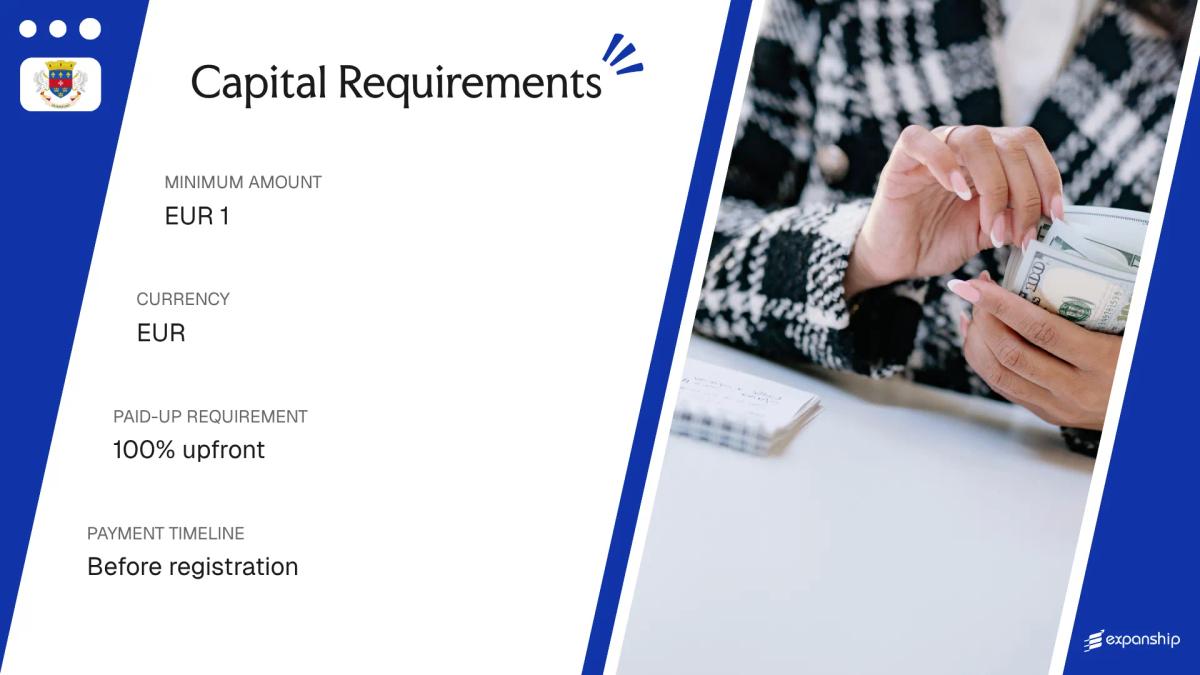
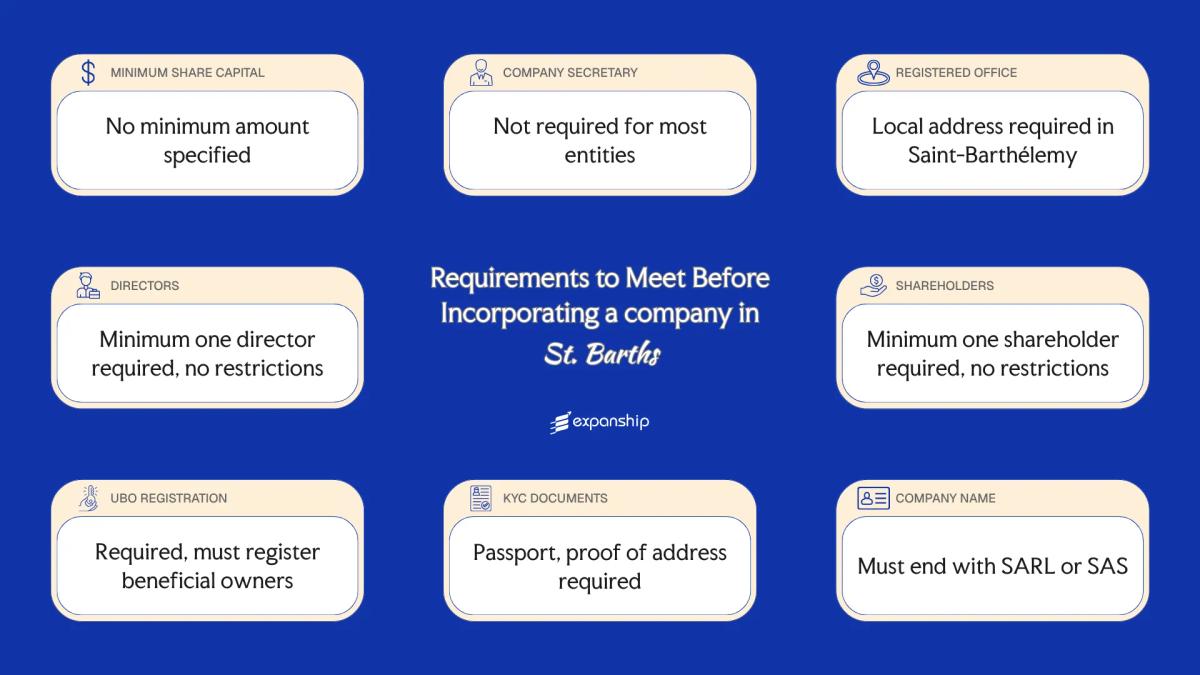
As a French collectivity, Saint Barthélemy applies French commercial law by default, meaning Saint Barthélemy share capital requirements follow the framework established under the French Code de Commerce. For a Société par Actions Simplifiée (SAS), no statutory minimum share capital is prescribed, while a Société Anonyme (SA) requires a minimum of EUR 37,000.
Capital is deposited into a blocked bank account prior to the issuance of a certificate of deposit, which is then submitted to the Greffe du Tribunal de Commerce as part of the registration dossier. Once the entity is registered, the capital is released. This is a one-time procedural requirement tied to incorporation, not an ongoing statutory obligation.
| Parameter | Detail |
|---|---|
| Minimum Authorized Share Capital | None for SAS; EUR 37,000 for SA |
| Maximum Authorized Share Capital | No statutory requirement |
| Minimum Paid-Up Capital | None for SAS; EUR 37,000 for SA |
| Paid-Up Requirement at Incorporation | Capital must be fully deposited before registration for SA; no minimum threshold for SAS |
| Accepted Currency | Euro (EUR) |
| Accepted Forms of Contribution | Cash contributions and in-kind contributions (apports en nature) |
| Timeframe to Deposit Capital | Prior to filing with the Greffe du Tribunal de Commerce |
For an SAS, the absence of a statutory minimum does not remove the requirement to define an authorized share capital in the company statutes. A capital amount of EUR 1 is legally permissible but must still be formally stated and deposited before registration.
Company Secretary Requirements in Saint Barthélemy
Saint Barthélemy operates under French law as a French overseas collectivity, which means corporate governance obligations for entities formed there follow the French commercial code framework. Under this framework, company secretary requirements Saint Barthélemy follow the same general structure applied to French simplified joint-stock companies (SAS) and limited liability companies (SARL).
A designated legal representative, rather than a formal company secretary role, fulfills the administrative and compliance functions for most entity types. This representative is responsible for maintaining statutory records, filing annual accounts with the relevant commercial registry, and ensuring the entity meets its ongoing Saint Barthélemy corporate secretary obligations.
Qualification criteria for who may serve in this representative or agent capacity include:
- Individuals must have full legal capacity under French civil law.
- Corporate entities may act as legal representative if permitted under the applicable entity statutes.
- No mandatory local residency requirement applies under general French commercial law.
- The representative must not be subject to a court-ordered ban from managing a commercial entity.
- Professional licensing is not required for the role itself, though specific regulated activities may impose additional conditions.

Incorporate a Company in Saint Barthélemy
Set up your business entity in Saint Barthélemy under the French commercial framework, with guidance on entity selection, filing, and ongoing compliance.
Registered Office Requirements in Saint Barthélemy
Registered office requirements in Saint Barthélemy follow French territorial law, as the island operates under the administrative framework of France as a collectivité d'outre-mer, meaning your company's siège social must correspond to a real, physically verifiable address located within the territory.
- A physical address is required; P.O. boxes do not satisfy the legal address obligation for the siège social.
- The registered address must be located within Saint Barthélemy; an address in metropolitan France or another jurisdiction does not qualify.
- Virtual office arrangements may be permitted where the provider can confirm a genuine physical presence and mail reception at that address.
- Proof of occupancy is required, either through ownership title or a lease agreement covering the premises used as the registered address.
- The siège social is recorded in the Registre du Commerce et des Sociétés and is publicly accessible.
- Any change to the registered address must be formally declared to the relevant commercial registry authority, typically requiring an updated filing and payment of associated fees.
- Failure to maintain a valid, compliant address can result in administrative irregularities, potential nullification of corporate acts, or sanctions under French commercial law provisions applicable to the territory.
Director Requirements in Saint Barthélemy
Upon appointment, directors of companies incorporated in Saint Barthélemy assume statutory duties governed by French corporate law, including fiduciary obligations toward the entity, liability for mismanagement, and personal exposure in cases of insolvency or regulatory non-compliance. Meeting the director requirements Saint Barthélemy imposes is a prerequisite before the Collectivité de Saint-Barthélemy grants operational status to a registered entity.
| Parameter | Detail |
|---|---|
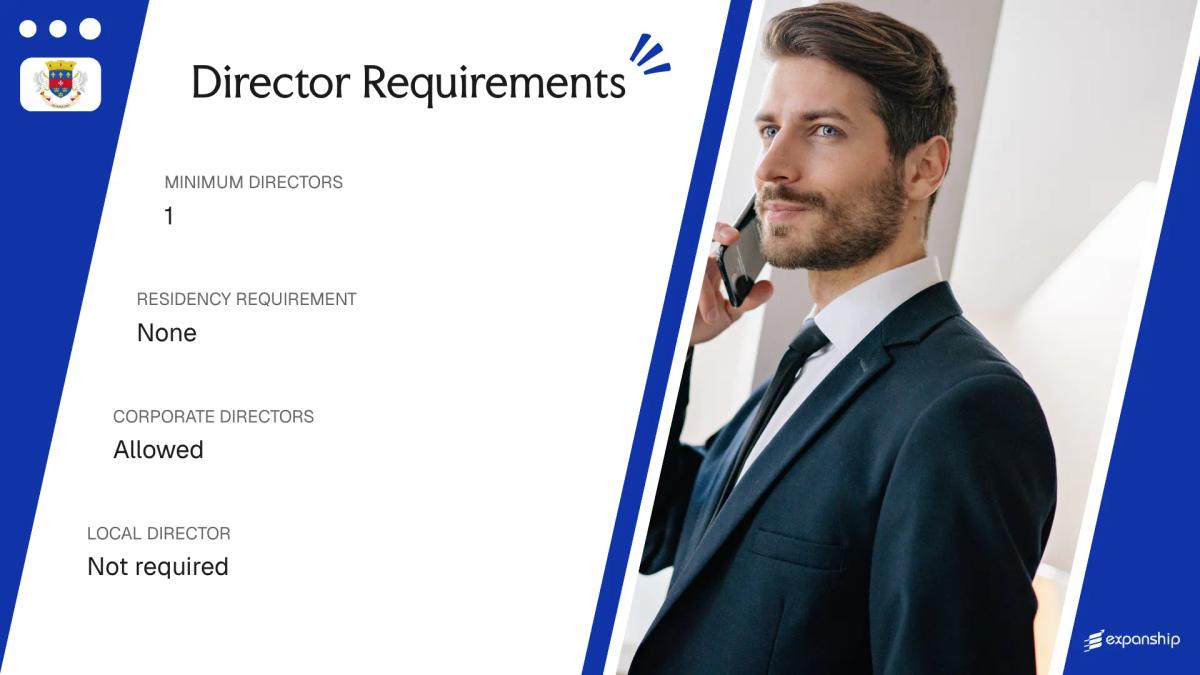
| Minimum Number of Directors | One director is required for a SARL (gérant); a SAS requires at least one président. |
| Maximum Number of Directors | No statutory maximum is prescribed under applicable French-derived corporate law. |
| Local/Resident Director Required | No statutory requirement for a locally resident director exists. |
| Nationality Restrictions | No nationality restrictions apply to director appointments. |
| Minimum Age Requirement | Directors must be at least 18 years of age at the time of appointment. |
| Corporate Directors Permitted | Corporate directors are permitted under SAS structure; a SARL gérant must be an individual. |
| Director Must Be a Shareholder | No statutory requirement for a director to hold shares in the company. |
| Publicly Listed on Registry | Director identities are disclosed through the Registre du Commerce et des Sociétés (RCS). |
| Disqualification Conditions | A director may be disqualified following a criminal conviction, bankruptcy, or court-ordered prohibition under French civil or commercial law. |
Despite its status as an overseas collectivity, Saint Barthélemy follows metropolitan French corporate law for director rules, meaning a single foreign national with no local ties can legally serve as sole director of an active commercial entity registered there.
Shareholder Requirements in Saint Barthélemy
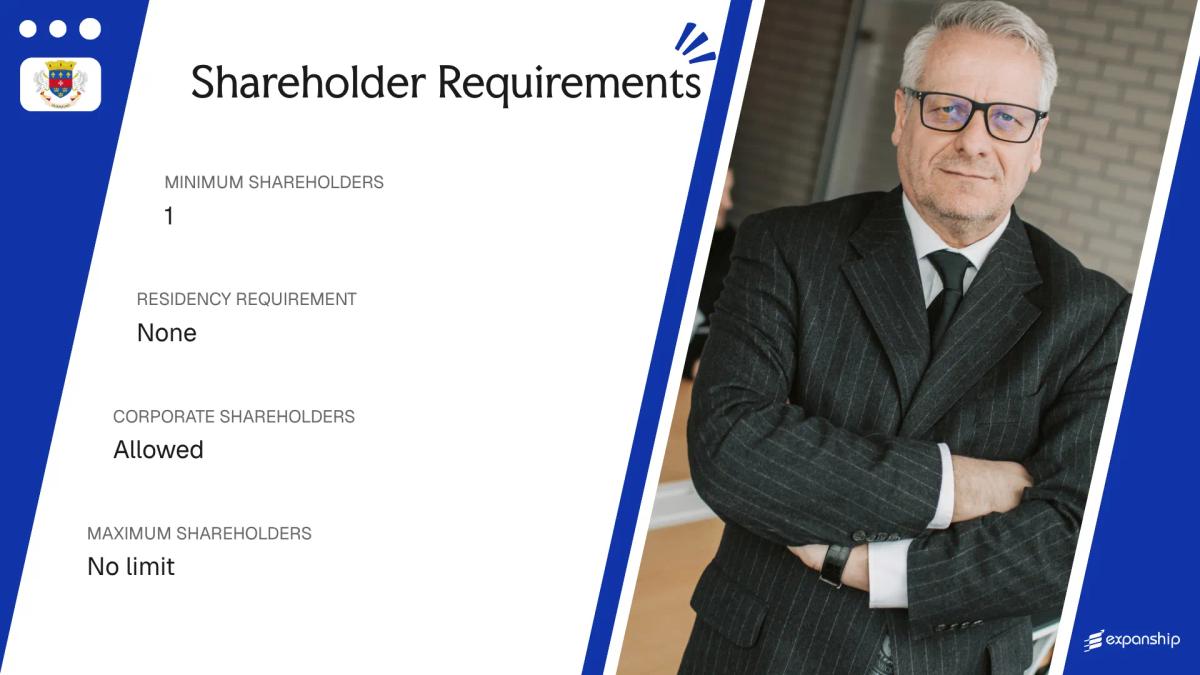
Saint Barthélemy, as a French overseas collectivity, applies French corporate law principles to entities formed under its jurisdiction. A simplified joint-stock company (SAS) may be incorporated with a single shareholder, while a société à responsabilité limitée (SARL) also permits a sole associate structure under French law.
Nationality and Residency Restrictions
Meeting shareholder requirements in Saint Barthélemy does not obligate shareholders to hold French nationality or local residency. Foreign nationals may hold 100% of the share capital without restriction under applicable French overseas territory rules.
Corporate Shareholders
Corporate entities are permitted to act as shareholders. No specific local conditions prohibit a foreign company from holding shares, provided the entity meets standard French corporate law eligibility criteria.
Shareholder Liability
Liability is generally limited to each shareholder's capital contribution. Extended liability does not arise under ordinary circumstances, though piercing of the corporate veil remains possible under French judicial doctrine in cases of fraudulent conduct.
Register of Shareholders
A register of shareholders must be maintained at the registered office. Under French corporate law obligations, this register is not publicly accessible, but it must be updated to reflect ownership changes and made available to competent authorities upon request.
Shareholder Structuring Support for Your Saint Barthélemy Entity
Get guidance on meeting corporate ownership requirements when setting up a company in Saint Barthélemy under applicable French law frameworks.
UBO / Beneficial Ownership Disclosure Requirements in Saint Barthélemy
As an overseas collectivity of France, beneficial ownership requirements in Saint Barthélemy follow French law, specifically the provisions of the Code monétaire et financier transposed from the EU's Anti-Money Laundering Directives. A beneficial owner is generally defined as any natural person holding, directly or indirectly, more than 25% of the capital or voting rights of an entity.
- Identify all natural persons meeting the 25% ownership or control threshold.
- Submit beneficial owner details to the Registre des bénéficiaires effectifs, maintained within the French commercial registry system (greffe).
- File the declaration at the time of incorporation, alongside standard registration documents.
- Report any changes in beneficial ownership within 30 days of the triggering event.
| Parameter | Detail |
|---|---|
| Ownership Threshold for UBO Status | 25% of capital or voting rights |
| Filing Authority | Registre des bénéficiaires effectifs (greffe) |
| Disclosure Deadline at Incorporation | At time of registration |
| Publicly Accessible Register | Restricted access; available to competent authorities and obliged entities |
| Penalties for Non-Disclosure | Civil and criminal penalties under French law |
| Ongoing Update Obligation | Within 30 days of any change |
KYC / Document Requirements in Saint Barthélemy
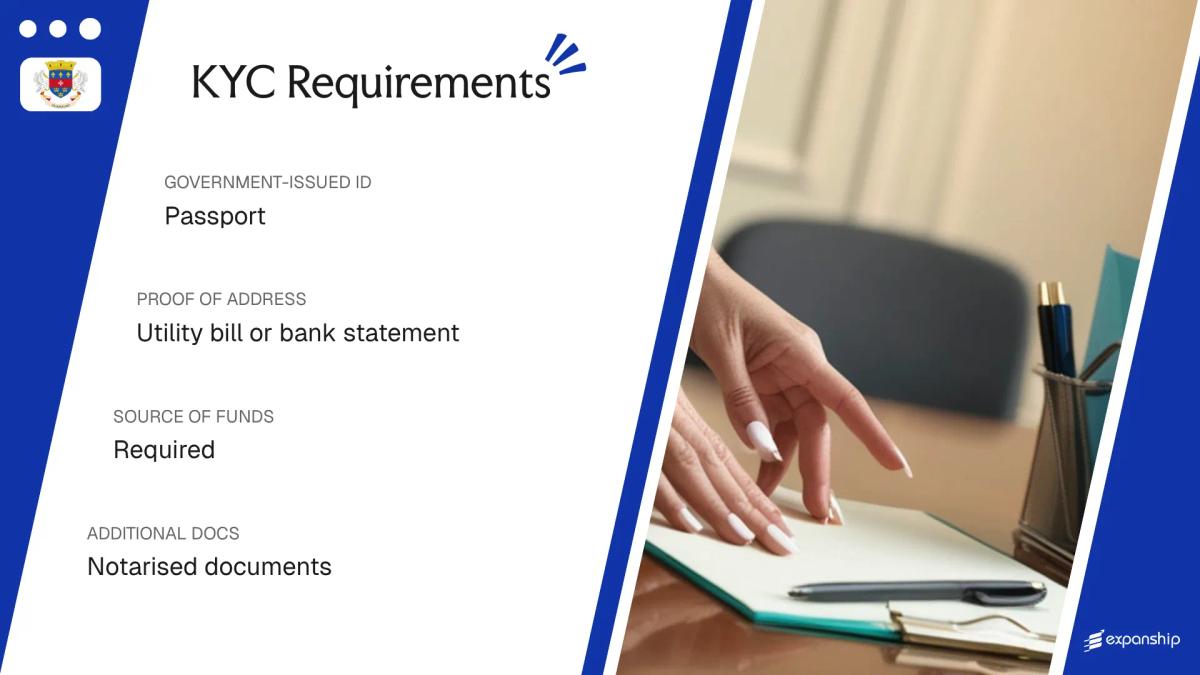
KYC requirements Saint Barthélemy incorporation are governed by French AML legislation, specifically the French Monetary and Financial Code (Code monétaire et financier), which applies to the territory through its status as a French overseas collectivity; the TRACFIN unit oversees financial intelligence obligations.
Individual / Personal Documents
- Valid government-issued photo identification (passport or national identity card)
- Proof of residential address dated within three months, such as a utility bill or bank statement
- Completed and signed KYC declaration form identifying the individual's role in the entity
- Recent curriculum vitae or professional profile may be required for directors
Corporate Documents
- Certificate of incorporation or equivalent formation document for the corporate shareholder or director
- Articles of association or constitutional documents
- Current register of directors confirming authorised signatories
- Proof of the corporate entity's registered office address
Source of Funds Documentation
- Recent bank statements covering a minimum of three months
- Audited financial accounts or accountant-certified statements where bank statements are insufficient
- A written declaration explaining the origin of capital introduced at incorporation
Notarisation and Apostille Requirements
- Documents issued outside France generally require apostille certification under the Hague Convention
- Non-French documents must be accompanied by a certified French translation
- Notarisation requirements depend on the document type and issuing country
The most common cause of incorporation delay is submission of address verification documents that exceed the three-month validity threshold at the time of filing.
Company Name Requirements in Saint Barthélemy
Company name requirements in Saint Barthélemy follow the same general framework applied across French-administered territories, where proposed names are assessed for distinctiveness and availability before registration is confirmed.
Names must be in French or use Romanised characters, and the legal suffix must reflect the chosen corporate structure — for example, "SARL" for a limited liability company or "SAS" for a simplified joint-stock company. No statutory minimum or maximum character count is prescribed under general French commercial law principles.
Certain words are restricted. Terms implying governmental authority, financial regulation, or connection to professional bodies require prior approval from the relevant supervisory authority before they may appear in a business name.
Name reservation is generally available through the commercial registration process. The reserved name is held for a limited period, typically tied to the filing timeline, and is applied for at the point of submitting the incorporation dossier.
Compliance Services for Companies in Saint Barthélemy
Maintain your entity's good standing in Saint Barthélemy with ongoing compliance support, including annual filings, registered office maintenance, and regulatory reporting.
Conclusion
Incorporation requirements in Saint Barthélemy are governed through French legal frameworks applied at the territorial level, spanning entity structuring, capital thresholds, registered presence, and beneficial ownership disclosure. Among the more consequential requirements covered are the UBO reporting obligations aligned with French anti-money laundering directives and the registered office condition, which necessitates a physical address on the island. Once these company registration requirements in Saint Barthélemy are understood, a foreign investor's next step shifts from compliance mapping to operational execution within the territory.
Expanship's Corporate Services for Saint Barthélemy Expansion
Expanship's Saint Barthélemy corporate services expansion support is built around the specific requirements this jurisdiction imposes, from maintaining a physical registered office address in Saint-Jean or Gustavia to meeting French civil law obligations that govern entity formation. Managing document preparation, notarised filings, and ongoing compliance with French overseas collectivity regulations takes time your team may not have available.
Beyond formation, Expanship covers the full operational setup:
- Your company registration and all associated document preparation are handled end to end.
- A registered agent and compliant local office address are provided on your behalf.
- Filings with the relevant government authorities and regulatory bodies are submitted and tracked.
- Post-incorporation obligations, including annual compliance management, are maintained on an ongoing basis.
- Banking introduction assistance is available to help establish your initial financial relationships.
- Tax registration and liaison with local authorities are coordinated as part of your setup.
Reach out to Expanship Saint Barthélemy to discuss your incorporation requirements.
Frequently Asked Questions (FAQ)
For a Société par Actions Simplifiée, French law sets the statutory minimum share capital at one euro, giving founders broad discretion over capitalisation. That figure must be stated in the articles of association and deposited in a blocked bank account prior to registration. The practical amount you choose may still be scrutinised by banks or counterparties when opening accounts or entering contracts.
Failure to file or maintain accurate UBO information in the registre des bénéficiaires effectifs can result in criminal sanctions under French law, including fines and, in serious cases, imprisonment for the legal representative of the entity. The obligation applies to all commercial companies, not only those with foreign shareholders. Regulators can also suspend the company's ability to carry out certain regulated activities pending compliance.
A non-resident foreigner can serve as sole director of an SAS or gérant of an SARL formed in Saint Barthélemy, as French law does not impose a residency requirement for these roles. Non-EU nationals intending to actively manage the business from the island itself may require a relevant titre de séjour with authorisation to conduct professional activity. The directorship appointment must be recorded in the company's statuts and notified to the Greffe du Tribunal de commerce.
Saint Barthélemy is classified as an Overseas Collectivity and sits outside the European Union's customs and fiscal territory, meaning French VAT does not automatically apply there. The collectivity levies its own local tax regime, which differs materially from metropolitan French corporate taxation. This distinction should be factored into your entity's constitutional documents and any intercompany arrangements from the outset.
Foreign individual shareholders must provide a certified copy of a valid passport or national identity document, proof of residential address dated within three months, and a declaration of source of funds where required by the depositary bank. Corporate shareholders must supply their constitutional documents, a certificate of good standing, and UBO information consistent with the registre des bénéficiaires effectifs filing. All non-French documents typically require a sworn translation into French before submission to the Greffe.
Legal Disclaimer
The information provided in this article is for general informational purposes only and does not constitute legal, tax, or professional advice. While we strive to ensure the accuracy and timeliness of the content, laws and regulations are subject to change, and the application of laws can vary widely based on specific facts and circumstances.
Readers should not act upon this information without seeking professional counsel tailored to their individual situation. Expanship and its authors disclaim any liability for actions taken or not taken based on the content of this article.
For specific advice regarding your business setup, compliance requirements, or any legal matters, please consult with qualified legal and tax professionals in the relevant jurisdiction.