
Key Takeaways
- Saint Barthélemy's constitutional status as a French Overseas Collectivity places it outside the French mainland VAT regime, meaning businesses operating here are not subject to the standard 20% TVA that applies across metropolitan France.
- Companies registered through the Greffe du Tribunal in the form of a SARL or SAS carry the institutional weight of recognised French legal structures, which materially reduces friction with banking counterparties compared to purely offshore registrations.
- The territory imposes no withholding tax on dividends distributed to foreign shareholders, eliminating a cost layer that commonly erodes cross-border returns in conventional EU-adjacent holding structures.
- Because corporate income tax is levied at zero percent locally and French mainland tax obligations do not automatically extend to qualifying entities formed here, businesses can retain operating profit without constructing complex treaty-based arrangements.
Saint Barthélemy is a French overseas collectivity located in the northeastern Caribbean, governed under its own local authority rather than as part of metropolitan France. This political arrangement gives the territory a distinct regulatory and fiscal identity, separate from mainland French law. Company registration falls under the jurisdiction of the Greffe du Tribunal, the commercial registry serving the territory through its administrative connection to Guadeloupe.
Foreign investors most commonly establish a SARL or SAS when structuring a business presence here. The territory operates a zero-tax posture across several key fiscal categories, making it structurally different from standard French-law jurisdictions. Foreign ownership is broadly permitted, with no general restrictions on non-resident investors holding equity in locally registered entities.
The benefits of incorporating in Saint Barthélemy are well-defined and tied directly to its unique constitutional status within the French Republic. This article examines those advantages in detail, drawing on the specific legal and regulatory conditions that apply to businesses formed here.
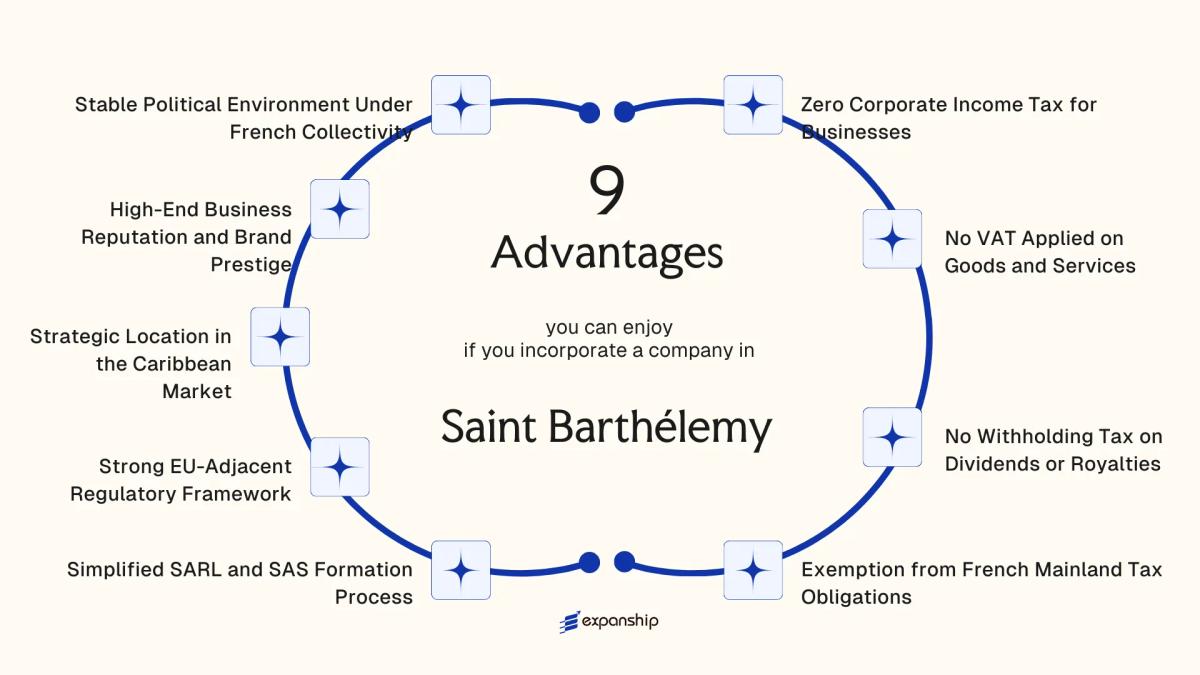
Zero Corporate Income Tax for Businesses
Corporate profits earned through a Saint Barthélemy-registered company are not subject to any corporate income tax at the territorial level. This zero-rate position is grounded in the collectivity's fiscal autonomy, granted under the 2007 statute that separated it from Guadeloupe and established its distinct tax framework.
What the Zero-Rate Structure Actually Means
Under the Organic Law of 21 February 2007, the collectivity holds full competence over direct taxation. Because no corporate income tax is levied locally, your business retains the entirety of its net profits, rather than remitting a portion to a territorial authority.
The Practical Advantage for Foreign-Owned Entities
For a foreign business owner, this translates directly into capital preservation at the entity level. A firm generating consistent operating profits faces no mandatory tax erosion on those earnings within the jurisdiction, which has material implications for reinvestment capacity and cash flow planning.
Profits retained within your Saint Barthélemy entity are not reduced by any local corporate tax charge, allowing full use of earnings for reinvestment or distribution decisions.
No VAT Applied on Goods and Services
Saint Barthélemy operates outside the European Union's VAT territory. Under the EU VAT Directive, the island holds the status of an Overseas Country and Territory (OCT), which means VAT is not imposed on goods sold or services rendered within the jurisdiction. For businesses, Saint Barthélemy no VAT on goods and services translates directly into lower transaction costs across every stage of commercial activity.
This matters because VAT compliance typically generates substantial administrative overhead. Across EU member states, the standard VAT rate averages around 21%. A business operating locally pays none of that, and neither do its customers.
The practical advantages of this structure include:
- Pricing goods without a consumption tax layer allows businesses to maintain tighter margins without squeezing profitability
- Service-based firms avoid the invoicing, filing, and reconciliation obligations that VAT registration typically demands
- Transactions settle faster when there is no VAT reclaim cycle between counterparties
For import and export activities, the OCT status also means the island is not subject to intra-EU VAT rules on cross-border trade. Your firm sells, invoices, and collects without embedding a recoverable tax into every transaction.

Company Incorporation in Saint Barthélemy
Incorporate your company in Saint Barthélemy and operate within a VAT-free framework under its OCT status.
No Withholding Tax on Dividends or Royalties
Saint Barthélemy applies no withholding tax on dividends or royalties distributed from a locally registered company to foreign shareholders or licensors. This rule applies regardless of the recipient's country of residence and is not conditional on a tax treaty between that country and France. For investors structuring international income flows, the absence of this withholding layer means distributions reach recipients at their full gross amount.
| Payment Type | Rate Applied | Recipient Eligibility |
|---|---|---|
| Dividends to foreign shareholders | 0% | No residency restriction |
| Royalties to foreign licensors | 0% | No residency restriction |
| Interest payments | Subject to general rules | Depends on arrangement |
Saint Barthélemy operates under a distinct fiscal regime established through its status as a French Overseas Collectivity, which removed it from the European Union's fiscal territory in 2012. As a result, EU directives governing withholding tax, such as the Parent-Subsidiary Directive and the Interest and Royalties Directive, do not apply by default. The territory instead maintains its own tax rules independently of metropolitan France.
For a business generating royalty income from intellectual property or dividend income from operating subsidiaries, the zero-rate treatment eliminates a cost that, in many jurisdictions, ranges between 5% and 30% of each distribution. That reduction in friction directly improves the net return on structures that rely on regular cross-border payments.
Exemption from French Mainland Tax Obligations
Saint Barthélemy's Saint Barthélemy French mainland tax exemption status derives directly from its designation as an Overseas Collectivity under Article 74 of the French Constitution, combined with the 2007 decision by the French Senate that formally separated the island from the administrative scope of Guadeloupe. Under this arrangement, French metropolitan tax law does not automatically extend to the territory.
This separation has concrete consequences for your business. French corporate tax, which applies at a standard rate of 25% on mainland-registered entities, does not bind companies incorporated and operating locally. French VAT directives, enforced across metropolitan France and most overseas departments, equally fall outside the island's fiscal jurisdiction.
Because the island operates under its own local fiscal code rather than the French General Tax Code (Code Général des Impôts), your entity's tax obligations are governed by territorial rules, not Parisian fiscal policy. This insulates your firm from unilateral changes to French national tax legislation.
Keep in mind while structuring your tax position:
- Confirm that your company's management and control genuinely resides within the territory
- Verify that revenues are not sourced from metropolitan France, which may trigger French tax nexus
- Review any applicable bilateral tax treaties France has signed, as their territorial scope can vary
- Tax residency status for individuals is assessed separately from corporate registration
Although Saint Barthélemy sits outside the French VAT zone, it retains the euro as its official currency, meaning you transact in a stable, widely accepted currency without the tax burden typically associated with eurozone membership.
Simplified SARL and SAS Formation Process
Both the SARL (Société à Responsabilité Limitée) and SAS (Société par Actions Simplifiée) are available in Saint Barthélemy, and the formation process for either entity carries structural advantages that directly reduce the administrative burden on foreign business owners. The Saint Barthélemy SARL SAS formation advantages stem largely from the collectivity's application of French commercial law, specifically the Code de Commerce, which governs both entity types, combined with local administrative procedures that are less bureaucratically dense than those on the French mainland.
Minimal Capital and Documentation Requirements
For the SARL, no minimum share capital is legally required under current French commercial law provisions applicable to the collectivity, meaning you can incorporate with a nominal amount. This removes a common barrier to entry that exists in many civil law jurisdictions, where paid-in capital thresholds can delay formation by weeks.
The SAS structure offers similar flexibility on capital while granting shareholders broader contractual freedom to define governance arrangements in the company's statuts. This is particularly relevant for foreign businesses that need to accommodate multi-party shareholding structures or tiered voting rights without seeking regulatory approval for each arrangement.
Speed and Local Registration Channels
Registration is handled through the Registre du Commerce et des Sociétés (RCS), and the collectivity's smaller administrative volume typically translates to faster processing compared to mainland commercial courts. Your business can become operational without navigating the multi-agency queues common in larger French metropolitan jurisdictions.
Structure Your Saint Barthélemy Entity the Right Way
Get tailored guidance on SARL and SAS formation in Saint Barthélemy, from capital structuring to RCS registration and compliance setup.
Strong EU-Adjacent Regulatory Framework
As an Overseas Country and Territory (OCT) of the European Union, Saint Barthélemy occupies a distinctive regulatory position that carries real advantages for foreign business owners. The Saint Barthélemy EU-adjacent regulatory framework benefits stem from a formal legal relationship with the EU that persists despite the island's exclusion from the EU's customs territory and VAT area.
- Under the EU-OCT Association Decision, businesses incorporated here maintain access to certain EU institutional protections and dispute resolution mechanisms, which reduces legal exposure compared to fully offshore jurisdictions outside this framework.
- French civil law governs commercial activity on the island, meaning corporate contracts, liability structures, and property rights follow a codified legal tradition familiar to European counterparties and financiers.
- French regulatory oversight applies to financial services and anti-money laundering compliance, aligning local standards with FATF requirements. For your business, this translates into easier correspondent banking relationships and smoother due diligence with European institutions.
- The Collectivité de Saint-Barthélemy administers local regulation under powers devolved from the French state, providing institutional consistency that fully independent micro-jurisdictions typically cannot offer.
European regulatory standards advantages are therefore not incidental here. They follow directly from the island's constitutional relationship with France and its OCT status under EU law.
Strategic Location in the Caribbean Market
Saint Barthélemy's geographic position delivers Saint Barthélemy strategic Caribbean location benefits that are structural, not incidental. Situated in the northeastern Caribbean, the island sits within a cluster of major shipping and trade corridors connecting North America, South America, and Europe. Your business gains proximity to high-volume commercial routes without operating from a jurisdiction that imposes trade barriers or customs duties on most goods.
As an Overseas Collectivity of France under Article 74 of the French Constitution, the territory maintains a distinct customs status separate from the European Union's customs territory. Goods move in and out under a local customs regime administered through the island's own territorial council, the Conseil Territorial. This means a company registered here can manage logistics toward both American and European markets without being locked into EU import tariffs on non-EU goods.
The island's port at Gustavia serves as a functional entry point for regional distribution. Nearby jurisdictions including Sint Maarten, Antigua, and Puerto Rico create a network of accessible markets within short freight distances.
A firm distributing luxury goods from Gustavia to five neighboring Caribbean islands, each within 300 nautical miles, avoids EU customs duties that would otherwise apply if the same goods transited through mainland France or another EU port of entry, a structurally material cost difference per shipment cycle.
High-End Business Reputation and Brand Prestige
Saint Barthélemy high-end business reputation benefits are closely tied to the island's established identity as a territory associated with luxury hospitality, high-net-worth clientele, and premium real estate. Registering a company here places your firm within that same commercial ecosystem.
The island functions as a French Collectivity under the oversight of the French State, which means your entity operates under a governance structure grounded in French administrative law. That institutional backing signals legal reliability to counterparties, financial institutions, and international partners without requiring additional explanation.
Businesses in sectors such as luxury goods, private wealth management, boutique hospitality, and design benefit from a territorial association that carries inherent positioning value. A company incorporated here is not registered in an anonymous low-cost jurisdiction; it carries a geographic identity that aligns with premium market segments.
- The connection to French civil law underpins contractual credibility with European partners.
- The French Collectivity status provides an internationally recognized governance reference point.
- Clients in premium sectors often respond to territorial provenance as a proxy for quality and discretion.
Brand association with the island's premium identity is contextual; it carries the most weight in luxury, hospitality, and private client sectors rather than in commodity or mass-market industries.
Stable Political Environment Under French Collectivity
Saint Barthélemy's political stability derives directly from its constitutional structure. As an Overseas Collectivity of France under Article 74 of the French Constitution, the territory operates within a French legal and administrative framework while exercising significant local autonomy. This dual arrangement means your business operates under a system backed by one of the G7 nations, without being subject to the full weight of metropolitan French regulation.
The Collectivité Territoriale de Saint-Barthélemy, the island's governing body, holds legislative competence over taxation, urban planning, and environmental rules. This local authority can act independently on fiscal matters, which is precisely why the island's favorable tax regime has remained structurally intact. Political decisions that affect your firm's tax position are made by a stable, locally elected council rather than shifting national governments in Paris.
France's presence also means the island benefits from French institutional protections, including access to French courts and the broader European legal order for certain matters. Foreign investors are not exposed to the kind of policy reversals that characterize politically volatile jurisdictions.
Key structural features that underpin this stability include:
- Governance under French constitutional law since the collectivity's establishment in 2007
- Local ordinances passed by the Territorial Council carry legal force within the island's competence
- French administrative oversight provides an institutional backstop without displacing local fiscal autonomy
- Disputes involving your entity can be adjudicated through the French legal system
For a foreign business owner, this structure means your operating environment is not dependent on a single local leader or fragile coalition government.
Why Saint Barthélemy Outshines Rival Offshore Jurisdictions
Comparing Saint Barthélemy against its Caribbean neighbours reveals a combination of features that few comparable territories can replicate within a single legal framework. The jurisdictions most relevant to this comparison are the British Virgin Islands, the Cayman Islands, and Curaçao — all of which attract the same profile of international investor seeking low-tax, politically stable incorporation environments. What separates this collectivity is not any single feature but the convergence of French civil law protections, EU-adjacent status, and zero-tax conditions operating simultaneously under one territorial regime.
Where rivals may offer comparable tax positions, they often lack the legal predictability that comes with French oversight and alignment to EU regulatory standards. The BVI and Cayman Islands, for instance, face ongoing international scrutiny under FATF and OECD frameworks, which has led to increased compliance burdens and reputational friction in recent years. Curaçao, while offering a territorial tax system, operates under a separate Dutch Caribbean framework with its own distinct compliance conditions. Saint Barthélemy's position as an Overseas Collectivity under French law gives your business a degree of institutional credibility that pure offshore registrations typically do not carry.
| Parameter | Saint Barthélemy | British Virgin Islands | Cayman Islands | Curaçao |
|---|---|---|---|---|
| Corporate Income Tax | 0% | 0% | 0% | 22% (standard rate) |
| VAT / Consumption Tax | None | None | None | 9% OB (turnover tax) |
| Withholding Tax on Dividends | 0% | 0% | 0% | 0% (to non-residents) |
| Governing Legal Framework | French Civil Law | English Common Law | English Common Law | Dutch Civil Law |
| EU Regulatory Alignment | Partial (OCT status) | None | None | Partial (OCT status) |
| SARL / SAS Entity Types | Available | Not available | Not available | Not available |
| Political Stability Indicator | French Collectivity | British Overseas Territory | British Overseas Territory | Autonomous country (Kingdom of the Netherlands) |
| Substance Requirements | Limited | Increasing (BOSS Act) | Yes (Economic Substance Law) | Yes (since 2019) |
Compliance Services for Companies in Saint Barthélemy
Maintain good standing and meet your ongoing regulatory obligations under French collectivity rules and local territorial requirements.
Conclusion
Saint Barthélemy presents a structurally coherent case for foreign incorporation, built on a fiscal framework that most Caribbean jurisdictions cannot replicate. The absence of corporate income tax, combined with the exemption from French mainland VAT obligations under the island's status as an Overseas Collectivity, means that qualifying businesses retain a materially higher share of operating profit without engaging in complex treaty arrangements.
Two features stand out as particularly consequential for foreign investors. First, the zero withholding tax position on dividends removes a layer of cost that routinely erodes cross-border returns in conventional EU-adjacent structures. Second, the availability of recognised French legal forms, specifically the SARL and SAS, means that your entity carries institutional credibility that purely offshore registrations rarely achieve with banking counterparties or commercial partners.
Whether this structure fits your business depends on the nature of your revenue, your residency position, and the jurisdictions in which you operate commercially. A holding company with passive income streams will access these benefits differently than an operating entity with staff and physical assets. The framework is well-defined, but its application is specific to circumstance.
For businesses where the conditions align, formalising a structure here requires engaging directly with the local regulatory and administrative process. Understanding which entity type, ownership arrangement, and compliance obligations apply to your situation is the necessary first step before any formation proceeds.
Start Your Saint Barthélemy Company With Expanship Today
Expanship Saint Barthélemy incorporation services cover the full formation process for both SARL and SAS structures, from preparing statutes that meet the requirements of the Collectivité de Saint-Barthélemy to filing with the relevant local registrar. The tax exemptions, absence of VAT obligations, and French legal framework discussed throughout this blog each carry specific documentation and compliance requirements that require accurate handling from the outset. Engaging a structured service provider reduces the risk of procedural delays with local authorities.
Expanship manages the administrative and regulatory steps involved in establishing and maintaining your entity in the jurisdiction:
- Preparation and legalization of incorporation documents, including statutes and identity verification
- Registered agent and registered office provision to satisfy local address requirements
- Filing liaison with the Collectivité de Saint-Barthélemy's commercial registrar and relevant government bodies
- Post-incorporation compliance management, including annual obligations and statutory updates
- Banking introduction assistance to support account opening for your newly formed firm
For direct enquiries about structuring or registering your business, contact Expanship Saint Barthélemy to discuss your requirements with a qualified adviser.
Frequently Asked Questions (FAQ)
Companies incorporated and operating within Saint Barthélemy are not subject to French corporate income tax, as the territory holds a special fiscal status under Article 74 of the French Constitution that excludes it from the French Tax Code's general provisions. Local fiscal rules apply instead, and under the territorial tax framework, no corporate income tax is levied on qualifying business income. This exemption is specific to the collectivity and does not extend to businesses merely registered there without genuine economic substance.
Saint Barthélemy is excluded from the European Union's VAT territory, meaning transactions conducted from the island are not subject to EU VAT directives. For businesses selling into EU member states, however, the VAT obligations of the destination country may still apply depending on the nature of the supply and the buyer's status. The absence of local VAT does not create a blanket exemption from the tax rules of the jurisdictions where your customers are located.
A SAS formed under French law, which governs company formation in the collectivity, has no statutory minimum share capital requirement. The capital amount is set freely by the shareholders in the articles of association, giving founders discretion over the initial financial structure of the entity. A SARL, by contrast, also carries no mandatory minimum under current French commercial law, though the declared capital must be fully described and allocated among associates at the time of registration.
If a company lacks genuine economic activity or physical presence in the territory, French tax authorities or foreign tax administrations may reclassify the entity's income as arising from another jurisdiction, potentially subjecting it to tax in the director's or shareholder's country of residence. Substance requirements are not codified in a single Saint Barthélemy-specific statute, but international standards under the OECD's BEPS framework, which France has adopted, inform how tax authorities assess the legitimacy of offshore structures. Maintaining a genuine registered office, local management activity, and documented business operations reduces exposure to such reclassification.
Formation timelines depend on the completeness of the submitted documentation and the availability of the notary or commercial registry handling the filing. Under standard conditions, registration of a SARL or SAS can be completed within one to three weeks once all constitutional documents, identity verification, and capital deposit confirmations are in order. Delays most commonly arise from apostille requirements on foreign-issued documents or incomplete KYC submissions rather than from the registry process itself.
No withholding tax is imposed at the territorial level on dividends distributed by a company incorporated in Saint Barthélemy to foreign shareholders. The absence of a local withholding regime means distributions leave the territory without deduction, though the recipient's home jurisdiction may still tax the income under its domestic rules or applicable tax treaty provisions. France's network of double taxation treaties does not automatically extend to Saint Barthélemy, so treaty relief must be assessed case by case based on the shareholder's country of residence.
Legal Disclaimer
The information provided in this article is for general informational purposes only and does not constitute legal, tax, or professional advice. While we strive to ensure the accuracy and timeliness of the content, laws and regulations are subject to change, and the application of laws can vary widely based on specific facts and circumstances.
Readers should not act upon this information without seeking professional counsel tailored to their individual situation. Expanship and its authors disclaim any liability for actions taken or not taken based on the content of this article.
For specific advice regarding your business setup, compliance requirements, or any legal matters, please consult with qualified legal and tax professionals in the relevant jurisdiction.