

Key Takeaways
- Foreign investors incorporating in Bangladesh must navigate the Companies Act 1994 — legislation that has not been comprehensively modernised — creating procedural friction throughout the RJSC registration process that adds time and unpredictability to company formation timelines.
- Repatriating foreign capital requires prior approval from Bangladesh Bank, meaning investors cannot freely move profits or equity out of the country without engaging a separate regulatory clearance process.
- Sector-specific foreign ownership caps and BIDA classification rules mean that a significant number of industries restrict or exclude full foreign ownership, limiting structural flexibility for international investors building wholly-owned subsidiary arrangements.
- Weak enforcement of intellectual property rights at the judicial level, combined with a slow court system, leaves foreign businesses with limited practical recourse when protecting proprietary assets registered in Bangladesh.
Bangladesh operates under an evolving but heavily regulated corporate framework, where the primary legislation governing company formation — the Companies Act 1994 — still reflects structures from a pre-digital era, with ongoing but incomplete modernisation efforts.
The disadvantages of incorporating in Bangladesh span regulatory, financial, and operational categories, each with distinct implications for foreign investors.
Not every drawback applies equally to all entities. A wholly foreign-owned manufacturing firm faces a materially different compliance burden than a joint venture or a liaison office, and sector classification under BIDA's investment frameworks further shifts which restrictions apply.
This article is most relevant to foreign entrepreneurs, offshore holding company owners, and international SMEs considering direct incorporation or a subsidiary structure in the country.
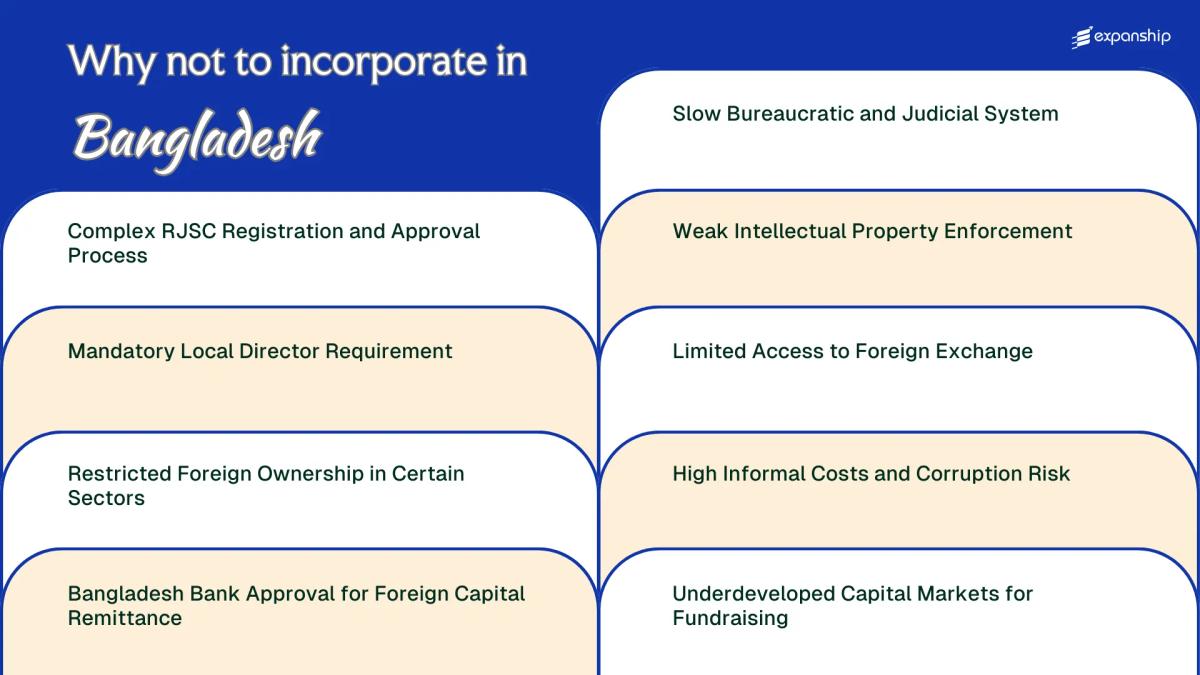
Complex RJSC Registration and Approval Process
RJSC registration challenges Bangladesh present a structural friction that disproportionately affects foreign investors who lack local legal infrastructure or familiarity with the process. The Registrar of Joint Stock Companies and Firms (RJSC) operates as the sole incorporation authority, and its procedural requirements create compounding delays from the outset.
Digitisation Gaps and Manual Verification Burdens
Although RJSC introduced an online portal for name clearance and form submission, significant portions of the process still require physical document submission and in-person follow-up. Foreign applicants must submit notarised and apostilled constitutional documents from their home jurisdiction, which the RJSC reviews manually, often extending the review period well beyond the official timeline. Bangladesh company registration process problems frequently trace back to this inconsistency between the portal's theoretical function and its operational reality.
Inconsistent Processing Timelines
RJSC approval delays affect foreign investors most acutely because their ability to open a bank account, obtain a Trade Licence, or register with the Board of Investment (BIDA) is sequentially dependent on receiving the Certificate of Incorporation. A single documentation query from RJSC can stall the entire downstream compliance chain for weeks.
RJSC approval delays affecting foreign investors can suspend all parallel regulatory processes, meaning a rejected or queried filing effectively freezes your entity's operational timeline across multiple government agencies simultaneously.
Mandatory Local Director Requirement
The Bangladesh local director requirement is not codified as a blanket statutory rule under the Companies Act 1994, but in practice, the Registrar of Joint Stock Companies and Firms (RJSC) expects at least one director with a local address during registration. For a foreign-owned entity, sourcing a credible resident director creates an immediate structural dependency on a local individual.
That dependency carries real risk. If the local director has formal signing authority or appears on regulatory filings, your business decisions are no longer fully insulated from that person's conduct, disputes, or legal exposure.
The foreign company director limitations in Bangladesh become especially visible in regulated sectors, where licensing authorities may require locally resident board representation as a condition of approval. This adds a layer of recruitment and legal cost before operations can begin.
Practical burdens this requirement creates for foreign owners include:
- Ongoing fees to retain a nominee director, adding a recurring cost with no operational value
- Contractual risk if the local director's cooperation is needed to execute statutory filings or bank account changes
- Difficulty replacing a local director quickly if the relationship deteriorates, given RJSC amendment procedures
- Exposure to disputes over directorial liability if roles and indemnities are not clearly defined in a separate agreement

Company Incorporation in Bangladesh
Set up your business entity in Bangladesh with guidance on RJSC registration, director requirements, and foreign ownership structures.
Restricted Foreign Ownership in Certain Sectors
Foreign ownership restrictions across Bangladesh sectors represent one of the more consequential structural limitations for inbound investors. Under the Bangladesh Investment Development Authority (BIDA) framework and related sector-specific regulations, certain industries impose hard equity ceilings on foreign participation, and several remain fully closed to foreign capital.
| Sector | Foreign Equity Cap | Practical Restriction |
|---|---|---|
| Inland shipping | Up to 49% | Foreign investor cannot hold majority control |
| Print and electronic media | Restricted / prohibited | Foreign ownership generally not permitted |
| Insurance sector | Subject to Bangladesh Insurance Act limits | Minority position only in most structures |
| Certain power and energy sub-sectors | Variable; subject to BIDA/government approval | Full ownership contingent on bilateral agreements |
Where an equity ceiling applies, your firm cannot hold a controlling stake, which directly undermines governance rights, profit allocation authority, and strategic decision-making. A foreign investor holding 49% in a joint venture is legally subordinate to the local partner on resolutions requiring simple majority approval.
Identifying the applicable cap is not straightforward. Sector classifications can fall under multiple overlapping regulatory regimes, including the Foreign Private Investment (Promotion and Protection) Act 1980 and sector-specific licensing authorities, making pre-entry legal due diligence a non-negotiable cost.
Exceptions exist in export-oriented industries, particularly in the Ready-Made Garment sector, where 100% foreign ownership is permitted, but this carve-out does not extend to domestic-market-facing businesses in the same categories.
Bangladesh Bank Approval for Foreign Capital Remittance
Bangladesh Bank foreign capital remittance risks are a consistent pressure point for foreign investors, particularly when attempting to repatriate dividends, capital gains, or proceeds from asset sales. Under the Foreign Exchange Regulation Act, 1947, all outward remittances require prior approval from Bangladesh Bank, and processing timelines are rarely predictable.
Approval is not automatic. Even for remittances that qualify under established guidelines, your firm must submit documentation through an Authorized Dealer bank, and delays at either the AD bank or Bangladesh Bank itself can hold funds for weeks or months.
The Foreign Exchange Investment Department handles capital account transactions, and its scrutiny of supporting documents — audited accounts, board resolutions, tax clearance certificates — creates a layered compliance burden that adds cost and time pressure to routine financial operations.
Profit repatriation faces similar friction. Dividend remittances require proof of tax payment and regulatory filings, meaning any outstanding compliance gap blocks the transfer entirely.
- All outward capital remittances require Bangladesh Bank approval; no self-certification pathway exists
- Tax clearance from the National Board of Revenue is a precondition for most repatriation requests
- Authorized Dealer banks act as intermediaries and can independently delay or reject submissions
- Documentation requirements include audited financials, board resolutions, and proof of inward remittance registration
Bangladesh Bank can require repatriation of export proceeds within a fixed period, meaning foreign-owned export businesses face mandatory inward remittance obligations before any outward transfer is permitted.
Slow Bureaucratic and Judicial System
Bangladesh's bureaucratic system drawbacks for business extend beyond registration alone. Delays embedded in day-to-day government interactions create sustained operational friction throughout a company's lifecycle.
Structural Causes of Administrative Delay
Multiple agencies govern foreign business activity, including the Bangladesh Investment Development Authority (BIDA), the National Board of Revenue, and various sector ministries, and coordination between them is inconsistent. Approvals that depend on inter-agency sign-off frequently stall without formal timelines or enforceable deadlines, leaving your operations in an indefinite queue.
Obtaining work permits, tax registration updates, or regulatory clearances can take months longer than officially projected. This unpredictability makes financial planning difficult, particularly for foreign entities operating on investor-committed timelines.
Judicial System Risks for Foreign Companies
Contract enforcement through Bangladeshi courts is slow. The backlog across civil courts is substantial, meaning commercial disputes can take years to reach resolution, creating real exposure for firms that rely on contractual agreements with local partners or suppliers.
Foreign investors have no guarantee of expedited commercial arbitration unless explicitly contracted under an arbitration clause referencing a recognized body. Without that clause, your firm defaults into a judicial system where government red tape and procedural delays in Bangladesh compound the cost of any legal dispute.
Managing Operational and Legal Challenges in Bangladesh
Speak with our team about structuring your Bangladesh entity to reduce exposure to administrative delays and judicial risks.
Weak Intellectual Property Enforcement
Intellectual property enforcement problems Bangladesh businesses face are structural, not incidental. The country's IP framework, governed by the Patents and Designs Act 1911 and the Trademarks Act 2009, suffers from systemic gaps between statutory rights and practical enforcement.
- The Department of Patents, Designs and Trademarks (DPDT) has limited investigative capacity, meaning registered IP rights offer little deterrent against infringement in practice.
- Civil IP litigation through the courts can take years to resolve, exposing your brand or technology to sustained unauthorized use during proceedings.
- Customs authorities lack a formal IP recordal system comparable to those in the EU or Singapore, which makes border enforcement against counterfeit imports unreliable.
- Criminal enforcement under the Trademarks Act 2009 requires rights holders to initiate complaints independently, placing the investigative burden on your firm rather than state authorities.
- Software and digital content piracy remains widespread, with no dedicated enforcement body equivalent to specialized IP units found in more mature jurisdictions.
Limited Access to Foreign Exchange
Foreign exchange limitations in Bangladesh companies stem from a tightly controlled currency regime administered by Bangladesh Bank under the Foreign Exchange Regulation Act, 1947. The taka (BDT) is not freely convertible, meaning your firm cannot exchange or transfer foreign currency without prior regulatory approval in most cases.
Outward remittances for dividends, royalties, technical service fees, and loan repayments require documentation-heavy approvals through authorized dealer banks, which must then satisfy Bangladesh Bank's compliance requirements. Delays in this process can hold working capital in-country for weeks or months, directly disrupting cash flow for parent companies abroad.
Foreign firms operating in export-oriented sectors may access foreign currency retention accounts, but this applies narrowly and does not resolve the broader constraint on general business transactions.
- Current account transactions are liberalized in principle, but capital account transactions remain subject to case-by-case approval.
- Repatriating proceeds from asset sales or equity divestment requires Bangladesh Bank clearance, adding exit risk for investors.
Hypothetical scenario: A UK-based parent company invoices its Dhaka subsidiary $150,000 in annual management fees. Repatriating this amount requires the subsidiary to submit audited accounts, a tax clearance certificate, and board resolutions to an authorized dealer bank before Bangladesh Bank releases approval, a process that can extend 60 to 90 days, tying up funds that the parent has already accrued in its own accounts.
High Informal Costs and Corruption Risk
Corruption risks incorporating in Bangladesh are documented, not anecdotal. Transparency International's Corruption Perceptions Index consistently ranks the country near the lower end of its global index, and foreign firms report that informal payments surface across multiple registration and licensing touchpoints.
At the Registrar of Joint Stock Companies and Firms (RJSC), delays that should be procedural often resolve faster when facilitated by a local intermediary charging fees that never appear in any official schedule. This creates unpredictable costs that your finance team cannot budget for in advance.
Beyond registration, informal costs recur across interactions with the National Board of Revenue, municipal licensing authorities, and port clearance processes. Each layer adds financial exposure that doesn't sit in any compliance ledger.
- Unofficial facilitation fees are common at inspection and approval stages
- Cost amounts are inconsistent and non-recoverable
- Foreign firms face heightened scrutiny, which increases exposure frequency
For companies subject to the U.S. Foreign Corrupt Practices Act or the UK Bribery Act, any informal payment made by a local agent on your behalf can still trigger liability at home. That legal exposure sits entirely with your entity, regardless of where in the chain the payment originated.
Foreign businesses operating under the UK Bribery Act or FCPA remain legally liable for facilitation payments made by local representatives or agents acting on their behalf, even without direct knowledge of the transaction.
Underdeveloped Capital Markets for Fundraising
Bangladesh capital market limitations fundraising options are a structural constraint that foreign businesses frequently underestimate before incorporation. The Dhaka Stock Exchange (DSE) remains shallow by regional standards, with market capitalization representing a modest fraction of GDP compared to peer economies like India or Vietnam.
Listing on the DSE requires approval from the Bangladesh Securities and Exchange Commission (BSEC), a process that is lengthy and heavily documentation-dependent. For most foreign-incorporated entities, accessing public equity markets is effectively out of reach in the early stages.
Private capital markets are equally thin. Venture capital activity is limited, institutional investor participation is low, and debt financing through domestic capital markets offers few viable instruments for foreign firms.
This leaves your business largely dependent on retained earnings, internal funding, or foreign direct investment as primary capital sources. That dependency slows growth cycles and restricts the financial flexibility that more developed markets would otherwise provide.
Overcoming These Disadvantages in Bangladesh
Overcoming these disadvantages in Bangladesh requires structural preparation before and during the incorporation process, not reactive adjustments after problems arise.
- Obtain prior approval from the Bangladesh Investment Development Authority (BIDA) for your investment proposal before initiating RJSC registration, which reduces delays at the approval stage.
- Appoint a Bangladesh-resident individual as a local director at the point of company formation to satisfy the Companies Act 1994 residency requirement.
- Verify your intended sector against the Foreign Private Investment (Promotion and Protection) Act 1980 restricted and prohibited lists before committing to a business structure.
- File all foreign capital inflow documentation with Bangladesh Bank in advance of remitting funds to avoid encashment and repatriation complications.
- Register intellectual property with the Department of Patents, Designs and Trademarks (DPDT) promptly upon incorporation, given the weak enforcement environment documented in this article.
Each of these steps operates within a regulatory framework where multiple agencies, including BIDA, RJSC, and Bangladesh Bank, hold concurrent authority over foreign business activity. Compliance gaps across any one of these bodies can produce cascading delays across the others.
Bangladesh's Overall Investment Appeal
Despite the disadvantages covered across this blog, Bangladesh remains a credible destination for foreign incorporation, particularly given its large domestic consumer base, competitive labor costs, and active export-oriented manufacturing sector. The structural and regulatory challenges are real, but they are consistent and documented, meaning your business can plan around them with reasonable accuracy.
| Pros | Cons |
|---|---|
| Large population base supports sustained domestic market demand | RJSC registration involves multiple approval stages and inconsistent processing times |
| Garment and manufacturing sectors benefit from preferential trade access to key export markets | Bangladesh Bank approval is required before foreign capital can be remitted abroad |
| No mandatory minimum capital for private limited companies in most sectors | Certain industries impose foreign ownership ceilings or require local equity participation |
| Labor costs remain among the more competitive in South Asia | Intellectual property rights are weakly enforced, exposing brand and technology assets |
| Export Processing Zones offer tax and operational incentives for qualifying businesses | Informal payments and corruption risks increase the unpredictability of operating costs |
Judicial resolution of commercial disputes is slow, and capital market options for fundraising remain limited compared to peer economies in the region.
Compliance Services for Companies in Bangladesh
Maintain your Bangladeshi company's good standing with filing deadlines, annual returns, and regulatory obligations managed accurately.
Conclusion
The cons of setting up a company in Bangladesh are real and material. Among the structural barriers covered here, RJSC registration delays, Bangladesh Bank's approval requirements for repatriating foreign capital, and the persistent risks tied to informal costs and corruption represent the most operationally significant friction points for foreign investors. Structural reform within government agencies has been gradual. For businesses that proceed with incorporation, understanding the specific regulatory bodies involved and the legal obligations attached to each approval stage is a practical necessity.
Expanship's Bangladesh Company Formation Services
From managing RJSC filings to coordinating Bangladesh Bank approvals for inward remittances, the compliance demands described throughout this blog place real administrative weight on foreign investors. Expanship's Bangladesh company formation services are structured to reduce that operational burden by handling the procedural groundwork alongside you, so your attention stays on business fundamentals rather than regulatory paperwork.
Our service scope covers the full incorporation and post-registration cycle:
- We prepare and submit all company registration documents with the RJSC on your behalf.
- A registered agent and local office address are provided to satisfy statutory presence requirements.
- Our team liaises directly with government bodies and regulatory authorities throughout the filing process.
- Post-incorporation compliance obligations, including annual returns and statutory filings, are managed on an ongoing basis.
- We facilitate introductions to local banking institutions suited to your business profile.
- Tax registration and liaison with the National Board of Revenue are handled as part of the setup process.
Reach out to Expanship Bangladesh to discuss your incorporation requirements.
Frequently Asked Questions (FAQ)
Bangladesh Bank approval is required for all inward foreign investment remittances and any subsequent repatriation of dividends, capital gains, or proceeds from share transfers under the Foreign Exchange Regulation Act 1947. There is no de minimis exemption that allows smaller transfers to bypass this requirement. Delays in receiving approval can freeze your operational capital for weeks or months.
Violations of the restricted and prohibited sector lists maintained under the Bangladesh Investment Development Authority's guidelines can result in the cancellation of registration and forced divestment of shares. The RJSC has authority to strike off non-compliant entities, and the penalties extend beyond administrative sanctions to potential criminal liability under the Companies Act 1994. Foreign investors are not exempt from these consequences.
Enforcement in Bangladesh is materially weaker than in India and Sri Lanka, both of which have more developed IP tribunal infrastructure and a stronger track record of injunctive relief. Bangladesh's Copyright Office and the Department of Patents, Designs and Trademarks have limited investigative capacity, and civil litigation through the courts is slow enough that infringement often continues throughout the legal process. This makes Bangladesh a higher-risk environment for IP-intensive businesses.
Official RJSC fees depend on authorized capital and are structured on a sliding scale under the Companies Act 1994, but total out-of-pocket costs routinely exceed the official schedule when agent facilitation fees and informal charges at various approval stages are included. Foreign investors using local representatives often pay a significant premium to move files through the process at standard speed. There is no official published figure that captures the full realistic cost.
No. Under the Companies Act 1994, a private limited company incorporated in Bangladesh must have at least two directors, and while the law does not explicitly require one to be a Bangladeshi national, obtaining a Tax Identification Number and meeting BIDA registration requirements in practice means at least one director must have a local tax presence. Structuring around this through nominee arrangements carries compliance and fiduciary risk that regulatory bodies have increasingly scrutinized.
The Dhaka Stock Exchange has limited depth for mid-market and foreign-linked companies, and access to debt capital through local banks typically requires collateral that foreign entities struggle to provide under Bangladeshi property and security law. This means most foreign subsidiaries remain dependent on parent-company funding or retained earnings, which in turn subjects each capital injection to Bangladesh Bank's foreign exchange approval process. The combined effect is a slower and more constrained growth trajectory than in markets with more developed local financing options.
Legal Disclaimer
The information provided in this article is for general informational purposes only and does not constitute legal, tax, or professional advice. While we strive to ensure the accuracy and timeliness of the content, laws and regulations are subject to change, and the application of laws can vary widely based on specific facts and circumstances.
Readers should not act upon this information without seeking professional counsel tailored to their individual situation. Expanship and its authors disclaim any liability for actions taken or not taken based on the content of this article.
For specific advice regarding your business setup, compliance requirements, or any legal matters, please consult with qualified legal and tax professionals in the relevant jurisdiction.