

Key Takeaways
- Under the Barbados Companies Act, resident corporations face a corporate tax rate that is materially higher than competing regional holding company jurisdictions, reducing the net tax efficiency of structures domiciled there.
- Foreign investors must retain a locally licensed registered agent as a statutory requirement, adding a recurring compliance cost that cannot be substituted by a foreign service provider.
- Barbados's double taxation treaty network is narrower than that of peer jurisdictions, limiting the range of cross-border structures that can benefit from reduced withholding tax on dividends, interest, and royalties.
- OECD-aligned substance requirements imposed through BEPS reforms oblige Barbados-registered entities to demonstrate genuine local operational activity, placing a measurable burden on holding and treasury vehicles that lack a physical presence in the jurisdiction.
Barbados operates under a heavily regulated corporate framework, shaped significantly by its commitments to OECD standards and FATF compliance requirements. The disadvantages of incorporating in Barbados span tax, administrative, workforce, and regulatory dimensions, each examined individually in this article.
Not every drawback will apply equally to your business. The relevance of each depends on your entity's structure, the industry you operate in, and whether you intend to conduct substantive activity within the jurisdiction or use it for holding and treasury functions.
This article is most relevant to foreign investors and multinational operators considering Barbados as a holding company domicile, a regional headquarters, or a vehicle for international tax planning. The governing legislation for corporate formation is the Companies Act, which sets the baseline obligations any registered entity must meet.
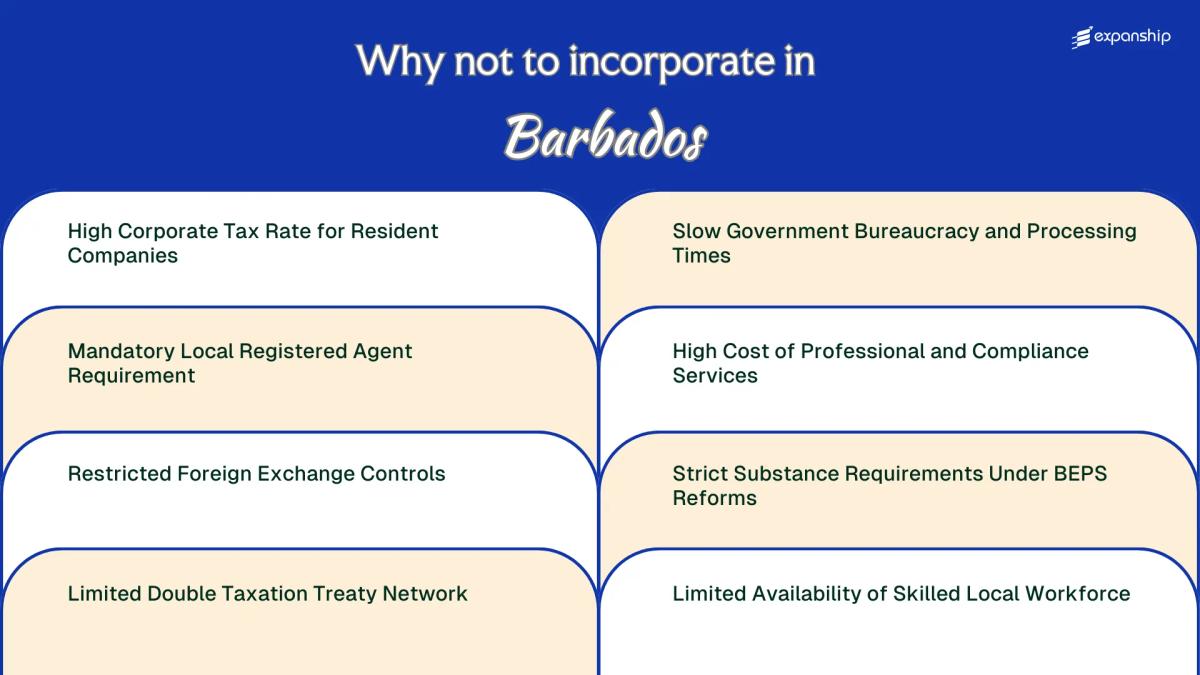
High Corporate Tax Rate for Resident Companies
One of the more direct Barbados corporate tax rate drawbacks for foreign operators is the tiered income tax structure applied to resident companies, which can reach rates that significantly reduce after-tax profitability.
Tax Rates That Compress Margins
Barbados applies a sliding scale corporate income tax to resident companies, starting at 5.5% on taxable income up to BBD 1 million and stepping down to 1% on income above BBD 30 million. While the upper band appears low, mid-tier income levels carry a higher effective rate than many competing offshore jurisdictions charge at any level. For a foreign business structuring regional operations through a resident entity, this middle-band exposure can materially affect the financial model.
The high tax burden on Barbados resident companies is governed under the Income Tax Act, Cap. 73. Foreign shareholders accustomed to zero or flat-rate regimes in comparable jurisdictions will find the compliance overhead of calculating tiered liability adds both cost and administrative complexity.
Resident Classification Triggers the Full Burden
A company incorporated under the Barbados Business Corporation Act that is centrally managed and controlled from within the island qualifies as a resident entity, subjecting it to domestic tax rates rather than the lower rates historically available to International Business Companies. That IBC regime was abolished following OECD pressure, removing the rate separation that once gave foreign investors a structural advantage.
If your company is classified as a tax resident under the Income Tax Act, it is fully subject to the tiered domestic rate structure, with no access to the preferential rates that previously applied to internationally-focused entities incorporated in Barbados.
Mandatory Local Registered Agent Requirement
Every company incorporated under the Companies Act, Cap. 308 of Barbados must maintain a registered office and a local registered agent within the jurisdiction. For foreign business owners, this is not a one-time administrative step — it creates a permanent dependency on a locally licensed intermediary.
The registered agent must be resident and licensed under local law. You cannot fulfill this requirement with a foreign-based representative or a group entity that lacks local licensing, regardless of how large or established your parent company is.
This structure generates recurring costs and operational friction in specific ways:
- Your agent controls the registered address, meaning a breakdown in that relationship can technically disrupt your company's standing
- Any formal legal or regulatory correspondence routes through a third party first, adding lag time before your team receives critical notices
- Replacing a registered agent requires filing updates with the Corporate Affairs and Intellectual Property Office (CAIPO), creating administrative overhead even for a routine change
- Annual retainer fees for licensed local agents add a fixed compliance cost that has no equivalent in jurisdictions where self-registration is permitted
CAIPO does not maintain a publicly standardized fee schedule for registered agent services, so pricing is set by private providers. This opacity makes cost planning harder, particularly for firms entering the market without an established local network.

Company Incorporation in Barbados
Understand the full compliance structure before committing to a Barbados entity, including registered agent obligations and CAIPO filing requirements.
Restricted Foreign Exchange Controls
Barbados foreign exchange controls restrictions present a concrete operational obstacle for foreign-owned entities. The Exchange Control Act, administered through the Central Bank of Barbados, requires that transactions involving non-residents and cross-border capital movements receive prior approval. For a foreign business owner, this means routine financial activity — paying overseas suppliers, distributing dividends, or returning capital — cannot move freely without regulatory clearance.
Capital outflows are the most affected. Repatriation of profits, loan repayments to foreign parent companies, and payments for imported services all fall within the approval framework. Delays in obtaining Central Bank of Barbados authorization directly disrupt cash flow management at the group level.
| Transaction Type | Approval Required | Practical Delay Risk |
|---|---|---|
| Repatriation of dividends | Yes, prior Central Bank approval | Moderate to High |
| Repayment of foreign loans | Yes, documentation and approval required | Moderate |
| Cross-border service payments | Yes, for non-resident payees | Moderate |
| Capital account transfers | Yes, case-by-case review | High |
The approval process is not purely automatic. Applications require supporting documentation, and the Central Bank retains discretion to request further information or impose conditions.
Foreign businesses structured around rapid intercompany settlements will find this framework operationally restrictive. The inability to move funds on demand introduces treasury risk that does not exist in jurisdictions with fully open capital accounts.
Limited Double Taxation Treaty Network
Barbados tax treaty network limitations create a structural problem that affects how your business handles cross-border income flows. As of current records, the country has tax treaties with roughly 40 jurisdictions. That number sounds reasonable until you compare it against treaty networks maintained by jurisdictions like the Netherlands or Singapore, which cover 90+ countries.
The practical consequence is direct. If your business receives dividends, royalties, or interest from a jurisdiction outside the treaty network, full domestic withholding tax rates apply with no treaty reduction available.
For a foreign company routing income through a Barbadian holding entity, this gap creates real exposure. Payments to or from markets in Southeast Asia, the Middle East, or Sub-Saharan Africa will frequently fall outside any treaty protection entirely.
Not every income type is equally affected. Certain domestic exemptions under Barbados' Income Tax Act may reduce withholding on specific payments, but those exemptions do not replicate the breadth of relief that a bilateral treaty provides.
- Treaty relief is unavailable for jurisdictions not covered under existing agreements
- Withholding tax at domestic rates applies automatically on out-of-network payments
- No treaty protection means no reduced rates on dividends, interest, or royalties from uncovered markets
- The Barbados Revenue Authority administers treaty claims; documentation requirements must be met to access any available relief
Despite its limited treaty count, Barbados has a tax treaty with Canada dating back to 1980, which historically made it one of the most used conduit structures for Canadian outbound investment into Latin America.
Slow Government Bureaucracy and Processing Times
Barbados government bureaucracy incorporation delays are a documented friction point for foreign businesses. Processing times at the Corporate Affairs and Intellectual Property Office (CAIPO) regularly extend beyond initial estimates, creating uncertainty that disrupts planned operational timelines.
Structural Delays at CAIPO
Company registration through CAIPO can take several weeks under standard processing, and more complex structures involving foreign ownership or specific licensing requirements can extend this further. For a foreign investor working against a contract deadline or fiscal year target, this unpredictability carries a direct operational cost.
Expedited processing options exist but are not uniformly applied across all entity types or filings. Your firm cannot rely on accelerated timelines as a consistent fallback.
Downstream Compliance Bottlenecks
Delays at the registration stage create a cascading effect: your business cannot open a corporate bank account, apply for sector-specific licenses, or execute local contracts until incorporation is formally confirmed. This idle period generates overhead costs without any corresponding business activity.
Tax registration with the Barbados Revenue Authority and post-incorporation regulatory filings carry their own independent processing queues. Each adds additional lag between entity formation and operational readiness.
Working Around Registration Delays in Barbados
Our team coordinates directly with CAIPO and local agents to manage your incorporation timeline and minimize processing gaps.
High Cost of Professional and Compliance Services
The high cost of compliance services Barbados imposes on foreign-incorporated entities stems from a concentration of specialized service providers and mandatory professional involvement at nearly every stage of company administration. Fees for legal, accounting, and secretarial services reflect a market with limited competition and high professional credentialing requirements.
- Registered agents and corporate secretaries must be licensed under the Companies Act Cap. 308, and their annual retainer fees typically run higher than comparable offshore centers such as the BVI or Cayman Islands.
- Audited financial statements are required for most business companies, meaning your entity cannot avoid engaging a licensed local auditor even if turnover is minimal.
- The Barbados Revenue Authority requires professionally prepared tax filings, adding recurring accounting costs that compound annual maintenance expenses.
- Legal fees for drafting or amending constitutional documents must involve a qualified local attorney, as foreign legal practitioners cannot directly execute these instruments.
- Compliance with the Beneficial Ownership Register introduces additional administrative work that most businesses must outsource to local professionals, further increasing recurring costs.
Strict Substance Requirements Under BEPS Reforms
Barbados BEPS substance requirements challenges stem directly from the country's commitment to OECD-aligned reform, which, while internationally respected, imposes real operational burdens on foreign business owners. Under the International Business Companies Act (Cap. 77) and subsequent amendments driven by the OECD's Base Erosion and Profit Shifting framework, entities conducting certain geographically mobile activities must demonstrate genuine economic substance on the island.
Qualifying activities, including holding company operations, intellectual property income, and finance and leasing functions, require you to maintain adequate physical presence, qualified personnel, and core income-generating activities within the jurisdiction. These are not checkbox requirements; failure to satisfy them exposes your entity to penalties, loss of tax benefits, and potential referral to the OECD for non-cooperative jurisdiction listing.
The substance obligation falls entirely on you as the business owner, not on the registered agent or service provider. Hiring local staff, maintaining office space, and directing decisions from within the jurisdiction generates recurring costs that many offshore structures were originally designed to avoid.
Hypothetical scenario: A foreign holding company earning USD 500,000 annually in passive income that cannot demonstrate adequate local management may face reclassification of its tax status, triggering back-assessed corporate taxes and penalties under the Barbados Revenue Authority's compliance review process, potentially eliminating the anticipated tax efficiency of the structure entirely.
Limited Availability of Skilled Local Workforce
Barbados skilled workforce availability limitations present a concrete operational constraint for foreign businesses, particularly those requiring specialised technical, financial, or legal talent. The island's total population sits at approximately 280,000, which places a structural ceiling on the depth of any professional labour pool.
Sectors such as fintech, advanced manufacturing, and specialised fund administration routinely encounter shortages of experienced local candidates. This forces employers to pursue expatriate hires, which then triggers obligations under the Immigration Act, CAP. 190, including work permit applications processed through the Immigration Department.
Work permit approval timelines are unpredictable, and permit fees vary by occupation category. For a foreign firm that needs to staff a new entity quickly, this adds both cost and delay that would not arise in larger markets.
The Employment Rights Act, 2012 also establishes protections that, in practice, require demonstrating that no suitable local candidate was available before a foreign hire can be approved. Your recruitment process must be documented accordingly, or permit applications face rejection.
- Roles in AI, blockchain infrastructure, and specialised tax structuring are particularly difficult to fill locally
- Talent retention is an additional concern, as high emigration rates thin the pool of experienced mid-career professionals
Before hiring any foreign national, your entity must demonstrate that the position was advertised locally and no qualified Barbadian candidate was available, as required under Immigration Department guidelines.
Overcoming These Incorporation Challenges
Overcoming Barbados incorporation challenges requires structural preparation before formation, not reactive adjustments after registration. The jurisdiction's regulatory framework rewards businesses that anticipate compliance obligations rather than discover them mid-operation.
- Elect an International Business Company structure where eligible to access the reduced tax rates available under the Income Tax Act, Cap. 73.
- Appoint a locally licensed registered agent at the outset, as required under the Companies Act, Cap. 308, to satisfy the resident agent requirement from day one.
- Obtain advance rulings from the Barbados Revenue Authority on foreign exchange transactions to reduce exposure to Central Bank of Barbados restrictions.
- Conduct an Economic Substance assessment against the criteria set by the Companies Act before selecting your entity type and operational model.
- Budget for ongoing compliance costs from incorporation, accounting for registered agent fees, audit requirements, and annual filing obligations under the Companies Act.
Mitigating Barbados business registration drawbacks is less a matter of finding workarounds and more a matter of aligning your structure with the existing statutory framework from the start. The Barbados Revenue Authority and the Corporate Affairs and Intellectual Property Office administer the rules governing these obligations, and both operate within frameworks that have limited administrative discretion.
Barbados Still Worth Considering
Barbados has accumulated a credible track record as an offshore and international business hub, backed by decades of treaty relationships and a stable legal system rooted in English common law. The disadvantages covered in this blog are real and measurable, yet they do not disqualify the jurisdiction for businesses whose structure and objectives align with what it actually offers.
| Pros | Cons |
|---|---|
| Long-standing network of bilateral tax treaties reduces withholding tax exposure in key partner countries | Treaty network is narrower than competing jurisdictions such as the Netherlands or Cyprus |
| English common law legal system provides a familiar and predictable framework for contract enforcement | Government processing times are slower than regional peers, adding weeks to formation and licensing timelines |
| International Business Companies benefit from a low flat tax rate under the IBC Act | Resident companies face a corporate tax rate that is high relative to most offshore alternatives |
| Substance requirements under BEPS reforms are codified and transparent, reducing regulatory uncertainty | Meeting those substance requirements raises ongoing operational costs, including payroll and office expenditure |
| No restrictions on repatriating profits earned in foreign currency by qualifying entities | Foreign exchange controls applied to local currency transactions add friction for firms operating domestically |
Professional and compliance costs in Barbados sit above the Caribbean average, and the mandatory registered agent requirement adds a recurring overhead that cannot be structured away.
Compliance Services for Companies in Barbados
Maintain good standing with Barbados's regulatory requirements, from annual filings with the Corporate Affairs and Intellectual Property Office to ongoing substance and reporting obligations.
Conclusion
This Barbados company formation drawbacks summary reflects a jurisdiction that offers genuine tax planning utility but carries structural constraints that affect how, and how efficiently, you can operate. Substance requirements under the BEPS-aligned reforms, the restricted foreign exchange environment, and consistently slow government processing times represent the most operationally significant friction points covered here. Each factor adds cost or delay that compounds over a compliance calendar. Firms entering with a clear understanding of these constraints, and the professional infrastructure to manage them, are better positioned than those who discover them post-incorporation.
Expanship for Your Barbados Expansion
Expanship's Barbados company formation services are built around the specific compliance architecture that makes this jurisdiction demanding for foreign businesses. From coordinating with the Corporate Affairs and Intellectual Property Office to managing substance documentation under the International Business Companies Act, Expanship works to reduce the operational burden these requirements place on your team, not to sidestep them.
Barbados incorporation support for foreign businesses extends across the full setup and maintenance cycle.
- Your company registration is handled with full document preparation tailored to Barbadian requirements.
- A local registered agent and office address are provided to satisfy statutory obligations under Barbadian law.
- Government filings and regulatory body liaison are managed on your behalf throughout the process.
- Post-incorporation compliance management keeps your entity in good standing year-round.
- Banking introduction assistance connects you with suitable financial institutions operating in Barbados.
- Tax registration and liaison with the Barbados Revenue Authority are coordinated as part of your setup.
Reach out to Expanship Barbados to discuss your incorporation requirements.
Frequently Asked Questions (FAQ)
Yes, all companies incorporated under the Companies Act of Barbados, including International Business Companies and domestic firms, must maintain a registered agent with a physical presence in Barbados. The Corporate Affairs and Intellectual Property Office (CAIPO) enforces this as a standing requirement, not a one-time filing formality. Failing to maintain a registered agent can result in a company being struck off the register.
Under the International Business Companies (Amendment) Act and the Substance Requirements legislation introduced following OECD BEPS pressure, companies that fail to demonstrate genuine economic substance in Barbados face financial penalties and potential spontaneous exchange of information with foreign tax authorities. The Barbados Revenue Authority and the Ministry of Finance oversee enforcement, and penalties can escalate with continued non-compliance. In serious cases, a business risks losing its operating licence or preferred tax status entirely.
Annual compliance costs in Barbados typically include registered agent fees, audit and accounting fees, annual return filing with CAIPO, and legal retainer costs for substance documentation, which collectively can exceed USD 10,000 to USD 20,000 per year for an international business company. These figures are materially higher than in many competing jurisdictions in the Caribbean. For smaller firms with limited Barbados-sourced revenue, the cost-to-benefit ratio warrants serious scrutiny before incorporation.
Barbados has a relatively small treaty network of roughly 40 agreements, which is functional but narrow when compared to jurisdictions like Cyprus or Malta, which offer access to broader EU-connected treaty frameworks. The network covers key partners including Canada, the United Kingdom, and the United States, so the limitation is not universal. However, if your business relies on treaty protection for dividend flows from markets in Asia, Africa, or Latin America, the gaps become a real structural constraint.
If a company subject to substance requirements cannot show that core income-generating activities are conducted by qualified employees in Barbados, it will be treated as failing the substance test under the relevant legislation. The Barbados Revenue Authority may then classify the entity as non-compliant, triggering reporting obligations to foreign tax authorities in the jurisdiction where the beneficial owner is tax resident. This creates direct exposure to back taxes and penalties in the home jurisdiction of the business owner.
Foreign exchange controls administered by the Central Bank of Barbados apply broadly to transactions involving the conversion of Barbados dollars to foreign currency, and no company structure entirely eliminates this exposure for resident entities. International Business Companies that earn and transact predominantly in foreign currencies have more operational flexibility, but repatriation of profits and cross-border payments still require compliance with Central Bank guidelines. Structuring decisions can reduce friction, but they do not bypass the regulatory framework.
CAIPO processing times for company incorporation and document filings can extend several weeks, particularly during high-volume periods, which creates a practical delay for businesses with time-sensitive commercial deadlines. Unlike jurisdictions such as Estonia or Singapore that offer same-day or next-day digital incorporation, Barbados does not yet offer a fully automated fast-track process for foreign applicants. This delay also propagates downstream, slowing bank account opening and the activation of local vendor or supplier relationships.
Legal Disclaimer
The information provided in this article is for general informational purposes only and does not constitute legal, tax, or professional advice. While we strive to ensure the accuracy and timeliness of the content, laws and regulations are subject to change, and the application of laws can vary widely based on specific facts and circumstances.
Readers should not act upon this information without seeking professional counsel tailored to their individual situation. Expanship and its authors disclaim any liability for actions taken or not taken based on the content of this article.
For specific advice regarding your business setup, compliance requirements, or any legal matters, please consult with qualified legal and tax professionals in the relevant jurisdiction.