

Key Takeaways
- Barbados applies a flat corporate tax rate below 5.5% under the Income Tax Act, giving internationally structured businesses a predictable and low-cost tax position across their Barbados-sourced and qualifying foreign income.
- With over 40 double taxation treaties in force, foreign investors can route cross-border transactions through Barbados while reducing or eliminating withholding tax exposure in counterparty jurisdictions.
- Foreign currency earnings held by a Barbados-registered entity can be repatriated in full without regulatory restriction, removing a material operational risk that affects companies incorporated in many competing jurisdictions.
- Companies incorporated under the Barbados Companies Act benefit from a common law legal framework and OECD-compliant regulatory standards, supporting enforceability of contracts and long-term structural stability for international holding arrangements.
Barbados is an independent sovereign nation located in the eastern Caribbean, governed under a parliamentary democratic system. Company registration falls under the authority of the Corporate Affairs and Intellectual Property Office, the statutory body responsible for incorporating and maintaining business entities on the island. Foreign businesses most commonly establish a presence through an International Business Company. The tax posture is low-rate and treaty-based, with obligations structured to attract cross-border commerce while maintaining compliance with international standards.
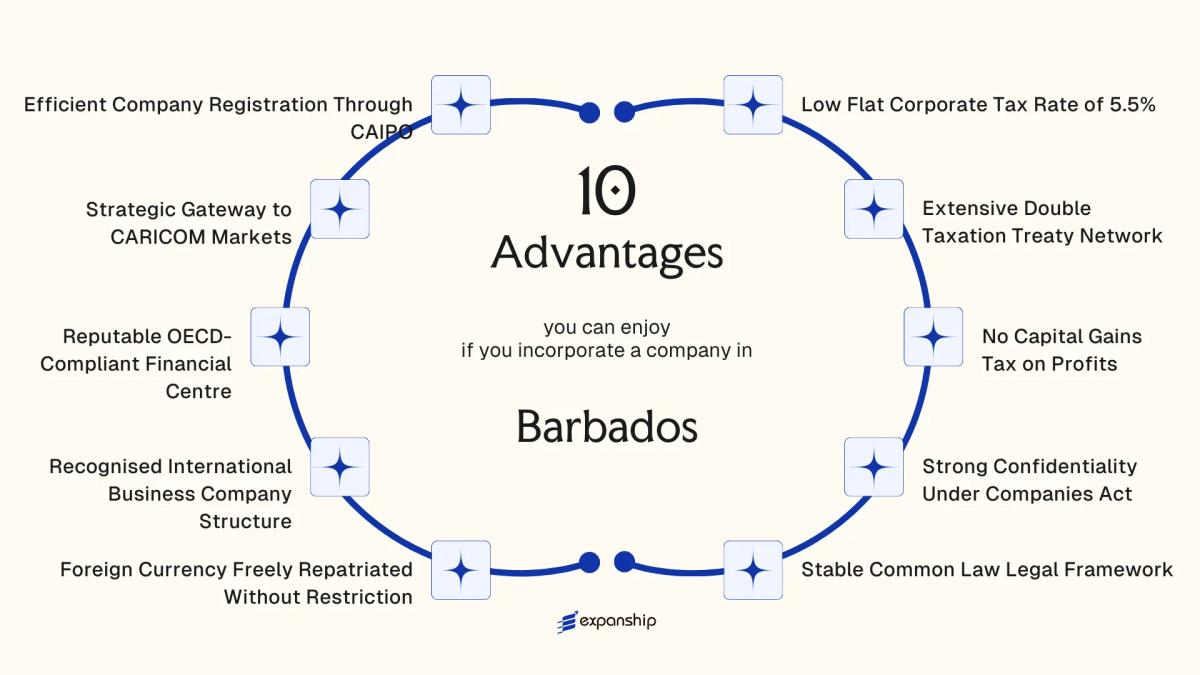
Foreign ownership is permitted across most sectors, and no restrictions on full foreign shareholding apply to the majority of registered entities. The regulatory environment is generally open to foreign direct investment, with few barriers to establishing or operating a business as a non-resident. This article examines the principal advantages that the benefits of incorporating in Barbados present to foreign investors, business owners, and internationally operating firms.
Low Flat Corporate Tax Rate of 5.5%
Barbados applies a low flat corporate tax rate of 5.5% to companies incorporated under its laws, including those engaged primarily in international business. This rate applies uniformly, without tiered bands or phased conditions tied to profit thresholds.
What the Rate Structure Means in Practice
Under the Income Tax Act, Cap. 73, resident companies are assessed on their chargeable income at this single flat rate. For a foreign business owner, the absence of progressive brackets means your effective rate does not increase as profits grow, which makes financial projections more straightforward and consistent.
Why This Matters Compared to Other Jurisdictions
The 5.5% Barbados corporate tax advantage becomes particularly visible against major jurisdictions — the UK corporate tax rate sits at 25%, while the EU average exceeds 21%. Operating through a properly structured Barbados entity subjects qualifying business income to a fraction of those liabilities. Tax residency and source-of-income rules under local legislation still govern eligibility, so the structure of your operations must be reviewed against those provisions.
A flat 5.5% rate means your corporate tax liability scales with profit without rate escalation, giving you predictable after-tax returns from the first dollar earned.
Extensive Double Taxation Treaty Network
Barbados has concluded double taxation treaties with over 40 countries, a figure that carries real weight when you consider how few Caribbean jurisdictions maintain treaty networks of comparable breadth. These agreements reduce or eliminate withholding taxes on dividends, interest, and royalties paid between treaty partners, which directly reduces the cost of moving capital across borders.
For a foreign business owner, the Barbados double taxation treaty network benefits are most visible when structuring holding companies or regional headquarters. Income flowing through a Barbados entity from a treaty partner country is not taxed twice — once at source and again locally. That protection is grounded in each bilateral agreement, many of which follow the OECD Model Tax Convention framework.
Treaty partners span multiple continents, including the United Kingdom, Canada, the United States, and several European nations. This geographic spread matters because your business can route transactions through a jurisdiction that has a formal, legally binding agreement with the country where your underlying operations sit.
Qualifying for treaty benefits generally requires that the entity meets substance requirements under Barbados tax law, including demonstrating genuine economic activity.
Key reasons the treaty network is accessible in practice:
- Treaty relief applies at the entity level, not requiring complex fund structures
- Substance requirements are defined under domestic legislation rather than vague regulatory guidance
- Treaty positions are supported by an established body of administrative practice

Incorporate a Company in Barbados
Set up a Barbados company with treaty access and full compliance support through Expanship.
No Capital Gains Tax on Profits
There is no capital gains tax in Barbados. Gains realised from the sale of shares, securities, real property, or other capital assets are not subject to tax under the country's Income Tax Act. This applies to both resident and non-resident entities, meaning that when your company disposes of an investment at a profit, the full gain is retained rather than reduced by a tax charge at the point of realisation.
For foreign investors and holding structures, the practical effect is direct. A company incorporated in Barbados that holds equity stakes in subsidiaries across the Caribbean or Latin America can exit those positions without triggering a domestic tax liability on the appreciation. This makes the jurisdiction structurally suited for investment holding, private equity, and asset management activity where capital events are a routine part of operations.
| Asset Type | Capital Gains Tax | Applicable Rule |
|---|---|---|
| Shares and securities | None | Income Tax Act |
| Real property (capital gain) | None | Income Tax Act |
| Business goodwill on sale | None | General principle |
| Dividends received | Subject to withholding rules | Income Tax Act |
The absence of this charge is a statutory position, not a concession or exemption requiring separate application. No election is needed to qualify, and no minimum holding period applies. Your business benefits from this treatment by default under the standard tax rules governing companies registered through the Corporate Affairs and Intellectual Property Office.
Strong Confidentiality Under Companies Act
Barbados Companies Act confidentiality benefits are grounded in statute, not merely administrative practice. Under the Companies Act, Cap. 308, the public register maintained by the Corporate Affairs and Intellectual Property Office (CAIPO) does not require disclosure of beneficial ownership details to the general public. Shareholder and director information is filed with CAIPO, but access to certain records is restricted, meaning your ownership structure does not become visible to commercial competitors or unsolicited third parties.
For foreign investors, this creates a meaningful layer of privacy around corporate governance. The identity of shareholders is recorded internally but is not routinely published in a publicly searchable format, which distinguishes the jurisdiction from several EU and UK-aligned registries that mandate open beneficial ownership registers.
Barbados director privacy under the Companies Act similarly limits unnecessary exposure. Directors are required for compliance purposes, but the firm's internal management structure does not need to be publicly advertised.
Keep the following in mind:
- Beneficial ownership records are held by CAIPO, not published on a free-access public portal
- Information sharing with foreign authorities occurs under specific treaty or regulatory frameworks, not automatically
- Local registered agents are bound by confidentiality obligations under applicable professional rules
- Barbados participates in the Common Reporting Standard (CRS), so financial account information is exchanged with treaty partners
Despite its privacy protections, Barbados has never been listed on the FATF blacklist, which signals that its confidentiality framework is compliance-based rather than opacity-driven.
Stable Common Law Legal Framework
Barbados operates under a common law system derived from English law, a structure that has remained consistent since independence in 1966. For foreign business owners, the Barbados common law legal framework advantages are concrete: contracts are interpreted under familiar precedent-based principles, property rights are clearly defined, and dispute resolution follows established judicial processes that courts in the UK, US, and Canada would recognise.
Predictability in Contract and Commercial Law
The Companies Act, Cap. 308 governs corporate formation and operation, providing a codified statutory base that sits alongside common law principles. Judicial decisions draw on a body of precedent that spans centuries, which means your contracts and corporate structures are evaluated against a well-developed body of case law rather than unpredictable administrative discretion. That predictability directly reduces legal risk when structuring agreements with counterparties or managing cross-border transactions.
The Eastern Caribbean Supreme Court and the Caribbean Court of Justice provide appellate mechanisms that give commercial disputes a clear escalation path. Barbados also retains the Judicial Committee of the Privy Council as a final appellate court for certain matters, connecting the legal system to one of the most authoritative common law bodies in the world.
Statutory Protections for Foreign Business Owners
The International Business Companies Act and related legislation extend specific protections to qualifying foreign-owned entities, including contractual enforceability and defined shareholder rights. These statutory protections reduce reliance on informal arrangements, which is a material advantage when investors from civil law countries establish operations here.
Structure Your Barbados Company With Full Legal Confidence
Speak with our team to understand how Barbados's common law framework applies to your specific corporate structure and investment goals.
Foreign Currency Freely Repatriated Without Restriction
Barbados free repatriation of foreign currency is governed by the Exchange Control Act, Cap. 71, which grants the Central Bank of Barbados authority over foreign exchange transactions. However, entities incorporated as International Business Companies (IBCs) or operating under approved foreign currency structures are generally exempt from exchange control restrictions, meaning profits, dividends, royalties, and capital can be moved abroad without regulatory approval delays.
For a foreign business owner, this has a direct operational consequence:
- Dividends paid to non-resident shareholders can be transferred to overseas accounts without filing for Central Bank approval, removing a bureaucratic step that exists in many emerging market jurisdictions.
- Loan repayments and management fees denominated in foreign currency can flow outward under the same exemption framework, giving treasury functions predictability.
- Because the exemption is structural rather than discretionary, your business is not subject to case-by-case review, which reduces the risk of funds being held pending regulatory decisions.
- The foreign currency transfer advantages extend to intercompany transactions, making the jurisdiction practical for holding structures where funds must circulate between parent and subsidiary entities across borders.
Eligibility for these exemptions depends on the entity maintaining its approved status under the relevant corporate or IBC registration framework.
Recognised International Business Company Structure
Barbados offers a specific vehicle for cross-border operations: the International Business Company, or IBC. Incorporated under the Companies Act, Cap. 308, and historically governed by the International Business Companies Act before its integration into the unified companies framework, the IBC structure was designed with foreign-owned, internationally focused entities in mind.
One of the practical advantages for your business is that an IBC can be structured to conduct operations entirely outside Barbados, keeping the entity legally domiciled in a well-regulated jurisdiction while its commercial activities span multiple markets. This separation is operationally meaningful for holding companies, IP ownership vehicles, and regional management entities.
The IBC structure also permits:
- A single shareholder and single director
- Corporate directors and shareholders
- No requirement for local directors in standard IBC configurations
Registration and ongoing oversight fall under the Companies and Intellectual Property Office (CAIPO) and the Barbados Financial Services Commission, giving foreign investors a defined regulatory counterparty rather than a fragmented authority structure.
A foreign-owned IBC earning $500,000 in net international business income in Barbados would be subject to a flat corporate tax rate of 5.5%, resulting in a tax liability of $27,500, compared to a liability of $105,000 under a standard 21% US federal corporate rate on the same income.
Reputable OECD-Compliant Financial Centre
Barbados OECD-compliant financial centre benefits stem directly from the country's sustained engagement with international regulatory standards. The jurisdiction has undergone peer reviews under the OECD's Global Forum on Transparency and Exchange of Information for Tax Purposes and holds a "Largely Compliant" rating. That standing matters because it signals to counterparties, banks, and tax authorities in your home country that structures formed here are not associated with harmful tax practices.
For foreign businesses, this has a concrete operational consequence. Holding companies, regional headquarters, and investment vehicles incorporated in a jurisdiction that meets OECD exchange-of-information standards face fewer automatic red flags when opening correspondent banking relationships or filing consolidated group accounts internationally.
Compliance with the Base Erosion and Profit Shifting (BEPS) minimum standards, which Barbados has committed to implement, also means that arrangements structured through a local entity are less likely to be challenged as artificial by foreign revenue authorities. Substance requirements do apply, so passive holding structures without genuine economic activity on the island may not qualify for treaty and preferential rate benefits.
Substance requirements under Barbados's BEPS commitments mean your entity must demonstrate genuine economic activity locally to access treaty benefits and the preferential corporate tax regime.
Strategic Gateway to CARICOM Markets
Barbados is a full member of the Caribbean Community (CARICOM) and operates within the CARICOM Single Market and Economy (CSME). For a foreign business, the Barbados gateway to CARICOM markets advantage is structural: a company incorporated here can access preferential trade conditions across 15 member states without facing the tariff barriers that apply to firms incorporated outside the bloc.
Free Movement of Goods and Services
Under the Revised Treaty of Chaguaramas, which establishes the legal foundation of the CSME, qualifying firms can move goods, services, and capital across member states with reduced trade friction. This matters because a foreign business that establishes a Barbadian entity can supply regional markets from a single base, rather than incorporating separately in each territory. The administrative and cost savings of that consolidation are direct and measurable.
Right of Establishment Across the Region
CSME provisions extend the right of establishment to CARICOM-incorporated entities, meaning your firm can set up operations in other member states without being treated as a foreign entrant. This removes a layer of regulatory complexity that would otherwise apply to a non-CARICOM structure attempting to enter Caribbean markets for Barbados CARICOM access.
Regional Market Reach
Operating from a single CSME-compliant entity, your business can reach:
- Trinidad and Tobago
- Jamaica
- Guyana
- Belize
- Saint Lucia and other Eastern Caribbean states
Each of these markets would otherwise require separate foreign business registration processes.
Efficient Company Registration Through CAIPO
The Corporate Affairs and Intellectual Property Office (CAIPO) is the statutory body responsible for company registration in Barbados, and the Barbados CAIPO company registration advantages begin with the straightforward filing structure it operates under the Companies Act, Cap. 308. For a foreign business owner, this means your entity can be incorporated without establishing a physical presence during the registration process itself.
CAIPO accepts applications through its online portal, reducing the time between submission and incorporation compared to jurisdictions that require in-person notarization or multi-agency clearances. A standard business company can typically be registered within a few working days once documentation is in order. That speed has a direct commercial value — your firm can open corporate bank accounts, execute contracts, and begin transacting sooner.
The documentation threshold is also a practical advantage:
- A completed application form with the proposed company name
- Articles of Incorporation or a Memorandum and Articles of Association
- Details of at least one director and one shareholder
- A registered office address in Barbados (provided by a licensed registered agent)
- Payment of the prescribed registration fee
No minimum paid-up capital is mandated for standard business companies under the Companies Act. This removes a common barrier that in some jurisdictions requires capital to be deposited and certified before registration is approved.
Registered agents licensed under local law can act on your behalf throughout the process. That means your business can be incorporated remotely, with a qualified intermediary handling name searches, document preparation, and filing directly with CAIPO.
Why Barbados Stands Out Among Offshore Jurisdictions
Assessed against comparable Caribbean and Latin American jurisdictions, Barbados holds a distinct position for foreign investors who prioritise treaty access, regulatory credibility, and legal predictability. The comparison below focuses on the Cayman Islands, Panama, and St. Kitts and Nevis — three jurisdictions that attract a similar profile of international business structures and are frequently evaluated alongside Barbados by investors and corporate advisers making incorporation decisions.
What the comparison reveals is not simply a difference in tax rates, but a structural one. Barbados is a treaty-based jurisdiction, meaning its tax advantages are backed by bilateral agreements recognised under international law, rather than relying solely on domestic zero-rate regimes that face increasing scrutiny from the OECD and EU. For businesses that need to actively use treaties — particularly those with Canadian, UK, or US counterparts — that distinction carries real operational weight.
| Parameter | Barbados | Cayman Islands | Panama | St. Kitts and Nevis |
|---|---|---|---|---|
| Corporate Tax Rate | 1% to 5.5% (tiered) | 0% | 0% on foreign income | 0% |
| Double Tax Treaties | 40+ active treaties | None | Limited | None |
| OECD Compliance Status | Largely compliant | Under monitoring | Under monitoring | Largely compliant |
| CARICOM Membership | Yes | No | No | Yes |
| Common Law Legal System | Yes | Yes | No (Civil Law) | Yes |
| IBC Legislation | International Business Companies Act | Exempted Company structure | Private Interest Foundation available | LLC and IBC structures |
| Foreign Ownership Restriction | Generally unrestricted | Generally unrestricted | Generally unrestricted | Generally unrestricted |
Compliance Services for Companies in Barbados
Maintain your Barbados entity in good standing with CAIPO and the Barbados Revenue Authority. Expanship supports annual filings, registered agent requirements, and ongoing regulatory obligations.
Conclusion
Barbados presents a well-defined case for international incorporation: a flat corporate tax structure under the Income Tax Act, a treaty network spanning over 40 jurisdictions, and full repatriation of foreign currency earnings without regulatory restriction. These are not incidental features; they form the structural foundation that determines how efficiently a foreign business can operate and extract value through this jurisdiction.
The benefits of incorporating in Barbados carry the most weight for businesses engaged in cross-border trade, regional distribution through CARICOM, or international holding structures where treaty protection and tax certainty are primary concerns. Your specific industry, ownership structure, and the jurisdictions you transact with will determine how much of this framework applies directly to your situation.
For businesses where these factors align, the practical advantages are material and grounded in enforceable law. The next step is assessing whether your business structure can be organised to qualify under the relevant provisions of the Companies Act and applicable tax regulations, and ensuring ongoing compliance is managed to preserve those advantages over time.
Start Your Barbados Company With Expanship Today
Expanship assists foreign businesses in forming and maintaining companies registered with the Corporate Affairs and Intellectual Property Office (CAIPO), the authority responsible for entity incorporation under the Companies Act, Cap. 308. The firm's service scope covers the full lifecycle addressed throughout this blog, from selecting the appropriate entity structure and preparing statutory documents to meeting annual compliance obligations and navigating the foreign currency repatriation rules governed by the Central Bank of Barbados.
Expanship's Barbados company formation services include:
- Preparation and legalization of all incorporation documents, including the Articles of Incorporation
- Registered agent and registered office provision as required under the Companies Act
- Filing and liaison with CAIPO throughout the registration process
- Post-incorporation compliance management, including annual returns and director obligations
- Coordination with local banks to support account opening for newly incorporated entities
- Ongoing corporate secretarial support to maintain good standing
To start a Barbados company with Expanship, contact the team directly through Expanship Barbados.
Frequently Asked Questions (FAQ)
Barbados applies a flat corporate income tax rate of 5.5% to companies operating under the International Business Company regime. This rate applies to net taxable profits and is fixed, meaning it does not scale with income levels in the way that tiered systems do. The rate is set out under domestic tax legislation administered by the Barbados Revenue Authority.
The Corporate Affairs and Intellectual Property Office (CAIPO) typically processes standard company registrations within a few business days, though timelines can vary depending on document completeness and the type of entity being registered. Expedited processing may be available in certain circumstances. Delays most commonly arise from incomplete submissions or outstanding due diligence documentation.
No capital gains tax is imposed under Barbados tax law, meaning gains realised on the disposal of assets or investments are not subject to a separate capital gains levy. Dividends paid to foreign shareholders from a Barbados-registered entity also benefit from exemptions under several of the country's double taxation treaties. The specific treatment will depend on the applicable treaty between Barbados and the shareholder's country of residence.
Yes, Barbados is an OECD-compliant jurisdiction and has committed to international standards on tax transparency and information exchange, including the Common Reporting Standard (CRS) and the Base Erosion and Profit Shifting (BEPS) framework. This status distinguishes it from jurisdictions classified as non-cooperative or blacklisted by bodies such as the EU. Compliance obligations for companies include economic substance requirements, which must be satisfied to maintain the benefits of the IBC structure.
A registered office address in Barbados is required for all companies incorporated under the Companies Act, Cap. 308. The requirement for a resident director depends on the corporate structure and applicable licensing conditions; international business companies may have specific criteria under the International Business Companies Act. You should confirm the exact directorship requirements based on the structure your business intends to use.
Foreign currency earnings held by an International Business Company can generally be repatriated without restriction, as these entities are permitted to operate accounts in foreign currencies and transfer funds internationally. Domestic companies are subject to exchange control regulations administered by the Central Bank of Barbados, so the applicable rules differ depending on the company type. Confirmation of the specific repatriation framework should be obtained in relation to the exact entity structure being used.
Barbados has concluded double taxation agreements with a significant number of countries, including Canada, the United Kingdom, the United States, and several other jurisdictions. These treaties reduce or eliminate withholding taxes on dividends, interest, and royalties paid between treaty partners, lowering the overall tax burden on cross-border transactions. A company structured to take advantage of a relevant treaty must meet the residency and substance requirements stipulated within that agreement to qualify for treaty benefits.
Legal Disclaimer
The information provided in this article is for general informational purposes only and does not constitute legal, tax, or professional advice. While we strive to ensure the accuracy and timeliness of the content, laws and regulations are subject to change, and the application of laws can vary widely based on specific facts and circumstances.
Readers should not act upon this information without seeking professional counsel tailored to their individual situation. Expanship and its authors disclaim any liability for actions taken or not taken based on the content of this article.
For specific advice regarding your business setup, compliance requirements, or any legal matters, please consult with qualified legal and tax professionals in the relevant jurisdiction.