
Key Takeaways
- Bosnia and Herzegovina's dual-entity structure forces companies operating across both the Federation of Bosnia and Herzegovina and Republika Srpska to navigate separate company laws, tax administrations, and registration procedures, effectively doubling administrative overhead for any cross-entity operation.
- The Law on Companies applicable within the Federation of Bosnia and Herzegovina creates a fragmented legal baseline that diverges from Republika Srpska's equivalent legislation, leaving businesses without a single unified corporate governance framework to rely on.
- Social contribution obligations layered on top of rigid labor protections impose substantial fixed employment costs that reduce workforce flexibility and raise the effective cost of hiring beyond the nominal wage level.
- A limited double taxation treaty network restricts the jurisdictions with which Bosnia and Herzegovina has formally agreed to eliminate dual tax liability, exposing cross-border transactions to a higher risk of income being taxed in multiple countries simultaneously.
Bosnia and Herzegovina operates under an evolving regulatory framework shaped by post-war institutional reconstruction and ongoing EU accession obligations. The disadvantages of incorporating in Bosnia and Herzegovina span administrative, legal, financial, and governance categories — each covered in the sections that follow.
The specific drawbacks your business encounters will depend considerably on its legal structure, sector of activity, and whether it operates across both the Federation of Bosnia and Herzegovina and Republika Srpska. A manufacturing firm faces different friction points than a services-based entity.
Foreign investors entering for the first time, particularly those from EU or common law jurisdictions, are most likely to encounter these challenges in a direct and operational sense. Company formation in Bosnia Herzegovina is governed by entity-level legislation, including the Law on Companies applicable within the Federation.
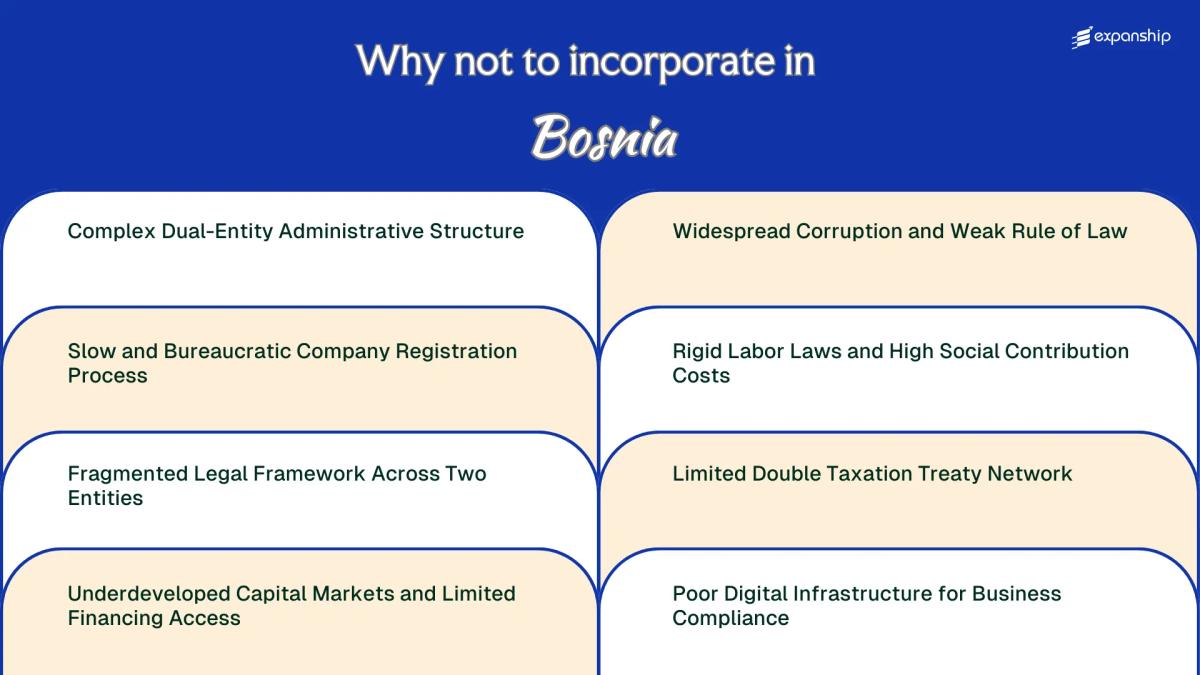
Complex Dual-Entity Administrative Structure
Bosnia Herzegovina dual entity business problems stem directly from the country's post-Dayton constitutional structure, which divides governing authority between two entities: the Federation of Bosnia and Herzegovina (FBiH) and Republika Srpska (RS).
Parallel Compliance Obligations Across Two Entities
A company incorporated in one entity is not automatically recognized as compliant in the other. If your business operates across both entities, you face separate registration requirements, tax filings, and regulatory interactions with distinct authorities, including the FBiH Tax Administration and the Republika Srpska Tax Administration, which function independently under separate legal codes.
This Federation BiH Republika Srpska administrative burden compounds over time, particularly for firms with employees or commercial activity in both territories.
Operational Risk From Regulatory Inconsistency
Entity-level compliance challenges in Bosnia Herzegovina extend beyond paperwork. Tax rates, labor regulations, and business licensing conditions differ between FBiH and RS, meaning a procedure that satisfies one entity's authorities may not satisfy the other's.
Dual jurisdiction risks for companies are not theoretical. Foreign firms without locally embedded legal counsel frequently face compliance gaps they only discover during audits or enforcement actions.
Operating across both entities without separate, entity-specific legal and tax representation exposes your business to enforcement actions and financial penalties under two independent regulatory regimes simultaneously.
Slow and Bureaucratic Company Registration Process
The slow company registration process in Bosnia and Herzegovina stems from a multi-layered institutional structure that requires sequential approvals across several separate bodies. Registering a d.o.o. (društvo s ograničenom odgovornošću) involves filing with the relevant entity-level court registry, which in the Federation of BiH operates through cantonal courts rather than a single centralized authority.
Each cantonal court applies its own administrative procedures, meaning processing times vary significantly depending on the canton where you register. This unpredictability makes planning a market entry timeline genuinely difficult.
Practical burdens this creates for foreign business owners include:
- Notarization requirements for founding documents force you to engage a local notary before submission, adding both cost and scheduling delays that cannot be bypassed.
- Court registry backlogs in commercially active cantons like Sarajevo extend waiting periods well beyond the nominal timeframes, disrupting planned operational start dates.
- Obtaining a company identification number (JIB) from the Tax Administration requires a separate post-registration step, delaying your ability to open a corporate bank account.
- Document translation and legalization requirements for foreign directors add procedural layers that most comparable EU-candidate jurisdictions have reduced or eliminated.
Registration in Republika Srpska, handled through the Republika Srpska Business Registers Agency (APIF), is comparatively more centralized, but foreign firms operating across both entities still face duplicate administrative obligations.

Company Incorporation in Bosnia and Herzegovina
Incorporate your business in Bosnia and Herzegovina with structured support across both entity jurisdictions, from document preparation to registry filing.
Fragmented Legal Framework Across Two Entities
Bosnia and Herzegovina's fragmented legal framework is not a procedural inconvenience — it is a structural condition that directly multiplies your compliance obligations. The country operates under two principal entities: the Federation of Bosnia and Herzegovina (FBiH) and Republika Srpska (RS), each with its own legislative assembly, laws, and regulatory bodies. Your company's legal obligations depend on where it is registered, and those obligations may bear little resemblance to what applies across the Inter-Entity Boundary Line.
Company law, tax administration, and labor regulation are all legislated separately at the entity level. A firm registered in FBiH operates under the FBiH Law on Companies, while one in RS falls under the RS Law on Business Companies — two distinct statutes with differing procedural requirements, filing obligations, and governance rules.
| Legal Area | FBiH Instrument | RS Instrument | Practical Burden |
|---|---|---|---|
| Company law | FBiH Law on Companies | RS Law on Business Companies | Separate registration, governance, and amendment procedures |
| Tax administration | FBiH Tax Administration | RS Tax Administration | Distinct filing systems; no unified tax portal |
| Labor law | FBiH Labor Law | RS Labor Law | Different termination rules and notice period requirements |
| Cantonal regulation (FBiH only) | 10 cantonal governments | Not applicable | Additional sub-entity permits required in FBiH |
FBiH's internal division into ten cantons adds a further tier that RS businesses do not face. Operating across both entities — common for firms targeting the national market — means maintaining dual legal counsel, dual filings, and reconciling entity law inconsistencies that no single national authority is empowered to resolve. Legal uncertainty doing business in Bosnia and Herzegovina under this structure is not incidental; it is built into the constitutional design established by the 1995 Dayton Agreement.
Underdeveloped Capital Markets and Limited Financing Access
Limited financing access in Bosnia Herzegovina is a structural condition, not a temporary gap. The country operates two separate stock exchanges: the Sarajevo Stock Exchange (SASE) and the Banja Luka Stock Exchange (BLSE). Combined, their market capitalization and trading volumes remain a fraction of regional peers, meaning your firm cannot realistically raise equity capital through public markets here.
Foreign companies face additional friction. Bosnia and Herzegovina's investment restrictions on foreign companies are not always codified in a single statute but emerge from fragmented entity-level regulations governing capital movements, which creates unpredictability when repatriating profits or securing local financing.
Banking credit remains the primary funding channel, yet commercial lending rates and collateral requirements are steep by regional standards. Local banks, supervised by the Banking Agency of the Federation of BiH and the Banking Agency of Republika Srpska respectively, apply conservative credit criteria that disadvantage newly registered foreign entities with no local credit history.
- Foreign entities cannot list on SASE or BLSE without meeting entity-specific listing requirements under local securities law.
- The Central Bank of Bosnia and Herzegovina maintains a currency board arrangement, which restricts monetary policy flexibility and affects liquidity conditions.
- Profit repatriation is permitted but subject to documentation requirements under entity-level foreign exchange regulations.
- No single national securities regulator exists; oversight is split between the Securities Commission of FBiH and the Securities Commission of RS.
Bosnia and Herzegovina operates two legally separate securities commissions in the same country, meaning a company seeking any form of regulated capital market activity must engage two distinct regulatory bodies simultaneously.
The Securities Commission FBiH provides the applicable regulatory framework for capital market activity within the Federation entity specifically.
Widespread Corruption and Weak Rule of Law
Corruption risks in Bosnia Herzegovina business environments are among the most frequently cited concerns by foreign investors, and the data reflects a persistent institutional problem rather than an isolated issue.
Systemic Corruption Across Governing Institutions
Transparency International's Corruption Perceptions Index has consistently ranked Bosnia and Herzegovina in the lower tier of European nations, with scores that reflect deep-rooted dysfunction across public institutions, procurement bodies, and the judiciary. For a foreign firm, this translates to an environment where contract enforcement is unreliable and commercial disputes can stall indefinitely when politically connected parties are involved.
Politically appointed judges and prosecutors within both the Federation and Republika Srpska create structural conflicts of interest that directly undermine judicial impartiality. Weak rule of law in Bosnia Herzegovina companies means that legal protections theoretically available under commercial codes carry limited practical weight.
Consequences for Foreign Investors and Business Operations
Bosnia Herzegovina governance problems for investors extend into licensing, permitting, and customs, where informal payments and bureaucratic delays are documented regularly in EU Progress Reports. Your business faces the real possibility that operational approvals depend less on regulatory compliance than on local political relationships.
Institutional risks incorporating Bosnia Herzegovina are compounded by the country's unresolved EU accession status, which has slowed the anti-corruption reforms that candidate countries typically adopt under Chapter 23 monitoring obligations.
Guidance on Operating Through Bosnia and Herzegovina's Institutional Challenges
Understand how corruption risks and weak governance frameworks affect your business structure, compliance obligations, and long-term operational exposure in Bosnia and Herzegovina.
Rigid Labor Laws and High Social Contribution Costs
Labor law restrictions in Bosnia and Herzegovina impose significant fixed costs on employers before a single operational expense is incurred. Social contribution rates are among the highest in the Western Balkans region, compressing margins from the point of hiring.
- Employers are required to pay total social contributions of approximately 41.5% on gross salary in the Federation entity, a rate that substantially increases your effective payroll cost beyond the agreed wage.
- The Labor Law in the Federation of Bosnia and Herzegovina (FBiH) restricts termination without documented just cause, exposing your business to legal liability if workforce restructuring becomes necessary.
- Mandatory notice periods and severance entitlements under both entity-level labor laws reduce the flexibility foreign firms typically require when testing a new market.
- Collective agreements in certain sectors impose additional obligations on employers beyond the statutory minimums set by entity labor codes.
Limited Double Taxation Treaty Network
Bosnia and Herzegovina's limited tax treaty network creates measurable exposure for foreign-owned companies engaged in cross-border transactions. The country has concluded double taxation agreements with roughly 40 states, a figure that falls short of more commercially active jurisdictions in the region and leaves significant trading corridors unprotected.
Dividends, royalties, and interest payments flowing to shareholders or parent companies in non-treaty countries are subject to a 10% withholding tax under domestic law. Without a treaty to reduce or eliminate that rate, your firm absorbs that cost on every outbound payment — with no mechanism for relief at source.
The treaty network also lacks agreements with several high-growth markets across Southeast Asia, the Gulf, and parts of Latin America. If your business structure involves entities or beneficial owners in those regions, double taxation risks become a recurring operational cost rather than an exceptional scenario.
Treaty application itself adds friction. Each entity applies the correct treaty — or confirms none exists — through self-assessment, without a centralized clearinghouse that pre-validates treaty eligibility.
A foreign holding company in a non-treaty jurisdiction receiving €200,000 in annual dividends from a Bosnian subsidiary would face €20,000 withheld at source, with no treaty provision to reclaim or offset that amount against home-country tax liability, depending on domestic rules abroad.
Poor Digital Infrastructure for Business Compliance
Poor digital infrastructure in Bosnia and Herzegovina creates measurable friction for foreign companies attempting to meet ongoing compliance obligations remotely or efficiently. Many administrative procedures tied to company maintenance still require physical presence or paper-based submissions, which adds cost and delays for foreign-owned entities operating across time zones.
E-government systems exist in fragmented form across the Federation of Bosnia and Herzegovina and Republika Srpska, but they are not unified or consistently functional. Your business may find that a digital process available in one entity has no equivalent in the other, forcing separate manual workflows for the same type of filing.
Online tax filing, registration updates, and regulatory reporting systems lack the integration common in EU member states. The Tax Administration of the Federation of BiH and the Republika Srpska Tax Administration each operate independent platforms with limited interoperability.
Qualified electronic signatures, which are necessary for certain official submissions, are not uniformly accepted across all institutions. This means that even where a digital channel technically exists, your firm may still need a local representative to execute procedures in person.
If your entity is registered in one entity but conducts activity subject to oversight in the other, you must interact with two separate digital and administrative systems, neither of which recognizes filings submitted to the other as sufficient.
Strategies to Overcome These Challenges
Overcoming business challenges in Bosnia Herzegovina requires structural preparation before incorporation, not reactive adjustment after problems emerge.
- Register your entity through the relevant Entity-level court registry — either the Cantonal Court in the Federation of Bosnia and Herzegovina or the Basic Court in Republika Srpska — to establish the correct jurisdictional foundation from the outset.
- Obtain a tax identification number and complete VAT registration with the Indirect Taxation Authority (UIO), which operates as the single unified tax body across both Entities.
- Map all applicable labor obligations under the relevant Entity-level Labor Law, including mandatory social contribution rates, before hiring local employees.
- Identify applicable double taxation treaties through the tax authority to assess withholding tax exposure on cross-border payments.
- Maintain parallel compliance records aligned to both Entity-level regulations if your business operates across the inter-entity boundary line.
Bosnia and Herzegovina's mitigating risks of incorporating in Bosnia Herzegovina remain structurally embedded in its constitutional framework, which means operational adjustments alone cannot eliminate underlying legal fragmentation. Managing drawbacks of Bosnia Herzegovina company formation depends largely on understanding which Entity's regulatory regime governs each aspect of your business activity.
Bosnia and Herzegovina's Overall Business Viability
Bosnia and Herzegovina business viability for foreign investors is best understood as a conditional proposition. The structural and regulatory disadvantages documented in this blog are real and measurable, yet the country retains a functional corporate framework, a strategic geographic position within the Western Balkans, and an EU accession trajectory that continues to attract patient, long-term capital.
| Pros | Cons |
|---|---|
| Corporate income tax is set at a flat 10%, one of the lower rates in the region | The dual-entity structure of the Federation and Republika Srpska creates parallel compliance obligations |
| EU candidate status provides a degree of policy direction and reform pressure | Company registration is slow and requires engagement with multiple administrative bodies |
| Low labor costs relative to EU member states | Employer-side social contributions add significantly to the nominal wage cost |
| Preferential trade arrangements offer export access to certain markets | Corruption indices and weak rule of law introduce unpredictable operational risk |
| A growing IT and services sector reflects an emerging skilled workforce | Capital markets remain underdeveloped, limiting access to local financing options |
Selecting Bosnia and Herzegovina as an incorporation destination requires an honest assessment of your business's tolerance for administrative complexity and legal fragmentation. For firms with the structure to manage dual-entity obligations and the timeline to absorb slower processes, the low-tax environment and regional positioning remain substantive factors.
Corporate Compliance Services in Bosnia and Herzegovina
Maintain your company's standing across both the Federation of Bosnia and Herzegovina and Republika Srpska with structured compliance support covering filing obligations, regulatory reporting, and ongoing entity maintenance.
Conclusion
The cons of Bosnia Herzegovina company incorporation are real and well-documented. The dual administrative structure divides authority between the Federation of Bosnia and Herzegovina and Republika Srpska, creating parallel compliance obligations that increase both cost and operational complexity. Weak anti-corruption enforcement and a fragmented legal framework further raise the risk profile for foreign-owned entities. Structural challenges of this scale do not resolve quickly. For businesses considering entry, specialist guidance on local registration procedures, entity-level tax obligations, and regulatory requirements across both entities reduces exposure to avoidable delays and compliance failures.
Expanship's Support for Your Bosnia and Herzegovina Expansion
Bosnia Herzegovina expansion support services require a clear-eyed approach to the specific friction points this jurisdiction creates. Expanship works with your business to manage the administrative weight of operating across the Federation of BiH and Republika Srpska simultaneously, including entity-level registration obligations, separate tax authority interactions, and compliance with the Court of Registration procedures in each entity. Our role is to reduce the operational burden these structures place on foreign firms, not to suggest those structures are simpler than they are.
Expanship offers practical, jurisdiction-specific assistance throughout the incorporation and post-incorporation process.
- We prepare and file all company registration documents with the relevant cantonal or entity-level court.
- Our team provides registered agent and office services within Bosnia and Herzegovina.
- We liaise directly with government bodies and regulatory authorities on your behalf.
- Post-incorporation compliance management is handled on an ongoing basis.
- We facilitate introductions to local banking institutions to support account opening.
- Tax registration and coordination with local fiscal authorities is managed by our team.
Reach out to Expanship Bosnia and Herzegovina to discuss your incorporation requirements.
Frequently Asked Questions (FAQ)
Yes, if your business intends to conduct commercial activity in both entities, you will generally need to comply with the registration and tax obligations of each separately. The Federation and Republika Srpska maintain distinct company registries, tax administrations, and regulatory bodies, so a registration in one entity does not automatically grant legal standing in the other. This effectively doubles certain administrative and compliance burdens for firms seeking a national presence.
In the Federation of Bosnia and Herzegovina, total employer and employee social contribution rates combined can reach approximately 41.5% of gross salary, covering pension, health, and unemployment insurance. Republika Srpska applies a different rate structure, but the overall burden remains among the higher in the Western Balkans relative to average wage levels. These costs significantly affect the financial modeling for any labor-intensive business entering the market.
Company registration in Bosnia and Herzegovina is broadly considered slower and more document-heavy than in Serbia or North Macedonia, both of which have invested in centralized e-registration systems. In Bosnia and Herzegovina, the process still relies heavily on physical submissions, notarized documentation, and in-person appearances before cantonal or entity-level courts and registries. Delays of several weeks are common even for straightforward limited liability company formations.
The Federation of Bosnia and Herzegovina is further subdivided into ten cantons, each with some legislative competence over business-related matters such as labor inspections and certain licensing requirements. If your firm operates without correctly identifying which cantonal or entity-level law governs a specific obligation, you risk non-compliance penalties, invalid contracts, or rejected license applications. The absence of a unified national commercial code means this jurisdictional ambiguity is a structural risk, not an isolated edge case.
Bosnia and Herzegovina has concluded a relatively small number of double taxation agreements by European standards, with its network covering fewer than 40 countries as of the most recent available data. Many commercially significant jurisdictions, particularly in Asia and the Americas, are not covered, which means dividend repatriation and cross-border service income may be subject to withholding taxes without treaty relief. For holding structures or businesses with multi-jurisdictional cash flows, this gap creates a meaningful tax cost that other European jurisdictions with wider treaty networks do not impose.
Late or missed filings with the Indirect Taxation Authority of Bosnia and Herzegovina, which administers VAT at the state level, or with the entity-level direct tax authorities can trigger penalty assessments and interest charges that accumulate quickly. Because tax administration is split between the state and entity levels, a compliance failure in one system does not absolve obligations in another, and the two systems do not automatically share data in ways that would alert you to a gap. Foreign directors or shareholders without local legal counsel are particularly exposed, as procedural requirements are not consistently communicated in languages other than Bosnian, Croatian, or Serbian.
Misclassification of workers is a recognized enforcement risk in Bosnia and Herzegovina, and labor inspectorates in both entities have authority to reclassify contractor arrangements as employment relationships if the economic reality of the engagement resembles subordinate employment. If reclassified, the engaging entity becomes liable for unpaid social contributions, back taxes, and potential fines for the full duration of the relationship. The Labor Law of the Federation of Bosnia and Herzegovina and the corresponding law in Republika Srpska both define employment broadly enough that service contract structures require careful legal review before implementation.
Legal Disclaimer
The information provided in this article is for general informational purposes only and does not constitute legal, tax, or professional advice. While we strive to ensure the accuracy and timeliness of the content, laws and regulations are subject to change, and the application of laws can vary widely based on specific facts and circumstances.
Readers should not act upon this information without seeking professional counsel tailored to their individual situation. Expanship and its authors disclaim any liability for actions taken or not taken based on the content of this article.
For specific advice regarding your business setup, compliance requirements, or any legal matters, please consult with qualified legal and tax professionals in the relevant jurisdiction.