

Key Takeaways
- Bosnia and Herzegovina's flat 10% corporate income tax rate under the Law on Income Tax positions foreign subsidiaries to retain a substantially larger share of operating profit than in most Western European holding locations.
- A D.O.O. can be established with low minimum share capital requirements while permitting 100% foreign ownership, reducing the financial barrier to entry for non-resident investors structuring a local presence.
- With double taxation treaties covering 40+ countries, businesses operating across multiple jurisdictions face meaningfully reduced withholding tax exposure on dividends, interest, and royalties routed through a Bosnian entity.
- Registration through parallel frameworks — APIF in Republika Srpska and the Federation's own system — gives investors flexibility in selecting the administrative entity that best aligns with their operational and regulatory priorities.
Bosnia and Herzegovina is a sovereign nation in southeastern Europe, situated at the crossroads of the Balkan Peninsula and sharing borders with Croatia, Serbia, and Montenegro. Company registration and business activity fall under the oversight of the APIF (Agency for Intermediary, Informatics and Financial Services) in the Republika Srpska entity, while the Federation of Bosnia and Herzegovina operates its own parallel registration framework — reflecting the country's distinctive dual-entity administrative structure. Foreign investors typically establish a D.O.O. (Društvo s ograničenom odgovornošću) when setting up a local presence.
From a tax perspective, the jurisdiction operates on a low-rate territorial model with an active network of bilateral treaties. Foreign ownership is broadly permitted across most sectors, with no general statutory restriction on non-resident shareholders holding full equity stakes, making the country relatively open to foreign direct investment by regional standards.
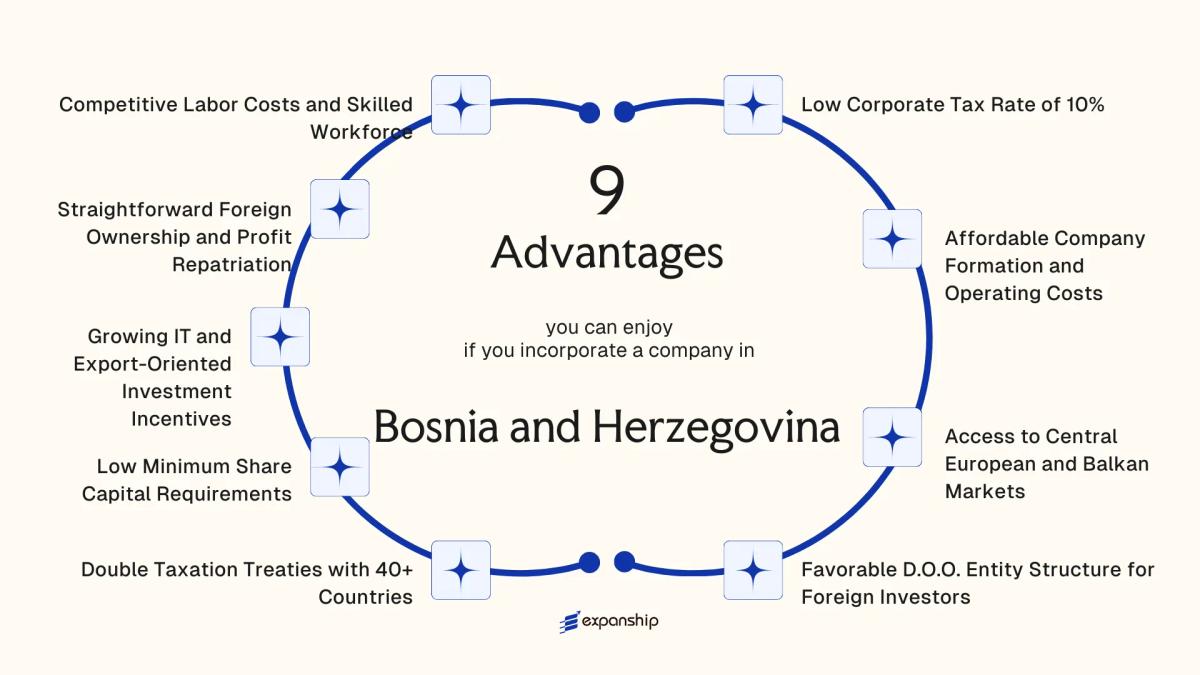
The benefits of incorporating in Bosnia and Herzegovina span tax efficiency, cost structure, market access, and workforce considerations. This article examines those advantages in detail across each of the areas most relevant to businesses evaluating a Bosnia and Herzegovina company formation.
Low Corporate Tax Rate of 10%
Bosnia and Herzegovina's 10% corporate tax advantage is one of the most straightforward fiscal arguments for incorporating there. Set against the EU average corporate tax rate of approximately 21%, the gap is substantial enough to directly affect net profitability.
What the Law Actually Provides
Corporate income tax in Bosnia and Herzegovina is governed separately across its two entities: the Federation of Bosnia and Herzegovina and Republika Srpska, each with its own tax administration. Both apply a flat 10% rate on taxable profit, meaning your effective liability is predictable regardless of how much your business earns.
This flat structure eliminates the bracket uncertainty common in progressive tax systems, where scaling revenue triggers higher marginal rates.
Why This Rate Has Direct Value
For a foreign-owned firm reinvesting profits into operations or repatriating earnings, a lower tax base means more capital retained per cycle. At 10%, a company generating 500,000 EUR in annual taxable profit pays 50,000 EUR in corporate tax — a figure that rises to roughly 105,000 EUR under the EU average rate.
A flat 10% corporate tax rate applied across both entity-level tax jurisdictions gives your firm cost certainty that progressive-rate environments cannot offer.
Affordable Company Formation and Operating Costs
Registering a D.O.O. in Bosnia and Herzegovina carries comparatively low upfront and ongoing costs, which directly reduces the financial risk for a foreign investor testing a new market. Affordable company operating costs in Bosnia Herzegovina mean that early-stage capital can be directed toward operations rather than administrative overhead.
Registration fees paid to the relevant entity court — the court of competent jurisdiction in the applicable entity (Federation of BiH or Republika Srpska) — are modest by regional standards. Notary and court charges for standard D.O.O. incorporation typically remain well below what you would encounter in Austria or Germany. Annual maintenance costs, including statutory accounting and bookkeeping obligations under local accounting law, are also lower due to the general cost structure of professional services in the country.
Several structural features keep your ongoing compliance costs contained:
- Local accountants and legal advisors charge rates that reflect a domestic wage base well below the EU average
- Statutory audit thresholds mean smaller firms are not automatically subject to mandatory external audit
- No annual state franchise fee exists at the entity level, unlike in several U.S. states or certain offshore jurisdictions
Your registered office address obligation is straightforward, without mandatory physical premises requirements that inflate costs in higher-rent jurisdictions.

Company Incorporation in Bosnia and Herzegovina
Register your D.O.O. in Bosnia and Herzegovina with full compliance support across both entities — Federation of BiH and Republika Srpska.
Access to Central European and Balkan Markets
Situated at the intersection of Southeast Europe and the broader Central European corridor, Bosnia and Herzegovina offers registered companies direct proximity to a combined market of over 150 million consumers across the Western Balkans, the Danube region, and the Adriatic rim. For a business seeking Bosnia Herzegovina access to Balkan markets without establishing multiple legal entities across the region, a single D.O.O. registered in Sarajevo or Banja Luka can serve as the operational base for cross-border commercial activity.
The country maintains a Stabilisation and Association Agreement (SAA) with the European Union, which entered into force in 2015. Under this framework, qualifying goods exported from a registered Bosnian entity to EU member states benefit from preferential tariff treatment, reducing the cost of accessing markets in Austria, Croatia, Slovenia, and Germany without requiring an EU-domiciled entity.
| Market | Trade Framework | Approximate Distance from Sarajevo |
|---|---|---|
| European Union | SAA Preferential Access | 300-900 km to key hubs |
| CEFTA Signatories | CEFTA 2006 Agreement | 50-400 km |
| Turkey | Bilateral Free Trade Agreement | ~2,000 km |
Membership in CEFTA 2006 extends preferential trading conditions across Albania, Kosovo, North Macedonia, Moldova, Montenegro, and Serbia. This positions your entity to source, distribute, or manufacture goods regionally under reduced tariff conditions. The Central European market access Bosnia Herzegovina provides through these overlapping agreements is structurally embedded in treaty obligations, not dependent on administrative discretion.
Favorable D.O.O. Entity Structure for Foreign Investors
The D.O.O. (Društvo sa ograničenom odgovornošću) is the dominant legal form chosen by foreign investors entering the Bosnian market, and the Bosnia Herzegovina D.O.O. advantages for foreign investors are grounded in how the structure itself is designed. Under the entity laws applicable in both the Federation of Bosnia and Herzegovina and Republika Srpska, the D.O.O. functions as a limited liability company where each member's exposure is capped strictly at their contributed capital. Your personal assets remain outside the reach of company creditors.
Ownership in a D.O.O. is represented by equity stakes rather than transferable shares, and these interests can be freely assigned to other members or third parties under the terms set in the founding act. This gives foreign principals meaningful control over succession and exit without the formality burdens of a joint-stock company.
Registration is handled through the relevant entity-level court registry, with the process governed by the respective Company Laws of each entity. Non-resident founders are not required to be physically present throughout the process, which reduces the administrative burden on foreign principals managing operations from abroad.
Keep in mind while structuring your D.O.O.:
- The founding act must define member rights and profit distribution explicitly
- A supervisory board is optional for single-member or small D.O.O. structures
- The company is a distinct legal person from its members upon registration
- Both entity jurisdictions maintain separate company registries
A D.O.O. in Bosnia and Herzegovina can legally operate with a single foreign member holding 100% equity, with no local partner requirement under either entity's company law.
Double Taxation Treaties with 40+ Countries
Bosnia and Herzegovina's double taxation treaty benefits extend to over 40 bilateral agreements, covering major trading and investment partners across Europe, Asia, and beyond. This network means that income earned through a BA-registered entity is not taxed twice — once locally and again in the shareholder's or parent company's home jurisdiction — provided the relevant treaty conditions are satisfied.
Who the Treaties Cover
Treaty partners include Germany, Austria, the United Kingdom, France, the Netherlands, Turkey, China, and several other economies with significant cross-border capital flows. Each agreement typically allocates taxing rights over dividends, interest, royalties, and capital gains between the two signatory states. For a foreign investor routing income from a BA entity back to a treaty country, this directly reduces or eliminates withholding tax obligations that would otherwise apply under domestic law.
What This Means for Your Structure
Withholding tax rates on dividends under BA domestic law stand at 5%, but applicable treaties can reduce or nullify that rate depending on the specific agreement and ownership threshold met. This matters when you are repatriating profits to a holding company abroad — the difference between a 5% and a 0% rate compounds meaningfully over time. Bosnia and Herzegovina's treaty obligations are administered under its domestic tax framework, and treaty eligibility generally requires that the recipient entity has genuine substance in the partner jurisdiction rather than existing solely for treaty access.
Maximize Your Tax Position Through Bosnia and Herzegovina's Treaty Network
Speak with Expanship about structuring your BA entity to qualify for applicable double taxation treaty benefits and reduce cross-border withholding obligations.
Low Minimum Share Capital Requirements
The low share capital requirements in Bosnia and Herzegovina reduce the financial threshold for entering the market, making the D.O.O. (Društvo s ograničenom odgovornošću) an accessible structure for foreign investors at the formation stage.
- The minimum share capital for a D.O.O. is BAM 1,000 (approximately EUR 500), one of the lower thresholds in the Western Balkans region. This means your initial capital commitment is limited to an administrative baseline, not a substantive financial barrier.
- Capital does not need to be fully paid in before registration in all cases, depending on the entity's registered jurisdiction within the country. This flexibility allows your business to begin operations without tying up working capital during the setup phase.
- The requirement is governed under the applicable Companies Acts of the Federation of Bosnia and Herzegovina and Republika Srpska, the two primary entities, each maintaining their own registration framework under bodies such as the relevant cantonal or entity-level courts.
- For foreign investors accustomed to higher capitalization requirements in EU member states, where minimums for comparable private limited structures can reach EUR 10,000 or more, the BAM 1,000 threshold represents a concrete cost reduction at the point of incorporation.
Growing IT and Export-Oriented Investment Incentives
Bosnia Herzegovina IT sector investment incentives are backed by formal policy frameworks at both the entity and state level. The Foreign Investment Promotion Agency of Bosnia and Herzegovina (FIPA) actively facilitates incentive access for qualifying foreign-owned firms, particularly those operating in technology and export-oriented industries.
Both the Federation of BiH and Republika Srpska have introduced profit tax relief mechanisms for companies engaged in qualifying export activities or operating in designated development zones. A firm that reinvests profit into qualifying business activities may reduce its taxable base, lowering the effective rate below the standard 10%.
For IT-specific operations, relatively low employer social contribution rates compared to Western European norms reduce the cost of hiring technical staff. This directly benefits software development, outsourcing, and SaaS businesses where payroll is the primary operating cost.
A foreign-owned IT firm incorporated in Bosnia and Herzegovina, billing €500,000 annually to EU clients, would report that revenue under the 10% corporate tax regime. If a portion of profit qualifies for reinvestment-based deductions under applicable entity-level tax law, the effective tax burden on those earnings could fall below what the same firm would pay in Germany (15% federal rate, plus trade tax) or Austria (23%).
Straightforward Foreign Ownership and Profit Repatriation
Bosnia and Herzegovina foreign ownership rights benefits are among the most direct in the Western Balkans. Under the Law on Foreign Direct Investment Policy in Bosnia and Herzegovina, non-residents may hold 100% ownership of a locally incorporated entity. No local partner is required, no minimum foreign capital threshold exists beyond standard share capital rules, and foreign shareholders receive the same legal treatment as domestic ones.
Profit repatriation is permitted without restriction on amount or frequency. After corporate tax obligations are settled, dividends may be transferred abroad in freely convertible currency. This eliminates the capital trapping risk that exists in jurisdictions with repatriation ceilings or approval requirements.
The convertibility framework is underpinned by the country's currency board arrangement, which pegs the Bosnian Convertible Mark (BAM) to the Euro at a fixed rate. For foreign investors receiving dividends in BAM, conversion and transfer costs remain predictable.
- No foreign ownership caps across most sectors
- No approval process required for outward dividend transfers
- Foreign and domestic shareholders carry equal rights under company law
Certain regulated sectors, including banking and media, may carry sector-specific ownership restrictions that fall outside the general FDI framework.
Competitive Labor Costs and Skilled Workforce
Bosnia and Herzegovina competitive labor cost advantages are among the most quantifiable benefits for foreign investors establishing operations in the country. Average gross monthly wages consistently sit well below the EU average, with figures generally ranging from approximately 1,000 to 1,500 BAM (Bosnian Convertible Mark) across many sectors. For a labor-intensive business, this differential directly reduces your payroll burden without requiring compromises on output quality.
Employer Social Contribution Structure
Statutory employer contributions in BiH are governed at the entity level, with the Federation of BiH and Republika Srpska each maintaining separate labor legislation. Total payroll-related obligations, including pension, health, and unemployment contributions, vary by entity but remain materially lower than in neighboring EU member states such as Slovenia or Croatia. This structural feature means your total cost-per-employee is predictable and lower than most of the region.
Technical and Professional Workforce
The country produces a consistent output of engineering, IT, and economics graduates through public universities including the University of Sarajevo and the University of Banja Luka. Literacy rates are high, and technical proficiency in sectors such as software development and manufacturing is well-documented. Skilled workforce benefits in Bosnia and Herzegovina extend to language competency, with German, English, and Italian commonly spoken across the professional labor pool.
- Hourly labor costs are substantially below Austria, Germany, and other primary foreign investment sources
- IT professionals are employed locally at rates that support competitive export-oriented service delivery
- Vocational education infrastructure produces candidates suited to manufacturing and logistics roles
Why Bosnia and Herzegovina Stands Out Among Regional Incorporation Destinations
Among Bosnia Herzegovina vs regional incorporation destinations, the jurisdictions most comparable to BiH are Serbia, North Macedonia, and Montenegro. All four operate within the Western Balkans framework, share overlapping investor profiles, and compete for similar categories of foreign direct investment, particularly in manufacturing, IT services, and export-oriented operations. The comparison below focuses on parameters where BiH holds a neutral or measurably favourable position relative to these peers.
What the comparison reveals is structural rather than incidental. BiH's dual-entity framework, comprising the Federation of BiH and Republika Srpska, means that tax administration is decentralised, which can require additional coordination. However, the flat 10% corporate income tax rate, applied uniformly across both entities, remains consistent with regional norms and does not create rate uncertainty for investors. The D.O.O. structure's low capitalisation threshold and unrestricted foreign ownership align with investor expectations across the region, while BiH's treaty network and free trade access through CEFTA provide an outward connectivity that smaller regional markets, particularly Montenegro, do not always match in scope.
| Parameter | Bosnia and Herzegovina | Serbia | North Macedonia | Montenegro |
|---|---|---|---|---|
| Corporate Tax Rate | 10% (flat) | 15% | 10% | 9% |
| Minimum Share Capital (D.O.O. / LLC) | BAM 1,000 (~EUR 511) | RSD 100 (nominal) | MKD 5,000 (~EUR 81) | EUR 1 |
| Foreign Ownership Permitted | 100% | 100% | 100% | 100% |
| CEFTA Membership | Yes | Yes | Yes | Yes |
| Double Tax Treaties (approx.) | 40+ | 60+ | 50+ | 40+ |
| EU Candidate Status | Candidate (since 2022) | Candidate | Candidate | Candidate (advanced) |
| Free Trade Agreement with EU | SAA (Stabilisation and Association Agreement) | SAA | SAA | SAA |
Compliance Services for Companies in Bosnia and Herzegovina
Maintain your company's good standing in Bosnia and Herzegovina with ongoing compliance support, including annual reporting, tax filings, and regulatory updates across both entities.
Conclusion
Bosnia and Herzegovina presents a structurally sound case for foreign incorporation, anchored by a flat 10% corporate income tax rate under the Law on Income Tax and an extensive network of double taxation agreements that reduce cross-border tax exposure for internationally active businesses.
For firms focused on cost efficiency, the combination of low minimum share capital requirements for a D.O.O. and genuinely competitive labor costs means your operational baseline stays lower than in most comparable European markets. These are not marginal differences — they affect the underlying economics of running a foreign subsidiary or holding structure.
Whether the benefits apply to your specific situation depends on your industry, ownership structure, and the jurisdictions where your clients or suppliers operate. A technology firm exporting services faces a different compliance and tax profile than a trading entity sourcing goods through the Western Balkans. Understanding how Bosnia and Herzegovina's regulatory framework intersects with your particular model is where the real value of this incorporation destination becomes clear. Engaging qualified local legal and corporate services professionals remains the practical next step before committing to any structure.
Let Expanship Handle Your Company Formation in Bosnia and Herzegovina
Expanship company formation Bosnia Herzegovina services cover the full incorporation lifecycle for foreign investors establishing a Društvo s ograničenom odgovornošću (D.O.O.) or other permitted entity types. From initial registration with the relevant cantonal or entity-level court to fulfilling obligations with the Tax Administration of the Federation of Bosnia and Herzegovina or the Republic of Srpska Tax Administration, depending on your chosen jurisdiction within the country, Expanship manages the procedural requirements so your business operates on solid legal footing from day one.
Bosnia Herzegovina company registration services through Expanship include the following:
- Preparation and legalization of all incorporation documents, including the Articles of Association and founder declarations
- Provision of a registered agent and local registered office address
- Filing with the competent court register and liaison with relevant cantonal or RS authorities
- Post-incorporation compliance management, including annual financial reporting and tax registration
- Assistance with opening a local business bank account through established banking relationships
- Ongoing support for statutory obligations under the applicable Company Law of the Federation of Bosnia and Herzegovina or the Law on Companies of Republika Srpska
For foreign business owners unfamiliar with Bosnia and Herzegovina's dual-entity administrative structure, professional incorporation services Bosnia Herzegovina removes the friction of navigating two parallel legal systems and their respective regulatory bodies.
Reach out to Expanship Bosnia Herzegovina to discuss your incorporation requirements directly.
Frequently Asked Questions (FAQ)
The corporate income tax rate is 10% in both the Federation of Bosnia and Herzegovina and Republika Srpska, making it one of the lower statutory rates in the region. Both entities administer their own tax legislation separately, so registration and filing obligations depend on which entity your business is registered in. The rate applies to net taxable profit calculated under the relevant entity's income tax law.
Bosnia and Herzegovina has concluded double taxation agreements with more than 40 countries, and these treaties frequently reduce or eliminate withholding tax on dividends paid to foreign shareholders. The applicable rate depends on the specific treaty between Bosnia and Herzegovina and the shareholder's country of residence. Where no treaty exists, the domestic withholding rate under the relevant entity's tax legislation applies.
The minimum share capital for a D.O.O. is relatively low compared to many European jurisdictions, and in practice the statutory minimum can be as little as 1 BAM (Bosnian Convertible Mark) under the applicable company law in each entity. The full amount does not need to be paid up before registration in all cases, though requirements can vary between the Federation and Republika Srpska. Confirming the current paid-in requirements with the relevant entity-level court registry before filing is advisable.
Both entities offer targeted incentives for technology and export-oriented businesses, including reduced or zero customs duties on imported equipment and preferential treatment under certain free zone arrangements. The Foreign Investment Promotion Agency of Bosnia and Herzegovina (FIPA) coordinates information on available incentive schemes at the state level. Specific tax holidays or grants may also be available at the cantonal or municipal level within the Federation, depending on the sector and location of operations.
A registered office address within the relevant entity is required at the point of incorporation, as it forms part of the mandatory registration documents submitted to the entity-level court registry. This address is used for official correspondence from regulatory and tax authorities. Whether this must be a dedicated commercial space or can be a registered agent address depends on the applicable entity-level company law and local municipal requirements.
Registration timelines vary by entity and by the specific court registry handling the application, but the process typically takes between one and three weeks from submission of a complete document set. Delays can occur if the application requires notarized translations, additional apostilles, or corrections to founding documents. Obtaining a tax identification number and registering with the relevant tax authority follows registration and adds further time before the entity is fully operational.
Legal Disclaimer
The information provided in this article is for general informational purposes only and does not constitute legal, tax, or professional advice. While we strive to ensure the accuracy and timeliness of the content, laws and regulations are subject to change, and the application of laws can vary widely based on specific facts and circumstances.
Readers should not act upon this information without seeking professional counsel tailored to their individual situation. Expanship and its authors disclaim any liability for actions taken or not taken based on the content of this article.
For specific advice regarding your business setup, compliance requirements, or any legal matters, please consult with qualified legal and tax professionals in the relevant jurisdiction.