

Key Takeaways
- Foreign investors entering sectors such as banking, media, and natural resources face ownership caps under Azerbaijani law that structurally limit the degree of control a non-resident entity can hold in a local company.
- Despite ASAN Service's streamlined interface, company registration remains a state-gatekept process that ties legal existence to government-administered procedures, creating dependency on a single point of failure in the incorporation workflow.
- Currency conversion and repatriation of profits in Azerbaijani manats are subject to central bank controls that add transactional friction and exchange rate exposure for foreign-owned entities operating on international revenue models.
- Azerbaijan's underdeveloped domestic capital markets offer limited equity and debt financing instruments, meaning most incorporated foreign businesses must rely on offshore funding structures rather than local institutional investment.
Azerbaijan operates under an evolving regulatory framework, where the rules governing foreign business activity continue to be updated through state-led reform programs. The disadvantages of incorporating in Azerbaijan span several distinct areas, from ownership restrictions to financing constraints and enforcement gaps. How significantly these affect your operations depends on the industry you're entering, the legal structure you choose, and the scale of your intended activity.
The primary legislation governing commercial entities is the Civil Code, which underpins company formation and corporate obligations.
This article is most relevant to foreign investors and internationally registered firms planning to establish a legal presence, enter regulated sectors, or repatriate earnings from Azerbaijan-based operations.
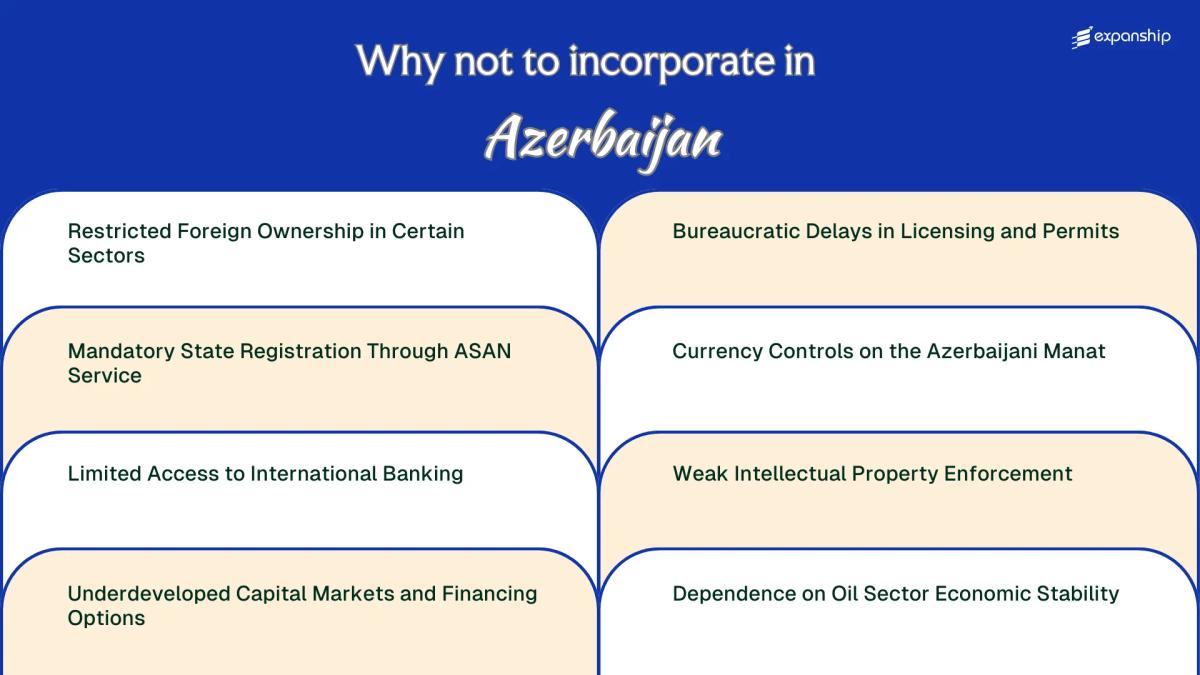
Restricted Foreign Ownership in Certain Sectors
Foreign ownership restrictions in Azerbaijan apply selectively across sectors considered strategically significant, and your ability to hold equity may depend entirely on the industry your business operates in.
Sectors Where Foreign Equity Is Formally Constrained
Under Azerbaijani law, foreign participation in media outlets is capped, and ownership of agricultural land by foreign nationals or foreign-registered entities is prohibited outright under the Land Code. These restrictions mean a foreign investor cannot hold a controlling or even partial stake in certain asset classes without restructuring through a locally controlled entity, which introduces dependency on Azerbaijani partners and dilutes operational control.
Broadcast media licensing falls under the National Television and Radio Council, which applies additional scrutiny to foreign-linked applicants. This layer of regulatory oversight translates directly into delayed or denied licensing outcomes for foreign-owned firms in affected sectors.
Practical Consequences for Foreign-Owned Structures
Where nominal local ownership is required to satisfy sector thresholds, you effectively transfer legal control to a domestic shareholder. That structural compromise carries governance risk that foreign investors in more open jurisdictions would not face.
If your intended business activity touches media, agriculture, or other strategically designated sectors, foreign ownership restrictions in Azerbaijan may prevent full equity control, forcing a joint-venture structure that limits your decision-making authority.
Mandatory State Registration Through ASAN Service
ASAN Service registration challenges in Azerbaijan stem partly from the monopolised nature of the process itself. All new business entities must register through the State Registry of Legal Entities under the Ministry of Justice, with the ASAN Xidmet network serving as the designated service delivery channel. This single-pathway structure means there is no alternative route if your documentation is rejected or an ASAN centre experiences delays.
Foreign founders frequently face friction at the document verification stage. Notarised and apostilled incorporation documents from your home country must meet specific formatting requirements, and minor discrepancies trigger rejection rather than a request for correction.
The practical burden this creates for a foreign business owner includes:
- Sourcing certified Azerbaijani translations of all foreign-issued documents, which adds cost and time before submission is even possible
- Travelling to or engaging local representation in Baku, since remote completion of certain steps remains restricted for foreign applicants
- Restarting the queue entirely after a rejection, as partial submissions are not held pending correction
The registered legal address requirement adds another layer of complexity. Your firm must provide a verified local address before registration completes, meaning you need a physical foothold before the entity legally exists.

Company Incorporation in Azerbaijan
Understand the full registration process and requirements for setting up a legal entity in Azerbaijan through the ASAN Service framework.
Limited Access to International Banking
International banking limitations in Azerbaijan present a genuine structural obstacle for foreign-owned entities. Local banks, supervised by the Central Bank of the Republic of Azerbaijan (CBA), operate under a correspondent banking network that remains far narrower than what foreign investors typically rely on in Western or Gulf financial centers.
Opening a corporate account as a non-resident director or shareholder triggers extended due diligence requirements under the Law on Combating Legalization of Criminally Obtained Funds and Financing of Terrorism. This process can delay account activation by weeks, sometimes longer, directly stalling payroll, supplier payments, and capital deployment.
| Restriction / Requirement | Practical Impact on Foreign Business |
|---|---|
| In-person appearance often required for account opening | Remote or non-resident founders cannot complete setup without traveling to Baku |
| Limited USD/EUR multi-currency account availability | Cross-border transactions require manual currency conversion, increasing cost and delay |
| Restricted access to SWIFT correspondent channels through smaller local banks | Payments to EU or US counterparties may route through intermediary banks, adding fees |
| Enhanced due diligence for foreign shareholders under CBA AML rules | Document-heavy process extends account activation timelines significantly |
Correspondent banking relationships between Azerbaijani banks and major international institutions remain limited in number. Your firm may find that even after account activation, outgoing international transfers face additional scrutiny or routing delays that would not occur in jurisdictions with deeper banking integration.
Foreign companies operating in non-oil sectors report the greatest friction, as local banks tend to prioritize clients with established domestic transaction histories.
Underdeveloped Capital Markets and Financing Options
The underdeveloped capital markets in Azerbaijan present a structural constraint that limits how foreign-incorporated entities can raise growth capital. The Baku Stock Exchange (BSE) remains thinly traded, with a narrow pool of listed securities and low transaction volumes, making equity financing through public markets largely inaccessible for most businesses.
Corporate bond issuance is similarly restricted by shallow investor demand. Without a functioning domestic institutional investor base, your firm cannot realistically price or place debt instruments locally.
Bank lending remains the dominant financing channel, but credit terms from Azerbaijani commercial banks tend to be restrictive, with collateral requirements that can be difficult for foreign-owned entities to satisfy. Loan maturities are generally shorter than what businesses in deeper financial markets would expect.
Venture capital and private equity infrastructure is nascent. Foreign businesses in early-growth or technology stages will find that domestic funding sources do not yet support those models at meaningful scale.
Key conditions and restrictions foreign business owners must keep in mind:
- The BSE operates under the Financial Markets Supervisory Authority (FIMSA), which governs securities issuance and listing eligibility requirements
- Foreign investors face additional disclosure and registration steps before participating in local capital market instruments
- Commercial bank financing typically requires immovable property as collateral, which foreign entities may not hold domestically
- There is no established stock options or equity incentive framework that aligns with international investor expectations
Despite being an energy-rich economy, Azerbaijan has no sovereign wealth fund mechanism open to co-investment by private foreign enterprises, unlike comparable hydrocarbon-dependent states such as Kazakhstan or the UAE.
Bureaucratic Delays in Licensing and Permits
Licensing delays Azerbaijan business operations are a tangible friction point, particularly for entities requiring sector-specific approvals before commencing activity.
Approval Bodies and Fragmented Oversight
Certain license categories fall under the jurisdiction of multiple ministries simultaneously, such as the Ministry of Economy and the relevant sectoral regulator, meaning your firm may need sequential sign-offs with no consolidated timeline. Each authority operates on its own internal schedule, and the absence of a unified licensing window for complex permit types extends the pre-operational period considerably.
Practical Impact on Foreign Business Entry
A foreign-owned entity cannot generate revenue in regulated sectors while approvals remain pending, which directly increases the cost of market entry. Sectors including construction, pharmaceuticals, and financial services face the heaviest regulatory approval challenges, with some permit processes extending months beyond initial estimates.
Procedural requirements, such as document notarization, apostille certification, and certified translation into Azerbaijani, add sequential dependencies that compound overall delay. Firms without local legal representation often misfile initial submissions, triggering full restart cycles that further extend the slow business licensing process.
Resolving Licensing Delays for Your Azerbaijan Operations
Expanship assists foreign businesses in managing sector-specific permit applications and regulatory submissions in Azerbaijan, reducing procedural bottlenecks before and after incorporation.
Currency Controls on the Azerbaijani Manat
Azerbaijan Manat currency controls risks are a concrete operational concern for any foreign business holding or repatriating funds in AZN. The Central Bank of the Republic of Azerbaijan (CBA) oversees a managed float regime that restricts how freely the manat converts against major currencies.
- The CBA's managed float means your firm cannot freely convert AZN at market rates, exposing it to administratively influenced exchange rates that may not reflect open-market valuations.
- Foreign exchange transactions above defined thresholds require documented justification, creating compliance obligations that delay routine cross-border payments.
- AZN convertibility problems for companies worsen during periods of oil price volatility, as the manat depreciated sharply in 2015, losing approximately 50% of its value against the USD within a single year.
- Repatriating profits requires compliance with the Foreign Exchange Regulation Law, adding procedural steps that increase transaction timelines and costs.
- Non-resident entities face additional CBA reporting requirements on foreign currency holdings that resident firms are not uniformly subject to.
Weak Intellectual Property Enforcement
Intellectual property risks in Azerbaijan stem from a gap between formal legal frameworks and actual enforcement capacity. The country is a signatory to major international IP conventions, including the Paris Convention and the TRIPS Agreement, but treaty membership does not automatically translate into effective protection at the operational level.
Trademark registration is handled by the Intellectual Property Agency of the Republic of Azerbaijan (COPAT), formerly the State Committee for Intellectual Property. Registration is a prerequisite for protection, meaning unregistered marks receive no formal legal recourse if copied or infringed.
Even with registration in place, enforcement depends on civil litigation or referral to the relevant prosecution authorities. Court proceedings are slow, and damages awarded in IP disputes have historically been modest, which reduces the deterrent effect against infringers.
For foreign firms operating in sectors such as software, branded consumer goods, or proprietary manufacturing processes, weak IP enforcement Azerbaijan businesses face means competitors can appropriate protected assets with limited financial consequence.
A foreign software company that licenses proprietary code to a local partner without registering its copyright domestically may find that Azerbaijani courts lack a consistent precedent base to award meaningful damages, leaving the firm with legal costs that exceed any recoverable sum.
Dependence on Oil Sector Economic Stability
Oil dependency economic risks in Azerbaijan are structural, not cyclical. Hydrocarbons account for the majority of government revenues and export earnings, meaning that a decline in global crude prices transmits directly into fiscal contraction, reduced public spending, and slower economic activity across all sectors.
The manat's sharp devaluation in 2015, when oil prices collapsed, resulted in the currency losing roughly half its value against the US dollar within months. For a foreign-registered entity holding manat-denominated contracts or local receivables, that kind of currency shock can erase margins before any operational fault of your own.
State budget allocations in Azerbaijan are heavily tied to the State Oil Fund (SOFAZ) and revenue projections from the State Oil Company (SOCAR). When hydrocarbon sector instability drives a revenue shortfall, government procurement slows, infrastructure investment stalls, and the local consumer market contracts.
Non-oil GDP growth has historically trailed the oil sector, and private credit markets remain shallow as a consequence. Your business, regardless of its industry, operates within an economy whose rhythm is set by oil production cycles rather than diversified economic output.
If your revenue model depends on government contracts, state-linked procurement, or manat-denominated cash flows, an oil price downturn can trigger simultaneous fiscal austerity, currency depreciation, and reduced local demand with no independent economic buffer to absorb the impact.
Strategies to Overcome These Challenges
Overcoming Azerbaijan business challenges requires structural preparation before incorporation, not reactive adjustments after problems emerge.
- Register your entity through the ASAN Service portal to meet the mandatory state registration requirement under Azerbaijani law.
- Identify whether your intended sector falls under foreign ownership restrictions governed by the relevant sector-specific legislation before selecting your legal structure.
- Open corporate banking relationships through institutions with correspondent banking ties outside the country to reduce exposure to limited international banking access.
- File intellectual property registrations with the Intellectual Property Agency of Azerbaijan at incorporation stage rather than after commercial activity begins.
- Structure capital planning to account for Azerbaijani Manat convertibility constraints and Central Bank of Azerbaijan currency control provisions.
- Build licensing timelines into your operational schedule to accommodate bureaucratic delays in permit approvals across relevant ministries.
Solutions to Azerbaijan incorporation drawbacks are most effective when aligned with the State Registry of Legal Entities procedures and sector-specific regulatory requirements from the outset. Mitigating risks of doing business in Azerbaijan depends on understanding which constraints are structural and which are procedural.
Azerbaijan's Overall Appeal for Foreign Investors
Azerbaijan's overall position as an investment destination reflects genuine structural constraints alongside real economic opportunity. The country's strategic location at the intersection of Europe and Central Asia, combined with its status as a signatory to the Baku-Tbilisi-Ceyhan pipeline corridor agreements, gives it measurable trade relevance. For the right business profile, the drawbacks covered in this blog are manageable conditions, not absolute barriers.
| Pros | Cons |
|---|---|
| ASAN Service provides a centralized, digitized registration process that reduces procedural fragmentation. | Foreign ownership is prohibited or restricted in sectors including media, banking, and certain strategic industries. |
| Azerbaijan's double tax treaty network helps mitigate withholding tax exposure for qualifying foreign entities. | The Azerbaijani manat is subject to currency controls, complicating dividend repatriation and foreign exchange planning. |
| Geographic position as a transit corridor between Europe and Central Asia supports logistics-oriented businesses. | Correspondent banking limitations make it difficult to open accounts with international financial institutions. |
| State Oil Fund (SOFAZ) provides a degree of macroeconomic stabilization that cushions fiscal volatility. | Intellectual property enforcement remains inconsistent, with limited practical recourse through local courts. |
| The government has made measurable improvements to business registration timelines through ASAN reforms. | Economic performance remains heavily tied to hydrocarbon revenues, exposing the broader business environment to oil price cycles. |
Capital market depth is limited, and businesses requiring external financing beyond bank credit will find few structured options available domestically.
Compliance Services for Companies in Azerbaijan
Maintain your Azerbaijani entity in good standing with local regulatory, tax, and reporting obligations covered by specialists in the jurisdiction.
Conclusion
Azerbaijan presents a mixed picture for foreign company formation. The cons of incorporating in Azerbaijan are real and documented: currency controls tied to the Central Bank's managed float policy, restrictions on foreign ownership in strategic sectors, and inconsistent intellectual property enforcement create friction that affects long-term operational planning. Capital markets remain thin, limiting financing options beyond conventional bank lending. Structural exposure to hydrocarbon revenue cycles adds macroeconomic unpredictability that sits outside any individual firm's control. Understanding these constraints in detail is the foundation for building a formation and compliance strategy that accounts for them from the outset.
Expanship's Services for Your Azerbaijan Expansion
Incorporating in Azerbaijan involves specific obligations that require local knowledge to manage effectively. From ASAN Service registration procedures and State Tax Service filings to sector-specific foreign ownership restrictions and manat currency controls, the compliance workload for a foreign-owned entity is considerable. Expanship's Azerbaijan company formation services are structured to reduce that operational burden so your business can focus on commercial activity rather than procedural friction.
Professional help incorporating in Azerbaijan covers more than just the initial filing. Expanship's scope across the formation and post-incorporation stages includes:
- Preparing and submitting your company registration documents through the ASAN Service portal.
- Providing a registered agent and local office address to satisfy residency requirements.
- Liaising directly with Azerbaijani regulatory bodies on government filings and approvals.
- Managing ongoing compliance obligations after your entity is established.
- Facilitating introductions to local banking institutions.
- Handling tax registration with the State Tax Service and coordinating with relevant local authorities.
Reach out through Expanship Azerbaijan to discuss your specific requirements.
Frequently Asked Questions (FAQ)
Restrictions apply to specific sectors rather than to all entity types uniformly. Foreign nationals can hold 100% ownership in a standard Limited Liability Company (MMC) operating in general commerce, but sectors such as media, certain agricultural land use, and strategic industries carry ownership caps or require prior state approval. The precise limits are governed by sector-specific legislation rather than a single consolidated foreign investment law.
Operating without a mandatory licence in Azerbaijan can result in administrative fines, suspension of business activities, or outright cancellation of your state registration. The Cabinet of Ministers maintains a list of activities requiring mandatory licensing under the Law on Licences and Permits, and enforcement is handled by sector-specific regulators. Penalties vary by industry, but the reputational consequence of a forced suspension often outweighs the direct financial fine.
Foreign firms registering trademarks or patents through the Intellectual Property Agency of Azerbaijan (COPAT) can secure formal protection, but enforcing those rights against infringers through the courts remains slow and inconsistent. Judicial capacity in IP matters is limited compared to EU or common law jurisdictions, meaning disputes can take years to resolve with uncertain outcomes. Businesses relying on proprietary software, brand recognition, or patented processes face a higher practical risk of infringement going unaddressed.
Azerbaijan's controls on the manat are stricter than those in Georgia, which operates a freely floating currency with minimal restrictions, but broadly comparable to some Central Asian peers. The Central Bank of Azerbaijan regulates foreign currency transactions, and repatriating profits in foreign currency requires documentation demonstrating the legitimacy of the underlying transaction. The practical burden is less the prohibition itself and more the compliance paperwork required for each outbound transfer.
If the State Tax Ministry identifies an error or missing document during the ASAN Service registration process, the application is returned for correction rather than processed conditionally. You must resubmit the full or corrected package, which resets the processing timeline and can delay your operational start date by weeks. There is no formal appeals tribunal specifically for registration rejections; disputes must be handled through administrative review or the courts.
Securing a corporate account that supports SWIFT transfers and holds foreign currency is genuinely difficult for newly formed entities, particularly those with non-resident directors or shareholders. Local banks such as ABB (International Bank of Azerbaijan) and Kapital Bank require extensive due diligence documentation, and account approval for foreign-owned firms can take several weeks. Even after approval, transaction monitoring is strict, and accounts have been frozen pending additional compliance reviews without advance notice.
The impact falls most heavily on businesses seeking equity financing or planning a local public offering, since the Baku Stock Exchange remains thin in both listed companies and trading volume. Debt financing through local banks is available but typically short-term and offered at higher interest rates than those accessible in EU or GCC markets. Foreign firms with access to offshore financing facilities are less exposed, but any business relying on local capital markets for growth funding will find the options materially limited.
Legal Disclaimer
The information provided in this article is for general informational purposes only and does not constitute legal, tax, or professional advice. While we strive to ensure the accuracy and timeliness of the content, laws and regulations are subject to change, and the application of laws can vary widely based on specific facts and circumstances.
Readers should not act upon this information without seeking professional counsel tailored to their individual situation. Expanship and its authors disclaim any liability for actions taken or not taken based on the content of this article.
For specific advice regarding your business setup, compliance requirements, or any legal matters, please consult with qualified legal and tax professionals in the relevant jurisdiction.