

Key Takeaways
- Azerbaijan's flat 20% corporate income tax rate, combined with full foreign ownership permissions under the country's foreign investment legislation, gives internationally-owned entities a structurally low-cost base without restriction on capital control.
- Businesses registered within Azerbaijan's Special Economic Zones can access tax exemptions under the Special Economic Zones Law, materially reducing the fiscal burden that would otherwise apply under the standard corporate regime.
- The network of 50+ double taxation treaties, each ratified by the Milli Majlis, reduces withholding tax exposure on cross-border transactions in proportion to where a company's shareholders, counterparties, and parent entities are domiciled.
- Registration through ASAN Service and the digitized State Register of Legal Entities, administered by the Ministry of Economy, compresses the administrative friction typically associated with foreign company formation in emerging-market jurisdictions.
Incorporating a business in Azerbaijan offers a defined set of structural and fiscal advantages that have drawn consistent foreign direct investment into the country over the past two decades. Azerbaijan is an independent republic in the South Caucasus, bordered by Russia, Georgia, Armenia, Iran, and the Caspian Sea — a position that gives registered entities meaningful access to both regional and transcontinental trade routes. Company registration falls under the authority of the Ministry of Economy, which administers the State Register of Legal Entities and oversees the incorporation process for domestic and foreign-owned firms alike.
Foreign nationals face no blanket restrictions on owning or operating a business in the country. Full foreign ownership is permitted across most sectors, and the government has maintained a generally open posture toward inbound capital under its foreign investment legislation.
The LLC, known locally as the Məhdud Məsuliyyətli Cəmiyyət, is the most common vehicle through which foreign businesses establish a presence here. The country operates a low-tax regime, with treaty-based protections further reducing cross-border tax exposure. This article examines the principal advantages that Azerbaijan company formation offers to internationally-minded business owners.
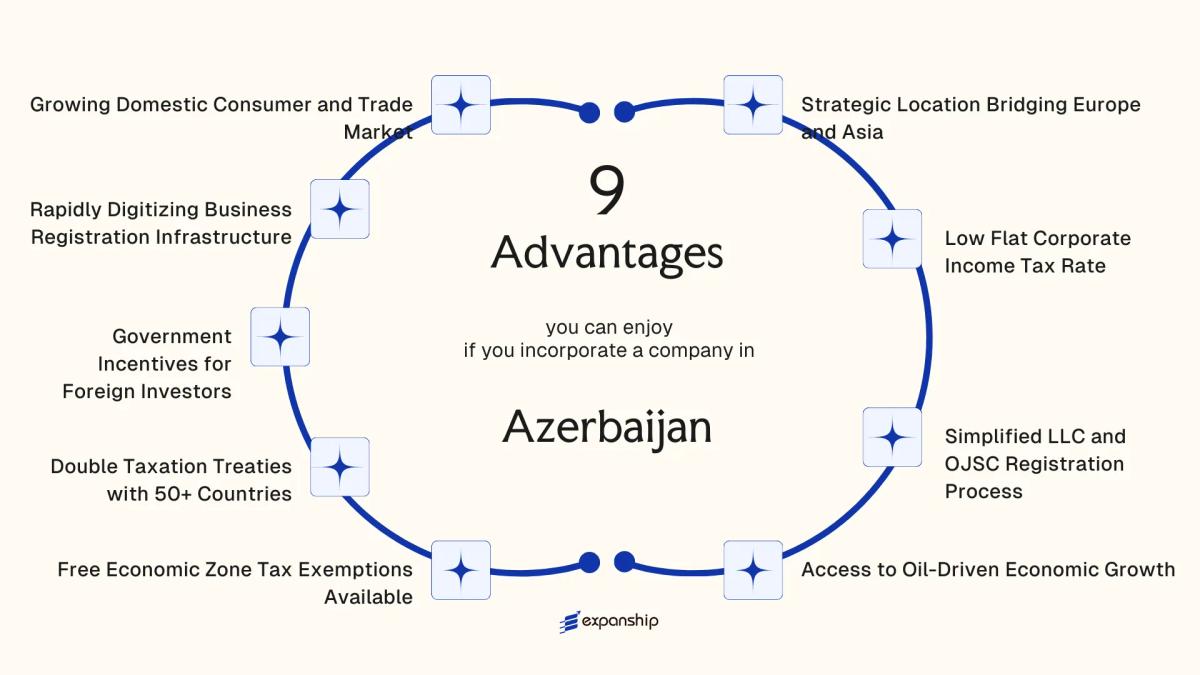
Strategic Location Bridging Europe and Asia
Azerbaijan's geographic position places it at the intersection of major east-west and north-south trade corridors, giving businesses registered there physical and logistical access that few jurisdictions in the region can match. For foreign investors, this translates directly into reduced transit costs and faster market reach across multiple continents.
The Middle Corridor Advantage
Azerbaijan sits at the core of the Trans-Caspian International Transport Route, commonly known as the Middle Corridor, which connects China and Central Asia to Europe via the Caspian Sea. Your cargo or goods can move between eastern and western markets without passing through Russian territory, a routing option that has grown in commercial significance.
Baku's port infrastructure, upgraded through the Baku International Sea Trade Port at Alat, handles multimodal freight across rail, road, and sea. This multimodal capacity means a firm incorporated locally can position itself as a regional distribution or logistics hub rather than operating solely within one national market.
Access to Regional Trade Networks
The country holds observer or member status in trade frameworks that extend its commercial reach into Central Asia, the South Caucasus, and Eastern Europe. A business registered under Azerbaijani law can use that positioning to access supplier and buyer networks across a combined market of several hundred million people.
A locally registered entity can serve as a transit or distribution base connecting European buyers with Central Asian and Chinese suppliers along the Middle Corridor route.
Low Flat Corporate Income Tax Rate
Azerbaijan's flat corporate income tax rate sits at 20 percent, applied uniformly to taxable profit under the Tax Code of the Republic of Azerbaijan. That single rate applies regardless of company size, sector, or revenue volume, which removes the tiered complexity that characterizes many competing jurisdictions in the region.
For a foreign-owned entity, this predictability has a direct operational value. You can model your tax exposure from the outset without accounting for bracket thresholds or phase-in rates. The EU average corporate tax rate hovers near 21 percent, placing Azerbaijan's rate broadly in line with Western Europe while carrying significantly lower labor and overhead costs.
The Azerbaijan low flat corporate income tax rate applies to resident legal entities on their worldwide income, while non-resident entities are taxed only on Azerbaijan-sourced income. This distinction matters if your firm maintains operations across multiple jurisdictions.
Several structural features make this rate particularly straightforward for foreign businesses to work with:
- Taxable profit is calculated on a net basis, meaning deductible expenses reduce the base before the 20 percent applies
- The uniform rate eliminates the need for income-splitting strategies common in progressive tax systems
- Non-resident entities face source-based taxation, limiting exposure to locally generated profits only

Incorporate Your Company in Azerbaijan
Set up a compliant legal entity in Azerbaijan with Expanship's end-to-end incorporation service.
Simplified LLC and OJSC Registration Process
Registering a limited liability company or open joint-stock company in Azerbaijan carries procedural advantages that directly reduce the time and cost of market entry. The Azerbaijan LLC OJSC registration advantages begin with the single-window registration system operated through ASAN Service centers, where business formation is processed without requiring visits to multiple government bodies.
A local LLC, known in Azerbaijani as a Məhdud Məsuliyyətli Cəmiyyət (MMC), can typically be registered within one to three business days once documentation is in order. For foreign investors accustomed to multi-week incorporation timelines in Central European or Southeast Asian markets, this speed has a tangible operational value: your entity can begin contracting, opening bank accounts, and hiring staff far sooner.
| Entity Type | Minimum Capital Requirement | Typical Registration Timeline |
|---|---|---|
| MMC (LLC) | No statutory minimum | 1 to 3 business days |
| OJSC | AZN 4,000 | 5 to 10 business days |
| CJSC | AZN 2,000 | 5 to 10 business days |
Registration is administered under the Civil Code of Azerbaijan and the Law on State Registration and State Registry of Legal Entities. Foreign nationals are permitted to serve as sole founders without a mandatory local partner, which preserves full ownership and decision-making authority from day one. This structural openness, combined with a digital-first registration infrastructure, means entry costs remain predictable rather than dependent on intermediary requirements.
Access to Oil-Driven Economic Growth
Azerbaijan oil economy business investment benefits are most visible in the country's fiscal position. Hydrocarbon revenues, managed through the State Oil Fund of the Republic of Azerbaijan (SOFAZ), have consistently funded public infrastructure, stabilized the manat, and kept sovereign debt low. For a foreign business, operating in an economy with strong state liquidity reduces the risk of sudden fiscal shocks that can disrupt contract enforcement or payment cycles.
Crude oil and natural gas exports account for the majority of the country's export earnings, and the government has channeled a portion of those revenues into non-oil sector development under successive State Programme frameworks. Construction, logistics, agriculture, and tourism have all received targeted capital allocation as a result.
GDP growth in the non-oil economy has generally outpaced the headline figure in recent years, meaning your business does not need direct exposure to the energy sector to benefit from oil-driven spending.
Keep these points in mind:
- SOFAZ assets are ring-fenced from the state budget and governed by a separate legal statute
- Non-oil GDP growth figures are published quarterly by the State Statistical Committee
- Energy sector contracts typically require participation of SOCAR, the state oil company
- Foreign entities operating in extractive industries face a distinct tax regime under the Tax Code of Azerbaijan
Azerbaijan's non-oil sector has grown faster than its oil sector in several recent years, meaning the hydrocarbon economy benefits foreign businesses primarily through infrastructure spending and fiscal stability rather than direct energy contracts.
Free Economic Zone Tax Exemptions Available
Azerbaijan Free Economic Zone tax exemptions represent one of the most structurally distinct advantages available to foreign investors operating through the Alat Free Economic Zone (Alat FEZ). Established under the Law of the Republic of Azerbaijan on the Alat Free Economic Zone, the Alat FEZ operates under a separate legal and tax framework that does not mirror the standard domestic tax code.
Scope of Tax Relief at Alat FEZ
Resident companies within the Alat FEZ are exempt from corporate income tax, value-added tax, property tax, and land tax for a defined period under the zone's governing legislation. For a foreign-owned entity, this means the tax cost base is significantly lower than operating under the standard 20% corporate income tax rate applicable to ordinary resident companies.
Custom duties on goods imported for use within the zone are also waived, which reduces operational costs for businesses involved in manufacturing, logistics, or trade processing.
Regulatory Structure and Governance
The Alat FEZ Agency (AGSC) functions as the zone's administrative authority, managing registration, licensing, and ongoing compliance for resident businesses. Having a single supervisory body simplifies your regulatory obligations, since AGSC coordinates across functions that would otherwise involve multiple state agencies.
Residency in the zone requires that your business activity align with the permitted categories defined under the zone's charter, so confirming eligibility before structuring your investment is a practical first step.
Structure Your Azerbaijan FEZ Entry Correctly
Our team can assess your eligibility for Alat FEZ residency and help you establish a compliant structure that captures the full scope of available tax exemptions.
Double Taxation Treaties with 50+ Countries
Azerbaijan's double taxation treaty network covers more than 50 countries, including major trading and investment partners across Europe, Asia, and the Middle East. For foreign businesses, Azerbaijan DTT advantages translate directly into reduced withholding tax rates on dividends, interest, and royalties paid across borders — costs that, without treaty protection, would otherwise erode returns on cross-border operations.
- Withholding tax rates on dividends, interest, and royalties are reduced under applicable treaties, which lowers the effective tax burden on profit repatriation for foreign shareholders.
- Treaties eliminate the risk of the same income being taxed twice — once in Azerbaijan and again in the investor's home jurisdiction — which makes cross-border structuring more predictable and financially efficient.
- Treaty partners include Germany, the United Kingdom, France, China, and the UAE, among others, giving your business access to reduced rates with some of the world's largest trade economies.
- The legal basis for treaty application flows through the Tax Code of the Republic of Azerbaijan, which incorporates ratified international agreements into domestic tax obligations.
- To claim treaty benefits, the foreign entity must typically provide a certificate of tax residency from its home jurisdiction, confirming eligibility under the relevant bilateral agreement.
Government Incentives for Foreign Investors
Azerbaijan government incentives for foreign investors are administered primarily through AZPROMO, the Azerbaijan Export and Investment Promotion Foundation, which operates under the Ministry of Economy. AZPROMO provides direct facilitation services, including site visits, introductions to local partners, and regulatory guidance, reducing the due diligence burden on incoming foreign entities.
Under the Law on Investment Activity, foreign investors are entitled to full repatriation of profits and capital, with protections against expropriation without fair compensation. This legal guarantee gives your business a defined safety net that is codified rather than discretionary.
Several sector-specific incentive regimes apply beyond the general framework:
- Agricultural enterprises may qualify for VAT exemptions on imported equipment
- Companies operating in priority sectors can access subsidized credit through state-backed institutions
- Industrial zones outside Baku offer reduced utility and land lease rates
A foreign manufacturing firm investing $2 million USD in an approved industrial zone could eliminate corporate income tax liability entirely for the first seven years under Special Economic Zone rules, while also avoiding customs duties on imported production equipment, producing a combined tax cost significantly below what equivalent investments would incur in Georgia or Turkey.
Eligibility for most incentive tiers requires formal registration as a legal entity in the country and, in some cases, a minimum capital commitment or sector alignment verified by the relevant ministry.
Rapidly Digitizing Business Registration Infrastructure
Azerbaijan digital business registration benefits stem largely from the ASAN Service network, a government-operated system that consolidates public services, including company registration, into unified physical and digital centers. Operated under the State Agency for Public Service and Social Innovations (DOST), ASAN has reduced the administrative friction that once required multiple agency visits and extended processing times.
Through the e-government portal (e-gov.az) and the Ministry of Taxes' online registration platform, foreign founders can initiate entity formation without being physically present in the country. This matters because it lowers the logistical cost of entry, particularly for investors based outside the region who cannot easily make in-person appearances during the setup phase.
Registration through these digital channels can be completed within a few business days for standard limited liability company structures. That compressed timeline means your business can move from incorporation to operational status faster than in many comparable markets in the South Caucasus and Central Asian region.
The digital tax registration system also links directly to the State Tax Service under the Ministry of Economy, so your entity receives its taxpayer identification number as part of the same process rather than through a separate application.
Digital registration options for foreign-owned entities may require prior notarization or apostille of certain founding documents before submission through online channels.
Growing Domestic Consumer and Trade Market
Azerbaijan's growing consumer market business advantages are grounded in measurable demographic and economic shifts that create concrete commercial opportunity for foreign-incorporated entities.
A Consumer Base With Rising Purchasing Power
The country's population exceeds 10 million, and per capita income has risen substantially over the past two decades, driven in part by energy revenues redistributed through public sector wages and infrastructure investment. For a foreign firm selling goods or services domestically, this translates into an expanding middle class with greater discretionary spending. Sectors including retail, food and beverage, financial services, and e-commerce have all recorded growth in consumer demand.
Trade Connectivity That Extends Beyond the Border
Azerbaijan sits at the intersection of major transit corridors under the Middle Corridor (Trans-Caspian International Transport Route), connecting Central Asia and China to European markets. A business incorporated locally can position itself as a regional trade hub rather than operating in a single-country market. The country is also a member of the Commonwealth of Independent States (CIS) Free Trade Area, which reduces tariff barriers across several former Soviet states.
Key trade market factors relevant to foreign-incorporated businesses include:
- CIS Free Trade Area membership covering multiple high-volume neighboring markets
- Active development of the Alat Free Economic Zone as a logistics and distribution base
- Growing bilateral trade volumes with Turkey under preferential frameworks
- Expanding port infrastructure at Baku International Sea Trade Port
Why Azerbaijan Stands Out Against Regional Competitors
Georgia and Armenia are the two most relevant comparators for a foreign investor evaluating South Caucasus incorporation options. Both target similar investor profiles, offer competing free zone regimes, and appear in the same due diligence shortlists. The comparison below focuses on parameters where the Baku-based framework holds a neutral or favourable structural position, drawing on publicly available treaty, tax, and regulatory data.
What the table cannot show is the treaty depth differential. Georgia's double taxation treaty network is narrower than Azerbaijan's 50+ agreements, which matters when your holding structure routes dividends or royalties through a third country. Armenia's corporate tax rate matches at 18%, but its free economic zone offering is less developed at the legislative level. The Alat Free Economic Zone operates under a dedicated statutory framework that grants full profit and property tax exemptions, a structural feature neither Georgia's VFZ nor Armenia's equivalent zones replicate in the same form.
| Parameter | Azerbaijan | Georgia | Armenia |
|---|---|---|---|
| Corporate Income Tax Rate | 20% | 15% | 18% |
| Double Taxation Treaties | 50+ | ~60 | ~40 |
| Dedicated FEZ Statutory Framework | Yes (Alat FEZ) | Partial (VFZ) | Limited |
| Government-Backed Investment Agency | AZPROMO | Invest in Georgia | Invest in Armenia |
| One-Stop Business Registration | Yes (ASAN Service) | Yes | Yes |
| Access to Caspian/Silk Road Trade Corridors | Direct | Indirect | Indirect |
Compliance Services for Companies in Azerbaijan
Stay aligned with Azerbaijan's corporate reporting, tax filing, and regulatory obligations after incorporation.
Conclusion
Azerbaijan's corporate tax rate of 20% combined with the FEZ exemptions available under the Special Economic Zones Law positions the country as a structurally competitive option for foreign-owned entities operating between European and Central Asian markets. The geographic reality of its location along active trade corridors reinforces this, giving registered businesses direct access to routes that connect major regional economies.
Fit matters. A firm in manufacturing or logistics will engage with Azerbaijan's incentive framework differently than one in professional services or digital commerce. The network of over 50 double taxation treaties, administered under agreements ratified by the Milli Majlis, reduces withholding tax exposure for cross-border operations, but the degree of benefit depends on where your counterparties, shareholders, or parent entities are based.
What the country offers is coherent rather than fragmented. The simplified LLC registration process through ASAN Service, the digitized State Registry infrastructure, and the treaty network are not isolated features. They form a consistent environment for foreign-owned businesses that need predictable costs, defined legal structures, and accessible administrative processes. Your specific industry, ownership structure, and planned market activity will determine how much of that framework applies directly to your operations. Getting accurate answers to those questions before proceeding with registration is where the process becomes substantive.
Let Expanship Handle Your Azerbaijan Company Setup
Expanship's services cover the full incorporation process for entities formed under Azerbaijani law, including LLCs registered under the Civil Code and OJSCs subject to the Law on Joint Stock Companies. From initial name reservation with the Ministry of Taxes to obtaining a VÖEN (taxpayer identification number), the firm manages each procedural requirement with the relevant authority. That scope extends to compliance obligations tied to the State Tax Service and the Financial Monitoring Service of Azerbaijan.
Expanship's service scope for Azerbaijan incorporations includes:
- Preparation and notarization of founding documents in accordance with local requirements
- Registered legal address and resident agent provision
- Filing coordination with the Ministry of Taxes and the State Register of Legal Entities
- Post-incorporation compliance support, including annual reporting obligations
- Apostille and document legalization where required for foreign-issued materials
- Banking introduction assistance for corporate account opening with local financial institutions
Expanship works with the same regulatory framework discussed throughout this guide, including the free economic zone regimes, the double tax treaty network, and the digitized e-government registration portal, ensuring that what applies in principle is also applied correctly in practice for your specific entity structure.
Reach out to Expanship Azerbaijan to discuss your incorporation requirements.
Frequently Asked Questions (FAQ)
Yes, foreign nationals can hold 100% ownership of a limited liability company (LLC) or open joint-stock company (OJSC) registered in Azerbaijan. The Law on Limited Liability Companies and the Law on Investment Activity both permit full foreign ownership without requiring a local partner or co-shareholder. Ownership rights extend to profits, asset transfers, and repatriation of capital, subject to standard banking and tax compliance procedures.
The standard corporate income tax rate is 20% on net profit, applied as a flat rate under the Tax Code of the Republic of Azerbaijan. Non-resident legal entities earning income from Azerbaijani sources are subject to withholding tax, the rate of which varies by income type. Companies operating within designated Free Economic Zones may qualify for full exemption from this rate under zone-specific regulatory frameworks.
Standard company registration through the State Registry of Legal Entities, which operates under the Ministry of Justice, can be completed within one to three business days when documents are submitted through the ASAN Xidmət e-government portal. Delays may occur if notarized documents require additional verification or if the charter needs amendment. The process has been significantly digitized, reducing the need for in-person attendance at government offices.
Azerbaijan has concluded double taxation agreements with over 50 countries, but as of available public records, a treaty with the United States is not among them. A treaty with the United Kingdom is in effect, providing relief on dividends, interest, and royalties for qualifying residents. Businesses with U.S. shareholders should structure their arrangements carefully, as U.S. tax obligations are determined by U.S. domestic law regardless of the absence of a bilateral treaty.
Companies registered in the Alat Free Economic Zone (AFEZ) are eligible for exemptions from corporate income tax, value-added tax, property tax, and land tax for a defined period under the Law on the Alat Free Economic Zone. The zone operates under a separate legal and regulatory framework from mainland Azerbaijan, allowing for customs duty exemptions on imported equipment and goods used within zone operations. Eligibility is contingent on the nature of the business activity and formal registration with the AFEZ Authority.
Azerbaijan does not impose a statutory requirement for a locally resident director when incorporating an LLC or OJSC. The executive body of the company, whether a sole director or a board, may be composed entirely of foreign nationals. However, practical considerations such as bank account opening and notarization of documents may require an authorized local representative or a power of attorney to be in place.
Failure to meet annual tax filing and payment obligations under the Tax Code of the Republic of Azerbaijan can result in financial penalties, accrual of interest on outstanding amounts, and potential suspension of the company's tax identification number. The State Tax Service under the Ministry of Economy administers enforcement and has the authority to initiate audits or legal proceedings for non-compliance. Repeated violations may affect the entity's standing with the State Registry and complicate future transactions involving the business.
Legal Disclaimer
The information provided in this article is for general informational purposes only and does not constitute legal, tax, or professional advice. While we strive to ensure the accuracy and timeliness of the content, laws and regulations are subject to change, and the application of laws can vary widely based on specific facts and circumstances.
Readers should not act upon this information without seeking professional counsel tailored to their individual situation. Expanship and its authors disclaim any liability for actions taken or not taken based on the content of this article.
For specific advice regarding your business setup, compliance requirements, or any legal matters, please consult with qualified legal and tax professionals in the relevant jurisdiction.