
Key Takeaways
- Armenia's limited double taxation treaty network constrains foreign investors' ability to repatriate profits efficiently, increasing effective tax costs for cross-border structures compared to jurisdictions with broader treaty coverage.
- Under the Law on State Registration of Legal Entities, ongoing compliance obligations create administrative layers that disproportionately burden foreign-owned LLCs and JSCs operating without local legal counsel.
- Geopolitical tensions stemming from Armenia's regional position — including unresolved conflicts on its borders — introduce material operational risk that is difficult to hedge through standard corporate structuring.
- The Armenian Dram's susceptibility to exchange rate volatility exposes foreign investors to currency conversion losses that erode the competitiveness of Armenia's otherwise low corporate tax environment.
Armenia operates under an evolving regulatory framework, with company formation governed primarily by the Law on State Registration of Legal Entities. The framework has seen ongoing reforms, but gaps and inconsistencies remain across several compliance, financial, and operational dimensions.
The disadvantages of incorporating in Armenia span areas including banking access, treaty coverage, workforce availability, and geopolitical exposure. Not all of these will apply equally to every business — a small digital services firm faces a different risk profile than a manufacturing entity or a financial services operation.
Foreign investors considering a Limited Liability Company (LLC) or a Joint Stock Company (JSC) under Armenian corporate law are the most likely to encounter these structural constraints, particularly those seeking cross-border financing or international market access. Armenia company formation drawbacks tend to surface most acutely at the operational stage, not during registration itself.
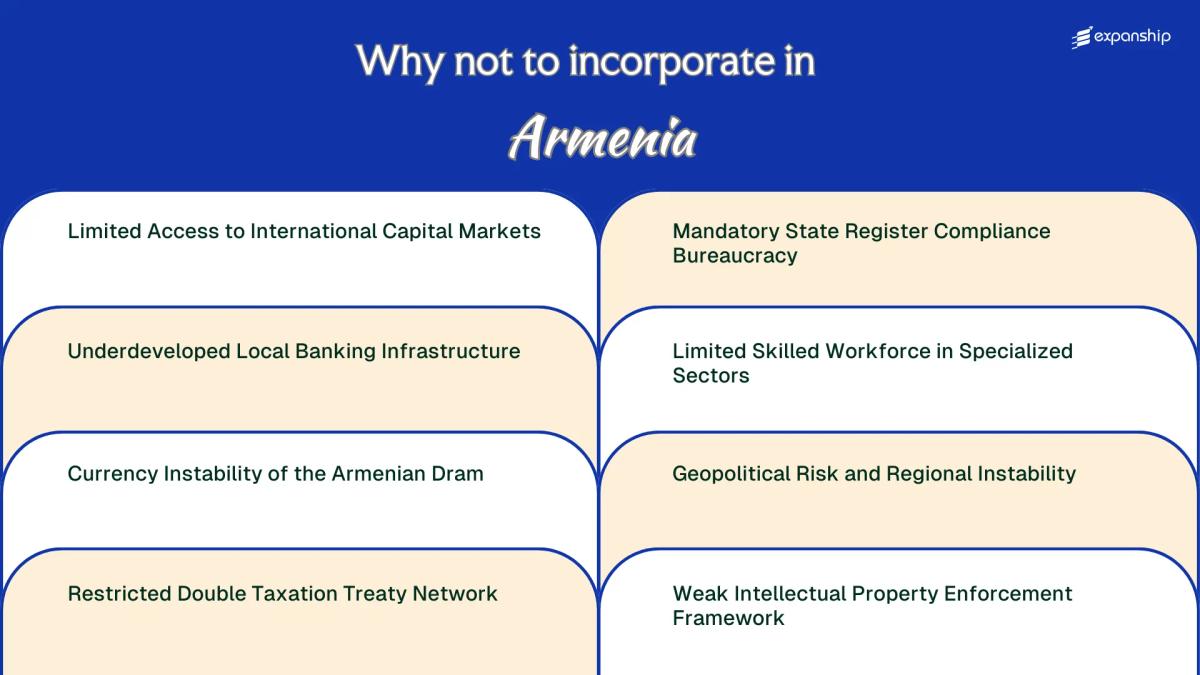
Limited Access to International Capital Markets
Armenia capital market access limitations affect foreign-incorporated entities from the earliest stages of fundraising and growth financing.
Shallow Domestic Capital Markets
The Armenian Stock Exchange (AMX) remains thinly traded, with a narrow range of listed securities and limited institutional investor participation. For a foreign business owner, this means equity-based fundraising through public markets is not a practical option within the jurisdiction. Venture capital infrastructure is similarly underdeveloped, restricting early-stage firms to personal networks or a small pool of regional funds with limited ticket sizes.
Barriers to Cross-Border Investment Access
Foreign investment restrictions in Armenia are not prohibitive by regulation, but structural factors limit your firm's visibility to international capital sources. Armenia is not a member of the European Union or the OECD, which reduces eligibility for institutional funding programs tied to those memberships. Armenia business funding challenges are compounded by the country's absence from major global index inclusions, making the jurisdiction largely invisible to portfolio-driven foreign institutional investors.
If your business model depends on growth capital from institutional investors or public equity markets, the AMX's thin liquidity and limited investor base will make raising meaningful capital within this jurisdiction structurally difficult.
Underdeveloped Local Banking Infrastructure
Armenia banking infrastructure problems present a tangible operational obstacle for foreign-owned entities, particularly those requiring multi-currency accounts, trade finance facilities, or cross-border payment services at scale.
The Central Bank of Armenia supervises the sector, but the commercial banking market remains concentrated among a small number of institutions. This concentration limits your options when negotiating fees, credit terms, or correspondent banking arrangements.
Opening a corporate account as a non-resident director or foreign shareholder frequently involves extended due diligence periods and in-person requirements that add time and cost before your business can operate.
Practical friction points for foreign firms include:
- Correspondent banking relationships with Western institutions are limited, causing delays and higher intermediary fees on international transfers
- Access to trade finance products such as letters of credit is restricted compared to banking markets in the EU or Gulf region
- Foreign-currency lending is constrained, forcing firms to rely on AMD-denominated credit at relatively high interest rates
- Multi-currency account functionality is inconsistent across banks, complicating treasury operations for firms billing in EUR or USD
Some larger Armenian banks with international partnerships offer broader services, but availability depends heavily on the specific institution and your company's transaction profile.

Company Incorporation in Armenia
Understand the structural and banking requirements involved in forming a company in Armenia before committing to the jurisdiction.
Currency Instability of the Armenian Dram
Armenian Dram currency instability risks are a concrete operational concern for any foreign-owned entity registered in the country. The AMD has historically experienced significant depreciation pressure, particularly during periods of regional stress, and its value remains sensitive to remittance flows, commodity prices, and geopolitical shocks that are structurally outside your control.
| Indicator | Detail | Business Implication |
|---|---|---|
| AMD/USD depreciation (2022 spike reversal) | AMD strengthened atypically in 2022 due to capital inflows, then partially reversed | Forward planning based on that period carries mispricing risk |
| Inflation rate (2022 peak) | Exceeded 9% annually | Erodes local cost predictability for multi-year contracts |
| Central Bank policy rate adjustments | Repeatedly adjusted by the Central Bank of Armenia to contain inflation | Signals persistent monetary instability, not temporary variance |
| Foreign currency loan restrictions | Central Bank regulations limit AMD-denominated lending terms | Firms requiring local financing face exposure on repayment |
Contracts denominated in AMD lose real value during depreciation cycles, which directly affects revenue repatriation when converting to USD or EUR. For a business billing local clients in AMD while holding costs in foreign currency, the margin erosion can be substantial.
The Central Bank of Armenia operates a managed float regime, meaning the AMD is not freely market-determined. That arrangement limits transparency in rate movement and makes hedging instruments harder to price accurately in the local market.
Restricted Double Taxation Treaty Network
Armenia's double taxation treaty restrictions present a concrete structural problem for foreign-owned entities. As of current records, Armenia has concluded treaties with approximately 50 jurisdictions, a figure that leaves significant gaps when compared to treaty networks maintained by EU member states, which commonly exceed 70 to 90 agreements.
The absence of treaties with major capital-exporting nations means dividend, interest, and royalty payments routed through an Armenian entity may face withholding taxes at full domestic rates in the counterparty country. Your business bears that cost directly, reducing the tax efficiency that cross-border structuring is meant to achieve.
Treaty gaps are particularly consequential for entities operating with shareholders or subsidiaries in jurisdictions where Armenia has no bilateral agreement. The Armenian tax treaty list maintained by the Ministry of Finance confirms which jurisdictions are covered, and the omissions are material.
Even existing treaties vary in scope, with some older agreements not covering modern income categories such as capital gains or certain digital service payments.
- Withholding taxes may apply at source-country domestic rates absent a treaty
- Treaty coverage does not extend uniformly to capital gains in all existing agreements
- The Ministry of Finance, not a separate treaty authority, administers DTT interpretations
- No treaty exists with several Gulf Cooperation Council states and key Southeast Asian markets
- Treaty renegotiations can lag years behind changes in business practice
Armenia's treaty with the United States was terminated in 2004 and has never been reinstated, meaning U.S.-source income routed through an Armenian entity receives no bilateral withholding tax relief.
Mandatory State Register Compliance Bureaucracy
Armenia's State Register compliance burden falls on the State Register of Legal Entities of the Republic of Armenia, which operates under the Ministry of Justice. Any structural change to your company — director appointments, share transfers, charter amendments — requires formal re-registration with documented filings, and delays in processing can leave your business in a legally ambiguous state during that window.
Mandatory Reporting Obligations and Their Costs
All legal entities must submit annual reports confirming their status, and failure to comply triggers administrative penalties under Armenian law. For a foreign-owned entity without local legal counsel, meeting these deadlines adds recurring overhead that many comparable jurisdictions handle through automated or simplified digital portals.
Impact on Foreign Business Operations
The Armenian company registration bureaucracy requires that charter documents and director changes be notarised and submitted in Armenian, creating a direct translation and authentication cost for foreign owners. Every amendment cycle demands notarial certification, legal translation, and physical submission to the registry, which compounds the administrative cost significantly compared to fully digitised European registries.
These procedural requirements apply uniformly, though entities with no operational activity are still subject to annual confirmation filings.
Addressing Armenia Corporate Compliance Challenges
Get structured guidance on managing State Register obligations and ongoing corporate compliance requirements for your Armenia-registered entity.
Limited Skilled Workforce in Specialized Sectors
Armenia skilled workforce limitations affect companies operating in technical, financial, and technology-intensive sectors most acutely.
- The domestic talent pool for specialized roles in software engineering, fintech compliance, and advanced manufacturing is structurally small, meaning your firm will compete intensely for a limited number of qualified candidates rather than drawing from a broad labor market.
- Armenia talent shortage business risk becomes measurable when senior technical positions go unfilled for extended periods, directly slowing product development cycles or client delivery timelines.
- Brain drain remains a documented pattern, with skilled professionals emigrating to EU member states and Russia, which reduces the available mid-career workforce your entity can realistically hire locally.
- Sourcing foreign specialists to fill gaps requires navigating work permit procedures under Armenian migration law, adding administrative cost and lead time to every senior hire.
- Outside Yerevan, Armenia specialized labor challenges intensify sharply, leaving businesses incorporated in secondary cities with very few viable local recruitment options.
Geopolitical Risk and Regional Instability
Armenia geopolitical risks for business extend well beyond theoretical concern. The country shares borders with two states, Turkey and Azerbaijan, with which it has no diplomatic relations, and the unresolved status of Nagorno-Karabakh has produced two armed conflicts since 1991 — the most recent in 2020, followed by a further military escalation in September 2023 that displaced over 100,000 ethnic Armenians.
The practical consequence for your business is supply chain fragility. With both the Turkish and Azerbaijani borders closed, overland trade routes are severely constrained, forcing reliance on Georgia and Iran as transit corridors.
Dependence on two transit states introduces compounded political risk. Any deterioration in Georgian stability or shifts in Iranian trade policy can disrupt logistics for companies registered in the country with physical operations or import-dependent supply chains.
Foreign investment decisions are also affected by treaty uncertainty. The alliance framework involving the Collective Security Treaty Organization (CSTO) and the Eurasian Economic Union (EAEU) has faced visible strain following the 2020 and 2023 conflicts, generating uncertainty about the durability of existing trade arrangements.
A business importing manufacturing inputs via the Georgian land corridor would face approximately 1,400 km of overland transit before reaching Yerevan. Any border disruption in Georgia — as occurred during the 2008 Russia-Georgia war — could halt inbound shipments entirely, with no viable alternative land route available given the closed Turkish and Azerbaijani borders.
Weak Intellectual Property Enforcement Framework
Armenia intellectual property enforcement problems stem from a gap between formal legal structures and practical enforcement capacity. The country is a member of WIPO and has ratified key treaties including the Paris Convention, yet treaty membership does not translate directly into effective on-the-ground protection for foreign rights holders.
The Intellectual Property Agency of Armenia handles registration, but enforcement of registered rights depends heavily on the courts and customs authorities. Both institutions have historically lacked specialized IP expertise, which means that infringement cases move slowly and outcomes are inconsistent.
For foreign firms, Armenia trademark enforcement risks are particularly acute in sectors involving counterfeit goods or unauthorized use of brand assets. Winning a registration does not guarantee that a local infringer will face meaningful consequences within a commercially useful timeframe.
- Civil IP litigation can extend over multiple years without interim injunctive relief being reliably granted
- Customs recordation procedures for IP rights exist but are not consistently applied at border points
- Criminal enforcement for trademark or copyright infringement requires a relatively high threshold of proven intent
If your business derives significant value from brand recognition or proprietary technology, you should assume that registration alone will not deter infringement, and that enforcement will require sustained legal expenditure with uncertain results.
Overcoming Incorporation Challenges in Armenia
Overcoming Armenia incorporation challenges requires a structural approach rather than reactive fixes. The disadvantages covered across this blog are interconnected, meaning that gaps in banking access, treaty coverage, and enforcement compound one another.
- Register your entity through the State Register of Legal Entities of Armenia to ensure your legal standing is established before engaging local banks or authorities.
- Select a corporate structure, such as a Limited Liability Company, that limits exposure to personal liability given the geopolitical and currency risks present in the region.
- Apply for tax residency clarification under the Tax Code of the Republic of Armenia to confirm treatment under any applicable double taxation agreements.
- File trademark and intellectual property protections with the Intellectual Property Agency of Armenia prior to commencing commercial operations.
- Open multi-currency accounts where permitted under Central Bank of Armenia regulations to reduce direct exposure to Armenian Dram volatility.
These steps operate within a regulatory environment governed by the Civil Code of Armenia, the Tax Code, and sector-specific oversight from the Central Bank. Structural decisions made at the formation stage carry long-term compliance consequences that are difficult to reverse under Armenian law.
Armenia's Overall Business Appeal Assessed
Despite the Armenia business environment drawbacks assessed throughout this blog, the country retains a credible position as a low-cost incorporation destination with a simplified tax structure and a relatively straightforward registration process under the Civil Code. The challenges are real and documented, but they are not uniformly prohibitive across all use cases.
| Pros | Cons |
|---|---|
| Flat 18% corporate income tax and a simplified tax regime for small entities reduce the compliance burden. | The Armenian dram carries a history of depreciation, exposing foreign businesses to currency conversion losses. |
| Company registration through the State Register of Legal Entities can be completed within a few business days. | The double taxation treaty network is limited in geographic reach, reducing cross-border tax planning options. |
| Yerevan has a growing tech and services sector with a functional, if modest, talent base. | Skilled workforce gaps in specialized sectors constrain growth in technical and professional service industries. |
| Territorial tax considerations can benefit certain holding and trading structures. | Geopolitical exposure, particularly from regional conflicts, introduces material operational and reputational risk. |
| Operating costs, including office space and local salaries, remain below regional averages. | Intellectual property enforcement through Armenian courts lacks consistency and international alignment. |
Access to international capital markets remains narrow, and banking infrastructure does not yet match the standards expected in more developed financial centers.
Corporate Compliance Services in Armenia
Maintain your Armenian company's good standing with accurate, timely filings and ongoing regulatory compliance support.
Conclusion
The Armenia incorporation disadvantages summary points to a jurisdiction that offers genuine structural benefits alongside documented constraints. Among the most consequential are the limited double taxation treaty network, which restricts efficient cross-border profit flows, and persistent geopolitical exposure tied to the South Caucasus region. Weak enforcement of intellectual property rights adds further friction for firms operating in knowledge-intensive sectors. Informed formation decisions require working with advisors who understand both the regulatory requirements under Armenian law and the practical conditions on the ground.
Expanship's Armenia Company Formation Support
Incorporating in Armenia involves a defined set of regulatory obligations, from registration through the State Register of Legal Entities to ongoing tax filings with the State Revenue Committee. Expanship's Armenia company formation support is structured around reducing the operational burden these requirements place on foreign founders, particularly those unfamiliar with Armenian administrative procedures. Your business still faces the jurisdiction's underlying challenges, but you handle them with clearer guidance and fewer procedural delays.
Beyond initial setup, Expanship covers the full incorporation lifecycle for your entity in Armenia.
- Your company is registered and all formation documents are prepared in accordance with Armenian legal requirements.
- A registered agent and official office address are provided to satisfy local presence obligations.
- Filings are submitted and liaised directly with the relevant Armenian government authorities on your behalf.
- Post-incorporation compliance is managed to keep your firm in good standing.
- Banking introductions are facilitated to support your firm's account-opening process.
- Tax registration is handled alongside liaison with the State Revenue Committee.
Reach out to Expanship Armenia to discuss your incorporation requirements.
Frequently Asked Questions (FAQ)
Any company with Armenian Dram-denominated contracts, payroll obligations, or local operating costs is exposed to Dram volatility, regardless of whether its revenue is generated domestically or internationally. The Central Bank of Armenia intervenes periodically to manage exchange rates, but the Dram remains sensitive to remittance flows and regional shocks, making financial planning harder for firms that cannot fully dollarize their cost base.
Armenia has concluded around 45 double taxation treaties, which is significantly fewer than jurisdictions like Cyprus or the Netherlands, which maintain networks exceeding 60 and 90 treaties respectively. Gaps in treaty coverage create withholding tax exposure on dividends, royalties, and interest payments routed through Armenia, particularly for businesses with counterparties in non-treaty countries.
Armenia is a signatory to major IP conventions, including the Berne Convention and the Paris Convention, but domestic enforcement through Armenian courts remains slow and inconsistent. A rights holder pursuing an infringement claim faces procedural delays and limited judicial experience with complex IP disputes, meaning deterrence is weak and damages awards are typically low.
Non-compliance with the State Register of Legal Entities, administered under Armenian law, can result in administrative fines and, in persistent cases, forced liquidation of the entity. Annual reporting and amendment obligations are not discretionary, and missed deadlines are recorded against the company's registration file, which can complicate future banking relationships or licensing applications.
For a foreign-owned entity, Armenia's banking access challenges are more pronounced than in jurisdictions like Georgia or Estonia, where international business account opening is more standardized. Armenian commercial banks apply enhanced due diligence to non-resident-controlled companies, account opening timelines can stretch several weeks, and correspondent banking restrictions limit the range of currencies and payment corridors available to newly registered firms.
Relocating foreign staff is possible under Armenian work permit regulations, but it adds cost and administrative burden that offsets some of the jurisdiction's tax advantages. Remote hiring from outside Armenia addresses the talent gap for certain functions, though it introduces payroll structuring complexity and may create permanent establishment risk depending on the nature of work performed by those employees.
Legal Disclaimer
The information provided in this article is for general informational purposes only and does not constitute legal, tax, or professional advice. While we strive to ensure the accuracy and timeliness of the content, laws and regulations are subject to change, and the application of laws can vary widely based on specific facts and circumstances.
Readers should not act upon this information without seeking professional counsel tailored to their individual situation. Expanship and its authors disclaim any liability for actions taken or not taken based on the content of this article.
For specific advice regarding your business setup, compliance requirements, or any legal matters, please consult with qualified legal and tax professionals in the relevant jurisdiction.