
Key Takeaways
- Armenia recognizes seven domestic legal entity types under the Law on State Registration of Legal Entities and Individual Entrepreneurs, ranging from the LLC and JSC to cooperatives and partnerships, each with distinct liability and governance implications.
- The Limited Liability Company is the most widely registered structure in Armenia, favoured for its minimal capital requirements and straightforward governance relative to other available forms.
- Foreign businesses can establish a presence in Armenia through a Branch Office or Representative Office without forming a separate local legal entity, avoiding full incorporation under Armenian law.
- Registration of all Armenian legal entities falls under the jurisdiction of the State Register of Legal Entities, which operates within the Ministry of Justice and handles formation, amendment, and dissolution records.
Introduction to Entity Types in Armenia
Armenia is a landlocked republic in the South Caucasus, bordered by Georgia, Azerbaijan, Turkey, and Iran. As an independent nation and member of the Eurasian Economic Union (EAEU), it operates a territorial-leaning tax system with a standard corporate income tax rate of 18%, and has signed a range of double taxation treaties that affect how foreign-sourced income is treated.
Company registration falls under the jurisdiction of the State Register of Legal Entities, which operates within the Ministry of Justice. This body handles the formation, amendment, and dissolution records for all legally recognized business structures in the country.
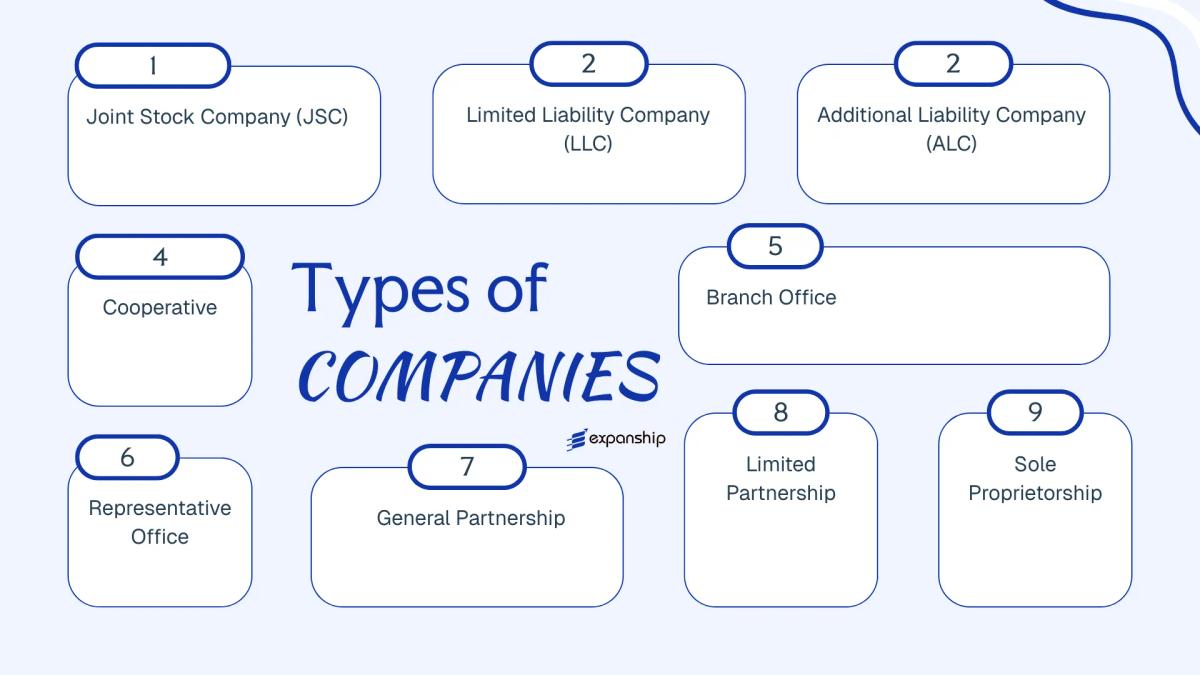
The available business entity types in Armenia span both domestic and foreign-origin structures. Armenian legal entity types recognized under the Law on State Registration of Legal Entities and Individual Entrepreneurs include the Joint Stock Company, Limited Liability Company, Additional Liability Company, Cooperative, General Partnership, Limited Partnership, and Sole Proprietorship. Foreign businesses may also establish a presence through a Branch Office or Representative Office without forming a separate local legal entity.
Each of these structures carries distinct implications for liability, governance, taxation, and registration requirements — all of which this article examines in detail.
An Overview of Business Structures in Armenia
Armenian company law provides several distinct legal forms for conducting business, each governed primarily by the Law on State Registration of Legal Entities (2001) and the Law on Joint Stock Companies, along with the Civil Code of the Republic of Armenia. Across these legislative instruments, six principal entity types are available to founders, ranging from fully liable partnerships to capital-based corporate structures. Each form carries different implications for ownership, liability, governance, and tax treatment.
Business Structures at a Glance
| Entity Type | Legal Form | Liability | Taxed / Exempt | Local Trading | Minimum Members | Regulatory Authority | Governing Act |
|---|---|---|---|---|---|---|---|
| Joint Stock Company (JSC) | Corporate | Limited to shares | Taxed | Yes | 1 shareholder | State Register of Legal Entities | Civil Code; Law on JSCs |
| Limited Liability Company (LLC) | Corporate | Limited to contribution | Taxed | Yes | 1 member | State Register of Legal Entities | Civil Code |
| Additional Liability Company (ALC) | Corporate | Extended personal liability | Taxed | Yes | 1 member | State Register of Legal Entities | Civil Code |
| Cooperative | Collective | Limited | Taxed | Yes | 3 members | State Register of Legal Entities | Law on Cooperatives |
| General Partnership | Non-corporate | Unlimited, joint | Taxed | Yes | 2 partners | State Register of Legal Entities | Civil Code |
| Limited Partnership | Non-corporate | Mixed | Taxed | Yes | 1 general + 1 limited | State Register of Legal Entities | Civil Code |
| Branch Office | Non-legal entity | Parent liable | Taxed | Yes | Parent company | State Register of Legal Entities | Civil Code |
| Representative Office | Non-legal entity | Parent liable | Not income-generating | Restricted | Parent company | State Register of Legal Entities | Civil Code |
| Sole Proprietorship | Individual | Unlimited personal | Taxed | Yes | 1 individual | State Register of Legal Entities | Civil Code |
Each of these structures is examined in full in the sections below.
Joint Stock Company (Բաժնետիրական Ընկերություն) — JSC
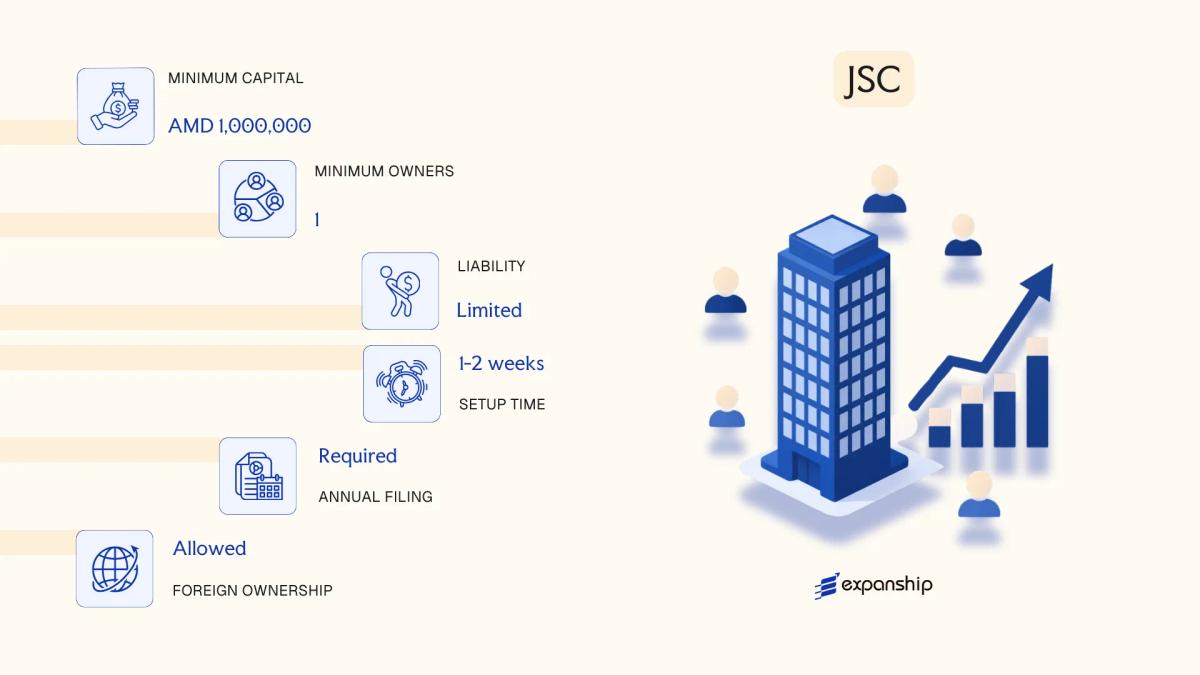
Governed by the Law of the Republic of Armenia "On Joint Stock Companies" (adopted 2001, with subsequent amendments), a JSC is a separate legal entity in which capital is divided into shares. Shareholders bear liability only to the extent of their contributed capital, making this structure suitable for businesses seeking external investment or public financing.
Armenia joint stock company JSC registration requires a minimum share capital that differs depending on whether the entity is open or closed, and shares may or may not be publicly traded accordingly. The Central Bank of Armenia exercises supervisory authority over certain JSC activities, particularly those involving securities issuance.
Key Characteristics
| Requirement | Detail | Notes |
|---|---|---|
| Legal Form | Joint Stock Company (Բաժնետիրական Ընկերություն) | Separate legal personality; limited liability |
| Members | Shareholders; Board of Directors; Executive Body | Closed JSC: 1–49 shareholders; Open JSC: no upper limit |
| Local Presence | Registered legal address in Armenia required | No statutory requirement for a local resident director |
| Share Capital | AMD 100,000 minimum (closed); AMD 5,000,000 minimum (open) | Must be fully declared at formation; partial payment permitted under conditions |
| Privacy | Shareholder register maintained; open JSCs subject to public disclosure obligations | Closed JSCs have more restricted disclosure requirements |
| Governance | Mandatory General Meeting of Shareholders; Board of Directors for larger entities | Single-member JSCs may consolidate governance functions |
Focus Points
- Taxation: Corporate profit tax at 18%; VAT at 20% on taxable turnover above the registration threshold; dividends paid to non-residents are subject to withholding tax at 5%; no stamp duty on share transfers under general rules.
- Annual Compliance: Annual financial statements required; open JSCs must undergo mandatory external audit; filings submitted to the State Register of Legal Entities.
- Treaty Access: Armenia has signed double tax treaties with over 40 countries, and a JSC qualifies as a resident entity for treaty purposes subject to substance conditions.
- Conversion: A JSC may be reorganised into an LLC or another legal form through procedures defined under the Law on Joint Stock Companies and the Civil Code.
- Securities Regulation: Open JSCs issuing shares publicly must comply with requirements set by the Central Bank of Armenia under the Law on Securities Market.
Sub-Types
Open JSC (Բաց Բաժնետիրական Ընկերություն)
Shares may be offered to an unlimited number of persons through public subscription. This structure is used when the business intends to list on the Nasdaq Armenia stock exchange or raise capital from a broad investor base.
Closed JSC (Փակ Բաժնետիրական Ընկերություն)
Share transfers are restricted, typically requiring the consent of existing shareholders or a right of first refusal. Closed JSCs suit closely held businesses that want the corporate structure of a JSC without public market obligations.
Recommendations
A JSC suits holding structures, businesses seeking institutional investment, or companies planning a future public listing; its primary advantage is unrestricted shareholder capacity in the open form, while the mandatory governance formalities and higher compliance burden relative to an LLC represent a clear drawback for smaller operations.
Open JSCs are best suited for businesses seeking public investment or stock exchange listing; closed JSCs work well for larger privately held firms requiring a formal share-based ownership structure.

Company Incorporation in Armenia
Expanship assists with JSC registration, document preparation, and ongoing compliance in Armenia.
Limited Liability Company (Սահմանափակ Պատասխանատվությամբ Ընկերություն) — LLC
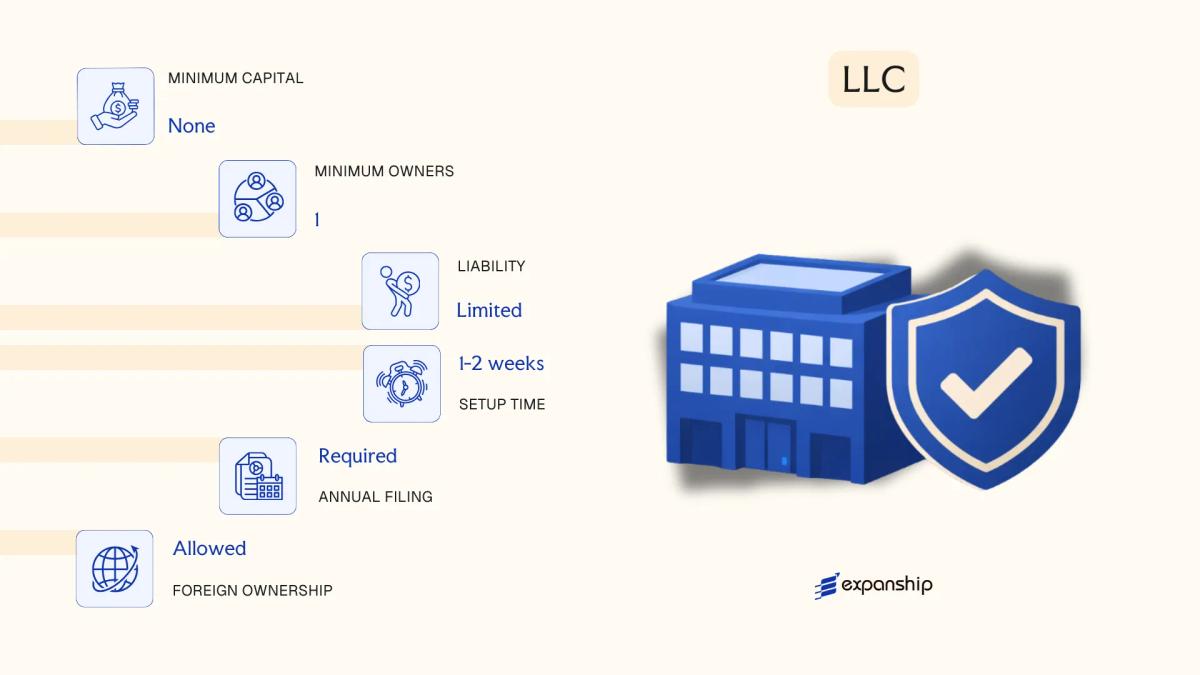
Governed by the Law of the Republic of Armenia "On Limited Liability Companies" (2001), the Armenia LLC limited liability company setup produces a separate legal entity with its own rights, obligations, and capacity to hold assets. Liability of each participant is capped at their contribution to the charter capital.
Known locally as ՍՊԸ (Սահմանափակ Պատասխանատվությամբ Ընկերություն), this structure combines corporate-style liability protection with relatively straightforward internal governance. Its hybrid character makes it suitable for both domestic operations and foreign-owned ventures registered through the State Register of Legal Entities of the Republic of Armenia.
Key Characteristics
| Requirement | Detail | Notes |
|---|---|---|
| Legal Form | Limited Liability Company (ՍՊԸ) | Separate legal personality from its participants |
| Members | 1–49 participants | Participants may be individuals or legal entities, domestic or foreign |
| Management | Director (General Director) + optional Board | Single-tier or two-tier governance; Director acts as executive body |
| Local Presence | Registered legal address required | No mandatory local director; registered address must be in Armenia |
| Charter Capital | AMD 10,000 minimum (nominal) | No paid-up timeline prescribed; contributions may be cash or in-kind |
| Privacy | Participant information filed with State Register | Register is publicly accessible; beneficial ownership rules apply |
Focus Points
- Taxation: Subject to 18% corporate profit tax; 20% VAT applies above the registration threshold; dividends paid to non-residents attract 5% withholding tax; no stamp duty on incorporation.
- Annual Compliance: Annual financial statements must be submitted to the tax authorities; audit requirements depend on company size and turnover thresholds.
- Economic Substance: No formal substance regime prescribed for domestic LLCs, though tax residency is determined by place of effective management.
- Treaty Access: As an Armenian tax resident entity, the ՍՊԸ can access Armenia's double tax treaty network, which covers over 40 countries.
- Conversion: An LLC may be reorganised into a Joint Stock Company or other permitted legal form under the Civil Code of the Republic of Armenia.
Closing
The ՍՊԸ is well-suited for trading operations, holding structures, and service businesses where owners prefer capped personal exposure without the disclosure burden of a public share register. Its primary constraint is the 49-participant ceiling, which limits equity distribution for businesses anticipating broad investor participation.
Best suited for small-to-medium foreign-owned enterprises and family-held businesses seeking straightforward governance with limited personal liability.
Additional Liability Company (Լրացուցիչ Պատասխանատվությամբ Ընկերություն) — ALC
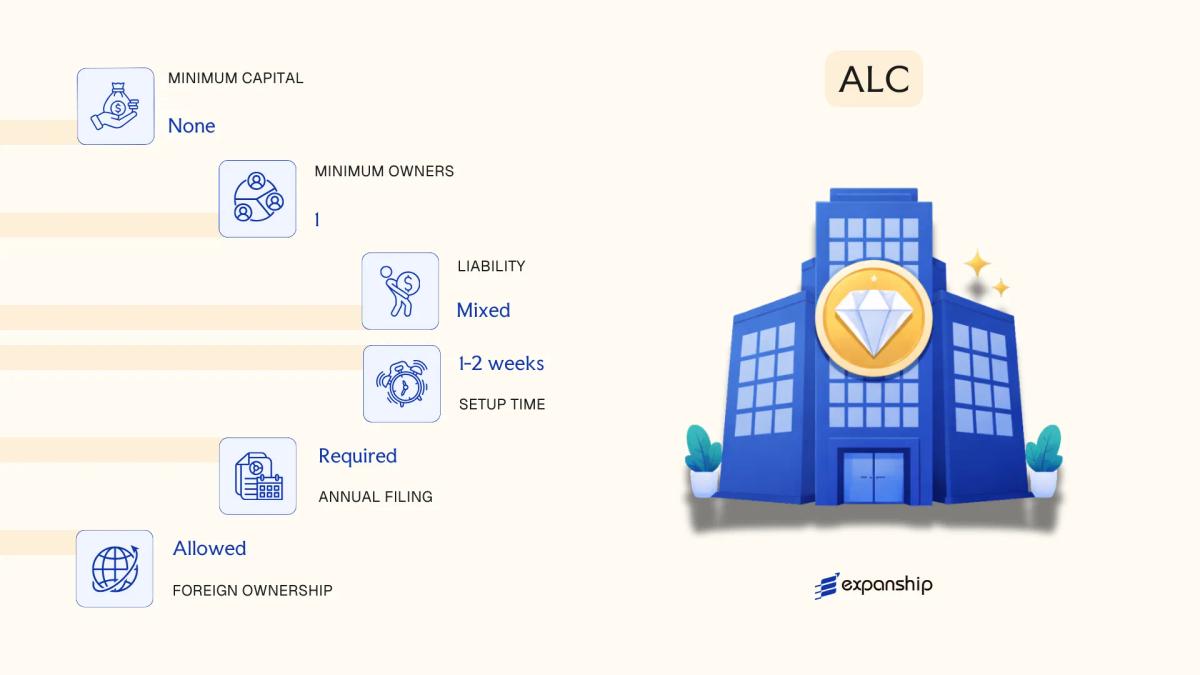
The additional liability company Armenia ALC structure is governed by the Law of the Republic of Armenia "On Limited Liability Companies and Additional Liability Companies" (1998). Like an LLC, it carries separate legal personality, but its liability architecture differs fundamentally.
Where an LLC caps member exposure at their contribution, an ALC extends that exposure. Members bear joint and several liability for the company's obligations beyond their capital contributions, up to a fixed multiple defined in the charter. This makes the ALC a hybrid: corporate in form, yet carrying a layer of personal liability closer to a partnership.
Key Characteristics
| Requirement | Detail | Notes |
|---|---|---|
| Legal Form | Additional Liability Company (ALC) | Separate legal entity; registered with the State Register of Legal Entities |
| Members | 1–50 participants | Referred to as participants; corporate or natural persons permitted |
| Liability | Personal liability up to a charter-defined multiple of capital contribution | Multiple applies jointly and severally across all participants |
| Minimum Capital | No statutory minimum | Charter must define the liability multiple |
| Local Presence | Registered legal address required | No mandatory local director |
| Privacy | Participant details filed in the State Register | Publicly accessible |
Focus Points
- Taxation: Subject to 18% corporate profit tax; 20% VAT applies at standard threshold; dividends distributed to non-residents attract 5% withholding tax; no stamp duty on incorporation.
- Annual Compliance: Annual financial statements required; statutory audit thresholds apply based on turnover and asset size.
- Conversion: An ALC may be converted into an LLC, JSC, or cooperative by participant resolution, subject to State Register procedures.
- Restrictions: Participant count cannot exceed 50; ALC shares cannot be publicly offered.
- Treaty Access: Qualifies as a resident entity under Armenian tax law and may access Armenia's double taxation treaties.
Closing
The ALC suits sectors where counterparties require a demonstrable personal commitment from participants beyond bare capital, such as financial services, lending, or trust-based professional services. Its key advantage is the credibility that extended liability signals to creditors; its primary drawback is that participants face personal financial exposure if company assets prove insufficient.
Best suited for closely held businesses in credit-sensitive or regulated industries where participant accountability beyond share capital strengthens counterparty confidence.
Cooperative (Կոոպերատիվ)
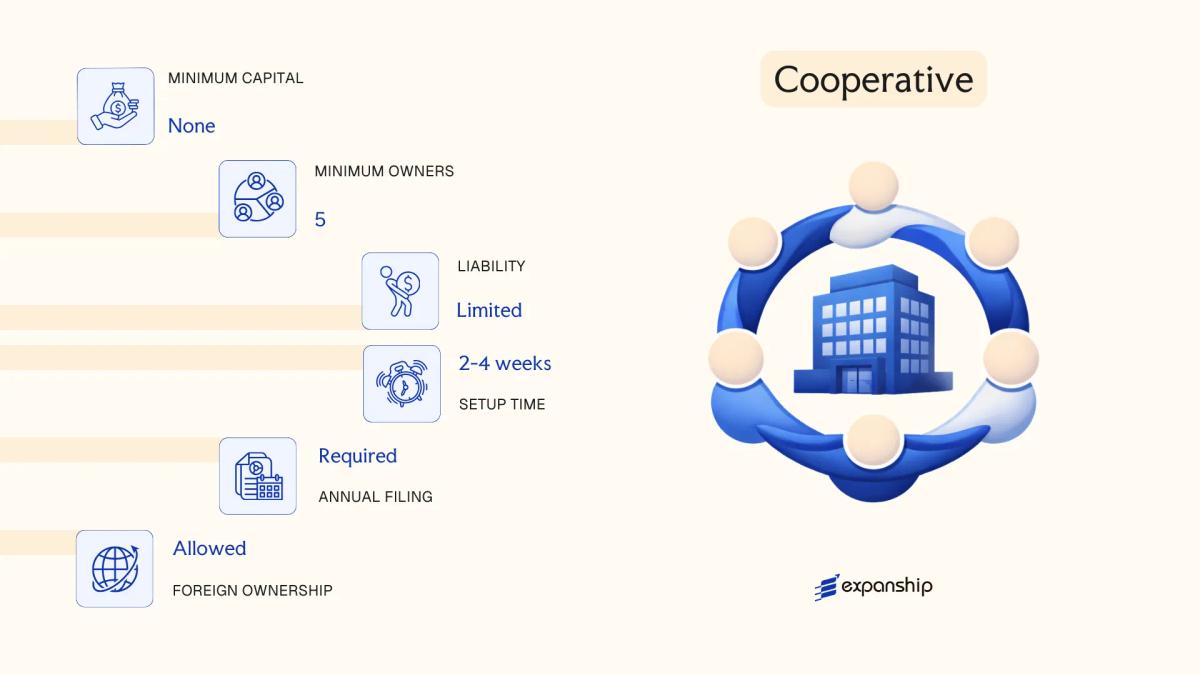
Governed by the Law of the Republic of Armenia "On Cooperatives" (1995, as amended), a cooperative is a voluntary association of individuals or legal entities formed to meet shared economic, social, or cultural needs. To register a cooperative in Armenia, the entity must be established with at least five founding members and obtains full legal personality upon state registration with the State Register of Legal Entities of the Republic of Armenia.
Liability within this structure is hybrid in nature. Members bear limited liability up to the value of their contributed shares, though the charter may impose supplemental liability for cooperative obligations, which distinguishes this form from a standard LLC.
Key Characteristics
| Requirement | Detail | Notes |
|---|---|---|
| Legal Form | Production or Consumer Cooperative | Recognized as a separate legal entity |
| Members | Referred to as members; minimum 5, no statutory maximum | Both individuals and legal entities may participate |
| Local Presence | Registered address in Armenia required | No registered agent requirement under current law |
| Capital | No statutory minimum share capital; contributions defined in the charter | Contributions may be monetary or in-kind |
| Governance | General Assembly (supreme body); Board of Directors for operational management | Supervisory Board required if membership exceeds 50 |
| Privacy | Member register not publicly disclosed in full | Charter and registration details are publicly accessible |
Focus Points
- Taxation: Subject to standard corporate profit tax at 18%; VAT applies at 20% if turnover exceeds the registration threshold; withholding tax on dividends distributed to non-residents is 5%.
- Annual Compliance: Annual financial statements must be submitted; production cooperatives with significant turnover may require an external audit.
- Treaty Access: As a domestic legal entity, a cooperative may access Armenia's double tax treaty network, subject to beneficial ownership requirements.
- Conversion: Armenian law permits reorganization of a cooperative into a commercial entity (LLC or JSC) by decision of the General Assembly.
- Restrictions: Cooperatives cannot issue publicly traded securities; this structure is unsuitable for attracting institutional equity investment.
Closing
A cooperative structure is most appropriate for member-driven agricultural, artisan, or consumer-services operations where collective ownership and democratic governance take priority over capital flexibility. The primary limitation is restricted access to external financing, as the entity cannot issue shares to outside investors.
Best suited for groups of five or more individuals or entities pursuing a shared economic activity — particularly in agriculture, credit services, or consumer goods — where profit distribution is secondary to member benefit.
Foreign Business Structures [Branch Office, Representative Office]
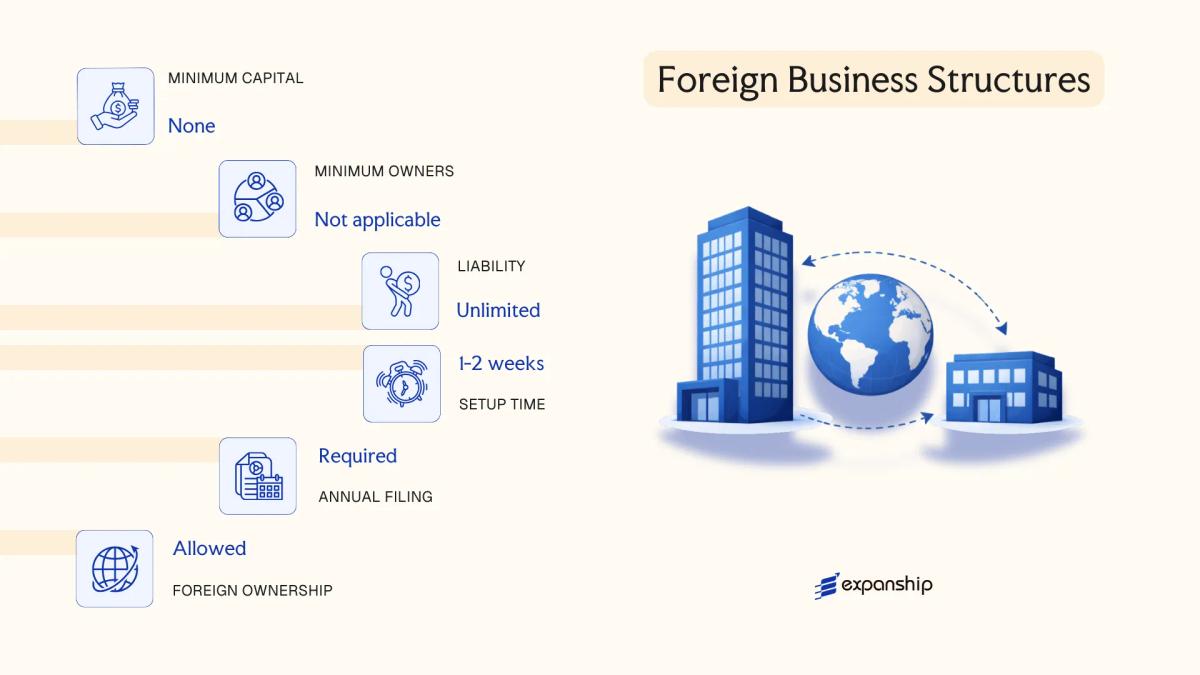
Registering a foreign company branch office Armenia involves operating under the Civil Code of the Republic of Armenia and the Law on State Registration of Legal Entities (2001). Neither a branch nor a representative office constitutes a separate legal entity — both are extensions of the parent company, which retains full legal and financial liability for their activities.
Registration is handled through the State Register of Legal Entities of the Republic of Armenia, administered by the Agency of State Register under the Ministry of Justice. Your foreign firm must submit notarised and apostilled incorporation documents, along with a power of attorney designating a local representative.
Key Characteristics
| Requirement | Branch Office | Representative Office |
|---|---|---|
| Legal Personality | None — extension of parent company | None — extension of parent company |
| Permitted Activities | Commercial operations (same scope as parent) | Non-commercial only: marketing, liaison, market research |
| Head | Accredited Director / Chief Representative (by power of attorney) | Accredited Chief Representative (by power of attorney) |
| Local Presence | Registered address in Armenia required | Registered address in Armenia required |
| Capital Requirement | No statutory minimum; parent's capital applies | No statutory minimum |
| Privacy | Parent company details filed in public register | Parent company details filed in public register |
Focus Points
- Taxation: Branch offices are subject to 18% corporate profit tax on Armenian-sourced income; VAT at 20% applies to taxable supplies; representative offices generating no revenue are generally not subject to profit tax, though payroll obligations (income tax, social payments) still arise for local staff.
- Treaty Access: Armenia maintains a network of double taxation treaties; branch profits may be subject to withholding considerations depending on the parent's home jurisdiction.
- Annual Compliance: Both structures must file annual reports with the State Register and maintain updated documentation of the authorised representative.
- Restrictions: Representative offices cannot invoice clients, conclude commercial contracts, or repatriate profits — any revenue-generating activity requires conversion to a branch or a standalone legal entity.
- Conversion: Upgrading a representative office to a branch, or incorporating a fully independent entity, requires a fresh registration process; there is no automatic conversion mechanism.
Sub-Types
Branch Office
A branch office may conduct the full range of commercial activities authorised under the parent company's charter. It is commonly used by foreign firms that wish to test the local market while keeping operations consolidated under the parent's balance sheet.
Representative Office
A representative office is restricted to auxiliary functions — promotion, information gathering, and liaison. It cannot generate revenue directly, making it suitable only for preparatory or support-oriented operations.
Both structures suit foreign companies seeking a presence without incorporating a standalone entity, though the prohibition on commercial activity in a representative office is a hard constraint. The branch structure carries the significant drawback of unlimited parent liability for all local obligations.
A branch office suits established foreign firms ready to trade commercially in the Armenian market; a representative office is appropriate only where the sole purpose is non-commercial liaison or market research.
Partnership Structures [General Partnership, Limited Partnership]
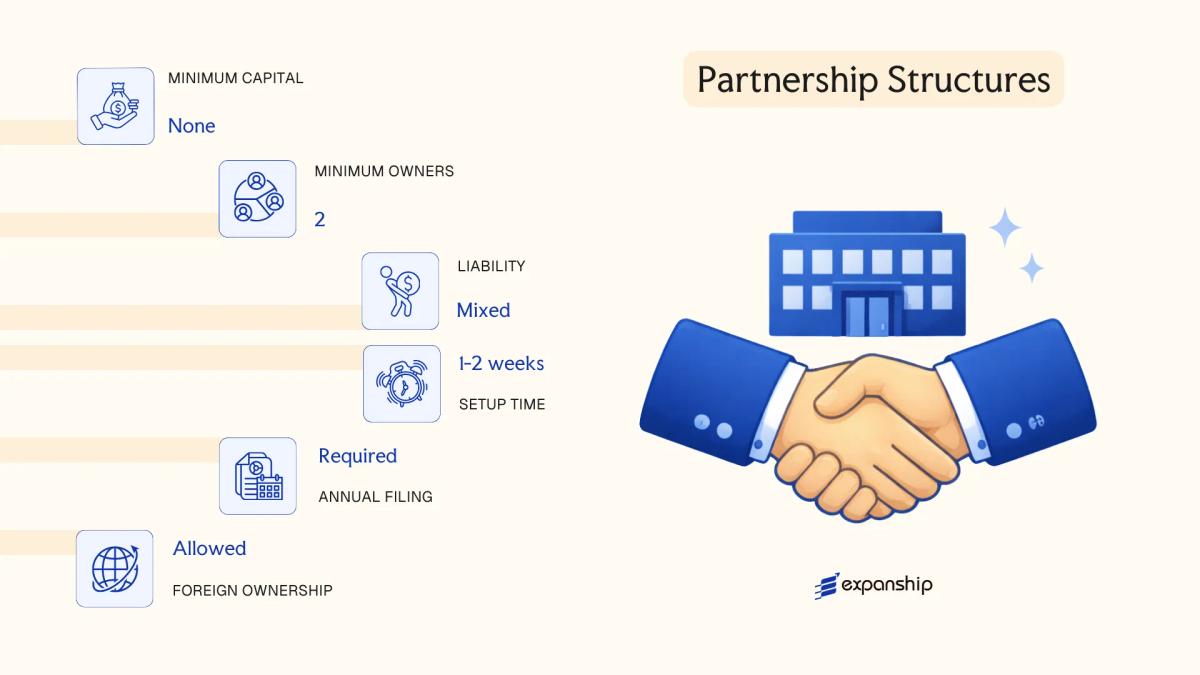
Regulated under the Law of the Republic of Armenia "On Limited Liability Companies and Additional Liability Companies" and the Civil Code of Armenia (1998), partnership structures occupy a distinct position among available business forms. Both the General Partnership (Լրիվ Ընկերակցություն) and the Limited Partnership (Կոմանդիտային Ընկերակցություն) possess separate legal personality under Armenian civil law, yet they retain a pass-through character that distinguishes them from corporate entities.
Liability allocation differs sharply between the two forms. In a general partnership, all partners bear unlimited joint liability for the firm's obligations. The limited partnership introduces a two-tier membership structure: general partners carry unlimited liability, while limited partners' exposure is capped at their contributed capital.
Key Characteristics
| Requirement | General Partnership | Limited Partnership | Notes |
|---|---|---|---|
| Legal Form | Separate legal entity | Separate legal entity | Both registered with the State Register of Legal Entities of Armenia |
| Members | Partners (min. 2, no statutory maximum) | Min. 1 general partner + min. 1 limited partner | Partners, not shareholders |
| Liability | Unlimited for all partners | Unlimited for general partners; limited for limited partners | Limited partners may not participate in management |
| Local Presence | Registered legal address required | Registered legal address required | No mandatory resident director |
| Capital | No statutory minimum; AMD contributions recorded in founding agreement | No statutory minimum | Capital structure defined in the partnership agreement |
| Privacy | Partner details filed with State Register | Partner details filed with State Register | Register is publicly accessible |
Focus Points
- Taxation: Partnerships are generally treated as transparent for Armenian profit tax purposes; partners are taxed individually on their share of income, subject to personal income tax rates; VAT registration obligations apply if turnover thresholds are met.
- Annual Compliance: Partners must file annual financial statements with the State Register; audit requirements depend on the scale of activity.
- Restrictions: Limited partners lose liability protection if they participate in day-to-day management on behalf of the firm.
- Treaty Access: Access to Armenia's double tax treaties is uncertain for transparent entities; independent advice is advisable before structuring cross-border income through a partnership.
- Conversion: Armenian law permits conversion of a partnership into a corporate entity (LLC or JSC) through a prescribed reorganisation procedure.
Sub-Types
General Partnership (Լրիվ Ընկերակցություն)
All members act as general partners with equal management rights unless the founding agreement specifies otherwise. This form is used primarily for professional services arrangements or closely held business ventures where all participants intend to be actively involved.
Limited Partnership (Կոմանդիտային Ընկերակցություն)
The defining feature is its dual membership class: general partners manage the business and carry unlimited liability, while limited partners contribute capital passively. This structure suits arrangements where investors wish to participate financially without assuming management responsibilities or personal exposure beyond their contribution.
Closing
Partnership structures in Armenia are suited to closely held ventures, professional collaborations, or capital-participation arrangements where participants are comfortable with direct income reporting at the partner level. The pass-through tax treatment can be advantageous, but unlimited liability for general partners represents a material risk that should be weighed against the structural flexibility on offer.
General and limited partnerships are best suited for small professional groups or investor-operator arrangements where partners have a high degree of mutual trust and are prepared to manage personal liability exposure directly.
Sole Proprietorship (Անհատ Ձեռնարկատեր)
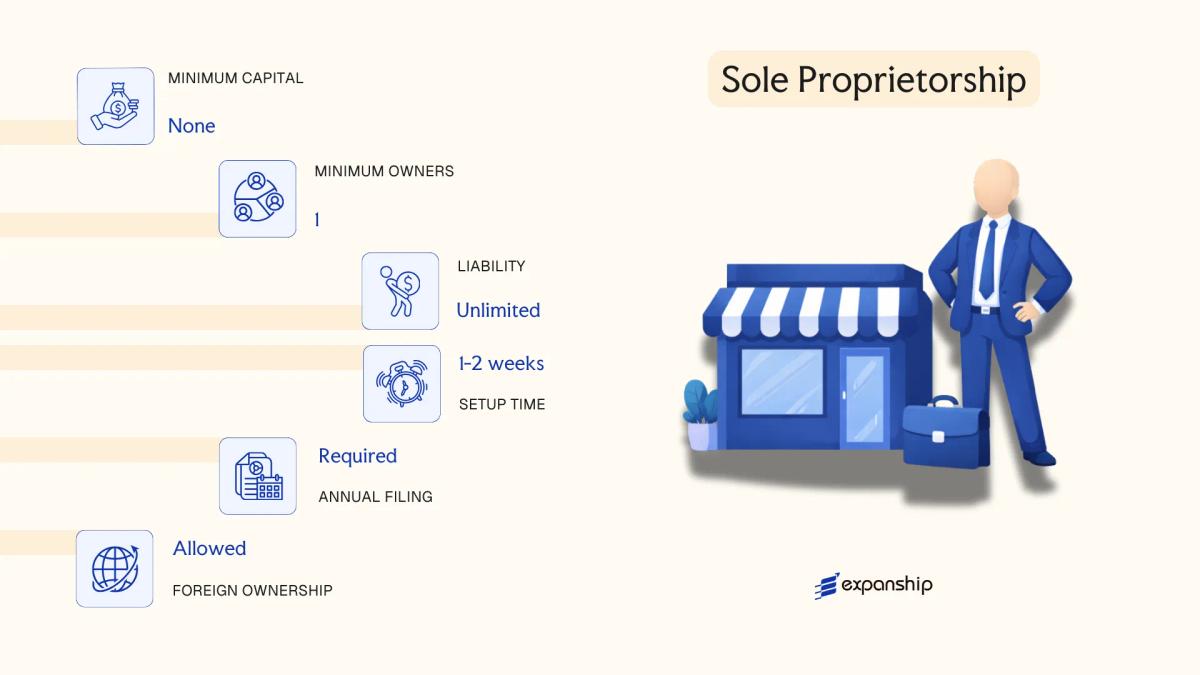
Sole proprietorship registration Armenia is governed primarily by the Law on State Registration of Legal Entities and Individual Entrepreneurs (2001), administered by the State Register of Legal Entities under the Ministry of Justice. Unlike corporate forms, the individual entrepreneur (Անհատ Ձեռնարկատեր) is not a separate legal entity — the registrant and the business are legally identical.
Because no separation exists between personal and business assets, the proprietor bears unlimited personal liability for all obligations arising from commercial activity. Registration is straightforward, with the process conducted through the e-Register portal or in person at the Agency for State Register.
Key Characteristics
| Requirement | Detail | Notes |
|---|---|---|
| Legal Form | Individual Entrepreneur (not a legal entity) | Personal and business identity are merged |
| Member Title | Proprietor | Single natural person only; no co-owners |
| Membership | 1 natural person (minimum and maximum) | Foreign nationals may register subject to residency rules |
| Local Presence | Registered address required | Must be a physical address in Armenia |
| Capital | No statutory minimum | No paid-up capital requirement |
| Liability | Unlimited personal liability | All personal assets are exposed to business debts |
Focus Points
- Taxation: Subject to personal income tax (flat 20%) on business profit; VAT registration mandatory once turnover exceeds AMD 115 million; micro-enterprise tax regime available for qualifying small operators at reduced rates.
- Annual Compliance: Must file an annual income tax declaration; bookkeeping obligations apply, though simplified accounting is permitted below certain turnover thresholds.
- Conversion: Can be converted into an LLC or other legal entity, but the process requires new incorporation rather than a structural transformation of the existing registration.
- Treaty Access: As a non-corporate form, access to Armenia's double tax treaty network is limited; treaty benefits generally apply to individuals, not business profits in all cases.
- Restrictions: Cannot issue shares, take on partners, or raise equity capital; unsuitable for businesses requiring distinct legal personality.
Closing
Self-employed business Armenia operators and individual service providers commonly use this structure for low-overhead trading, consulting, or freelance activity. The primary advantage is minimal administrative burden at registration; the key limitation is unrestricted personal exposure to all business liabilities.
Best suited for resident individuals operating small-scale, single-person businesses with limited liability exposure and no plans for external investment or equity participation.
How to Choose the Right Entity Type in Armenia
Choosing the right business entity in Armenia determines your tax exposure, liability boundaries, and regulatory obligations from the moment of registration — not as an afterthought.
Why Your Entity Choice Matters
Selecting the wrong structure carries concrete legal and financial consequences:
- Forming an LLC when your activity requires a licensed structure — such as banking or insurance — results in the Civil Aviation Committee or Central Bank of Armenia refusing to issue the required operating licence, leaving the entity non-operational.
- Choosing a structure that does not qualify under Armenia's double tax treaties means counterpart states will apply full withholding tax rates, with no reduction available regardless of your holding period.
- Registering as a sole proprietor when your business will have multiple investors provides no mechanism for equity participation, forcing a costly re-registration once shareholders are introduced.
- Selecting an Additional Liability Company when a standard LLC suffices exposes members to personal liability beyond their contributions — an outcome with no corresponding tax or operational benefit in most commercial contexts.
Key Factors to Consider
- Business Activity: Active trading, passive asset-holding, and regulated sectors each correspond to distinct permissible structures under the Law of the Republic of Armenia on State Registration of Legal Entities.
- Ownership Structure: A single founder may prefer an LLC, whereas multi-party arrangements requiring a board and shareholder registry point toward a JSC.
- Tax Objectives: If your business qualifies for Armenia's micro-enterprise or turnover tax regimes, the entity type must be compatible with those regimes' eligibility criteria.
- Privacy Requirements: Shareholder and director information for JSCs is accessible through the State Register maintained by the Agency for State Register of Legal Entities; LLCs offer comparatively less public disclosure exposure.
- Exit Strategy: Not all Armenian entity types permit conversion without full liquidation and re-registration, so your intended exit path should inform the initial structure choice.
- Substance Capacity: If your firm cannot maintain a physical presence or local decision-making, certain structures carry greater compliance risk under economic substance principles.
Compliance Services for Companies in Armenia
Ongoing compliance support for Armenian legal entities, including annual filings, statutory reporting, and regulatory obligations.
Conclusion
Selecting the right structure is the first substantive decision in any Armenia company formation conclusion guide, and it has downstream effects on liability, governance, and tax treatment under Armenian law. The LLC dominates registration volumes, favoured by small and mid-sized businesses for its minimal capital requirements and straightforward governance. JSCs suit firms anticipating equity investment or public share issuance. The ALC applies in narrow sectors where member liability extends beyond contributed capital. Cooperatives serve member-owned enterprises with shared economic objectives, while partnerships and sole proprietorships fit lower-complexity operations with fewer compliance layers. Branch and representative offices allow foreign entities to establish a presence without incorporating a separate legal person.
Armenia's regulatory trajectory points toward continued treaty expansion and gradual alignment with international transparency standards, which affects how foreign-held entities are perceived and structured. Professional guidance at the entity selection stage reduces the likelihood of structural changes later, which carry their own administrative and legal costs.
How Expanship Can Assist You
Expanship Armenia company registration services cover the full range of entity types discussed in this blog, from the LLC (ՍՊԸ) favored by most foreign investors to the JSC (ԲԸ) required for regulated industries. Our team works directly with the State Register of Legal Entities of the Republic of Armenia, the agency responsible for all entity registrations, to keep your filing accurate and on schedule.
Depending on what your business needs, we handle the process from the ground up:
- Document preparation, notarization, and apostille legalization
- Registered agent and legal address provision in Yerevan
- Filing and liaison with the State Register of Legal Entities
- Post-incorporation compliance, including annual reporting obligations
- Tax registration with the State Revenue Committee
- Banking introduction assistance for corporate account opening
Reach out to Expanship Armenia to discuss your incorporation requirements directly with our team.
Frequently Asked Questions (FAQ)
The Limited Liability Company (LLC) is the most frequently incorporated entity. Its combination of a single-shareholder option, no minimum capital requirement, and limited liability for members makes it the default choice for small and mid-sized domestic and foreign-owned businesses.
An LLC restricts share transferability and does not issue publicly tradable securities, while a JSC can list shares on the stock exchange and must comply with more extensive disclosure obligations under the Law on Joint Stock Companies. Both entity types are subject to Armenian corporate income tax at 18%, but the JSC carries higher administrative costs through mandatory audits and shareholder reporting requirements.
The LLC does not require public disclosure of member-level shareholding percentages in the same manner as a JSC, and nominee arrangements are permissible under Armenian law. Registered beneficiary information is, however, subject to submission to the State Register of Legal Entities.
A sole proprietor, LLC, or Additional Liability Company can each be established by a single individual. General Partnerships and Limited Partnerships require at least two participants by definition, and a Cooperative requires a minimum of five founding members under the Law on Cooperatives.
Non-residents face no statutory ownership restrictions on forming an LLC, JSC, ALC, or branch of a foreign entity. Registration is conducted through the State Register of Legal Entities, and a foreign founder does not need to be physically present, provided the relevant documents are notarised and apostilled or legalised according to applicable treaty obligations.
Armenian law permits the reorganisation of legal entities through transformation, which allows an LLC to convert into a JSC and vice versa. The process involves a resolution by the founding members, amended charter submission, and re-registration with the State Register; not all transformation combinations are explicitly codified, so specific restructuring paths should be verified against the Civil Code provisions on reorganisation.
LLCs, JSCs, ALCs, and Cooperatives all possess distinct legal personality under the Civil Code, meaning they can enter contracts, own assets, and incur liabilities independently of their founders. Sole proprietorships do not form a separate legal entity; the individual and the business are treated as one subject before creditors and regulatory authorities.
A sole proprietorship has the simplest reporting structure, with no requirement to file separate corporate financial statements. Among incorporated structures, the LLC has lighter disclosure and audit obligations than the JSC, making it the lower-maintenance option for businesses that do not require external capital raising.
Legal Disclaimer
The information provided in this article is for general informational purposes only and does not constitute legal, tax, or professional advice. While we strive to ensure the accuracy and timeliness of the content, laws and regulations are subject to change, and the application of laws can vary widely based on specific facts and circumstances.
Readers should not act upon this information without seeking professional counsel tailored to their individual situation. Expanship and its authors disclaim any liability for actions taken or not taken based on the content of this article.
For specific advice regarding your business setup, compliance requirements, or any legal matters, please consult with qualified legal and tax professionals in the relevant jurisdiction.