
Key Takeaways
- Armenia's flat 18% corporate income tax rate and zero-rate treatment for certified IT firms under the Tax Code of the Republic of Armenia give businesses concrete structural options for reducing their effective tax burden based on industry classification.
- Foreign-owned LLCs registered with the State Register of Legal Entities face no nationality requirements for shareholders or directors, removing a common barrier that complicates incorporation in many competing jurisdictions.
- With double taxation treaties covering more than 50 partner states, Armenian-registered entities can materially reduce withholding friction on cross-border dividends, service fees, and royalty payments.
- Operations established within Armenia's Free Economic Zones qualify for full tax exemption, making them a substantively different proposition from the standard corporate tax regime available elsewhere in the country.
Armenia is an independent republic in the South Caucasus, bordered by Georgia, Azerbaijan, Turkey, and Iran. Company registration falls under the authority of the State Register of Legal Entities, which operates within the Ministry of Justice. Foreign investors most commonly establish a Limited Liability Company when entering the market. The country maintains a low-tax posture reinforced by an expanding network of double taxation treaties. Permitted foreign ownership is unrestricted in most sectors, and the legal framework does not impose nationality requirements on shareholders or directors of a locally registered entity.
The benefits of incorporating in Armenia extend across tax structure, operating costs, and market access — and this article examines each of them in detail. Whether you're a technology firm seeking favorable treatment or a trading business looking for a cost-efficient base, the Armenia company formation advantages are grounded in concrete legislative provisions rather than broad policy statements. Understanding why incorporate in Armenia requires looking at specific regulations, and the sections that follow address precisely that.
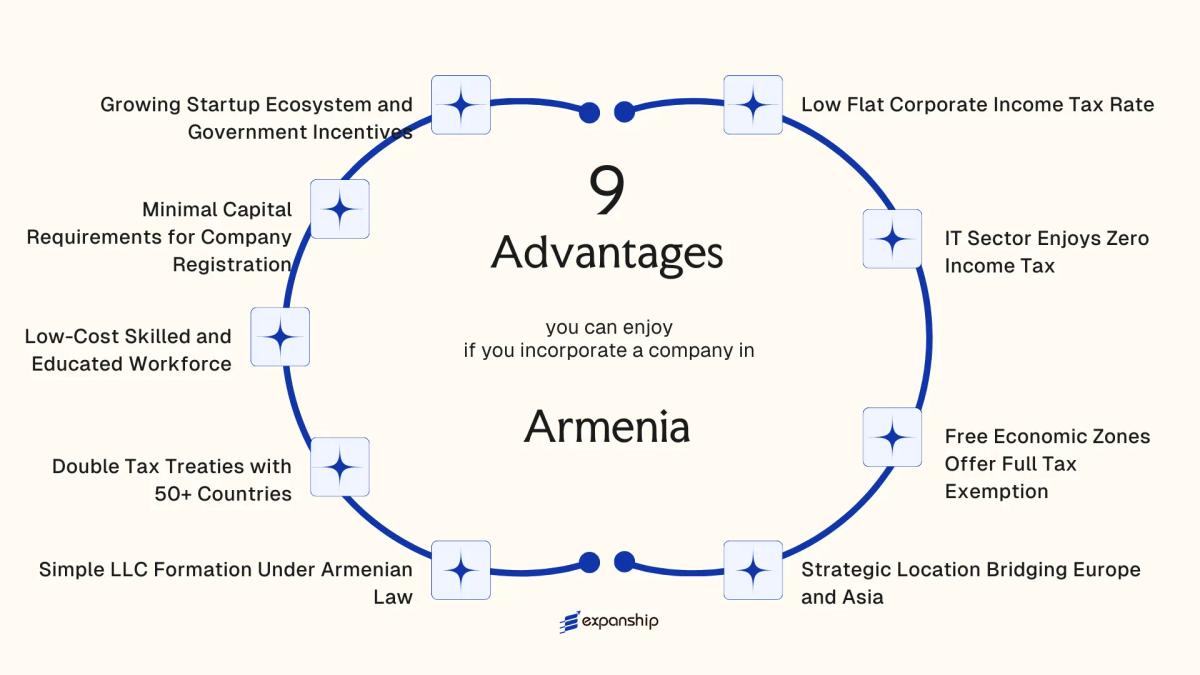
Low Flat Corporate Income Tax Rate
Armenia applies a flat corporate income tax rate of 18 percent on net profits, governed by the Tax Code of the Republic of Armenia. This single-rate structure removes the bracket complexity that affects profit planning in many European jurisdictions.
What the 18 Percent Rate Actually Means for Profit Retention
The flat design means your effective rate does not escalate as your company grows. For context, the EU average corporate tax rate sits above 21 percent, so a foreign-owned entity incorporated in Armenia retains a measurably larger share of taxable profit at equivalent revenue levels.
How the Tax Base Is Calculated
Taxable income is determined after deducting allowable business expenses, which follows standard accrual accounting principles under Armenian tax law. The State Revenue Committee of Armenia administers corporate tax obligations, including filing deadlines and audit procedures, giving businesses a single regulatory point of contact for income tax matters.
Your after-tax profit margin is structurally higher in Armenia than in most EU member states at the same gross income level.
IT Sector Enjoys Zero Income Tax
Armenia's IT sector benefits from one of the more targeted tax incentive structures in the region. Under the Law on State Support to Information Technologies Sector, certified IT enterprises pay zero income tax on qualifying activities. This Armenia IT sector zero income tax benefit applies to companies that receive official certification from the Enterprise Incubator Foundation, the state body responsible for administering the program.
That certification removes income tax liability entirely for covered operations, which means profits generated through software development, IT services, and related technology activities are retained in full. For a foreign-owned entity, this materially changes the return profile compared to standard corporate tax regimes elsewhere.
Eligibility conditions are specific:
- The company must hold a valid IT certificate, which requires meeting defined activity criteria
- Certified status ties income tax relief directly to the nature of the business rather than its ownership structure, so foreign shareholders qualify on equal footing with local ones
- The exemption applies to qualifying income only, keeping the structure straightforward for firms with a single-focus tech operation
- No minimum paid-in capital threshold is tied to certification eligibility
The zero-rate applies for the duration of certified status, giving your business a predictable tax position for financial planning purposes.

Incorporate an IT Company in Armenia
Set up a certified IT enterprise in Armenia and access the zero income tax benefit under the state's IT sector support program.
Free Economic Zones Offer Full Tax Exemption
Armenia's Free Economic Zones (FEZs) operate under a full tax exemption regime, making them one of the most structurally significant features of an Armenia Free Economic Zone tax exemption arrangement available to foreign-owned businesses today. Companies registered and operating within a designated FEZ pay no corporate income tax, no VAT, no customs duties, and no property tax on assets used within the zone. This exemption is not time-limited — it applies for the entire duration of operations within the zone.
| Tax Type | Standard Rate Outside FEZ | Rate Inside FEZ |
|---|---|---|
| Corporate Income Tax | 18% | 0% |
| VAT | 20% | 0% |
| Customs Duties | Varies by goods | 0% |
| Property Tax | Up to 1% | 0% |
The legal foundation rests on the Law of the Republic of Armenia on Free Economic Zones, which defines eligible activities and zone boundaries. Permitted sectors typically include manufacturing, logistics, trade, and technology services, so your business model must align with these categories to qualify for residence within a zone.
For a foreign firm exporting goods or services, operating inside an FEZ eliminates tax friction at multiple points in the supply chain. Goods entering the zone from abroad are not subject to import duties, and finished products leaving the zone for export face no additional tax burden. This structure allows foreign entities to price competitively in international markets while maintaining legal operations inside a formally regulated jurisdiction.
Strategic Location Bridging Europe and Asia
Armenia's strategic location Europe Asia business corridor makes it one of the few territories where a single registered entity can realistically access both Eastern European and Western Asian markets without reestablishing legal presence elsewhere. Sitting at the crossroads of the South Caucasus, the country shares proximity with Turkey, Iran, Georgia, and Azerbaijan, placing your firm within reach of over 600 million consumers across interconnected regional markets.
Membership in the Eurasian Economic Union (EAEU) since 2015 is the structural feature that converts geographic position into a commercial advantage. Under the EAEU framework, goods produced or substantially transformed within Armenia can move across Russia, Kazakhstan, Belarus, and Kyrgyzstan under unified customs rules, without additional tariffs. For a foreign-owned company registered locally, this translates to a single point of entry into a combined market exceeding 180 million people, governed by the EAEU Treaty.
Beyond the EAEU, the country holds a Generalized System of Preferences (GSP) arrangement with the EU and a GSP+ status, allowing eligible Armenian exports to enter European markets at reduced or zero duties.
Keep these points in mind:
- EAEU membership applies to goods that meet rules-of-origin requirements
- GSP+ benefits are contingent on compliance with specific international conventions
- Your entity's registered activity must align with the goods or services being exported
Despite not sharing a land border with Russia, Armenia functions as a fully integrated EAEU member, meaning a company registered in Yerevan can clear customs into Russian territory under the same rules as a Moscow-based firm.
Simple LLC Formation Under Armenian Law
Armenia LLC formation advantages begin with the structure itself. The Shnorhavor Ynkeroutyun (ՍՆ), or Limited Liability Company, is governed by the Law of the Republic of Armenia on Limited Liability Companies, and its formation process is administered through the State Register of Legal Entities under the Ministry of Justice. Registration typically completes within one to three business days, which means your entity can be legally operational almost immediately after submission.
Minimal Documentation Requirements
Foreign founders are not required to be physically present during incorporation. A single shareholder and a single director suffice to form the entity, and there is no requirement for a local resident director, which removes a structural dependency that many other jurisdictions impose on non-resident investors.
The State Register accepts electronic filings, so the process does not hinge on in-person bureaucratic procedures. For a foreign business owner managing multiple markets, this reduces both the time cost and the logistical burden of establishing a legal presence.
Unrestricted Foreign Ownership
A Shnorhavor Ynkeroutyun permits 100% foreign ownership with no mandatory local partner. This gives investors complete control over equity structure from the outset, without negotiating ownership arrangements dictated by law.
Corporate decisions are also straightforward to execute. The LLC structure allows a sole participant to hold all voting rights, which simplifies governance when the founding team operates from outside the country.
Plan Your Armenian Company Setup with Expanship
Get tailored guidance on structuring your LLC in Armenia and ensuring full compliance from day one.
Double Tax Treaties with 50+ Countries
Armenia's double tax treaty network spans more than 50 countries, covering major trading partners across Europe, the CIS, Asia, and the Middle East. For a foreign-owned entity operating through an Armenian holding or subsidiary structure, this means withholding taxes on dividends, interest, and royalties remitted abroad can be substantially reduced under applicable treaty provisions.
- Reduced withholding rates apply under specific bilateral agreements. Many treaties signed by the Republic of Armenia cap dividend withholding at 5% to 10% for qualifying corporate shareholders, compared to a standard domestic rate that would otherwise apply without treaty protection.
- Treaty coverage eliminates dual taxation at the corporate level. If your home country has an active agreement with Armenia, profits earned through a local entity are taxed once, with the treaty determining which jurisdiction holds primary taxing rights.
- The treaties follow OECD and UN model conventions, which means provisions on permanent establishment, capital gains, and business profits are structured along internationally recognized principles. This gives foreign investors a predictable legal framework when structuring cross-border transactions.
- Treaty benefits are accessed by submitting proof of tax residency to the relevant withholding agent or the State Revenue Committee of Armenia. Residency certificates issued by the competent authority of the treaty partner country are the standard documentation required.
Low-Cost Skilled and Educated Workforce
Armenia skilled workforce advantages for business are rooted in a Soviet-era legacy of technical education that continues to produce engineers, mathematicians, and programmers at a scale disproportionate to the country's population of roughly 3 million. Yerevan State University and the American University of Armenia, among others, supply a consistent pipeline of graduates in STEM disciplines. For a foreign firm hiring locally, this translates to technical capacity without the salary overhead common in Western European markets.
Average monthly wages in the country remain significantly below those in Eastern European tech hubs such as Poland or Romania, while English and Russian proficiency rates among educated professionals are high. A software development firm, for example, can staff a mid-sized engineering team at a fraction of the cost of an equivalent team in Germany or France.
The labor relationship is governed by the Labour Code of the Republic of Armenia, which sets out employment contracts, termination rules, and working-hour standards. This gives your business a defined legal framework for workforce management.
A senior software engineer in Yerevan commands an average monthly salary of approximately USD 1,200–1,800, compared to USD 5,000–7,000 for an equivalent role in Western Europe, according to data aggregated by regional HR consultancies active in the South Caucasus market.
Minimal Capital Requirements for Company Registration
Armenia minimal capital requirements for company registration present a direct cost advantage at the point of entry. Under the Law of the Republic of Armenia on Limited Liability Companies, there is no statutory minimum share capital required to form an LLC. You can incorporate with a capital amount determined entirely by your business needs, which eliminates the upfront capital-lock-in that many European jurisdictions impose.
This matters because capital reserved for statutory minimums is capital unavailable for operations. Founders can allocate their initial funds toward staffing, licensing, or market entry rather than satisfying a regulatory threshold that offers no corresponding operational benefit.
- No minimum share capital is prescribed for an LLC under Armenian corporate law
- Capital contributions can be made in cash or in-kind assets
- The State Register of Legal Entities does not require proof of capital deposit before incorporation is completed
This structure suits foreign investors who are testing a new market and prefer to keep initial financial exposure low while the entity establishes its operating base.
While no minimum capital is required, certain licensed activities, including financial services and insurance, carry sector-specific capital adequacy requirements set by the Central Bank of Armenia.
Growing Startup Ecosystem and Government Incentives
Armenia's startup ecosystem and government incentives have created a structured environment where early-stage and growth-phase companies receive direct institutional support. This is not an informal network but a set of programs backed by legislation and dedicated state bodies.
The Entrepreneurship Development Foundation
The Entrepreneurship Development Foundation (EDF), operating under Armenia's Ministry of Economy, administers grants, co-financing programs, and capacity-building initiatives for startups and SMEs. Access to state-backed funding reduces the capital burden on foreign founders who are scaling operations from outside the country.
FAST Foundation and Tech-Specific Support
The Foundation for Armenian Science and Technology (FAST) focuses specifically on deep tech and innovation-driven businesses. Firms operating in areas such as AI, biotechnology, and engineering can apply for targeted funding and receive connections to international research networks. This gives technically oriented businesses a channel to institutional resources that most emerging markets do not offer at the national level.
Tumo and Technopark Infrastructure
The country hosts several technology parks, including the Gyumri Technology Center and Yerevan-based innovation facilities, where registered entities can access co-working infrastructure, mentorship, and incubation programs. These are physical assets that reduce overhead for a new firm during its early operating phase.
Startup Armenia Initiative
Under the Startup Armenia initiative, qualifying businesses can receive structured mentorship, investor introductions, and program participation. Eligibility is generally tied to the company being registered locally and operating in an innovation-adjacent sector.
Why Armenia Stands Out Among Regional Business Hubs
Compared to Georgia and Azerbaijan, the two most commonly evaluated alternatives for South Caucasus incorporation, Armenia holds a distinct position on several structural parameters that matter to foreign investors. Georgia attracts attention for its territorial tax system, but its standard corporate rate sits at 15%, and its startup policy framework is less formalized. Azerbaijan imposes tighter restrictions on foreign ownership in certain sectors and operates a more state-directed economy. For investors weighing Armenia business hub advantages over regional competitors, the comparison points toward a jurisdiction with lighter tax conditions in key sectors and fewer ownership barriers.
What the table below reflects is not a comprehensive ranking but a narrower look at parameters where the regulatory and tax architecture here creates measurable differences. The State Register of Legal Entities under the Ministry of Justice processes registrations with a speed and cost structure that Georgia's National Agency of Public Registry matches in some respects but not across all criteria. On IT tax treatment and free zone exemptions, neither regional peer currently offers an equivalent combination at the statutory level.
| Parameter | Armenia | Georgia | Azerbaijan |
|---|---|---|---|
| Standard Corporate Tax Rate | 18% flat | 15% (distributed profits) | 20% |
| IT Sector Tax Incentive | 0% income tax for certified operators | No equivalent statutory exemption | No direct equivalent |
| Free Economic Zone Tax Status | Full exemption on profit, VAT, customs | FIZ available; partial exemptions | Available; more restricted access |
| Foreign Ownership Restriction | None for most sectors | None for most sectors | Restrictions in select strategic sectors |
| Double Tax Treaties | 50+ | 60+ | 50+ |
| Minimum Share Capital (LLC) | No statutory minimum | No statutory minimum | AZN 0 (nominal) |
Compliance Services for Companies in Armenia
Stay aligned with Armenian regulatory requirements, from annual filings to tax reporting obligations under the Tax Code of the Republic of Armenia.
Conclusion
Armenia's tax structure, formation mechanics, and geographic position form a coherent case for foreign incorporation that few regional alternatives replicate. The zero income tax available to certified IT firms, the flat 18% corporate rate applicable to most other businesses, and the full exemption within Free Economic Zones give your business genuine flexibility to structure operations around real tax outcomes rather than theoretical ones.
Those advantages hold particular weight when combined with the country's network of double tax treaties, which reduces withholding friction across more than 50 partner states. For a foreign owner managing cross-border payments, dividends, or service fees, that treaty coverage translates directly into lower leakage between jurisdictions.
What makes Armenia company formation advantages meaningful in practice is that they apply within a legal environment that does not impose high capital thresholds or lengthy registration timelines. Your business structure, industry classification, and residency position will all affect which benefits apply and to what degree. Engaging qualified local counsel before formation ensures that the applicable provisions of the Tax Code of the Republic of Armenia and the Law on State Registration of Legal Entities are applied correctly to your specific circumstances. The groundwork for a compliant and tax-efficient Armenian entity is well-defined for those who approach it with the right professional support.
Start Your Armenian Company with Expanship Today
Incorporating in Armenia involves a defined set of legal, tax, and compliance obligations that Expanship handles from start to finish. From registering your Limited Liability Company with the State Register of Legal Entities under the Ministry of Justice, to maintaining annual statutory compliance under the Law on State Registration of Legal Entities, each step requires accurate documentation and coordination with Armenian authorities. The benefits outlined throughout this blog, including the 18% flat corporate tax, IT sector exemptions, and Free Economic Zone privileges, can only be accessed once your entity is properly constituted and in good standing.
Expanship's service scope covers every stage of that process:
- Preparation and legalization of incorporation documents in accordance with Armenian law
- Provision of a registered agent and local registered office address
- Filing with the State Register of Legal Entities and liaison with the Ministry of Justice
- Post-incorporation compliance management, including tax registration and annual reporting
- Banking introduction assistance to support your firm's operational setup in-country
Reach out to Expanship Armenia to discuss your company formation requirements.
Frequently Asked Questions (FAQ)
The standard corporate income tax rate under Armenian tax legislation is 18%, applied as a flat rate on taxable profit. This rate applies broadly, though companies operating under the IT sector certification scheme administered by the Ministry of High-Tech Industry benefit from a 0% income tax regime. Free Economic Zone operators face a separate framework and are exempt from corporate income tax entirely under their respective licensing terms.
State registration through the Agency of the State Register of Legal Entities can be completed within one to three business days under the standard procedure. Expedited registration is available for an additional fee and can reduce that timeline further. Post-registration steps such as tax registration and bank account opening add time but are generally straightforward procedural requirements.
The zero income tax benefit for IT companies is not automatic. A firm must obtain certification through the Ministry of High-Tech Industry of the Republic of Armenia, which evaluates whether the business conducts qualifying technology activities. Without that certification, the standard 18% corporate income tax rate applies.
Armenia has concluded double taxation agreements with more than 50 countries, including major trading partners across Europe, the CIS, and parts of Asia. These treaties typically address withholding tax rates on dividends, interest, and royalties, reducing or eliminating the default rates specified in domestic tax law. The specific rate applicable to your situation depends on the treaty in force between Armenia and the country of your entity's tax residency.
Armenian law does not impose a mandatory minimum share capital for a standard LLC formation. The founders define the charter capital in the company's constituent documents, and there is no statutory floor that must be met before registration is approved. This contrasts with jurisdictions that require paid-up capital to be deposited and verified prior to incorporation.
If a certified IT company begins generating revenue from activities that fall outside the scope of its approved certification, those revenues may not qualify for the zero income tax treatment. The Ministry of High-Tech Industry may review the certification status if the company's activities materially diverge from its certified profile. Businesses operating across multiple revenue streams should obtain a legal assessment of how income is classified under their certification terms.
Legal Disclaimer
The information provided in this article is for general informational purposes only and does not constitute legal, tax, or professional advice. While we strive to ensure the accuracy and timeliness of the content, laws and regulations are subject to change, and the application of laws can vary widely based on specific facts and circumstances.
Readers should not act upon this information without seeking professional counsel tailored to their individual situation. Expanship and its authors disclaim any liability for actions taken or not taken based on the content of this article.
For specific advice regarding your business setup, compliance requirements, or any legal matters, please consult with qualified legal and tax professionals in the relevant jurisdiction.