
Key Takeaways
- Under Law No. 9901/2008, foreign investors must navigate a corporate governance framework that continues to undergo legal harmonisation with EU standards, creating compliance uncertainty during Albania's ongoing accession process.
- Persistent weaknesses in intellectual property enforcement and an inconsistent judicial system mean contractual protections that function reliably in more developed jurisdictions carry measurably higher execution risk in Albania.
- Frequent amendments to Albanian tax legislation impose a recurring compliance burden on incorporated entities, requiring ongoing legal monitoring to maintain accurate filings and avoid unintentional non-compliance.
- Access to equity financing remains structurally limited in Albania, as the absence of a developed venture capital ecosystem and shallow domestic capital markets forces most businesses to rely on bank debt or retained earnings for growth funding.
Albania operates under an evolving regulatory framework, shaped in part by its EU accession process and ongoing legal harmonisation efforts. The primary disadvantages of incorporating in Albania span several operational, institutional, and compliance-related categories — each examined separately in this article.
The drawbacks of Albania company formation affect businesses differently depending on sector, structure, and ownership model. A manufacturing entity faces different friction points than a technology firm or a holding company.
Foreign investors conducting substantive operations — rather than using Albania purely as a holding location — are most likely to encounter these challenges at a practical level. Governing corporate matters falls under the Law on Entrepreneurs and Companies (Law No. 9901/2008), which sets out the foundational framework for entity formation and governance.
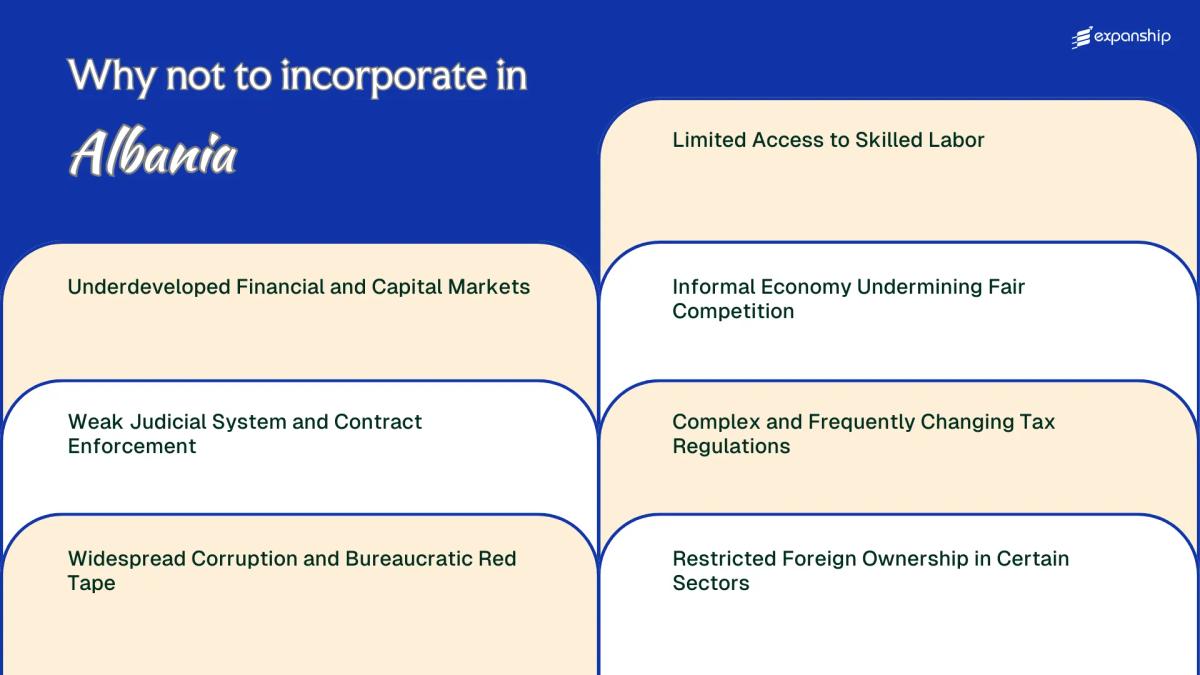
Underdeveloped Financial and Banking Infrastructure
Albania banking infrastructure problems affect foreign-owned entities from the moment of registration, creating friction that extends well beyond routine account management.
Limited Correspondent Banking and Payment Processing
Albania's banking sector is dominated by a small number of commercial banks, several of which are subsidiaries of regional groups such as Raiffeisen and OTP. Despite this presence, the correspondent banking relationships available to businesses operating locally remain thin by regional standards, which restricts cross-border transaction capacity. Your firm may encounter delays or outright refusals when processing transfers to certain jurisdictions, particularly where enhanced due diligence requirements apply under the Bank of Albania's supervisory framework.
Corporate Account Opening Challenges for Foreign Entities
Albania business banking restrictions are most acute at the account-opening stage. Foreign-owned companies are routinely subjected to extended Know Your Customer procedures, requiring notarised and apostilled beneficial ownership documentation that can take weeks to compile. This delays operational readiness and creates a direct cash-flow gap between entity registration and the ability to transact.
Your company may be fully registered but operationally paralysed for weeks while the bank completes its due diligence process, blocking payroll, supplier payments, and client invoicing.
Bureaucratic Delays at the National Registration Centre
Albania National Registration Centre delays remain a consistent friction point for foreign founders attempting to establish a legal presence. The Qendra Kombëtare e Biznesit (QKB) serves as the single window for business registration, but the system's practical performance frequently falls short of its design intent.
Processing timelines can extend beyond the stated one-day registration target when document submissions contain errors or require additional verification. For a foreign entity, this matters because minor discrepancies in notarised documents often trigger re-submission cycles, each adding days or weeks to your launch timeline.
The QKB registration bureaucracy in Albania creates compounding costs across several operational areas:
- Delayed registration pushes back your ability to open a corporate bank account, stalling access to working capital before operations begin
- Re-notarisation requirements for foreign documents force additional consular or apostille appointments abroad, adding both cost and travel
- Extended timelines expose your firm to shifting administrative requirements if regulatory updates occur during the registration gap
Online portal instability has been reported as an intermittent issue, making it difficult to track application status in real time.

Company Incorporation in Albania
Establish your business presence in Albania with accurate documentation and structured support throughout the QKB registration process.
Limited Access to Venture Capital and Equity Markets
Limited venture capital access in Albania reflects a structural gap rather than a temporary market condition. The Tirana Stock Exchange (Bursa e Tiranës) operates with minimal trading volume and a narrow roster of listed companies, meaning equity financing through public markets is not a realistic path for most newly incorporated businesses.
Private venture capital activity is similarly constrained. Few dedicated VC funds operate locally, and most foreign institutional investors concentrate capital in more established regional markets. For a startup or growth-stage company, this absence forces dependence on retained earnings, bank credit, or informal investor networks, each of which carries its own limitations.
| Indicator | Detail | Implication for Your Business |
|---|---|---|
| Tirana Stock Exchange listed companies | Fewer than 10 actively traded securities | Public equity raise is practically unavailable |
| Domestic VC fund activity | No established domestic VC fund ecosystem | No institutional early-stage capital pipeline |
| Regional capital market integration | Not integrated with EU capital markets union | Cross-border equity access remains limited |
| Primary funding alternative | Collateral-backed bank lending | Dilutes equity runway; requires hard assets |
Albania equity market restrictions also affect exit planning. Without a functioning secondary market, early investors cannot liquidate positions easily, which itself discourages initial investment. This circular constraint keeps deal volumes low and valuations difficult to establish with any market discipline.
The country's non-EU membership means Albanian firms cannot passport financial instruments across EU member states under MiFID II frameworks. That exclusion meaningfully narrows the investor base available to a firm incorporated here.
Weak Intellectual Property Enforcement
Weak intellectual property enforcement in Albania poses a material risk for any foreign business that relies on brand identity, proprietary technology, or licensed content. The country has made legislative progress, including alignment with EU IP directives through its Stabilisation and Association Agreement obligations, but the gap between law on paper and enforcement in practice remains significant.
The General Directorate of Patents and Trademarks handles IP registration, yet registration alone offers limited protection. Counterfeit goods and unauthorised use of trademarks persist in local markets, and civil enforcement through the courts is slow and unpredictable.
Judicial proceedings involving IP disputes can extend over multiple years. For a foreign firm, that timeline translates directly into sustained revenue loss and brand dilution with no near-term remedy.
Albania IP protection risks are compounded by limited customs-level enforcement. Border controls intercept a fraction of infringing goods, meaning distribution of counterfeits is not reliably disrupted at the point of entry.
- IP registration must be completed locally through the General Directorate of Patents and Trademarks; foreign registrations do not automatically confer protection.
- Civil IP claims are subject to general court timelines, with no specialist IP tribunal currently in operation.
- Customs authorities have seizure powers but exercise them inconsistently across border crossings.
- Criminal IP enforcement requires a formal complaint and is rarely initiated without sustained pressure from the rights holder.
Albania's trademark registration system operates independently from the EU trademark framework, meaning an EUIPO-registered trademark provides no automatic protection within Albanian territory.
Frequent Tax Law Amendments and Regulatory Uncertainty
Albania tax law regulatory uncertainty poses a measurable compliance burden for foreign firms, particularly given how frequently core tax statutes are revised outside of predictable legislative cycles.
A Pattern of Frequent Revision
The Albanian tax framework, governed primarily by the Law on Income Tax (Law No. 8438/1998) and subsequent amendments administered by the General Tax Directorate, has undergone repeated structural changes affecting corporate tax rates, withholding obligations, and transfer pricing rules. Each revision forces your legal and accounting teams to reassess existing structures, creating recurring costs that stable jurisdictions do not impose.
Operational Consequences for Foreign Entities
Retroactive or short-notice changes to VAT treatment and tax thresholds mean that financial projections prepared at the time of incorporation can become inaccurate within a single fiscal year. For a foreign-owned entity without established local advisory relationships, identifying the operative version of a given regulation is itself a time-consuming process. Firms registered through a branch structure face compounded exposure, since procedural updates issued by the General Tax Directorate do not always receive formal translation or consolidated publication.
Managing Tax Compliance Risks for Your Albanian Entity
Get specialist guidance on staying ahead of regulatory changes that affect your company's compliance obligations in Albania.
Mandatory Albanian-Language Documentation Requirements
Albania's mandatory language documentation requirements mean that all official documents submitted to the National Registration Centre (QKB) and other regulatory bodies must be prepared in Albanian, forcing foreign business owners to incur certified translation costs for every filing.
- All corporate documents, including statutes, board resolutions, and shareholder agreements, must be drafted or translated into Albanian before the QKB will process your registration, adding both cost and time to the formation process.
- Contracts and agreements originally executed in a foreign language carry no direct legal standing before Albanian courts, requiring certified translations that create an ongoing operational expense.
- Any amendments to your company's founding documents must also be submitted in Albanian, meaning each structural change to the entity generates a new round of translation obligations.
- Foreign-language financial statements prepared under IFRS or other international standards must be accompanied by Albanian-language versions for tax authority submissions, duplicating your accounting workload.
Corruption and Inconsistent Judicial Enforcement
Corruption risks incorporating in Albania are well-documented and consistently reported across international monitoring frameworks. Transparency International's 2023 Corruption Perceptions Index ranked Albania 99th out of 180 countries, a position that signals systemic exposure rather than isolated incidents.
For foreign-owned entities, the practical consequence is unpredictability. Permit approvals, licensing renewals, and contract enforcement can depend on informal relationships rather than procedural merit, creating unequal conditions that disadvantage firms without established local connections.
Judicial enforcement adds a separate layer of risk. Albanian courts have faced documented criticism for inconsistent application of commercial law, delayed rulings, and susceptibility to external influence, all of which undermine your ability to rely on litigation as a credible remedy for contract disputes or asset recovery.
- Enforcement outcomes in commercial cases can vary significantly across different courts
- Intellectual property and insolvency proceedings are particularly affected by judicial delays
- Arbitration clauses in contracts offer limited protection if counterparties are locally incorporated
The scope of this disadvantage narrows somewhat for businesses operating under bilateral investment treaties, which provide access to international arbitration outside the domestic court system.
"Albania's score of 37/100 on the 2023 Corruption Perceptions Index places it below the Western Balkans regional average, reflecting persistent concerns about institutional integrity." — Transparency International, CPI 2023
Restricted Talent Pool and Skilled Labour Shortage
Albania skilled labour shortage businesses encounter stems from sustained emigration over three decades. Since the early 1990s, an estimated 1.4 million Albanians have left the country, representing a significant share of the working-age population. This outflow has disproportionately affected professionals in engineering, IT, finance, and healthcare.
The phenomenon is structural, not cyclical. Young graduates, particularly those from public universities in Tirana, routinely seek employment in Germany, Italy, and the United Kingdom under EU mobility schemes. Your firm absorbs the recruitment cost of this gap directly, through higher salaries to retain qualified staff or through reliance on expatriate hires that trigger additional work permit obligations under Albanian Labour Law (Law No. 136/2015).
Talent pool limitations in Albania are particularly acute in specialised technical roles. Sectors requiring advanced digital skills or multilingual capacity face the sharpest shortages. Filling a mid-to-senior position locally can take considerably longer than in comparable Western Balkan markets.
- Software development and cybersecurity roles are among the hardest to fill domestically.
- Finance professionals with IFRS experience are scarce outside major Tirana-based firms.
- Bilingual staff capable of operating in English at a corporate level remain limited in supply outside the capital.
Foreign nationals hired to fill skill gaps must be processed through the State Labour Inspectorate under Law No. 136/2015, and work permit timelines add direct operational delays that compound the underlying recruitment difficulty.
Overcoming Albania's Incorporation Challenges
Overcoming Albania's Incorporation Challenges
Overcoming Albania incorporation challenges requires a structured approach built on verified legal instruments, not assumptions about how the system functions in practice. Foreign founders who prepare for procedural and regulatory friction before registering tend to experience fewer compounding delays.
- Register through the National Business Centre and confirm entity type eligibility under the Law on Entrepreneurs and Commercial Companies (Law No. 9901/2008) before initiating any filings.
- Appoint a locally resident administrator to satisfy Albanian-language documentation requirements and ensure regulatory correspondence is handled within statutory deadlines.
- Establish a corporate bank account with a licensed bank early, given the onboarding friction documented in the financial infrastructure section.
- File intellectual property registrations with the General Directorate of Industrial Property (GDIP) at incorporation, not after operations begin.
- Implement fixed-fee contractual structures to reduce exposure to unpredictable tax law amendments and mid-year regulatory changes.
Albania's mitigation steps operate within a legal environment where enforcement gaps and institutional inconsistencies remain structural, not incidental. Mitigating Albania business formation risks depends on how consistently a firm monitors regulatory updates issued by the Ministry of Finance and Economy.
Albania's Overall Investment Appeal
Albania's overall investment appeal rests on a foundation of genuine opportunity undermined by structural constraints. The Albania investment appeal risks and limitations covered in this blog are real and measurable, yet none individually renders the jurisdiction unworkable for a foreign entity with the right preparation and expectations.
| Pros | Cons |
|---|---|
| Corporate tax rate is a flat 15%, among the lower rates in the Western Balkans region | Tax law amendments occur with regularity, creating planning uncertainty for foreign firms |
| EU candidate status is driving gradual regulatory alignment with European standards | Judicial enforcement is inconsistent, and corruption risk remains documented by international indices |
| Operating costs, including labour, remain comparatively low against Western European markets | The skilled labour pool is constrained by sustained emigration of qualified professionals |
| National Registration Centre processes are centralised under a single framework | Bureaucratic delays at the NRC can extend timelines beyond projected incorporation schedules |
| Geographic position supports trade access across the Adriatic and Balkan corridors | Intellectual property protections exist in statute but enforcement in practice remains weak |
Pros and cons investing in Albania will always reflect this duality: structural incentives on one side, institutional gaps on the other. Your business must weigh both columns with equal seriousness before committing.
Corporate Compliance Services in Albania
Keep your Albanian entity in good standing with local regulatory, filing, and reporting obligations across all stages of the company lifecycle.
Conclusion
Albania's position as an EU candidate state with a simplified registration framework through the National Registration Centre does not neutralise the structural obstacles your business will face. Among the most consequential: persistent judicial inconsistency that undermines contract enforcement, a corporate tax environment subject to frequent legislative revision, and a limited domestic talent base that raises operational costs for foreign firms. An Albania company formation disadvantages summary cannot be reduced to administrative friction alone — the risks are systemic. Addressing them requires jurisdiction-specific knowledge and ongoing compliance oversight.
Expanship's Albania Company Formation Support
Expanship's Albania company formation support is designed to reduce the operational burden that comes with registering and maintaining a business under Albanian law, where requirements such as National Registration Centre (QKB) filings, mandatory Albanian-language documentation, and frequent tax code amendments create real friction for foreign firms. Expanship does not remove these obligations, but helps your business meet them accurately and on time.
Beyond initial registration, our services cover the full incorporation lifecycle:
- Preparing and submitting company registration documents to the QKB on your behalf.
- Providing a registered agent and local office address to satisfy Albanian residency requirements.
- Liaising directly with government bodies and regulatory authorities throughout the filing process.
- Managing post-incorporation compliance obligations as your entity operates in-country.
- Facilitating introductions to local banking institutions to support your account opening process.
- Handling tax registration and coordination with Albanian tax authorities on your behalf.
To discuss your specific requirements, contact Expanship Albania.
Frequently Asked Questions (FAQ)
Weak IP enforcement is most acute for businesses in software, pharmaceuticals, branded consumer goods, and creative industries, where copying and counterfeiting carry lower barriers. Albania is a signatory to several international IP conventions, but local enforcement through the General Directorate of Industrial Property and the courts remains inconsistent and slow. If your business model depends on proprietary technology or brand exclusivity, the gap between legal protection on paper and practical enforcement on the ground is significant.
Your business becomes immediately subject to any new tax obligations once amendments take effect, with no grandfathering protection unless explicitly stated in transitional provisions. Albania has amended its Value Added Tax Law and corporate income tax regulations multiple times over the past decade, sometimes with limited advance notice to businesses. This means your tax compliance costs can increase unexpectedly, and previously valid structures may require restructuring to remain compliant.
It is broadly comparable to other Western Balkans jurisdictions such as North Macedonia and Bosnia and Herzegovina, where official filings must also be submitted in the national language. In Albania, all documents filed with the National Registration Centre and tax authorities must be in Albanian, which means certified translation is required for any foreign-language contracts, corporate records, or articles of association. The added cost and time for certified translation is a recurring operational expense, not a one-time incorporation burden.
There is no fixed cost, but businesses in technology, finance, and engineering consistently report either paying above-market salaries to retain qualified Albanian nationals or bearing relocation and visa costs to bring in foreign specialists. Albania's emigration rate is among the highest in the region, with a significant share of university-educated professionals relocating to EU member states, which directly shrinks the available domestic talent pool. For roles requiring specific technical certifications or multilingual capacity, recruitment timelines extend considerably and salary expectations among qualified candidates are rising.
The Albanian Tax Procedures Law provides for financial penalties ranging from fixed fines to percentage-based surcharges on unpaid or underpaid tax liabilities, along with interest accruing from the date the obligation arose. In cases of repeated non-compliance or suspected evasion, the Tax and Customs Directorate has authority to initiate criminal referrals. The risk is not simply the penalty itself but the administrative burden of resolving a dispute with Albanian tax authorities, which can take months and requires local legal representation.
Partially. Several international banking groups operate in Albania, including Intesa Sanpaolo and OTP Bank, which offer more reliable cross-border transaction services than purely domestic institutions. However, correspondent banking restrictions, local KYC requirements, and limitations on foreign currency account structures still apply regardless of the bank's parent entity. Multi-currency treasury operations and complex cross-border payment structures that function smoothly in EU jurisdictions often require workarounds in Albania, adding administrative overhead even with an internationally affiliated bank.
Until the National Registration Centre issues your certificate of registration, your entity has no legal standing to sign contracts, open a corporate bank account, or obtain sector-specific licences. Processing times at the NRC can extend beyond the officially stated one-day timeline when documentation is queried or when there is a backlog, which pushes back every downstream step in your setup process. For businesses with a fixed market-entry deadline, this sequential dependency means that a delay at the NRC has a cascading effect on the entire operational launch schedule.
Legal Disclaimer
The information provided in this article is for general informational purposes only and does not constitute legal, tax, or professional advice. While we strive to ensure the accuracy and timeliness of the content, laws and regulations are subject to change, and the application of laws can vary widely based on specific facts and circumstances.
Readers should not act upon this information without seeking professional counsel tailored to their individual situation. Expanship and its authors disclaim any liability for actions taken or not taken based on the content of this article.
For specific advice regarding your business setup, compliance requirements, or any legal matters, please consult with qualified legal and tax professionals in the relevant jurisdiction.