
Key Takeaways
- Albania's primary corporate governance framework is established under Law No. 9901/2008 "On Entrepreneurs and Commercial Companies," administered through the National Registration Centre (QKR).
- The SH.P.K is Albania's most widely registered entity structure, favored by small and medium enterprises for its single-member eligibility and comparatively limited compliance requirements.
- Branch offices expose the foreign parent company directly to Albanian legal and financial obligations, whereas representative offices are structurally prohibited from generating revenue.
- Albania's ongoing EU candidacy continues to drive reforms that align its corporate and regulatory frameworks with European standards, gradually expanding viable options for foreign investors.
Introduction to Entity Types in Albania
Albania sits in the western Balkans, bordered by Montenegro, Kosovo, North Macedonia, and Greece, with a coastline along the Adriatic and Ionian seas. It is an independent republic and a candidate for European Union membership, a status that has shaped ongoing reforms to its commercial and regulatory frameworks.
Company registration falls under the jurisdiction of the National Registration Centre (Qendra Kombëtare e Regjistrimit, or QKR), which serves as the central authority for incorporating and maintaining business entities. The types of legal entities in Albania are governed primarily by Law No. 9901/2008 "On Entrepreneurs and Commercial Companies," as amended. Albania operates a territorial-style tax system with a flat corporate income tax rate, though specific rates and exemptions vary by entity type and activity.
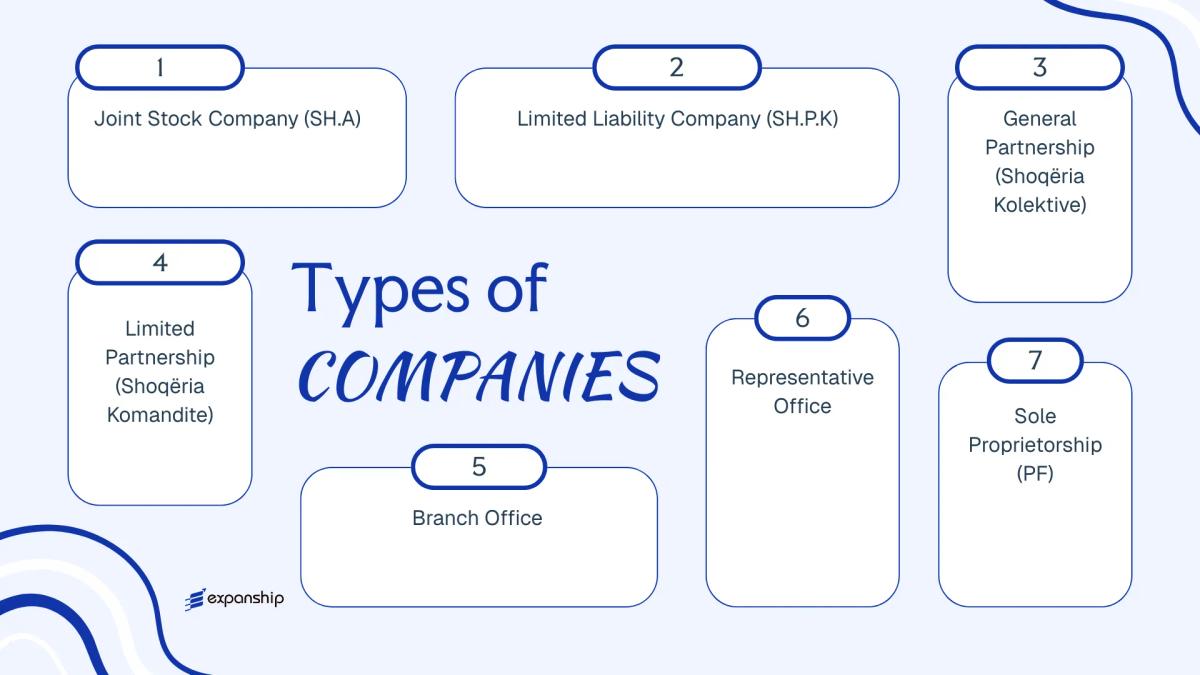
Businesses operating in the country can register under one of the following structures:
- Shoqëria Aksionare (SH.A) — Joint Stock Company
- Shoqëria me Përgjegjësi të Kufizuar (SH.P.K) — Limited Liability Company
- Shoqëria Kolektive — General Partnership
- Shoqëria Komandite — Limited Partnership
- Branch Office
- Representative Office
- Person Fizik (PF) — Sole Proprietorship
Each structure carries distinct liability rules, capital requirements, governance obligations, and tax treatment, all of which this article examines in turn.
An Overview of Business Structures in Albania
Albanian company law recognises six principal business structures, each governed primarily by Law No. 9901/2008 "On Entrepreneurs and Companies," as amended. Subsequent legislation, including Law No. 9723/2007 "On the National Registration Centre," established the procedural framework under which entities are formed and maintained. Each structure carries distinct implications for liability, governance, and permitted commercial activity.
Business Structures at a Glance
| Entity Type | Legal Form | Liability | Corporate Tax | Local Trading | Minimum Members | Regulatory Authority | Governing Act |
|---|---|---|---|---|---|---|---|
| Shoqëria Aksionare (SH.A) | Joint Stock Company | Limited to share capital | 15% flat rate | Permitted | 1 shareholder | QKB (National Business Centre) | Law No. 9901/2008 |
| Shoqëria me Përgjegjësi të Kufizuar (SH.P.K) | Limited Liability Company | Limited to contribution | 15% flat rate | Permitted | 1 member | QKB | Law No. 9901/2008 |
| Shoqëria Kolektive | General Partnership | Unlimited, joint | 15% flat rate | Permitted | 2 partners | QKB | Law No. 9901/2008 |
| Shoqëria Komandite | Limited Partnership | Mixed liability | 15% flat rate | Permitted | 2 partners (1 general, 1 limited) | QKB | Law No. 9901/2008 |
| Branch Office | Foreign branch | Parent bears liability | 15% on local profit | Permitted | N/A (parent entity) | QKB | Law No. 9901/2008 |
| Representative Office | Non-trading presence | Parent bears liability | Generally exempt | Not permitted | N/A (parent entity) | QKB | Law No. 9901/2008 |
| Person Fizik (PF) | Sole Proprietorship | Unlimited, personal | Progressive personal tax | Permitted | 1 individual | QKB | Law No. 9723/2007 |
Each of these structures is examined in full in the sections below.
Shoqëria Aksionare (SH.A) — Joint Stock Company
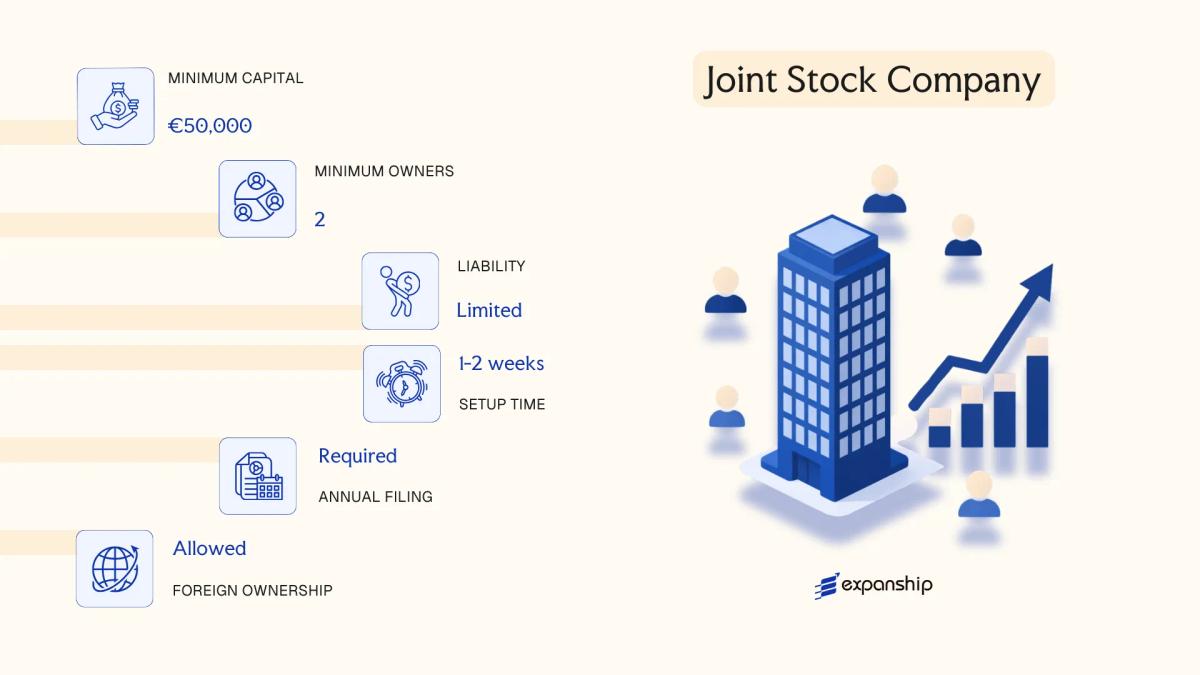
Governed by the Law on Entrepreneurs and Commercial Companies (Law No. 9901, dated 14 April 2008, as amended), the SHA joint stock company Albania is the most capital-intensive corporate structure available under Albanian law. The entity holds a distinct legal personality, separate from its shareholders, and liability is confined to the subscribed share capital.
Shares in a SH.A are freely transferable unless the articles of association impose restrictions, making this structure suited to businesses seeking external investment or a future public listing. Shoqëria Aksionare registration Albania follows a formal procedure administered through the National Business Centre (Qendra Kombëtare e Biznesit, QKB).
Key Characteristics
| Requirement | Detail | Notes |
|---|---|---|
| Legal Form | Joint Stock Company (Shoqëria Aksionare) | Separate legal personality; limited liability |
| Members | Shareholders (minimum 1; no maximum) | Single-shareholder SH.A is permitted under Albanian law |
| Governing Bodies | General Meeting, Board of Directors (or Supervisory Board + Management Board for two-tier structure) | Two-tier governance is optional but available |
| Registered Office | Physical address in Albania required | Registered with QKB; PO Box not accepted |
| Share Capital | Minimum ALL 3,500,000 (approx. EUR 35,000); must be denominated in Albanian Lek | At least 25% paid up at registration; remainder within 5 years |
| Share Transferability | Shares freely transferable by default | Restrictions may be written into the articles of association |
| Privacy | Shareholder and director details recorded in the QKB public register | No nominee shareholder provisions under standard Albanian law |
Focus Points
- Taxation: Subject to corporate income tax at 15%, VAT at the standard rate of 20% (registration threshold applies), and a 15% withholding tax on dividends paid to non-residents, subject to applicable double tax treaty relief.
- Annual Compliance: Mandatory annual financial statements; entities meeting two of three thresholds (turnover, assets, employees) require statutory audit by a licensed auditor.
- Treaty Access: Albania has an active network of double taxation agreements; a SH.A qualifies as a resident entity for treaty purposes, provided it meets substance requirements.
- Economic Substance: No formal substance legislation comparable to certain offshore regimes, but genuine management and control should be demonstrable for treaty benefits to apply.
- Conversion: A SH.A may be converted into another commercial form, including a SH.P.K, through a resolution of the General Meeting and re-registration at QKB.
Closing
The SH.A suits medium-to-large enterprises, holding structures, and businesses planning to raise capital through share issuance. Its principal advantage is unrestricted share transferability; the main drawback is the higher minimum capital requirement and more demanding governance obligations compared to other Albanian structures.
This entity type is best suited for businesses anticipating institutional investment, joint ventures with multiple shareholders, or eventual public listing on a regulated market.

Company Incorporation in Albania
Set up a Shoqëria Aksionare or other Albanian entity with end-to-end support from registration through to ongoing compliance.
Shoqëria me Përgjegjësi të Kufizuar (SH.P.K) — Limited Liability Company
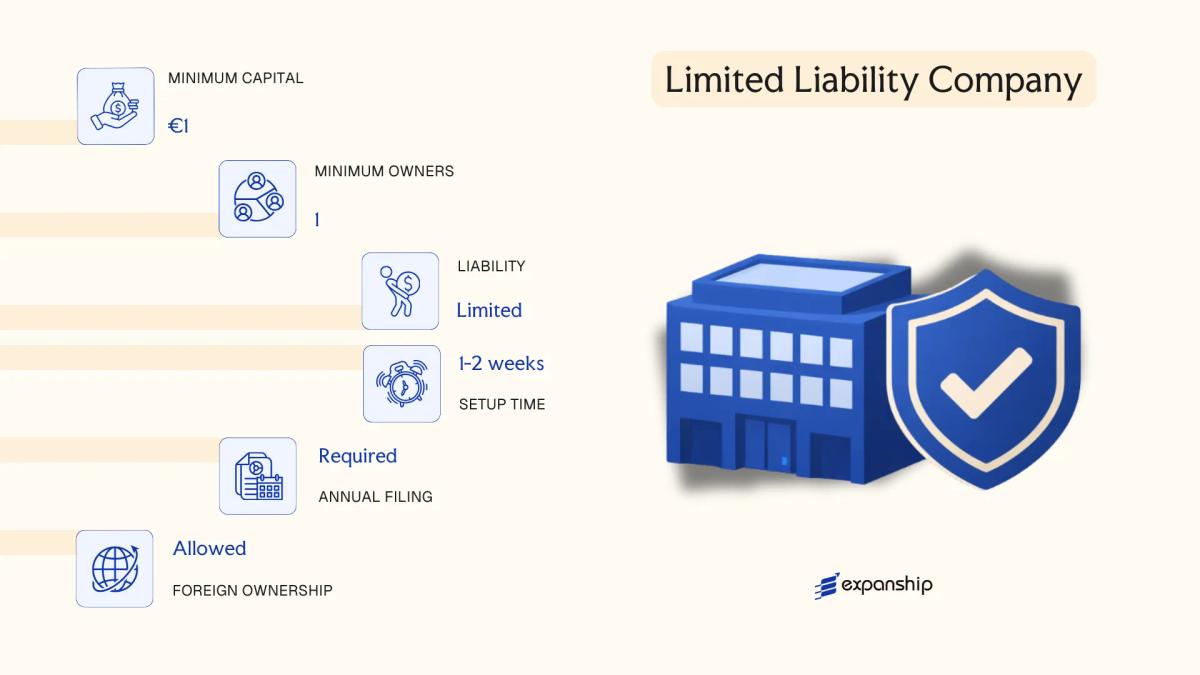
The SHPK limited liability company Albania is the most widely used corporate structure in the country, governed by Law No. 9901/2008 "On Entrepreneurs and Companies." As a separate legal entity, the SH.P.K carries its own rights and obligations distinct from those of its members, who bear no personal liability beyond their subscribed capital contributions.
Its hybrid character makes it suitable for both closely held ventures and subsidiaries of foreign groups. Formation and ongoing governance are less procedurally demanding than a joint stock company, while still offering full legal personality and the protection of limited liability.
Key Characteristics
| Requirement | Detail | Notes |
|---|---|---|
| Legal Form | Shoqëria me Përgjegjësi të Kufizuar (SH.P.K) | Registered with the National Registration Centre (QKB) |
| Members | 1–50 members (natural or legal persons) | Members hold ownership quotas, not shares |
| Management | One or more administrators (managers) | No board requirement; administrators may be foreign nationals |
| Local Presence | Registered address in Albania required | No mandatory resident administrator under general rules |
| Capital | Minimum ALL 100 (approx. €1); no maximum | Capital divided into quotas, not publicly tradeable shares |
| Privacy | Member details filed in the public QKB register | Beneficial ownership disclosure required under AML legislation |
Focus Points
- Taxation: Subject to 15% corporate income tax; standard VAT rate of 20% applies above the registration threshold; withholding tax of 8% on dividends distributed to non-residents; no stamp duty on capital contributions.
- Annual Compliance: Annual financial statements must be filed with the QKB; audit requirements depend on company size thresholds set under accounting legislation.
- Economic Substance: No formal economic substance regime exists, but tax residency determinations follow effective management and control principles.
- Treaty Access: Albania maintains a network of double tax treaties; SH.P.K entities qualify as residents for treaty purposes provided they meet residency conditions.
- Conversion: A SH.P.K may convert into a SH.A through a formal transformation procedure under Law No. 9901/2008, subject to member approval and capital requirements.
Closing
The SH.P.K suits trading operations, holding structures, and local service businesses where full limited liability is required without the compliance burden of a public company. Its primary constraint is the 50-member cap, which restricts equity-raising from a broad investor base.
Small to mid-sized foreign-owned subsidiaries, family-held trading companies, and investors seeking a straightforward Albanian corporate vehicle with capped personal liability.
Partnerships in Albania [General Partnership (Shoqëria Kolektive), Limited Partnership (Shoqëria Komandite)]
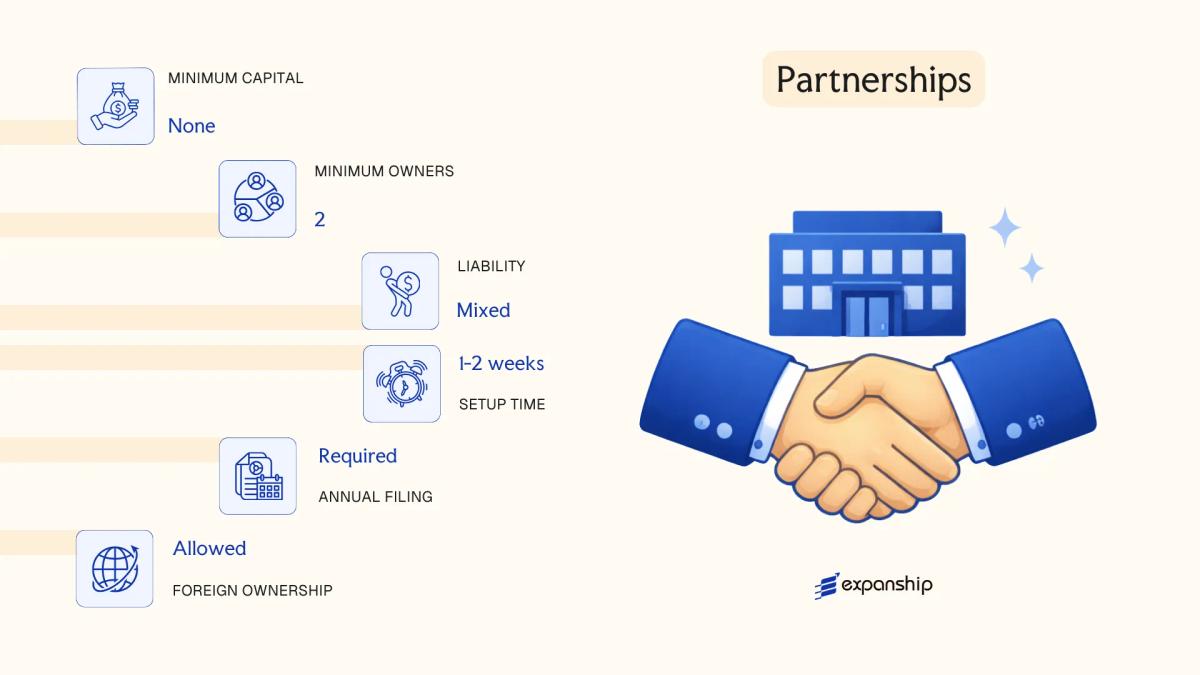
Albanian law recognises two partnership structures under the Law on Entrepreneurs and Commercial Companies (Law No. 9901, dated 14 April 2008): the Shoqëria Kolektive (general partnership) and the Shoqëria Komandite (limited partnership). Both are registered with the National Business Centre (QKB) and constitute separate legal entities, distinct from their partners.
Partnership company registration Albania follows a straightforward registration process, yet both structures carry characteristics that distinguish them sharply from capital-based entities. The general partnership holds all partners jointly and unlimitedly liable for the firm's obligations, while the limited partnership introduces a two-tier partner structure — general partners bear unlimited liability, and limited partners are exposed only to the extent of their agreed contribution.
Key Characteristics
| Requirement | Shoqëria Kolektive (General) | Shoqëria Komandite (Limited) |
|---|---|---|
| Legal Form | Separate legal entity | Separate legal entity |
| Members | Partners (minimum 2, no statutory maximum) | At least 1 general partner + 1 limited partner |
| Liability | All partners: unlimited, joint and several | General partners: unlimited; Limited partners: capped at contribution |
| Registered Office | Required in Albania (no registered agent mandate) | Required in Albania |
| Minimum Capital | No statutory minimum | No statutory minimum |
| Management | All partners entitled to manage unless restricted by partnership agreement | Only general partners may manage; limited partners excluded from management |
Focus Points
- Taxation: Partnerships are treated as pass-through entities for tax purposes; partners are taxed individually on their share of profits under Albania's personal income tax rules, with the standard corporate tax rate of 15% applying where the entity is treated as a taxable person — VAT registration is required if annual turnover exceeds the statutory threshold.
- Annual Compliance: Partnerships must file annual financial statements with the QKB and maintain accounting records in accordance with Albanian accounting legislation.
- Treaty Access: Pass-through treatment may limit direct access to Albania's double tax treaty network; treaty eligibility depends on the partner's residency and applicable treaty provisions.
- Conversion: A general partnership may be converted into a limited partnership or another commercial form through a formal amendment process registered with the QKB.
- Restrictions: Limited partners who participate in management lose their liability protection under Law No. 9901 and are treated as general partners.
Sub-Types
Shoqëria Kolektive (General Partnership)
Every partner holds equal management rights and bears unlimited personal liability. This structure is typically used by small professional firms or family-run businesses where all principals intend to participate actively in operations.
Shoqëria Komandite (Limited Partnership)
The defining feature is the separation between active general partners and passive limited partners. This form suits arrangements where investors wish to contribute capital without assuming operational control or unlimited exposure.
Closing
Both structures are better suited to small, closely-held operations or professional service arrangements than to businesses seeking external investment or scalable growth, given the unlimited liability exposure for at least one class of partner.
Albanian partnerships are most appropriate for small professional practices or family businesses where partners have an established trust relationship and limited external capital requirements.
Consultation on Choosing the Right Business Structure in Albania
Speak with our team to determine whether a partnership or an alternative Albanian entity type fits your operational and liability requirements.
Foreign Business Presence in Albania [Branch Office, Representative Office]
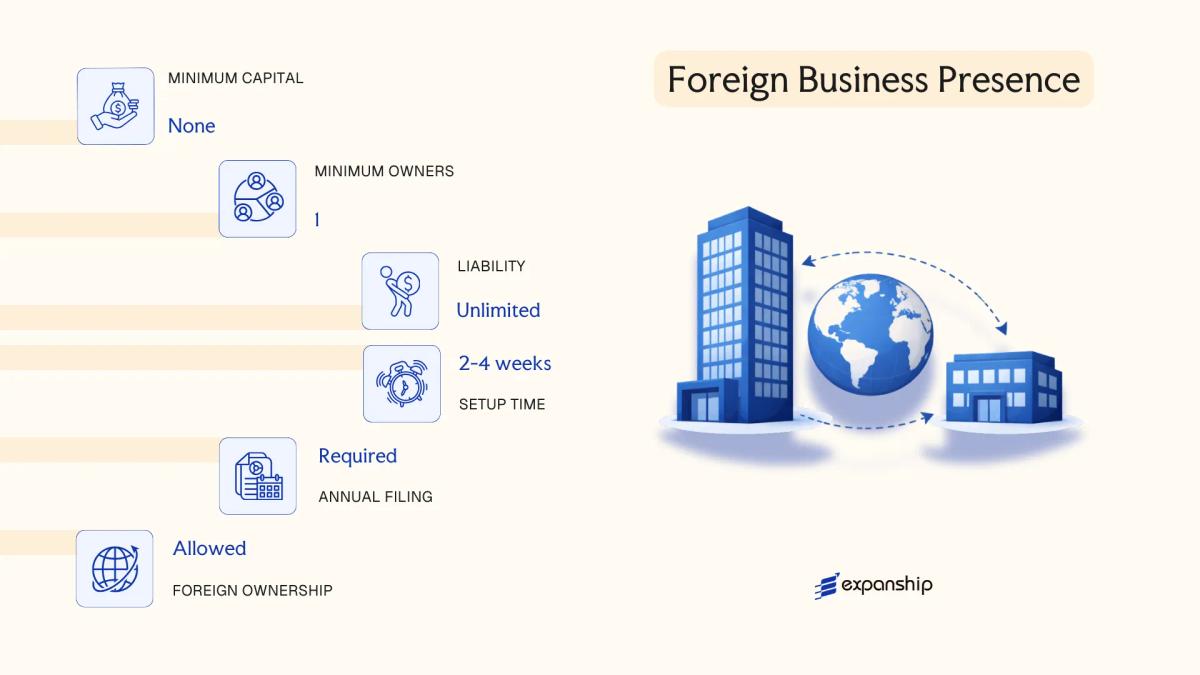
Establishing a foreign company branch office Albania falls under the Law on Entrepreneurs and Commercial Companies (Law No. 9901/2008), which governs both branch offices and representative offices as the two primary vehicles for foreign business presence. Neither form constitutes a separate legal entity — each remains an extension of the parent company, which retains full liability for its Albanian operations.
Registration is handled through the National Business Center (QKB), and the parent company must submit authenticated corporate documents alongside a designated local representative's details. A branch may conduct commercial activities directly; a representative office is restricted to non-revenue-generating functions such as market research or liaison work.
Key Characteristics
| Requirement | Branch Office | Representative Office |
|---|---|---|
| Legal Personality | None — extension of parent | None — extension of parent |
| Commercial Activity | Permitted | Not permitted |
| Parent Liability | Full and unlimited | Full and unlimited |
| Local Representative | Mandatory (authorized agent) | Mandatory (authorized agent) |
| Registered Address | Required in Albania | Required in Albania |
| Minimum Capital | None prescribed | None prescribed |
Focus Points
- Taxation: Branch profits are subject to the standard 15% corporate income tax; VAT registration is required if taxable turnover exceeds the statutory threshold; withholding tax applies to remitted profits.
- Economic Substance: No formal substance regime, but the branch must maintain a functional local address and a named representative.
- Annual Compliance: Annual financial statements must be filed with QKB; branches follow the same accounting obligations as resident entities.
- Treaty Access: Access to Albania's double tax treaties depends on treaty terms — some treaties may not extend benefits to branches as they would to resident subsidiaries.
- Restrictions: A representative office cannot invoice clients, sign commercial contracts, or generate revenue in its own right.
Sub-Types
Branch Office
A branch conducts full commercial operations on behalf of the foreign parent and is the form used when your business needs to execute contracts, employ staff locally, or generate revenue directly. It mirrors an operational subsidiary in function, without separate incorporation.
Representative Office
Used exclusively for promotional, informational, or preparatory activities, this form suits businesses exploring the market before committing to a full operational presence. Its activity scope is strictly non-commercial, limiting exposure but also limiting utility as the business grows.
Closing
A branch office suits foreign firms that require an operational footprint without incorporating a standalone entity, while a representative office fits early-stage market assessment where commercial activity is not yet intended. The key limitation for both is the absence of liability protection — the parent remains fully exposed to all obligations incurred locally.
Foreign companies testing or entering the Albanian market without committing to a separately incorporated local entity.
Person Fizik (PF) — Sole Proprietorship
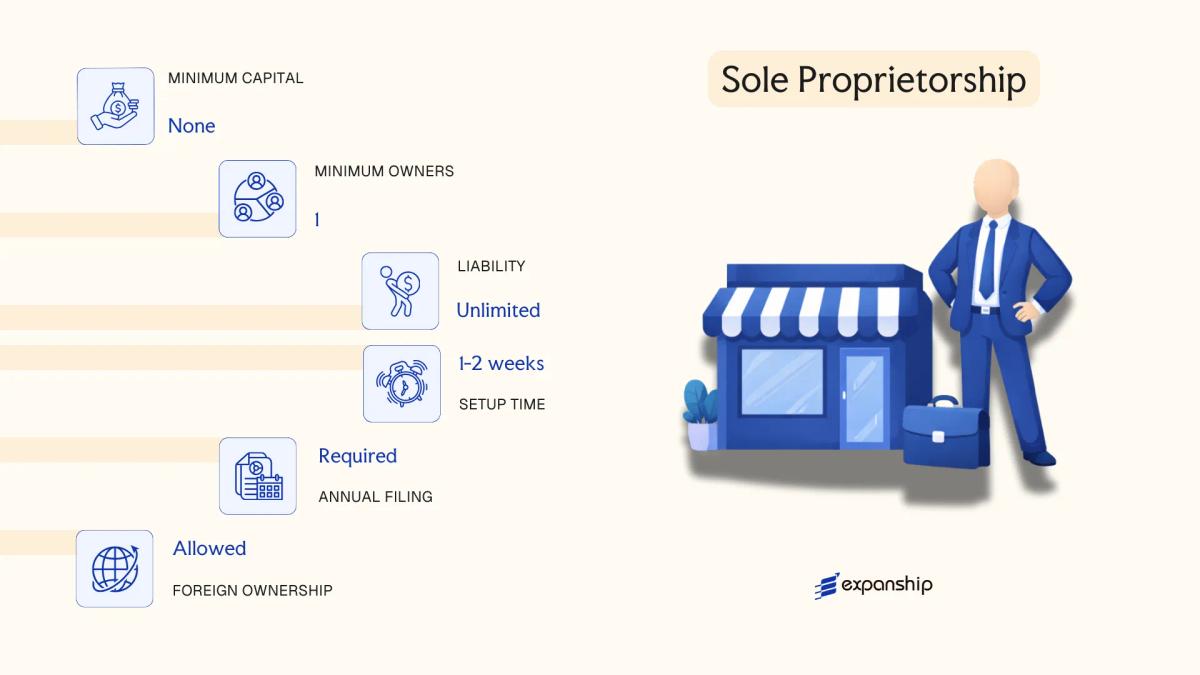
The Person Fizik sole proprietorship Albania represents the simplest form of business registration available under Albanian law. The entity is governed primarily by Law No. 9901/2008 "On Entrepreneurs and Commercial Companies," as amended. Unlike capital-based entities, a PF carries no separate legal personality — the proprietor and the business are legally one, meaning personal assets are fully exposed to business liabilities.
Registration is handled through the National Business Center (QKB), the unified registration authority overseeing all commercial entities. PF registration Albania is relatively straightforward, with no minimum capital requirement and a single-step process at the QKB.
Key Characteristics
| Requirement | Detail | Notes |
|---|---|---|
| Legal Form | Unincorporated sole proprietorship | No separate legal personality from the owner |
| Members | Single individual proprietor | No shareholders, directors, or partners |
| Local Presence | Registered address in Albania required | Must be a physical, verifiable address |
| Capital | No minimum capital requirement | Contributions are entirely at the proprietor's discretion |
| Liability | Unlimited personal liability | Personal assets are directly exposed to business debts |
| Privacy | Proprietor's name appears on public register | No separation between personal and business identity |
Focus Points
- Taxation: Subject to personal income tax on business profit; standard VAT registration threshold applies; no corporate income tax applies to this structure.
- Annual Compliance: Annual financial declaration required with the Tax Administration (Administrata Tatimore e Shqipërisë); simplified bookkeeping rules apply below certain turnover thresholds.
- Treaty Access: PFs do not benefit from double tax treaty provisions available to corporate entities, limiting international tax planning options.
- Conversion: A PF can be converted into an SH.P.K or other corporate form through the QKB, though the process requires full re-registration rather than a structural transformation.
- Restrictions: Foreign nationals face additional requirements to establish a PF, including proof of legal residence or work authorisation in Albania.
Recommendations
A Person Fizik suits small-scale local trading, freelance services, and individual artisans operating with low overhead and no cross-border structuring needs. The absence of a capital requirement reduces setup costs, but unlimited personal liability makes this structure unsuitable for any business carrying meaningful commercial or financial risk.
Local freelancers, sole traders, and individual service providers with no employees and minimal liability exposure.
How to Choose the Right Entity Type in Albania
Selecting how to choose the right business entity in Albania requires weighing several structural, fiscal, and operational variables before filing with the National Registration Centre (QKB).
Why Your Entity Choice Matters
The structure you register has binding legal consequences from day one.
- Operating through a representative office while conducting revenue-generating transactions violates its permitted scope under Albanian law, exposing the business to administrative penalties and potential deregistration.
- Registering as a sole proprietor (Person Fizik) when your activity requires liability separation means personal assets remain fully exposed to business creditors with no legal buffer.
- Choosing a structure without considering Albania's flat 15% corporate income tax rate and applicable double taxation agreements can result in avoidable withholding tax costs on cross-border payments.
- Forming a SH.A when a two-person SH.P.K would suffice creates mandatory audit obligations and higher maintenance costs that are disproportionate for small or single-activity firms.
Key Factors to Consider
- Business Activity: Active trading, passive asset-holding, and regulated sectors such as banking or insurance each require distinct structures under Albanian commercial law.
- Ownership Structure: A single-member SH.P.K suits sole ownership, while multi-investor arrangements may require the governance framework of a SH.A.
- Tax Objectives: Your eligibility for treaty benefits under Albania's double taxation agreements depends on the entity type and its tax residency status.
- Liability Exposure: Whether your business activities carry litigation or contractual risk determines whether unlimited personal liability (partnerships, sole proprietorship) is acceptable.
- Substance Capacity: If you cannot maintain a genuine operational presence locally, certain structures will face scrutiny from the Albanian tax authorities.
- Exit and Continuity: Not all entity types permit straightforward conversion or redomiciliation; your long-term plans should inform the initial choice.
The full text of Law No. 9901/2008 "On Entrepreneurs and Commercial Companies" sets out the legal requirements for each structure registered in Albania.
Compliance Services for Companies in Albania
Ongoing compliance support for Albanian-registered entities, including annual filings, statutory obligations, and regulatory reporting.
Conclusion
Albania company formation key takeaways point to one consistent pattern: entity choice determines your tax exposure, liability profile, and administrative burden from day one. The SH.P.K remains the most registered structure in the country, favored by small and medium enterprises for its single-member option and contained compliance requirements. The SH.A suits capital-intensive ventures where share transferability and investor participation are priorities. Partnerships carry unlimited liability, making them appropriate only where the principals have deliberate reasons to accept that exposure. Branch offices bind the foreign parent directly to Albanian obligations, while representative offices are structurally restricted from generating revenue. Sole proprietorships carry the lightest registration burden but the greatest personal financial risk. Albania continues to expand its double tax treaty network and align its corporate framework with EU standards, a trajectory that gradually broadens the range of viable cross-border structures available to foreign investors. Expanship's team works directly with these entity types across Albanian registration and compliance processes.
How Expanship Can Assist You
Expanship Albania company incorporation services cover the full registration process — from selecting the right entity structure, whether an SH.P.K or SH.A, to filing documentation with the National Business Center (QKB), Albania's central registry for commercial entities. As a corporate services provider in Albania, Expanship works directly with the QKB and other relevant authorities to keep your registration accurate and your compliance obligations met.
From day one, our team handles the practical work so your business can move forward without administrative delays:
- Document preparation, notarization, and legalization
- Registered agent and registered office provision in Albania
- Government filing and QKB liaison
- Post-incorporation compliance management, including annual reporting
- Banking introduction assistance for corporate account opening
Reach out to Expanship Albania to discuss your incorporation requirements directly with our team.
Frequently Asked Questions (FAQ)
The Shoqëria me Përgjegjësi të Kufizuar (SH.P.K) is the most frequently formed entity. Its lower minimum capital requirement and flexible governance structure make it the default choice for small-to-medium businesses and foreign investors entering the market.
A Branch Office has no separate legal personality and its parent company bears full liability for Albanian operations, while a SH.P.K is an independent legal entity with liability limited to its registered capital. For tax purposes, both are subject to Albanian corporate income tax on locally sourced income, but the SH.P.K offers cleaner structural separation and broader operational rights.
Among Albanian structures, the SH.P.K provides a comparatively restrained disclosure profile, as beneficial ownership information is filed with the National Registration Centre (QKB) but is not always fully searchable through public interfaces. Nominee arrangements are legally permissible, though ultimate beneficial ownership must still be declared under Law No. 112/2020 on the prevention of money laundering.
No. A Shoqëria Kolektive (General Partnership) and Shoqëria Komandite (Limited Partnership) each require a minimum of two partners by their legal definition under the Law on Entrepreneurs and Commercial Companies. A SH.P.K and SH.A, however, can each be formed by a single shareholder.
Foreign individuals and legal entities may register a SH.P.K, SH.A, Branch Office, or Representative Office without restrictions on foreign ownership. Albania's Law on Foreign Investment guarantees national treatment, meaning foreign investors face no additional licensing barriers solely on the basis of nationality for standard commercial activities.
Albanian law permits the transformation of one commercial entity type into another, including conversion from a SH.P.K to a SH.A, subject to compliance with the procedural requirements set out in the Law on Entrepreneurs and Commercial Companies. The process involves shareholder resolutions, updated constitutional documents, and re-registration with the QKB.
Not all. The SH.P.K, SH.A, and partnerships registered as legal entities hold separate legal personality under Albanian law, while a Representative Office does not. A Sole Proprietorship (Person Fizik) also lacks legal separation from its owner, meaning personal assets remain exposed to business liabilities.
The Person Fizik (Sole Proprietorship) has the lightest statutory burden, with simplified accounting requirements and no mandatory audit threshold. By contrast, a SH.A faces the most extensive obligations, including mandatory external audits once it meets size thresholds defined under Albanian accounting legislation.
Legal Disclaimer
The information provided in this article is for general informational purposes only and does not constitute legal, tax, or professional advice. While we strive to ensure the accuracy and timeliness of the content, laws and regulations are subject to change, and the application of laws can vary widely based on specific facts and circumstances.
Readers should not act upon this information without seeking professional counsel tailored to their individual situation. Expanship and its authors disclaim any liability for actions taken or not taken based on the content of this article.
For specific advice regarding your business setup, compliance requirements, or any legal matters, please consult with qualified legal and tax professionals in the relevant jurisdiction.