
Key Takeaways
- Albania's 15% flat corporate income tax rate applies uniformly to resident companies, giving foreign-held entities a predictable and comparatively low tax burden relative to most EU member states.
- The Shoqëri me Përgjegjësi të Kufizuar (SHPK) structure imposes no minimum capital requirement, allowing foreign investors to incorporate without committing capital reserves to satisfy formation thresholds.
- Registration through the QKB (National Business Center) consolidates business registration and licensing under a single public authority, reducing the administrative friction that typically delays market entry in comparable jurisdictions.
- Foreign nationals face no general ownership restrictions under Albanian commercial law, meaning a fully foreign-held SHPK can be established without requiring a local partner or nominee shareholder.
Albania is an independent republic in southeastern Europe, sharing borders with Kosovo, North Macedonia, Greece, and Montenegro, with direct Adriatic and Ionian coastline connecting it to Italy and broader European markets. The benefits of incorporating in Albania draw increasing attention from foreign investors, partly because the country maintains EU candidate status and has undertaken sustained regulatory reforms aligned with European standards. Company registration is administered by the QKB, the National Business Center, which serves as the primary public authority for business registration and licensing.
Foreign nationals face no general restrictions on ownership, and the legal framework permits 100% foreign-held entities across most sectors. The Shoqëri me Përgjegjësi të Kufizuar, known as the SHPK, is the most common vehicle used by international businesses establishing a presence in the country. From a tax perspective, the regime is broadly low-tax in character, with a flat corporate rate applied uniformly to resident companies. This article examines the principal advantages that Albania company formation offers to foreign investors and business operators.
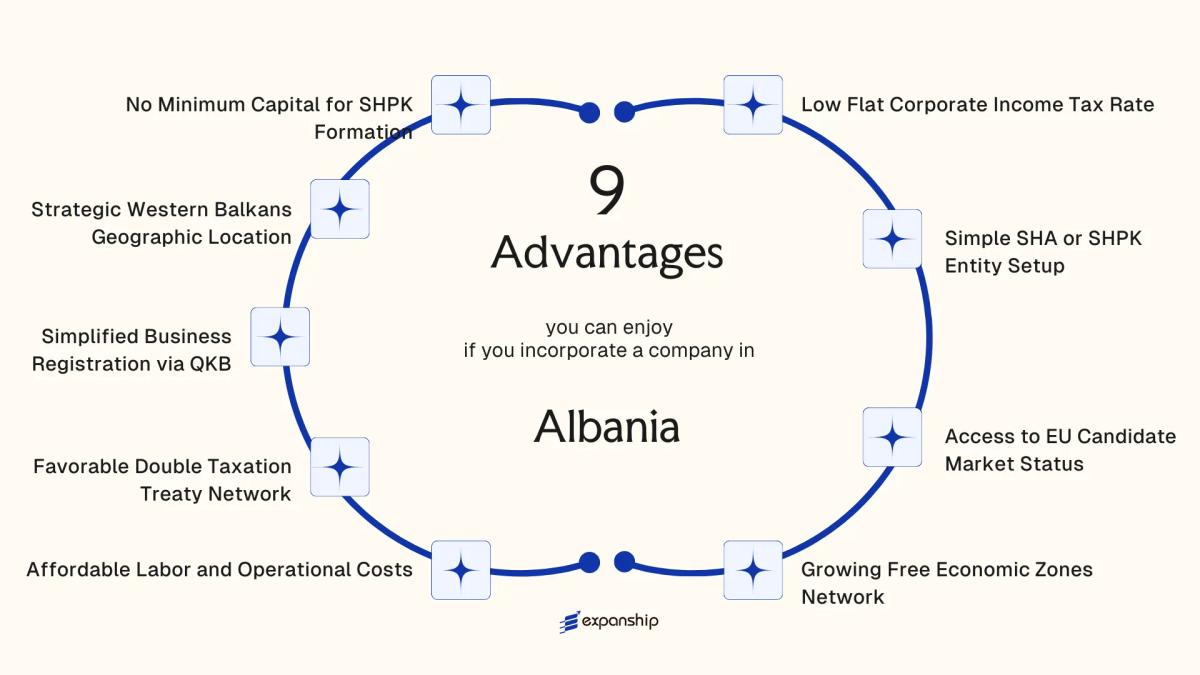
Low Flat Corporate Income Tax Rate
Albania applies a flat corporate income tax rate of 15%, which is governed under the Law on Income Tax (Law No. 8438/1998, as subsequently amended). The Albania flat corporate income tax advantage lies not just in the rate itself, but in its structural simplicity — there are no tiered brackets to calculate against, which reduces the administrative complexity of tax planning for foreign-owned entities.
A Rate That Holds Against Regional Benchmarks
At 15%, the rate sits below the EU average of approximately 21%, and matches or undercuts several neighboring jurisdictions in the Western Balkans. For a foreign investor structuring a holding company or an operating subsidiary, a lower and predictable rate directly affects retained earnings available for reinvestment or repatriation.
How Small Businesses Are Treated Differently
Entities with annual turnover below ALL 14 million are subject to a reduced 0% corporate tax rate, though the specific threshold and conditions are defined under current fiscal legislation. This tiered entry point means early-stage businesses can establish a presence with minimal tax exposure during initial operating years.
A flat 15% rate with no bracket calculations simplifies your annual tax filing obligations and makes profit forecasting more predictable from day one.
Simple SHA or SHPK Entity Setup
Both Albanian business entity types available to foreign investors — the Shoqëri me Përgjegjësi të Kufizuar (SHPK) and the Shoqëri Aksionare (SHA) — are governed under Law No. 9901/2008 "On Entrepreneurs and Commercial Companies." Each structure is legally straightforward, and the formation process does not require specialized local legal counsel to initiate.
Albania SHA SHPK entity benefits are most visible in how the two structures scale. The SHPK suits smaller or single-investor operations, while the SHA accommodates multi-shareholder arrangements with transferable stock — making it viable for firms planning external investment rounds or eventual public listing.
Foreign founders benefit from several structural features that reduce early administrative friction:
- A single founder can establish an SHPK, removing the need to source local partners
- The SHA can issue multiple share classes, giving investors flexibility in structuring equity distribution
- Neither entity type requires a local resident director as a statutory condition under Albanian law
- Both structures permit 100% foreign ownership without sector restrictions in most industries
Registration is handled through the Qendra Kombëtare e Biznesit (QKB), the national business registration center, which processes new company applications through a unified electronic system. This centralization means your entity interacts with one authority for initial registration rather than multiple agencies simultaneously.

Company Incorporation in Albania
Register your SHPK or SHA in Albania through the QKB with full compliance support from Expanship.
Access to EU Candidate Market Status
Albania EU candidate status business advantages extend beyond symbolic alignment with European standards. Granted official EU candidate status in 2014, the country has since advanced through structured accession negotiations under the Stabilisation and Association Agreement (SAA), which has been in force since 2009. For a foreign business, this treaty framework matters practically: it governs preferential trade terms, gradual harmonisation of technical standards, and regulatory convergence with EU norms.
| Factor | Detail |
|---|---|
| EU Candidate Status Granted | 2014 |
| Stabilisation and Association Agreement (SAA) | In force since 2009 |
| Accession Negotiation Chapters Opened | Ongoing since 2022 screening |
| Regulatory Alignment Direction | Progressive convergence with EU acquis |
Companies registered in Albania operate within a legal environment that is progressively adopting EU commercial, consumer protection, and competition law through the accession process. This creates a degree of regulatory predictability that firms targeting European markets will recognise. For businesses investing in Albania as an EU candidate country, this trajectory reduces the gap between local compliance and EU-standard operations over time.
Proximity to EU norms also affects how Albanian entities are perceived by European counterparties and financial institutions. A firm incorporated here can engage in cross-border commercial relationships with greater structural credibility than in jurisdictions with no EU alignment pathway. The SAA's trade provisions further support this by facilitating preferential access conditions for goods and services moving between Albania and EU member states.
Growing Free Economic Zones Network
Albania free economic zones business benefits have expanded considerably since the government introduced the Free Economic Zones Law (Law No. 26/2020), which created a formal regulatory basis for designated zone operations. These zones offer qualifying businesses a structured environment with fiscal and administrative incentives that differ from the standard national regime.
Under this framework, entities operating within approved free zones can benefit from reduced customs procedures, VAT relief on imports used for production, and preferential treatment on certain profit distributions. For a foreign investor establishing a manufacturing, logistics, or processing business, this reduces the operating cost base from day one rather than through retrospective tax credits.
The National Agency for Investment and Development (AIDA) oversees zone eligibility and investor applications, providing a defined entry point for businesses seeking zone status.
Keep these points in mind:
- Zone benefits apply only to activities conducted within the designated perimeter
- Eligibility criteria under Law No. 26/2020 vary by sector and investment size
- VAT exemptions apply to imported inputs, not necessarily domestic transactions
- Operating outside the approved zone boundary forfeits zone-specific incentives
AIDA maintains the current list of operational and planned zones, so verifying active zones before site selection is necessary.
Albania's free zone framework was introduced as recently as 2020, meaning many of the designated zones are still in early development stages, giving early entrants the ability to negotiate infrastructure terms directly with zone authorities.
Affordable Labor and Operational Costs
Albania affordable labor costs for businesses represent a tangible financial advantage, particularly when measured against Western European and even regional benchmarks. The national minimum wage, set periodically by Council of Ministers decision, has historically remained well below EU member state floors, which directly reduces your fixed payroll baseline from day one.
Wage Levels and What They Mean for Payroll Planning
Gross average monthly wages in Albania have remained among the lowest in the European continent, giving foreign firms that establish local operations a measurable cost differential on recurring staff expenditure. For labor-intensive functions such as back-office processing, software development, or customer support, this gap translates into a sustained reduction in operating expenses rather than a one-time saving.
Social contribution obligations are governed under Albanian labor and social insurance legislation, with employer contributions covering pension, health, and unemployment funds. These statutory contribution rates, while subject to periodic adjustment, are structured at levels that keep total employment costs competitive against comparable workforce markets in the region.
Office and Infrastructure Costs
Commercial rental rates in Tirana, where most foreign entities choose to register and operate, remain substantially lower than in EU capital cities, allowing your firm to maintain a physical presence without the overhead burden common in Western markets. Utility costs and general administrative expenses follow a similar pattern, keeping operational overheads proportionate to the size of the business rather than inflated by geography.
Plan Your Entry into the Albanian Market
Speak with an Expanship specialist about structuring your Albanian company to fully capture the country's cost advantages, from payroll planning to office setup.
Favorable Double Taxation Treaty Network
Albania's double taxation treaty benefits stem from a network of agreements that eliminate the risk of the same income being taxed twice — once in Albania and once in the investor's home country. For foreign business owners routing dividends, royalties, or service fees through an Albanian entity, these treaties directly reduce withholding tax exposure and clarify which jurisdiction holds taxing rights.
- Albania has concluded double tax agreements with over 40 countries, including major trading partners such as Germany, Italy, Turkey, Switzerland, and China, giving your business access to reduced withholding rates on passive income flows.
- Under several of these agreements, withholding tax on dividends can fall to 5%, compared to the domestic rate that would otherwise apply without treaty protection.
- Treaty provisions cover not only dividends but also interest and royalties, which matters for holding structures and IP arrangements where cross-border payments are routine.
- Albania tax treaty benefits for businesses also include permanent establishment definitions, which provide legal certainty about when your foreign operations create a taxable presence.
- The treaties are grounded in the OECD Model Convention framework, meaning the interpretive standards are familiar to tax advisors in most contracting states.
- Treaty eligibility generally requires that the recipient entity qualifies as a tax resident under Albanian law, governed by the Law on Income Tax No. 8438/1998 and its subsequent amendments.
Simplified Business Registration via QKB
Albania QKB business registration benefits begin at the registration desk itself. The Qendra Kombëtare e Biznesit (QKB), or National Business Centre, operates as a one-stop registration authority that consolidates company formation, tax registration, and social security enrollment into a single administrative process.
For a foreign business owner, this structure eliminates the need to engage multiple government offices in sequence. A new entity can receive its NIPT (tax identification number) and commercial registration simultaneously, reducing setup time to as little as one business day in straightforward cases.
The QKB also provides an online registration portal, allowing foreign applicants to initiate the process without physical presence in Tirana. This is governed under Law No. 9723 of 2007 on the National Registration Centre, which established the unified registration framework.
A hypothetical scenario: A foreign entrepreneur registering a SHPK remotely through the QKB online portal, without requiring a local representative or in-person attendance, avoids the legal fees and logistical costs typically associated with multi-agency registration procedures common in neighboring Western Balkans jurisdictions, where processes can span two to four weeks across separate bodies.
Strategic Western Balkans Geographic Location
Albania's geographic position gives your business direct physical access to multiple distinct markets from a single base. Bordering North Macedonia, Kosovo, Montenegro, and Greece, with the Adriatic and Ionian coasts facing Italy, a firm registered here sits within reach of both Western Balkan trade corridors and EU member-state ports without needing secondary regional offices.
The Albania Western Balkans strategic location advantages become concrete when you consider freight and logistics. The Port of Durrës is the largest commercial port in the Western Balkans by cargo volume, connecting directly to Italian ports like Bari and Brindisi. Combined with the Trans-Adriatic Pipeline corridor and ongoing investments under the Western Balkans Connectivity Agenda, physical supply chains through this territory carry real cost and time advantages.
For regional market access, the CEFTA agreement — of which Albania is a signatory — removes tariff barriers across participating Western Balkan economies. This means a company registered here can trade across the region under preferential conditions without needing separate legal presences in each country.
- Adriatic coast access to EU (Italy) via ferry routes
- Land borders with four non-EU Western Balkan jurisdictions
- CEFTA preferential trade across the region
- Durrës port as a primary regional freight hub
CEFTA preferential rates apply to goods meeting the agreement's rules-of-origin requirements, so your product's manufacturing source affects whether tariff benefits actually apply.
No Minimum Capital for SHPK Formation
Under Albanian law, a Shoqëri me Përgjegjësi të Kufizuar (SHPK) carries no statutory minimum share capital requirement. The Albania SHPK no minimum capital advantage means you can legally register a fully operational limited liability entity with whatever initial capital your business plan requires, including a nominal amount. This removes a financial barrier that exists in many other jurisdictions and makes entry practical for early-stage businesses or holding structures that do not need significant upfront assets.
Many European jurisdictions impose minimum capital thresholds ranging from EUR 1,000 to EUR 25,000 before a limited liability company can be incorporated. An Albanian SHPK faces no such threshold, so capital that would otherwise be locked into a statutory reserve can be deployed directly into operations.
The practical implication for a foreign founder is straightforward:
- Your initial registered capital does not need to reflect your operating budget or investment volume
- A single-member SHPK can be formed with a token capital contribution and scaled as the business generates revenue
- There is no requirement to deposit capital into a blocked account prior to registration with the Qendra Kombëtare e Biznesit (QKB)
This flexibility applies regardless of shareholder nationality. Foreign individuals and foreign legal entities can form an SHPK on the same capital terms as Albanian residents, with ownership rights governed by Law No. 9901 "On Merchants and Commercial Companies." The absence of a minimum capital rule also reduces the formality of notarization requirements tied to capital verification, which shortens the overall incorporation timeline.
Why Albania Stands Out Against Regional Competitors
Comparing Albania vs regional competitors on business advantages requires selecting jurisdictions that target a similar investor profile. North Macedonia, Serbia, and Montenegro are the most relevant benchmarks: all three operate within the Western Balkans framework, compete for the same foreign direct investment, and offer comparable incorporation structures. The comparison is instructive precisely because the differences are granular rather than dramatic.
Where the picture becomes clearer is in the combination of factors rather than any single metric. A 15% flat corporate tax rate under the Law on Income Tax, zero minimum capital for SHPK formation, and registration processed through the National Business Centre (QKB) within days collectively produce a cost and time profile that several neighbouring jurisdictions do not match simultaneously. Montenegro's corporate tax rate sits at 9%, lower in isolation, but its smaller domestic market and more limited treaty network affect the overall picture for trade-oriented entities.
| Parameter | Albania | North Macedonia | Serbia | Montenegro |
|---|---|---|---|---|
| Corporate Tax Rate | 15% flat | 10% flat | 15% flat | 9% flat |
| Minimum Share Capital (LLC equivalent) | None | None | RSD 100 (nominal) | None |
| Registration Body | QKB | Central Registry | APR | CRPS |
| EU Candidate Status | Yes (since 2014) | Yes (since 2005) | Yes (since 2012) | Yes (since 2010) |
| Free Economic Zones | Yes | Yes | Yes | Limited |
| Standard VAT Rate | 20% | 18% | 20% | 21% |
Compliance Services for Companies in Albania
Maintain good standing with Albanian regulatory requirements, from annual filings to tax reporting obligations under local law.
Conclusion
Albania's combination of a 15% flat corporate tax rate, a zero-minimum-capital SHPK structure, and registration processed through the QKB within a matter of days produces a formation environment that is both cost-efficient and administratively straightforward for foreign operators. The benefits of incorporating in Albania are most tangible for businesses that prioritize fast entry, low overhead, and access to a Western Balkans market connected by road and rail to multiple EU borders.
Those advantages hold particular weight when your business is structured to take full benefit of Albania's double taxation treaty network or its emerging free economic zones, where preferential conditions apply to qualifying activities. The fit varies depending on your industry, the volume of cross-border transactions you expect, and whether your entity type aligns with the legal requirements under Albanian commercial law.
For businesses that meet those conditions, the regulatory and fiscal framework in place presents a credible case for incorporation. The next step is translating that general case into a formation plan that reflects your specific ownership structure, tax residency position, and operational timeline.
Start Your Albanian Company with Expanship Today
Incorporating in Albania with Expanship begins with understanding which entity structure fits your objectives, whether a SHPK or SHA, and what ongoing obligations apply under Albanian law. Expanship works directly with the Qendra Kombëtare e Biznesit (QKB), the national business registration center, to manage the procedural side of formation and post-incorporation compliance on your behalf.
From document preparation through to maintaining a registered office address, the service scope covers the full formation and maintenance cycle:
- Document preparation and notarization for QKB submission
- Registered agent and legal address provision in Albania
- Government filing and direct liaison with QKB and relevant tax authorities
- Post-incorporation compliance management, including annual reporting obligations
- Banking introduction assistance with locally operating financial institutions
- Legalization and apostille coordination for foreign-sourced documentation
Expanship Albania is available to discuss your formation requirements.
Frequently Asked Questions (FAQ)
The standard corporate income tax rate in Albania is 15%, applied as a flat rate on taxable profit. Businesses with annual turnover below ALL 14 million are subject to a reduced tax regime, effectively lowering the burden for smaller operations. This threshold and the applicable reduced rates are set under the Law on Income Tax and are subject to periodic adjustment through the annual Finance Law.
Registration through the QKB can typically be completed within one to several business days once all documentation is in order. Foreign applicants are generally required to submit identification documents, a registered address in Albania, and the founding act of the SHPK. Notarization and apostille requirements on foreign-issued documents may extend the overall preparation timeline, though the QKB registration itself is processed electronically.
Albania has concluded double taxation agreements with a number of countries across Europe, the Middle East, and Asia, including several EU member states and regional trading partners. These treaties generally cover income from dividends, interest, royalties, and business profits, reducing or eliminating withholding tax obligations at source. The exact rates and covered income categories vary by treaty, so the specific agreement between Albania and your home jurisdiction should be reviewed directly.
Labor costs in Albania remain among the lower ones in the Western Balkans, with the national minimum wage set by Council of Ministers decision and reviewed periodically. Office rental costs in Tirana are generally below those in regional capitals such as Belgrade or Skopje, though the gap varies by district and property type. These figures reflect general market conditions rather than a fixed statutory benchmark and should be verified against current market data.
Free economic zone operators in Albania are subject to the Law on Free Zones, which sets out the conditions for maintaining zone status, including investment thresholds and operational requirements. Failure to meet these obligations can result in revocation of zone privileges, including the loss of applicable tax exemptions and customs benefits. The administering body for each zone oversees compliance monitoring, and penalties or de-registration procedures follow the terms specified in the relevant concession or operating agreement.
There is no minimum share capital requirement for forming a SHPK under Albanian company law, which allows founders to set the capital at any amount they consider appropriate. Sector-specific exceptions apply in regulated industries such as banking, insurance, and financial services, where the Bank of Albania or the Financial Supervisory Authority may impose statutory minimum capital thresholds as a licensing condition. Outside these regulated sectors, the absence of a capital floor gives founders full discretion over initial capitalization.
Legal Disclaimer
The information provided in this article is for general informational purposes only and does not constitute legal, tax, or professional advice. While we strive to ensure the accuracy and timeliness of the content, laws and regulations are subject to change, and the application of laws can vary widely based on specific facts and circumstances.
Readers should not act upon this information without seeking professional counsel tailored to their individual situation. Expanship and its authors disclaim any liability for actions taken or not taken based on the content of this article.
For specific advice regarding your business setup, compliance requirements, or any legal matters, please consult with qualified legal and tax professionals in the relevant jurisdiction.