
Key Takeaways
- Under Llei 20/2007, foreign investors face ownership restrictions in certain strategic sectors, limiting their ability to hold full equity stakes in the businesses they establish.
- Andorra's exclusion from the EU Single Market means companies incorporated there cannot passport services or goods into EU member states without additional regulatory steps, adding cost and complexity for businesses targeting European customers.
- With a population of approximately 77,000, the domestic market is too small to sustain most businesses on local demand alone, making cross-border revenue generation a structural necessity rather than a growth option.
- Andorra's limited network of double taxation treaties creates a material risk of income being taxed in both Andorra and the counterpart jurisdiction, increasing the effective tax burden for internationally active companies.
Andorra operates under an evolving but structured regulatory framework, governed primarily by the Llei 20/2007 on foreign investment and related commercial legislation. The disadvantages of incorporating in Andorra span several operational, financial, and structural areas that foreign founders may not anticipate before committing to registration.
Not every drawback applies equally across business types. A technology consultancy faces a different compliance profile than a financial services firm or a retail operation targeting regional customers.
This article is most relevant to non-resident entrepreneurs and foreign investors seeking to establish an active business presence, rather than those with passive holding structures. The cons of registering a company in Andorra tend to surface most sharply during the operational phase, not just at incorporation.
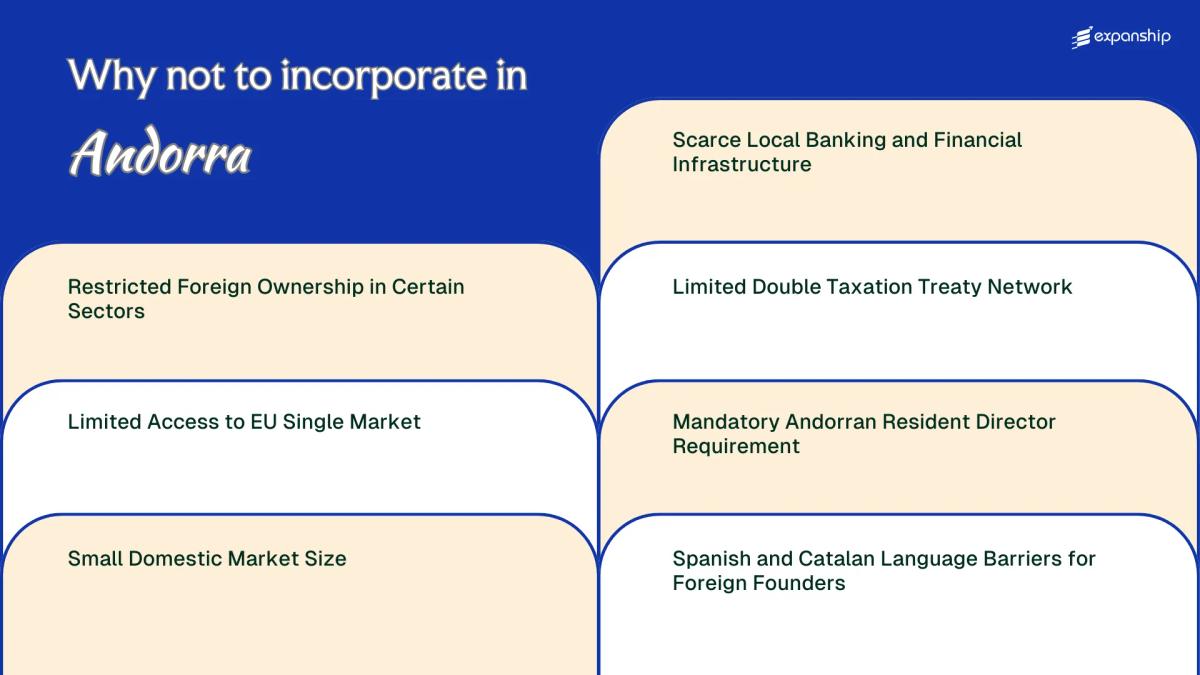
Restricted Foreign Ownership in Certain Sectors
Andorra foreign ownership restrictions remain one of the more tangible structural barriers for foreign investors. Under the Foreign Investment Law (Llei 10/2012), non-resident foreign nationals were historically capped at 49% ownership in most sectors, though general liberalization has since raised the default ceiling to 100% in many industries.
Sector-Specific Ownership Caps That Limit Control
Certain industries retain hard ownership limits that prevent full foreign control. Sectors tied to national interest, including agriculture, real estate on specific land categories, and activities linked to natural resource exploitation, continue to carry restrictions that can cap your effective stake well below majority ownership, directly limiting strategic decision-making authority.
The regulatory body overseeing foreign investment approvals is the Andorran Foreign Investment Register, and prior administrative authorization is mandatory before any restricted-sector investment is formalized.
Approval Processes That Create Operational Delays
Even where ownership is technically permitted, the prior authorization requirement adds a pre-incorporation layer that delays your timeline. For foreign investment limitations in Andorra, this procedural burden has no equivalent in fully open EU jurisdictions, where sector entry rarely requires advance regulatory sign-off.
Exemptions exist for EU and EEA investors in certain contexts, but the scope of those exemptions is not uniformly applied across all restricted industries.
Foreign business owners targeting restricted sectors must secure prior administrative authorization before completing any shareholding structure, meaning incorporation timelines and costs are directly extended before the entity is even operational.
Limited Access to EU Single Market
Andorra EU single market access limitations stem from the country's unusual status: it is neither an EU member state nor part of the European Economic Area. For goods, a customs union with the EU has existed since 1990, but this arrangement covers only trade in physical products and excludes services entirely.
Your business cannot passport financial, insurance, or professional services into EU member states. That restriction is structural, not procedural, meaning no local license or registration workaround resolves it.
Practical burdens this creates for foreign-owned firms:
- Selling regulated financial products into EU markets requires a separate entity established within an EU or EEA jurisdiction, adding incorporation and compliance costs.
- Service contracts with EU-based clients may face legal uncertainty, since the firm holds no recognized EU operating authorization.
- EU procurement frameworks and public tenders are generally closed to entities without an EU establishment.
- Cross-border VAT arrangements that EU-registered businesses benefit from do not automatically extend to this jurisdiction.
Negotiations between Andorra and the EU on a potential Association Agreement have been ongoing for years without a finalized outcome, so the current restrictions remain in force indefinitely.

Company Incorporation in Andorra
Understand the structural limitations of an Andorran entity before you incorporate. Expanship provides jurisdiction-specific guidance to help you assess your options accurately.
Small Domestic Market Size
Andorra's resident population sits at approximately 77,000 people. For any business model dependent on local consumer volume, that ceiling is reached almost immediately, making Andorra small domestic market drawbacks a structural reality rather than a cyclical risk.
The country's GDP hovers around $3.3 billion USD. While per-capita income is relatively high, aggregate demand is constrained by sheer headcount, meaning sectors like retail, food and beverage, or consumer services face a hard volume limit from day one.
| Market Metric | Andorra Figure | Implication for Business |
|---|---|---|
| Total resident population | ~77,000 | Addressable consumer base too small for scale-dependent models |
| Annual tourist visitors | ~8–9 million | Revenue becomes seasonally concentrated and structurally volatile |
| Retail sector dependency on tourism | Estimated 60%+ of activity | Domestic demand alone cannot sustain most consumer-facing firms |
| GDP (nominal) | ~$3.3 billion USD | Total market size limits reinvestment potential and growth ceiling |
Your firm's scalability depends on exporting goods or services beyond the Pyrenean border. Without that capacity, growth stalls against a fixed population constraint that no operational efficiency can overcome.
Seasonal tourist traffic partially offsets the limited consumer base, but that volume concentrates in winter ski months and summer visits, creating revenue cycles that are difficult to plan around. A business anchored solely to the domestic economy has no structural buffer against off-peak periods.
Scarce Local Banking and Financial Infrastructure
Andorra banking infrastructure limitations affect foreign businesses from the moment incorporation is complete. The principality has a small number of licensed banks, with the sector supervised by the INAF (Institut Nacional Andorrà de Finances), and access to accounts is tightly controlled for non-resident corporate clients.
Opening a corporate bank account here is not a formality. Banks apply rigorous due diligence under Andorran AML legislation, and foreign-owned entities frequently face extended review periods, requests for extensive documentation chains, and, in some cases, outright refusal.
Because the financial sector has historically operated in relative isolation from the eurozone banking network, correspondent banking relationships can be limited. This restricts your firm's ability to process international payments efficiently and at competitive cost.
- Banks may require Andorran economic substance evidence before approving an account for a foreign-owned entity
- Account opening timelines commonly extend beyond 60 days for non-resident applicants
- INAF oversight means AML documentation requirements are applied stringently to all corporate clients
- International wire transfer capacity varies significantly between the handful of licensed institutions
- Access to multi-currency accounts or trade finance products is structurally limited compared to major EU financial centres
Despite operating in euros, Andorra is not part of the European System of Central Banks, meaning its banks cannot access ECB liquidity facilities that are available to institutions in EU member states.
Limited Double Taxation Treaty Network
Andorra's double taxation treaty network is among the smallest in Europe, and that structural gap creates tangible withholding tax risks for businesses with cross-border income flows.
Scope of Treaty Coverage
As of 2024, Andorra has signed double taxation agreements with fewer than 15 jurisdictions, including Spain, France, Portugal, Luxembourg, and the UAE. For a business transacting with counterparties in the United States, Germany, or most of Asia, no treaty protection exists, meaning dividends, royalties, and interest payments may be subject to source-country withholding taxes at full domestic rates.
Practical Consequences for Foreign-Owned Entities
Without a treaty, your firm cannot claim reduced withholding rates or foreign tax credits that would otherwise prevent the same income from being taxed twice. A holding structure routing royalty income through an Andorran entity from a non-treaty jurisdiction could face withholding rates of 25% or higher at source, eroding the tax efficiency that incorporation was intended to achieve.
The limited DTT coverage disadvantage is partially offset for businesses whose operations are concentrated within treaty-partner countries, but that represents a narrow use case for most internationally active companies.
Assessing Treaty Exposure for Your Andorran Structure
Understand how Andorra's limited double taxation treaty network may affect your cross-border income flows and holding arrangements before committing to incorporation.
Mandatory Andorran Resident Director Requirement
The Andorra resident director requirement drawbacks are immediate and practical: under Andorran company law, at least one director of a locally incorporated entity must hold legal residence in the Principality, which creates a direct structural dependency on local personnel for foreign founders.
- You must either obtain Andorran residency yourself or engage a professional resident director, generating an ongoing third-party cost that does not exist in most comparable low-tax jurisdictions.
- Sourcing a qualified resident director through licensed service providers in a microstate of approximately 77,000 people means your options are limited and fees reflect that scarcity.
- Delegating directorial authority to a resident nominee introduces legal exposure, since that individual holds formal signing and liability powers over your business.
- The residency obligation applies continuously, not just at incorporation, so a director who loses Andorran resident status triggers an immediate compliance breach for the firm.
- No exemption exists for foreign entities with established operational presence elsewhere; the Andorran directorship residency obligation applies regardless of your company's international structure.
Spanish and Catalan Language Barriers for Foreign Founders
Andorra language barriers for foreign founders begin at the earliest stage of company formation. All official documentation submitted to the Registre de Societats — the national registry overseeing company registration — must be drafted in Catalan, which is the sole official language under the Constitution of Andorra.
Spanish is widely spoken in practice, but it holds no official legal status. This distinction matters because government agencies, notaries, and the Ministeri de Finances process filings exclusively in Catalan, meaning any document produced in another language requires certified translation before submission.
For founders without Catalan proficiency, every registration instrument — articles of incorporation, shareholder agreements, statutory declarations — incurs translation costs. Certified legal translation is not a one-time expense; ongoing compliance filings, annual accounts, and regulatory correspondence maintain this recurring burden throughout the entity's operational life.
- Government portals and official forms are published in Catalan only
- Notarial deeds, which are mandatory for SL and SA formation, must be executed in Catalan
- Public registry responses and official notices are issued exclusively in Catalan
Hypothetical scenario: A UK-based founder incorporating a Societat Limitada submits five foundational documents for notarisation. At a conservative rate of £120 per certified legal translation page, a 40-page document package would generate approximately £4,800 in translation costs before a single regulatory filing has been made.
Overcoming Incorporation Challenges in Andorra
Overcoming Andorra incorporation challenges requires a structured approach to the regulatory, fiscal, and operational constraints outlined in this blog.
- Apply for foreign investment authorisation through the Andorran Foreign Investment Registry before establishing any entity, particularly in restricted sectors.
- Appoint a qualified Andorran-resident director who meets the residency requirements set out under Andorran corporate law to satisfy the mandatory director obligation.
- Select a legal structure — such as a Societat Limitada — that accommodates your ownership model while remaining compliant with the 10% minimum local capital contribution rules.
- Engage a local banking institution early, given the extended due diligence timelines that foreign-owned firms typically face during account opening.
- Assess your treaty exposure by consulting the tax treaty register maintained by the Ministeri de Finances to identify jurisdictions where withholding tax relief is unavailable.
- Prepare all formation documents in Catalan, the sole official administrative language recognised by the Registre de Societats.
These steps sit within a broader regulatory framework governed by the Comú system and national legislation administered through the Govern d'Andorra. Addressing each constraint methodically reduces exposure without eliminating the structural limitations this jurisdiction presents.
Andorra's Overall Investment Appeal
Andorra's investment appeal despite drawbacks is not undermined by the structural limitations covered here. The jurisdiction remains a credible destination for businesses that prioritise tax efficiency, personal security, and a stable regulatory environment — provided those businesses can operate without EU market access or a large domestic customer base.
| Pros | Cons |
|---|---|
| Corporate income tax is capped at 10%, among the lowest statutory rates in Europe | The double taxation treaty network is limited, creating potential exposure to withholding taxes in counterparty countries |
| No wealth tax, inheritance tax, or capital gains tax on share disposals in most cases | Foreign ownership in certain sectors is restricted by the Foreign Investment Law, requiring Andorran participation |
| The principality offers a stable legal system and low levels of corruption | Domestic market size is approximately 77,000 residents, constraining local revenue potential |
| Personal residency and low cost of living attract owner-managed businesses | Mandatory Andorran-resident director requirements add ongoing operational cost for foreign founders |
| Access to the EU Single Market is not available; the 2024 association agreement is not yet fully ratified |
Compliance obligations for companies registered in Andorra are administered through the Registre de Societats and overseen by the Departament de Tributs i Fronteres, requiring ongoing attention to filing deadlines and local regulatory requirements.
Corporate Compliance Services in Andorra
Ongoing compliance support for Andorra-registered companies, covering annual filings, directorship requirements, and regulatory obligations under Andorran law.
Conclusion
The Andorra company formation drawbacks summary is straightforward: this is a jurisdiction with genuine structural constraints that affect a range of businesses. Limited treaty coverage reduces tax planning options for firms with cross-border operations. The resident director requirement adds administrative overhead that remote founders must plan around. Restricted foreign ownership in regulated sectors closes off certain structures entirely. These are fixed features of the regulatory environment, not temporary conditions. Professional guidance specific to Andorran corporate law and BOPA-registered requirements remains a practical necessity for foreign incorporators.
Expanship's Andorra Incorporation Support
Expanship's Andorra incorporation support is structured around the specific friction points this jurisdiction creates for foreign founders: the 100% foreign ownership restrictions in regulated sectors, the mandatory Andorran resident director under the Llei 20/2007, the thin local banking options, and Andorra's limited tax treaty coverage. Expanship's role is to reduce the administrative and compliance burden these requirements place on your business, not to circumvent them.
From initial registration through to ongoing compliance, Expanship supports your firm across a defined scope of services:
- Your company's registration documents are prepared and filed with the Registre de Societats.
- A registered agent and local office address are provided to meet Andorran requirements.
- Government filings and liaison with the relevant regulatory authorities are handled on your behalf.
- Post-incorporation compliance obligations are managed on an ongoing basis.
- Banking introduction assistance is provided to help your entity establish a local account.
- Tax registration and coordination with the Ministeri de Finances are carried out for your business.
To discuss your incorporation requirements, contact Expanship Andorra.
Frequently Asked Questions (FAQ)
Yes, it creates real exposure. Andorra has signed a relatively small number of double taxation agreements compared to jurisdictions like the Netherlands or Luxembourg, which means dividend payments, royalties, and service fees flowing between your Andorran entity and entities in non-treaty countries may be subject to withholding taxes in both jurisdictions simultaneously. The impact depends on which countries your business operates across, but for firms with multi-jurisdictional cash flows, this gap in treaty coverage can meaningfully increase the effective tax burden.
Andorran corporate law requires at least one director with Andorran residency for certain company structures, and failing to maintain that requirement puts the entity in non-compliance with the Registre de Societats. Regulatory consequences can include administrative sanctions and, in sustained cases, challenges to the company's legal standing. Sourcing a qualifying resident director from outside your existing team also adds recurring cost and introduces a layer of governance dependency on a third party.
It is comparable to other micro-states such as Monaco or Liechtenstein, but the practical effect depends on your business model. Andorra has a customs union with the EU covering industrial goods, but it sits outside the EU's single market for services and financial products, meaning a firm incorporated there cannot passport financial services or use EU regulatory approvals to operate across member states. For service-based businesses targeting European clients, this is a structural limitation that a standard EU incorporation would not carry.
No. All documentation submitted to the Registre de Societats must be in Catalan, the official language of Andorra, and notarial processes are conducted in Catalan or Spanish. Foreign founders without fluency in either language must work through qualified local legal counsel or notaries, which adds both cost and timeline to the incorporation process. There is no official English-language filing pathway at present.
With a population of approximately 77,000 people, the domestic consumer base is genuinely limited for businesses dependent on local sales volume. A company structured purely around serving Andorran residents faces a ceiling that most other European jurisdictions do not impose at equivalent tax and cost levels. This makes Andorra most viable for internationally oriented businesses that use the jurisdiction for holding, IP, or service structures rather than for selling into the local market.
Andorra's banking sector is small, dominated by a handful of institutions including MoraBanc, Crèdit Andorrà, and Andorra Banc Agrícol Reig, and these banks apply thorough due diligence requirements that can delay or block account opening for foreign-owned entities. Without a functional corporate bank account, your company cannot receive payments, pay suppliers, or meet payroll obligations, effectively stalling operations even after incorporation is complete. Non-resident founders with complex ownership structures or business models perceived as higher risk face the most friction in this process.
Legal Disclaimer
The information provided in this article is for general informational purposes only and does not constitute legal, tax, or professional advice. While we strive to ensure the accuracy and timeliness of the content, laws and regulations are subject to change, and the application of laws can vary widely based on specific facts and circumstances.
Readers should not act upon this information without seeking professional counsel tailored to their individual situation. Expanship and its authors disclaim any liability for actions taken or not taken based on the content of this article.
For specific advice regarding your business setup, compliance requirements, or any legal matters, please consult with qualified legal and tax professionals in the relevant jurisdiction.