
Key Takeaways
- Andorra's Registre de Societats oversees the incorporation and ongoing filing requirements for all legal entities established within the jurisdiction.
- The Societat de Responsabilitat Limitada (SL) is the most commonly registered structure among foreign investors due to its lower minimum capital threshold and flexible governance arrangements.
- Foreign multinationals can establish a branch office in Andorra to test the market without creating a separate legal entity with independent liability.
- Governed by the Llei de societats anònimes i de responsabilitat limitada, Andorra continues to expand its tax treaty network, strengthening its position as a structured corporate domicile in Southern Europe.
Introduction to Entity Types in Andorra
Andorra is a landlocked microstate in the eastern Pyrenees, bordered by France to the north and Spain to the south. It operates as a parliamentary co-principality and functions as a fully independent sovereign state, not a territory or dependency of any larger nation.
Company registration falls under the oversight of the Registre de Societats, the official registry responsible for the incorporation and ongoing filing requirements of legal entities established within the jurisdiction. Andorra operates a low-tax regime, with corporate income tax capped at a rate significantly below EU member state averages.
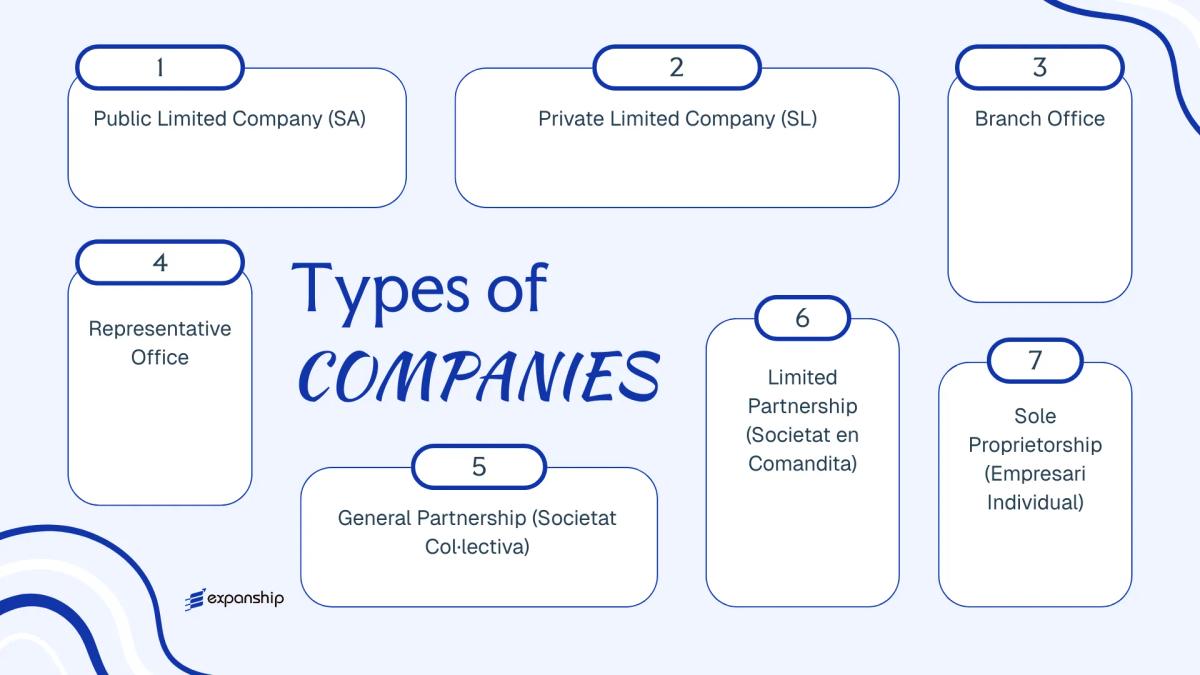
The types of business entities in Andorra span several distinct legal forms, each governed by the country's commercial legislation:
- Societat Anònima (SA)
- Societat de Responsabilitat Limitada (SL)
- Societat Col·lectiva
- Societat en Comandita
- Empresari Individual
- Branch Office
- Representative Office
Each structure carries different requirements around minimum capital, liability, governance, and foreign ownership eligibility. This article examines each form in detail to help you identify which structure aligns with your operational and compliance needs.
An Overview of Business Structures in Andorra
Andorran company law recognises several distinct legal forms, governed primarily by the Llei 20/2007, del 18 d'octubre, de la societat anònima and the broader commercial legislation framework administered by the Registre de Societats. Each structure carries different implications for liability, ownership, and permitted commercial activity.
Business Structures at a Glance
| Entity Type | Legal Form | Liability | Tax Status | Local Trading | Minimum Members | Regulatory Authority | Governing Legislation |
|---|---|---|---|---|---|---|---|
| Societat Anònima (SA) | Public limited company | Limited to share capital | Subject to corporate tax | Permitted | 1 shareholder | Registre de Societats | Llei 20/2007 |
| Societat de Responsabilitat Limitada (SL) | Private limited company | Limited to contribution | Subject to corporate tax | Permitted | 1 shareholder | Registre de Societats | Llei 20/2007 |
| Branch Office | Extension of foreign entity | Parent bears full liability | Subject to local tax | Permitted | N/A (parent entity) | Registre de Societats | Foreign Investment Law |
| Representative Office | Non-trading presence | Parent bears full liability | Generally exempt | Not permitted | N/A (parent entity) | Govern d'Andorra | Foreign Investment Law |
| Societat Col·lectiva | General partnership | Unlimited, joint and several | Subject to corporate tax | Permitted | 2 partners | Registre de Societats | Commercial Code |
| Societat en Comandita | Limited partnership | Mixed (general/limited) | Subject to corporate tax | Permitted | 2 partners | Registre de Societats | Commercial Code |
| Empresari Individual | Sole proprietorship | Unlimited personal liability | Subject to personal income tax | Permitted | 1 individual | Registre de Comerç | Commercial Code |
Each of these structures is examined in full in the sections below.
Societat Anònima (SA) – Andorran Public Limited Company
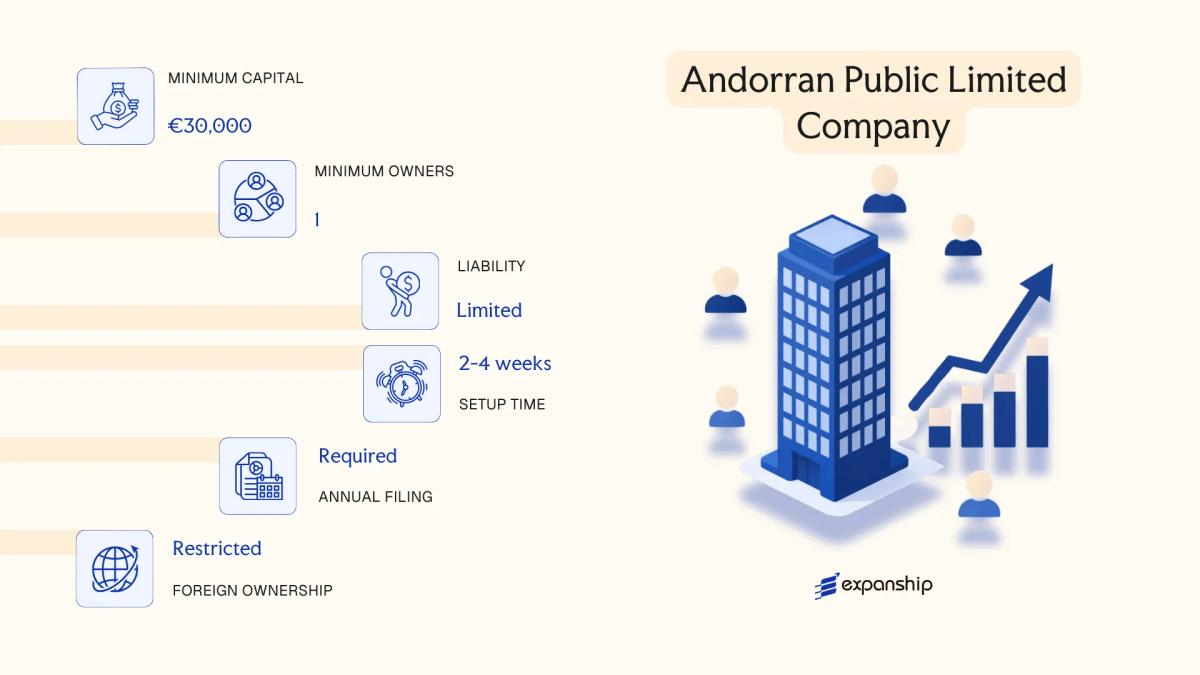
Governed by the Llei 20/2007, de 18 d'octubre, de societats anònimes i de responsabilitat limitada, the Andorra Societat Anònima SA formation creates a distinct legal entity separate from its shareholders. Liability is confined to the amount of capital subscribed, meaning personal assets of shareholders remain protected from corporate obligations.
As an SA public limited company Andorra, this structure is suited to larger enterprises, regulated industries, and businesses that anticipate issuing shares to multiple investors or seeking institutional financing.
Key Characteristics
| Requirement | Detail | Notes |
|---|---|---|
| Legal Form | Societat Anònima (SA) | Separate legal personality; regulated under Llei 20/2007 |
| Members | Shareholders (minimum 1, no maximum) | Single-shareholder SA permitted; shares may be nominative or bearer (subject to restrictions) |
| Governing Body | Board of Directors or sole administrator | Minimum 1 director; no mandatory residency requirement for directors |
| Local Presence | Registered office in Andorra required | No mandatory local director, but a registered address is obligatory |
| Share Capital | Minimum AED 60,000 EUR; at least 25% paid up on incorporation | Andorran SA share capital requirements are defined in EUR |
| Privacy | Shareholder register held at the company; beneficial ownership disclosed to AFA | Full public anonymity is not available |
Focus Points
- Taxation: Subject to corporate income tax at a standard rate of 10% under the Llei 95/2010; VAT equivalent (IGI) applies at 4.5%; withholding tax on dividends applies at 0% for qualifying residents; no wealth or inheritance tax at entity level — further detail available via the Departament de Tributs i de Fronteres.
- Economic Substance: Andorran-resident entities must demonstrate genuine economic activity; shell structures without local substance face scrutiny from the Autoritat Financera Andorrana (AFA).
- Annual Compliance: Mandatory annual accounts, audit requirements above certain thresholds, and annual filing with the Registre de Societats.
- Foreign Ownership: Up to 100% foreign ownership is permitted following the liberalisation of the Llei 10/2012.
- Conversion: An SA may be converted to an SL by shareholder resolution, subject to compliance with capital and procedural requirements under the same governing law.
Closing
The SA suits holding structures, regulated financial entities, and businesses seeking scalable equity arrangements with multiple investor tiers. Its principal advantage is the capacity to issue transferable shares freely, while the primary drawback is the higher administrative burden relative to an SL, including potential audit obligations and more formal governance requirements.
The Societat Anònima is most appropriate for mid-to-large enterprises, investment holding companies, or any business that requires a flexible share issuance structure with institutional-grade credibility.

Company Incorporation in Andorra
Incorporate your Societat Anònima in Andorra with end-to-end support from entity formation through to compliance registration.
Societat de Responsabilitat Limitada (SL) – Andorran Private Limited Company
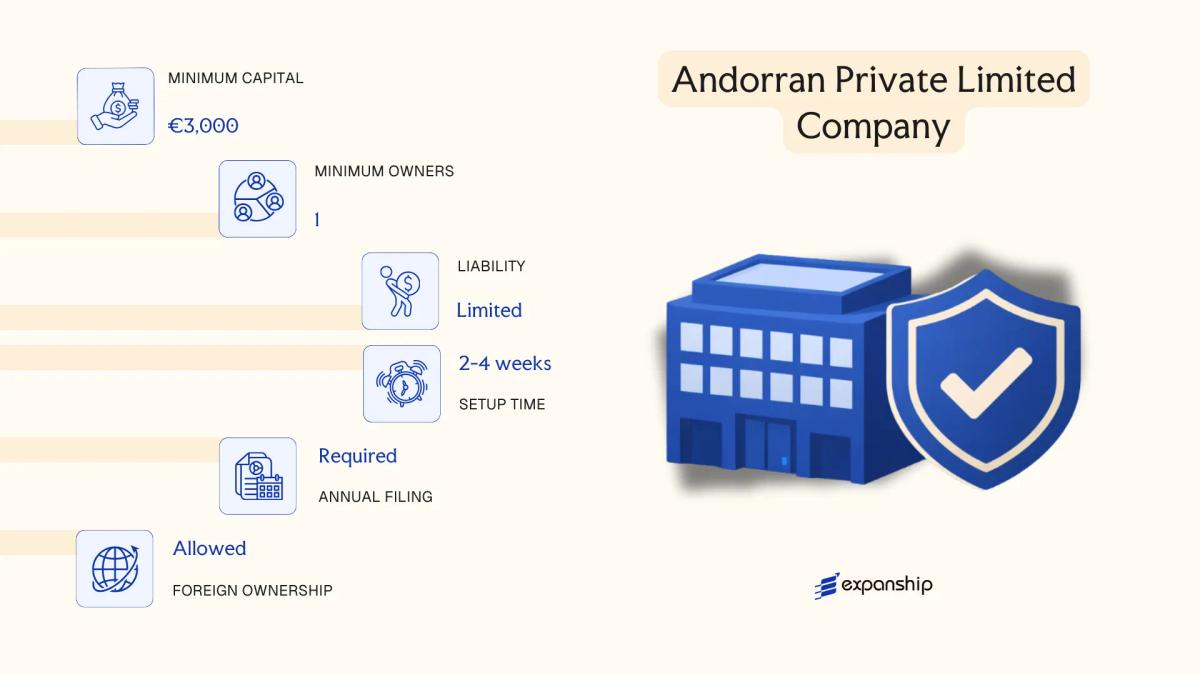
The Andorra Societat de Responsabilitat Limitada (SL) is governed by the Llei 20/2007, del 18 d'octubre, de la societat limitada, which established the primary framework for this form of limited liability company. As a separate legal entity, the SL shields its shareholders from personal liability beyond their capital contributions.
Structurally, the SL occupies a middle ground between a sole proprietorship and a public company. Its shares are not freely transferable on open markets, and any transfer is subject to restrictions defined in the company statutes or shareholder agreements, making it more suitable for closed ownership arrangements.
Key Characteristics
| Requirement | Detail | Notes |
|---|---|---|
| Legal Form | Societat de Responsabilitat Limitada (SL) | Separate legal personality; limited liability |
| Members | Shareholders (Socis); 1 to 50 | Single-member formation permitted; 50-shareholder ceiling applies |
| Management | Administered by one or more Administrators (Administradors) | Can be individual or collegiate board |
| Local Presence | Registered office in Andorra required | Physical address; no mandatory local director requirement under general rules |
| Share Capital | Minimum EUR 3,000; fully subscribed and paid at incorporation | Divided into participations (participacions), not publicly tradeable |
| Privacy | Shareholders and directors recorded with the Registre de Societats | Beneficial ownership disclosure required under AML regulations |
Focus Points
- Taxation: Subject to corporate income tax at a standard 10% rate; VAT (IGI) applies at 4.5%; no withholding tax on dividends distributed to non-residents under general rules, though treaty positions should be verified.
- Economic Substance: No formal substance requirements comparable to offshore regimes, but Andorran tax residency requires genuine local management and operations.
- Annual Compliance: Mandatory filing of annual accounts with the Registre de Societats; statutory audit thresholds apply above certain revenue or asset levels.
- Share Transfer Restrictions: Participacions cannot be freely transferred; existing shareholders hold pre-emption rights unless the statutes provide otherwise.
- Conversion: An SL may be converted into a Societat Anònima (SA) subject to meeting the SA's higher capital requirements and following the prescribed legal transformation procedure.
Closing Paragraph
The SL is the standard vehicle for SMEs, family-owned businesses, joint ventures, and foreign investors seeking a controlled ownership structure for trading or holding activities in Andorra. Its principal advantage is the low minimum capital threshold combined with full limited liability protection; its primary limitation is the 50-shareholder ceiling, which restricts scalability for businesses anticipating broad investor participation.
The Andorran SL is best suited for small to mid-sized businesses, family enterprises, and foreign investors who require limited liability with a closed, controlled shareholder base.
Foreign Business Structures in Andorra [Branch Office, Representative Office]
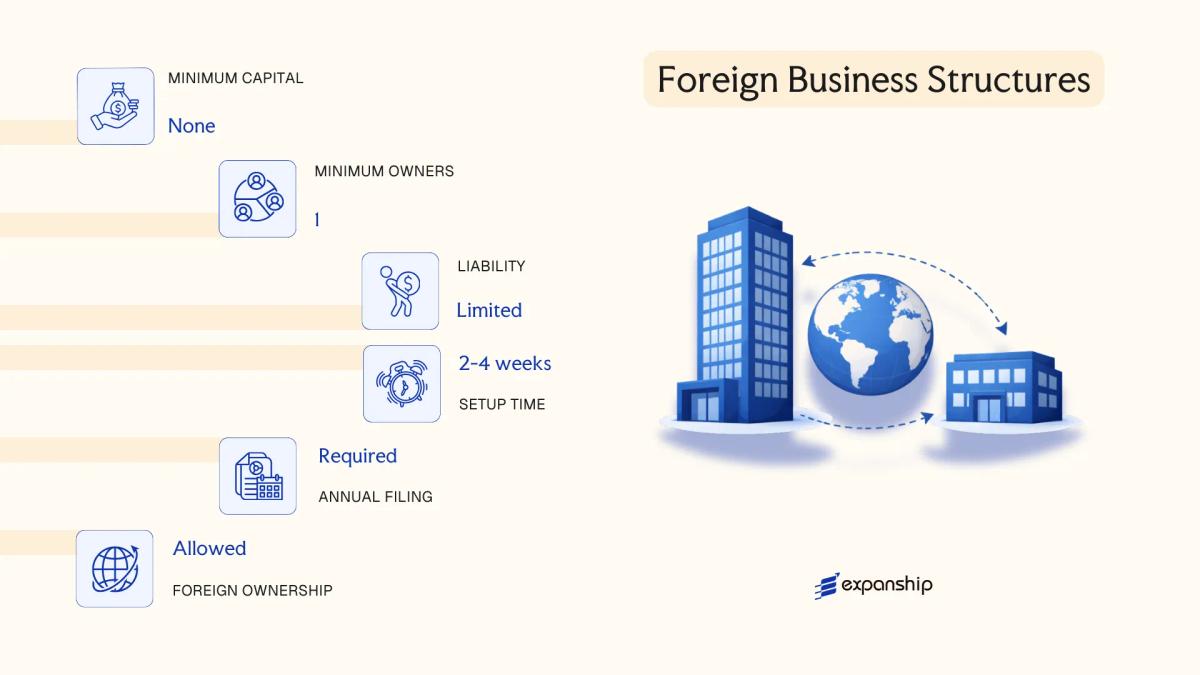
Foreign companies seeking a presence without incorporating a new local entity have two primary options: a branch office or a representative office. To open branch office in Andorra, a foreign firm must register with the Andorran Financial Authority (AFA) and the Register of Companies (Registre de Societats Mercantils), following the procedures established under the Llei 20/2007 on foreign investment and subsequent commercial regulations.
A branch (sucursal) is not a separate legal entity — the parent company retains full liability for its obligations. A representative office, by contrast, is limited to non-commercial activities such as market research or liaison functions, and cannot generate local revenue.
Key Characteristics
| Requirement | Branch Office | Representative Office |
|---|---|---|
| Legal Form | Extension of foreign parent; no separate legal personality | Administrative presence only; no legal personality |
| Liability | Parent bears unlimited liability | Parent bears unlimited liability |
| Local Presence | Registered address and local representative required | Registered address required |
| Capital | No statutory minimum, but parent's capital must be evidenced | None required |
| Revenue Generation | Permitted | Not permitted |
| Privacy | Parent company details filed publicly | Parent company details filed publicly |
Focus Points
- Taxation: Branches are subject to the standard 10% corporate income tax on Andorran-sourced profits; VAT (IGI) at 4.5% applies to taxable supplies; no withholding tax on profit remittances to the parent under general rules.
- Economic Substance: The branch must demonstrate genuine operational activity through a local representative and a registered address.
- Annual Compliance: Annual accounts of the branch must be filed with the Register of Companies; the parent's audited financials may also be required.
- Treaty Access: Access to Andorra's tax agreements depends on the parent's residence jurisdiction; treaty benefits are not automatically available to the branch.
- Restrictions: Representative offices cannot invoice, sign commercial contracts, or conduct profit-generating activity of any kind.
Sub-Types
Branch Office (Sucursal)
Operates under the parent company's name and legal identity, conducting full commercial activity. Used by foreign firms testing the local market before committing to full incorporation.
Representative Office (Oficina de Representació)
Restricted to promotional and preparatory functions on behalf of the parent. No revenue may be generated locally, making it unsuitable for operational business activity.
A branch office suits foreign companies with established operations seeking direct commercial exposure without a separately capitalised subsidiary, though the absence of limited liability protection for the parent is a material drawback.
Foreign companies wishing to conduct commercial activity directly under their existing corporate identity before committing to a locally incorporated entity.
Partnerships in Andorra [General Partnership (Societat Col·lectiva), Limited Partnership (Societat en Comandita)]
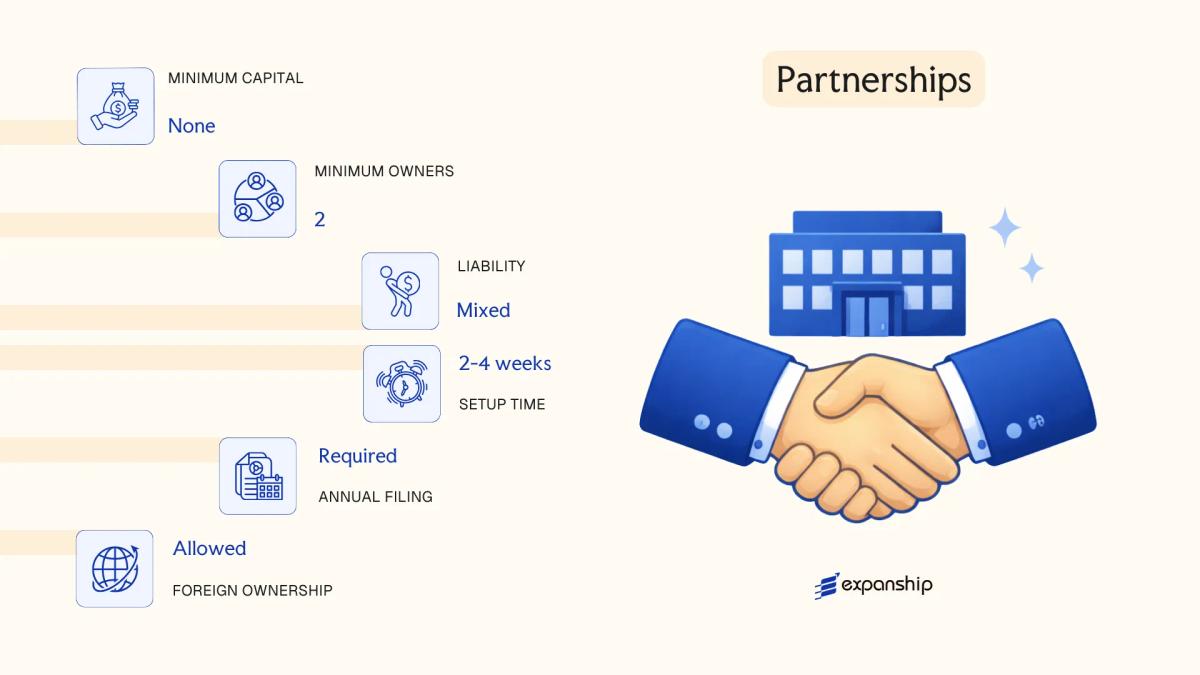
Governed by the Codi de Comerç and supplemented by general civil and commercial legislation, partnership structures in Andorra occupy a distinct position within the local corporate framework. The Andorra Societat Col·lectiva (general partnership) and the Societat en Comandita (limited partnership) both carry separate legal personality under Andorran law, though liability exposure differs significantly between partner classes.
Unlike capital-based entities, both forms are constituted through a partnership agreement registered with the Registre de Societats. Because each structure ties personal liability directly to partner participation, they are more commonly adopted by professional services firms or closely-held family businesses than by foreign investors.
Key Characteristics
| Requirement | Societat Col·lectiva | Societat en Comandita | Notes |
|---|---|---|---|
| Legal Form | General Partnership | Limited Partnership | Both carry separate legal personality |
| Partners | General Partners (Socis Col·lectius) | General + Limited Partners (Socis Comanditaris) | Societat en Comandita requires at least one of each class |
| Minimum Members | 2 General Partners | 2 (1 general + 1 limited) | No statutory maximum under general rules |
| Local Presence | Registered office in Andorra | Registered office in Andorra | Physical address required; no registered agent mandate |
| Minimum Capital | No statutory minimum | No statutory minimum | Capital contributions defined in the partnership deed |
| Liability | Unlimited for all partners | Unlimited for general; limited to contribution for limited partners | Limited partners may not participate in management |
| Privacy | Partner names filed in the Registre de Societats | Same as Col·lectiva | Records are accessible to the public |
Focus Points
- Taxation: Profits are generally attributed to partners and taxed at the individual or corporate level depending on partner classification; the standard Andorran corporate income tax rate of 10% may apply, with VAT (IGI) at 4.5% on applicable transactions; no withholding tax on dividends in most configurations.
- Economic substance: No specific substance regime targets partnerships directly, but the registered office must be operational and management activity must occur within the principality.
- Annual compliance: Partners must file annual accounts with the Registre de Societats and maintain updated partnership documentation; audit requirements depend on size thresholds.
- Restrictions: Foreign nationals may hold partner positions subject to general foreign investment regulations administered by the Ministeri de Finances.
- Conversion: A Societat Col·lectiva may be converted into a Societat de Responsabilitat Limitada or Societat Anònima through a formal restructuring process before the Registre de Societats.
Sub-Types
Societat Col·lectiva (General Partnership)
All partners bear joint and unlimited personal liability for the firm's obligations, and each holds the authority to bind the partnership unless the deed restricts this. This structure suits small professional practices where partners share both management responsibility and commercial risk equally.
Societat en Comandita (Limited Partnership)
Andorra limited partnership registration under this form introduces a two-tier partner structure: general partners retain full management authority and unlimited liability, while limited partners contribute capital and bear loss only to the extent of that contribution. The limitation on limited partner involvement in day-to-day management is a defining legal constraint of this structure.
Closing Paragraph
Partnership structures in Andorra are best suited to closely-held professional services businesses or family enterprises where partners wish to retain direct operational control. The absence of a minimum capital requirement offers flexibility in structuring contributions, though the unlimited personal liability of general partners represents a material exposure that capital-based entities do not carry.
These structures are most appropriate for small professional firms or family-owned trading businesses where founders accept joint liability in exchange for simplified governance.
Sole Proprietorship (Empresari Individual) in Andorra
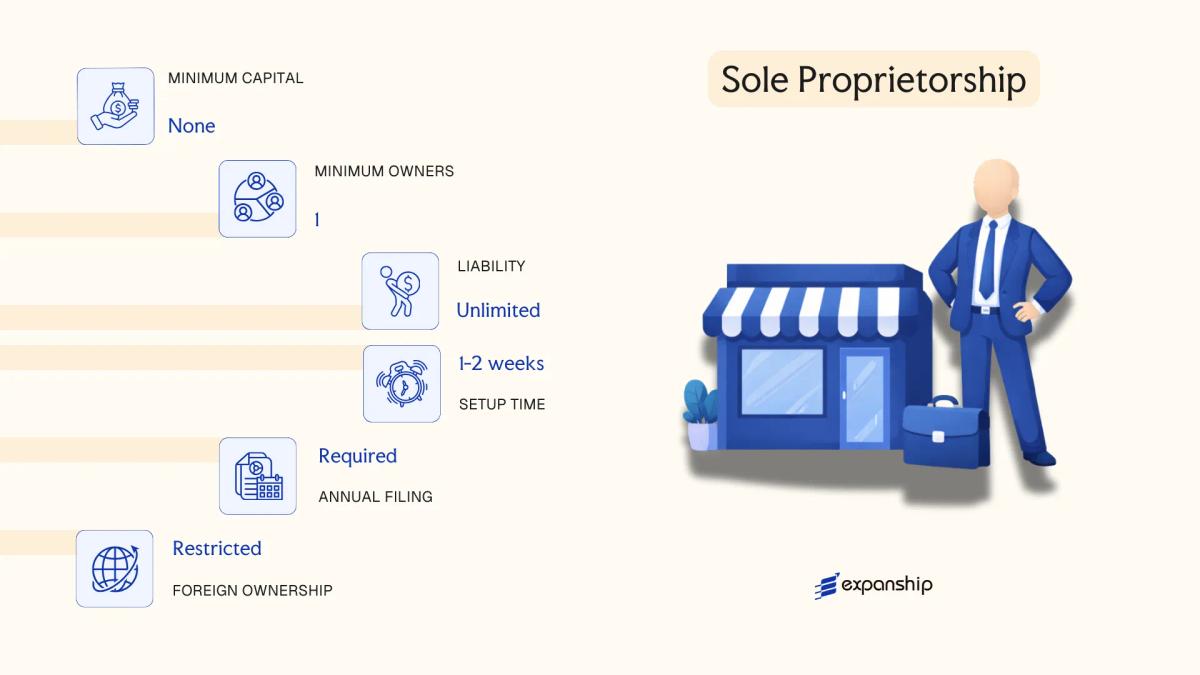
The Andorra Empresari Individual sole proprietorship is the simplest business form available to individuals operating commercially within the Principality. Governed by the Llei 20/2007, de 18 d'octubre, de la societat limitada unipersonal i de l'empresari individual (Law 20/2007), this structure carries no separate legal personality — the proprietor and the business are treated as a single legal subject.
Because no distinction exists between personal and business assets, the proprietor bears unlimited personal liability for all obligations incurred. Registration is administered through the Registre de Societats Mercantils, with the applicant also required to enrol with the Comú of their municipality and obtain a business licence (autorització d'activitat comercial) from the Ministeri de Presidència, Economia i Empresa.
Key Characteristics
| Requirement | Detail | Notes |
|---|---|---|
| Legal Form | Sole proprietorship (unincorporated) | No separate legal personality; operates under proprietor's name or a registered trade name |
| Members | Single individual (proprietor) | No minimum capital; one person only — cannot be converted into a multi-member structure without adopting a distinct entity type |
| Local Presence | Registered business address in Andorra required | Physical address, not a P.O. box; must correspond to the declared place of activity |
| Capital | No statutory minimum | No paid-in capital requirement; proprietor's personal assets back all liabilities |
| Liability | Unlimited personal liability | Proprietor's personal estate is fully exposed to business creditors |
| Privacy | Name of proprietor appears in public registry | No meaningful separation between business identity and personal identity |
Focus Points
- Taxation: Subject to the Impost sobre la Renda de les Persones Físiques (IRPF) — personal income tax at a general rate of 10%, with a lower threshold bracket; no corporate income tax applies; standard IGI (Andorran VAT equivalent) at 4.5% on qualifying transactions.
- Annual Compliance: Mandatory annual income tax declaration with the Departament de Tributs i de Fronteres; bookkeeping obligations apply proportional to turnover.
- Economic Substance: No formal substance test applies to this structure, but the proprietor must genuinely reside and operate within the jurisdiction.
- Treaty Access: Access to Andorra's tax agreements is limited compared to corporate entities; individual treaty benefits depend on residency status.
- Conversion: Conversion to an SL or SA requires a fresh incorporation process; assets and liabilities must be formally transferred.
Closing
The Empresari Individual suits freelancers, consultants, and small-scale traders seeking a low-cost entry point for local commercial activity, with the key advantage of minimal administrative overhead — though the absence of liability protection makes it unsuitable for ventures carrying significant financial or contractual exposure.
This structure is most appropriate for Andorran residents running small, low-risk, owner-operated businesses who do not require liability separation.
How to Choose the Right Entity Type in Andorra
Choosing the right company type in Andorra is a structural decision with direct legal and financial consequences — not a formality.
Why Your Entity Choice Matters
The structure you register determines your compliance obligations from day one. Concrete outcomes of a mismatched choice include:
- Selecting a branch office when you intend to conduct independent commercial activity means the parent company retains full liability, exposing foreign assets to local creditors without the protection a separate legal entity would provide.
- Forming an SA when your business operates as a single-person consultancy subjects you to the higher capital requirement and potentially to statutory audit thresholds that an SL would not trigger at the same revenue level.
- Choosing an entity without the capacity to demonstrate genuine local substance — physical presence, resident management, local decision-making — can result in reporting failures under Andorra's tax residency and economic substance framework.
- Registering a general partnership (Societat Col·lectiva) when limited liability is a commercial requirement leaves partners personally exposed to the firm's obligations without recourse.
Key Factors to Consider
- Business Activity: Active trading, passive asset-holding, and regulated sectors each point toward a different structure under Andorran commercial law.
- Ownership Structure: A sole owner with no co-investors will find the SL more administratively proportionate than a multi-shareholder SA with mandatory board requirements.
- Tax Objectives: Your eligibility for Andorra's 10% corporate tax rate, or any applicable exemption, depends partly on the entity type and its registered activity.
- Liability Exposure: Partners in a Societat Col·lectiva bear unlimited personal liability, whereas shareholders in an SA or SL do not.
- Substance Capacity: If you cannot maintain a genuine local presence, your chosen structure must align with what the regulatory framework permits for non-resident operations.
- Exit Strategy: Not all Andorran entity types permit straightforward redomiciliation or conversion — verify this before incorporation if an exit event is foreseeable.
Andorra's primary company formation framework is governed by the Llei 20/2007, de 18 d'octubre, de la societat anònima i la societat de responsabilitat limitada, published in the Butlletí Oficial del Principat d'Andorra (BOPA), which sets out the structural requirements for each entity type.
Corporate Compliance Services in Andorra
Ongoing compliance obligations vary by entity type. Expanship assists Andorran companies with annual filings, registered agent requirements, and regulatory reporting.
Conclusion
Andorra company incorporation summary points to a jurisdiction with a small number of entity types, each serving a distinct commercial purpose. The Societat Anònima suits larger operations requiring capital markets access or institutional credibility, while the Societat de Responsabilitat Limitada remains the most registered structure among foreign investors and resident entrepreneurs alike, given its lower minimum capital threshold and flexible governance. Branch offices serve multinationals testing the market without committing to a separate legal entity. Partnerships and the Empresari Individual form the foundation for locally embedded, smaller-scale operations.
Regulated by the Registre de Societats under the framework established by the Llei de societats anònimes i de responsabilitat limitada, the country continues to expand its tax treaty network and refine its foreign investment rules. This trajectory positions the jurisdiction as a maturing destination for structured corporate presence in Southern Europe, with growing institutional recognition from international counterparts. Professional guidance through this process remains advisable.
How Expanship Can Assist You
Expanship Andorra company formation services cover the full arc of establishing a business in the Principality, from choosing between an SA and an SL to satisfying the foreign investment authorization requirements administered by the Andorran Financial Authority (AFA). Every entity type discussed in this blog carries its own registration obligations with the Registre de Societats, and our team works directly within those frameworks.
From initial documentation through to post-incorporation maintenance, our services include:
- Preparation and legalization of constitutional documents
- Registered agent and registered office provision
- Filing and liaison with the Registre de Societats
- Foreign investment authorization support through the AFA
- Ongoing compliance and annual obligations management
- Banking introduction assistance for newly incorporated entities
Ready to move forward? Reach out to Expanship Andorra to discuss your specific requirements.
Frequently Asked Questions (FAQ)
The Societat de Responsabilitat Limitada (SL) is the most frequently incorporated entity. Its lower minimum share capital requirement and flexible management structure make it the default choice for small to mid-sized businesses and foreign investors entering the market.
Both entity types are subject to the 10% corporate income tax rate under Andorran tax law, but the SA requires higher share capital and is structured for broader shareholder bases, including potential public listings. The SL restricts share transferability, which reduces administrative complexity but limits capital-raising options.
The SL generally offers a higher degree of confidentiality for smaller ownership structures. Beneficial ownership information is registered with the Registre de Societats but is not publicly searchable in the same manner as some EU jurisdictions. Nominee arrangements are available through licensed professionals, though ultimate beneficial ownership must still be disclosed to the relevant authorities.
A sole individual can form an SL or SA, as both permit single-shareholder structures. General partnerships (Societat Col·lectiva) and limited partnerships (Societat en Comandita) require a minimum of two partners by their legal definition.
Foreigners can incorporate an SL, SA, or establish a branch of a foreign company. Since the removal of the general 100% foreign ownership restriction under the 2012 foreign investment law, non-residents may hold full ownership in most sectors, with exceptions applying to specific regulated industries.
Andorran corporate law permits structural transformation between certain entity types, most commonly from an SL to an SA, as the business scales and capital requirements change. The process requires approval from the Registre de Societats and must satisfy the capital and governance conditions of the target structure.
The SL, SA, and both partnership forms all carry separate legal personality under Andorran law. The sole proprietorship (Empresari Individual) does not — the owner and the business remain legally indistinct, meaning personal assets are exposed to business liabilities without limitation.
Legal Disclaimer
The information provided in this article is for general informational purposes only and does not constitute legal, tax, or professional advice. While we strive to ensure the accuracy and timeliness of the content, laws and regulations are subject to change, and the application of laws can vary widely based on specific facts and circumstances.
Readers should not act upon this information without seeking professional counsel tailored to their individual situation. Expanship and its authors disclaim any liability for actions taken or not taken based on the content of this article.
For specific advice regarding your business setup, compliance requirements, or any legal matters, please consult with qualified legal and tax professionals in the relevant jurisdiction.