
Key Takeaways
- Andorra's corporate income tax is capped at a flat 10% under the Llei 95/2010 del 29 de desembre, placing it well below the EU average and creating a structurally competitive position for internationally mobile businesses.
- Reforms introduced in 2012 eliminated prior restrictions on non-resident ownership, meaning foreign investors can now hold full equity in an Andorran Societat Limitada across most sectors without requiring a local partner.
- The complete absence of wealth, inheritance, and capital gains taxes makes Andorra a particularly effective jurisdiction for businesses whose primary objective is long-term capital preservation rather than short-term income optimisation.
- Geographic positioning between France and Spain gives Andorra-registered entities practical proximity to two major EU economies, which carries operational weight for businesses engaged in cross-border trade with French or Spanish counterparts.
Situated in the eastern Pyrenees, the Principality of Andorra is a sovereign co-principality bordered by France and Spain, governed jointly by the French President and the Bishop of Urgell. Company registration falls under the authority of the Registre de Societats, which operates within the country's civil law framework. Foreign investors typically establish a Societat Limitada when entering the market.
Andorra operates as a low-tax jurisdiction, applying a corporate income tax rate well below the European average, with no participation in the EU's tax directives despite its geographic proximity to member states. The general posture toward foreign direct investment has shifted considerably since 2012 reforms removed prior restrictions on non-resident ownership, making the territory broadly open to international capital across most sectors.
The benefits of incorporating in Andorra extend across tax efficiency, regulatory structure, and geographic positioning. This article examines the principal advantages that make Andorra company formation a practical consideration for businesses seeking a European-adjacent base with a defined and transparent legal framework.
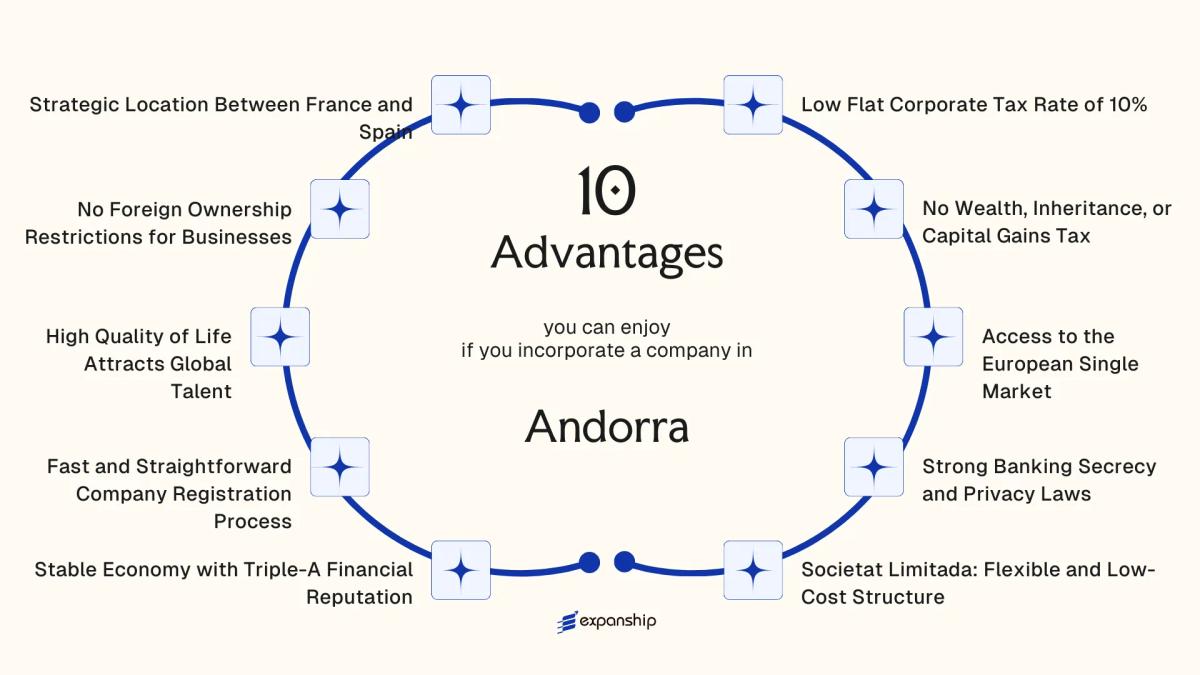
Low Flat Corporate Tax Rate of 10%
Andorra's Impost de Societats applies a flat 10% corporate tax rate to resident companies, well below the OECD average of roughly 23%. For a foreign business owner, that gap translates directly into retained earnings that can be reinvested or distributed.
What the Rate Covers
Under the Impost de Societats framework, the 10% rate applies to net taxable income after allowable deductions. Newly incorporated entities benefit from a reduced rate of 2% during the first two years of operation, giving early-stage businesses a further period of lower tax exposure before the standard rate applies.
Why the Structure Matters
Your company's effective tax burden can be reduced further through deductions on operating expenses, depreciation, and qualifying reinvestments. The flat structure eliminates the bracket complexity found in jurisdictions like France or Spain, where corporate rates can reach 25% to 30%, meaning tax planning requires less administrative effort to produce predictable outcomes.
A fixed 10% rate with no bracket thresholds lets you forecast your corporate tax liability with straightforward arithmetic, regardless of how much your net income grows.
No Wealth, Inheritance, or Capital Gains Tax
Andorra's tax code contains no provision for capital gains tax, inheritance tax, or wealth tax. For a business owner or investor, this means that profits from the sale of shares, assets, or property are not subject to a separate tax charge at the point of disposal. The Andorra no capital gains tax advantage is particularly relevant for holding structures, where exits or asset transfers represent a primary source of return.
Under the current fiscal framework, these absences are structural, not temporary exemptions. They apply to both resident individuals and qualifying corporate entities, meaning your firm's accumulated value is not eroded by wealth-based levies over time.
For estate and succession purposes, the zero inheritance tax benefit means that ownership of a company or its underlying assets can pass between parties without triggering a tax charge at the point of transfer. This has direct implications for long-term ownership planning.
Several features make this tax position particularly favourable for foreign-owned businesses:
- Capital gains on equity disposals are not taxed at the corporate or individual level
- There is no annual wealth declaration or levy tied to asset holdings
- Succession of business interests does not generate a separate fiscal event
- The absence of these taxes is embedded in the general tax law, not dependent on specific rulings or advance approvals

Incorporate Your Company in Andorra
Set up a compliant Andorran entity and access one of Europe's most tax-efficient fiscal frameworks.
Access to the European Single Market
Andorra's access to the European Single Market is one of the more consequential structural features available to companies incorporated there. Under the EU-Andorra Association Agreement, which entered into force in stages and replaced the older 1990 Customs Union arrangement, goods originating in Andorra can enter EU member states without customs duties across a defined range of product categories. For businesses manufacturing or distributing physical products, this removes a layer of cost that competitors based in non-associated third countries must absorb.
| Feature | Detail |
|---|---|
| Governing framework | EU-Andorra Association Agreement |
| Prior arrangement | 1990 Customs Union (limited to industrial goods) |
| Goods coverage | Expanded product scope under association framework |
| Service sectors | Subject to ongoing negotiated access provisions |
| Regulatory alignment | Requires partial adoption of EU internal market rules |
Services access operates under separate provisions and is not automatic. The association framework requires partial alignment with EU internal market regulations in relevant sectors, which means your firm must meet specific compliance thresholds to benefit from preferential treatment in services trade.
The practical advantage is geographic and commercial reach. A firm registered in the principality can position itself to supply EU-based clients under terms that a purely offshore structure could not replicate, without being subject to the full tax and regulatory burden of incorporation inside an EU member state.
Strong Banking Secrecy and Privacy Laws
Andorra banking secrecy advantages for businesses stem from a legal framework that has been deliberately structured to protect account holder information. The country's financial privacy rules are codified in the banking law, governed by the Autoritat Financera Andorrana (AFA), the national financial regulator. Unauthorized disclosure of client financial data by banking personnel carries criminal liability under domestic law, not merely administrative penalties.
That distinction matters. Criminal-level protection means your firm's account details, transaction records, and ownership structures are shielded by a standard that banks cannot waive unilaterally.
Andorra is not a jurisdiction outside the international regulatory perimeter. It has signed the OECD Common Reporting Standard (CRS) and participates in automatic exchange of tax information with partner jurisdictions. Privacy protections therefore apply within those treaty boundaries, not as an override to them.
Keep the following in mind:
- AFA supervises all licensed banking institutions operating in the country
- Banking confidentiality obligations bind staff at the individual level under domestic criminal statutes
- CRS participation means your home jurisdiction's tax authority can receive financial data under treaty obligations
- Privacy protections do not shield undeclared income or structures used for tax evasion
Andorra did not have a formal personal income tax at all until 2015, which means its modern financial privacy framework was built almost entirely around corporate and banking confidentiality rather than adapted from an older tax-reporting infrastructure.
Societat Limitada: Flexible and Low-Cost Structure
The Andorra Societat Limitada flexible structure sits at the center of why the country draws foreign entrepreneurs seeking a cost-effective yet credible legal vehicle. Governed by the Llei 20/2007, de societats limitades, the SL requires a minimum share capital of just €3,000, fully subscribed at incorporation. That figure is modest by any comparative standard, particularly given that the entity carries full limited liability protection.
Capital Efficiency and Structural Simplicity
Your liability as a shareholder is capped at the value of your contributed capital. This separation between personal and business assets means that operational risk does not extend to personal holdings, which matters considerably when entering a new market. A single shareholder can form and wholly own an SL, removing the need for local partners or nominee arrangements purely for structural reasons.
Governance Flexibility That Serves Foreign Owners
The SL does not require a board of directors. A sole administrator can manage the entity, which reduces both governance overhead and the recurring cost of maintaining corporate formalities. Annual general meeting requirements are comparatively light, and the firm's articles of association can be tailored to reflect the specific decision-making structure your business requires.
For investors comparing entity types across jurisdictions, the Andorra SL company advantages are concrete: low formation capital, single-member eligibility, and an administrative framework that does not impose unnecessary structural layers on a small or mid-size operation.
Structure Your Andorra SL the Right Way
Get professional guidance on incorporating and maintaining a Societat Limitada in Andorra, tailored to your business objectives.
Stable Economy with Triple-A Financial Reputation
Andorra stable economy benefits for business are grounded in measurable fiscal discipline, not perception. The principality has maintained a consistent budget position, with public debt levels that remain among the lowest in Europe as a proportion of GDP. That structural conservatism translates directly into monetary predictability for any foreign-owned entity operating there.
- The financial system is supervised by the Autoritat Financera Andorrana (AFA), established under the 2013 financial system regulation law. A single, clearly mandated regulator reduces the compliance ambiguity that businesses face in jurisdictions with fragmented oversight.
- Andorra uses the euro as its official currency under a monetary agreement with the European Union, despite not being an EU member state. Your firm avoids currency conversion costs and exchange rate exposure when transacting with counterparties across the eurozone.
- The banking sector maintains capital adequacy ratios that consistently exceed international Basel III minimums. For a business owner, this signals that local banking infrastructure is unlikely to disrupt operations through systemic instability.
- Sovereign credit assessments of the principality reflect a track record of balanced public finances and controlled government expenditure. A stable sovereign environment reduces the macro-level risk that can erode the value of a long-term corporate structure.
Fast and Straightforward Company Registration Process
Andorra fast company registration benefits stem largely from the role of the AEI, the Agència Estatal d'Inversió. This government body acts as the single point of contact for foreign investors, consolidating the registration process through one administrative channel rather than requiring you to coordinate across multiple ministries.
Incorporation typically completes within four to six weeks. That timeline reflects a structured but comparatively short process, given that many European jurisdictions extend well beyond three months for equivalent procedures involving foreign shareholders.
The AEI also pre-screens investment applications before formal notarial steps begin. This front-loaded review reduces the likelihood of procedural delays mid-process, which directly protects your planned launch timeline.
Foreign-owned companies go through the same registration pathway as domestically owned ones. There is no parallel or extended track for non-resident founders, which means your firm is not subject to additional bureaucratic layers solely due to its ownership structure.
A business owner incorporating a Societat Limitada with a standard share capital of €3,000 can expect total government registration fees to remain well below €1,000, with notarial and AEI filing costs combined typically falling under that threshold, depending on the complexity of the articles of incorporation.
High Quality of Life Attracts Global Talent
Andorra quality of life benefits for businesses extend well beyond tax efficiency. The principality records one of the highest life expectancy rates in the world, consistently ranking among the top globally, and operates a low-crime environment that makes it genuinely practical for business owners relocating with families.
The absence of pollution, a compact geography that places ski resorts and hiking trails within minutes of the capital Andorra la Vella, and a year-round outdoor culture make residency appealing to senior professionals and technical specialists who have options about where they live.
For your business, this matters in a direct way: talent that values lifestyle over salary premiums is easier to retain. Professionals willing to accept competitive rather than inflated compensation are a measurable operational advantage for firms building lean, skilled teams.
- The official language is Catalan, though Spanish, French, and Portuguese are widely spoken, reducing friction for multilingual teams.
- The public health system, managed under the Caixa Andorrana de Seguretat Social (CASS), provides coverage to residents and employees, reducing the need for costly private health arrangements.
Active residency in Andorra requires spending a minimum of 90 days per year in the principality, which applies to business owners holding passive or active residency permits.
No Foreign Ownership Restrictions for Businesses
Prior to 2012, foreign nationals could hold no more than 49% of an Andorran company. The Qualified Foreign Investment Law (Llei 10/2012) reversed this entirely, and the Andorra no foreign ownership restrictions benefit now means non-residents can own 100% of a locally registered entity without a local partner requirement.
What Full Ownership Actually Means for Your Business
Retaining complete equity means you control all voting rights, profit distributions, and strategic decisions from day one. There is no requirement to dilute your shareholding to satisfy a residency or nationality threshold, which eliminates a structural dependency that commonly affects foreign investors in comparable jurisdictions.
Scope of the Permission
Foreign ownership at 100% applies across most sectors, including commercial, industrial, and service activities. Certain regulated industries, such as financial services and broadcasting, remain subject to sector-specific authorisation from bodies like the Andorran Financial Authority (AFA), but these are licensing requirements, not ownership caps.
Practical Control Over Capital and Profits
Because no local partner holds a mandatory equity stake, all dividend distributions and retained earnings flow according to your own shareholder structure. This is a direct consequence of Andorra's open ownership policy for companies, and it means profit repatriation decisions remain entirely within your control rather than subject to a co-owner's consent.
The categories below summarise the ownership framework:
- 100% foreign equity permitted across general commercial sectors
- No mandatory local director or shareholder requirement
- Sector-specific licences apply in finance, insurance, and broadcasting
- Foreign investor business rights are governed by Llei 10/2012
Strategic Location Between France and Spain
Andorra's geographic position offers a concrete operational advantage for businesses with activity across southwestern Europe. Sitting at the border between France and Spain, the Principality provides direct physical access to two of the eurozone's largest economies without the administrative overhead of locating inside either one. For firms managing distribution, logistics, or client relationships across both countries, this proximity reduces travel time and freight costs in ways that purely offshore jurisdictions cannot replicate.
Road connections link the capital, Andorra la Vella, to Barcelona in approximately three hours and to Toulouse in roughly the same duration. Both cities are major commercial and industrial hubs, meaning your business can maintain day-to-day contact with suppliers, partners, and clients in either country without establishing a separate operational presence there.
The geographic position also carries regulatory implications. Because Andorra operates under a customs union agreement with the European Union, goods moving across its borders with France and Spain follow defined procedures that differ from standard third-country trade. This gives physically present businesses a degree of cross-border operational clarity that benefits firms in sectors such as retail, wholesale distribution, and manufacturing.
- French and Spanish are both widely spoken in the business community, reducing language barriers with your primary neighboring markets.
- Andorra la Vella functions as the administrative center, keeping government offices, banking institutions, and legal services concentrated in a single location.
- The country's time zone aligns with Central European Time, placing it in the same working-hours window as most EU commercial partners.
Why Andorra Stands Out Against Other Low-Tax Jurisdictions
Compared against jurisdictions that foreign investors most commonly evaluate alongside Andorra, such as Monaco, Gibraltar, and Luxembourg, the competitive picture is shaped less by headline tax rates alone and more by the combination of structural factors. Monaco eliminates personal income tax entirely but imposes no formal corporate tax framework that suits trading companies, and its residency requirements are among the most capital-intensive in Europe. Gibraltar offers a 10% corporate rate, but its post-Brexit status creates ongoing uncertainty for businesses with EU market exposure.
What the comparison below reflects is that Andorra's advantages over other low-tax jurisdictions are not concentrated in a single metric. The absence of wealth and inheritance taxes, combined with a territorial tax system governed under the Llei 95/2010, del 29 de desembre, de l'impost sobre societats, positions the jurisdiction distinctly from peers that carry hidden compliance costs or structural limitations that only become apparent after incorporation.
| Parameter | Andorra | Monaco | Gibraltar | Luxembourg |
|---|---|---|---|---|
| Corporate Tax Rate | 10% flat | 0% (non-trading) / 33% (trading) | 10% | 17% (standard) |
| Capital Gains Tax | None | None (individuals) | None | Varies by structure |
| Wealth / Inheritance Tax | None | None | None | Applicable in certain cases |
| EU Single Market Access | Partial (customs union) | No | No (post-Brexit) | Full |
| Foreign Ownership Restriction | None | None | None | None |
| Territorial Tax Scope | Yes | Partial | Yes | No |
Compliance Services for Companies in Andorra
Maintain your Andorran company's good standing with ongoing compliance support, including annual filings, registered agent services, and regulatory reporting under Andorran commercial law.
Conclusion
Andorra's corporate framework offers a coherent set of structural advantages that are rarely available together in a single jurisdiction. A flat corporate income tax rate capped at 10% under the Llei 95/2010 del 29 de desembre, the complete absence of wealth and inheritance taxes, and unrestricted foreign ownership combine to create conditions where the economics of incorporation align directly with the interests of internationally mobile businesses. These are not incidental features but deliberate policy positions that have been maintained consistently.
The benefits of incorporating in Andorra carry most weight for business owners whose operations are structured around capital preservation, cross-border trade, or talent retention. Not every firm will extract equal value from the same provisions. A business with no EU market exposure, for example, may weigh the jurisdiction's European positioning differently than one actively trading with French or Spanish counterparts.
For those whose commercial profile does align with what the Principality offers, the structural case is clear and well-documented. The next step is translating that case into a correctly formed entity, registered in compliance with requirements set by the Registre de Societats, and maintained in accordance with ongoing obligations under Andorran commercial law. Getting that foundation right from the outset determines how effectively the available advantages are realised in practice.
Start Your Andorra Company with Expanship Today
Expanship assists foreign entrepreneurs in forming and maintaining companies in Andorra, covering the full cycle from initial registration with the Registre de Societats to ongoing compliance with the Departament de Tributs i de Fronteres. The blog has outlined the structural, fiscal, and operational advantages available to incorporated entities here, including the 10% corporate tax rate, the SL entity format, and the absence of capital gains or inheritance taxes. Expanship's role is to translate those advantages into an operational business structure without gaps in documentation or regulatory standing.
The firm's services across this jurisdiction include:
- Preparation and legalization of incorporation documents, including the public deed executed before a Notari d'Andorra
- Registered agent and registered office provision as required under Andorran commercial law
- Filing coordination with the Registre de Societats and liaison with the relevant government departments
- Post-incorporation compliance management, including annual accounts and tax filing obligations
- Corporate secretarial support for ongoing governance requirements
- Banking introduction assistance for account opening with Andorran financial institutions regulated by the AFA (Autoritat Financera Andorrana)
Reach out to Expanship Andorra to discuss your incorporation requirements directly.
Frequently Asked Questions (FAQ)
The standard corporate income tax rate is 10%, established under the Impost sobre Societats framework. Newly incorporated companies engaged in qualifying activities may benefit from a reduced rate of 2% during an initial period, subject to conditions set by the Andorran Tax Authority (ATA). The 10% rate applies to net taxable profit, not gross revenue.
Company registration typically takes between four and eight weeks from submission of complete documentation to the Registre de Societats. The timeline can extend if foreign documents require apostille certification or if the chosen company name needs additional review. Processing times vary based on the complexity of the structure and responsiveness of the applicant.
Andorra has signed a limited number of double taxation agreements, including treaties with Spain, France, Luxembourg, and Portugal, among others. Distributions to shareholders in non-treaty countries may be subject to withholding tax considerations that depend on the applicable domestic rules at the time of payment. You should verify the current treaty status with the ATA before structuring cross-border distributions.
A registered office address within Andorran territory is a mandatory requirement for all incorporated entities. This address must be a verifiable physical location, not simply a postal box. The address is recorded in the Registre de Societats and used for official correspondence from regulatory authorities.
The minimum share capital for a Societat Limitada (SL), the most commonly used private limited structure, is EUR 3,000. This amount must be fully paid up at the time of incorporation. The capital is divided into participations rather than shares, and no public offering is permitted under this structure.
Andorra has progressively aligned with international transparency standards, including commitments under the OECD's Common Reporting Standard (CRS) and the Foreign Account Tax Compliance Act (FATCA) framework. While domestic banking privacy laws remain in place, financial account information can be exchanged with competent foreign authorities under applicable bilateral agreements. Banking secrecy no longer functions as an absolute shield against legitimate foreign regulatory or tax inquiries.
Legal Disclaimer
The information provided in this article is for general informational purposes only and does not constitute legal, tax, or professional advice. While we strive to ensure the accuracy and timeliness of the content, laws and regulations are subject to change, and the application of laws can vary widely based on specific facts and circumstances.
Readers should not act upon this information without seeking professional counsel tailored to their individual situation. Expanship and its authors disclaim any liability for actions taken or not taken based on the content of this article.
For specific advice regarding your business setup, compliance requirements, or any legal matters, please consult with qualified legal and tax professionals in the relevant jurisdiction.