
Key Takeaways
- Sierra Leone's corporate registration process, administered by the RCSL under the Companies Act 2009, suffers from procedural inconsistencies that can extend incorporation timelines well beyond what comparable jurisdictions require.
- Foreign investors face sector-specific ownership restrictions that limit or preclude majority control in areas such as extractive industries and financial services, directly constraining the structural options available at the point of incorporation.
- The corporate tax and compliance burden in Sierra Leone — including applicable corporate income tax rates and associated filing obligations — imposes a recurring administrative cost that smaller or early-stage foreign entities may find disproportionate to their operating footprint.
- Weak enforcement of intellectual property rights means businesses relying on proprietary technology, branding, or licensed content have limited practical recourse through Sierra Leone's legal system, regardless of what protections exist on paper.
Sierra Leone operates under an evolving regulatory framework, governed primarily by the Companies Act 2009, which the Corporate Affairs Commission and the Registrar of Companies Sierra Leone (RCSL) jointly administer. The framework has undergone incremental reform, but enforcement and procedural consistency remain uneven across agencies.
The disadvantages of incorporating in Sierra Leone span operational, financial, legal, and governance categories. Not all of these will affect every business equally — a small service firm faces a different risk profile than a foreign-owned extractive or financial sector entity.
Foreign investors entering through a formal company structure, particularly those in capital-intensive or regulated industries, are most likely to encounter the drawbacks of company formation in Sierra Leone covered in this article.
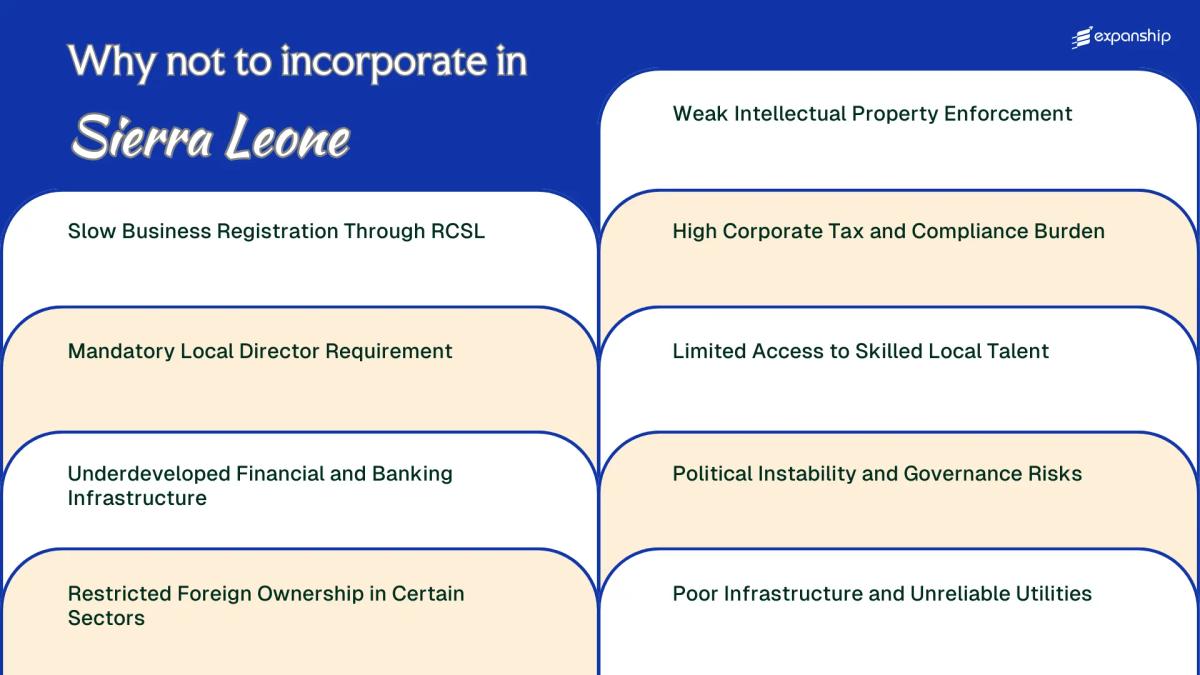
Slow Business Registration Through RCSL
Slow business registration in Sierra Leone is a documented operational barrier for foreign investors. Registration through the Corporate Affairs Commission, which operates under the Registration of Business Act 2007, routinely exceeds projected timelines.
Structural Delays Within the RCSL Process
The Registrar of Companies of Sierra Leone (RCSL) handles all formal company incorporations, but manual processing, inconsistent document verification, and procedural backlogs extend registration beyond the standard window. For a foreign-owned entity, this delay means your business cannot legally operate, open a bank account, or sign contracts during the waiting period.
Online filing infrastructure remains underdeveloped, requiring physical document submission in many cases.
Practical Cost of RCSL Registration Delays
Every week your registration stalls is a week of operational inactivity, accumulating fixed costs without generating revenue. Foreign directors coordinating remotely face compounded difficulty, as follow-up typically requires in-country presence or a locally appointed representative.
RCSL registration delays problems are particularly acute for time-sensitive market entries where competitors are already established.
If your incorporation documents contain any discrepancy, the RCSL may return the entire application without a clear remediation timeline, indefinitely stalling your ability to commence operations.
Mandatory Local Director Requirement
The local director requirement in Sierra Leone restrictions stems from the Companies Act 2009, which mandates that every registered company maintain at least one director who is ordinarily resident in the country. For a foreign business owner without existing local connections, satisfying this requirement adds both cost and operational dependency before the business can legally function.
Finding a qualified, trustworthy resident director is not straightforward in a jurisdiction with limited corporate governance infrastructure. You are effectively placing legal signatory authority with an individual whose actions can bind your company under Sierra Leonean law.
This creates a set of recurring practical burdens:
- Paying ongoing fees to a nominee director service, which represents a fixed annual cost with no operational return
- Accepting that a local director can influence or delay decisions requiring their signature or formal consent
- Exposure to liability if the appointed director acts outside their agreed scope, given limited legal recourse mechanisms locally
- Difficulty replacing a non-performing director quickly due to procedural filing requirements with the Corporate Affairs Commission
Private companies with entirely non-resident ownership face this restriction without exception.

Company Incorporation in Sierra Leone
Understand the full legal requirements for registering a company in Sierra Leone, including director obligations under the Companies Act 2009.
Underdeveloped Financial and Banking Infrastructure
Sierra Leone banking infrastructure limitations present a direct operational problem for foreign-incorporated entities from the moment they attempt to open a corporate account. The banking sector is supervised by the Bank of Sierra Leone under the Banking Act 2011, but the sector remains thin, with a small number of licensed commercial banks serving a largely underbanked population.
Opening a corporate account as a foreign-owned entity typically involves extended due diligence timelines, multiple in-person requirements, and documentation burdens that banks in more developed markets do not impose. Your firm may wait weeks before an account becomes operational, delaying payroll, supplier payments, and capital deployment.
| Constraint | Practical Impact on Foreign Business |
|---|---|
| Limited number of licensed commercial banks | Minimal competition, fewer product options for corporate clients |
| Underdeveloped trade finance products | Cross-border transactions require correspondent banking arrangements that add cost and delay |
| Low digital banking penetration for corporate accounts | Reliance on branch-based processes slows routine financial operations |
| Restricted foreign currency account access | Repatriating profits or managing multi-currency exposure becomes structurally difficult |
Correspondent banking relationships between Sierra Leonean banks and international financial institutions are limited, which means cross-border wire transfers often route through intermediary banks, adding both fees and processing time. For a foreign firm managing international supplier contracts or investor distributions, this creates a recurring friction point.
Access to credit facilities for foreign-incorporated businesses is also constrained. Lending products for corporates are limited in scope, and interest rates on commercial loans have historically been high relative to comparable frontier markets.
Restricted Foreign Ownership in Certain Sectors
Foreign ownership restrictions in Sierra Leone are not uniform across the economy. Certain sectors are either fully closed to foreign participation or subject to binding equity thresholds that require a local ownership stake, limiting how much control your business can retain.
Under the Investment Promotion Act and related sector-specific regulations, activities deemed sensitive to national interests, including small-scale retail trade, artisanal mining, and some agricultural activities, are reserved exclusively for Sierra Leonean citizens. Foreign investors who attempt to structure operations in these areas face direct legal exposure.
Even in sectors where foreign participation is permitted, joint venture requirements may apply, forcing equity sharing with local partners. This creates valuation complexity and governance friction that directly affects your operational autonomy.
- Confirm the sector classification of your intended business activity before incorporation
- Identify whether equity thresholds or local partnership requirements apply under sector-specific law
- Artisanal and small-scale mining is legally restricted to Sierra Leonean nationals under the Mines and Minerals Act
- Small-scale retail trade is closed to foreign-owned entities regardless of investment size
- Ownership caps, where applicable, bind your shareholding structure from the date of registration
Sierra Leone restricts foreign ownership in small-scale retail trade even when the foreign investor holds a valid business registration and meets all other incorporation requirements.
Weak Intellectual Property Enforcement
Weak intellectual property enforcement in Sierra Leone exposes foreign businesses to significant risks that are difficult to manage through internal controls alone. Brand owners, software developers, and content producers face a legal environment where rights registration does not reliably translate into practical protection.
Structural Gaps in IP Law and Administration
Sierra Leone is a party to the African Regional Intellectual Property Organization (ARIPO), and domestic IP matters fall under the purview of the Registrar General's Department. However, the enforcement infrastructure supporting these frameworks remains thin, with limited institutional capacity to investigate infringement or prosecute violations efficiently.
Your trademark registration may be valid on paper, yet counterfeit goods and unauthorized brand use persist with little deterrent. The absence of a dedicated IP tribunal means disputes are funneled through general civil courts, where case backlogs routinely extend proceedings by years.
Practical Consequences for Foreign Rights Holders
Intellectual property rights problems in Sierra Leone become a direct financial liability when enforcement depends on costly private litigation rather than regulatory intervention. Businesses operating in consumer goods, technology, or media sectors bear a disproportionate burden because the remedies available rarely justify the legal expenditure required to pursue them.
Even where judgments are secured, enforcement of court orders against infringing parties is inconsistently applied, reducing the deterrent value of litigation as a protection strategy.
Legal Guidance for IP and Compliance Challenges in Sierra Leone
Get expert advice on structuring your business presence in Sierra Leone to reduce exposure to intellectual property risks and regulatory gaps.
High Corporate Tax and Compliance Burden
The high corporate tax burden in Sierra Leone adds measurable cost to operating a foreign-owned entity, with the National Revenue Authority (NRA) administering a standard corporate income tax rate of 30% on taxable profits. Meeting ongoing obligations requires dedicated local accounting resources and consistent coordination with the NRA, which increases your annual overhead.
- The standard corporate income tax rate of 30% applies to most companies, exceeding the global average of approximately 23%, which directly reduces after-tax returns for foreign investors.
- Goods and Services Tax (GST) registration is mandatory once your firm exceeds the prescribed turnover threshold, adding a recurring filing obligation managed through the NRA.
- Pay-As-You-Earn (PAYE) obligations require monthly remittance for all employees, creating administrative frequency that strains lean operational teams.
- Non-compliance with NRA filing deadlines triggers penalties and interest charges under the Income Tax Act, exposing your business to escalating financial liability.
- Transfer pricing rules apply to related-party transactions, requiring documentation that imposes additional compliance costs on foreign-owned groups with cross-border structures.
Limited Access to Skilled Local Talent
The limited skilled talent Sierra Leone's labor market can supply is a structural constraint, not a temporary gap. Tertiary enrollment rates remain low, and the technical and professional workforce is thin across sectors including finance, engineering, ICT, and legal services.
Foreign companies typically respond by importing senior personnel. Expatriate employment triggers work permit obligations administered by the Ministry of Labour and Social Security, and costs accumulate quickly across visa fees, relocation, housing allowances, and salary premiums demanded by candidates willing to relocate.
Local hiring quotas under the Non-Citizens (Registration, Immigration and Expulsion) Act add a further layer of obligation. Your firm may be required to demonstrate that no qualified Sierra Leonean candidate was available before a work permit is granted for a foreign hire.
- Technical roles in ICT and engineering face acute shortfall
- Accounting and compliance professionals are in limited supply relative to demand
- Mid-level management talent is difficult to retain without above-market compensation
A foreign-owned firm hiring three expatriate managers in Freetown could reasonably incur relocation and housing costs exceeding USD 80,000 annually per employee, before salary, given typical housing rates in the capital and standard expatriate package structures in West African markets.
Political Instability and Governance Risks
Political instability risks in Sierra Leone are a documented concern for foreign investors, rooted in the country's history of civil conflict and its ongoing post-conflict governance transition. The All People's Congress (APC) and Sierra Leone People's Party (SLPP) have historically presided over sharp policy reversals between administrations, creating an unpredictable regulatory environment for businesses with long-term capital commitments.
Government contracts and licenses issued under one administration have faced review or renegotiation under successor governments. For a foreign entity relying on a concession agreement or a sector-specific operating license, this exposes the business to retroactive changes with limited legal recourse.
The Anti-Corruption Commission (ACC), while active, operates within a justice system that international assessments have rated as weak on enforcement consistency. Corruption at the regulatory level can translate into informal costs and unpredictable timelines for approvals your firm legally should receive without condition.
Sierra Leone's ranking in global governance indices, including the World Bank's Worldwide Governance Indicators, reflects persistent deficits in rule of law and government effectiveness. These are not abstract metrics; they directly affect how reliably your contractual rights are protected under local courts.
If your business model depends on a government-issued license, concession, or regulatory approval, a change in administration can trigger policy reversals that override existing agreements, and local courts may not provide effective protection against such actions.
Poor Infrastructure and Unreliable Utilities
Poor infrastructure challenges Sierra Leone presents to foreign businesses go beyond inconvenience — they translate directly into elevated operating costs and unpredictable production schedules.
Electricity supply across the country is heavily dependent on the Bumbuna Hydroelectric Power Station and smaller thermal generators, both of which suffer from chronic underinvestment and seasonal output drops. Businesses outside Freetown face even less grid coverage, forcing reliance on private diesel generators that add significant recurring expense.
Unreliable utilities problems for businesses in Sierra Leone extend to water supply, internet connectivity, and road networks. Supply chain delays caused by poor road infrastructure in rural and peri-urban areas directly affect firms dependent on logistics or physical distribution.
- Grid power cuts are frequent and prolonged, requiring backup power infrastructure at your expense
- Internet bandwidth remains constrained, limiting cloud-dependent or data-intensive operations
- Port infrastructure at Freetown's Queen Elizabeth II Quay, while functional, experiences congestion that delays import-dependent businesses
Strategies to Overcome These Drawbacks
Overcoming Sierra Leone incorporation drawbacks requires structural preparation rather than reactive problem-solving. The challenges documented in this blog span registration delays, ownership restrictions, tax exposure, and infrastructure gaps — each requiring a distinct operational response.
- Register your entity directly through the RCSL portal to reduce processing delays associated with manual filings.
- Appoint a qualifying resident director prior to submission to satisfy the local directorship requirement under the Companies Act 2009.
- Open a corporate account with a bank holding a current Bank of Sierra Leone licence to reduce transactional risk tied to underdeveloped banking infrastructure.
- File for any applicable sector licences early, particularly in mining or telecommunications, where foreign ownership ceilings apply under sector-specific legislation.
- Register trademarks and other intellectual property with the Registrar General's Department to establish the strongest available legal footing given current enforcement gaps.
- Engage a local payroll structure to address the skilled talent shortage through documented employment contracts compliant with the Employment Act.
These steps operate within a regulatory framework that continues to undergo reform, including ongoing updates to investment policy under the Sierra Leone Investment and Export Promotion Agency. Structural preparation reduces exposure but does not eliminate the underlying institutional constraints this blog has identified.
Sierra Leone's Overall Investment Viability
:::Sierra Leone investment viability risks sit within a broader picture of a frontier market that is open to foreign capital but structurally constrained in ways that affect day-to-day operations. The Companies Act 2009 and the Registrar of Companies in Sierra Leone provide a formal legal basis for incorporation, and the country's natural resource base continues to draw interest from mining and agribusiness sectors. For businesses with low infrastructure dependency and a tolerance for regulatory friction, the jurisdiction remains a credible option.
| Pros | Cons |
|---|---|
| The Companies Act 2009 provides a codified legal framework for foreign-owned entities. | RCSL registration processes are slow and administratively inconsistent. |
| The mining, agriculture, and energy sectors are formally open to foreign participation. | Certain sectors impose foreign ownership restrictions that limit equity control. |
| Corporate tax incentives exist within designated sectors and investment categories. | The overall corporate tax and compliance burden remains high relative to peer markets. |
| Sierra Leone's geographic position offers access to West African trade corridors. | Power, transport, and logistics infrastructure is unreliable across much of the country. |
| English is the official language of business and law, reducing documentation friction. | IP protections exist on paper but lack consistent enforcement mechanisms. |
Governance risk remains the most consequential variable for long-term planning. Political volatility, combined with weak institutional capacity, can affect contract enforceability and regulatory predictability in ways that balance sheet analysis alone will not capture.
Corporate Compliance Services in Sierra Leone
Stay aligned with Sierra Leone's statutory filing requirements, including annual returns, tax obligations, and post-incorporation compliance under the Companies Act 2009.
Conclusion
The cons of Sierra Leone company formation are real and well-documented. Slow registration through the Corporate Affairs Commission, unreliable utilities, and the high corporate tax burden each present operational friction that compounds over time. Firms entering this market without prior exposure to West African regulatory environments often encounter delays and costs that outpace initial projections. Structural barriers do not disappear through planning alone; some require local expertise to manage effectively. Professional guidance from those familiar with the Registrar of Companies for Sierra Leone and the relevant compliance frameworks can reduce the time and cost of establishing a viable corporate presence.
Expanship's Sierra Leone Incorporation Services
From managing the Registrar of Companies of Sierra Leone (RCSL) filing requirements to maintaining post-incorporation compliance under the Companies Act 2009, the operational demands of running a foreign-owned entity here are real. Expanship's Sierra Leone incorporation services are structured to reduce that administrative burden, helping your business stay organized and on record without requiring you to manage every regulatory touchpoint yourself.
Beyond registration, Expanship supports the full formation cycle.
- Your company documents are prepared and submitted accurately to the RCSL.
- A registered agent and local office address are provided to satisfy statutory presence requirements.
- Expanship liaises directly with government agencies and regulatory bodies on your behalf.
- Post-incorporation obligations, including annual returns and statutory filings, are tracked and managed.
- Banking introduction support is available to help you approach local financial institutions.
- Tax registration and coordination with the National Revenue Authority (NRA) are handled as part of the setup process.
Reach out to Expanship Sierra Leone to discuss your incorporation requirements.
Frequently Asked Questions (FAQ)
The local director requirement applies broadly to companies incorporated under the Companies Act 2009 and is not limited to specific sectors or entity types. Foreign investors cannot satisfy this requirement by appointing a nominee from outside Sierra Leone; the individual must be locally resident. Failure to comply leaves the company in breach of its incorporation obligations, which can affect its ability to enter contracts or open a corporate bank account.
Sierra Leone applies a standard corporate income tax rate of 30%, which sits at the higher end among West African peers, with additional levies depending on sector classification. Companies in mining or extractive industries face separate fiscal regimes under the Mines and Minerals Act 2009, which can push the effective tax rate significantly higher. When combined with annual filing fees, business licence renewals, and sector-specific levies, the cumulative compliance cost is a genuine deterrent for small to mid-sized foreign entities.
Non-compliance with annual return filings under the Companies Act 2009 can result in financial penalties imposed by the RCSL, and persistent default may lead to the company being struck off the register. Reinstatement after deregistration requires a formal application and payment of outstanding fees, adding both cost and delay to resuming operations. Directors of struck-off companies may also face personal liability for obligations incurred during the period of non-compliance.
Sierra Leone's IP enforcement is weaker in practice than in Ghana or Côte d'Ivoire, primarily because judicial capacity and specialist IP tribunals are limited. The country is a member of WIPO, and the Registration of Business Names Act provides a basic framework, but registration alone offers limited deterrence against infringement without consistent court enforcement. For businesses whose value is concentrated in trademarks, proprietary technology, or creative content, this gap between legal protection on paper and enforcement in practice carries direct commercial risk.
Restructuring through a local holding company does not bypass sector-specific foreign ownership restrictions, as the restrictions under laws such as the Sierra Leone Investment and Export Promotion Agency Act apply based on the ultimate beneficial ownership of the entity. Regulatory bodies examine the ownership chain, not just the immediate shareholding structure. Attempting to circumvent these rules through nominee arrangements exposes the foreign investor to sanctions and potential loss of operating licences.
Businesses operating in Sierra Leone routinely spend on backup power generation, water storage, and connectivity redundancy because grid electricity supply from the Electricity Distribution and Supply Authority (EDSA) is inconsistent, particularly outside Freetown. These are not optional expenditures; they function as a baseline operational cost that foreign investors from markets with reliable infrastructure frequently underestimate. The financial impact compounds for manufacturing, data-dependent, or cold-chain businesses where utility interruptions directly disrupt output.
Sierra Leone's history includes periods of significant governance disruption, and while the post-war period has brought relative stability, institutional unpredictability remains a documented risk in assessments by bodies such as the World Bank and the Mo Ibrahim Foundation. A deterioration in governance can affect contract enforceability, regulatory consistency, and the ability to repatriate profits. Foreign investors without political risk insurance or bilateral investment treaty protections from their home jurisdiction have limited recourse if the operating environment shifts materially after incorporation.
Legal Disclaimer
The information provided in this article is for general informational purposes only and does not constitute legal, tax, or professional advice. While we strive to ensure the accuracy and timeliness of the content, laws and regulations are subject to change, and the application of laws can vary widely based on specific facts and circumstances.
Readers should not act upon this information without seeking professional counsel tailored to their individual situation. Expanship and its authors disclaim any liability for actions taken or not taken based on the content of this article.
For specific advice regarding your business setup, compliance requirements, or any legal matters, please consult with qualified legal and tax professionals in the relevant jurisdiction.