

Key Takeaways
- Foreign investors establishing a commercial presence in Saudi Arabia must obtain an investment licence from the Ministry of Investment (MISA) in addition to registering with the Ministry of Commerce, making dual-agency compliance a structural requirement rather than an optional step.
- Under Royal Decree No. M/132 of 2022, the applicable Companies Law sets out capital thresholds that vary according to entity type and investor classification, meaning the required minimum share capital cannot be assessed without first confirming the specific legal structure being formed.
- Beneficial ownership disclosure obligations under MISA's framework apply to all foreign-owned entities and must be satisfied as part of the formation process, not as a post-registration formality.
- All registered entities are required to maintain a licensed local office address in Saudi Arabia, and failure to meet this or any other formation requirement can result in rejection of the registration application or suspension of the business licence once granted.
Entity formation in Saudi Arabia is governed by the Companies Law, most recently updated through Royal Decree No. M/132 of 2022, with the Ministry of Commerce serving as the primary regulatory authority overseeing company registration. The Ministry of Investment (MISA) holds additional oversight for foreign-owned entities seeking an investment licence. This article addresses the structural, documentary, and compliance-based incorporation requirements in Saudi Arabia that apply across the formation process.
Failure to satisfy these requirements results in rejection of the registration application or, where non-compliance is identified post-formation, potential suspension of the business licence. Requirements vary depending on the legal entity type, the ownership structure, and the sector in which your business intends to operate.
Foreign investors and multinational firms establishing a commercial presence for the first time will find this article most directly applicable to their situation. The applicable framework is set out in the Companies Law.
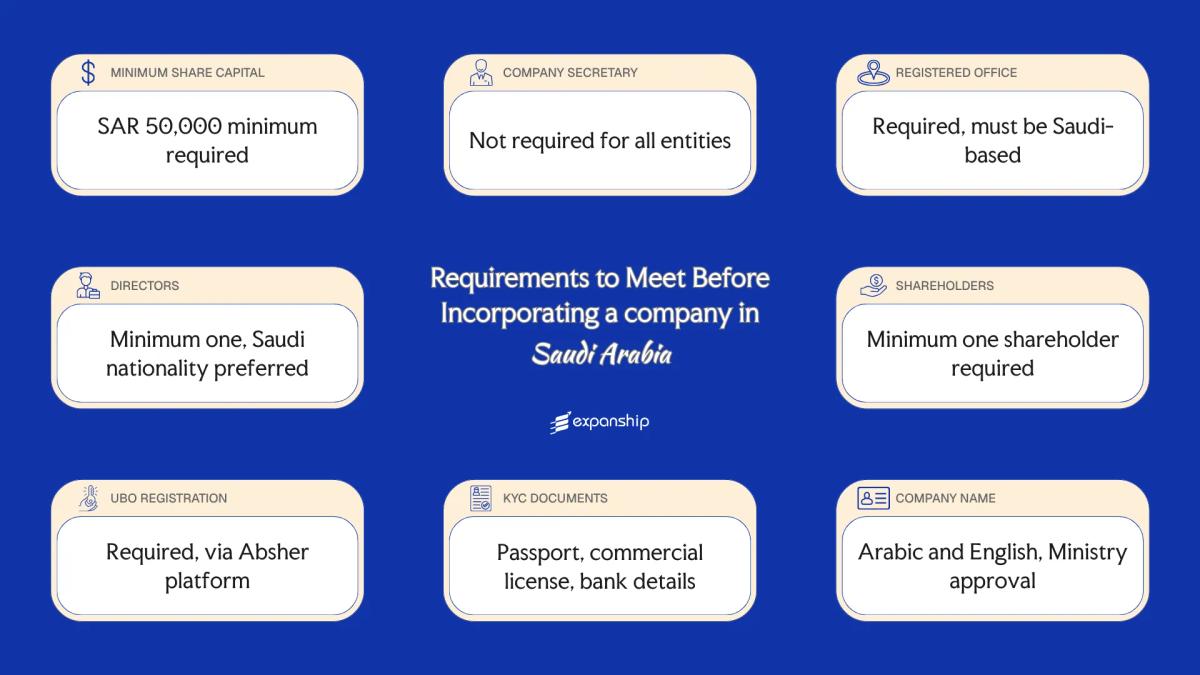
Minimum Share Capital Requirements in Saudi Arabia
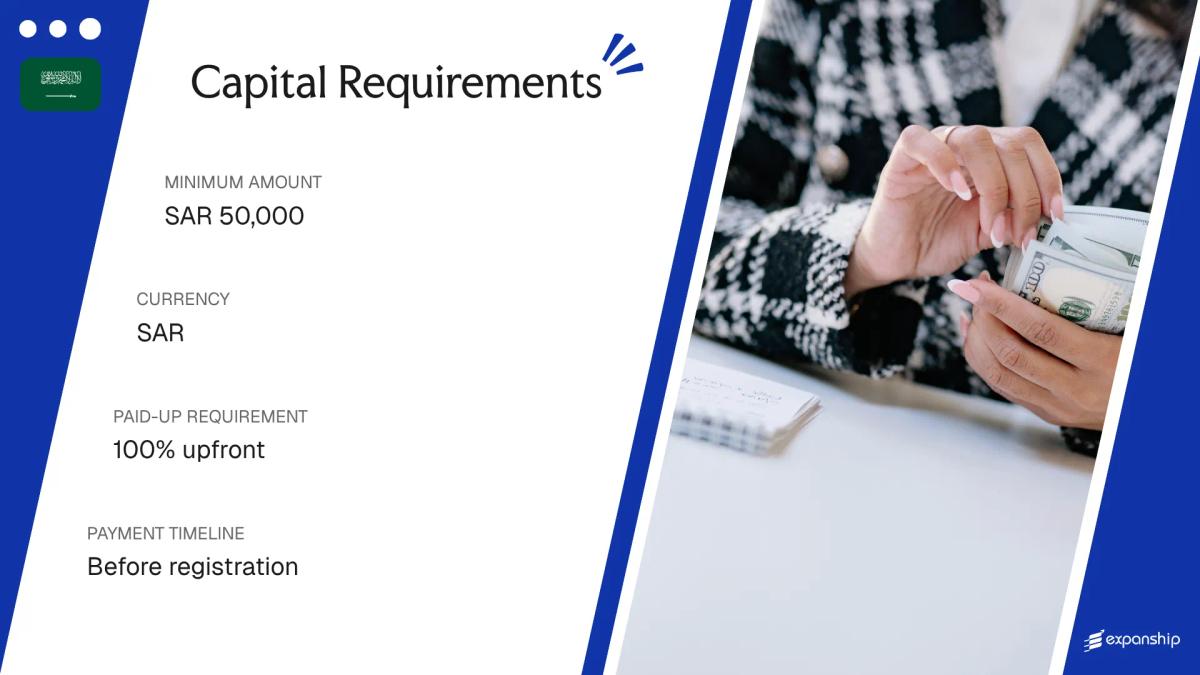
Saudi Arabia minimum share capital requirements vary by entity type and are governed by the Companies Law (Royal Decree No. M/3 of 2022) and its executive regulations. The Ministry of Investment (MISA) oversees foreign-incorporated entities, while the Ministry of Commerce administers domestic company registrations.
Under the paid-up capital regulations, a Limited Liability Company (LLC) has no statutory minimum capital requirement under the current Companies Law, though MISA retains discretion to impose capital conditions on foreign investors depending on the activity licence. Capital is deposited into a dedicated bank account, and a bank certificate confirming deposit is required as part of the incorporation documentation submitted to the relevant authority.
| Parameter | Detail |
|---|---|
| Minimum Authorized Share Capital | No statutory minimum for LLCs under the Companies Law (Royal Decree No. M/3 of 2022) |
| Maximum Authorized Share Capital | No statutory maximum |
| Minimum Paid-Up Capital | No statutory minimum; MISA may impose activity-specific requirements for foreign investors |
| Paid-Up Requirement at Incorporation | Bank certificate confirming capital deposit required prior to commercial registration |
| Accepted Currency | Saudi Riyal (SAR) |
| Accepted Forms of Contribution | Cash; in-kind contributions permitted subject to valuation and regulatory approval |
| Timeframe to Deposit Capital | Prior to submission of incorporation documents to the Ministry of Commerce or MISA |
The bank certificate confirming your capital deposit must be obtained before submitting incorporation documents. Attempting to register without this certificate will result in rejection by the Ministry of Commerce.
Company Secretary Requirements in Saudi Arabia
Under the Companies Law and its implementing regulations, company secretary requirements in Saudi Arabia do not follow the same formal framework as common law jurisdictions. There is no statutory obligation to appoint a dedicated company secretary for most commercial entity types, including the limited liability company (LLC), which is the most commonly used structure by foreign investors.
Certain corporate governance functions are instead distributed among managers, board members, or appointed compliance officers, depending on the entity's structure and the requirements set by the Ministry of Commerce and the relevant regulatory body.
Eligibility criteria for those fulfilling a secretarial or equivalent governance role typically include:
- Natural persons or appointed officers acting under the entity's articles of association
- Saudi Arabia corporate secretary obligations may be assigned to a manager or board member already registered with the Ministry of Commerce
- No standalone licensing requirement exists specifically for a company secretary role under general commercial regulations
- For listed entities supervised by the Capital Market Authority, board secretary requirements follow the Corporate Governance Regulations

Incorporate a Company in Saudi Arabia
Set up your business entity in Saudi Arabia with guidance on structure selection, regulatory filings, and Ministry of Commerce registration.
Registered Office Requirements in Saudi Arabia
Registered office requirements in Saudi Arabia mandate that every company maintains a physical address within the Kingdom, as specified under the Companies Law (Royal Decree No. M/3 of 2022) and overseen by the Ministry of Commerce. Failure to maintain a compliant local address can result in administrative penalties, suspension of commercial registration, or difficulties renewing your business licence through the Ministry of Commerce's Maroof or Sijilat platforms.
- A physical address located within Saudi Arabia is required; P.O. Box addresses alone do not satisfy this requirement.
- Virtual offices are not recognised as a compliant registered address under current Ministry of Commerce guidance.
- The address must be based within the Kingdom; foreign addresses cannot fulfil this obligation.
- Supporting documentation, such as a lease agreement or title deed, is required to evidence occupancy of the registered premises.
- Your company's registered address is publicly listed on the commercial register, accessible through the Ministry of Commerce's official records.
- Any change to the registered address must be formally notified to the Ministry of Commerce, with the commercial registration updated accordingly.
Director Requirements in Saudi Arabia

Under the Companies Law (Royal Decree No. M/3 of 2022) and its implementing regulations, director requirements in Saudi Arabia place direct fiduciary, statutory, and administrative obligations on individuals appointed to the board. Directors are personally liable for resolutions that contravene the Companies Law, the firm's articles of association, or decisions issued by the Ministry of Commerce.
| Parameter | Detail |
|---|---|
| Minimum Number of Directors | A Limited Liability Company (LLC) requires at least one manager/director; a Joint Stock Company (JSC) requires a minimum of three board members. |
| Maximum Number of Directors | No statutory maximum for LLCs; JSCs are generally subject to a ceiling of eleven board members under the Companies Law. |
| Local/Resident Director Required | No statutory residency requirement, though a resident representative is often required for licensing purposes under certain regulatory authorities. |
| Nationality Restrictions | No general nationality restriction, though specific licensed sectors may impose Saudi national requirements under applicable sector regulations. |
| Minimum Age Requirement | Directors must have full legal capacity; the general civil majority age under Saudi law is 18 years. |
| Corporate Directors Permitted | Corporate directors are not permitted; board membership must be held by natural persons. |
| Director Must Be a Shareholder | No statutory requirement for directors to hold shares, unless the articles of association expressly require it. |
| Publicly Listed on Registry | Directors of JSCs are disclosed in filings with the Ministry of Commerce and, where applicable, the Capital Market Authority (CMA). |
| Disqualification Conditions | A person convicted of offences involving dishonesty, bankruptcy, or a breach of fiduciary duty may be disqualified from directorship under the Companies Law. |
Foreign nationals can hold 100% of board seats in a Saudi LLC without any mandatory local director, yet the entity may still require a Saudi-resident authorised signatory to satisfy certain municipal and sector-specific licensing conditions.
Shareholder Requirements in Saudi Arabia
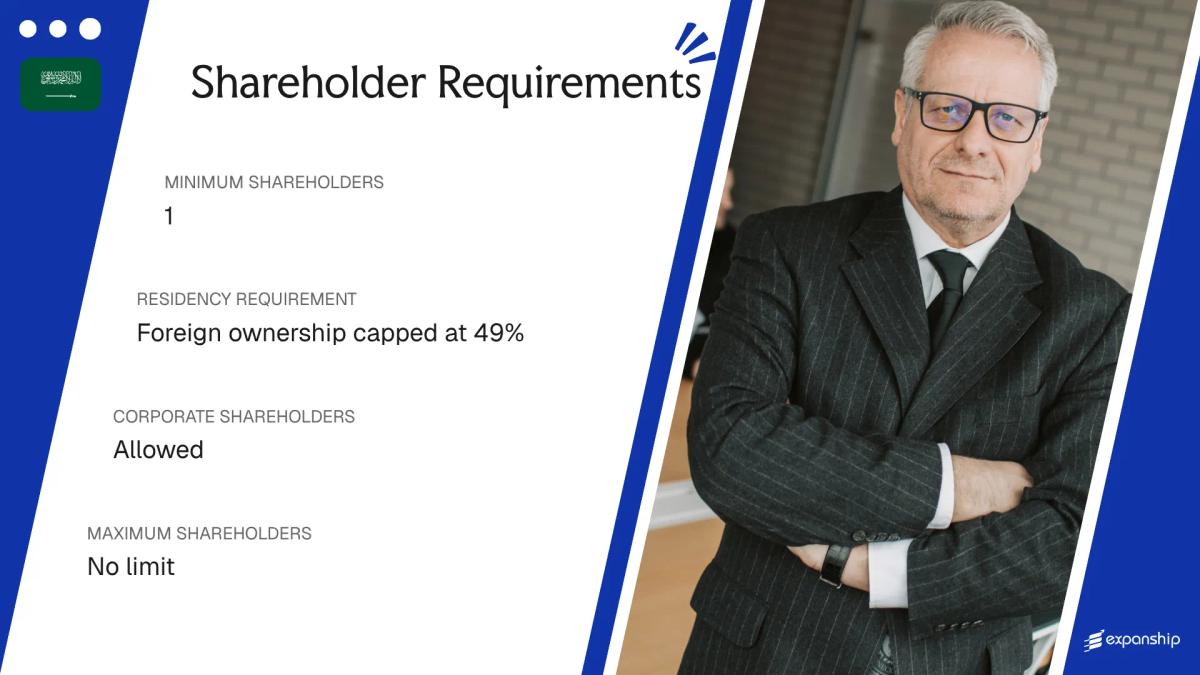
A Saudi Limited Liability Company requires a minimum of one shareholder and permits up to fifty. Single-member LLCs are recognized under the Companies Law issued by Royal Decree No. M/3 of 2022.
Nationality and Residency Restrictions
Saudi Arabia foreign shareholder regulations permit full foreign ownership in most sectors following reforms under Vision 2030, though certain industries remain subject to the Foreign Investment Law and the Negative List administered by the Ministry of Investment (MISA). Shareholders are not required to be Saudi residents, but MISA licensing conditions may impose local partnership requirements in restricted sectors.
Corporate Shareholders
Corporate entities, whether domestic or foreign, may hold shares in a Saudi LLC. The corporate shareholder must provide valid constitutional documents and evidence of legal standing in its jurisdiction of incorporation.
Shareholder Liability
Liability is limited to each shareholder's capital contribution. The Companies Law does not extend personal liability to shareholders except in cases of fraud or misuse of the corporate structure.
Register of Shareholders
A register of shareholders must be maintained at the company's registered office. Changes to shareholding must be reflected through a notarized amendment to the articles of association and filed with the Ministry of Commerce.
Guidance on Shareholder Structuring for Your Saudi Entity
Get expert support on meeting shareholder requirements when setting up a company in Saudi Arabia, including foreign ownership compliance and MISA licensing considerations.
UBO / Beneficial Ownership Disclosure Requirements in Saudi Arabia
Under Saudi Arabia's Anti-Money Laundering Law and its Executive Regulations, a beneficial owner is any natural person who ultimately owns or controls 25% or more of a company's shares or voting rights, or who otherwise exercises effective control over the entity.
- Identify all natural persons meeting the 25% ownership or effective control threshold at the time of incorporation.
- Record beneficial ownership information in the company's internal register, including full name, nationality, date of birth, and identification details.
- Submit UBO data to the Ministry of Commerce through the commercial registration process or the Qiyas platform, as applicable.
- Update the register within 15 days of any change in beneficial ownership status.
| Parameter | Detail |
|---|---|
| Ownership Threshold for UBO Status | 25% of shares or voting rights, or effective control |
| Filing Authority | Ministry of Commerce |
| Disclosure Deadline at Incorporation | At the time of commercial registration |
| Publicly Accessible Register | No |
| Penalties for Non-Disclosure | Administrative fines under the Anti-Money Laundering Law |
| Ongoing Update Obligation | Within 15 days of any change |
KYC / Document Requirements in Saudi Arabia
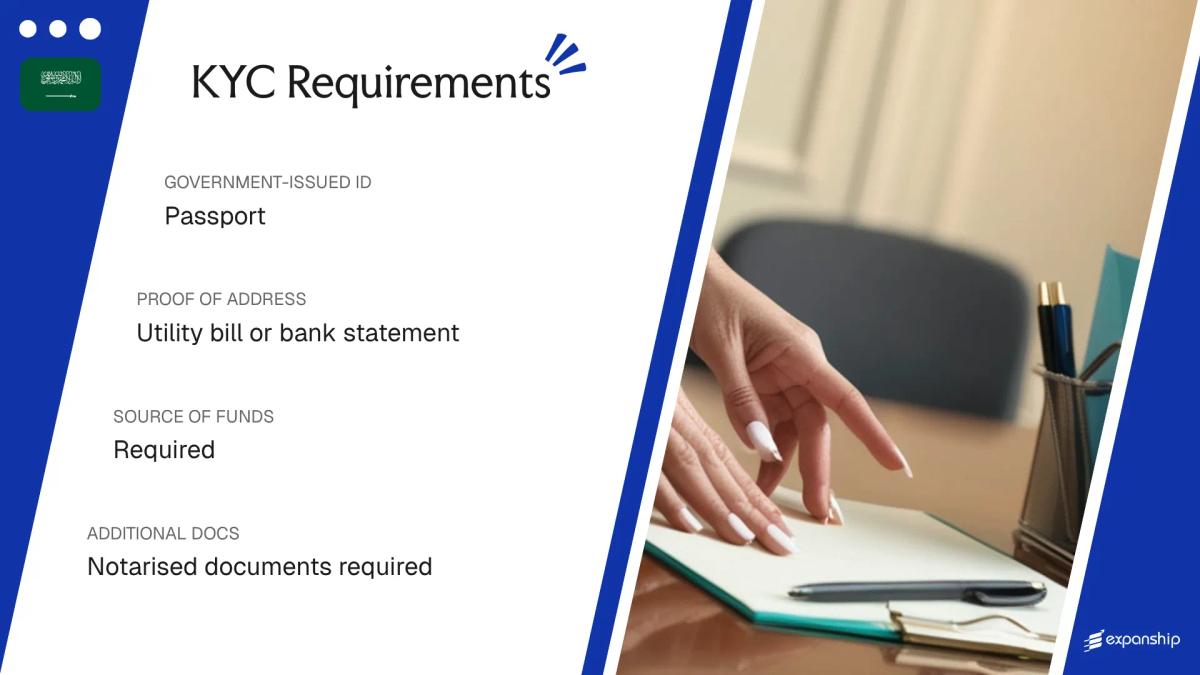
KYC requirements for Saudi Arabia incorporation are governed by the Anti-Money Laundering Law issued under Royal Decree No. M/31, enforced through the Financial Intelligence Unit. All parties to an incorporation — directors, shareholders, and beneficial owners — must submit identity and source-of-funds documentation before the Ministry of Investment (MISA) or Ministry of Commerce will proceed with registration.
Individual / Personal Documents
- Valid passport copy for all foreign nationals; national ID for Saudi nationals
- Proof of residential address dated within three months (utility bill or bank statement)
- Recent passport-sized photograph where required by the registering authority
- Completed KYC declaration form as specified by MISA or the relevant commercial registry
Corporate Documents
- Certificate of incorporation of the parent or shareholder entity, certified as current
- Articles of association or equivalent constitutional document
- Register of directors or equivalent officer confirmation document
- Proof of the corporate entity's registered address in its home jurisdiction
Source of Funds Documentation
- Recent bank statements covering a minimum of three to six months
- Audited financial statements of the investing entity where available
- A written declaration explaining the origin of capital contributed
Notarisation and Apostille Requirements
- Foreign documents must generally be notarised in the country of origin
- Saudi Arabia requires apostille certification under the Hague Convention for eligible countries
- All non-Arabic documents must be translated by a certified translator recognised in the Kingdom
Inconsistencies between the stated beneficial owner and the corporate shareholding structure are the most frequent cause of registration delays at MISA.
Company Name Requirements in Saudi Arabia
Company name requirements in Saudi Arabia are assessed by the Ministry of Commerce during the incorporation process. Each proposed name must be unique and must not duplicate or closely resemble an existing registered trade name.
Names must be written in Arabic; a Latin-script transliteration may accompany the Arabic form but cannot replace it. A legal suffix indicating the entity type, such as "Limited Liability Company" or its Arabic equivalent, is mandatory.
Certain words are outright prohibited, including terms that reference government bodies, religious phrases used without authorization, and any wording considered contrary to public order or morals. Words implying a regulated activity, such as banking or insurance, require prior approval from the relevant sectoral authority.
Name reservation is available through the Ministry of Commerce's online portal (Maroof). Reservations are granted for a limited period, after which the name lapses if incorporation is not completed.
Compliance Services for Companies in Saudi Arabia
Maintain your Saudi Arabian company's good standing with ongoing compliance support, from annual filings to regulatory reporting.
Conclusion
Saudi Arabia company incorporation requirements span multiple regulatory layers, governed primarily by the Companies Law and administered through the Ministry of Investment (MISA) and the Ministry of Commerce. Capital thresholds vary by entity type and investor classification. The requirement for a licensed local office address and the UBO disclosure obligations under MISA's beneficial ownership framework carry particular weight in practice. Once these requirements are understood, the practical work of engaging local agents, preparing compliant documentation, and coordinating across government portals becomes the next step for any foreign investor.
Expanship's Corporate Services for Saudi Arabia Expansion
Expanding into Saudi Arabia involves working within a tightly regulated corporate environment, from MISA registration requirements to mandatory local office provisions and Saudization obligations. Expanship's Saudi Arabia corporate services expansion support is designed to reduce the administrative weight of these jurisdiction-specific requirements, so your team can focus on operational priorities rather than procedural ones.
Our service scope covers the full formation and maintenance cycle:
- We prepare and file all company registration documentation with the relevant Saudi authorities.
- Our team provides registered agent and office solutions that satisfy the Ministry of Investment's physical presence requirements.
- We manage government filings and liaise directly with regulatory bodies on your behalf.
- Post-incorporation compliance obligations, including annual filings and Qiwa-related reporting, are handled on an ongoing basis.
- Banking introduction support is available to help your entity establish an operational account in-country.
- We also assist with VAT registration and coordination with ZATCA and other local authorities.
Reach out to Expanship Saudi Arabia to discuss how we can support your setup.
Frequently Asked Questions (FAQ)
A foreign national can hold a director or manager position in a Saudi LLC, but the entity must still meet the Ministry of Investment (MISA) foreign investment licensing requirements before the appointment is valid. Regulated industries may impose additional nationality or residency conditions on management roles. The Commercial Companies Law governs the general appointment framework, while sector-specific regulators can layer further restrictions on top of it.
Failure to comply with beneficial ownership disclosure obligations under Saudi Arabia's Anti-Money Laundering Law and the implementing regulations issued by the Financial Intelligence Unit can result in administrative penalties, fines, and potential suspension of the company's commercial registration. The Ministry of Commerce has the authority to take enforcement action where disclosures are incomplete or inaccurate. Directors and managers can bear personal liability where non-disclosure is found to be willful.
There is no general residency requirement for shareholders in a Saudi LLC, but foreign shareholders must hold a valid foreign investment license issued by MISA before their ownership stake is recognized. Certain sectors restricted under the Negative List published by MISA are closed to foreign ownership entirely, regardless of residency. Saudi nationals face no equivalent licensing condition to hold shares in an LLC.
If the Ministry of Commerce rejects a proposed company name, you must submit an alternative before the registration process can advance. Names are rejected on grounds that include duplication with an existing registered entity, use of prohibited terms, or names that conflict with Saudi public order standards under the Commercial Companies Law. The reservation of an approved name is time-limited, so delays in proceeding after approval can require re-submission.
Yes, corporate shareholders face additional documentary requirements beyond what is required from individual shareholders. In addition to identity documents, a corporate shareholder must provide certified constitutional documents, a certificate of good standing or equivalent from its home jurisdiction, and evidence of its own beneficial ownership structure. All foreign-language documents must be officially translated into Arabic and typically require notarization and apostille or legalization depending on the country of origin.
Using a non-genuine or mail-only address as a registered office where a physical presence is required constitutes a misrepresentation in the commercial registration, which can trigger penalties under the Commercial Register Law. The Ministry of Commerce conducts periodic verification of registered addresses, and discrepancies can lead to fines or suspension of the commercial registration. Foreign-invested entities licensed through MISA are subject to additional scrutiny given that physical operational presence is often a condition of the investment license itself.
Legal Disclaimer
The information provided in this article is for general informational purposes only and does not constitute legal, tax, or professional advice. While we strive to ensure the accuracy and timeliness of the content, laws and regulations are subject to change, and the application of laws can vary widely based on specific facts and circumstances.
Readers should not act upon this information without seeking professional counsel tailored to their individual situation. Expanship and its authors disclaim any liability for actions taken or not taken based on the content of this article.
For specific advice regarding your business setup, compliance requirements, or any legal matters, please consult with qualified legal and tax professionals in the relevant jurisdiction.