

Key Takeaways
- All companies incorporated in Romania must register with the National Trade Register Office (ONRC) under the framework established by Company Law No. 31/1990, and failure to meet formation requirements results in rejection of the registration application.
- Unlike many EU member states, an SRL (societate cu răspundere limitată) carries no minimum share capital threshold, making it a structurally accessible vehicle for foreign investors establishing a Romanian presence.
- Foreign-sourced documents submitted as part of the KYC process are subject to notarisation and apostille requirements before they will be accepted by Romanian authorities.
- Beneficial ownership information must be registered with the Central Registry maintained by the ONRC, an obligation that carries cross-border compliance implications for non-resident shareholders and controlling persons.
Company incorporation in Romania is governed primarily by Company Law No. 31/1990, with the National Trade Register Office (ONRC) serving as the central authority responsible for registering and maintaining records of legal entities.
This article covers the structural, documentary, and regulatory requirements that apply when forming a company under Romanian law.
Requirements vary depending on the entity type selected, the industry in which your business will operate, and the profile of the investors involved. Failure to satisfy the applicable formation requirements results in rejection of the registration application by the ONRC, preventing the entity from legally conducting business.
This article is most relevant to foreign investors and non-resident business owners intending to establish a legal presence in Romania through a locally registered entity.
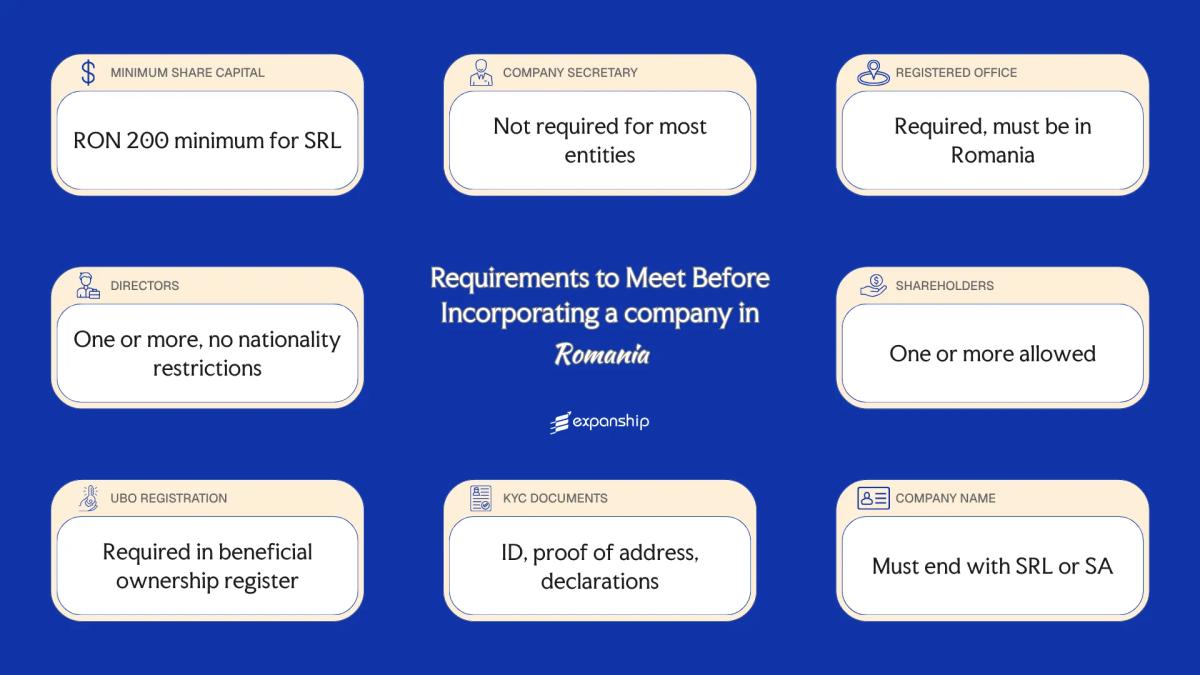
Minimum Share Capital Requirements in Romania
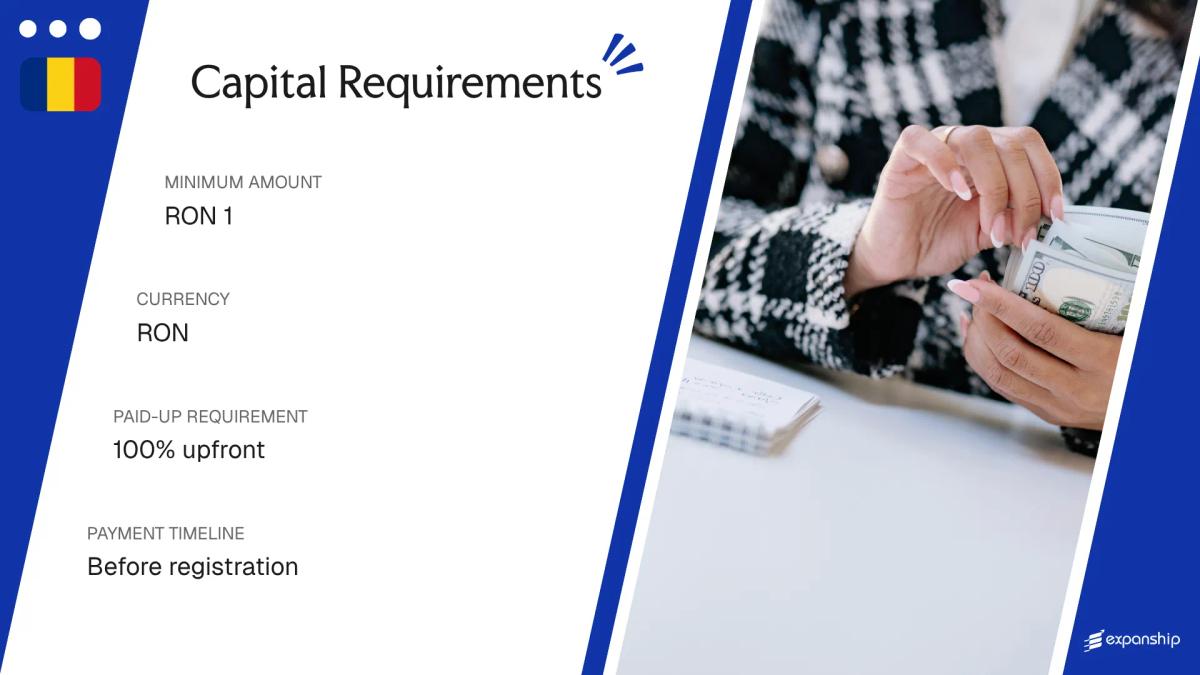
Romania minimum share capital requirements vary by entity type and are governed by Law No. 31/1990 on commercial companies, as amended. For a Societate cu Răspundere Limitată (SRL), the statutory minimum is 1 Romanian leu, a figure set following legislative amendments that effectively removed any meaningful capital threshold for this structure. Capital deposit is verified by the Trade Register (Oficiul Național al Registrului Comerțului, or ONRC) at the point of incorporation, and the firm operates on a par value share system.
Share capital is a one-time incorporation requirement rather than an ongoing statutory obligation, though any subsequent increases or reductions must be registered with the ONRC. Your business must deposit the subscribed capital into a dedicated bank account before registration is finalized.
| Parameter | Detail |
|---|---|
| Minimum Authorized Share Capital | 1 Romanian leu (for SRL) |
| Maximum Authorized Share Capital | No statutory requirement |
| Minimum Paid-Up Capital | 1 Romanian leu (for SRL) |
| Paid-Up Requirement at Incorporation | Full subscription required before ONRC registration |
| Accepted Currency | Romanian leu (RON) |
| Accepted Forms of Contribution | Cash contributions; in-kind contributions permitted under Law No. 31/1990 |
| Timeframe to Deposit Capital | Prior to submission of incorporation documents to the ONRC |
A statutory minimum of 1 leu does not mean share capital structure is optional. Each SRL share must have a minimum nominal value of 10 lei, so the actual capital amount depends on the number of shares issued.
Company Secretary Requirements in Romania
Romanian company law does not impose a mandatory company secretary requirement for a standard private limited liability company (Societate cu Răspundere Limitată). Under Law No. 31/1990 on companies, the SRL structure is administered through its designated managers (administratori), who bear responsibility for statutory filings, regulatory correspondence, and maintaining the entity's legal records.
Where a company secretary or equivalent administrative officer is voluntarily appointed, that individual or entity typically handles communication with the Oficiul Național al Registrului Comerțului (ONRC), coordinates annual reporting obligations, and ensures the firm's statutory documents remain current. These functions, while not compulsory for an SRL, become more structured in larger entities or where corporate governance policies require them.
Qualification criteria for anyone serving in a company secretary or equivalent administrative capacity:
- No statutory licensing requirement exists under Romanian law for this role in an SRL.
- Both natural persons and legal entities may serve in an administrative support capacity.
- There is no mandatory residency condition attached to this function.
- The individual or firm must have legal capacity under Romanian civil law.
- Any foreign national may serve without prior authorisation specific to this role.

Incorporate a Company in Romania
Set up your Romanian SRL with full statutory compliance, from ONRC registration to post-incorporation formalities.
Registered Office Requirements in Romania
Romania registered office requirements are governed by Law no. 31/1990 on companies, which mandates that every company registered with the Trade Registry (Oficiul Național al Registrului Comerțului, or ONRC) maintain a declared legal seat within the country at all times. Failure to maintain a valid, verifiable address can result in the ONRC initiating dissolution proceedings against the entity under Article 237 of the same law.
- A physical address is required; P.O. boxes do not qualify as a legal seat.
- Virtual office addresses are permitted, provided a legitimate service agreement is in place with a licensed provider.
- The address must be located within Romanian territory; foreign addresses are not accepted by the ONRC.
- Proof of right of use over the premises is mandatory, in the form of a lease agreement, ownership title deed, or a notarized consent from the property owner.
- The registered address is publicly listed in the Trade Registry and accessible through the ONRC's online portal.
- Any change to the legal seat requires a formal amendment filed with the ONRC, supported by updated proof of address and a resolution from the company's decision-making body.
Director Requirements in Romania
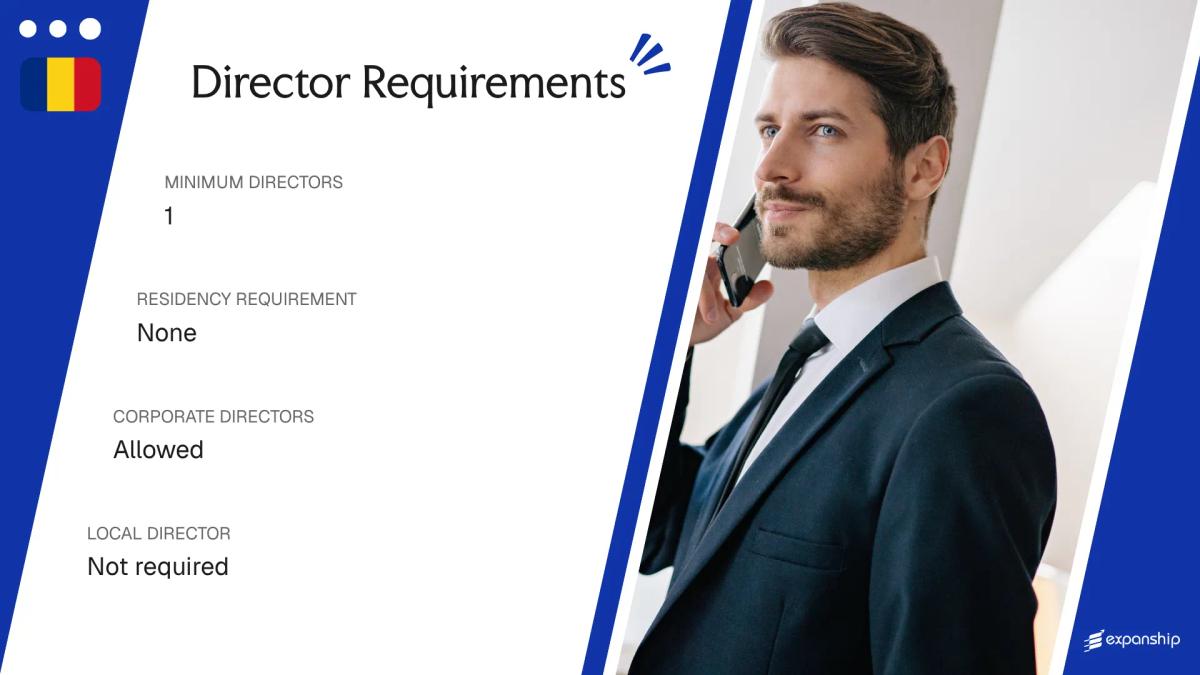
Under Romanian company law, specifically Law No. 31/1990 on companies, directors of a Societate cu Raspundere Limitata (SRL) assume personal liability for decisions made in breach of their fiduciary duties, including obligations to act in the company's interest and maintain accurate financial records. Meeting Romania director requirements incorporation standards also means directors are jointly liable for any damages resulting from non-compliance with statutory reporting obligations to the Oficiul Registrului Comertului (ORC).
| Parameter | Detail |
|---|---|
| Minimum Number of Directors | One director is required by law. |
| Maximum Number of Directors | No statutory maximum is prescribed for an SRL. |
| Local/Resident Director Required | No residency requirement exists under Romanian law. |
| Nationality Restrictions | No nationality restrictions apply; foreign nationals may serve. |
| Minimum Age Requirement | Directors must be at least 18 years of age. |
| Corporate Directors Permitted | Corporate directors are not permitted for an SRL; only natural persons may serve. |
| Director Must Be a Shareholder | No statutory requirement for a director to hold shares in the company. |
| Publicly Listed on Registry | Directors are publicly listed in the Trade Register maintained by the ORC. |
| Disqualification Conditions | A person convicted of fraud, embezzlement, or similar offences under the Romanian Penal Code may be barred from serving as director. |
Despite having no residency requirement, a foreign director must obtain a Romanian fiscal identification code (CIF) before being registered with the ORC, adding an administrative step that many first-time incorporators overlook.
Shareholder Requirements in Romania
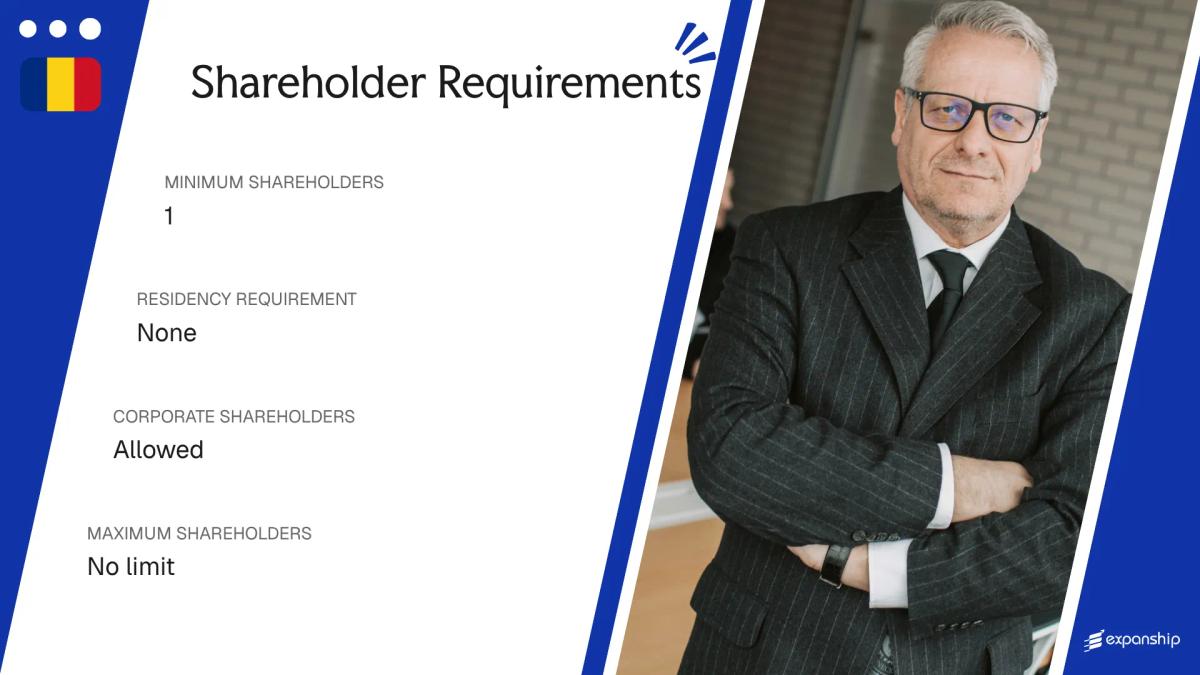
Under Romanian corporate law, a Societate cu Răspundere Limitată (SRL) requires a minimum of one shareholder and permits a maximum of 50. A sole associate structure is fully permitted, though a single natural person may hold this position in only one SRL at a time.
Nationality and Residency Restrictions
Romania imposes no nationality or residency requirements on shareholders. Foreign individuals and entities may hold 100% ownership in a Romanian SRL without restriction.
Corporate Shareholders
Legal entities are permitted to act as shareholders in a Romanian SRL. No special conditions specific to corporate shareholding are imposed beyond standard registration and KYC documentation requirements.
Shareholder Liability
Shareholder liability is limited to each associate's subscribed share capital contribution. Romanian company law does not generally extend liability beyond this amount, except in cases of fraud or abuse of the corporate form.
Register of Shareholders
An SRL must maintain an internal register of associates. This register is not publicly accessible, but ownership data is disclosed through the Trade Register, and any changes to shareholder structure require filing with the Oficiul Național al Registrului Comerțului (ONRC).
Shareholder Structuring Support for Your Romanian Entity
Get guidance on meeting associate requirements and structuring ownership correctly when setting up an SRL in Romania.
UBO / Beneficial Ownership Registration Requirements in Romania
Romania beneficial ownership registration requirements are governed primarily by Law No. 129/2019 on preventing and combating money laundering and terrorist financing, which transposes the EU's Fourth and Fifth Anti-Money Laundering Directives. A beneficial owner (beneficiar real) is defined as any natural person who ultimately owns or controls more than 25% of the shares or voting rights in a legal entity.
- Identify all natural persons holding, directly or indirectly, more than 25% of the company's shares or voting rights.
- Prepare a UBO declaration (declaratie privind beneficiarul real) at the time of incorporation.
- Submit the declaration to the Trade Register (Oficiul National al Registrului Comertului) as part of the incorporation filing.
- File an updated declaration annually, regardless of whether ownership has changed.
- Submit a new declaration within 15 days whenever a change in beneficial ownership occurs.
| Parameter | Detail |
|---|---|
| Ownership Threshold for UBO Status | Above 25% of shares or voting rights |
| Filing Authority | Oficiul National al Registrului Comertului (ONRC) |
| Disclosure Deadline at Incorporation | At the time of incorporation filing |
| Publicly Accessible Register | Yes, the UBO register is publicly accessible |
| Penalties for Non-Disclosure | Fines under Law No. 129/2019; amounts vary by violation severity |
| Ongoing Update Obligation | Annual re-declaration and within 15 days of any ownership change |
KYC / Document Requirements in Romania
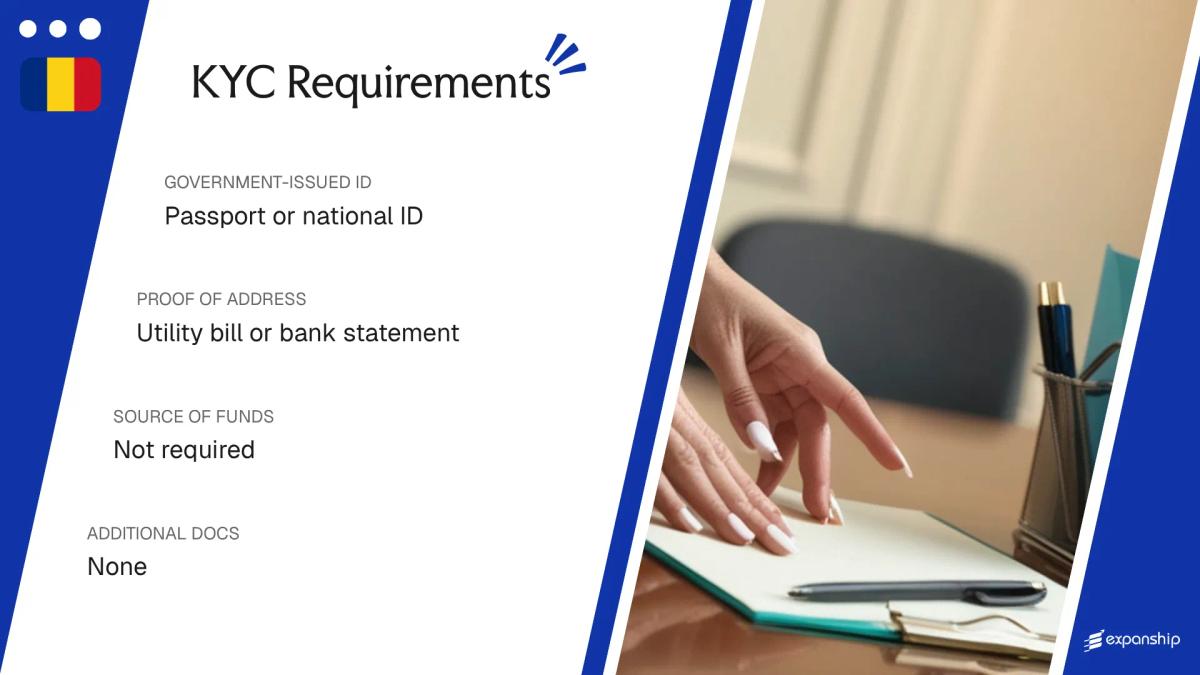
Incorporating in Romania triggers KYC obligations under Law No. 129/2019 on preventing and combating money laundering and terrorist financing, which governs the due diligence procedures applied by the Trade Register and authorised intermediaries. Romania KYC requirements company registration processes are administered through the National Office of the Prevention and Control of Money Laundering (ONPCSB).
Individual / Personal Documents
- Valid passport or national identity card for each individual director, shareholder, or beneficial owner
- Proof of residential address dated within three months, such as a utility bill or bank statement
- Completed and signed specimen signature form, as required by the Romanian Trade Register
- Tax identification number or equivalent fiscal identifier from the individual's country of residence
Corporate Documents
- Certificate of incorporation or equivalent constitutional document for the corporate shareholder or director
- Articles of association or memorandum confirming the entity's legal structure and authorised representatives
- Register of directors and shareholders of the corporate entity, certified as current
- Proof of registered address for the corporate entity, such as an official utility statement or lease agreement
Source of Funds Documentation
- Personal or corporate bank statements covering a minimum of three to six months prior to incorporation
- Audited financial statements where the shareholder is a corporate entity
- Written declaration of source of funds signed by the contributing party
Notarisation and Apostille Requirements
- Foreign-issued identity and corporate documents must generally be apostilled under the Hague Convention or legalised where the issuing country is not a signatory
- All non-Romanian documents must be accompanied by a certified translation into Romanian
- Notarisation of the articles of association is required before a Romanian public notary prior to Trade Register submission
Uncertified translations or missing apostilles on foreign-issued documents are the most frequent cause of Trade Register rejection in Romania.
Company Name Requirements in Romania
Romania company name requirements are assessed by the Trade Register Office (Oficiul Registrului Comerțului) prior to incorporation. A proposed name must be unique, not already registered or reserved, and must not create confusion with existing entities.
Names must be written in the Romanian alphabet and include a legal form suffix such as "S.R.L." or "S.A." No minimum word count applies, though the name must be distinct enough to avoid duplication.
Certain words are restricted. Terms referencing the state, national institutions, or regulated professions require prior approval from the relevant authority before the Trade Register will accept them.
Name reservation is available through the Trade Register Office and can be requested before formally submitting incorporation documents. A reservation is valid for three months.
Compliance Services for Companies in Romania
Maintain your Romanian entity's standing with accurate filings, deadline tracking, and regulatory reporting handled by specialists.
Conclusion
Meeting Romania company incorporation requirements involves working within a defined legal framework established primarily under Law No. 31/1990 on companies. Among the requirements covered, the mandatory UBO registration with the Central Registry held at the National Trade Register Office carries cross-border implications, and the absence of a minimum share capital threshold for an SRL distinguishes the entity from equivalents in many EU member states. Romania business registration compliance also requires attention to KYC documentation, where notarisation and apostille standards apply to foreign-sourced materials. Once these obligations are understood, a foreign investor's next practical step is engaging the relevant Romanian authorities and structuring the entity accordingly.
Expanship's Corporate Services for Romania Expansion
Expanship supports businesses working through Romania's specific incorporation requirements, from preparing the constitutive act in the correct legal form to coordinating registration with the Oficiul Național al Registrului Comerțului. Romania's combination of notarised documentation, UBO disclosure obligations, and fiscal registration across multiple authorities places a real administrative load on foreign founders, and Expanship's Romania corporate services company formation work is structured around reducing that burden.
Beyond initial setup, Expanship offers a practical scope of support for your business throughout the process:
- Preparing and filing all incorporation documents with the Trade Register
- Providing a registered agent and compliant local office address
- Liaising directly with ONRC, ANAF, and other relevant Romanian authorities
- Managing ongoing compliance obligations after your entity is established
- Facilitating introductions to banking partners for account opening
- Handling tax registration and coordination with local fiscal authorities
To discuss your Romania expansion, contact Expanship Romania.
Frequently Asked Questions (FAQ)
The RON 200 minimum applies to all SRLs irrespective of the number of shareholders or the nature of the business activity. Certain regulated sectors, such as banking, insurance, or investment services, are governed by separate legislation that imposes substantially higher capital thresholds set by their respective supervisory authorities.
Operating without a valid registered address puts your entity in breach of the Companies Law and can trigger administrative sanctions, including suspension of activity by the Trade Register. Any change of registered office must be formally registered with the Oficiul Național al Registrului Comerțului (ONRC) before the change takes effect legally.
Beneficial owners must be reported to the ONRC under Romania's AML legislation transposing the EU's Fourth and Fifth Anti-Money Laundering Directives. The registration must be completed at the time of incorporation, with annual confirmation filings required thereafter to keep the record current.
The ONRC will reject a name that is identical or confusingly similar to an existing registered entity. Before submitting incorporation documents, you must obtain a name reservation from the ONRC, which confirms availability and secures the name for a defined period while your registration is processed.
A foreign corporate shareholder must provide certified copies of its constitutional documents, proof of legal existence such as a certificate of good standing, and documentation identifying its own beneficial owners. These materials typically require apostille certification or notarised translation into Romanian, depending on the country of origin and whether it is party to the Hague Apostille Convention.
Legal Disclaimer
The information provided in this article is for general informational purposes only and does not constitute legal, tax, or professional advice. While we strive to ensure the accuracy and timeliness of the content, laws and regulations are subject to change, and the application of laws can vary widely based on specific facts and circumstances.
Readers should not act upon this information without seeking professional counsel tailored to their individual situation. Expanship and its authors disclaim any liability for actions taken or not taken based on the content of this article.
For specific advice regarding your business setup, compliance requirements, or any legal matters, please consult with qualified legal and tax professionals in the relevant jurisdiction.