
Key Takeaways
- Foreign companies incorporating in Paraguay must navigate SET's tax registration process under a system that lacks the digital integration and procedural clarity found in more mature jurisdictions, creating measurable administrative delays before operations can begin.
- Registering under Paraguay's Código Civil (Ley N° 1183) does not insulate a business from the country's weak intellectual property enforcement environment, which leaves foreign-owned brands, patents, and proprietary processes with limited practical recourse.
- Paraguay's high perceived corruption risk and low judicial transparency mean that contractual disputes and regulatory decisions carry a degree of unpredictability that foreign investors typically do not encounter in OECD-member incorporation destinations.
- Access to international payment infrastructure remains structurally limited for foreign-owned entities in Paraguay, with correspondent banking relationships and multi-currency account facilities harder to establish than in jurisdictions with broader financial sector development.
Paraguay operates under an evolving regulatory framework — one that continues to develop its commercial infrastructure but has not yet reached the compliance maturity of more established incorporation destinations. The disadvantages of incorporating in Paraguay span regulatory, financial, judicial, and operational categories, each addressed separately in this article.
The extent to which these drawbacks affect your business depends significantly on the sector, the corporate structure you choose, and whether your operations involve cross-border transactions. A sole foreign investor opening a Sociedad Anónima faces different friction points than a firm entering a regulated industry under the Código Civil.
This article is most relevant to foreign entrepreneurs, offshore holding company operators, and international SMEs considering Paraguay as a primary or secondary jurisdiction for corporate registration.
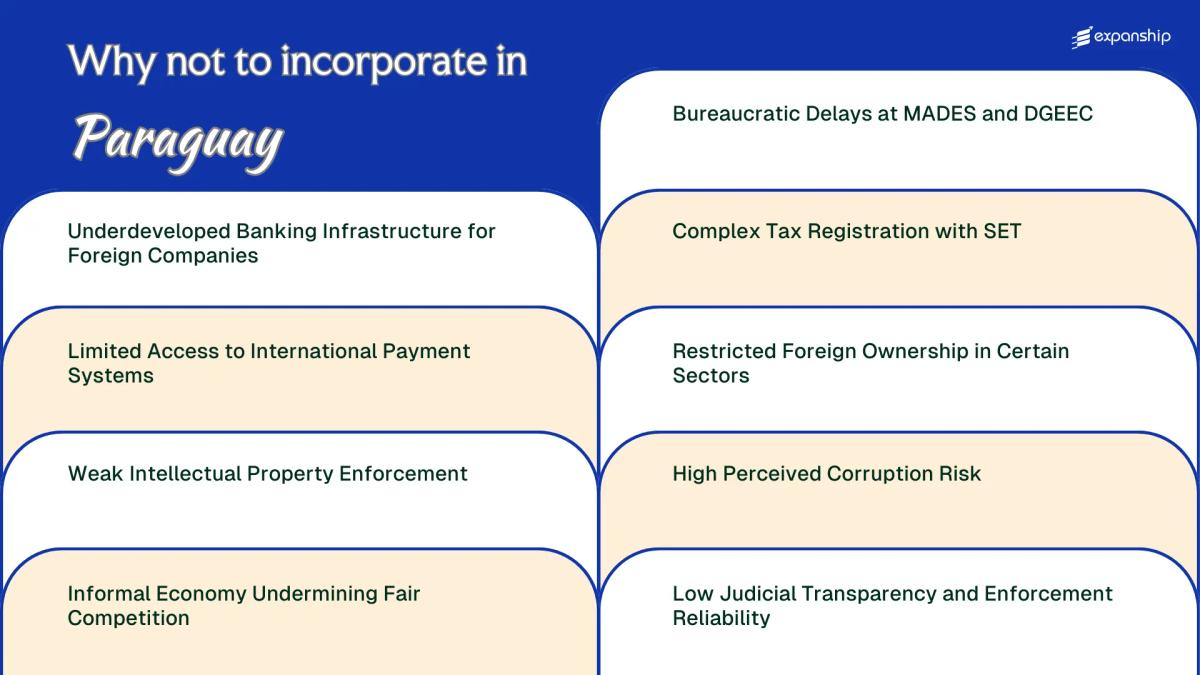
Underdeveloped Banking Infrastructure for Foreign Companies
Paraguay banking infrastructure problems for foreign companies stem from a financial sector that remains underdeveloped relative to regional peers, creating concrete operational friction from the moment your entity needs a transactional account.
Account Opening Barriers Under BCP Oversight
The Banco Central del Paraguay (BCP) governs the country's banking sector, and local commercial banks operating under its framework apply stringent due diligence requirements to foreign-owned entities. Compliance with Law No. 1015/97 on anti-money laundering and its subsequent amendments means documentation demands are extensive, often requiring apostilled corporate records, certified translations, and physical presence of beneficial owners.
Many banks simply decline account applications from foreign-controlled companies without a local guarantor or established credit history in the country. This effectively delays your company's ability to receive payments or disburse funds for weeks or months post-incorporation.
Thin Correspondent Banking Coverage
The concentration of correspondent banking relationships among a small number of institutions limits wire transfer options and increases transaction costs for businesses operating across borders. Rural and secondary commercial branches frequently lack the infrastructure to process foreign currency transactions efficiently.
The combination of BCP compliance requirements and reluctance among local banks to onboard foreign-controlled entities means your company may be legally incorporated yet functionally unable to operate financially for an extended period.
Limited Access to International Payment Systems
Paraguay international payment system limitations affect foreign-incorporated businesses more directly than local firms, which typically rely on cash-based transactions or informal networks. For a company needing to receive payments from international clients or process payroll across borders, the gaps in formal payment infrastructure become an operational constraint rather than a minor inconvenience.
Banco Central del Paraguay (BCP) regulates payment system operators, but international gateways such as Stripe and Braintree do not offer native merchant accounts to entities registered in the country. This means your business cannot accept card payments through major processors without routing transactions through a third-party intermediary, adding fees and settlement delays.
Cross-border payments face additional friction under foreign exchange regulations governed by the BCP. Repatriating revenue or paying overseas suppliers requires documentation that many correspondent banking relationships treat with elevated scrutiny.
Practical burdens this creates for foreign operators:
- Receiving USD or EUR payments forces reliance on intermediary accounts in neighboring jurisdictions, increasing transaction costs
- Payroll for foreign staff often cannot be processed through standard platforms like Wise Business due to limited local banking API integrations
- Subscription billing tools with automated invoicing rarely support Paraguayan-registered entities as the merchant of record
- Settlement timelines for cross-border wire transfers can extend significantly compared to SEPA or ACH standards
Fintech-licensed operators do exist under BCP oversight, but their services are primarily oriented toward domestic remittances rather than supporting B2B international commerce.

Company Incorporation in Paraguay
Understand the full structure, requirements, and timelines for registering a company in Paraguay before committing to the jurisdiction.
Weak Intellectual Property Enforcement
Weak intellectual property enforcement in Paraguay creates measurable exposure for foreign businesses that hold registered trademarks, proprietary software, or branded products. The country's IP framework is administered by the Dirección Nacional de Propiedad Intelectual (DINAPI), established under Law No. 4798/2012, but registration alone does not translate into effective protection. Enforcement depends heavily on judicial follow-through, which remains inconsistent.
Counterfeiting and trademark infringement are documented problems in border zones, particularly in Ciudad del Este, where informal trade volumes make monitoring difficult. If your brand is copied, pursuing a civil or criminal remedy requires engaging local legal counsel, navigating slow court proceedings, and absorbing costs that often outweigh recoverable damages.
| Factor | Detail | Business Impact |
|---|---|---|
| DINAPI trademark registration timeline | 18 to 24 months on average | Brand exposure during the registration window |
| Criminal IP prosecution threshold | Requires demonstrable commercial scale | Small-scale infringement rarely prosecuted |
| Border seizure coordination | Limited customs-DINAPI integration | Infringing goods frequently pass through undetected |
| Civil damages recovery | No statutory minimum damages framework | Legal costs typically exceed recoverable awards |
Paraguay is not on the USTR Special 301 Watch List as a priority foreign country, but it has appeared on the Watch List in prior years, reflecting persistent concerns about IP risks for foreign businesses. The absence of a specialized IP court means cases are handled by general civil tribunals with limited technical expertise in intellectual property matters. Rights holders with high-value brands or software assets face the greatest exposure under this structural gap.
Informal Economy Undermining Fair Competition
Paraguay informal economy competition risks are a structural reality that formal businesses cannot price around. Estimates from the International Labour Organization place informal employment in Paraguay at over 60% of the total workforce, meaning a substantial portion of commercial activity operates outside tax registration, labor regulations, and customs compliance entirely.
Unregistered vendors and micro-enterprises avoid SET (Subsecretaría de Estado de Tributación) obligations, including VAT at 10% and corporate income tax. Your formally registered entity bears those costs in full, creating a direct price disadvantage against competitors who face none of them.
Customs evasion compounds the problem. Smuggled goods entering through the Tri-Border Area undercut formal importers on price, particularly in electronics, tobacco, and consumer goods sectors.
- Formal entities are subject to SET tax obligations that shadow economy operators evade entirely
- Your cost structure includes mandatory social security contributions under IPS (Instituto de Previsión Social) that informal employers ignore
- Customs-compliant importers face direct price competition from smuggled goods with no duty burden
- There is no regulatory mechanism that equalizes pricing between formal and informal competitors
- Sector exposure varies; consumer goods, retail, and manufacturing face the highest informal competition pressure
Paraguay's informal sector is so embedded in regional trade that some product categories have no viable formal market to enter at competitive price points.
Bureaucratic Delays at MADES and DGEEC
Registering a new business in Paraguay means interacting with agencies that operate on inconsistent timelines. Paraguay MADES bureaucratic delays are a documented friction point for companies that require environmental clearance as part of their incorporation or licensing process.
MADES Environmental Clearance as a Bottleneck
The Ministerio del Ambiente y Desarrollo Sostenible requires an environmental impact assessment for activities classified under its regulatory scope, and processing times for these approvals frequently extend beyond the statutory deadlines without formal explanation. For a foreign investor, this means your operational launch date becomes structurally unpredictable, with capital already committed but no clear recourse to accelerate the review.
DGEEC Registration and Statistical Reporting Delays
The Dirección General de Estadística, Encuestas y Censos handles company registration data that feeds into broader compliance records, and procedural backlogs within DGEEC registration processes can delay the issuance of certificates your firm needs to open bank accounts or complete other regulatory steps. These delays are not capped by enforceable service-level obligations, so a process that should take days can extend to weeks. Smaller entities with limited in-country legal support are particularly exposed, as they lack the local relationships that sometimes accelerate administrative processing.
Guidance on Addressing Incorporation Obstacles in Paraguay
Get practical support in managing regulatory timelines and administrative requirements across MADES, DGEEC, and other Paraguayan government bodies.
Complex Tax Registration with SET
Paraguay SET tax registration challenges create significant friction for foreign entities attempting to establish tax compliance from outside the country. The Subsecretaría de Estado de Tributación (SET) administers the RUC (Registro Único del Contribuyente), and the registration process imposes a series of requirements that foreign-owned firms are poorly positioned to satisfy without local support.
- Obtaining a RUC requires a physical registered address in Paraguay, meaning foreign companies must secure local premises before they can legally begin tax compliance procedures.
- SET requires notarized and apostilled documentation from the company's home jurisdiction, which adds weeks of preparation time and third-party costs before registration can even be submitted.
- Corporate representatives who sign before SET must hold valid local standing, so foreign directors without a Paraguayan legal proxy face structural barriers to completing the process.
- SET's digital platform does not fully support foreign-issued identification, forcing many applicants into in-person procedures that are only available during restricted office hours.
- Non-compliance with RUC obligations triggers penalties under the Ley N° 125/91, and these accumulate even during administrative processing delays outside your control.
Restricted Foreign Ownership in Certain Sectors
Paraguay foreign ownership restrictions across sectors are less sweeping than in many Latin American jurisdictions, but targeted limitations exist that can materially affect your investment structure. Certain economically sensitive sectors reserve partial or full ownership rights for Paraguayan nationals.
Land ownership presents the most direct constraint for foreign entities. Law No. 2532/2005 prohibits foreign individuals and companies from owning rural land within 50 kilometers of Paraguay's international borders. For agricultural or logistics businesses that depend on frontier-adjacent territory, this restriction forces reliance on local ownership structures or long-term lease arrangements rather than direct title.
Beyond border zones, media and broadcasting concessions carry additional scrutiny under the legal framework governing telecommunications, which favors domestic control in licensing decisions. Foreign-controlled firms seeking broadcast licenses may face administrative resistance that domestic applicants do not encounter.
- Rural land within border zones: barred from direct foreign ownership under Law No. 2532/2005
- Broadcasting and media: domestic preference applied in concession grants
- Agricultural operations in restricted zones: require indirect structures or local partners
A foreign agribusiness intending to acquire 500 hectares of productive land near the Argentine border would be legally barred from holding title directly, requiring a Paraguayan-held holding structure — adding legal formation costs, ongoing compliance obligations, and dependency on a local counterpart's cooperation to maintain operational control.
High Perceived Corruption Risk
Paraguay corruption risk business incorporation is a documented concern, not a perception problem. Transparency International's Corruption Perceptions Index (CPI) consistently ranks the country in the lower tier of Latin American nations, with scores that reflect systemic weaknesses in public procurement, customs administration, and judicial appointments.
For a foreign business, this creates a practical operating problem. Unofficial payments to expedite licensing, clear goods through Dirección Nacional de Aduanas, or secure government contracts have been reported across multiple sectors, meaning your cost projections can be structurally unreliable.
Anti-corruption legislation exists under Law No. 2523/04, which covers illicit enrichment and bribery of public officials. Enforcement, however, is inconsistent, so the legal framework provides limited protection against solicitation at the operational level.
Foreign firms registered under Paraguayan law remain subject to their home country's extraterritorial anti-bribery statutes. A company incorporated locally but owned by U.S. nationals, for example, still falls under the Foreign Corrupt Practices Act (FCPA), creating dual liability exposure.
- Governance risks are concentrated in sectors involving state contracts, land registration, and import clearance.
- Due diligence on local partners and intermediaries is structurally necessary, not optional.
If your business engages with public-sector procurement or requires regulatory approvals from bodies such as SENAVE or SENACSA, the corruption perception index Paraguay data indicates these are the highest-exposure touchpoints, and FCPA or UK Bribery Act liability follows your entity regardless of where it is incorporated.
Low Judicial Transparency and Enforcement Reliability
Paraguay judicial transparency problems businesses face stem largely from structural weaknesses within the Poder Judicial, the country's court system. Judicial appointments have historically been susceptible to political influence, which undermines the impartiality that contract enforcement requires.
Foreign firms relying on Paraguayan courts to enforce commercial agreements face unpredictable timelines. Civil proceedings can extend for years without resolution, creating direct financial exposure for creditors and contract holders.
Paraguay ranks poorly on the World Justice Project's Rule of Law Index, particularly in civil justice and absence of corruption sub-categories. For a foreign entity, this means that even a legally sound contract may produce no practical remedy if the counterparty disputes it in court.
The Código de Organización Judicial governs court structure, but procedural rules alone do not resolve systemic capacity issues. Backlogs in commercial courts translate into deferred judgments, which shifts the actual risk of non-performance onto your business rather than onto the defaulting party.
Overcoming Paraguay's Incorporation Challenges
Overcoming Paraguay's incorporation challenges requires a structured approach that addresses systemic issues rather than individual procedural hurdles. The disadvantages covered in this blog span banking access, tax registration, sector restrictions, and institutional reliability.
- Register your entity's tax obligations directly through SET to establish a formal RUC number before initiating any commercial activity.
- Structure ownership to comply with sector-specific foreign investment restrictions under Law No. 60/90 and related sectoral regulations before selecting a corporate form.
- Engage a locally registered legal representative to manage filings with MADES and DGEEC, reducing exposure to bureaucratic processing delays.
- File intellectual property protections with DINAPI under the applicable industrial property laws to establish a formal record before entering the market.
- Open a local corporate bank account through a regulated Paraguayan financial institution to address international payment system limitations.
- Conduct formal anti-corruption due diligence aligned with GRECO assessment recommendations before entering into public procurement or partnership arrangements.
These steps operate within a regulatory framework that, while functional, lacks the institutional consistency found in higher-ranked jurisdictions. Structural preparation before incorporation reduces procedural friction but does not eliminate the underlying systemic risks.
Paraguay's Value Despite Its Drawbacks
Paraguay's drawbacks — banking limitations, SET registration complexity, weak IP enforcement, and corruption risk — are real and documented. Yet the country's territorial tax system, low corporate tax rate under the IRACIS framework, and cost-competitive operating environment mean the incorporation decision vs advantages calculation is not straightforwardly negative for every foreign business profile.
| Advantage | Drawback |
|---|---|
| Territorial taxation means foreign-sourced income falls outside IRACIS scope | Correspondent banking reluctance makes account opening unreliable for foreign-owned firms |
| Corporate income tax rate is fixed at 10% under IRACIS | SET registration involves multiple steps across Marangatú and in-person procedures |
| No restrictions on profit repatriation under current foreign investment law | Foreign ownership is prohibited or capped in sectors including media and rural land |
| Low cost of company formation relative to regional peers | Judicial enforcement of contracts and IP rights lacks consistency |
| Free trade zone operations offer additional fiscal incentives | MADES and DGEEC processing timelines create unpredictable delays |
Corruption perception scores from Transparency International consistently place the country in the lower tier regionally. That reality affects both day-to-day operations and confidence in dispute resolution.
Compliance Services for Companies in Paraguay
Maintain your Paraguayan entity in good standing with SET filings, statutory obligations, and ongoing regulatory requirements.
Conclusion
The Paraguay company incorporation risks summary presented across this blog reflects a jurisdiction that offers genuine tax advantages but carries structural and institutional drawbacks that materially affect foreign investors. Corruption risk measured by Transparencia Internacional's regional indices, unreliable judicial enforcement, and persistent difficulties opening corporate bank accounts represent the most consequential friction points. These are not administrative inconveniences that dissolve once your entity is registered. Operational exposure to these conditions continues throughout the life of the business. Structural support from experienced local legal and compliance representation remains the most consistent factor in managing what the regulatory environment does not resolve on its own.
Expanship's Paraguay Expansion Services
Dealing with SET's tax registration requirements, MADES environmental approvals, and Paraguay's bureaucratic delays creates real operational friction for foreign businesses. Expanship Paraguay company formation services are structured to help your business manage these specific obligations without building an in-house compliance function from scratch. Our role is to reduce the administrative burden these processes create, not to suggest they disappear.
From initial registration through ongoing obligations, Expanship supports foreign firms across the full incorporation cycle.
- We prepare your company documentation and file it with the relevant Paraguayan authorities.
- A registered agent and local office address are provided to satisfy residency requirements.
- We liaise directly with government bodies including SET, MADES, and the Registro Público de Comercio on your behalf.
- Post-incorporation compliance is managed to keep your entity in good standing.
- Banking introductions are facilitated to help you establish a functional local account.
- Tax registration and coordination with local authorities are handled as part of our standard engagement.
Reach out to Expanship Paraguay to discuss your incorporation requirements.
Frequently Asked Questions (FAQ)
Any business that relies on trademarks, patents, or proprietary software is exposed, but the risk is highest in consumer goods, pharmaceuticals, and technology. Paraguay's IP registration framework exists under DINAPI, but enforcement through the courts is inconsistent, and counterfeit goods continue to circulate openly in markets like Ciudad del Este. A registered IP right in Paraguay offers legal standing on paper, but practical enforcement often requires sustained legal effort with uncertain outcomes.
Errors or omissions during registration with the Subsecretaría de Estado de Tributación can result in delays in obtaining your RUC number, which blocks the company from issuing legal invoices or operating formally. Without an active RUC, your entity cannot enter into compliant supplier or client contracts under Paraguayan commercial law. Rectifying registration errors typically requires resubmitting documentation and restarting parts of the approval sequence.
Paraguay ranks below Uruguay and Panama on judicial independence metrics published by the World Economic Forum, making it a comparatively weaker jurisdiction for contract enforcement. Disputes involving foreign parties can stall for years in the civil court system, and arbitration clauses in contracts are not always reliably upheld. For a business that depends on enforceable agreements with local partners or clients, this is a material operational risk, not an abstract one.
Yes, but only with thorough pre-incorporation due diligence. Paraguay's Constitution and sector-specific legislation restrict or cap foreign ownership in areas including media, land ownership near border zones, and certain public services, and these restrictions are not always consolidated in a single regulatory source. Your legal structure must be reviewed against each applicable sector law before finalising the entity type and shareholder composition.
There is no fixed additional cost, but delays at MADES for environmental clearances and at DGEEC for statistical registration can extend the incorporation timeline by several weeks beyond the baseline estimate. If your business activity triggers an environmental impact assessment requirement under Law 294/93, the review process alone can add months. These delays translate directly into deferred revenue and extended overhead during the setup phase.
Yes, because competitors operating informally can undercut your pricing on labour, tax, and regulatory costs without consequence. SET has increased audit activity on formal businesses while informal operators in sectors like retail and construction remain largely outside the tax net. This asymmetry can distort market conditions and put a compliant foreign-owned entity at a structural competitive disadvantage.
Legal Disclaimer
The information provided in this article is for general informational purposes only and does not constitute legal, tax, or professional advice. While we strive to ensure the accuracy and timeliness of the content, laws and regulations are subject to change, and the application of laws can vary widely based on specific facts and circumstances.
Readers should not act upon this information without seeking professional counsel tailored to their individual situation. Expanship and its authors disclaim any liability for actions taken or not taken based on the content of this article.
For specific advice regarding your business setup, compliance requirements, or any legal matters, please consult with qualified legal and tax professionals in the relevant jurisdiction.