

Key Takeaways
- Foreign companies incorporating in Papua New Guinea must navigate IPA registration under the Companies Act 1997, a process that adds procedural layers not present in more streamlined jurisdictions.
- Papua New Guinea's corporate income tax rate places a measurable cost burden on foreign-owned entities relative to lower-rate competing jurisdictions in the Asia-Pacific region.
- Currency controls and restrictions on repatriating Kina earnings create material cash flow constraints for multinationals that depend on moving profits across borders efficiently.
- Mandatory local resident director requirements and Foreign Investment Review Board approval obligations impose structural compliance costs before a foreign entity can begin lawful operations.
Papua New Guinea operates under an evolving regulatory framework, where the Investment Promotion Authority (IPA) administers company registration and foreign investment oversight under the Companies Act 1997. The disadvantages of incorporating in Papua New Guinea span procedural, financial, and structural categories that affect how foreign-owned entities are formed and operated.
Not every challenge applies equally across all business types. A mining joint venture faces different constraints than a small services firm, and your exposure to specific drawbacks depends heavily on the industry, ownership structure, and intended operating scale.
This article is most relevant to foreign investors and multinational entities seeking to establish a locally registered presence, particularly those without prior experience in Pacific Island regulatory environments.
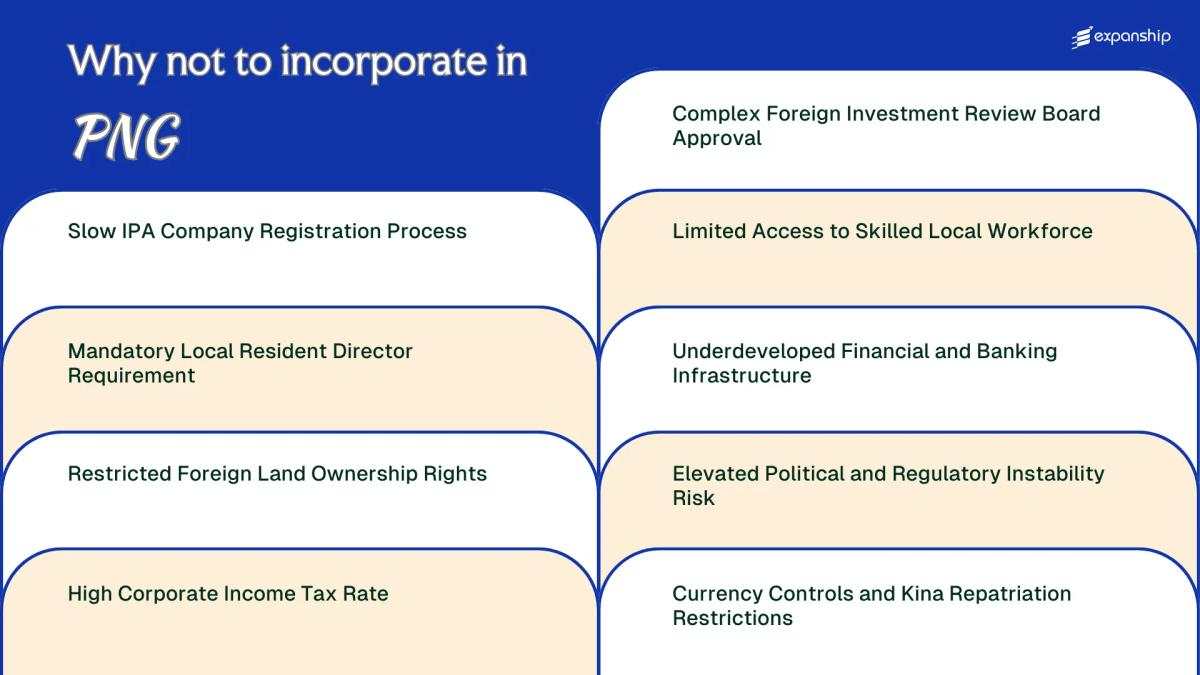
Slow IPA Company Registration Process
The slow IPA registration process in Papua New Guinea is a documented friction point for foreign investors. Processing times at the Investment Promotion Authority regularly extend beyond official estimates, creating uncertainty before your business can legally operate.
Unpredictable Timelines at the IPA
Under the Companies Act 1997, all companies must register with the Investment Promotion Authority before commencing business. In practice, PNG company registration delays frequently arise from manual processing bottlenecks, inconsistent document verification, and inter-agency coordination gaps that push standard registration beyond several weeks.
Each delay directly defers your ability to open a corporate bank account, sign contracts, or hire staff under a legally constituted entity.
Compounding Bureaucratic Friction
Foreign-owned businesses face additional filing layers, since the IPA also administers the foreign investment certification process. A single administrative error or missing document can restart review periods entirely, multiplying the total wait time.
This dual processing burden imposes real holding costs, particularly for businesses with time-sensitive market entry windows.
PNG company registration delays at the IPA can leave your entity legally inactive for months, exposing you to contract and operational risks before you have any legal standing in the jurisdiction.
Mandatory Local Resident Director Requirement
Under the Companies Act 1997, every company registered in Papua New Guinea must appoint at least one director who is ordinarily resident in the country. This PNG resident director requirement means that a foreign-owned entity cannot be governed solely by offshore principals, regardless of where strategic decisions are actually made.
For most foreign investors, satisfying this requirement means hiring a local nominee or a professional director service. That arrangement introduces direct costs and, more critically, creates a layer of legal accountability you do not fully control.
The practical burdens this creates for your business include:
- Sourcing a trustworthy resident director from a limited professional pool adds recruitment costs and due diligence obligations before your entity can even begin operating.
- Because a local director holds statutory signing authority, any breakdown in that relationship can delay regulatory filings or bank account operations.
- Ongoing director fees represent a recurring overhead with no operational return.
- If the resident director resigns unexpectedly, the company falls out of compliance with the Companies Act until a replacement is appointed, exposing the entity to IPA enforcement action.
Even where a foreign director holds majority board control, the resident director obligation remains a binding structural constraint under local law.

Company Incorporation in Papua New Guinea
Set up your Papua New Guinea company with full compliance support, including resident director arrangements and IPA registration.
Restricted Foreign Land Ownership Rights
Foreign land ownership restrictions in Papua New Guinea are among the most structurally limiting factors for any foreign business seeking a physical foothold. The Land Act and the underlying constitutional framework reserve land ownership for PNG citizens, meaning foreign entities cannot hold freehold title under any standard pathway.
| Land Category | Foreign Ownership Permitted | Typical Lease Term | Key Constraint |
|---|---|---|---|
| Customary Land (97% of total land) | No | Not applicable | Held collectively by clans; cannot be sold or leased directly to foreigners |
| State Land (Freehold) | No | N/A | Reserved exclusively for PNG citizens |
| State Land (Leasehold) | Yes, via special lease | Up to 99 years | Limited supply; administrative delays common |
| Special Agricultural Business Lease (SABL) | Restricted | Variable | Subject to government review and cancellation history |
Approximately 97% of the country's land is customary land, governed by traditional clan ownership structures rather than the state. Your business cannot negotiate directly with customary landowners for a binding title transfer, which means operational certainty is structurally unavailable for most land parcels.
Leasehold arrangements over state land represent the only viable route for foreign firms, but state land supply is severely limited. Securing a lease involves multiple government approvals, and the process carries no guaranteed timeline.
The PNG customary land ownership problems extend beyond access. Disputes over customary boundaries are frequent and can result in business disruptions years after operations commence.
High Corporate Income Tax Rate
The high corporate tax rate in Papua New Guinea sits at 30% for most resident companies, rising to 48% for certain foreign-incorporated entities operating branches in the country. This rate spread creates an immediate cost disadvantage for foreign businesses that have not structured their presence through a locally registered subsidiary.
Under the Income Tax Act, administered by the Internal Revenue Commission (IRC), taxable income includes income sourced within the country regardless of where the parent entity is domiciled. That scope means your offshore operations can generate PNG tax exposure even without a physical establishment in some circumstances.
Extractive industries face additional fiscal pressure. Mining and petroleum companies are subject to separate, sector-specific tax regimes that can produce effective rates well above the standard 30% threshold, compounding the PNG tax burden on companies in resource sectors.
- Branch operations of foreign companies are taxed at 48%, not the standard 30% rate
- The IRC administers assessment and collection; non-compliance triggers penalties under the Income Tax Act
- Dividend withholding tax applies on distributions to foreign shareholders, adding a layer of cost beyond the corporate rate
- Resource sector entities are governed by distinct fiscal regimes with different rate structures
- Tax residency status affects which rate applies to your entity
PNG imposes a higher branch profits tax rate specifically on foreign-incorporated entities than on locally registered subsidiaries, meaning your choice of legal structure directly determines which tax rate bracket applies before you earn a single kina.
Complex Foreign Investment Review Board Approval
Foreign Investment Review Board PNG challenges add a distinct layer of procedural complexity that goes beyond standard company registration. Foreign entities operating in regulated or restricted sectors must obtain certification from the Investment Promotion Authority under the Investment Promotion Act 1992 before commencing operations.
Structural Restrictions That Limit Market Entry
Certain business activities are reserved exclusively for Papua New Guinean citizens under the Reserved Activities List, effectively barring foreign participation regardless of capital or intent. This exclusion directly reduces the scope of viable business structures available to an incoming investor.
Approval Timelines and Compliance Costs
The PNG foreign investment restrictions review process involves documentation review, sector classification, and in some cases ministerial referral, all of which extend your pre-operational timeline considerably. Delays of several months are not uncommon, and during this period your entity cannot lawfully trade, which carries real opportunity and liquidity costs.
Each submitted application must satisfy prescribed minimum capital thresholds that vary by sector, and failure to meet these thresholds results in rejection without a formal appeals mechanism that is straightforward to access.
Support for Foreign Investment Approval in Papua New Guinea
Get structured guidance on IPA certification requirements, reserved activities classifications, and foreign investment thresholds before you commit to incorporation.
Limited Access to Skilled Local Workforce
The limited skilled workforce Papua New Guinea presents is a structural constraint that directly affects how quickly and cost-effectively your business can become operational. Across technical, financial, and managerial disciplines, the domestic talent pool remains shallow relative to the demands of commercially active foreign firms.
- Low tertiary enrollment rates and uneven distribution of vocational training institutions across PNG's provinces mean your firm will likely face extended recruitment timelines for qualified staff.
- Heavy reliance on expatriate professionals to fill skilled roles triggers obligations under the Work Permit Act, adding administrative cost and processing delays to your hiring pipeline.
- The Investment Promotion Authority requires foreign firms in certain sectors to submit localization plans, binding your business to workforce development commitments that carry ongoing compliance obligations.
- Retaining locally trained talent is complicated by competition from extractive industry employers, particularly in the resources sector, who typically offer compensation packages that smaller entrants cannot match.
- Skills gaps are most acute outside Port Moresby, making regional expansion substantially more difficult if your operations require technically trained personnel.
Underdeveloped Financial and Banking Infrastructure
PNG's underdeveloped banking infrastructure creates direct operational friction for foreign-owned companies. The sector is dominated by a small number of commercial banks, primarily BSP Financial Group, Kina Bank, ANZ PNG, and Westpac PNG, leaving limited competition and constrained service options for businesses.
Opening a corporate bank account is not straightforward. Banks typically require extensive documentation, in-person verification, and compliance checks that can extend the process by weeks, delaying your ability to transact commercially after incorporation.
Access to credit is another structural problem. Lending rates are high relative to regional peers, and collateral requirements are demanding, making domestic financing largely inaccessible for newly established foreign entities without an established local asset base.
- Formal financial services penetration remains low, meaning supplier and contractor payments often depend on cash or informal channels
- Digital payment infrastructure outside Port Moresby and Lae is limited, affecting payroll and vendor management
- Correspondent banking relationships with international banks can be restricted, complicating cross-border transactions
According to the World Bank's Global Findex Database, only around 38% of adults in Papua New Guinea had access to a formal financial account, reflecting how thin the financial services base remains across the country.
Elevated Political and Regulatory Instability Risk
Political instability risks in Papua New Guinea are not theoretical. The country has seen frequent changes in government, votes of no confidence, and parliamentary disputes that have disrupted policy continuity and delayed regulatory decisions affecting foreign businesses.
Regulatory frameworks across key sectors — including mining, energy, and foreign investment — have undergone repeated amendments, often with limited advance notice. For a foreign entity operating under multi-year investment assumptions, this unpredictability increases compliance costs and complicates long-term financial planning.
The Investment Promotion Authority (IPA) and sector-specific regulators operate within a governance environment that has, at times, seen conflicting ministerial directives and inconsistent enforcement. Your firm may find that approvals granted under one administration are revisited or stalled under a successor government.
Corruption risk compounds this exposure. Papua New Guinea ranks poorly on Transparency International's Corruption Perceptions Index, which signals that rule-of-law protections cannot always be relied upon to shield your business from arbitrary regulatory action or contract enforcement failures.
Businesses in extractive industries face additional exposure, as resource nationalism sentiment has periodically influenced renegotiations of existing agreements under the Oil and Gas Act and the Mining Act.
If your business operates in a regulated sector such as resources, telecommunications, or finance, a change in government can trigger a full policy review that directly affects your existing licenses, contracts, or operational approvals with no guaranteed continuity protections.
Currency Controls and Kina Repatriation Restrictions
PNG currency controls and kina repatriation restrictions create direct cash flow problems for foreign-owned businesses. The Bank of Papua New Guinea (BPNG) governs all foreign exchange transactions under the Central Banking Act 2000, requiring formal approval before funds can be transferred offshore.
Repatriating dividends, loan repayments, or service fees denominated in foreign currency requires documented justification and BPNG sign-off. Processing delays are common, and your capital can remain trapped in kina for extended periods while approvals are pending.
The kina exchange rate risks for businesses compound this further. The currency has historically experienced periods of depreciation against major trading currencies, meaning retained earnings lose real value the longer they sit unconverted.
Foreign exchange limitations also affect day-to-day operations. Importing goods or paying overseas suppliers requires accessing hard currency through commercial banks, which face their own BPNG-imposed allocation constraints.
Businesses with minimal offshore payment obligations are less exposed, but most internationally active firms will encounter these restrictions as a recurring operational cost.
Overcoming Incorporation Challenges in Papua New Guinea
Overcoming PNG incorporation challenges requires structural preparation before any registration step is taken. The obstacles covered in this blog are systemic, and addressing them depends on working within the specific regulatory mechanisms that govern foreign business activity in the country.
- Register your company through the IPA portal and prepare documentation in advance to reduce processing delays.
- Appoint a qualifying PNG-resident director prior to submitting your application to the Investment Promotion Authority.
- Obtain a Foreign Investment Certificate from the IPA before commencing any regulated business activity.
- Structure land access through lease arrangements under the Land Act rather than pursuing freehold acquisition.
- Open a formal bank account early to manage Kina repatriation restrictions under the Central Banking Act.
- Factor in the 30% corporate income tax rate when modelling financial projections for your entity.
These steps address the most material compliance requirements a foreign firm will face, though each carries its own procedural depth. PNG's regulatory framework, administered across multiple bodies including the IPA and Bank of Papua New Guinea, does not simplify with familiarity alone.
Papua New Guinea's Business Potential in Perspective
Papua New Guinea presents real incorporation challenges, and the disadvantages covered in this blog are not minor administrative inconveniences. For businesses with the right strategic fit, particularly those tied to natural resources, infrastructure development, or trade corridors across the Pacific, the country remains a credible destination. Placing Papua New Guinea business risks in perspective requires holding both sides of that equation at once.
| Consideration | Drawback |
|---|---|
| Natural resource base | IPA registration is slow, with timelines often exceeding statutory targets |
| Direct access to Pacific and Asia-Pacific trade routes | The Investment Promotion Authority's foreign investment review adds procedural layers and delays |
| Frontier market with limited foreign competition in many sectors | Foreign nationals cannot freehold land; only leasehold arrangements are available |
| LNG and mining sectors offer long-term revenue visibility | Corporate income tax at 30% sits above regional peers for foreign-owned entities |
| Growing infrastructure investment from multilateral sources | The Bank of Papua New Guinea imposes Kina repatriation controls that restrict profit outflows |
Workforce depth remains a structural constraint. The formal education pipeline does not yet produce the volume of credentialed professionals that a scaling business typically requires.
Compliance Services for Companies in Papua New Guinea
Maintain your company's good standing with the Investment Promotion Authority and meet ongoing statutory obligations under the Companies Act 1997.
Conclusion
The cons of Papua New Guinea company incorporation are material and consistent across regulatory, financial, and operational dimensions. Currency repatriation restrictions imposed through the Bank of Papua New Guinea create persistent cash flow constraints for foreign-owned entities. The mandatory resident director requirement under the Companies Act 1997 adds structural complexity before operations begin. Slow IPA processing timelines compound both challenges by delaying the point at which a registered entity can legally transact. For businesses weighing PNG business formation challenges, the cumulative picture requires a deliberate, well-informed formation strategy from the outset.
Expanship's Papua New Guinea Expansion Support
Expanship works with businesses managing the specific compliance obligations that make PNG expansion challenges support services a practical necessity in this market. From coordinating with the Investment Promotion Authority on foreign business certification to liaising with the Foreign Investment Review Board during approval processes, the firm helps reduce the administrative weight these requirements place on your operations. That support extends to currency control compliance under the Bank of Papua New Guinea's framework and the resident director obligations under the Companies Act 1997.
Beyond registration, Expanship offers a range of corporate services tailored to this jurisdiction:
- Your company registration and corporate document preparation are handled end-to-end through the IPA's processes.
- A registered agent and local office address are provided to satisfy statutory presence requirements.
- Government filings and regulatory body liaison are managed on your behalf.
- Ongoing post-incorporation compliance obligations are monitored and maintained.
- Banking introduction assistance is available to help your entity establish a local account.
- Tax registration and liaison with the Internal Revenue Commission is coordinated for you.
To discuss your incorporation requirements, contact Expanship Papua New Guinea.
Frequently Asked Questions (FAQ)
The resident director requirement applies to companies incorporated under the Companies Act 1997, which governs the majority of standard business structures in PNG. There is no exemption based on company size or sector, meaning even a small foreign-owned firm must appoint a PNG-resident individual to the board before registration is complete. Sourcing a qualified, willing resident director adds both cost and an ongoing governance dependency to your structure.
At 30%, PNG's corporate tax rate sits at the higher end for the Asia-Pacific region, where several competing jurisdictions charge between 17% and 25%. Resource extraction companies face different rate structures under specific legislation, but a standard foreign-owned company operating outside those regimes pays the full 30%. This rate materially affects post-tax return calculations for businesses evaluating regional incorporation options.
Operating without the required certification from the Investment Promotion Authority's foreign investment register exposes your business to penalties including fines and potential forced cessation of operations. The Investment Promotion Act 1992 sets out the obligations for foreign investors, and non-compliance is not treated as a minor administrative oversight. Authorities have the power to deregister a non-compliant foreign enterprise.
Foreign-owned companies cannot hold freehold land in PNG. Land ownership is constitutionally restricted, with most land classified as customary land under the Lands Act 1996 and related legislation, leaving only state leasehold arrangements accessible to foreign entities. This restriction directly limits a company's ability to secure physical premises, establish manufacturing facilities, or hold real property as a business asset.
The Bank of Papua New Guinea enforces foreign exchange controls that require approval for significant outward transfers, and the illiquidity of the kina on international markets compounds this problem. For a foreign parent company relying on regular dividend remittances or intercompany payments, the approval process introduces timing uncertainty that disrupts standard treasury planning. Conversion delays and limited kina liquidity are operational realities, not edge-case scenarios.
PNG carries a higher risk profile than most comparable Pacific nations, with a history of policy reversals, legislative amendments affecting foreign investor terms, and instances of resource project disputes that have resulted in protracted legal proceedings. The regulatory environment can shift between administrations, and sector-specific rules, particularly in resources and telecommunications, have been revised in ways that affected existing foreign investors. This unpredictability is a structural feature of doing business there, not an isolated occurrence.
Foreign companies in PNG frequently encounter difficulties opening corporate bank accounts promptly, processing cross-border payments, and accessing trade finance through local institutions. The correspondent banking relationships that PNG's commercial banks maintain are limited compared to more developed markets, which slows international transactions and increases transfer costs. For businesses with frequent import requirements or overseas supplier payments, this friction directly raises operating costs.
Legal Disclaimer
The information provided in this article is for general informational purposes only and does not constitute legal, tax, or professional advice. While we strive to ensure the accuracy and timeliness of the content, laws and regulations are subject to change, and the application of laws can vary widely based on specific facts and circumstances.
Readers should not act upon this information without seeking professional counsel tailored to their individual situation. Expanship and its authors disclaim any liability for actions taken or not taken based on the content of this article.
For specific advice regarding your business setup, compliance requirements, or any legal matters, please consult with qualified legal and tax professionals in the relevant jurisdiction.