

Key Takeaways
- Peru's General Companies Law (Ley General de Sociedades, Law No. 26887) imposes multi-step formation procedures across SUNARP and notarial channels that add time and cost to entity registration compared to streamlined single-window jurisdictions.
- Foreign-owned entities incorporated in Peru must navigate SUNAT's layered tax compliance obligations, which can include IGV filings, corporate income tax at 29.5%, and transfer pricing documentation requirements that collectively create a substantial administrative burden.
- Structural rigidities in Peru's labor legislation, including mandatory statutory benefits and severance protections, increase the true cost of employment well beyond base salary and complicate workforce adjustments for growing subsidiaries.
- Weaknesses in Peru's judicial enforcement system mean that contract disputes and creditor claims can face protracted resolution timelines, reducing the practical reliability of contractual protections that foreign investors typically depend on.
Peru operates under a moderately regulated corporate framework, with oversight distributed across multiple national bodies including SUNARP, SUNAT, and sector-specific regulators. The primary disadvantages of incorporating in Peru span formation procedures, tax compliance, labor obligations, and judicial reliability — each examined in detail across this article.
The severity of these drawbacks is not uniform. A small foreign-owned Sociedad Anónima Cerrada faces a different compliance burden than a large publicly structured Sociedad Anónima Abierta operating in a regulated sector.
Peru's governing corporate legislation is the General Companies Law (Ley General de Sociedades, Law No. 26887), which establishes the foundational rules for entity formation and governance. Foreign investors establishing their first Latin American subsidiary, particularly those unfamiliar with civil law systems, are most likely to encounter the friction points this article addresses.
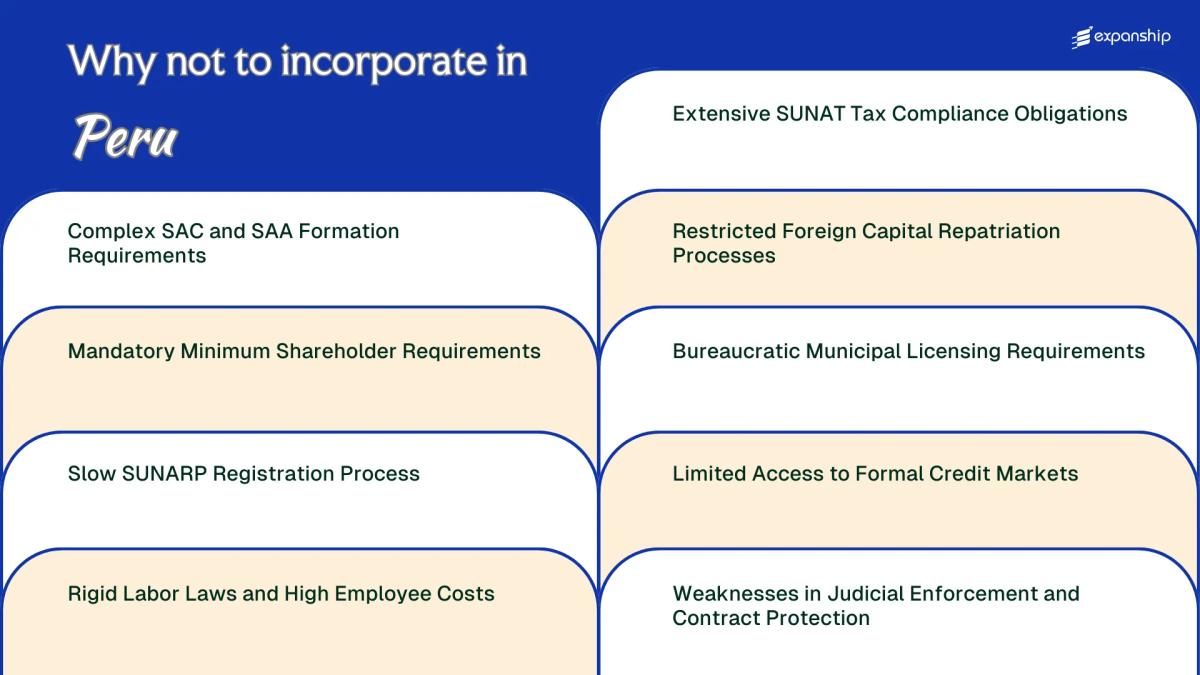
Complex SAC and SAA Formation Requirements
Peru SAC formation requirements problems begin at the drafting stage, where the General Corporations Law (Ley General de Sociedades, Law No. 26887) imposes distinct structural rules depending on whether you form a Sociedad Anónima Cerrada or a Sociedad Anónima Abierta.
Notarized Documentation and Capital Structuring
Both entity types require a public deed executed before a Peruvian notary, which means your founding documents must be drafted, translated if necessary, and authenticated before any registration can proceed. For a foreign founder without a local legal representative, this creates an immediate logistical barrier that delays the entire formation timeline.
The SAA incorporation structure adds further complexity by requiring a formal share subscription process and, in some cases, a prospectus-style offering document. This level of formality is disproportionate for a firm that has no intention of listing publicly.
Minimum Capital and Structural Constraints
The Sociedad Anónima Cerrada restricts share transfers to existing shareholders unless the board waives this right, which can create governance deadlocks when foreign co-founders disagree on buyout terms. No statutory minimum paid-in capital is prescribed, but banks and regulators often apply informal thresholds when approving accounts or licenses.
Structuring equity across foreign and local shareholders also triggers obligations under the registro de personas jurídicas at SUNARP before the entity can legally operate.
If your foreign founding documents are not apostilled and properly translated by a certified translator, SUNARP will reject the registration application, adding weeks to your incorporation timeline.
Mandatory Minimum Shareholder Requirements
One of the Peru minimum shareholder requirements drawbacks that directly affects foreign investors is the structural constraint imposed by the Sociedad Anónima Cerrada (SAC) formation rules under the Ley General de Sociedades, Ley N° 26887.
A SAC requires a minimum of two shareholders and a maximum of twenty. For a sole foreign investor intending to operate a wholly-owned subsidiary, this creates an immediate structural problem.
You cannot form a SAC alone. This forces many foreign principals to either bring in a nominal local shareholder or restructure their intended ownership arrangement entirely, both of which introduce legal exposure and added complexity.
The shareholder cap of twenty creates a separate friction point for firms planning to expand their local equity base over time, as crossing that threshold requires converting to a different corporate structure.
Practical burdens this generates for foreign business owners include:
- Sourcing a second shareholder when no genuine business partner exists, increasing dependence on nominee arrangements with associated legal risk
- Drafting a shareholder agreement to manage a forced co-ownership structure that would not exist under a single-member entity regime
- Restructuring costs if investor count approaches the twenty-shareholder ceiling during a growth phase
- Revisiting the ownership model entirely if the foreign parent company later absorbs or buys out the local co-shareholder
These constraints do not apply to the Sociedad Anónima Abierta (SAA), which accommodates broader shareholding, but that structure carries its own regulatory obligations under CONASEV oversight that are disproportionate for most small or mid-size foreign ventures.

Company Incorporation in Peru
Set up your Peruvian entity with the correct structure from the outset, with full compliance under Ley N° 26887 and SUNARP registration requirements handled on your behalf.
Slow SUNARP Registration Process
SUNARP registration delays Peru create a measurable operational gap between company formation and the legal ability to conduct business. Once your incorporation documents are notarized and submitted to the Superintendencia Nacional de los Registros Públicos, the registry must process the entry before your entity has legal existence. That processing window is not guaranteed within a fixed statutory deadline under current practice, and examiner objections — known as tachas or observaciones — can reset the clock entirely.
| Stage | Typical Delay Trigger | Practical Impact |
|---|---|---|
| Escritura pública notarization | Notary availability and queue time | Adds days before SUNARP submission is even possible |
| Registrar review period | Examiner raises observaciones | Applicant must correct and resubmit; no automatic approval |
| Re-submission after objection | Additional review cycle required | Total timeline can extend beyond 30 days |
| RUC activation at SUNAT | Dependent on SUNARP registration completion | Tax enrollment cannot begin until registration is confirmed |
Each observación requires a formal written response and resubmission, a cycle that foreign incorporators managing this remotely often find disproportionately slow. Your firm cannot open a bank account, obtain municipal operating licenses, or activate its tax identification number with SUNAT until SUNARP registration is complete. Operational readiness is effectively frozen during this period.
The slow company registration process in Peru falls hardest on businesses with time-sensitive entry strategies. A single rejected filing can delay an entire market entry by several weeks.
Rigid Labor Laws and High Employee Costs
Peru labor law restrictions for businesses create some of the highest mandatory employment costs in Latin America, making workforce expansion a structurally expensive decision for any foreign entity operating here.
Under the Ley de Productividad y Competitividad Laboral (Legislative Decree 728) and complementary social security legislation, employers must contribute to multiple statutory obligations beyond base salary. CTS (Compensación por Tiempo de Servicios) deposits, mandatory profit-sharing under Decree 892, ESSALUD contributions at 9% of payroll, and two annual salary bonuses (gratificaciones) are all legally required. Together, these obligations can push total employment costs to roughly 50-60% above the nominal salary figure.
Termination is equally constrained. Dismissing a worker without a legally recognized cause under Decreto Legislativo 728 exposes your firm to reinstatement orders or significant severance liability, a risk that makes workforce restructuring far more costly and slow than in many comparable markets.
The Ministry of Labor enforces compliance through labor inspections, and violations carry graduated fines based on company size and severity.
- CTS deposits must be made twice yearly, in May and November
- ESSALUD contributions of 9% of gross salary are payable monthly
- Profit-sharing obligations apply once the firm exceeds 20 employees in qualifying sectors
- Unjustified dismissal can trigger reinstatement orders, not just severance payments
- Gratificaciones equal one full monthly salary each, paid in July and December
Peru's profit-sharing mandate under Decree 892 can apply retroactively if a company exceeds the 20-employee threshold mid-year, creating an unexpected liability that many foreign employers only discover at year-end.
Extensive SUNAT Tax Compliance Obligations
SUNAT tax compliance burdens Peru extend well beyond a simple annual return, placing sustained administrative pressure on foreign-owned entities throughout the fiscal year.
Volume and Frequency of SUNAT Filing Requirements
Businesses registered under the Registro Único de Contribuyentes (RUC) must file monthly tax declarations covering IGV (Impuesto General a las Ventas, currently at 18%) and income tax advance payments under the regime established in Legislative Decree 774. Your firm is required to submit these declarations through SUNAT's SOL online platform regardless of whether revenue was generated that month, meaning compliance costs run continuously even during periods of inactivity.
Practical Cost and Risk for Foreign Business Owners
Peru corporate tax compliance risks are compounded by SUNAT's electronic invoicing mandate (Sistema de Emisión Electrónica), which requires technical integration with approved software providers, adding setup and maintenance costs that smaller foreign entities often underestimate. Penalties for late or incorrect filings are calculated as a percentage of unpaid tax under the Código Tributario, and SUNAT's audit selection algorithms increasingly target entities with irregular filing patterns, raising exposure for businesses still establishing local accounting infrastructure.
Managing SUNAT Compliance for Your Peru Entity
Understand the filing obligations and tax risks that foreign-owned companies face under Peru's SUNAT framework before you commit to incorporation.
Restricted Foreign Capital Repatriation Processes
Foreign capital repatriation restrictions in Peru are less about outright prohibitions and more about procedural friction that imposes real costs on your business. Without proper documentation in place, transferring profits abroad can stall indefinitely.
- Under Legislative Decree No. 662, foreign investors must formally register their capital contributions with the Agencia de Promoción de la Inversión Privada (ProInversión) to legally repatriate profits, and failing to complete this registration before remitting funds blocks access to the free availability guarantee.
- Currency transfers must be processed through the Sistema Financiero under Banco Central de Reserva del Perú (BCRP) oversight, adding a compliance layer that slows profit remittance timelines.
- Supporting documentation requirements for each transfer, including tax clearance records from SUNAT, mean that any outstanding compliance gap can freeze your remittance entirely.
- The registration process through ProInversión is not automatic, and delays in approval directly delay your ability to repatriate capital legally.
Bureaucratic Municipal Licensing Requirements
Peru municipal licensing bureaucracy problems stem largely from the decentralized structure of local government, where each municipalidad (municipal government) sets its own licensing procedures under Ley N° 28976, the Marco de Licencia de Funcionamiento. Your firm must obtain a Licencia de Funcionamiento before operating commercially, and requirements, fees, and processing timelines vary significantly from one district to the next.
In cities like Lima, different districts — Miraflores, San Isidro, and La Victoria — maintain separate inspection protocols and documentation requirements. This fragmentation means a business with multiple locations across districts faces compounding administrative burdens, not a single unified process.
Beyond the initial license, municipalities can require:
- Certificado de Defensa Civil (civil defense inspection clearance)
- Zoning compatibility certificates (Certificado de Compatibilidad de Uso)
- Separate signage permits for exterior branding
Delays in obtaining civil defense clearance alone can stall operations by several weeks, and foreign-owned entities without a locally fluent representative frequently encounter requests for document resubmission.
A foreign retail firm opening three locations across different Lima districts could face three separate municipal inspection queues, with each inspection costing between S/ 200 and S/ 800, plus potential reinspection fees if zoning documentation is disputed — extending pre-opening timelines by four to eight weeks per location.
Limited Access to Formal Credit Markets
Limited credit access Peru business drawbacks are largely structural. The Peruvian banking sector is concentrated among a small number of institutions, with the Superintendencia de Banca, Seguros y AFP (SBS) overseeing a system where the four largest banks — BCP, BBVA, Scotiabank, and Interbank — control the majority of commercial lending. For a newly incorporated foreign entity, this concentration means fewer competing lenders and less flexibility on terms.
Banks operating under SBS regulations apply stringent credit assessment criteria that heavily weight local credit history. A foreign-owned Sociedad Anónima Cerrada with no domestic track record will typically face either rejection or high collateral requirements that domestic firms with established relationships avoid.
Working capital financing is particularly difficult to secure in the short term. Credit lines, factoring facilities, and trade finance products are accessible in principle, but the due diligence timelines and documentation requirements make them operationally slow for a business that needs liquidity quickly.
- SBS requires audited financial statements, often spanning multiple years
- Collateral must typically be locally registered and SBS-recognized
- Foreign parent guarantees are not always accepted as substitute security
If your incorporated entity lacks a Peruvian credit history and locally registered collateral, SBS-regulated lenders are unlikely to extend standard commercial credit regardless of your parent company's financial standing abroad.
Weaknesses in Judicial Enforcement and Contract Protection
Peru judicial enforcement weaknesses business owners face stem largely from a court system that is chronically under-resourced and slow to resolve commercial disputes. Civil litigation through the Poder Judicial can extend for years before reaching a final, enforceable judgment.
Contract protection risks in Peru are compounded by inconsistent application of the Código Civil and the Ley General de Sociedades across different judicial districts. A ruling in Lima may not reflect how a court in Arequipa or Trujillo interprets the same contractual terms, creating unpredictability for foreign firms.
Corruption within the judiciary remains a documented concern. Transparency International has consistently ranked Peru below regional peers on judicial integrity, which directly affects how confidently your business can rely on enforcement outcomes.
Arbitration under the Decreto Legislativo 1071 offers an alternative, but enforcing arbitral awards against locally connected counterparties still requires court intervention, reintroducing the same delays.
Overcoming Peru's Incorporation Challenges
Overcoming Peru's incorporation challenges requires structural preparation before engaging with any local registry or authority.
- Engage a notary (notario público) early to prepare the estatuto social and complete the escritura pública required for SAC or SAA formation under the Ley General de Sociedades.
- Pre-register your RUC with SUNAT and identify which tax regime applies to your entity before commencing operations.
- Budget for SUNARP registration timelines by submitting documentation well in advance of planned operational start dates.
- Obtain your municipal operating licence (licencia de funcionamiento) from the relevant district municipality before any commercial activity begins.
- Structure shareholder agreements to meet the minimum two-member requirement applicable to the SAC from incorporation.
- Establish a local bank account early to address credit access constraints and facilitate capital repatriation through formally documented transactions.
These steps address procedural requirements set by multiple overlapping authorities, including SUNARP, SUNAT, and municipal governments. None eliminates the underlying structural friction, but each reduces exposure to the compliance gaps documented throughout this blog.
Peru's Investment Potential Despite the Drawbacks
Peru presents a credible case for foreign investment despite the incorporation and operational friction documented across this blog. The country's legal framework, anchored by Legislative Decree No. 757 (the Framework Law for Private Investment), guarantees equal treatment for domestic and foreign capital, and its position as a Pacific Alliance member sustains meaningful trade access.
| Pros | Cons |
|---|---|
| Legislative Decree No. 757 guarantees foreign investors the same legal standing as domestic firms. | SUNARP registration timelines extend incorporation by weeks due to procedural backlogs. |
| Pacific Alliance membership provides preferential trade access across Chile, Colombia, and Mexico. | SUNAT imposes layered tax compliance obligations, including monthly IGV filings and transfer pricing documentation. |
| No sector-based restrictions on foreign capital repatriation under the general investment framework. | In practice, repatriating capital involves multi-agency currency and tax clearance steps that add time and cost. |
| Peru's mining, agribusiness, and energy sectors offer established foreign investment precedent. | Municipal licensing requirements vary by district and lack a unified processing standard. |
| The SAC structure allows private share transfers without public disclosure. | Judicial enforcement of contracts remains slow and outcomes unpredictable in commercial dispute proceedings. |
Peruvian labor law adds fixed cost obligations that persist regardless of business performance, and credit access through the formal banking system remains constrained for newly registered entities without local credit history.
Compliance Services for Companies in Peru
Managing ongoing compliance obligations in Peru involves coordinating between SUNAT, SUNARP, and municipal authorities. This service covers the regulatory requirements your entity must meet to remain in good standing.
Conclusion
The cons of company incorporation in Peru are real and measurable. SUNARP registration delays, the administrative burden imposed by SUNAT's tax compliance framework, and the structural rigidity of labor regulations under the General Labor Law collectively create friction that affects timelines and operating costs. Foreign firms also face procedural complexity when repatriating capital. None of these factors make Peru an unsuitable destination, but they do require deliberate planning before committing to a legal structure. Specialist guidance specific to Peruvian regulatory requirements can reduce exposure to the procedural risks that catch unprepared investors off guard.
Expanship's Support for Your Peru Expansion
Incorporating in Peru carries real operational weight, from managing SUNARP registration timelines to meeting SUNAT's ongoing tax obligations and satisfying MTPE labor compliance requirements. Expanship works alongside your business to reduce the administrative burden those processes create, handling the procedural groundwork so your internal team can focus elsewhere. Peru expansion challenges corporate support is what we're built around.
Our service scope covers the full formation and post-incorporation cycle.
- We prepare and file all company registration documents required under Peruvian law.
- Our team provides a registered agent and local office address for your entity.
- We liaise directly with SUNARP, SUNAT, and relevant municipal authorities on your behalf.
- Ongoing compliance obligations are tracked and managed after incorporation is complete.
- We facilitate introductions to local banking institutions to support account opening.
- Tax registration with SUNAT and coordination with local authorities is handled as part of your setup.
Reach out to Expanship Peru to discuss how we can support your formation process.
Frequently Asked Questions (FAQ)
It applies to the most commonly used structures. A Sociedad Anónima Cerrada (SAC) requires a minimum of two shareholders and a maximum of twenty, while a Sociedad Anónima Abierta (SAA) requires at least 750 shareholders. This rules out single-owner corporate structures for most foreign investors unless they use a nominee arrangement, which introduces its own legal and governance considerations.
SUNAT imposes graduated financial penalties for late or incorrect filings, and persistent non-compliance can trigger formal audits. Peru's tax administration requires monthly VAT declarations, annual income tax settlements, and electronic invoicing through the SEE system, meaning the compliance calendar is continuous rather than periodic. Falling behind on even one obligation can generate compounding interest charges under the Código Tributario.
Costs vary by municipality and business activity type, but the licencia de funcionamiento fee is set locally and can range from a few hundred to several thousand soles depending on your district and premises size. Beyond the fee itself, the process requires a prior certificate of zoning compatibility (certificado de compatibilidad de uso) and inspections, which add both cost and time. Lima's Metropolitana municipality and provincial governments each apply their own schedules, so there is no single national figure.
Peru's judiciary ranks poorly on contract enforcement speed relative to Chile and Colombia in World Bank Doing Business assessments. A commercial dispute resolved through Peru's ordinary courts can take several years from filing to final judgment, partly due to case backlogs and procedural requirements under the Código Procesal Civil. International investors frequently address this by including arbitration clauses under UNCITRAL rules or by specifying the Centro de Arbitraje de la Cámara de Comercio de Lima as the dispute resolution forum.
The Ministerio de Trabajo y Promoción del Empleo (MTPE) and SUNAFIL, Peru's labor inspectorate, can issue fines that scale with company size and the severity of the violation. Under Legislative Decree No. 910 and its successors, sanctions for underpaying mandatory benefits such as CTS (Compensación por Tiempo de Servicios) or failing to register workers in the social security system (EsSalud) can reach tens of UIT (Unidad Impositiva Tributaria) per infraction. Repeat violations or those classified as serious can result in operational restrictions.
Peru does not impose a blanket prohibition on profit repatriation, but the process involves withholding tax obligations and must be documented through the banking system under BCRP (Banco Central de Reserva del Perú) reporting requirements. Dividends paid to non-resident shareholders are subject to a 5% withholding tax under the Ley del Impuesto a la Renta, and transfers must be processed through entities authorized under Peru's foreign exchange regulations. Incomplete documentation or using informal transfer channels can trigger regulatory scrutiny and delays.
Foreign-owned entities face a steeper path to local credit because Peruvian financial institutions typically require an established local credit history, real estate collateral registered in Peru, and several years of audited local financials. A newly incorporated foreign-owned SAC will not have these, regardless of the parent company's financial standing abroad. This effectively means most foreign businesses must self-fund initial operations or rely on intercompany loans, which carry their own transfer pricing documentation requirements under SUNAT regulations.
Legal Disclaimer
The information provided in this article is for general informational purposes only and does not constitute legal, tax, or professional advice. While we strive to ensure the accuracy and timeliness of the content, laws and regulations are subject to change, and the application of laws can vary widely based on specific facts and circumstances.
Readers should not act upon this information without seeking professional counsel tailored to their individual situation. Expanship and its authors disclaim any liability for actions taken or not taken based on the content of this article.
For specific advice regarding your business setup, compliance requirements, or any legal matters, please consult with qualified legal and tax professionals in the relevant jurisdiction.