
Key Takeaways
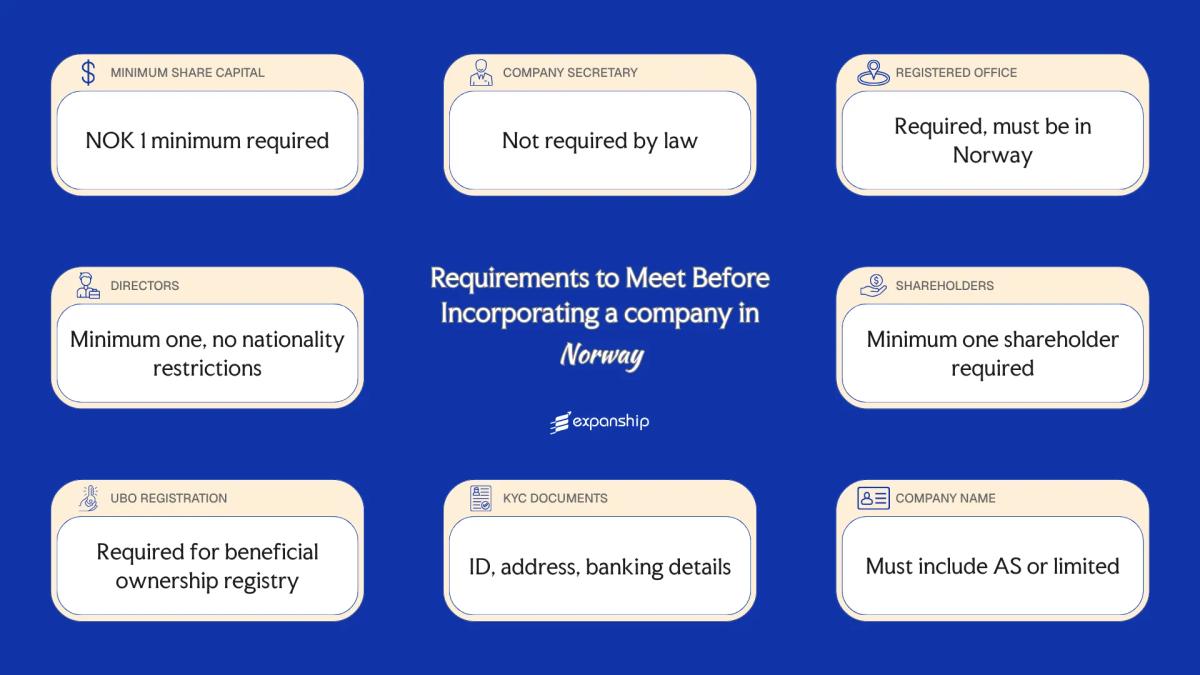
- Incorporating a private limited company (AS) in Norway requires a minimum share capital of NOK 30,000, as mandated by the Private Limited Liability Companies Act (aksjeloven).
- Foreign-controlled entities must ensure their beneficial owners are registered in the Norwegian BO Register maintained by the Brønnøysund Register Centre, an obligation that persists beyond the point of incorporation.
- Director residency rules under Norwegian law impose specific requirements on who may serve in that capacity, with implications for companies whose proposed directors are non-resident.
- All company registration applications are processed through the Brønnøysund Register Centre's Register of Business Enterprises, which will reject submissions that fail to satisfy the structural and documentary requirements set out under aksjeloven.
Entity formation in Norway is governed by the Companies Act (Aksjeloven), which sets out the legal framework for private limited companies and is administered through the Brønnøysund Register Centre. This article covers the structural, administrative, and compliance requirements that apply when registering a business entity in the country.
Failure to meet these requirements results in rejection of the application by the Register of Business Enterprises, or in post-registration penalties where obligations are breached after incorporation.
Requirements can differ depending on the legal form chosen, whether the entity operates in a regulated industry, and the residency status of the founders or investors. Your specific circumstances will determine which obligations apply.
This article is most relevant to foreign entrepreneurs and international businesses assessing Norway company registration requirements before establishing a local presence.
Minimum Share Capital Requirements in Norway
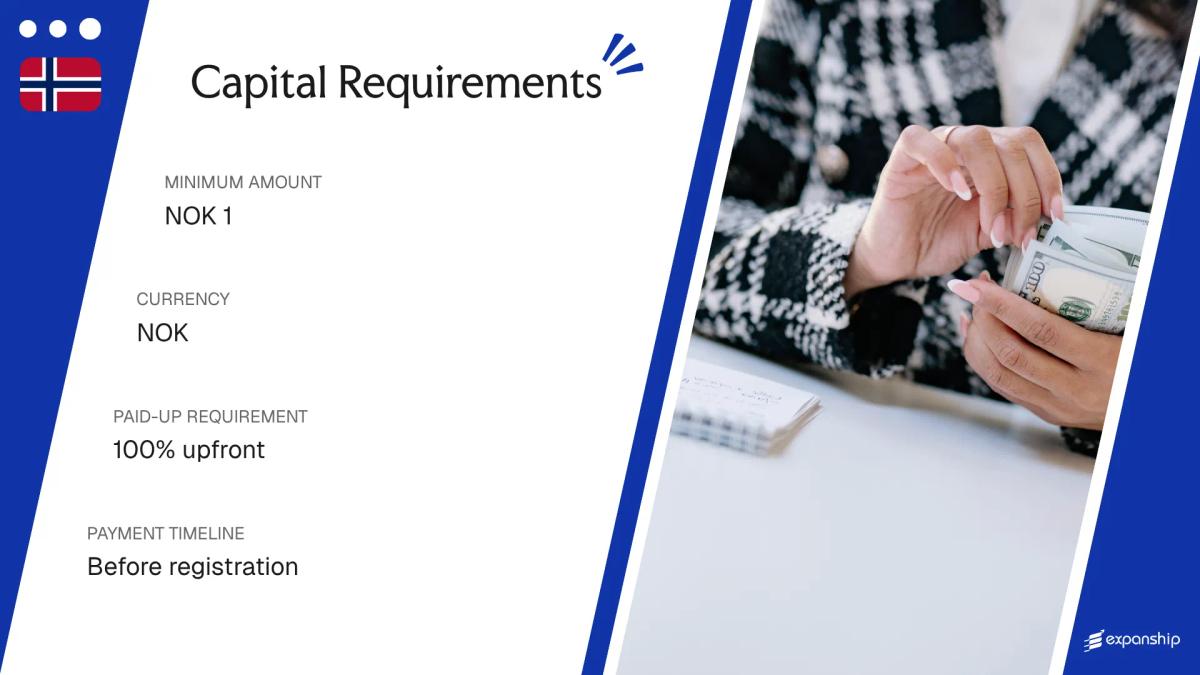
Under the Aksjeloven (Private Limited Companies Act), Norway minimum share capital requirements apply specifically to the aksjeselskap (AS) structure, which is the most common vehicle for private enterprise. The Brønnøysund Register Centre oversees the incorporation process and verifies that the entity meets statutory capital conditions before registration is confirmed.
AS minimum capital operates on a par value share system, meaning each share carries a nominal value. Capital requirements function as an ongoing statutory obligation, not merely a one-time threshold at formation.
| Parameter | Detail |
|---|---|
| Minimum Authorized Share Capital | NOK 30,000 |
| Maximum Authorized Share Capital | No statutory requirement |
| Minimum Paid-Up Capital | NOK 30,000 |
| Paid-Up Requirement at Incorporation | Full minimum capital must be paid up before registration |
| Accepted Currency | Norwegian Krone (NOK) |
| Accepted Forms of Contribution | Cash or non-cash assets (subject to valuation rules under Aksjeloven) |
| Timeframe to Deposit Capital | Prior to submission of incorporation documents to the Brønnøysund Register Centre |
The NOK 30,000 must be deposited and confirmed before the registration application is submitted. Registration will not proceed without evidence of capital payment.
Company Secretary Requirements in Norway
Norwegian law does not impose a statutory obligation to appoint a company secretary for a private limited company (aksjeselskap) or public limited company (allmennaksjeselskap). Under the Aksjeloven and Allmennaksjeloven, these corporate secretary obligations are generally absorbed by the board of directors and, where applicable, a general manager. Certain Norway corporate secretary rules do apply in practice, however, particularly around record-keeping, shareholder register maintenance, and board minutes.
Day-to-day administrative duties are typically delegated to the general manager (daglig leder), who holds statutory responsibility for routine management. The board retains accountability for minutes, resolutions, and filings with the Brønnøysund Register Centre.
Where businesses choose to appoint a secretary-equivalent, the following criteria generally govern eligibility:
- No mandatory licensing or professional certification is required to perform secretarial functions.
- The role may be filled by an individual or a corporate entity.
- Foreign nationals are not excluded, though practical access to Norwegian filings is necessary.
- The function may be outsourced to a third-party service provider registered in Norway.
- No minimum age or nationality requirement applies beyond general legal capacity.

Incorporate a Company in Norway
Set up your Norwegian aksjeselskap or allmennaksjeselskap with full compliance support across all statutory requirements.
Registered Office Requirements in Norway
Registered office requirements Norway follow a straightforward rule: the entity must maintain a physical address within the country that corresponds to its actual place of business or administration, as recorded with the Brønnøysund Register Centre (Foretaksregisteret).
- A physical street address is required; P.O. boxes are not accepted as a registered office address.
- The address must be located within Norway; foreign addresses do not satisfy this requirement.
- Virtual office addresses are generally permissible provided a physical presence at that address can be substantiated.
- Ownership of the premises is not required; a lease or service agreement with the address provider is sufficient.
- The registered address is publicly listed in the Foretaksregisteret and accessible to third parties.
- Any change to the registered address must be formally notified to the Foretaksregisteret, and the update takes effect upon registration.
- Failure to maintain a valid, current registered address can result in the Foretaksregisteret initiating compulsory dissolution proceedings against the firm.
Director Requirements in Norway
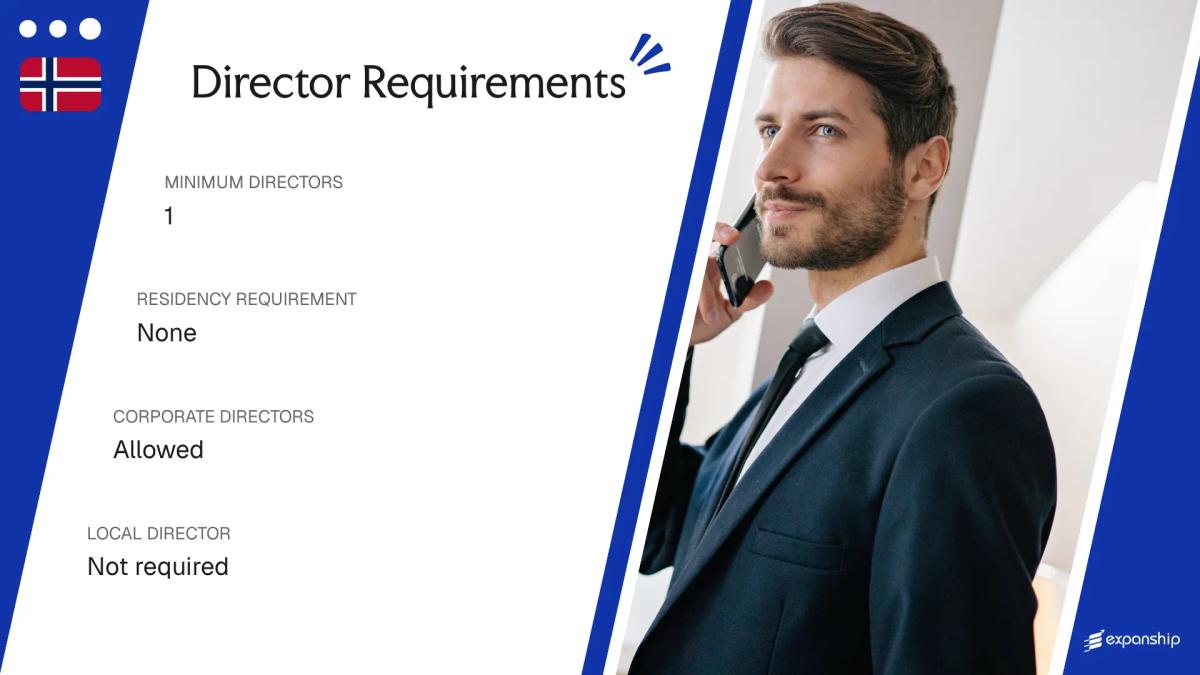
Under the Private Limited Companies Act (aksjeloven), directors of a Norwegian aksjeselskap (AS) assume personal liability for ensuring the company meets its statutory obligations, including maintaining adequate equity and filing accurate accounts with the Brønnøysund Register Centre. Appointment triggers immediate fiduciary duties toward the company and its creditors under Norwegian law.
| Parameter | Detail |
|---|---|
| Minimum Number of Directors | One director is required for a private limited company (AS). |
| Maximum Number of Directors | No statutory maximum is prescribed for a private limited company. |
| Local/Resident Director Required | At least half of the board members must be residents of the European Economic Area (EEA); however, the Norwegian Ministry of Trade may grant exemptions from this rule. |
| Nationality Restrictions | No nationality restrictions apply, provided the EEA residency requirement is satisfied. |
| Minimum Age Requirement | Directors must be at least 18 years of age. |
| Corporate Directors Permitted | Corporate directors are not permitted; directors must be natural persons. |
| Director Must Be a Shareholder | No statutory requirement exists for a director to hold shares in the company. |
| Publicly Listed on Registry | Directors are publicly listed in the Brønnøysund Register Centre (Foretaksregisteret). |
| Disqualification Conditions | A person who is bankrupt or has been disqualified by a Norwegian court may not serve as a director. |
Despite Norway's strict EEA residency rule for board members, a sole-director AS can have that single director based entirely outside Norway if the Ministry of Trade grants a specific exemption, meaning the rule is not always an absolute barrier for foreign-only boards.
Shareholder Requirements in Norway
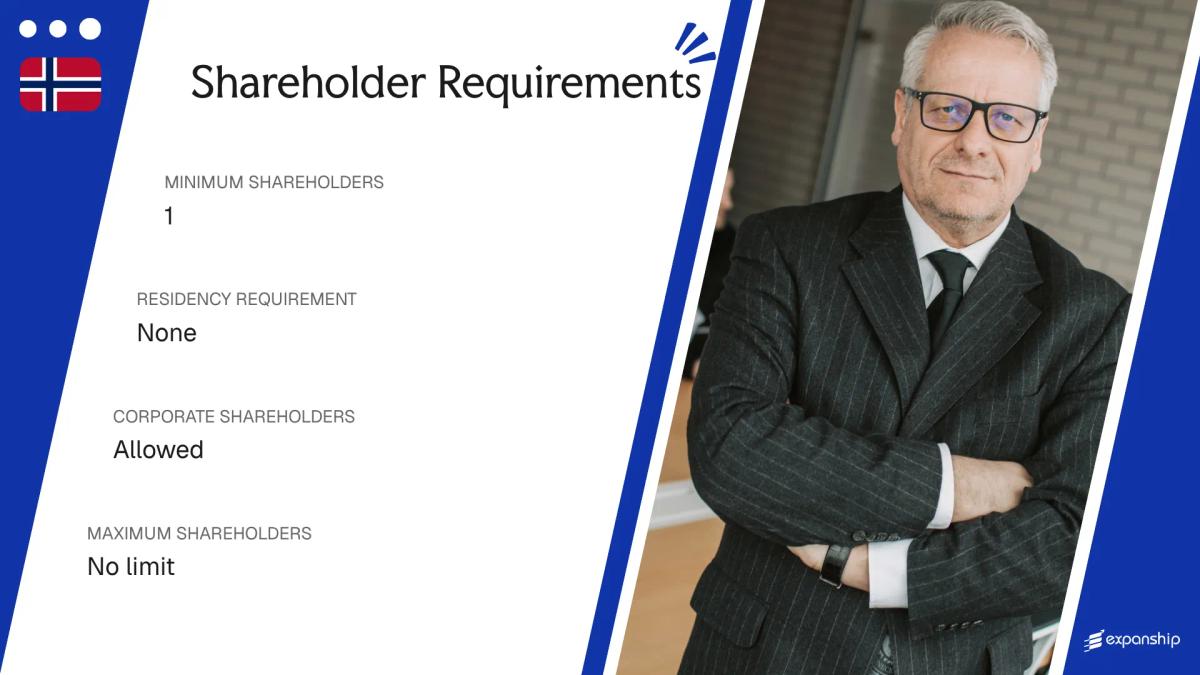
An aksjeselskap (AS) requires a minimum of one shareholder, meaning a sole shareholder structure is fully permitted under the Norwegian Private Limited Companies Act (aksjeloven). No statutory maximum applies to the number of shareholders an AS may have.
Nationality and Residency Restrictions
Shareholder requirements in Norway impose no nationality or residency conditions on individuals or entities holding shares in an AS. Foreign nationals and non-resident investors may hold 100% of the share capital without restriction.
Corporate Shareholders
Corporate entities are permitted to act as shareholders in a Norwegian AS. No special conditions are attached to corporate shareholding beyond standard KYC and beneficial ownership disclosure obligations.
Shareholder Liability
Shareholder liability is limited to the amount of share capital each party has subscribed. Norwegian corporate law does not provide for general extended liability, though courts may pierce the corporate veil in cases of abuse or undercapitalisation.
Register of Shareholders
Under aksjeloven, every AS must maintain an internal shareholder register. This register is not publicly accessible, but your entity is obliged to keep it current and must report ownership data to the Norwegian Shareholder Register (aksjonærregisteret) administered by the Tax Administration.
Shareholder Compliance Support for Your Norwegian Company
Get guidance on structuring your shareholding, maintaining your shareholder register, and meeting disclosure obligations when setting up an AS in Norway.
UBO / Beneficial Ownership Registration Requirements in Norway
Under Norway's Anti-Money Laundering Act (hvitvaskingsloven) and the Beneficial Ownership Register Act (lov om register over reelle rettighetshavere), UBO registration requirements Norway entities must comply with are administered through the Brønnøysund Register Centre, with beneficial ownership defined as any individual holding or controlling more than 25% of shares, voting rights, or other ownership interests.
- Identify all individuals who meet the 25% ownership or control threshold within your entity's ownership structure.
- Register those individuals as reelle rettighetshavere in the Beneficial Ownership Register maintained by the Brønnøysund Register Centre.
- Submit the registration within a statutory deadline following the entity's incorporation or establishment.
- Report any changes to beneficial ownership details promptly upon those changes occurring.
| Parameter | Detail |
|---|---|
| Ownership Threshold for UBO Status | More than 25% of shares, voting rights, or equivalent control |
| Filing Authority | Brønnøysund Register Centre |
| Disclosure Deadline at Incorporation | No statutory requirement specifying an exact number of days |
| Publicly Accessible Register | Yes |
| Penalties for Non-Disclosure | Fines under the Beneficial Ownership Register Act |
| Ongoing Update Obligation | Yes; updates required upon any change in beneficial ownership |
KYC / Document Requirements in Norway
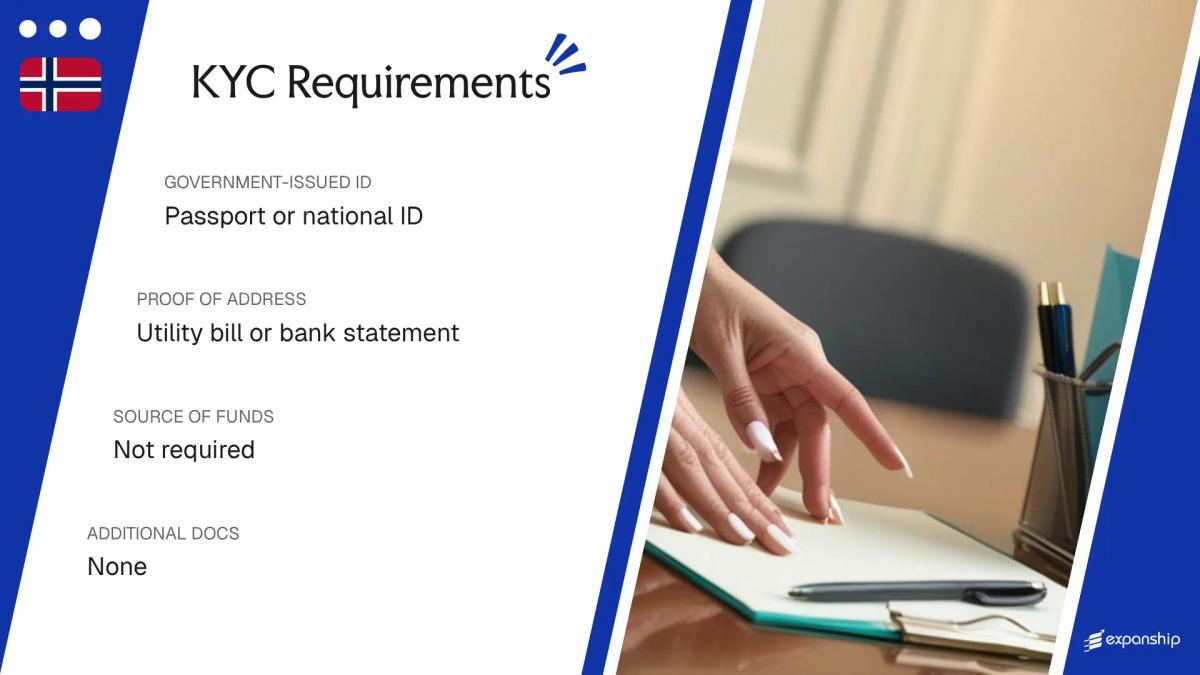
KYC document requirements Norway arise under the Money Laundering Act (Hvitvaskingsloven) of 2018, which transposes the EU's Fourth Anti-Money Laundering Directive into Norwegian law and imposes identity verification obligations on formation agents and financial institutions at the point of incorporation. Compliance with this framework is overseen by Finanstilsynet.
Individual / Personal Documents
- Valid government-issued photo ID (passport or national identity card) for each individual director, shareholder, and beneficial owner
- Proof of residential address dated within three months, such as a utility bill or bank statement
- Completed self-certification form confirming tax residency status where required
- Signed declaration confirming the individual's role and authority within the entity
Corporate Documents
- Certificate of incorporation or equivalent formation document for the corporate shareholder or director
- Constitutional documents, such as articles of association or equivalent
- Current register of directors confirming who holds authority on behalf of the corporate entity
- Official proof of the corporate entity's registered address
Source of Funds Documentation
- Recent bank statements covering a minimum of three months prior to incorporation
- Audited financial accounts where the corporate entity has been trading
- Written explanation of the commercial origin of capital being introduced
Notarisation and Apostille Requirements
- Foreign public documents must be apostilled under the Hague Convention of 1961 before submission
- Documents not issued in Norwegian, English, or another accepted language require certified translation
- Notarisation requirements depend on the issuing jurisdiction's standards and the receiving agent's policies
Incomplete or unverified beneficial ownership documentation is the most frequent cause of incorporation delays under Norwegian AML review procedures.
Company Name Requirements in Norway
Company name requirements in Norway are assessed by the Brønnøysund Register Centre at the point of incorporation. A proposed name must be clearly distinguishable from existing registered names, and names that create a risk of confusion with another entity are rejected.
Norwegian law requires a legal suffix that reflects the chosen entity type, such as "AS" for an aksjeselskap. The name must be written using the Norwegian alphabet, and single-word names consisting solely of a common noun are generally not accepted.
Certain words are restricted or prohibited. Terms implying a connection to the state, royal family, or financial institutions require prior approval from the relevant authority, and names considered contrary to public order or decency are outright banned.
Name reservation is available through the Brønnøysund Register Centre. A reserved name holds its status for a defined period while incorporation proceedings are completed, preventing another applicant from registering the same name during that window.
Compliance Services for Companies in Norway
Ongoing compliance obligations in Norway include annual filings, beneficial ownership updates, and regulatory reporting. Expanship manages these requirements on your behalf.
Conclusion
Norway company incorporation requirements span several distinct obligations, from minimum share capital thresholds under the Private Limited Liability Companies Act (aksjeloven) to director residency rules and UBO registration with the Brønnøysund Register Centre. Among the more consequential obligations, the NOK 30,000 minimum share capital for an AS and the requirement to register beneficial owners in the Norwegian BO Register carry ongoing compliance implications. Once these foundations are understood, a foreign investor moves into the operational phase of entity setup and ongoing statutory maintenance.
Expanship's Corporate Services for Norway Expansion
Incorporating a Norwegian entity involves specific obligations under the Companies Act, from minimum capital contributions to UBO registration with Brønnøysund. Expanship's Norway company formation services are structured around these exact requirements, helping your business meet each step without adding unnecessary layers of complexity to the process.
Beyond initial registration, our corporate services for Norway expansion cover the full lifecycle of establishing and maintaining a compliant entity.
- We prepare and file all incorporation documents with the Register of Business Enterprises on your behalf.
- Our team provides a registered office address and acts as your registered agent in Norway.
- We manage government filings and liaise directly with Norwegian regulatory bodies as required.
- Post-incorporation compliance, including annual reporting obligations, is handled as your business grows.
- Banking introduction support is available to help connect your entity with suitable Norwegian financial institutions.
- We coordinate tax registration and communication with Skatteetaten and other relevant local authorities.
To discuss your requirements, contact Expanship Norway.
Frequently Asked Questions (FAQ)
A majority of the board members of a Norwegian AS, including the general manager if one is appointed, must be resident in the European Economic Area (EEA). If your company has a single-member board, that individual must be EEA-resident. An exemption can be applied for from the Norwegian Ministry of Trade, Industry and Fisheries, but it is not automatically granted.
Failure to register beneficial ownership information with the Brønnøysund Register Centre, as required under the Norwegian Anti-Money Laundering Act, can result in enforcement measures including coercive fines (tvangsmulkt) issued by the Register Centre itself. The obligation applies to all legal entities registered in Norway, with no size or revenue threshold exemptions. Persistent non-compliance can also affect the entity's ability to operate with regulated financial institutions.
Yes, the EEA residency requirement applies to public limited companies (allmennaksjeselskap, ASA) as well. Under the Norwegian Companies Act (aksjeloven and allmennaksjeloven respectively), the majority of board members must be EEA-resident unless a formal exemption is obtained. The threshold applies to the board as a whole, so a single non-EEA director is permissible provided the remaining directors satisfy the residency condition.
The Register Centre does not impose a formal waiting period before you can resubmit with a revised name, but the overall registration timeline resets from the point of resubmission. Standard processing through the Coordinated Register Notification (Samordnet registermelding) typically takes a few business days for electronic filings, though this depends on the completeness of the documentation submitted. Choosing a name that clearly distinguishes the entity from existing registered names reduces the risk of rejection.
A Norwegian bank account is not a formal prerequisite to complete the legal incorporation process, but one is needed to deposit the share capital and obtain the bank confirmation required for AS registration. In practice, this means opening a bank account is an early step in the process rather than a post-incorporation formality. Some founders use a notarised deposit confirmation as an alternative, though direct bank confirmation remains the standard route accepted by the Register Centre.
Foreign shareholders are subject to the same underlying KYC obligations under the Norwegian Anti-Money Laundering Act, but in practice the documentation burden is higher because foreign identity documents and corporate records must often be apostilled or notarised and translated into Norwegian. A foreign corporate shareholder will typically need to provide certified copies of its constitutional documents, proof of registered address, and evidence of its own beneficial ownership structure. Norwegian shareholders can generally satisfy identity requirements through the national BankID system, which is not available to foreign nationals.
Legal Disclaimer
The information provided in this article is for general informational purposes only and does not constitute legal, tax, or professional advice. While we strive to ensure the accuracy and timeliness of the content, laws and regulations are subject to change, and the application of laws can vary widely based on specific facts and circumstances.
Readers should not act upon this information without seeking professional counsel tailored to their individual situation. Expanship and its authors disclaim any liability for actions taken or not taken based on the content of this article.
For specific advice regarding your business setup, compliance requirements, or any legal matters, please consult with qualified legal and tax professionals in the relevant jurisdiction.