
Key Takeaways
- Saint Martin (MF)'s distinct fiscal regime, set locally rather than by Paris, allows foreign-owned companies to operate outside the standard French metropolitan tax structure while retaining the legal legitimacy of French commercial law under the Code de commerce.
- Because the collectivity maintains formal ties to the French Republic, entities incorporated here can access EU single market frameworks and conduct business in euros, reducing currency risk and counterparty friction that typically accompanies Caribbean-based structures.
- Foreign nationals face no general ownership restrictions under the collectivity's open investment posture, and the Greffe du Tribunal Mixte de Commerce processes filings under established French commercial law, giving international founders a recognised legal foundation rather than an unfamiliar offshore regime.
- The availability of both the SARL and SAS entity forms means founders can select a governance structure that European banks and business counterparties already understand, lowering the practical barriers to opening accounts and executing cross-border commercial agreements.
Saint Martin (MF) is a French overseas collectivity located in the northeastern Caribbean, sharing the island of Saint Martin with the Dutch territory of Sint Maarten. Its political status places it outside the European Union customs territory while retaining formal ties to France and the French Republic's legal order. Company registration is administered through the Greffe du Tribunal Mixte de Commerce, which processes incorporation filings under French commercial law as applied to the collectivity.
Foreign nationals face no general restrictions on owning or operating a business here, and the territory maintains an open posture toward foreign direct investment across most sectors. The SARL remains the most common vehicle used by international founders establishing a local presence. From a tax standpoint, the collectivity operates under a distinct fiscal regime separate from metropolitan France, with rates and rules set locally rather than by Paris.
Understanding the full benefits of incorporating in Saint Martin MF requires examining several distinct dimensions — legal, financial, geographic, and operational. This article addresses each of those areas in turn.
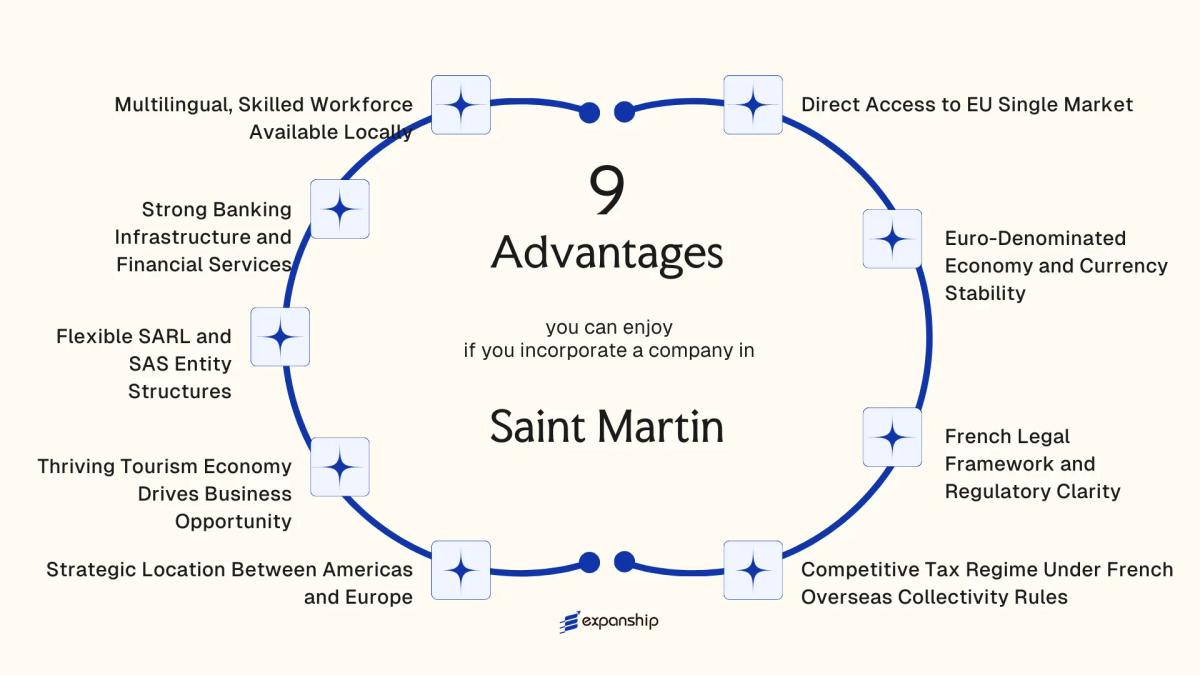
Direct Access to EU Single Market
As a French collectivity, Saint Martin MF EU single market access benefits are grounded in its constitutional relationship with France under Article 349 of the Treaty on the Functioning of the European Union (TFEU). Companies incorporated here operate within the French legal order, which carries direct implications for how goods, capital, and services move across European borders.
What the TFEU Status Actually Confers
Saint Martin holds Outermost Region (OMR) status under EU law, meaning EU regulations and directives apply directly. A business registered here can ship goods into mainland France and across the EU27 without customs duties, giving it tariff-free entry to a market of over 440 million consumers.
Practical Consequences for Foreign-Owned Entities
EU market access through Saint Martin French collectivity status means your firm benefits from mutual recognition frameworks that eliminate many non-tariff barriers — product standards approvals obtained under French authority, for instance, are valid across member states. Capital transactions with EU-based partners are also governed by EU free movement of capital rules, reducing friction for cross-border investment structures.
Your entity incorporated here carries EU-origin status, enabling tariff-free entry into all 27 EU member states without a separate European subsidiary.
Euro-Denominated Economy and Currency Stability
Saint Martin MF euro currency stability benefits begin with a structural fact: the collectivity uses the euro as its official currency, not a pegged or managed alternative. Because France extended the euro to its overseas collectivities, businesses incorporated here operate within the same monetary framework as the eurozone's 20 member states, without needing a separate currency conversion layer for European transactions.
For foreign investors, this removes a category of financial risk that affects many Caribbean jurisdictions. Exchange rate volatility does not factor into pricing contracts with European counterparties, repatriating profits to France, or settling invoices across the euro area.
The euro-denominated economy also produces measurable operational advantages:
- Accounting, payroll, and financial reporting all use a single stable currency, reducing administrative complexity for multi-jurisdiction businesses
- European suppliers, service providers, and institutional lenders operate in the same currency, avoiding conversion costs that compound over time
- Investors holding euro-denominated assets face no currency mismatch when funding local operations
French monetary policy, governed by the Banque de France under the European Central Bank framework, applies directly. Your business benefits from the same institutional oversight that governs monetary conditions across the eurozone, not a local central bank operating independently with limited reserves.

Company Incorporation in Saint Martin (MF)
Incorporate your company in Saint Martin (MF) and operate within a euro-denominated economy backed by the European Central Bank framework.
French Legal Framework and Regulatory Clarity
Saint Martin (MF) operates under French civil law, and that legal foundation is one of the more substantive French legal framework benefits Saint Martin MF offers to foreign business owners. The Collectivité de Saint-Martin applies the French Civil Code and French Commercial Code directly, meaning your company operates within a codified legal system with centuries of case law, defined liability rules, and predictable contract enforcement.
| Legal Source | Applicable Instrument | Practical Relevance |
|---|---|---|
| Civil law foundation | French Civil Code | Governs contracts, obligations, and commercial relationships |
| Commercial law | French Commercial Code | Regulates company formation, director duties, and insolvency |
| Judicial oversight | French court system | Disputes resolved under French procedural law |
| Intellectual property | French IP law (via INPI) | Trademarks and IP protections apply under French national framework |
For foreign investors accustomed to common law jurisdictions, the codified structure offers a different kind of predictability: written rules govern most scenarios rather than reliance on precedent alone. Contracts drafted under French commercial law are enforceable with clear standards. Regulatory clarity through French overseas collectivity status in Saint Martin means that the legal environment is not improvised at the local level but anchored in a national framework maintained by a sovereign state.
Business registration and compliance obligations follow procedures aligned with French national standards, administered through the Registre du Commerce et des Sociétés. Your entity operates under a system that French and European counterparties already recognize, which reduces friction in cross-border commercial relationships.
Competitive Tax Regime Under French Overseas Collectivity Rules
Saint Martin MF competitive tax regime advantages stem from a fiscal structure that operates outside the standard French metropolitan tax code. Under the Organic Law of 21 February 2007, which established the collectivity's autonomous status, the territory manages its own tax policy independently from mainland France.
The corporate income tax rate applied locally is generally lower than the standard French rate of 25%. For businesses operating within the collectivity's jurisdiction, this differential directly reduces annual tax liability without requiring complex offshore structuring.
Unlike many EU member states, the collectivity does not apply French VAT. Local consumption tax rules govern indirect taxation instead, which affects how your business prices goods and services and reports revenue.
French overseas collectivity tax benefits here also extend to certain sector-specific exemptions. Economic activities tied to tourism, construction, and productive investment may qualify for reduced contribution rates under local fiscal ordinances issued by the Collectivité de Saint-Martin.
Keep these points in mind:
- Tax rules are governed locally, not by the Direction Générale des Finances Publiques (DGFiP) of mainland France
- VAT does not apply; local indirect tax rules apply instead
- Sector-based exemptions require formal application through local fiscal authorities
- Residency and substance requirements may condition access to preferential rates
Refer to the fiscal ordinances published by the Collectivité for current rates and eligibility criteria.
Despite being geographically adjacent to Dutch Sint Maarten, the French side operates under an entirely separate tax regime with no fiscal harmonisation agreement between the two sides of the island.
Strategic Location Between Americas and Europe
Saint Martin MF strategic location business advantages stem from a geographic position that few Caribbean territories can replicate. Sitting at approximately 18 degrees north latitude in the northeastern Caribbean, the island sits roughly equidistant between Miami and Lisbon, placing your business within practical reach of two of the world's largest economic zones without requiring a regional headquarters in each.
Atlantic Crossroads for Trade and Logistics
Princess Juliana International Airport, shared across the Dutch-French border, handles direct connections to major hubs in both North America and Europe. For businesses managing supply chains or client relationships across the Atlantic, this access compresses travel time and operational coordination in ways that matter to daily business function, not just investor presentations. French collectivity status means the territory operates within the EU's external trade framework, which has direct implications for customs procedures when goods flow toward European markets.
Time Zone Alignment with Both Markets
Operating from UTC-4, your firm can realistically hold working calls with Paris in the morning and New York or Miami in the afternoon during standard business hours. This overlap is a structural operational asset for financial services firms, consulting entities, or digital businesses that depend on real-time communication with counterparts in both regions. Most Caribbean jurisdictions sit in the same time zone but lack the EU regulatory alignment that makes this temporal position commercially meaningful for European-facing operations.
Plan Your Market Positioning from Saint Martin (MF)
Speak with Expanship about how Saint Martin's geographic and regulatory position can be structured into your business model from day one.
Thriving Tourism Economy Drives Business Opportunity
Tourism is the primary economic driver in Saint Martin MF, and that concentration creates direct, measurable advantages for businesses incorporating there. Visitor arrivals, hospitality revenue, and ancillary spending generate consistent demand across multiple commercial sectors throughout the year.
- The French side receives millions of tourist arrivals annually, sustaining year-round demand for hospitality, retail, food and beverage, transport, and professional services. A company incorporated there can access that spending base from day one without building a market from scratch.
- Tourism-linked sectors on the French side operate under French commercial law, meaning supplier contracts, service agreements, and consumer transactions follow a familiar, enforceable legal framework rather than an untested local code.
- The absence of a customs border between the French and Dutch sides of the island means a registered entity can supply clients and partners across the entire island, effectively doubling the accessible tourist market without additional licensing complexity.
- Seasonal peaks drive demand for temporary staffing, logistics, and specialized services. A locally registered firm can engage contractors and short-term employees under French labor regulations, which apply in Saint Martin as a collectivity, giving your business a compliant structure to scale with demand cycles.
- Real estate and property management tied to tourist accommodation represent a documented high-activity sector, offering incorporated entities a concrete route into asset-backed revenue.
Flexible SARL and SAS Entity Structures
Saint Martin MF SARL SAS entity structure benefits are rooted in French commercial law, specifically the Code de commerce, which applies in full to this collectivity. Two entity types dominate: the Société à Responsabilité Limitée (SARL) and the Société par Actions Simplifiée (SAS). Each carries distinct structural advantages depending on your ownership preferences and operational scale.
The SARL requires a minimum of one shareholder and has no minimum share capital requirement under current French law. This makes it accessible for sole founders without the capital commitments associated with public company structures elsewhere.
The SAS offers greater flexibility in how governance, profit distribution, and shareholder rights are defined. These terms are set through the company's statuts, allowing founders to tailor internal arrangements to investor agreements or holding structures without needing regulatory approval for each variation.
- SARL: capped at 100 shareholders; suited to closely held businesses
- SAS: no shareholder ceiling; accommodates complex multi-party ownership
A foreign-owned SAS with two shareholders can allocate dividends disproportionately to capital contribution through a clause in the statuts, something a standard equity split structure in many non-French jurisdictions would not permit without separate shareholder agreements.
Strong Banking Infrastructure and Financial Services
Saint Martin MF banking infrastructure advantages stem from the territory's direct integration into the French banking system. Banks operating on the French side are subject to oversight by the Autorité de Contrôle Prudentiel et de Résolution (ACPR), the same prudential regulator that supervises institutions in metropolitan France. This means your business accounts are held within a regulated framework that meets EU banking standards, not a lighter offshore equivalent.
French Caribbean banking advantages in Saint Martin are particularly tangible for businesses that need cross-border payment functionality. Accounts held through French-regulated banks grant access to SEPA transfers, which cover 36 European countries. For a firm trading with European counterparties, this eliminates correspondent banking friction that is common in purely offshore structures.
The collectivity's euro denomination means no currency conversion is required when transacting within the eurozone. Funds move at face value, which reduces both transaction costs and exchange rate exposure for your treasury operations.
- French-regulated banks operating locally fall under ACPR supervision
- SEPA access covers 36 countries, including all EU member states
- Euro-denominated accounts eliminate intra-eurozone conversion costs
Banking relationships for newly registered entities in French overseas collectivities may require in-person due diligence or notarised documentation; confirm requirements with your chosen institution before incorporation.
Multilingual, Skilled Workforce Available Locally
Saint Martin MF multilingual workforce advantages are rooted in the territory's distinct social and administrative history. As a French collectivity sharing an island with a Dutch territory, the local population routinely operates in French, English, and Dutch, with many residents also speaking Spanish and Creole. For a business serving international clients or managing cross-border operations, this linguistic range reduces the cost and complexity of building a functional team.
French is the official administrative language under the Collectivité de Saint-Martin governance structure, which means your legal documents, filings, and correspondence with the Préfecture de Guadeloupe are conducted in French. English, however, functions as the de facto commercial language across much of the island. A firm can therefore hire locally for both compliance-facing and client-facing roles without splitting those functions between separate markets.
The tourism and hospitality sector has historically driven demand for multilingual service professionals, producing a resident workforce accustomed to adapting communication across languages and cultures. This depth extends beyond front-line roles.
- Accounting and administrative professionals familiar with French regulatory requirements are present locally.
- English-speaking staff experienced in U.S. and Caribbean commercial contexts are accessible.
- Bilingual candidates who can bridge both regulatory environments exist within the same labor pool.
French labor law applies in the collectivity, meaning employment contracts and workplace obligations follow the Code du travail. That legal consistency gives your entity a predictable framework for hiring, without needing to interpret an unfamiliar or uncodified employment system.
Why Saint Martin (MF) Stands Out Among Caribbean Business Destinations
Foreign investors evaluating Caribbean incorporation options tend to compare Saint Martin (MF) against jurisdictions with similar tourism-driven economies and offshore appeal. The Dutch side (Sint Maarten), the British Virgin Islands, and the Cayman Islands are the competitors most likely to appear on the same shortlist. What the comparison reveals is less about tax rates in isolation and more about the legal architecture underpinning those rates — and the access that architecture unlocks.
Saint Martin MF advantages over Caribbean business destinations become most visible at the structural level. As a French collectivity operating under the Code de commerce, entities here benefit from a civil law framework that EU counterparties recognise and trust. That recognition reduces friction in cross-border contracting and financing that more traditional offshore structures do not resolve. EU treatment of the collectivity under OCT status also means preferential trade access unavailable to purely offshore jurisdictions.
| Parameter | Saint Martin (MF) | Sint Maarten (SX) | British Virgin Islands | Cayman Islands |
|---|---|---|---|---|
| Legal Framework | French civil law (Code de commerce) | Dutch civil law | English common law | English common law |
| Currency | Euro (EUR) | East Caribbean Dollar / USD | USD | KYD / USD |
| EU OCT Trade Access | Yes | No | No | No |
| Standard Corporate Tax Rate | 0% (territorial, local-source rules apply) | 0% on offshore income | 0% | 0% |
| Primary Entity Type | SARL, SAS | NV, BV | BVI BC | Exempted Company |
| Regulatory Oversight Body | Collectivité de Saint-Martin | Financial Services Regulatory Authority (FSRA) | BVI Financial Services Commission | Cayman Islands Monetary Authority (CIMA) |
| Euro-Zone Banking Access | Yes | No | No | No |
Compliance Services for Companies in Saint Martin (MF)
Stay aligned with French collectivity regulations, local filing obligations, and reporting requirements for your Saint Martin (MF) entity.
Conclusion
Saint Martin (MF) presents a structurally distinct case among Caribbean incorporation destinations. Its position as a French collectivity gives foreign-owned entities access to EU single market frameworks and euro-denominated financial operations, while its local fiscal rules preserve meaningful cost advantages that standard EU jurisdictions do not offer.
For businesses where currency exposure, legal predictability, and market access carry significant weight, the benefits of incorporating in Saint Martin MF are rooted in verifiable structural features rather than promotional claims. The application of French civil law under the Code de commerce, combined with the availability of the SAS and SARL entity forms, gives foreign owners a governance architecture that European counterparties and banks already recognise and accept.
Whether a business is oriented toward tourism-linked services, cross-border trade, or regional holding structures, the appropriate use of Saint Martin MF company formation advantages depends on how your specific business model, tax position, and operational footprint align with what the collectivity actually offers. Not every structure benefits equally, and professional analysis of your circumstances remains necessary before formation.
Saint Martin MF business incorporation benefits are not generic to the region; they derive from a specific legal and fiscal configuration that few comparable territories replicate. Understanding that configuration precisely is the starting point for any formation decision.
Start Your Saint Martin (MF) Company with Expanship Today
Expanship's services for Saint Martin (MF) company formation are structured around the specific regulatory requirements of a French overseas collectivity. From registering a SARL or SAS with the Centre de Formalités des Entreprises to meeting ongoing obligations under French commercial law, each step involves precise documentation and coordination with the relevant local administrative bodies.
Expanship supports your business through every stage of that process:
- Preparation and legalization of incorporation documents in accordance with French legal standards
- Registered agent and registered office provision within the collectivity
- Government filing and liaison with the Centre de Formalités des Entreprises and local authorities
- Post-incorporation compliance management, including annual reporting and statutory obligations
- Banking introduction assistance to support account opening with local or regional financial institutions
To start your Saint Martin MF company with Expanship, contact our team directly through the Expanship Saint Martin MF page.
Frequently Asked Questions (FAQ)
Saint Martin (MF) operates under a distinct fiscal regime established following its separation from Guadeloupe in 2007, with tax rules set by the Collectivité de Saint-Martin rather than applying mainland French rates in full. The local tax framework is designed to be more competitive than metropolitan France, though the precise rates applicable to your entity type should be confirmed with a local tax adviser familiar with the Collectivité's délibérations fiscales. The general principle is that the territory has legislative competence over taxation, allowing it to diverge from standard French corporate tax schedules.
French company law, which applies as the base legal framework, does not impose a mandatory local residency requirement for directors of a SAS or SARL. A non-resident can serve as président of a SAS or gérant of a SARL without being domiciled in the territory. Practical considerations around banking and regulatory correspondence may make a local representative useful, but this is not a statutory formation requirement.
Registration through the relevant Centre de Formalités des Entreprises (CFE) or via the guichet unique electronic procedure generally takes between one and three weeks for a standard SARL or SAS, assuming all documentation is in order. Delays can occur if notarized or apostilled foreign documents are required, particularly for non-EU directors or shareholders. The timeline does not include any sector-specific licensing that may be required after the base entity is registered.
As a collectivity of France, Saint Martin (MF) is part of the European Union under Article 349 of the Treaty on the Functioning of the European Union, which classifies it as an outermost region. A company incorporated there is a French legal entity and can benefit from EU regulatory frameworks, including those governing cross-border services, where the specific EU directive or regulation applies to outermost regions. Certain EU financial services passporting regimes are administered at the member-state level through French authorities, so the scope of passporting rights depends on the regulated activity in question.
Because the Collectivité de Saint-Martin holds autonomous legislative competence over direct taxation, any change to local tax rules would require a formal délibération by the territorial council. Companies incorporated there would be subject to the updated rules from the effective date of such a délibération, with no grandfathering guaranteed unless transitional provisions are explicitly included. Monitoring publications from the Collectivité de Saint-Martin's official journal is the standard way to track regulatory changes that could affect your entity's tax position.
The answer depends on the nature and scale of your operations. Saint Martin (MF) offers a geographically central position in the northeastern Caribbean with direct connections to both North American and European markets, combined with a euro-denominated economy and French legal certainty that some other Caribbean jurisdictions do not provide. Other French collectivities such as Saint Barthélemy also maintain autonomous tax regimes, so a direct comparison requires evaluating the specific fiscal délibérations, banking infrastructure, and workforce availability relevant to your business activity.
Legal Disclaimer
The information provided in this article is for general informational purposes only and does not constitute legal, tax, or professional advice. While we strive to ensure the accuracy and timeliness of the content, laws and regulations are subject to change, and the application of laws can vary widely based on specific facts and circumstances.
Readers should not act upon this information without seeking professional counsel tailored to their individual situation. Expanship and its authors disclaim any liability for actions taken or not taken based on the content of this article.
For specific advice regarding your business setup, compliance requirements, or any legal matters, please consult with qualified legal and tax professionals in the relevant jurisdiction.