

Key Takeaways
- St. Lucia's limited double taxation treaty network increases the risk of withholding taxes and cross-border tax inefficiencies for companies conducting international operations through the jurisdiction.
- Companies incorporated under the St. Lucia Companies Act face mandatory registered agent and office requirements that add recurring administrative costs regardless of actual business activity in the country.
- The jurisdiction's small domestic market and underdeveloped local professional services infrastructure constrain access to specialized legal, accounting, and financial advisory support on the ground.
- Ongoing reputational scrutiny applied to Caribbean offshore jurisdictions can complicate correspondent banking relationships and introduce additional due diligence burdens for St. Lucia-registered entities.
St. Lucia operates under an evolving regulatory framework, shaped in part by its obligations to international compliance bodies and regional oversight mechanisms. The disadvantages of incorporating in St. Lucia span several operational, financial, and structural categories that this article examines in sequence.
Not every drawback carries equal weight across all business types. A holding company, an active trading firm, and a service-based entity will each encounter a different subset of these constraints depending on structure, industry, and target markets.
This article is most relevant to foreign investors and non-resident business owners considering St. Lucia company formation, particularly those structuring international operations or exploring offshore incorporation. The Companies Act governs the formation and ongoing obligations of companies registered in the jurisdiction.
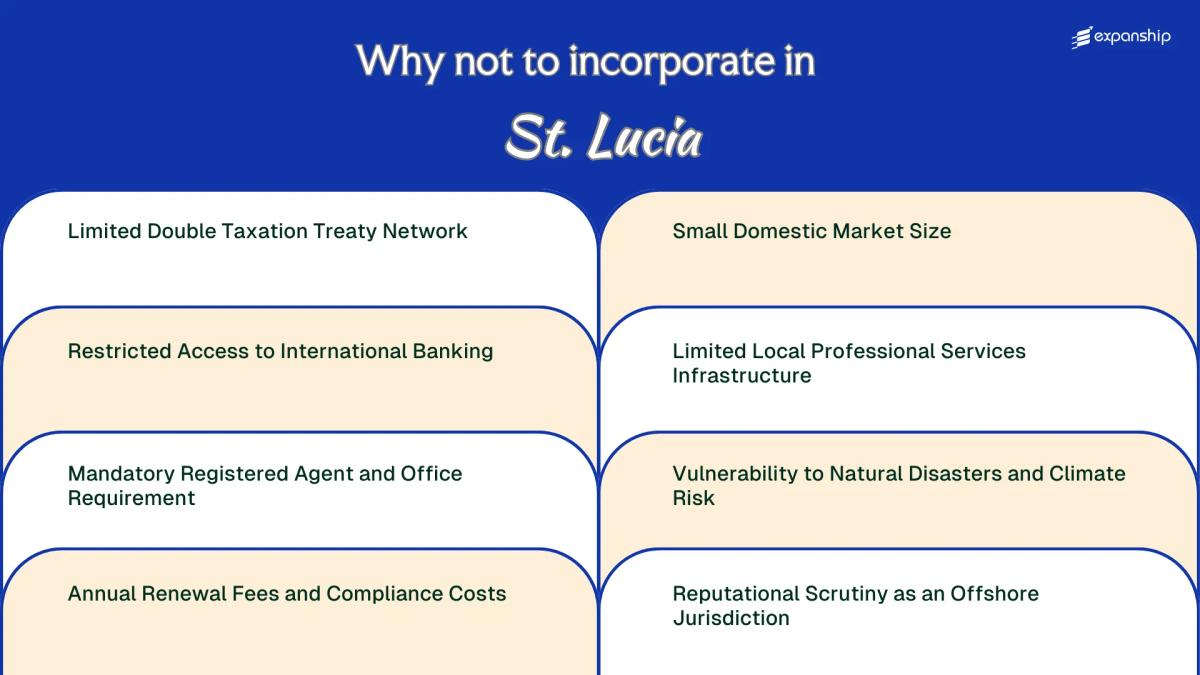
Limited Double Taxation Treaty Network
St. Lucia's double taxation treaty limitations represent one of the more consequential structural gaps for foreign business owners relying on cross-border income flows. The country maintains a narrow treaty network that leaves most international transactions exposed to full withholding taxes in counterpart jurisdictions.
Thin Treaty Coverage and Its Income Cost
St. Lucia has signed a limited number of double taxation agreements, primarily through the CARICOM tax treaty framework, which covers Caribbean Community member states. If your clients, suppliers, or investors are based in the United States, the United Kingdom, or continental Europe, dividends, royalties, and interest payments routed through a St. Lucian entity will typically be subject to the domestic withholding tax rates of those source countries, with no treaty relief available.
Structural Disadvantage Against Better-Connected Jurisdictions
Countries such as Cyprus or Mauritius maintain 40 to 60 bilateral tax treaties with major economies, giving resident companies meaningful withholding tax reductions. A St. Lucia IBC operating in those same corridors receives no equivalent protection, which can materially increase the effective tax burden on cross-border income streams.
For businesses whose revenue depends on jurisdictions outside the CARICOM bloc, this lack of tax treaties creates a permanent, structural cost that cannot be resolved through entity structuring alone.
Without applicable treaty protection, your St. Lucian entity may face full statutory withholding tax rates in key trading jurisdictions, directly reducing net returns on dividends, royalties, and service payments.
Restricted Access to International Banking
St. Lucia offshore banking restrictions represent one of the more concrete operational friction points for foreign-owned entities registered under the International Business Companies Act. Major global banks, particularly those headquartered in the United States, Canada, and the United Kingdom, have systematically reduced or eliminated correspondent banking relationships with Caribbean jurisdictions, and St. Lucia is included in that pattern.
Opening a business bank account problems often surface immediately after incorporation. Many international banks apply heightened due diligence to companies registered in small-island offshore jurisdictions, treating them as elevated-risk regardless of the firm's actual activity or ownership structure.
Practically, this creates a set of compounding operational burdens:
- Your company may be rejected by tier-one banks before the account application is even reviewed on its merits.
- Maintaining a correspondent banking relationship often requires additional compliance documentation that adds both time and professional fees.
- Payment processors and fintech platforms frequently apply the same risk filters, limiting your options beyond traditional banking.
- Repeat requests for source-of-funds verification can delay routine transactions and disrupt cash flow.
This friction is not unique to St. Lucia, but the jurisdiction's limited presence in formal anti-money-laundering cooperative frameworks reduces the leverage a business owner has when challenging adverse banking decisions.

Company Incorporation in St. Lucia
Set up your St. Lucia international business company with full compliance support from registration through ongoing maintenance.
Mandatory Registered Agent and Office Requirement
Under the International Business Companies Act of St. Lucia, every IBC must maintain a registered agent and a registered office address within the jurisdiction at all times. This is not a one-time setup formality — it is a continuous statutory obligation, and the St. Lucia registered agent requirement drawbacks become apparent once you account for the recurring costs and the structural dependency it creates for foreign-owned entities.
Your business cannot self-appoint as its own agent. The registered agent must be a licensed professional or firm authorized under local law, which means you are permanently reliant on a third-party service provider for basic legal standing.
| Requirement | Detail | Practical Burden |
|---|---|---|
| Registered agent | Licensed local professional only | No self-filing option for foreign owners |
| Registered office address | Physical address in St. Lucia required | Cannot use foreign or virtual address |
| Typical annual agent fee | USD 400–800 per year | Unavoidable recurring overhead |
| Lapse consequence | Company struck off the register | Loss of legal existence without notice |
If the agent relationship lapses or the provider ceases operations, your company's registered status is at risk. Reinstatement under the Companies Act carries additional administrative fees, and the process is not immediate.
Agent fees are billed annually regardless of whether the company conducts any transactions. For a dormant or holding entity, this creates a fixed overhead with no operational offset.
Annual Renewal Fees and Compliance Costs
St. Lucia annual renewal fees drawbacks become apparent once you move past the initial registration stage. Under the International Business Companies Act, an IBC incorporated in St. Lucia is subject to annual renewal fees payable to the Companies Registry, and failure to pay on time results in penalties, and eventually, striking off the entity from the register.
The fee structure itself may appear modest in isolation. The real cost burden emerges when you factor in the mandatory registered agent fees, which run concurrently and cannot be waived under the Act.
For foreign owners without a local presence, all compliance actions must be routed through a licensed registered agent. This creates a recurring cost layer that has no equivalent in jurisdictions where remote self-filing is permitted.
- Annual renewal fees must be paid by the anniversary date of incorporation each year
- A licensed registered agent must be retained throughout the life of the company, not just at formation
- Late payment of renewal fees triggers penalty surcharges under the IBC Act
- If struck off for non-payment, reinstatement requires additional fees and a formal application process
- The registered office address obligation cannot be satisfied by a foreign address
Even a dormant IBC in St. Lucia that conducts zero business activity still incurs the full annual renewal fee and registered agent cost, with no reduced rate available for inactive entities.
Small Domestic Market Size
St. Lucia's small market size limitations become immediately apparent when you consider the island's population of roughly 180,000 people, a consumer base that cannot support scale-dependent business models across most industries.
Structural Constraints of a Micro-Economy
Gross domestic product remains below USD 2.5 billion, which places St. Lucia among the smallest economies in the Western Hemisphere. For a foreign business owner seeking to generate meaningful local revenue, that ceiling is reached quickly, often before operational costs are recovered.
Tourism and related services dominate the economy, meaning firms outside those sectors face a structurally narrow addressable market. Any business oriented toward local consumption rather than international trade will find the limited consumer base a persistent constraint on growth.
Implications for Foreign Business Owners
Incorporating locally to serve the domestic market rarely produces the volume needed to justify setup and ongoing compliance costs under the Companies Act of 1996. This structural reality forces most foreign entities to treat the jurisdiction purely as a holding or administrative base rather than an operating market.
Structuring Around St. Lucia's Market Limitations
Understand how to position your entity in St. Lucia given its domestic market constraints, and whether an international business structure better fits your commercial objectives.
Limited Local Professional Services Infrastructure
St. Lucia's professional services infrastructure limitations create a tangible operational gap for foreign-owned entities, particularly those requiring specialized cross-border legal or tax counsel. The pool of locally qualified practitioners familiar with international corporate structures is narrow, which forces many businesses to source expertise from abroad at considerably higher cost.
- Firms incorporated under the International Business Companies Act may struggle to find local legal counsel with direct experience in cross-border M&A, transfer pricing, or multi-jurisdictional restructuring, requiring engagement of overseas advisors who charge foreign-market rates.
- The limited accounting services St. Lucia can provide at a sophisticated level means that preparing IFRS-compliant financial statements often falls to external firms in larger regional hubs such as Barbados or Trinidad.
- St. Lucia corporate services availability is constrained by the small number of licensed firms, reducing competitive pricing pressure and leaving your business with fewer options if a service relationship deteriorates.
- Specialized due diligence support for regulated industries, including fintech or insurance, is particularly scarce given the size of the local professional market.
Vulnerability to Natural Disasters and Climate Risk
St. Lucia natural disaster risk for businesses is not a peripheral concern — it is a structural feature of operating in the Eastern Caribbean. The island sits within the Atlantic hurricane belt, exposing any registered entity to seasonal storm risk between June and November each year.
Physical damage to office infrastructure, registered agent premises, or local service providers can trigger compliance gaps. If your registered office is disrupted, filings under the International Business Companies Act or the Companies Act may still fall due regardless of local conditions.
Beyond hurricanes, the island faces seismic activity, volcanic proximity (the Soufrière volcanic complex remains active), and flooding from intense rainfall. Each of these events can interrupt banking access, delay government processing, and disrupt the professional service chains your entity depends on.
- Utility and communications outages can delay statutory filings
- Local banking infrastructure may become temporarily inaccessible
- Government registry operations can be suspended following major weather events
A foreign-owned IBC whose registered agent suffers a direct hurricane strike in late September could miss an annual renewal deadline falling in October, potentially triggering penalties or involuntary dissolution under St. Lucia's Companies Act, with no automatic grace period tied to natural disaster events.
Reputational Scrutiny as an Offshore Jurisdiction
St. Lucia offshore jurisdiction reputational risks are a concrete operational concern, not a theoretical one. The country's International Business Companies (IBC) framework, governed under the International Business Companies Act, has historically attracted scrutiny from bodies such as the OECD and FATF due to its low-tax structure and confidentiality provisions.
Foreign banks and correspondent institutions increasingly run enhanced due diligence on entities registered in offshore-branded jurisdictions. For your business, this can translate into account rejections, restricted payment processing, or elevated compliance requirements even before any wrongdoing is alleged.
Counterparties in the EU and North America may treat an IBC structure with suspicion, affecting contract negotiations, investor confidence, or access to regulated markets. The reputational burden falls on the entity regardless of its actual activity or beneficial ownership transparency.
Jurisdictions with perceived offshore characteristics also face periodic blacklisting reviews. Placement on EU or FATF grey lists can have immediate downstream consequences for your firm's banking relationships and cross-border transactions.
- This scrutiny applies based on jurisdiction of incorporation, not the nature of your business operations.
Even a fully compliant IBC registered under St. Lucia's International Business Companies Act can face account closures or transaction blocks from foreign banks applying blanket de-risking policies to offshore-flagged jurisdictions.
Overcoming St. Lucia's Incorporation Drawbacks
Overcoming St. Lucia's Incorporation Drawbacks
Overcoming St. Lucia incorporation drawbacks requires deliberate structural planning rather than reactive fixes after registration. The challenges discussed in this blog span treaty gaps, banking friction, compliance costs, and reputational exposure — each requiring a distinct but coordinated response.
- Register your entity under the International Business Companies Act or the Companies Act, Cap. 13.01 depending on your operational scope, to ensure the correct legal framework applies from the outset.
- Appoint a licensed registered agent listed under the Financial Services Regulatory Authority to satisfy the mandatory local presence requirement.
- Open banking relationships in parallel jurisdictions to reduce dependence on a single correspondent banking route.
- Enrol in FATF-aligned AML/CFT compliance procedures to address due diligence requirements that affect both banking access and reputational standing.
- Budget for annual renewal fees payable to the Companies Registry to avoid administrative dissolution.
- Maintain disaster contingency protocols for business continuity, given documented hurricane and climate exposure in the Eastern Caribbean region.
Each of these steps operates within a regulatory environment overseen by the Financial Services Regulatory Authority. Adherence to that framework does not eliminate the structural disadvantages outlined in this blog, but it does reduce exposure to their most direct consequences.
St. Lucia's Overall Business Appeal
St. Lucia carries a set of structural limitations that any foreign incorporator should weigh honestly before committing. Assessed against the full picture of St. Lucia business incorporation overall risks, the jurisdiction remains a credible option for offshore holding structures and asset protection vehicles, provided those limitations are understood in advance.
| Pros | Cons |
|---|---|
| IBCs are exempt from local income tax on foreign-sourced income under the International Business Companies Act | No significant double taxation treaty network to reduce withholding exposure in counterparty countries |
| The regulatory framework is governed by the Financial Services Regulatory Authority, a recognised supervisory body | International banks apply enhanced due diligence to St. Lucia entities, restricting account opening options |
| Company formation follows a structured statutory process with defined timelines | A licensed registered agent and a local registered office are mandatory ongoing requirements |
| Confidentiality provisions exist for IBC beneficial ownership in certain contexts | Annual renewal fees and compliance costs represent a recurring fixed obligation regardless of business activity |
| The jurisdiction is politically stable with a functioning legal system rooted in English common law | Geographic exposure to Atlantic hurricanes and seismic events creates operational continuity risk |
Compliance Services for Companies in St. Lucia
Maintain your St. Lucia company's good standing with timely filings, registered agent support, and regulatory compliance managed under the FSRA framework.
Conclusion
St. Lucia's overall position as an offshore incorporation destination reflects a trade-off between its accessible IBC framework and a set of structural constraints that merit careful consideration. The St. Lucia incorporation disadvantages summary points to three recurring concerns: the limited tax treaty network, restricted international banking access, and ongoing reputational scrutiny tied to its offshore classification. These are not minor administrative inconveniences — each carries direct operational consequences for your business. Specialist guidance, particularly from firms with jurisdiction-specific experience, remains the most reliable way to manage these drawbacks before and after registration.
Expanship's St. Lucia Business Setup Support
Incorporating in St. Lucia under the International Business Companies Act or as a domestic entity under the Companies Act brings specific compliance obligations that require consistent attention. Expanship's St. Lucia business setup support is structured around the actual requirements of this jurisdiction, including registered agent obligations, FSRA-related filings, and annual renewal processes. The firm's role is to reduce the operational burden these requirements place on you, not to suggest the obligations can be bypassed.
From initial registration through ongoing compliance, Expanship covers the full operational scope of your St. Lucia entity:
- Preparing and filing company registration documents with the relevant St. Lucia authority
- Providing a registered agent and registered office address in-country
- Handling government filings and liaising with regulatory bodies on your behalf
- Managing post-incorporation compliance obligations as they fall due
- Introducing your business to banking providers suited to your structure
- Registering your entity for applicable taxes and coordinating with local authorities
Reach out to Expanship St. Lucia to discuss your incorporation requirements.
Frequently Asked Questions (FAQ)
The scrutiny applies most heavily to International Business Companies registered under the International Business Companies Act, since that structure is explicitly designed for non-resident use and is the one most commonly flagged in enhanced due diligence processes. Domestic companies can face less external pressure, but any entity with offshore characteristics — non-resident ownership, foreign-sourced income, or nominee arrangements — is likely to face the same banking and counterparty friction.
A failure to renew on time results in the company falling into non-compliance with the Registered Agent and Trustee Licensees Act and the IBC Act, which can lead to administrative strike-off. Reinstatement is possible within a defined window, but it incurs additional fees and may interrupt your ability to operate bank accounts or execute contracts during the lapsed period.
St. Lucia faces the same correspondent banking pressures affecting most Caribbean offshore centers, but it does not benefit from the more established banking reputations of jurisdictions like the Cayman Islands or BVI. Many global banks have reduced or terminated correspondent relationships with Eastern Caribbean institutions, which means your St. Lucia entity may have limited options for opening accounts outside the region, and those that are available often require extensive documentation.
Registered agent fees in St. Lucia typically range from a few hundred to over a thousand USD per year depending on the service provider, the entity type, and any additional compliance services included. This cost is non-optional under the IBC Act, which requires every IBC to maintain a registered agent and registered office in St. Lucia at all times. It is a recurring operational expense that exists regardless of whether the company conducts any active business.
A hurricane or major natural disaster can disrupt the physical operations of your registered agent, delay government filings, and interrupt access to local professional services. While it would not automatically affect the legal standing of your entity, missed compliance deadlines caused by such disruptions are not always automatically excused, and you would need to proactively coordinate with your registered agent and the relevant authorities to document any force majeure circumstances.
It still creates friction. If your entity ever requires local legal representation, a notarised corporate resolution, certified documents, or in-person regulatory interaction, the smaller pool of qualified professionals in St. Lucia compared to larger offshore centers means slower turnaround times and fewer competitive options. The constraint becomes more pronounced if your structure is complex or if you face a compliance issue that requires specialised legal or accounting expertise on the ground.
Legal Disclaimer
The information provided in this article is for general informational purposes only and does not constitute legal, tax, or professional advice. While we strive to ensure the accuracy and timeliness of the content, laws and regulations are subject to change, and the application of laws can vary widely based on specific facts and circumstances.
Readers should not act upon this information without seeking professional counsel tailored to their individual situation. Expanship and its authors disclaim any liability for actions taken or not taken based on the content of this article.
For specific advice regarding your business setup, compliance requirements, or any legal matters, please consult with qualified legal and tax professionals in the relevant jurisdiction.