
Key Takeaways
- Cambodia's Law on Investment 2021 enables foreign-owned Qualified Investment Projects to access structured tax incentives that directly lower operating costs during the early stages of business establishment.
- Eliminating the minimum capital requirement for most standard private limited company structures reduces the financial barrier to market entry, making Cambodia accessible to smaller enterprises and first-time foreign investors.
- Full 100% foreign equity ownership in QIP-registered entities, confirmed through the Council for the Development of Cambodia, removes the joint-venture obligations that complicate market entry in several neighbouring ASEAN jurisdictions.
- Membership in ASEAN's regional trade framework, combined with Cambodia's bilateral double taxation agreements, provides incorporated businesses with a degree of cross-border tax predictability that strengthens the country's position as a regional operating base.
Cambodia is an independent nation in Southeast Asia, bordered by Thailand, Laos, and Vietnam, with Phnom Penh serving as its capital and primary commercial center. The benefits of incorporating in Cambodia have drawn increasing attention from foreign investors, particularly following the enactment of the Law on Investment 2021, which significantly restructured the country's foreign direct investment framework. Company registration falls under the authority of the Ministry of Commerce, which oversees business licensing and entity registration through its online and in-person filing systems.
Foreign businesses most commonly establish a presence through a private limited company. The country operates a territorial-based tax system with a relatively low standard corporate income tax rate. Foreign ownership is broadly permitted across most sectors, and the government has maintained a general policy of openness toward foreign direct investment through both the Ministry of Commerce and the Cambodia Development Council.
This article examines the key advantages that the country's legal and regulatory framework offers to businesses considering setting up operations here.
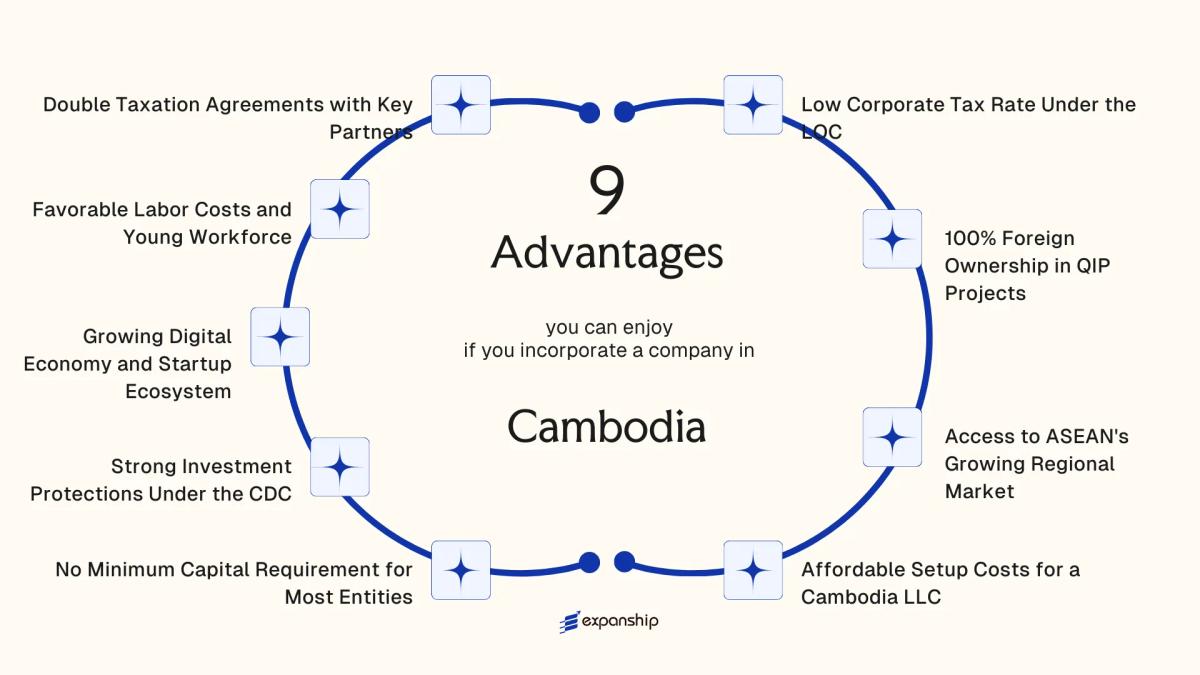
Low Corporate Tax Rate Under the LOC
The Cambodia low corporate tax rate under the Law on Investment (LOC) gives qualifying businesses a measurable cost advantage from the outset. Your effective tax burden can drop to zero during the exemption period, depending on how your entity is structured.
The Standard Rate and What QIP Status Changes
Cambodia's standard corporate income tax rate sits at 20%, which aligns with regional norms but is not the operative rate for most investment-grade projects. Under the LOC, a business registered as a Qualified Investment Project (QIP) with the Council for the Development of Cambodia (CDC) can access a profit tax exemption for a Trigger Period, plus an additional two to three years of reduced liability.
Why the Exemption Period Has Real Financial Weight
For a capital-intensive firm in its early operating years, deferring tax liability entirely can free up funds that would otherwise leave the business during its growth phase. The Cambodia QIP tax exemption benefits apply across manufacturing, tourism, agriculture, and other priority sectors, meaning the relief is not narrowly scoped.
A QIP-registered entity can operate profit-tax-free for several years, materially reducing the capital your business needs to sustain early-stage operations.
100% Foreign Ownership in QIP Projects
Under Cambodia's Law on Investment (2021), foreign nationals can hold 100% equity in a Qualified Investment Project without any mandatory local partnership. That structural permission removes a barrier that exists in many Southeast Asian jurisdictions, where minimum local shareholding thresholds are standard.
A QIP designation is granted by the Council for the Development of Cambodia (CDC) and applies to qualifying sectors including manufacturing, agro-processing, tourism infrastructure, and certain services. Approval triggers a package of fiscal incentives, but the ownership right itself is the foundational advantage: your firm retains full decision-making authority, profit allocation, and exit control without negotiating equity positions with local partners.
Several features of the QIP framework make this ownership right practically accessible:
- The CDC application process is centralized through a single institution, reducing inter-agency friction for foreign applicants.
- No foreign equity cap applies once QIP status is confirmed, so ownership structure reflects your business model rather than regulatory compromise.
- The 2021 law consolidated and clarified foreign investor ownership advantages Cambodia had previously offered under older frameworks, reducing legal ambiguity.
Eligible projects must meet sector and investment threshold criteria set by the CDC, so the benefit is conditional on prior approval rather than available by default.

Incorporate a Company in Cambodia
Set up your Cambodia-registered entity with full compliance support, from CDC coordination to post-incorporation filings.
Access to ASEAN's Growing Regional Market
Cambodia's membership in the Association of Southeast Asian Nations positions any registered entity there at the center of a regional bloc comprising over 670 million people and a combined GDP exceeding $3.6 trillion. For foreign investors assessing Cambodia access to ASEAN market benefits, this membership is not incidental — it translates into enforceable preferential trade terms.
Under the ASEAN Trade in Goods Agreement (ATIGA), goods produced in Cambodia and meeting the applicable Rules of Origin criteria qualify for tariff reductions or elimination when exported to other member states. This means your manufacturing or processing operation can reach consumers and distributors across Thailand, Vietnam, Indonesia, and beyond at a structural cost advantage over non-ASEAN exporters.
| Agreement | Coverage | Benefit to Cambodia-Based Firms |
|---|---|---|
| ATIGA | Intra-ASEAN goods trade | Reduced or zero tariffs on qualifying exports |
| RCEP | 15 Asia-Pacific nations | Expanded market access beyond ASEAN |
| ASEAN-China FTA | China market | Preferential rates on eligible product categories |
Beyond ASEAN itself, Cambodia is party to the Regional Comprehensive Economic Partnership (RCEP), extending preferential access to markets including China, Japan, South Korea, and Australia. A business incorporated here can ship into these markets under terms unavailable to firms registered outside the agreement.
Qualifying for these benefits requires meeting specific Rules of Origin thresholds set within each agreement, typically requiring a defined percentage of value-added activity within the country.
Affordable Setup Costs for a Cambodia LLC
Affordable Cambodia LLC setup costs are one of the more concrete financial advantages available to foreign entrepreneurs registering under the Law on Commercial Enterprises. Registration fees at the Ministry of Commerce are generally modest, and government-prescribed charges are fixed rather than calculated as a percentage of capital.
For most private limited companies, total official incorporation fees fall within a range accessible to small businesses and solo operators. This matters because your initial capital is preserved for operations rather than absorbed by administrative costs before the business even starts trading.
The registration process itself is managed through the Ministry of Commerce's online business registration portal, which reduces the need for extended in-person procedures. A faster, lower-cost setup translates directly into a shorter runway before your entity is legally operational.
Keep the following in mind:
- Official fees are government-fixed; ensure you are referencing the current Ministry of Commerce fee schedule
- Third-party registered agent fees are separate from government charges
- A local registered address is required and adds to total setup cost
- Annual renewal fees apply and should be factored into the first-year budget
A Cambodia private limited company can be incorporated with as few as one shareholder and one director, with no requirement for a local resident director.
No Minimum Capital Requirement for Most Entities
There is no minimum capital requirement Cambodia company law imposes on most private limited liability companies (LLCs). Under the Law on Commercial Enterprises (LCE), the registered capital amount is left to the discretion of the shareholders, meaning you can legally incorporate with a nominal capital figure. This gives your business full control over how much capital is formally committed at the point of registration.
Practical Financial Flexibility at Formation
For a foreign investor, the absence of a statutory floor means upfront capital does not become a barrier to entry. Funds that would otherwise sit locked in a registered capital account can remain in operational reserve, allocated toward actual business activities from day one.
Declared share capital does appear on public registration records filed with the Ministry of Commerce, so the figure you choose carries some reputational weight. That said, there is no escrow requirement or third-party verification of capital deposit during the standard LLC registration process.
Implications for Structuring Your Entity
Sectors subject to specific licensing, such as banking, insurance, and certain financial services, carry their own capital thresholds set by their respective regulators. Outside those regulated industries, the LCE framework does not differentiate between entities based on declared capital size.
This structure allows businesses operating in consulting, trading, or services to incorporate without tying up liquidity in a formal capital account, a material advantage when cash flow management matters in the early stages of market entry.
Maximize Your Incorporation Advantages in Cambodia
Speak with our corporate services team about structuring your Cambodia entity with the right capital declaration and compliance setup for your business model.
Strong Investment Protections Under the CDC
Cambodia investment protections under the CDC give foreign investors access to a formal guarantee framework that is uncommon among lower-middle-income economies in Southeast Asia. The Council for the Development of Cambodia, established under the Law on Investment, administers Qualified Investment Project status and with it a set of legally codified protections that apply directly to your business.
- The Law on Investment prohibits the nationalization of approved investment projects. Your assets cannot be requisitioned by the state without due legal process and fair compensation, which removes a material risk that remains present in several neighboring jurisdictions.
- The CDC guarantees that QIP holders will not face price controls on their products or services. This allows your firm to set market-rate pricing without government interference in commercial decisions.
- Foreign investors are permitted to repatriate capital, profits, and royalties in freely convertible foreign currency. This is administered through the National Bank of Cambodia and means your returns are not locked inside the local financial system.
- Import duties on production equipment and construction materials are waived for approved projects, reducing your initial capital outlay.
- The same Law on Investment prohibits the application of special taxes targeted specifically at foreign-owned entities, placing your business on equal fiscal footing with domestic firms.
Growing Digital Economy and Startup Ecosystem
Cambodia digital economy benefits for startups are increasingly tied to the government's National Digital Economy and Society Policy 2021-2035, which outlines targets for digital infrastructure, e-commerce, and financial technology development. For a foreign founder, this policy creates a regulated environment where early-market entry carries a structural advantage over entering a more saturated tech market.
The Telecommunication Regulator of Cambodia (TRC) oversees the digital and telecom sector, while the National Bank of Cambodia (NBC) has issued frameworks for payment service providers and fintech licensing. These defined regulatory pathways reduce the ambiguity that early-stage tech firms typically face in frontier markets.
Cambodia's startup ecosystem is still early-stage, which means lower competition for local talent, lower commercial rents in Phnom Penh's growing tech districts, and more accessible early-adopter consumer segments compared to regional hubs like Singapore or Bangkok.
- The government has actively promoted Special Economic Zones with digital sector inclusions.
- E-commerce activity has expanded following growth in mobile internet penetration, which exceeded 50% of the population by recent estimates.
According to the GSMA Mobile Economy report, Cambodia's mobile internet adoption rate continues to grow, with smartphone usage concentrated in the 18-35 demographic — the primary consumer base for digital products and services.
Favorable Labor Costs and Young Workforce
Cambodia's labor cost advantages for businesses are grounded in one of the lowest minimum wage structures in Southeast Asia. The monthly minimum wage for the garment and footwear sector is set by the Labor Advisory Committee and adjusted annually; for broader industries, general labor costs remain similarly competitive. For a foreign-owned entity, this translates directly into lower operating expenditures from the first payroll cycle.
The demographic profile reinforces this. Approximately 70% of the population is under 35, producing a large, entry-level workforce available across manufacturing, services, and light industry. Youth concentration in urban centers like Phnom Penh reduces recruitment timelines for companies scaling quickly.
Labor relations in Cambodia are governed by the Labor Law of 1997, which establishes clear frameworks for employment contracts, termination, and working hours. This statutory clarity reduces legal uncertainty when structuring employment arrangements for a foreign firm.
- Minimum wage adjustments are announced annually, giving your business a predictable cost planning cycle.
- A growing technical and vocational education sector is gradually expanding the pool of mid-skilled workers.
- Social security contributions are administered through the National Social Security Fund (NSSF), with defined contribution rates for both employer and employee.
Minimum wage rates vary by sector, and not all industries fall under the garment sector schedule, so confirm the applicable rate for your specific business activity before projecting labor costs.
Double Taxation Agreements with Key Partners
Cambodia double taxation agreements benefits remain limited in number but carry meaningful weight for specific investor profiles. The Kingdom has concluded DTAs with a relatively small group of countries, including China, Singapore, Thailand, Vietnam, Brunei, Indonesia, Malaysia, the Philippines, and South Korea, among others. For businesses structured to route income through a treaty partner jurisdiction, these agreements can reduce or eliminate withholding tax on dividends, interest, and royalties that would otherwise be deducted at source.
Reduced Withholding Tax on Cross-Border Payments
Under domestic rules, withholding tax on payments to non-residents generally applies at rates that vary by income type. A DTA with a partner country can lower that rate, sometimes significantly. For a foreign firm receiving royalties or management fees from a Cambodian subsidiary, this reduction directly affects the net return on intercompany arrangements.
Treaty Protection Against Double Taxation
Each ratified DTA establishes which country holds primary taxing rights over specific income categories. This prevents the same income from being taxed twice, once in Cambodia and again in the investor's home country. For businesses operating across multiple ASEAN jurisdictions simultaneously, treaty clarity reduces uncertainty in tax planning.
Eligibility Conditions
Treaty benefits generally apply to residents of the contracting states, as defined within each agreement. Your business structure and the jurisdiction of tax residence must align with treaty definitions to qualify. Where Cambodia has not concluded a DTA with your home country, domestic unilateral relief provisions under the Law on Taxation may still apply.
Why Cambodia Stands Out Against Regional Competitors
Foreign investors evaluating Southeast Asia for incorporation typically compare Cambodia against Vietnam, Thailand, and Singapore. Vietnam and Thailand attract significant FDI volumes, but their regulatory frameworks impose restrictions that Cambodia does not. Singapore ranks as the region's most established financial hub, yet its cost structure places it out of reach for early-stage businesses and lean holding structures. The comparison below focuses on parameters where Cambodia's regulatory and fiscal framework offers a measurable, verifiable difference.
What the table reveals is a structural pattern: Cambodia's LOC framework removes several friction points that foreign investors in neighboring markets routinely encounter. A foreign shareholder in Vietnam, for instance, faces sector-specific ownership caps under the Law on Investment, whereas a QIP-registered entity in Cambodia permits full foreign ownership without a joint-venture requirement. Thailand's Foreign Business Act similarly restricts majority foreign ownership across a defined list of business activities. These are not minor procedural differences; they affect how your business is structured, who controls it, and how profits are repatriated.
| Parameter | Cambodia | Vietnam | Thailand |
|---|---|---|---|
| Foreign Ownership | 100% permitted in most sectors | Capped in restricted sectors under Law on Investment | Restricted under Foreign Business Act (max 49% in many categories) |
| Standard Corporate Tax Rate | 20% (0% under QIP during incentive period) | 20% (standard) | 20% (standard) |
| Minimum Paid-Up Capital | None for most entities | None general, but sector-specific thresholds apply | THB 2M+ for foreign business licenses |
| Investment Incentive Body | Council for the Development of Cambodia (CDC) | Ministry of Planning and Investment | Board of Investment (BOI) |
| ASEAN Market Access | Full member, RCEP signatory | Full member, RCEP signatory | Full member, RCEP signatory |
| GSP Trade Preferences | EBA (EU) + GSP access as LDC | Graduated from LDC status | Not eligible as LDC |
Compliance Services for Companies in Cambodia
Maintain your Cambodia entity in good standing with annual filings, tax compliance, and regulatory reporting managed by specialists.
Conclusion
The core case for Cambodia rests on a structural alignment between its legal framework and the practical needs of foreign investors. The Qualified Investment Project regime under the Law on Investment offers tax incentives that directly reduce operational costs during the critical early years of a business, while the absence of a minimum capital requirement for most standard entities keeps the barrier to entry low for smaller firms and first-time market entrants.
Ownership rights reinforce that foundation. The ability to hold 100% equity in a QIP-registered entity, confirmed through the Council for the Development of Cambodia, removes the friction that often accompanies foreign direct investment in neighbouring markets. Combined with Cambodia's treaty obligations under the ASEAN frameworks, that ownership security translates into a predictable operating environment.
Your specific industry, intended activities, and long-term structure will determine how fully these advantages apply to your business. A firm operating in a restricted sector under the Foreign Investment Law faces different conditions than one qualifying under the QIP. Understanding which regulatory pathway applies to your entity is the step that converts Cambodia's statutory benefits into real commercial outcomes.
Start Your Cambodia Company Formation With Expanship Today
Cambodia company formation with Expanship covers the full incorporation cycle for foreign investors, from structuring your entity under the Law on Commercial Enterprises to registering with the Ministry of Commerce and obtaining a patent tax certificate from the General Department of Taxation. The service scope addresses the specific compliance obligations discussed throughout this blog, including QIP applications to the Council for the Development of Cambodia, annual audit filings, and VAT registration where applicable.
Expanship's service scope across the incorporation and post-incorporation phases includes:
- Document preparation, notarization, and legalization for MOC submission
- Registered agent and registered office provision in Phnom Penh
- Government filing and liaison with the Ministry of Commerce and GDT
- Post-incorporation compliance management, including annual returns and accounting obligations
- Banking introduction assistance for corporate account opening with locally licensed banks
- QIP application support and CDC engagement where investment incentives are being pursued
Each service is handled by personnel with direct knowledge of Cambodian regulatory requirements, reducing the administrative burden on foreign principals who are managing incorporation remotely or across multiple jurisdictions.
Expanship Cambodia is available to assist with your incorporation inquiry.
Frequently Asked Questions (FAQ)
Companies granted QIP status by the Council for the Development of Cambodia are eligible for a corporate income tax holiday, which can extend up to nine years depending on the investment type and priority sector. Following the tax holiday period, the standard corporate income tax rate of 20% applies. The specific duration and conditions of the incentive are set out in the company's final registration certificate issued by the CDC.
Incorporation through the Ministry of Commerce typically takes between five and ten business days once all required documents are submitted, though timelines can vary based on application volume and document completeness. Registration with the General Department of Taxation for a VAT number and patent tax certificate is a separate step that follows MoC approval. In practice, the full setup process, including tax registration, often runs two to four weeks.
Cambodia has signed a limited number of double taxation agreements, with confirmed treaties in place with countries including China, Brunei, Singapore, and Thailand, among others. Coverage depends on your country of residence, so you should verify whether a treaty exists and review its specific provisions on dividends, royalties, and capital gains before structuring your entity. The General Department of Taxation administers treaty-related matters and publishes applicable agreements.
No statutory minimum paid-up capital is required for most standard private limited companies registered under the Law on Commercial Enterprises. However, certain regulated sectors, such as banking, insurance, and financial services, carry their own minimum capital thresholds set by their respective regulatory bodies. For a general trading or services LLC, the amount declared is a commercial decision rather than a legal obligation.
The CDC, under the Law on Investment, provides guarantees against nationalization without compensation and against discriminatory treatment compared to domestic investors. If the government alters the fiscal incentives applicable to a QIP after registration, existing QIP holders generally retain the terms set out in their original registration certificate for the agreed incentive period. These protections do not cover changes to general laws that apply uniformly across all businesses operating in the country.
A local director is not a strict requirement for a private limited company under the Law on Commercial Enterprises, and foreign nationals may serve as sole directors. The company must, however, maintain a registered address within the country and comply with annual filing obligations with the Ministry of Commerce and the General Department of Taxation. Failure to meet annual renewal and patent tax filing deadlines can result in deregistration or penalties.
Legal Disclaimer
The information provided in this article is for general informational purposes only and does not constitute legal, tax, or professional advice. While we strive to ensure the accuracy and timeliness of the content, laws and regulations are subject to change, and the application of laws can vary widely based on specific facts and circumstances.
Readers should not act upon this information without seeking professional counsel tailored to their individual situation. Expanship and its authors disclaim any liability for actions taken or not taken based on the content of this article.
For specific advice regarding your business setup, compliance requirements, or any legal matters, please consult with qualified legal and tax professionals in the relevant jurisdiction.