


Key Takeaways
- Foreign directors appointed to an Icelandic company must satisfy EEA residency conditions, making compliance with this rule a prerequisite before any directorship can be confirmed at registration.
- Under the Companies Act No. 2/1995 (Lög um hlutafélög), private limited companies (Ehf.) and public limited companies (Hf.) are subject to distinct minimum share capital thresholds that must be met before Fyrirtækjaskrá will accept an incorporation application.
- Every company registered in Iceland must maintain a physical address within the country as its registered office, as a virtual or foreign address does not satisfy the statutory requirement.
- Beneficial ownership information must be filed with the Directorate of Internal Revenue, and failure to register qualifying UBOs constitutes a compliance breach under Icelandic law.
Entity formation in Iceland is governed by the Companies Act (Lög um hlutafélög) and administered through Fyrirtækjaskrá, the official Register of Enterprises operated by the Directorate of Internal Revenue. Meeting the incorporation requirements in Iceland is a prerequisite for legal registration, and any application that falls short of statutory criteria will be rejected or returned for correction.
This article addresses the structural, documentary, and compliance requirements that apply across the formation process. Failure to satisfy these obligations prevents a business from obtaining legal standing or operating within the jurisdiction.
Specific requirements vary depending on the entity type selected, the industry sector, and whether the applicant is a domestic or foreign-registered investor. Iceland company formation requirements for a private limited company (Einkahlutafélag, Ehf.) differ in several respects from those governing a public limited company (Hlutafélag, Hf.).
This article is most relevant to foreign entrepreneurs, non-resident investors, and overseas firms exploring registering a company in Iceland for the first time.
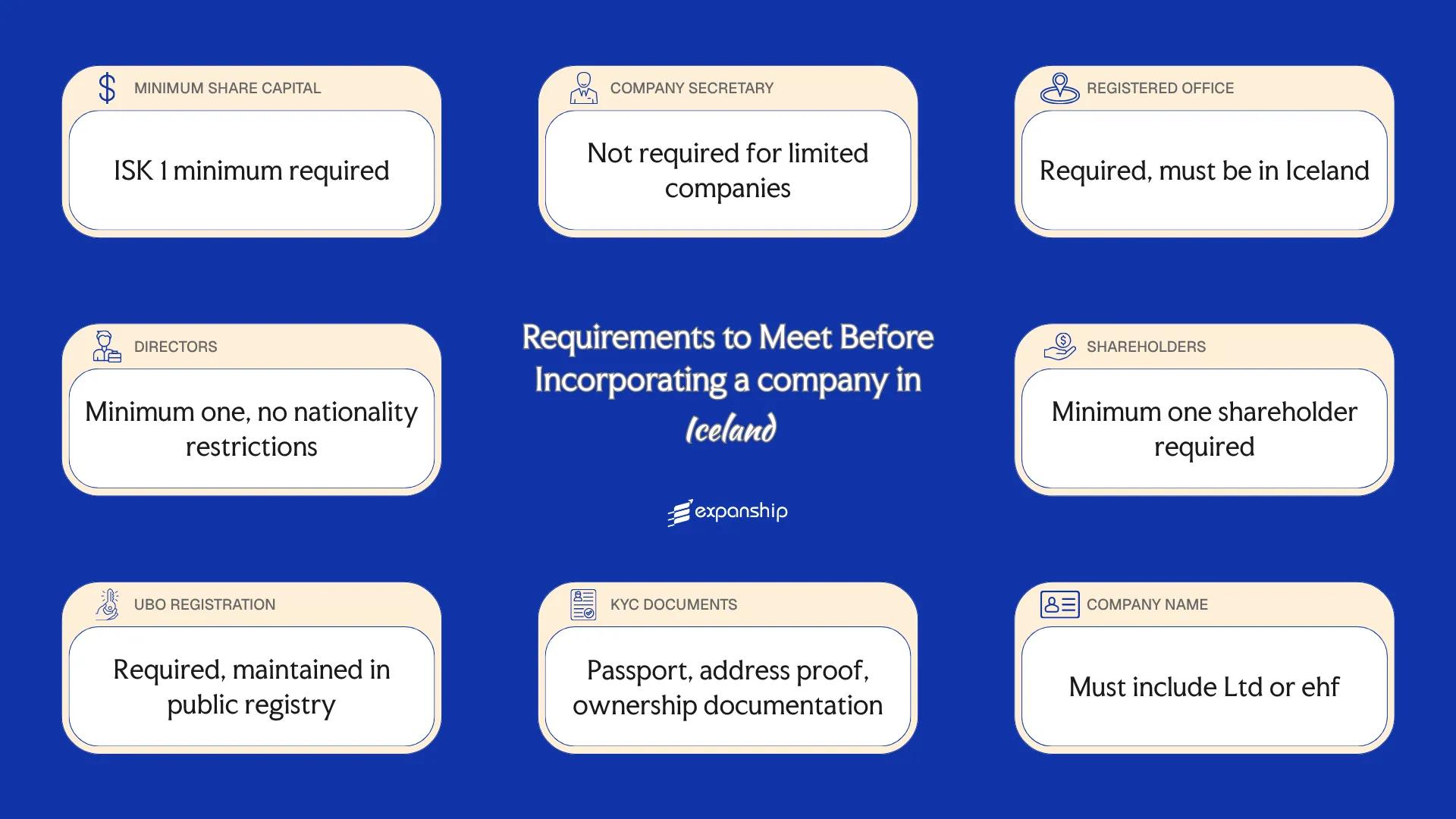
Minimum Share Capital Requirements in Iceland
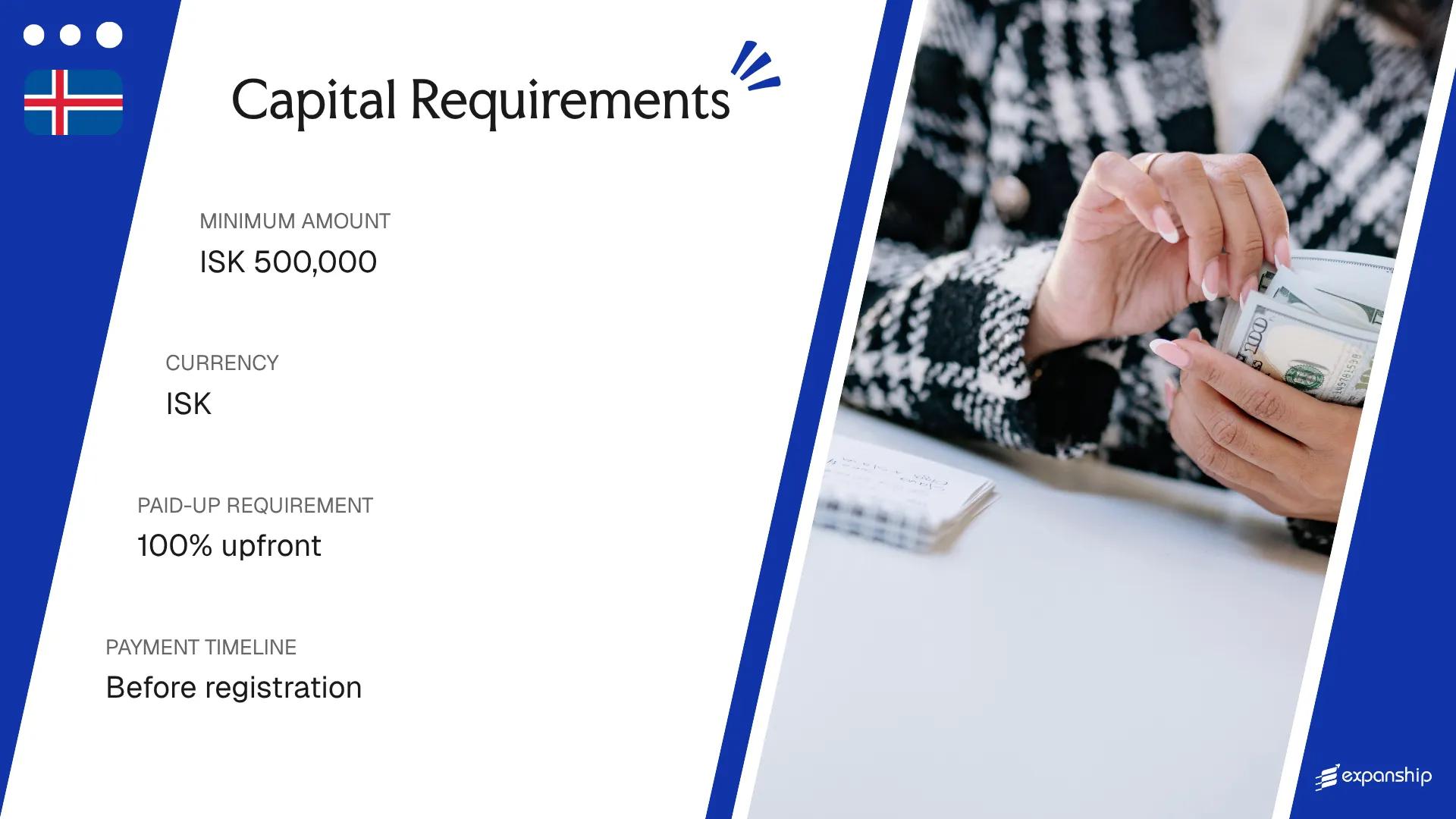
| Parameter | Detail |
|---|---|
| Minimum Authorized Share Capital | ISK 500,000 |
| Maximum Authorized Share Capital | No statutory requirement |
| Minimum Paid-Up Capital | ISK 500,000 |
| Paid-Up Requirement at Incorporation | Full amount must be paid up before registration |
| Accepted Currency | Icelandic Króna (ISK) |
| Accepted Forms of Contribution | Cash or non-cash assets (subject to valuation) |
| Timeframe to Deposit Capital | Prior to submission of the registration application |
The full ISK 500,000 must be deposited before the registration application is submitted to Fyrirtækjaskrá. Registration will not proceed without confirmed paid-up capital, so the deposit is a precondition, not a post-incorporation formality.
Company Secretary Requirements in Iceland
Under Icelandic company law, there is no statutory requirement for a company secretary position in the traditional sense. For a private limited company (Einkahlutafélag, Ehf.) or a public limited company (Hlutafélag, Hf.), the board of directors collectively assumes administrative and compliance duties that would elsewhere fall to a corporate secretary.
Certain formal obligations are distributed among board members and the managing director, including maintaining the share register, ensuring timely submission of annual accounts to Fyrirtækjaskrá (the Companies Registry), and keeping minutes of shareholder and board meetings.
Who can fulfill the secretarial functions within an Icelandic entity:
- No separately licensed company secretary profession exists under Icelandic corporate regulations.
- Board members, including the managing director, may collectively discharge secretarial duties.
- External legal or administrative professionals may be engaged to assist, though no formal accreditation is required.
- There is no residency requirement specifically tied to secretarial functions.
- Corporate service providers operating in Iceland may perform administrative support under a service agreement.

Incorporate a Company in Iceland
Set up your Icelandic Ehf. or Hf. with full compliance support, from registry filings to corporate documentation.
Registered Office Requirements in Iceland
Iceland registered office requirements mandate that every limited liability company (Einkahlutafélag) and public limited company (Hlutafélag) maintains a registered legal address within the country at all times, as governed by the Companies Act No. 2/1995.
- A physical address is required; a P.O. box alone does not satisfy the legal address requirements.
- The address must be located in Iceland; foreign addresses are not accepted by Fyrirtækjaskrá, the Companies Registry.
- Virtual office addresses are generally permitted provided they correspond to a real, identifiable physical location.
- No ownership of the premises is required; a lease or service agreement covering the address is sufficient.
- The registered address is publicly listed on the Fyrirtækjaskrá company register and accessible to third parties.
- Any change to the registered address must be formally notified to the Companies Registry; failure to maintain an accurate address can result in administrative sanctions or the company being struck from the register.
Director Requirements in Iceland
Under the Private Limited Companies Act (lög um einkahlutafélög nr. 138/1994), directors of an Icelandic einkahlutafélag (ehf.) assume statutory duties of care toward the company and its shareholders upon appointment. Liability for breaches of fiduciary duty, negligent management, or violations of the Companies Act rests personally with each director.
| Parameter | Detail |
|---|---|
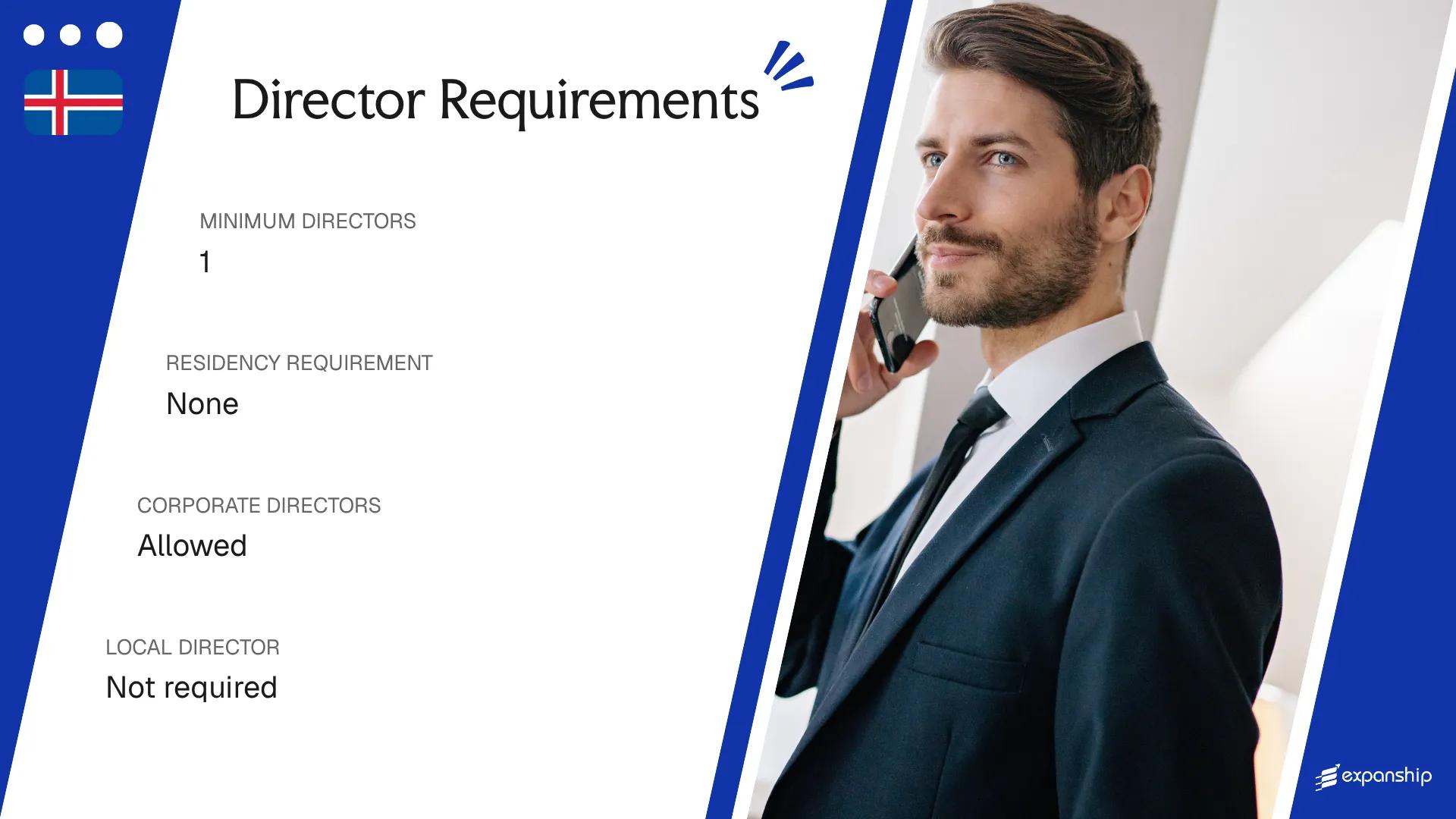
| Minimum Number of Directors | One director is required for a private limited company (ehf.). |
| Maximum Number of Directors | No statutory maximum is prescribed under the Companies Act. |
| Local/Resident Director Required | At least one director or the managing director must be domiciled within the European Economic Area (EEA), unless the Directorate of Internal Revenue (Ríkisskattstjóri) grants an exemption. |
| Nationality Restrictions | No nationality restrictions apply, provided the EEA domicile requirement is met. |
| Minimum Age Requirement | Directors must be at least 18 years of age. |
| Corporate Directors Permitted | Corporate directors are not permitted; directors must be natural persons. |
| Director Must Be a Shareholder | No statutory requirement exists for a director to hold shares in the company. |
| Publicly Listed on Registry | Directors are registered in the Icelandic Companies Registry (Fyrirtækjaskrá) and are publicly visible. |
| Disqualification Conditions | A person declared bankrupt or otherwise legally incapacitated under Icelandic law may not serve as a director. |
Despite Iceland's small domestic market, the EEA domicile requirement for directors means a director based anywhere from Norway to Liechtenstein satisfies the residency condition without needing to be physically present in Iceland itself.
Shareholder Requirements in Iceland
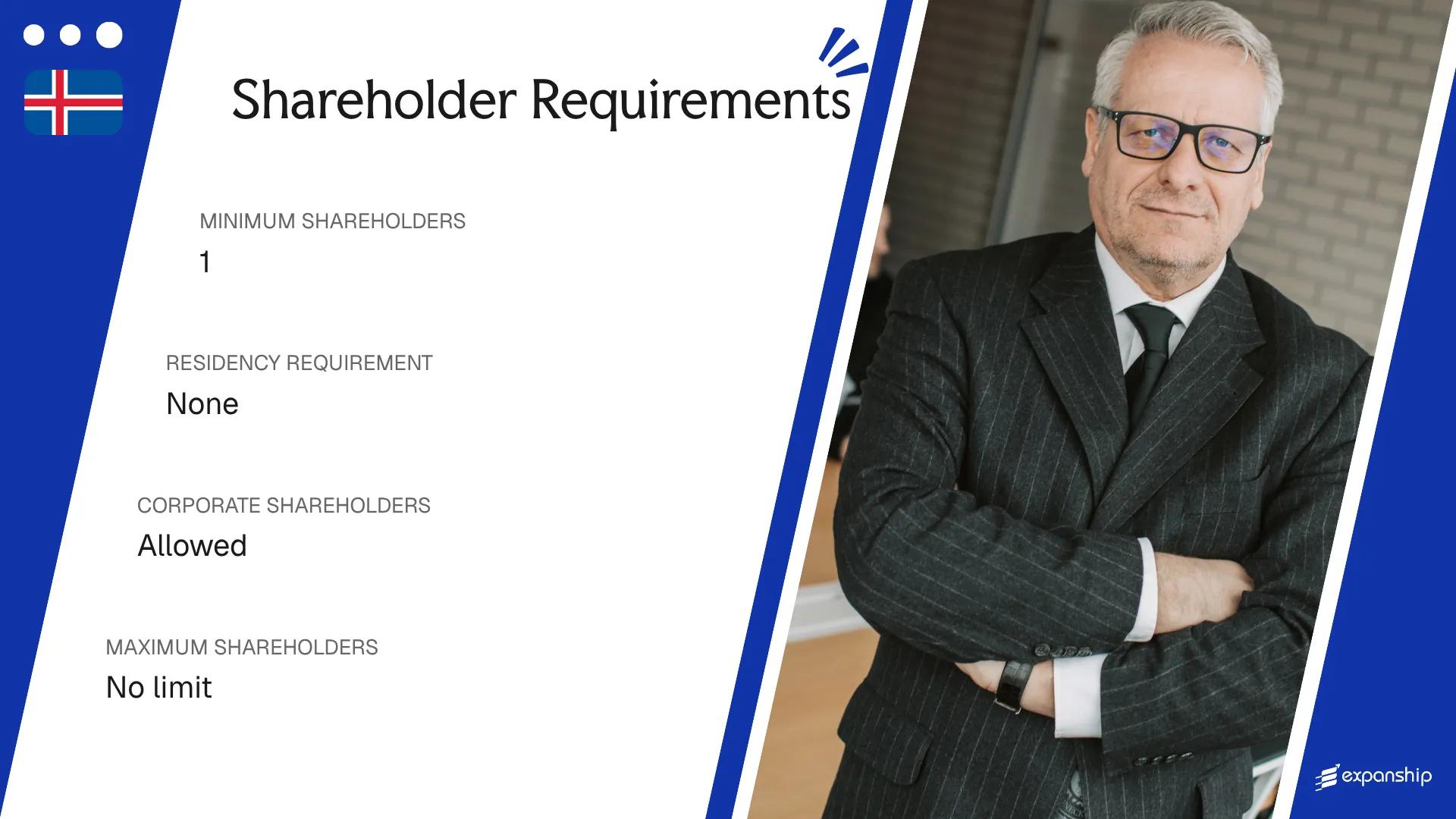
An Icelandic private limited company (Einkahlutafélag, or Ehf) requires at least one shareholder, meaning a sole shareholder structure is fully permitted under the Private Limited Companies Act (Lög um einkahlutafélög nr. 138/1994). No statutory maximum applies to the number of shareholders.
Nationality and Residency Restrictions
Iceland imposes no nationality or residency requirements on shareholders. Foreign individuals and entities may hold 100% of the share capital in an Ehf without restriction.
Corporate Shareholders
Corporate entities are permitted to act as shareholders in an Ehf. No additional conditions are imposed solely on the basis of the shareholder being a legal entity rather than a natural person.
Shareholder Liability
Iceland Ehf shareholder obligations are consistent with the limited liability principle. Each shareholder's liability is confined to their subscribed share capital contribution, with no personal liability for company debts under ordinary circumstances.
Register of Shareholders
Under the Private Limited Companies Act, the company must maintain an internal register of shareholders. This register is not publicly accessible, though certain ownership information is reported to the Directorate of Internal Revenue (Ríkisskattstjóri) under applicable disclosure obligations.
Guidance on Shareholder Structuring for Your Iceland Incorporation
Get clarity on shareholder criteria, ownership structures, and compliance obligations when setting up an Ehf in Iceland.
UBO / Beneficial Ownership Registration Requirements in Iceland
Under Iceland's beneficial ownership registration requirements, a beneficial owner (raunverulegur eigandi) is defined as any individual who ultimately owns or controls more than 25% of a company's shares or voting rights. This framework is established under Act No. 82/2019 on Measures against Money Laundering and Terrorist Financing, which transposed the EU's Fourth Anti-Money Laundering Directive into Icelandic law.
- Identify all individuals who meet the 25% ownership or control threshold at the time of incorporation.
- Submit beneficial ownership information to the Fyrirtækjaskrá (Companies Registry) operated by Skatturinn (the Icelandic Tax Authority).
- Update the register within a reasonable period whenever a change in beneficial ownership occurs.
- Retain supporting documentation that substantiates the disclosed ownership structure.
| Parameter | Detail |
|---|---|
| Ownership Threshold for UBO Status | More than 25% of shares or voting rights |
| Filing Authority | Fyrirtækjaskrá (Companies Registry) / Skatturinn |
| Disclosure Deadline at Incorporation | At time of registration |
| Publicly Accessible Register | Yes |
| Penalties for Non-Disclosure | Fines applicable under Act No. 82/2019 |
| Ongoing Update Obligation | Yes; updates required upon any change in beneficial ownership |
KYC / Document Requirements in Iceland
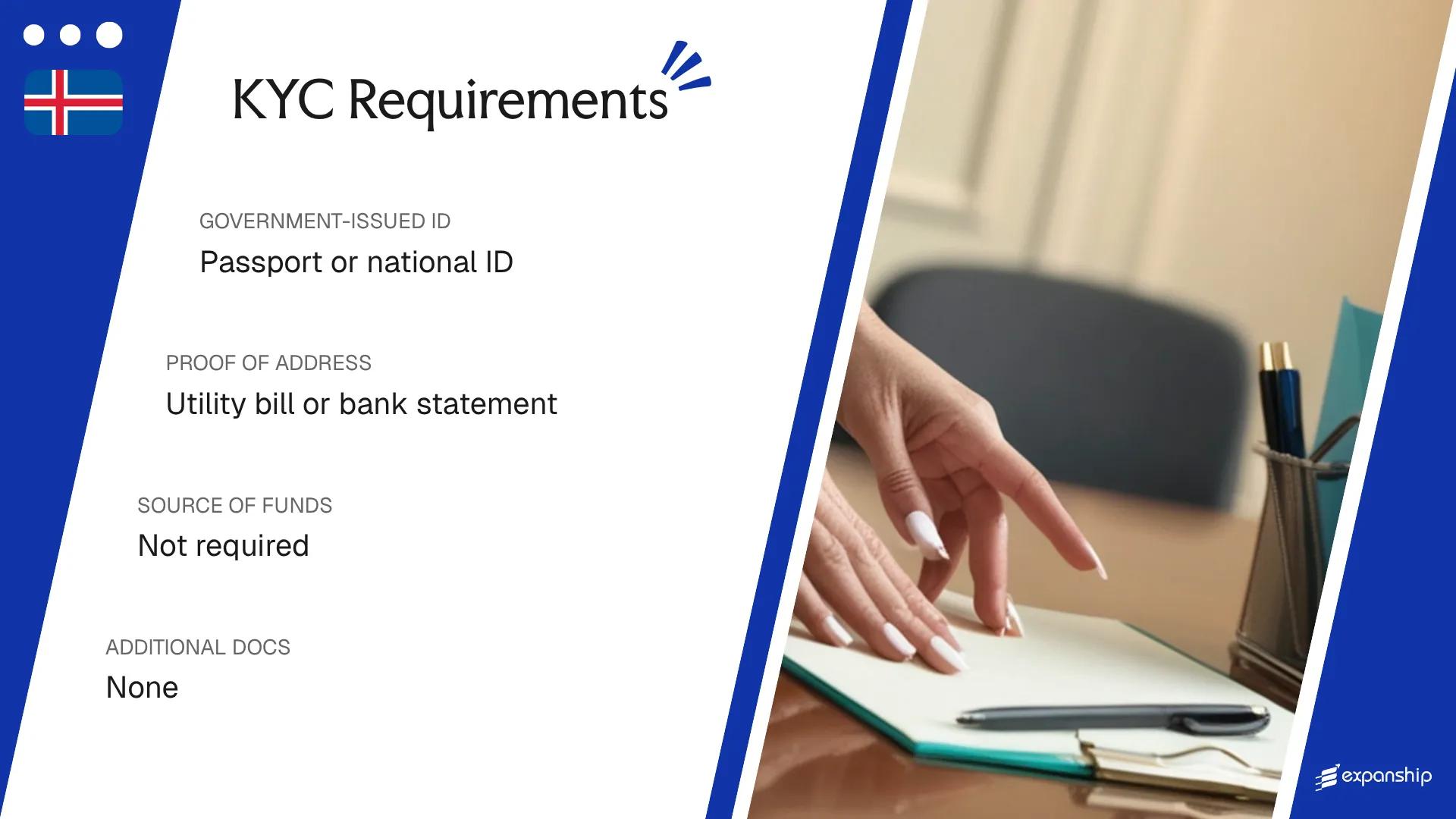
Iceland KYC document requirements incorporation are governed by Act No. 140/2018 on Measures against Money Laundering and Terrorist Financing, which obliges registered agents and formation service providers to conduct due diligence on all principals before an entity is established. The Fjármálaeftirlit (Financial Supervisory Authority) oversees compliance with this framework.
Individual / Personal Documents
- Valid government-issued photo ID (passport or national identity card) for each director, shareholder, and beneficial owner
- Proof of residential address dated within three months, such as a utility bill or official bank statement
- Completed and signed KYC declaration or self-certification form as required by the formation agent
- Taxpayer identification number or equivalent where the individual is tax-resident outside Iceland
Corporate Documents
- Certificate of incorporation or equivalent constitutional registration document for the corporate shareholder or director
- Articles of association or equivalent constitutional document confirming the entity's structure and powers
- Current register of directors confirming authorised signatories
- Proof of registered address for the corporate entity, issued by a recognised authority
Source of Funds Documentation
- Bank statements covering a minimum of three to six months evidencing the origin of contributed capital
- Audited financial accounts where the corporate shareholder is an established trading entity
- Written declaration of source of funds signed by the relevant principal
Notarisation and Apostille Requirements
- Foreign public documents must carry an Apostille under the 1961 Hague Convention before submission
- Documents not in Icelandic or English generally require a certified translation by a sworn translator
- Notarisation requirements depend on the issuing country's document standards and the formation agent's internal policy
Incomplete or unverified source of funds documentation is the most frequent cause of incorporation delays under Icelandic AML review procedures.
Company Name Requirements in Iceland
All proposed company names are assessed against a register of existing business names before incorporation is approved. A name that is identical or confusingly similar to an already registered entity will be rejected.
Names must be written in Icelandic or use the Icelandic alphabet, and the legal suffix must reflect the chosen entity type, such as "ehf." for a private limited company (einkahlutafélag). Character length requirements follow general registry standards, though no fixed maximum is publicly prescribed.
Certain words implying governmental authority, financial regulation, or national institutions are either prohibited outright or require prior approval from the relevant supervisory body. Words suggesting banking, insurance, or state affiliation fall into this restricted category.
Name reservation is generally available through the Companies Registry prior to formal incorporation. Reservations are time-limited, and the application is submitted directly to the registry to hold the chosen name while incorporation documents are prepared.
Compliance Services for Companies in Iceland
Maintain your Icelandic company's good standing with ongoing compliance support, from annual filings to regulatory reporting.
Conclusion
Iceland company incorporation requirements span several distinct statutory obligations, from minimum share capital under the Companies Act No. 2/1995 to director residency conditions and beneficial ownership registration with the Directorate of Internal Revenue. Among the most consequential factors for foreign investors are the EEA residency rules governing directors and the requirement to maintain a registered office at a physical Icelandic address. Once these obligations are understood, the practical work of engaging local agents, preparing documentation, and filing with Fyrirtækjaskrá begins.
Expanship's Corporate Services for Iceland Expansion
Expanship supports your Iceland corporate services expansion by managing the procedural requirements that come with forming a private limited company under Icelandic law, from coordinating with Fyrirtækjaskrá (the Register of Enterprises) to preparing compliant documentation for submission.
Beyond registration, Expanship covers the full scope of what your business needs to operate with confidence in Iceland:
- Preparing and filing all company formation documents with the relevant Icelandic authorities.
- Providing a registered agent and local office address to satisfy residency requirements.
- Handling government filings and liaising directly with regulatory bodies on your behalf.
- Managing ongoing post-incorporation compliance obligations as your entity matures.
- Facilitating introductions to banking institutions familiar with foreign-owned Icelandic companies.
- Coordinating tax registration and engagement with the Icelandic Tax Directorate (Ríkisskattstjóri).
To discuss how Expanship can support your entry into Iceland, contact the team through Expanship Iceland.
Frequently Asked Questions (FAQ)
At least half of the directors on the board of an ehf. must be residents of the European Economic Area, unless the Icelandic government grants a specific exemption. This residency rule applies to the board as a whole, not just the managing director, so a company with two directors would need at least one to be EEA-resident. Non-EEA nationals who do not qualify for an exemption cannot hold the majority of board seats.
Failure to register ultimate beneficial owner information as required under Icelandic anti-money laundering legislation can result in fines imposed on the company and its management. The obligation to identify and disclose individuals who own or control more than 25% of the entity is not discretionary, and non-compliance can also trigger regulatory scrutiny from Fjármálaeftirlitið, the Financial Supervisory Authority. Persistent non-compliance may affect the company's standing and ability to open bank accounts or enter regulated contracts.
Yes, a single foreign national can hold 100% of the shares in an Icelandic ehf., as there is no requirement for Icelandic or EEA nationality among shareholders. Ownership and directorship rules are separate, so while shareholding has no nationality restriction, the directorship residency requirement under the Private Limited Companies Act No. 138/1994 still applies independently. Your shareholder structure has no bearing on whether the director residency rule is satisfied.
Proposed company names are reviewed and approved by Fyrirtækjaskrá, the Companies Registry, which checks submissions against existing registered names and statutory naming rules. A name will be rejected if it is identical or confusingly similar to an already-registered entity, or if it fails to include the required legal form suffix, such as "ehf." for a private limited company. The registry has discretionary authority to refuse names it considers misleading as to the nature or purpose of the business.
Icelandic law does not impose a statutory requirement to appoint a company secretary for a private limited company. The governance structure of an ehf. centres on its board of directors and, where applicable, a managing director, with no equivalent to the company secretary role found in common law jurisdictions such as the UK or Ireland. Administrative and compliance responsibilities that would typically fall to a secretary in other jurisdictions are distributed among the directors under Icelandic corporate law.
A foreign director will generally need to provide a certified copy of a valid government-issued passport, proof of residential address, and, where applicable, documentation confirming their EEA residency status to satisfy the director eligibility requirement. These documents support both the Companies Registry filing and the KYC process required by any Icelandic bank where the company opens an account. Requirements can vary slightly depending on the nationality of the individual and the registered agent or service provider handling the incorporation.
A company incorporated in Iceland must maintain a registered office address within the country, to which official correspondence from Fyrirtækjaskrá and other authorities can be directed. A serviced or virtual office address may satisfy this requirement, provided it is a genuine, reachable address and not simply a post office box. The address must be declared at the time of incorporation and updated with the registry whenever it changes, as an outdated or invalid address constitutes a compliance breach.
Legal Disclaimer
The information provided in this article is for general informational purposes only and does not constitute legal, tax, or professional advice. While we strive to ensure the accuracy and timeliness of the content, laws and regulations are subject to change, and the application of laws can vary widely based on specific facts and circumstances.
Readers should not act upon this information without seeking professional counsel tailored to their individual situation. Expanship and its authors disclaim any liability for actions taken or not taken based on the content of this article.
For specific advice regarding your business setup, compliance requirements, or any legal matters, please consult with qualified legal and tax professionals in the relevant jurisdiction.