


Key Takeaways
- All companies registering in Guyana must maintain a physical registered office address within the country, as administered through the Deeds Registry Authority under the Companies Act Cap. 89:01.
- Guyana imposes no minimum share capital threshold on incorporation, meaning founders must determine an appropriate capital structure without a statutory floor to guide compliance.
- Beneficial ownership disclosure obligations extend beyond the point of registration, requiring ongoing reporting of ultimate beneficial owners as a continuing compliance duty rather than a one-time filing requirement.
- Foreign investors incorporating under the Companies Act 1991 are subject to Deeds Registry procedures that apply regardless of the sector in which the entity will operate, including extractive industries, services, and trading.
Company incorporation in Guyana is governed by the Companies Act Cap. 89:01, administered by the Deeds Registry Authority, which serves as the principal body overseeing entity registration and compliance. Businesses operating without completing lawful registration face rejection of their application or inability to conduct operations legally within the country.
This article covers the principal categories of formation requirements that apply to entities registered under Guyanese law. Specific requirements vary depending on the type of entity being formed, the industry in which it operates, and whether the applicant is a domestic or foreign investor.
Foreign entrepreneurs and investors establishing a presence in Guyana's extractive, services, or trading sectors will find this article most directly relevant to their registration process.
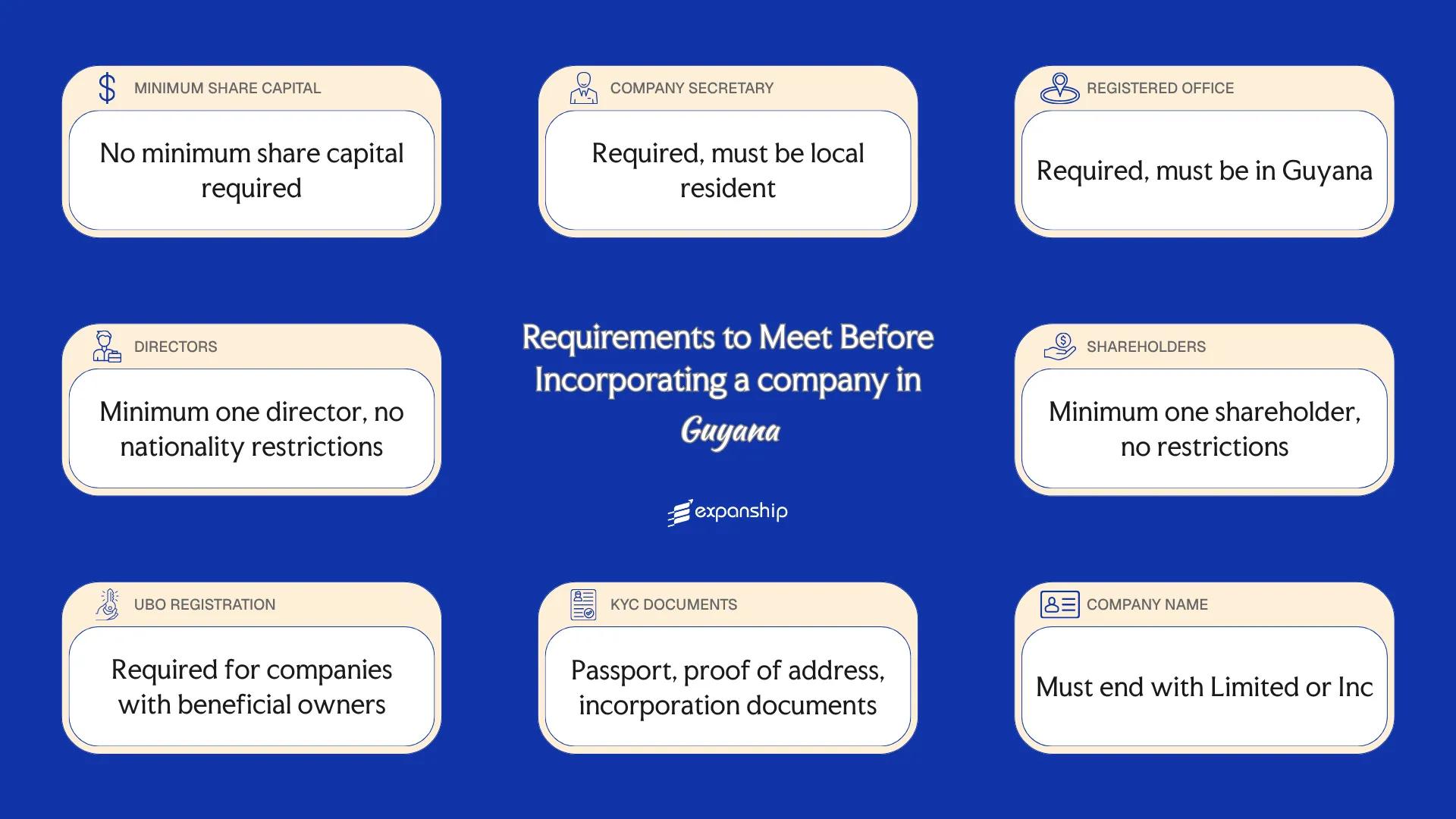
Minimum Share Capital Requirements in Guyana

Under the Companies Act of Guyana (Cap. 89:01), there are no statutory minimum share capital requirements imposed on private or public companies at the point of incorporation. The Deeds Registry Authority, which oversees company registration, does not mandate a minimum authorized or paid-up capital figure before a certificate of incorporation is issued.
Guyana operates on a no-par value share system, meaning shares are issued without a fixed face value. Capital deposit verification by a bank or regulatory authority is not a prescribed step in the incorporation process.
| Parameter | Detail |
|---|---|
| Minimum Authorized Share Capital | No statutory requirement |
| Maximum Authorized Share Capital | No statutory requirement |
| Minimum Paid-Up Capital | No statutory requirement |
| Paid-Up Requirement at Incorporation | No statutory requirement |
| Accepted Currency | Guyana Dollar (GYD); foreign currencies permissible |
| Accepted Forms of Contribution | Cash and non-cash contributions permissible |
| Timeframe to Deposit Capital | No statutory timeframe prescribed |
Even without a statutory minimum, your company's articles of incorporation must define the classes of shares and the rights attached to them. Leaving the capital structure undefined at incorporation can create complications when issuing shares or onboarding investors later.
Company Secretary Requirements in Guyana
Under the Companies Act of Guyana, every company incorporated in the country is required to appoint a company secretary. Meeting the company secretary requirements Guyana mandates is a condition of ongoing corporate compliance, not a post-incorporation formality.
The secretary is responsible for maintaining the company's statutory registers, filing annual returns with the Deeds Registry, and ensuring that board resolutions and minutes are properly recorded. Guyana corporate secretary obligations also extend to notifying the Deeds Registry of any changes to the company's officers or constitutional documents.
Qualification criteria for who may serve as company secretary:
- A natural person of full legal capacity may serve as company secretary.
- A body corporate may be appointed, subject to the company's own constitutional documents permitting this.
- No statutory requirement mandates that the secretary be a resident of Guyana.
- The sole director of a company may not simultaneously serve as company secretary.
- No specific professional licensing is prescribed under the Companies Act for this role.

Incorporate a Company in Guyana
Set up your business in Guyana with proper structure, statutory compliance, and registered officer appointments handled from the start.
Registered Office Requirements in Guyana
Under the Companies Act of Guyana (Cap. 89:01), registered office requirements Guyana mandates that every company maintain a physical registered office address within the country at all times. Failure to maintain a compliant local address can result in regulatory action by the Deeds Registry Authority, including the company being struck off the register.
- A physical address is required; a P.O. box alone does not satisfy the registered office obligation.
- The address must be located within Guyana; foreign addresses are not permitted.
- Virtual offices may be used provided they supply a verifiable physical street address within the jurisdiction.
- The company is not required to own the premises; a lease or service agreement covering the address is acceptable.
- The registered address is publicly listed in the Deeds Registry and is accessible as part of the company's official record.
- Any change to the registered office address must be formally notified to the Deeds Registry Authority by filing the appropriate notice within the prescribed period.
Director Requirements in Guyana

Under the Companies Act of Guyana (Cap. 89:01), director requirements Guyana company formations must satisfy are relatively straightforward, though directors assume full statutory duties upon appointment, including duties of care, loyalty, and acting in the best interests of the entity. Liability for fraudulent trading, wrongful conduct, or failure to maintain proper accounts can fall personally on directors under the Act.
| Parameter | Detail |
|---|---|
| Minimum Number of Directors | One director is required. |
| Maximum Number of Directors | No statutory maximum is prescribed. |
| Local/Resident Director Required | No residency requirement exists under the Companies Act. |
| Nationality Restrictions | No nationality restrictions apply. |
| Minimum Age Requirement | Directors must be at least 18 years of age. |
| Corporate Directors Permitted | No statutory provision expressly permits corporate directors; natural persons are the standard requirement. |
| Director Must Be a Shareholder | No requirement for a director to hold shares in the company. |
| Publicly Listed on Registry | Director details are filed with the Deeds Registry and form part of the public record. |
| Disqualification Conditions | Persons who are undischarged bankrupts or have been convicted of fraud-related offences may be disqualified. |
Despite no residency requirement, director information in Guyana is publicly accessible through the Deeds Registry, meaning your appointed directors have no privacy protection from public disclosure.
Shareholder Requirements in Guyana

Under the Companies Act of Guyana, a private company requires a minimum of one shareholder, permitting a sole shareholder structure. No statutory maximum applies to private companies, though public companies may have different thresholds.
Nationality and Residency Restrictions
Guyana imposes no nationality or residency requirements on shareholders. Foreign individuals and entities may hold 100% of the shares in a locally registered company.
Corporate Shareholders
Corporate entities are permitted to act as shareholders in a Guyanese company. No additional conditions specific to corporate shareholders are prescribed beyond standard registration documentation.
Shareholder Liability
Liability is limited to the amount unpaid on a shareholder's shares. No general circumstances under the Companies Act extend personal liability to shareholders beyond that contribution, except where a court pierces the corporate veil.
Register of Shareholders
Your company must maintain an internal register of shareholders at its registered office. This register is not routinely open to the general public, but filing obligations may require disclosure to the Deeds Registry on certain corporate changes.
Shareholder Structuring for Your Guyana Company Formation
Get guidance on structuring your shareholding in line with Guyana's Companies Act requirements, from single-shareholder setups to multi-party corporate ownership.
UBO / Beneficial Ownership Disclosure Requirements in Guyana
Beneficial ownership disclosure requirements in Guyana are governed by the Anti-Money Laundering and Countering the Financing of Terrorism Act (AML/CFT Act), which defines an ultimate beneficial owner as any natural person who ultimately owns or controls 20% or more of a legal entity.
- Identify all natural persons meeting the 20% ownership or control threshold at the time of incorporation or registration.
- Record beneficial ownership information in the company's internal registers, maintained at the registered office.
- Submit the required beneficial ownership details to the Guyana Revenue Authority (GRA) and the relevant registering authority under the Companies Act.
- Update the register whenever a change in beneficial ownership occurs.
| Parameter | Detail |
|---|---|
| Ownership Threshold for UBO Status | 20% or more ownership or control |
| Filing Authority | Guyana Revenue Authority (GRA) |
| Disclosure Deadline at Incorporation | At the time of registration |
| Publicly Accessible Register | No statutory public register |
| Penalties for Non-Disclosure | Subject to AML/CFT Act sanctions |
| Ongoing Update Obligation | Yes; updates required upon any change in beneficial ownership |
KYC / Document Requirements in Guyana

KYC document requirements for a Guyana company are governed by the Anti-Money Laundering and Counter-Financing of Terrorism Act (AML/CFT Act), administered by the Financial Intelligence Unit.
Individual / Personal Documents
- Valid government-issued photo ID (passport or national identity card) for each individual director, shareholder, or beneficial owner
- Proof of residential address dated within three months, such as a utility bill or bank statement
- Completed and signed KYC declaration or customer due diligence form as required by the registered agent
- Recent passport-sized photograph may be requested depending on the agent's internal compliance procedures
Corporate Documents
- Certificate of incorporation of the corporate shareholder or director
- Constitutional documents, such as articles of association or equivalent instrument
- Register of directors and register of members from the home jurisdiction
- Proof of registered office address of the corporate entity
Source of Funds Documentation
- Recent bank statements covering a minimum of three to six months
- Audited financial statements or management accounts where applicable
- A written declaration explaining the origin of capital being introduced
Notarisation and Apostille Requirements
- Foreign documents generally require notarisation by a qualified notary in the country of origin
- Apostille certification is required for documents issued in Hague Convention member states
- Certified English translations must accompany any documents not originally in English
Incomplete or unverified source of funds documentation is among the most common reasons for delays in processing a company registration application.
Company Name Requirements in Guyana
Company name requirements in Guyana are assessed by the Deeds Registry Authority, which reviews proposed names for availability and compliance before incorporation is confirmed. A name is rejected if it is identical or deceptively similar to an existing registered entity.
Proposed names must be in English and end with a legal suffix such as "Limited" or "Ltd" to denote limited liability status. No prescribed minimum or maximum character length appears to be codified under general practice.
Certain words are restricted or prohibited outright. Terms implying a connection to government, financial institutions, or regulated professions require prior approval from the relevant authority before the name can be accepted.
Name reservation is available through the Deeds Registry Authority. Reserved names are held for a fixed period, and the reservation must be converted into a full registration before expiry to retain the right to use the name.
Compliance Services for Companies in Guyana
Understand your ongoing compliance obligations under Guyanese corporate law, from annual filings to statutory record-keeping requirements.
Conclusion
Incorporation requirements in Guyana are governed primarily by the Companies Act 1991, administered through the Deeds Registry. Among the requirements covered, the absence of a minimum share capital threshold and the mandatory local registered office address are two structural features that shape how foreign entities approach formation. Beneficial ownership disclosure obligations add a compliance dimension that persists beyond registration. Once these requirements are understood, the practical next step for a foreign investor is engaging a local agent or service provider familiar with Deeds Registry procedures and current filing practices.
Expanship's Corporate Formation Services in Guyana
Expanship's Guyana company formation services are structured around the specific requirements set out under the Companies Act and enforced by the Deeds Registry Authority. From managing registered office obligations to preparing the documentation required for beneficial ownership disclosure, Expanship reduces the operational burden that comes with meeting Guyana's compliance framework.
Beyond initial registration, our service scope covers the full incorporation and post-formation cycle:
- We prepare and file all company registration documents with the relevant Guyanese authorities on your behalf.
- Registered agent and office provision is included for entities requiring a physical presence in Georgetown.
- Our team manages government filings and liaises directly with the Deeds Registry Authority throughout the process.
- Post-incorporation compliance management keeps your business current with annual and ongoing statutory obligations.
- Banking introduction assistance is available to help your firm establish a local account.
- We handle tax registration and coordinate with the Guyana Revenue Authority on your behalf.
Reach out to Expanship Guyana to discuss your incorporation requirements.
Frequently Asked Questions (FAQ)
Guyana's Companies Act does not impose a residency requirement on directors, meaning non-resident foreign nationals can serve on the board. At least one director must be an individual rather than a corporate body, but that individual does not need to hold Guyanese citizenship or reside in the country.
A company secretary is required under the Companies Act of Guyana. There is no statutory requirement for the secretary to be resident in Guyana, though they must be a named, identifiable individual or qualified body capable of fulfilling the administrative and compliance obligations the role carries.
Companies incorporated in Guyana are required to disclose ultimate beneficial owners as part of the country's anti-money laundering framework. This disclosure must identify the natural persons who ultimately own or exercise control over the entity, and failure to maintain accurate records can expose the company to regulatory penalties.
Yes, a single individual can serve simultaneously as the sole director and sole shareholder of a private company in Guyana. The Companies Act permits one-person private companies, making it a viable structure for sole founders who want full control without bringing in additional participants.
A registered office in Guyana is a legal requirement, and failure to maintain one puts the company in breach of the Companies Act. The Deeds Registry Authority, which oversees company registration, can take compliance action against the entity, and correspondence from regulators sent to the registered address is deemed legally delivered regardless of whether the company actually receives it.
Certain words and phrases are restricted or require prior approval before they can be used in a company name under Guyanese law. Names that suggest a connection to government bodies or regulated industries such as banking or insurance require additional clearance, and the proposed name must be distinguishable from entities already registered with the Deeds Registry Authority.
Legal Disclaimer
The information provided in this article is for general informational purposes only and does not constitute legal, tax, or professional advice. While we strive to ensure the accuracy and timeliness of the content, laws and regulations are subject to change, and the application of laws can vary widely based on specific facts and circumstances.
Readers should not act upon this information without seeking professional counsel tailored to their individual situation. Expanship and its authors disclaim any liability for actions taken or not taken based on the content of this article.
For specific advice regarding your business setup, compliance requirements, or any legal matters, please consult with qualified legal and tax professionals in the relevant jurisdiction.