
Key Takeaways
- Foreign-owned companies incorporated in the Falkland Islands face no corporate income tax liability, removing a cost layer that would apply in most onshore jurisdictions.
- The Companies Ordinance provides the statutory foundation for Private Limited Company registration, giving foreign investors a defined legal instrument governed by English common law rather than a civil or hybrid system.
- Entities registered with the Falkland Islands Government's Companies Registry are not subject to capital gains or inheritance tax, which is relevant for holding structures where asset appreciation and intergenerational transfer are central planning considerations.
- Operating within a British Overseas Territory under a stable constitutional framework means the regulatory environment carries low political risk and a transparent institutional structure, distinguishing the Falkland Islands from jurisdictions where policy reversals present ongoing compliance uncertainty.
Incorporating in the Falkland Islands offers a distinct profile that separates this jurisdiction from more commonly discussed offshore destinations. A self-governing British Overseas Territory in the South Atlantic, it operates under a constitutional framework administered through the Falkland Islands Government, with company registration overseen by the Companies Registry. Foreign businesses typically establish a private limited company when setting up a formal corporate presence here.
The territory maintains a broadly low-tax posture, with limited taxation applying to most commercial activities. Foreign ownership of locally registered entities faces no general statutory restriction, reflecting an openness to international capital that is embedded in the territory's commercial legislation.
This article examines the documented advantages of Falkland Islands company formation — across tax treatment, legal structure, regulatory requirements, and operational considerations — to give your business a grounded understanding of what incorporation here actually involves.
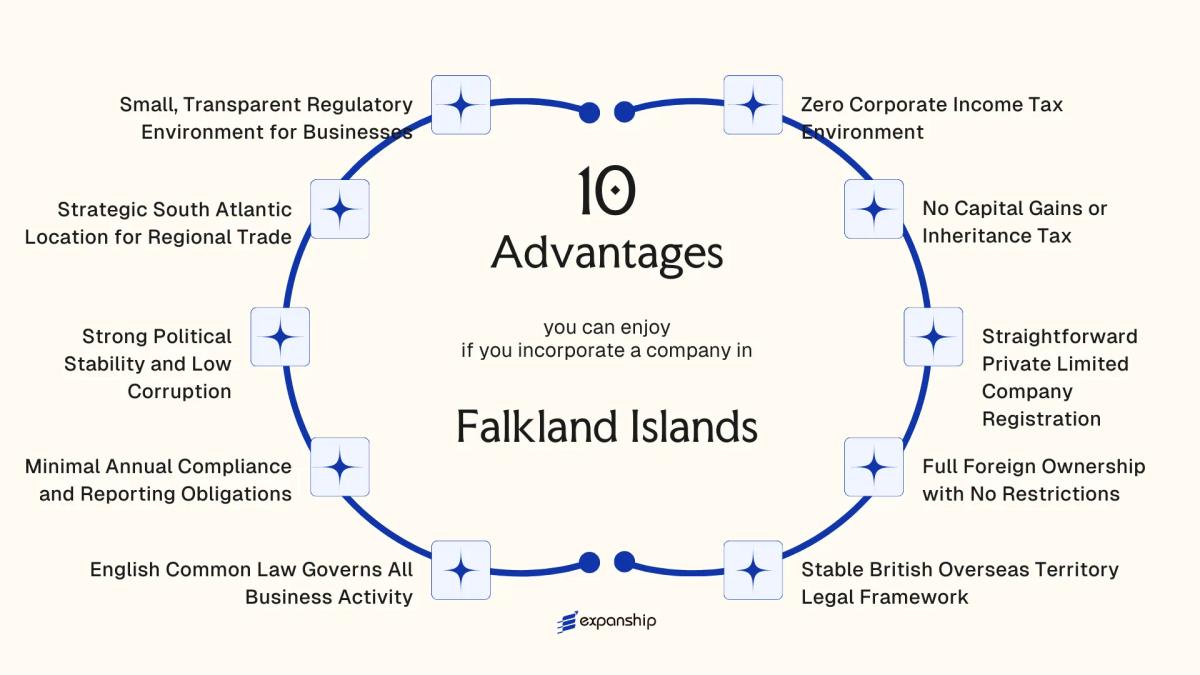
Zero Corporate Income Tax Environment
Corporate tax is one of the most direct costs a business bears on its profits. Under the Falkland Islands zero corporate income tax framework, registered companies pay no tax on corporate income derived from outside the territory.
What the Tax Structure Actually Means
The absence of corporate income tax means profits earned by your company are not subject to any statutory reduction at the entity level. For a foreign-owned firm operating internationally, this preserves capital that would otherwise be redistributed to a government treasury.
Taxation in the territory is governed by the Falkland Islands Income Tax Ordinance, which draws the distinction between locally sourced and externally sourced income. An entity structured to conduct business outside the islands operates in a tax-free business environment with respect to those foreign earnings.
The Practical Advantage for Foreign-Owned Entities
No corporate income tax translates directly into a higher retained earnings position after each financial year. That retained capital can be redeployed into operations, distributed to shareholders, or held as reserves without an intervening tax event at the corporate level.
This Falkland Islands corporate tax advantage applies to private limited companies as the primary vehicle for foreign business activity.
Profits generated outside the Falkland Islands are retained in full at the corporate level, with no statutory corporate income tax reducing your year-end earnings.
No Capital Gains or Inheritance Tax
There is no capital gains tax in the Falkland Islands. That single fact has a direct and measurable effect on your investment returns: profits realised from the sale of shares, property, or business assets are not subject to a separate tax charge at the point of disposal.
For foreign investors holding equity in a local entity, this means the full gain on an exit is retained rather than reduced by a tax levied solely because an asset changed hands. In jurisdictions where capital gains tax applies, rates commonly range from 20% to 33% on qualifying disposals — an amount that can materially affect decisions around restructuring, asset sales, or phased exits.
Inheritance tax is also absent from the territory's tax framework. Assets transferred through an estate are not subject to a separate charge, which has relevance for succession planning within family-owned or closely held businesses.
The practical benefits of this structure include:
- Gains from share disposals are not subject to an additional tax layer beyond standard income or corporate assessments
- Exit planning and business sales can be structured without factoring in a capital gains charge
- Estate transfers do not trigger a tax event that could force a liquidity event or asset sale to meet a tax liability

Company Incorporation in the Falkland Islands
Set up a private limited company in the Falkland Islands with no capital gains tax liability on business disposals or asset sales.
Straightforward Private Limited Company Registration
Registering a private limited company in the Falkland Islands is governed by the Companies Ordinance, the primary legislation that sets out the rules for incorporation, share structure, and director appointments. Under this framework, forming a private limited company requires filing a memorandum and articles of association with the Falkland Islands Registry of Companies. The process does not involve extensive pre-approval procedures or government discretion over whether a company may be registered, provided the statutory filing requirements are met.
| Parameter | Detail |
|---|---|
| Governing Legislation | Companies Ordinance |
| Registering Authority | Falkland Islands Registry of Companies |
| Minimum Directors | 1 |
| Minimum Shareholders | 1 |
| Registered Office | Required in the Falkland Islands |
| Liability Structure | Limited to share capital |
For a foreign business owner, this matters because the registration pathway is defined by statute rather than administrative discretion. You are working within a predictable legal structure, not negotiating entry. The requirement to maintain a registered office address within the territory is a standard condition that ensures the entity remains anchored to the local registry. Share capital requirements under the Ordinance are not set at prohibitive minimums, which reduces the capital commitment needed simply to establish the legal entity before trading begins.
Full Foreign Ownership with No Restrictions
Foreign nationals face no ownership caps when forming a company in the Falkland Islands. The Companies Ordinance does not impose nationality-based restrictions on shareholding or directorship, meaning you can hold 100 percent of equity in a private limited company without a local partner requirement. That structural openness is a direct Falkland Islands full foreign ownership benefit: your capital, voting rights, and profit entitlements remain entirely under your control.
Many jurisdictions impose foreign equity ceilings in specific sectors. No such sectoral carve-outs restrict foreign shareholders in standard commercial activities here, so the Falkland Islands 100 percent foreign ownership advantage applies broadly across trading, holding, and service structures.
Keep the following points in mind when structuring ownership:
- Confirm the intended business activity does not fall under a separately licensed or regulated sector, such as fishing or broadcasting, which may carry specific permit conditions
- Verify that your shareholder register is maintained accurately, as the Companies Registry requires up-to-date records
- Foreign directors are permitted, but at least one person must be appointed to fulfill directorial responsibilities per the Ordinance
- Dividend repatriation is not blocked by foreign exchange controls under current Falkland Islands policy
The Falkland Islands imposes no minimum capital requirement for a private limited company, so a foreign investor can incorporate with a single share of nominal value.
Stable British Overseas Territory Legal Framework
The Falkland Islands' status as a British Overseas Territory is not merely a constitutional classification — it is the structural foundation that gives your business predictable legal ground to operate from. As a territory under British sovereignty, the Falkland Islands British Overseas Territory legal benefits stem directly from a governance model that mirrors British institutional standards, including independent courts and a functioning legislature.
Constitutional Underpinning of Commercial Life
The Falkland Islands Constitution Order 2008 establishes the territory's legal framework, setting out the separation of powers and the structure of its judiciary. For a foreign business owner, this matters because your entity is subject to a constitution modeled on British constitutional principles rather than an opaque or untested legal order. Disputes involving contracts, property, or commercial obligations are adjudicated within a system that reflects established norms of due process.
Sovereign Backing Without Jurisdictional Uncertainty
Ultimate sovereignty resting with the United Kingdom means the territory operates under a level of institutional oversight that many offshore or semi-autonomous jurisdictions simply do not have. This is not a theoretical distinction: the UK government retains responsibility for the territory's defense and foreign affairs under the same 2008 Constitution, which reduces exposure to the kind of political discontinuity that can destabilize business operations. A firm incorporated here benefits from that structural continuity without being subject to UK corporate tax rules, since the territory maintains its own fiscal legislation independently.
Get Clarity on Incorporating Under the Falkland Islands' Legal Framework
Speak with an Expanship specialist about how the territory's British Overseas Territory status affects your incorporation structure and compliance position.
English Common Law Governs All Business Activity
The Falkland Islands operates under English common law, the same legal tradition that governs the United Kingdom, Australia, and other established commercial jurisdictions. For foreign business owners, this is a substantive structural advantage — not merely a point of heritage.
- Contract disputes, commercial agreements, and property rights are all interpreted through a body of case law accumulated over centuries. Your legal counsel anywhere in the common law world will work within a familiar framework, reducing the cost and complexity of cross-border legal coordination.
- Common law jurisdictions are known for strong judicial independence and the doctrine of precedent (stare decisis), which means court decisions are predictable and consistent over time. Predictability in dispute resolution directly reduces the legal risk premium that foreign investors typically price into their operations.
- English is the operative language of both the legal system and all business documentation. There is no translation layer between your contracts, filings, and the courts that would adjudicate them.
- The common law framework also underpins property rights protections that are enforceable through the local court system. For a foreign entity holding assets or entering long-term agreements, this means recourse through a structured, rules-based judicial process rather than administrative discretion.
Minimal Annual Compliance and Reporting Obligations
Among the Falkland Islands minimal compliance obligations benefits, the filing structure is straightforward by design. Companies registered under the Companies Ordinance are required to submit an annual return, but the associated administrative load is substantially lighter than what most OECD jurisdictions impose on private limited companies.
Private firms with no public shareholders are not subject to mandatory audit requirements under the general threshold, which means your business avoids the cost and time of appointing a statutory auditor each year. Annual accounts must still be prepared and maintained, but these are typically for internal record-keeping and regulatory review rather than public disclosure.
- Annual return filed with the Companies Registry
- Financial accounts prepared but not necessarily lodged publicly for smaller private firms
- No requirement for quarterly regulatory filings or complex multi-agency reporting
For many foreign-owned businesses operating across multiple jurisdictions, the low annual reporting requirements reduce the administrative overhead that compounds across subsidiaries.
A foreign-owned private limited company in the Falkland Islands, generating £500,000 in annual revenue, would typically require only a basic annual return and internally maintained accounts, compared to a UK equivalent entity facing statutory audit obligations once turnover exceeds £10.2 million, alongside mandatory Companies House filings, confirmation statements, and PSC register updates.
Strong Political Stability and Low Corruption
The Falkland Islands political stability business advantages are grounded in its constitutional status as a United Kingdom Overseas Territory, governed under the Falkland Islands Constitution Order 2008. This framework establishes an elected Legislative Assembly and an Executive Council, creating a structured, accountable system of government that functions predictably for foreign-registered entities.
Corruption is measurably low. The territory's small population, close-knit civil service, and direct accountability to UK oversight mechanisms leave limited room for opaque dealings or institutional misconduct. For investors, this means regulatory decisions are applied consistently rather than selectively.
The practical value for your business lies in certainty. Licensing decisions, company filings, and regulatory interactions follow defined procedures rather than informal arrangements.
- Government decisions are subject to judicial review under common law principles
- UK oversight bodies provide an additional accountability layer beyond local administration
- Public finances and government conduct are subject to audit, reducing the risk of arbitrary policy shifts affecting registered businesses
The Falkland Islands' stable governance framework applies to locally incorporated entities, but the extent to which UK-level political protections directly cover your specific commercial interests depends on the nature of your business activity and any applicable bilateral arrangements.
Strategic South Atlantic Location for Regional Trade
Positioned in the South Atlantic approximately 300 miles east of the Argentine coast, the Falkland Islands South Atlantic trade location advantages are most apparent for businesses operating across maritime sectors, natural resource supply chains, and logistics corridors connecting South America, Sub-Saharan Africa, and Antarctica.
Proximity to Key Maritime Routes
The islands sit at a convergence point between the Atlantic and Pacific Oceans via the Drake Passage, placing registered entities in close geographic proximity to international shipping lanes used by vessels transiting between major southern hemisphere ports. For businesses supplying offshore energy operations, fisheries, or Antarctic research expeditions, this positioning reduces transit distances and operational lead times compared to sourcing from European or North American bases.
Access to South Atlantic Resource Industries
The surrounding waters fall under Falkland Islands jurisdiction for licensing purposes, with the Falkland Islands Government overseeing significant fishing and hydrocarbon exploration activities. Companies incorporated locally gain a jurisdictional foothold that can support supply agreements, service contracts, and procurement relationships tied directly to these industries.
A Gateway for Sub-Antarctic and Antarctic Commerce
- Research logistics firms servicing British Antarctic Survey operations frequently route through the territory
- Fisheries management coordination under the South Atlantic Fisheries Commission involves commercial operators registered in the jurisdiction
- Antarctic tourism operators use Stanley as a staging point for vessel provisioning and crew transfers
The practical consequence for your business is direct access to an established, albeit niche, regional commercial ecosystem that few offshore jurisdictions can replicate geographically.
Small, Transparent Regulatory Environment for Businesses
The Falkland Islands transparent regulatory environment benefits foreign business owners not because of a complex incentive architecture, but because of what is absent: overlapping bureaucratic layers, opaque licensing tiers, and unpredictable administrative discretion. The regulatory structure governing companies is relatively contained, administered through a small number of clearly defined bodies, which means your firm interacts with fewer agencies and encounters fewer points of ambiguity.
Under the Companies Ordinance, the legal obligations placed on a registered private limited company are defined and finite. The ordinance specifies what is required from directors and shareholders without the kind of discretionary regulatory expansion seen in larger common law jurisdictions. For a foreign owner, this translates to greater predictability: you can structure your entity knowing that the rules are unlikely to shift through administrative interpretation.
The small jurisdiction business advantages here are partly a function of scale. Regulatory authorities in Stanley operate with direct accountability that larger financial centers cannot replicate. When compliance questions arise, they can typically be addressed through official channels without extended delays.
Key structural features that support this transparency include:
- Company registers are maintained under statutory authority, with defined public access provisions
- Licensing requirements are sector-specific rather than broadly applied to all commercial activity
- There is no parallel regulatory regime for foreign-owned entities; the same rules apply regardless of where shareholders are domiciled
- The absence of a discretionary approval process for standard company registration removes a common source of administrative friction
This uniformity of treatment under the business-friendly regulatory framework means your planning assumptions remain stable once incorporation is complete.
Why the Falkland Islands Stands Apart from Rival Jurisdictions
The Falkland Islands' most direct competitors for incorporation consideration are other British Overseas Territories, particularly Bermuda, the Cayman Islands, and the British Virgin Islands. Businesses evaluating these jurisdictions typically seek common law governance, English-language administration, and a stable political environment. What the comparison reveals is not that those territories lack these qualities, but that the Falkland Islands advantages over rival jurisdictions emerge from a different structural profile: lower operating complexity, no mandatory paid-up capital requirements for private limited companies, and a regulatory environment scaled to small and mid-sized foreign firms rather than large financial services operators.
Bermuda and Cayman impose sector-specific licensing regimes and economic substance requirements that can significantly increase the compliance burden for non-financial businesses. The Companies Ordinance governing Falklands entities does not impose the same substance thresholds, which matters for holding structures and trading companies with limited in-territory operations. That distinction is meaningful when evaluating why choosing the Falkland Islands over other offshore jurisdictions may produce lower ongoing administrative costs for certain entity types.
| Parameter | Falkland Islands | Bermuda | British Virgin Islands |
|---|---|---|---|
| Corporate Income Tax | 0% | 0% | 0% |
| Capital Gains Tax | None | None | None |
| Economic Substance Requirements | Not applicable to standard trading companies | Yes, sector-specific | Yes, for certain categories |
| Annual Filing Complexity | Low | Moderate to High | Moderate |
| Legal Framework | English Common Law | English Common Law | English Common Law |
| Governing Companies Legislation | Companies Ordinance | Companies Act 1981 | BVI Business Companies Act 2004 |
| Foreign Ownership Restrictions | None | Restricted in some sectors | None |
Compliance Services for Falkland Islands Companies
Maintain good standing under the Companies Ordinance with structured compliance support covering annual returns, registered office requirements, and ongoing statutory obligations.
Conclusion
The benefits of incorporating in Falkland Islands rest on a coherent set of structural advantages: the absence of corporate income tax, the reliability of an English common law framework administered under British Overseas Territory governance, and a compliance environment that does not impose disproportionate administrative burdens on foreign-owned entities.
Not every business will extract equal value from this jurisdiction. A firm with no connection to South Atlantic trade routes or no need for a low-tax holding structure will assess these factors differently than one positioned for regional resource, fisheries, or logistics activity. The suitability of any jurisdiction depends on your corporate structure, the residency of your shareholders, and the nature of your underlying operations.
For those whose profile aligns with what this territory offers, the case is built on durable fundamentals rather than policy-driven incentives that can be reversed. Establishing a Private Limited Company here means operating within a legal system governed by the Companies Ordinance, overseen by a stable regulatory authority, with no capital gains exposure and full foreign ownership permitted from the outset. Understanding precisely how those factors interact with your existing corporate structure is the step that converts jurisdictional eligibility into a functional incorporation decision.
Let Expanship Handle Your Falkland Islands Company Formation
Expanship's Falkland Islands company formation service covers the full incorporation process for private limited companies registered under the Companies Ordinance, from name reservation through to the issuance of a certificate of incorporation by the Falkland Islands Government Registry. This blog has outlined the specific advantages that make this territory worth serious consideration, including its zero corporate income tax position, unrestricted foreign ownership rules, and minimal annual compliance burden. Each of those benefits requires accurate execution at the registration stage to be fully accessible to your business.
Expanship manages the procedural and administrative work that incorporation requires, so your firm can take advantage of those benefits without delays caused by unfamiliarity with local filing requirements:
- Preparation and legalization of incorporation documents, including memorandum and articles of association
- Provision of a registered agent and registered office address in the territory
- Liaison with the Falkland Islands Government Registry for all government filings
- Post-incorporation compliance management, including annual return preparation
- Director and shareholder documentation support for foreign nationals
- Banking introduction assistance for newly incorporated entities
Reach out to Expanship Falkland Islands to discuss your company formation requirements.
Frequently Asked Questions (FAQ)
Companies incorporated in the Falkland Islands are subject to zero corporate income tax on their profits. No capital gains tax or inheritance tax applies either, which affects how retained earnings and asset transfers are treated over the life of the business. This tax position is governed under local fiscal legislation and applies to qualifying entities operating within the territory's framework.
Registration timelines are generally short given the territory's small regulatory environment and straightforward administrative process. The exact duration depends on document preparation and submission completeness, but the process does not involve lengthy multi-agency review procedures. Companies are registered through the Falkland Islands Registry.
English common law forms the basis of the territory's legal system and governs commercial contracts, company structure, and dispute resolution. This means legal precedents and doctrines developed in England and Wales are applicable, giving foreign investors a familiar and well-documented legal framework to reference. Local courts apply these principles directly to business matters.
Annual obligations are minimal relative to many other jurisdictions, with requirements centred on maintaining registered office details and filing basic returns with the Companies Registry. There are no complex consolidated reporting mandates or extensive audit requirements imposed on standard private limited companies. Specific obligations are set out under the Companies Ordinance.
The risk of abrupt legislative change is low. As a British Overseas Territory, the Falkland Islands operates under constitutional arrangements with the United Kingdom, which provides an additional layer of institutional oversight alongside the elected local government. This relationship contributes to the political continuity that has characterised the territory's governance over recent decades.
The territory's position in the South Atlantic provides geographic proximity to Patagonian and sub-Antarctic maritime trade routes, relevant for sectors such as fisheries, hydrocarbons, and shipping. However, the small local market means most companies registered there operate internationally rather than serving a domestic consumer base. Infrastructure connections, while functional, are limited compared to major financial centres.
A registered office address in the Falkland Islands is required under the Companies Ordinance, though this does not necessarily require you to maintain a staffed physical premises. Director residency requirements follow the general framework of the Ordinance, which does not mandate that directors be local residents. Confirming current requirements with a registered agent in the territory before submission is advisable.
Legal Disclaimer
The information provided in this article is for general informational purposes only and does not constitute legal, tax, or professional advice. While we strive to ensure the accuracy and timeliness of the content, laws and regulations are subject to change, and the application of laws can vary widely based on specific facts and circumstances.
Readers should not act upon this information without seeking professional counsel tailored to their individual situation. Expanship and its authors disclaim any liability for actions taken or not taken based on the content of this article.
For specific advice regarding your business setup, compliance requirements, or any legal matters, please consult with qualified legal and tax professionals in the relevant jurisdiction.