
Key Takeaways
- Foreign investors incorporating a Sociedad Anónima in Ecuador must navigate mandatory registration and oversight requirements under the Ley de Compañías enforced by the Superintendencia de Compañías, Valores y Seguros, adding procedural layers that extend setup timelines considerably beyond those typical in comparable Latin American jurisdictions.
- Employer contributions to the Instituto Ecuatoriano de Seguridad Social (IESS) represent a substantial payroll cost burden, with employer rates that materially increase the effective cost of hiring local staff beyond the base salary obligation.
- Sectors including hydrocarbons, telecommunications, and financial services impose restrictive foreign ownership caps that can prevent full foreign control of an Ecuadorian entity, forcing investors into joint venture or minority shareholding structures regardless of commercial preference.
- Tax compliance obligations administered by the Servicio de Rentas Internas (SRI) require regular filings, withholding obligations, and transfer pricing documentation for related-party transactions, creating an ongoing administrative load that scales with corporate complexity and cross-border dealings.
Ecuador operates under a heavily regulated corporate framework, shaped by multiple oversight bodies and a layered compliance structure that affects how foreign-owned entities are registered, taxed, and managed. The disadvantages of incorporating in Ecuador span procedural, financial, legal, and political dimensions, all of which are addressed across this article.
The severity of these drawbacks is not uniform. A small consulting firm structured as a Sociedad por Acciones Simplificada faces a materially different compliance burden than a foreign-controlled Sociedad Anónima operating in a restricted sector under the supervision of the Superintendencia de Compañías, Valores y Seguros.
Ecuador's primary corporate legislation is codified in the Ley de Compañías. This article is most relevant to foreign investors, non-resident shareholders, and multinational firms considering direct incorporation rather than operating through a local partner or branch structure.
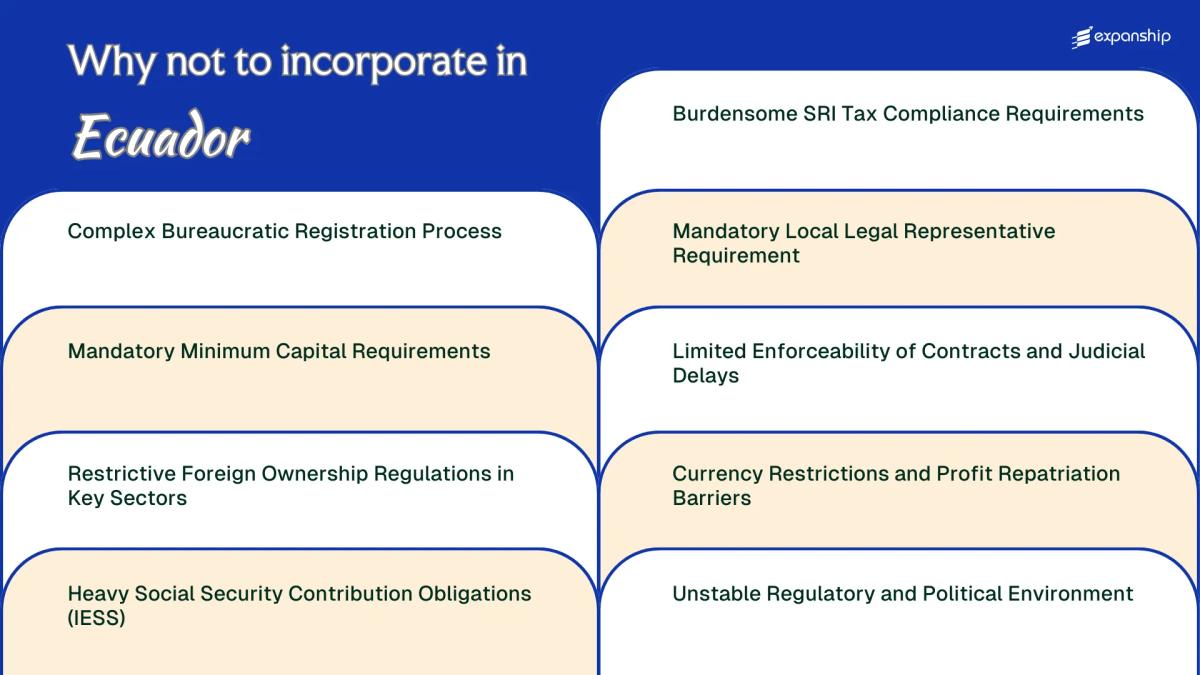
Complex Bureaucratic Registration Process
Ecuador company registration bureaucracy problems stem primarily from a multi-agency approval sequence that imposes sequential dependencies, meaning a delay at one stage blocks all subsequent steps.
Superintendencia de Compañías as a Structural Bottleneck
The Superintendencia de Compañías, Valores y Seguros (SCVS) serves as the primary supervisory body for company formation, and your entity cannot legally operate until it receives SCVS approval of its incorporation deed. Processing timelines vary and are not governed by a statutory deadline, leaving foreign founders without a reliable window for operational planning.
Sequential Multi-Agency Dependencies
Before the SCVS step, your firm must obtain a company name reservation, notarize the public deed before an Ecuadorian notary, and register with the Registro Mercantil, each stage contingent on completing the one before it. This sequential structure means that a single administrative backlog, a rejected document, or a notary scheduling delay can suspend the entire process for weeks.
The Servicio de Rentas Internas (SRI) RUC tax registration and municipal patent license add further layers after SCVS approval, extending the pre-operational period considerably.
Foreign investors should budget conservatively for a multi-week, sometimes multi-month, incorporation timeline due to the absence of defined processing deadlines within Ecuador's complex business registration process.
Mandatory Minimum Capital Requirements
Ecuador minimum capital requirements restrictions create a direct financial barrier before your business generates a single dollar of revenue. Under the Ley de Compañías, a Sociedad Anónima (S.A.) requires a minimum subscribed capital of USD 800, while a Compañía de Responsabilidad Limitada (Cía. Ltda.) requires USD 400. At least 50% must be paid in at the time of incorporation, with the remainder due within 12 months.
These figures may appear modest, but the structural obligations they trigger are not.
- Capital must be deposited in a local bank account and verified by the Superintendencia de Compañías, Valores y Seguros (SCVS), adding procedural steps that delay the incorporation timeline.
- Foreign founders often lack an existing Ecuadorian bank account, creating a circular dependency that stalls the entire registration.
- Any shortfall in paid-in capital can expose the company to legal challenges regarding its valid formation.
- S.A. entities require a minimum of two shareholders, meaning a sole foreign investor must introduce a second party solely to meet this structural threshold.
Capital requirements in practice function as a gating mechanism controlled by multiple institutions simultaneously. Your firm cannot proceed with SCVS registration until the bank confirms the deposit, and the bank may require documentation that a newly established foreign entity cannot yet produce.

Company Incorporation in Ecuador
Set up your Ecuadorian S.A. or Cía. Ltda. with full compliance support across SCVS registration, capital requirements, and documentation.
Restrictive Foreign Ownership Regulations in Key Sectors
Foreign ownership restrictions in Ecuador's sectors represent one of the more structurally limiting factors for international investors. The Constitution of Ecuador, ratified in 2008, grants the state authority to reserve strategic sectors for public control or heavily regulated mixed-enterprise arrangements, which directly narrows where a foreign firm can hold majority ownership.
Strategic sectors defined under Article 313 of the Constitution include telecommunications, energy, natural resources, and biodiversity. Foreign entities seeking any meaningful stake in these industries face ownership ceilings or outright exclusion, reducing their operational scope before incorporation even begins.
| Sector | Ownership Restriction | Practical Impact on Foreign Investor |
|---|---|---|
| Oil and Mining | State-controlled concession model | Foreign firms operate under contracts, not equity ownership |
| Telecommunications | Strategic sector under Art. 313 | Majority private foreign ownership is constitutionally restricted |
| Water and Sanitation | Reserved for public administration | Private foreign investment is prohibited |
| Biodiversity/Genetic Resources | State sovereign rights apply | Commercial foreign exploitation requires state authorization |
Even outside constitutionally reserved sectors, the Organic Law for Production, Trade and Investment imposes conditions on foreign participation in sensitive industries. Your business may find that the permitted structure forces minority positions or joint arrangements with state entities, which reduces both control and profit distribution flexibility.
These restrictions apply regardless of the legal form your entity takes, whether a Sociedad Anónima or Compañía de Responsabilidad Limitada.
Heavy Social Security Contribution Obligations (IESS)
The Ecuador IESS social security contribution burden falls on every registered employer, regardless of company size or revenue stage. Contributions are governed by the Instituto Ecuatoriano de Seguridad Social (IESS), and employer rates currently sit at approximately 12.15% of an employee's gross salary, with workers contributing an additional 9.45%.
For a foreign firm entering the market with even a small headcount, total payroll costs rise substantially beyond the contracted salary figure. These obligations attach from the first hired employee, with no de minimis threshold or startup exemption.
IESS payroll compliance challenges in Ecuador also include strict monthly filing and payment deadlines. Missing these triggers automatic penalties and interest charges calculated under the Social Security Code.
- Employer contribution rate of approximately 12.15% applies to each employee's full gross salary
- Payments must be reported and remitted monthly through the IESS employer portal with no grace period
- Failure to register employees within 15 days of hire date constitutes a separate, penalized infraction
- Arrears generate compounding interest, and IESS holds collection authority independent of SRI
The IESS employer obligations page outlines the full contribution schedule and registration requirements applicable to your entity.
IESS can file directly against an employer's assets to recover unpaid contributions without first obtaining a court judgment, bypassing the standard civil enforcement process entirely.
Burdensome SRI Tax Compliance Requirements
Ecuador SRI tax compliance challenges extend well beyond annual filings. Corporate entities face a demanding cycle of obligations administered by the Servicio de Rentas Internas (SRI) that generates significant ongoing cost and administrative exposure for foreign-owned firms.
Frequency and Volume of Required Filings
Monthly VAT declarations, withholding tax returns, and income tax advance payments create a near-continuous reporting calendar under Ecuador's Tax Code (Código Tributario) and the Ley de Régimen Tributario Interno. Missing a single filing deadline triggers automatic penalties and interest accruals, meaning that without a dedicated local tax specialist, your business accumulates liabilities before you are aware of the exposure.
Audit Risk and Transfer Pricing Exposure
The SRI holds broad audit authority and actively scrutinizes related-party transactions under Ecuador's transfer pricing regulations, which require annual reports submitted alongside the income tax return for qualifying transactions. Foreign-owned companies with intercompany transactions face the cost of preparing technical transfer pricing studies each fiscal year, an obligation that adds professional fees and documentation burdens not typically encountered in simpler tax regimes.
Managing SRI Compliance as a Foreign Business in Ecuador
Learn how Expanship supports foreign-owned entities in meeting SRI filing obligations, transfer pricing documentation requirements, and ongoing tax reporting under Ecuadorian law.
Mandatory Local Legal Representative Requirement
Foreign companies incorporating in Ecuador face Ecuador local legal representative requirement risks that are structural, not procedural. Under the Ley de Compañías, a foreign entity must appoint a domiciled legal representative who holds personal legal accountability for the company's obligations before the Superintendencia de Compañías, Valores y Seguros (SCVS).
- Your appointed representative can be held personally liable for regulatory non-compliance, creating a significant deterrent when recruiting qualified candidates willing to accept that exposure.
- Replacing a legal representative requires formal SCVS approval and public registry updates, meaning any personnel change introduces operational delays your business cannot easily absorb.
- The representative must maintain active domicile in Ecuador, which restricts your ability to appoint a trusted foreign national in that role.
- Candidates with sufficient legal standing to satisfy SCVS requirements typically demand compensation that materially increases your ongoing operating costs.
Limited Enforceability of Contracts and Judicial Delays
Ecuador contract enforcement problems stem from a judicial system that ranks poorly on efficiency and independence metrics. According to the World Bank's Doing Business methodology, resolving a commercial dispute in Ecuador takes an estimated 1,288 days on average, at a cost representing roughly 27.2% of the claim value.
That timeline is not an outlier — it reflects structural backlogs across the Función Judicial, the body overseeing civil and commercial courts. For a foreign firm awaiting payment or seeking breach-of-contract remedies, capital remains frozen throughout proceedings.
Contract disputes are governed under the Código Orgánico General de Procesos (COGEP), which replaced Ecuador's former civil procedure code in 2016. Despite its modernization intent, enforcement outcomes remain inconsistent, particularly against state-linked entities where political considerations can affect judicial conduct.
Arbitration clauses offer a partial alternative through the Centro de Arbitraje y Mediación de la Cámara de Comercio de Quito, but counterparties must contractually agree to this mechanism upfront.
A foreign supplier owed $80,000 under a commercial contract entering standard litigation could realistically spend $21,760 in legal and procedural costs alone — before recovering a single dollar — based on the World Bank's 27.2% cost-of-claim estimate for Ecuador.
Currency Restrictions and Profit Repatriation Barriers
Ecuador profit repatriation restrictions stem partly from the country's dollarized economy, which eliminated independent monetary policy. Without a central bank capable of managing foreign exchange, the government has historically relied on capital flow taxes to compensate for lost revenue levers.
Under the Ley Orgánica para el Desarrollo Económico y Sostenibilidad Fiscal, remittances sent abroad were subject to the Impuesto a la Salida de Divisas (ISD), a tax on currency outflows that reached 5% at its peak. Every dividend transfer, loan repayment, or service fee paid to a foreign parent company triggers this cost, directly reducing the after-tax return on your investment.
The ISD applies broadly, covering intercompany payments and shareholder distributions alike. For foreign firms relying on regular profit transfers to fund regional operations or service offshore debt, this creates a structural cash flow disadvantage with no straightforward offset.
- Dividends paid to non-resident shareholders are subject to both withholding tax and potential ISD exposure
- Royalties and management fees remitted abroad face similar outflow tax treatment
- The Servicio de Rentas Internas (SRI) enforces transfer pricing rules that can reclassify or restrict deductible cross-border payments
Even if ISD rates have been reduced or temporarily modified by legislative reform, your firm's specific payment category, whether dividends, loans, or service fees, determines the applicable rate, and assuming a blanket exemption applies without a formal SRI ruling exposes you to back taxes and penalties.
Unstable Regulatory and Political Environment
Ecuador political instability business risks are not theoretical. The country has seen significant constitutional changes, including a 2008 constitution that expanded state intervention across key economic sectors and allowed for the renegotiation of private contracts, including those with foreign oil companies.
Policy reversals between administrations create direct exposure for incorporated entities. Tax regimes, sector-specific regulations, and investment protections have shifted materially from one government to the next, making long-term financial projections unreliable.
The Organic Code of Production, Commerce and Investment (COPCI) provides investor protections on paper, but enforcement has historically depended on the political priorities of the sitting government. Your business cannot assume that negotiated terms or regulatory approvals will remain intact across election cycles.
Security conditions have also deteriorated. The government declared an internal armed conflict in 2024, which elevated operational risk and created regulatory unpredictability in affected regions.
Overcoming Incorporation Challenges in Ecuador
Overcoming Ecuador incorporation challenges begins with understanding which structural decisions, made before registration, have the most bearing on your long-term compliance position.
- Register your entity through the Superintendencia de Compañías, Valores y Seguros (SCVS) portal to reduce manual processing delays in the incorporation workflow.
- Select a company structure with a minimum capital threshold aligned to your sector, since the S.A. and C. Ltda. forms carry different paid-in capital obligations.
- Conduct a sector-specific foreign ownership review before committing to a corporate structure, as restricted industries require adjusted shareholding arrangements under Ecuadorian law.
- Appoint a domiciled legal representative prior to filing, as the absence of one halts the registration process at multiple checkpoints.
- Register with the SRI and IESS simultaneously after incorporation to avoid separate penalty exposure under each authority's compliance timelines.
- Establish a formal profit repatriation policy from the outset to manage dividend flows within the constraints of Ecuador's tax and foreign exchange framework.
These measures address the structural and administrative dimensions of operating in this jurisdiction, but they do not insulate your business from shifts in the regulatory or political environment that have historically altered compliance obligations with limited notice.
Ecuador's Overall Business Viability
Ecuador's overall business viability picture is mixed. The Ecuador business viability risks assessment presented across this blog reveals a jurisdiction where structural barriers are real, recurring, and in some cases difficult to predict. Yet dollarization provides monetary stability that many emerging markets cannot offer, and the country's position on the Pacific coast gives it meaningful access to both Andean and global trade routes.
| Pros | Cons |
|---|---|
| Full dollarization eliminates currency exchange risk for foreign investors | Profit repatriation can be subject to administrative friction and restrictions |
| No minimum capital requirement for simplified entity types like the SAS | Sociedad Anónima and Cía. Ltda. structures carry mandatory capital thresholds |
| Ecuador has signed multiple bilateral investment treaties offering some investor protections | Contract enforceability is inconsistent, and judicial resolution timelines are lengthy |
| The SRI tax framework includes a structured corporate income tax regime | SRI compliance obligations are detailed and penalties for procedural errors apply |
| Foreign nationals can hold equity in most commercial sectors | Strategic sectors including hydrocarbons and telecommunications restrict or condition foreign ownership |
| Dollarized economy reduces inflation-related business planning uncertainty | IESS employer contribution rates add significant fixed payroll cost regardless of company size |
Your assessment of the country as a potential base should account for sector, operational footprint, and tolerance for administrative complexity.
Corporate Compliance Services in Ecuador
Manage your ongoing statutory obligations in Ecuador, from SRI filings and IESS reporting to annual corporate maintenance with the Superintendencia de Compañías.
Conclusion
The Ecuador incorporation drawbacks summary is straightforward: this jurisdiction presents a genuinely demanding compliance environment for foreign investors. IESS contribution obligations, SRI reporting requirements, and the mandatory local legal representative condition under Ecuadorian commercial law each impose recurring costs and administrative burdens that extend well beyond initial registration. Judicial delays further compound the risk, particularly where contract enforcement is concerned. Structural awareness of these constraints, combined with current knowledge of regulatory changes from bodies such as the SRI and Superintendencia de Compañías, determines whether your business operates without interruption or faces avoidable exposure.
Expanship's Ecuador Expansion Services
Incorporating in Ecuador involves a defined set of obligations that your business must manage from day one. Expanship's Ecuador company formation services are structured around the specific compliance demands covered throughout this blog, from coordinating with the Superintendencia de Compañías, Valores y Seguros during registration to managing ongoing IESS contribution filings and SRI tax obligations. The firm's role is to reduce the operational burden these requirements place on foreign companies, particularly during the early stages when administrative missteps carry the most risk.
Expanship supports your Ecuador entry across the full incorporation and post-formation cycle:
- Preparing and filing company registration documents with the relevant authorities.
- Providing a registered agent and local office address to satisfy legal residency requirements.
- Handling government filings and liaising directly with regulatory bodies on your behalf.
- Managing post-incorporation compliance obligations as your entity becomes operational.
- Facilitating introductions to local banking institutions.
- Registering your business with the SRI and coordinating with local tax authorities.
Reach out to Expanship Ecuador to discuss your incorporation requirements.
Frequently Asked Questions (FAQ)
Yes, all foreign-incorporated entities establishing a legal presence in Ecuador must appoint a domiciled legal representative under the Ley de Compañías. This person assumes personal legal liability for the company's compliance obligations, which makes finding a qualified and willing representative genuinely difficult. The requirement is not limited to branches; it applies across standard structures including the Sociedad Anónima and Compañía de Responsabilidad Limitada.
Failure to register employees with the Instituto Ecuatoriano de Seguridad Social or to remit contributions on time triggers automatic surcharges, accrued interest, and potential legal action by the IESS. Employer contributions currently stand at approximately 12.15% of the employee's salary, and non-compliance can result in asset freezes and reputational damage with regulators. Directors and legal representatives can be held personally liable for outstanding balances.
Restrictions are sector-specific rather than economy-wide, but they apply to strategically significant industries including hydrocarbons, telecommunications, and certain financial services. In these sectors, Ecuadorian law limits foreign participation or requires state partnership arrangements that reduce operational control. Outside these sectors, 100% foreign ownership is generally permitted, though the approval process still involves multiple regulatory bodies.
Ecuador's use of the US dollar as its official currency removes exchange rate risk, but repatriating profits still requires demonstrating full tax compliance with the Servicio de Rentas Internas and satisfying dividend withholding tax obligations. A 10% withholding tax generally applies to dividend distributions to foreign shareholders, and any outstanding tax obligations will block the transfer. Compared to some regional peers, the dollar-based system simplifies currency conversion but does not eliminate regulatory friction.
The Servicio de Rentas Internas imposes automatic monetary penalties for late filings, and repeated non-compliance can result in the suspension of the company's RUC tax identification number. Operating without an active RUC effectively prevents the entity from issuing valid invoices, which halts commercial activity. Ecuador's tax calendar is detailed and varies by taxpayer identification number, so missing a single cycle can trigger a compounding series of obligations.
Ecuador has experienced multiple constitutional reforms, changes to investment protection frameworks, and periods of civil unrest that have resulted in abrupt regulatory changes affecting foreign investors. The country has renegotiated or exited bilateral investment treaties at various points, reducing the protections that foreign-owned entities might otherwise rely on. Businesses operating in regulated sectors face the highest exposure, as licensing conditions and royalty structures have historically shifted between administrations.
The minimum capital requirement for a Sociedad Anónima is set by the Superintendencia de Compañías, Valores y Seguros, and it cannot be waived for foreign investors. The minimum subscribed capital must be paid in at the time of incorporation, and the Superintendencia reviews capitalization as part of its ongoing oversight role. Choosing a Compañía de Responsabilidad Limitada involves a different capital threshold, but neither structure eliminates the upfront capital commitment.
Legal Disclaimer
The information provided in this article is for general informational purposes only and does not constitute legal, tax, or professional advice. While we strive to ensure the accuracy and timeliness of the content, laws and regulations are subject to change, and the application of laws can vary widely based on specific facts and circumstances.
Readers should not act upon this information without seeking professional counsel tailored to their individual situation. Expanship and its authors disclaim any liability for actions taken or not taken based on the content of this article.
For specific advice regarding your business setup, compliance requirements, or any legal matters, please consult with qualified legal and tax professionals in the relevant jurisdiction.