
Key Takeaways
- Cabo Verde's standard corporate tax rate of 25% operates alongside a Special Economic Zone regime, giving businesses two structurally distinct tax positions to select from based on operational model rather than a one-size-fits-all rate.
- The escudo's formal peg to the euro under agreement with Portugal eliminates a layer of currency volatility that remains a material financial planning risk in many comparable African jurisdictions.
- Foreign investors incorporating through the Registo Comercial face no general statutory restrictions on foreign ownership, with the legal framework grounded in Portuguese civil law tradition providing a familiar and predictable basis for commercial structuring.
- Double taxation treaties with key partner jurisdictions directly reduce the risk of cross-border income being taxed twice, a concrete advantage for entities conducting international transactions through a Cabo Verde-registered Sociedade de Responsabilidade Limitada.
Cabo Verde is an independent island nation located in the central Atlantic Ocean, positioned at the crossroads of Africa, Europe, and the Americas. Registering a business there falls under the authority of the Casa do Cidadão, the integrated public services body that oversees commercial registration through the Registo Comercial. Foreign investors typically incorporate using the Sociedade de Responsabilidade Limitada as their primary legal vehicle.
The benefits of incorporating in Cabo Verde draw interest from businesses seeking a territorial tax framework combined with treaty-based protections. Foreign ownership faces no general statutory restrictions, and the government has maintained an active posture toward foreign direct investment through structured legal mechanisms rather than ad hoc policy.
This article examines the principal advantages of Cabo Verde company formation across tax structure, treaty access, sectoral opportunity, and regulatory environment. Each factor carries distinct relevance depending on the nature and scale of your business operations.
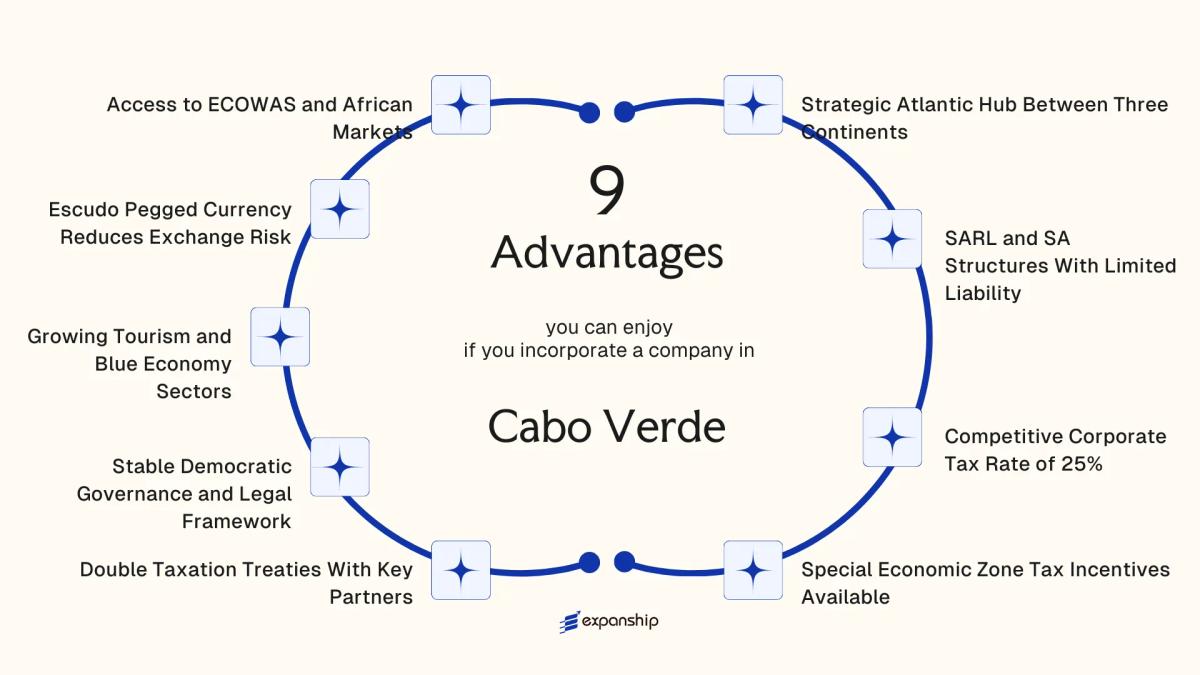
Strategic Atlantic Hub Between Three Continents
Cabo Verde's geographic position in the central Atlantic — roughly 570 kilometres off the West African coast — places it at an intersection point between Europe, Africa, and the Americas. For a business handling cross-continental trade flows, that proximity is a structural asset, not an incidental detail.
A Natural Transit Point for Multi-Regional Operations
The archipelago sits along major Atlantic shipping and aviation corridors. Sal and Santiago islands host international airports with scheduled connections to Lisbon, Amsterdam, Boston, and multiple West African capitals, which means your operations can reach three continents without routing through a regional hub first.
What Geographic Position Means for Corporate Structuring
Cabo Verde's membership in international frameworks, including its partnership agreements with the European Union under the Special Partnership signed in 2007, formally recognises the country's role as a bridge economy. That status gives a company incorporated here a credible, treaty-backed position when accessing both EU-adjacent and African markets simultaneously. Logistics firms, import-export entities, and holding structures particularly benefit from this dual-access positioning.
A company registered here can serve as a single operational base for contracts and trade flows across Atlantic-facing markets on three continents.
SARL and SA Structures With Limited Liability
Both the Sociedade por Quotas (SARL) and the Sociedade Anónima (SA) are governed under the Cabo Verde Commercial Code, and each structure separates personal assets from business liabilities by design. For a foreign investor, that separation is the foundational protection: your exposure is capped at your capital contribution, regardless of what debts or obligations the entity incurs.
The SARL requires a minimum share capital of 200,000 CVE, split into quotas rather than transferable shares. This threshold is low enough that it does not function as a meaningful barrier to entry for most international businesses. An SA, by contrast, issues shares and suits firms planning to raise external capital or accommodate multiple investors with varying ownership stakes.
The Cabo Verde SARL limited liability benefits extend beyond asset protection alone:
- A minimum of one shareholder suffices, removing the need to bring in nominal partners
- Quota transfers are subject to consent requirements, which gives founders control over who enters the company
- The SA structure allows share issuance, making equity-based financing structurally available without requiring a full restructuring
Under either structure, liability remains contained at the company level. That predictability matters when contracting with local counterparties or securing trade finance, because the legal boundary between you and the entity is clearly defined and enforceable.

Incorporate a Company in Cabo Verde
Set up a SARL or SA in Cabo Verde with full compliance support across registration, capital requirements, and ongoing obligations.
Competitive Corporate Tax Rate of 25%
Cabo Verde corporate tax rate advantages position the country as a measurable option for foreign businesses seeking cost-efficient incorporation in the Atlantic region. The standard corporate income tax rate, known locally as the Imposto sobre o Rendimento das Pessoas Colectivas (IRPC), is set at 25%. For context, the OECD average corporate tax rate hovers around 23%, while many European Union member states apply rates ranging from 25% to over 30%. At 25%, the IRPC rate sits within a competitive band without the opacity that sometimes accompanies low-tax jurisdictions.
| Parameter | Detail |
|---|---|
| Standard IRPC Rate | 25% |
| Tax Authority | Direcção-Geral das Contribuições e Impostos (DGCI) |
| Tax Year | Calendar year (1 January to 31 December) |
| Filing Basis | Worldwide income for resident entities |
| Withholding Tax on Dividends | 20% (subject to treaty relief) |
Resident companies, including those incorporated as SARLs or SAs with effective management in-country, are taxed on worldwide income. This means your business structure and substance matter directly to how the IRPC applies. The tax is administered by the Direcção-Geral das Contribuições e Impostos (DGCI), which operates under an established legal framework, giving foreign investors a defined regulatory counterparty rather than an ambiguous administrative environment.
For foreign shareholders, the 20% withholding tax on dividend distributions is a relevant cost factor, though applicable tax treaties can reduce this rate materially. A predictable rate at the entity level allows for cleaner financial modelling when projecting post-tax returns across multi-year investments.
Special Economic Zone Tax Incentives Available
Cabo Verde special economic zone tax incentives represent one of the more targeted fiscal tools available to foreign investors in the Atlantic basin. Under the legal framework governing the Zona Especial de Negócios (ZEN), qualifying businesses can access reduced corporate income tax rates that fall well below the standard 25% rate applied to conventional entities registered under the general tax code.
Businesses operating within the ZEN framework may benefit from reduced or zero rates on qualifying income, depending on sector classification and the volume of activity conducted within the zone. These concessions are not automatic. Your firm must meet defined eligibility criteria, including minimum investment thresholds and employment commitments, as established by the applicable enabling legislation.
For a foreign-owned entity, this structure creates a material cost difference on taxable profits, which is particularly relevant for trading, logistics, or services businesses using the archipelago as a distribution or holding point between Europe, Africa, and the Americas. The official investment code administered through the Agência para o Investimento e Comércio Externo de Cabo Verde (AICEP CV) governs the application process.
Keep the following in mind when assessing this benefit:
- Qualifying activity must align with approved sector classifications
- Minimum capital or employment conditions typically apply
- Incentives are time-bound and subject to periodic review
- Failure to maintain compliance with ZEN conditions can result in claw-back of tax benefits
ZEN-registered companies can potentially combine reduced corporate tax rates with the escudo's euro peg, effectively eliminating two major cost variables simultaneously from a single operating base.
Double Taxation Treaties With Key Partners
Cabo Verde double taxation treaty benefits are most relevant when your business generates income across multiple jurisdictions. Without treaty protection, the same income can be taxed in both the source country and the country of residence, reducing effective returns. The country's treaty network addresses this directly, offering formal mechanisms to eliminate or reduce that overlap.
Treaty Coverage and What It Prevents
Cabo Verde has signed double taxation agreements with Portugal, Macau, and several other partners, primarily through the framework established under the Código do Imposto sobre o Rendimento das Pessoas Coletivas (IRPC). These treaties typically reduce or eliminate withholding taxes on dividends, interest, and royalties paid between treaty partners. For a foreign firm routing transactions through Lisbon or Macau, this can materially lower the tax retained at source before income reaches your entity.
Portugal is particularly significant here. Given the shared legal and linguistic heritage, many investors use Portugal as a gateway, and the bilateral treaty means cross-border income flows between the two countries are not taxed twice under standard conditions.
Practical Impact on Foreign-Owned Entities
Treaty eligibility generally requires that your entity qualifies as a tax resident under local rules, meaning it must be incorporated or effectively managed within the territory. Meeting this threshold gives your business access to reduced withholding rates that non-treaty counterparts cannot claim. Over time, for businesses with regular dividend repatriation or intercompany lending arrangements, these reductions compound into measurable cost differences.
Maximise Your Treaty Benefits in Cabo Verde
Speak with our corporate specialists about structuring your Cabo Verde entity to qualify for double taxation treaty protections and optimise cross-border income flows.
Stable Democratic Governance and Legal Framework
Cabo Verde's stable governance benefits for business are grounded in its constitutional framework and longstanding multiparty democracy, which has remained uninterrupted since independence in 1975. The country consistently ranks among Africa's top performers on rule of law and institutional quality indices, including the Ibrahim Index of African Governance. For foreign investors, this translates directly into predictable regulatory conditions and a judiciary that operates with a degree of independence unusual in the region.
- The legal system is based on Portuguese civil law, giving it structural familiarity for investors from Lusophone and broader continental European backgrounds.
- Property rights and contractual obligations are enforceable through the civil courts, reducing counterparty risk for foreign entities operating under local law.
- The Investment Code governs foreign investment protections, including provisions against arbitrary expropriation without compensation.
- Political transitions occur through constitutional processes, meaning your business is not exposed to the regulatory disruption that frequently accompanies changes in government in comparable small-island or West African jurisdictions.
- The democratic legal framework advantages extend to press freedom and anti-corruption mechanisms, which contribute to a lower-risk operating environment for compliance-conscious firms.
Growing Tourism and Blue Economy Sectors
Tourism accounts for roughly 25% of Cabo Verde's GDP, and the sector has attracted sustained foreign direct investment into resort development, hospitality management, and aviation services. For foreign investors, this concentration creates a traceable demand base, particularly across the islands of Santiago, Sal, and Boa Vista, where visitor infrastructure continues to expand.
The blue economy dimension extends the opportunity further. The archipelago's exclusive economic zone covers approximately 734,000 square kilometers of Atlantic Ocean, supporting commercial activity in fisheries, aquaculture, maritime transport, and offshore services. Foreign-registered entities operating in these sectors can access dedicated licensing frameworks administered through the Agência para o Investimento e Comércio Externo de Cabo Verde (AICEP CV) and relevant sectoral ministries.
Cabo Verde tourism sector investment advantages are reinforced by the country's status as a signatory to international tourism promotion frameworks and its bilateral air service agreements with European and African markets, which sustain year-round visitor arrivals rather than seasonal peaks alone.
A foreign firm establishing a hospitality entity in Cabo Verde under standard SARL structure could position operations across a market that received over 800,000 tourist arrivals annually pre-COVID, with figures recovering toward and exceeding that threshold by 2023, according to Instituto Nacional de Estatística de Cabo Verde (INE) reporting.
Escudo Pegged Currency Reduces Exchange Risk
The Cabo Verde escudo pegged currency business benefit is concrete: the CVE has been fixed to the euro since 1999, initially under a formal agreement with Portugal and later guaranteed through the Bank of Cabo Verde (Banco de Cabo Verde) in coordination with the Portuguese Treasury. This arrangement eliminates floating-rate volatility between your accounts in CVE and any euro-denominated obligations.
For businesses with European suppliers, clients, or financing, the peg removes a cost that would otherwise require active hedging. Currency conversion between CVE and EUR is predictable, which simplifies cash flow forecasting across billing cycles.
The practical implications for investors include:
- Euro revenues and CVE operating costs carry no exchange rate mismatch risk
- Financial statements prepared in CVE reflect a stable base when benchmarked against euro-zone transactions
- Repatriation calculations to EU jurisdictions do not require currency risk provisions
The peg is maintained through a foreign exchange reserve agreement, not through capital controls, which means funds can move across borders within normal regulatory limits.
The CVE-euro peg is a monetary policy arrangement, not a statutory guarantee embedded in commercial law, so any future policy change by the Banco de Cabo Verde would affect its continuity.
Access to ECOWAS and African Markets
Cabo Verde ECOWAS market access advantages stem from the country's status as an associate member of the Economic Community of West African States. While the archipelago is not a full ECOWAS member, its associate status grants businesses incorporated there a formal channel into a regional bloc covering 15 countries and over 400 million people.
Associate Membership and What It Means for Trade
Associate status does not carry the same rights as full membership, but it creates a recognized relationship with the bloc's trade and regulatory institutions. For a foreign firm using Cabo Verde as a base, this affiliation provides a degree of institutional credibility when engaging with West African counterparts and, in certain contexts, preferential access arrangements.
African Continental Free Trade Area (AfCFTA)
Cabo Verde is a signatory to the AfCFTA, which aims to reduce tariffs across 54 African Union member states. For a business incorporated in the country, AfCFTA participation opens potential preferential treatment on goods and services traded across the continent, rather than limiting market reach to the immediate subregion.
Practical Reach Into West Africa
- Portuguese is an official language, creating direct commercial ties with Guinea-Bissau and São Tomé and Príncipe
- The firm can engage ECOWAS-based clients without establishing a separate entity in the region
- Proximity to Senegal, Mauritania, and Guinea positions Cabo Verde-registered businesses within reach of Atlantic West African supply chains
Why Cabo Verde Stands Out Among Atlantic Jurisdictions
Assessed against other Atlantic-facing jurisdictions, the Cabo Verde advantages over other Atlantic jurisdictions become clearest when you examine what competitors cannot offer in combination: a pegged currency, bilateral treaty access, and ECOWAS proximity within a politically stable, civil-law framework. The archipelago occupies an unusual position as an African sovereign state with a Portuguese legal tradition and a currency arrangement tied to the euro, a profile that distinguishes it from both offshore Caribbean jurisdictions and larger West African economies competing for the same foreign investor profile.
Realistic alternatives for a company evaluating Atlantic or West African incorporation include Madeira's MIBC regime in Portugal, São Tomé and Príncipe, and Senegal. Each targets a similar combination of geography and investor type, yet each presents trade-offs in treaty depth, currency exposure, or political risk that the following comparison helps to clarify. The CVCA regulatory framework and the escudo's peg arrangement, confirmed under Portugal-EU monetary agreements, are structural features that smaller Atlantic competitors cannot replicate.
| Parameter | Cabo Verde | Madeira (MIBC), Portugal | São Tomé & Príncipe | Senegal |
|---|---|---|---|---|
| Standard Corporate Tax Rate | 25% | 5% (MIBC licensed entities) | 25% | 30% |
| Currency Risk | Low (CVE pegged to EUR) | None (EUR) | Moderate (STN) | Moderate (XOF, CFA franc) |
| ECOWAS Market Access | Yes | No | Observer status only | Yes |
| Double Tax Treaties | Yes (Portugal, EU-linked) | Extensive (via Portugal) | Limited | Moderate |
| Political Stability Index | High (democratic since 1991) | High | Moderate | Moderate |
| Legal System | Civil law (Portuguese tradition) | Civil law (EU-aligned) | Civil law (Portuguese tradition) | Civil law (French tradition) |
| Special Economic Zone Regime | Yes | Yes (MIBC) | Limited | Yes (Dakar, Diamniadio) |
Compliance Services for Companies in Cabo Verde
Maintain your Cabo Verde entity in good standing with ongoing compliance support, including annual filings, registered agent services, and regulatory reporting.
Conclusion
Cabo Verde presents a coherent case for Atlantic-facing incorporation: a geographically central position between Europe, Africa, and the Americas, combined with a legal framework grounded in Portuguese civil law tradition and a currency pegged to the euro under formal agreement with Portugal.
The Special Economic Zone regime and the standard 25% corporate tax rate create two distinct but complementary options depending on your business model and the sectors you intend to operate in. For firms with cross-border exposure, the double taxation agreements with key treaty partners reduce the risk of income being taxed twice, a practical factor that directly affects after-tax returns on international transactions.
The benefits of incorporating in Cabo Verde apply most directly to businesses that can connect the jurisdiction's geographic position to their operational model, whether in maritime services, tourism infrastructure, or trade-oriented activities tied to ECOWAS access. The escudo's euro peg removes a layer of currency uncertainty that affects many comparable African jurisdictions, which has tangible implications for financial planning and repatriation of profits. Cabo Verde company formation advantages are most pronounced when the entity structure, the applicable tax regime, and the intended market are aligned from the outset. The next step is ensuring that your specific incorporation structure, share capital arrangements, and ongoing compliance obligations under Cape Verdean commercial law are properly configured before registration proceeds.
Start Your Cabo Verde Company With Expanship Today
Cabo Verde company formation with Expanship covers the full incorporation cycle, from preparing constitutional documents under the Código das Empresas Comerciais to registering your entity with the Casa do Cidadão or the Conservatória do Registo Comercial. The blog has outlined the SARL and SA structures, the 25% corporate tax rate, Special Economic Zone incentives, and the currency stability provided by the escudo's peg to the euro. Expanship's services are designed to address each of these dimensions without requiring you to manage local bureaucratic processes from abroad.
Working with Expanship Cabo Verde, your engagement covers the following:
- Preparation and legalization of incorporation documents, including articles of association
- Registered agent and registered office provision in accordance with local requirements
- Filing and liaison with the Conservatória do Registo Comercial and relevant tax authorities
- Post-incorporation compliance management, including annual reporting obligations
- Banking introduction assistance to support your firm's operational setup
- Ongoing registered address maintenance for your entity's official correspondence
Reach out to Expanship Cabo Verde to discuss how your business objectives align with the regulatory and fiscal framework this jurisdiction offers.
Frequently Asked Questions (FAQ)
Yes, foreign nationals can incorporate a company in Cabo Verde without being resident in the country. Both the SARL (Sociedade por Quotas) and SA (Sociedade Anónima) structures are available to non-resident foreign investors, with no nationality restrictions on shareholding. Depending on the entity type and activity, you may need a locally registered office address and a fiscal representative to fulfill obligations with the Agência de Regulação e Supervisão dos Produtos Farmacêuticos e Alimentares and other regulatory bodies.
The standard corporate income tax (IRPC) rate in Cabo Verde is 25%. Companies operating within designated Special Economic Zones may qualify for significantly reduced rates and other fiscal incentives under the applicable SEZ framework, though eligibility depends on the nature of the business activity and meeting specific investment thresholds established by the relevant enabling legislation.
The Cape Verdean Escudo is pegged to the euro under a longstanding agreement with Portugal and the European Union, which provides exchange rate predictability for businesses transacting in euros. Foreign currency transactions are subject to oversight by the Banco de Cabo Verde, the central bank, which regulates capital flows and foreign exchange operations. Companies should confirm applicable reporting requirements with the Banco de Cabo Verde when structuring cross-border payments.
Cabo Verde has concluded double taxation agreements with Portugal and Macau, among other partners, which reduce or eliminate withholding taxes on dividends, interest, and royalties paid between treaty jurisdictions. The specific withholding rates and exemptions vary by treaty and income type. Investors from non-treaty countries remain subject to domestic withholding rates under the IRPC regime.
Cabo Verde's membership in ECOWAS provides incorporated entities with a framework for preferential trade access across the 15-member bloc under the ECOWAS Trade Liberalization Scheme. In practice, the degree of benefit depends on the specific goods or services traded and whether all conditions of origin and compliance under the scheme are satisfied. Companies engaged in manufacturing or re-export should assess their eligibility under ECOWAS protocols before structuring operations around this access.
If a company ceases to meet the qualifying conditions of the Special Economic Zone regime, it generally reverts to standard IRPC taxation at the 25% corporate rate. Depending on the terms of the original authorization, there may also be clawback provisions or penalties applicable to the period during which incentives were incorrectly claimed. The specific consequences are governed by the SEZ enabling legislation and the terms of the individual authorization issued by the competent authority.
Yes, both structures carry minimum share capital requirements under Cabo Verdean company law. The SA generally requires a higher minimum capital than the SARL, reflecting its suitability for larger or publicly oriented enterprises. Exact figures should be confirmed against the current Commercial Code, as statutory minimums can be amended by legislative update.
Incorporation timelines vary depending on the entity type, completeness of documentation, and whether any regulatory approvals are required for the intended business activity. For a standard SARL with no sector-specific licensing requirements, registration through the Casa do Cidadão one-stop-shop service can be completed within a few business days. Activities in regulated sectors, such as financial services or tourism, may require additional approvals that extend the overall timeline.
Legal Disclaimer
The information provided in this article is for general informational purposes only and does not constitute legal, tax, or professional advice. While we strive to ensure the accuracy and timeliness of the content, laws and regulations are subject to change, and the application of laws can vary widely based on specific facts and circumstances.
Readers should not act upon this information without seeking professional counsel tailored to their individual situation. Expanship and its authors disclaim any liability for actions taken or not taken based on the content of this article.
For specific advice regarding your business setup, compliance requirements, or any legal matters, please consult with qualified legal and tax professionals in the relevant jurisdiction.