

Key Takeaways
- Chile's SpA structure allows a single foreign shareholder to incorporate a legally recognised entity under the Chilean Commercial Code, removing the multi-partner requirements that complicate entry in many regional jurisdictions.
- Under the Foreign Investment Promotion Law, foreign nationals face no statutory restrictions on full ownership of a Chilean company, placing international operators on equal legal footing with domestic shareholders.
- The Empresa en un Día portal enables formal company registration through the Registro de Empresas y Sociedades in a single procedural step, materially reducing the administrative timeline compared to traditional notarial incorporation.
- Oversight from the CMF and Chile's investment-grade sovereign credit rating give Chilean-registered entities a level of international institutional recognition that supports cross-border financing, contracting, and regulatory acceptance across Latin America.
Chile is an independent republic on the western coast of South America, bordered by the Pacific Ocean and sharing land borders with Peru, Bolivia, and Argentina. The benefits of incorporating in Chile draw significant attention from foreign investors, largely because the country maintains a transparent regulatory environment and a territorial tax system that applies corporate tax only to locally sourced income. Company registration falls under the jurisdiction of the Registro de Empresas y Sociedades, the national registry through which new entities are formally constituted. Foreign nationals face no general statutory prohibition on owning or controlling a locally registered business, and the government has historically maintained open policies toward foreign direct investment across most sectors.
For businesses entering Latin America, the Sociedad por Acciones — commonly known as the SpA — is the legal vehicle most frequently used by foreign investors establishing a presence here.
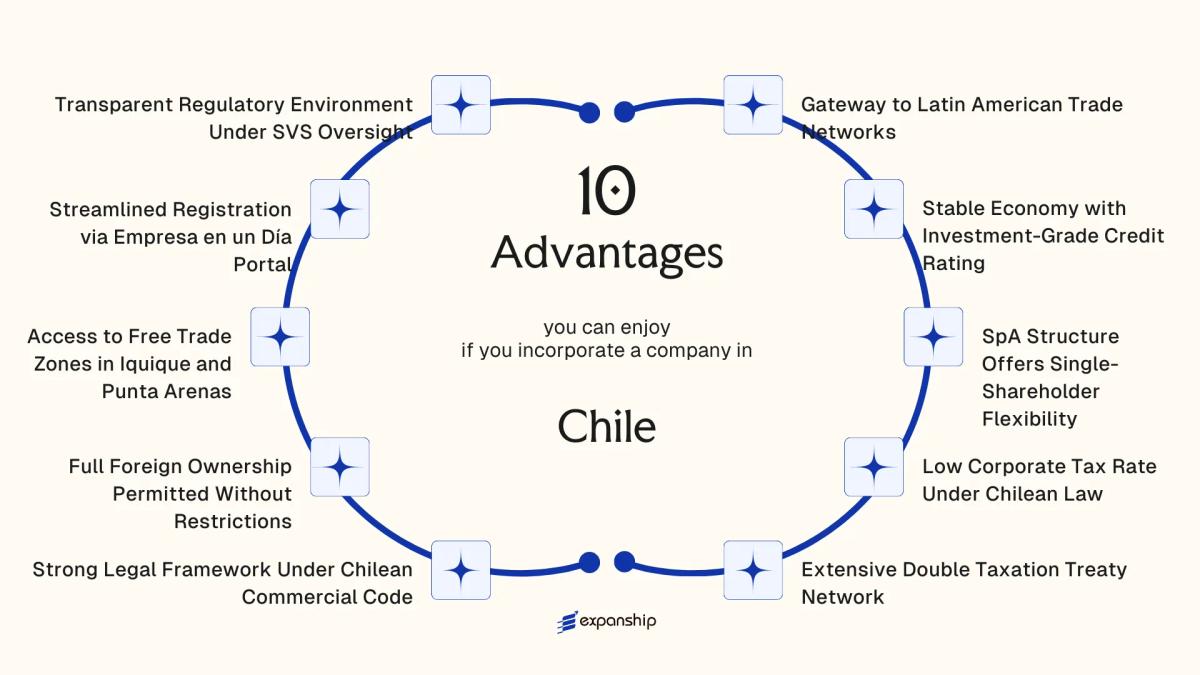
This article examines the principal advantages that company formation in Chile offers to international businesses and individual entrepreneurs operating across industries.
Gateway to Latin American Trade Networks
Chile's position as a gateway to Latin American trade is backed by a treaty architecture that few economies in the region can match. Incorporated entities here gain preferential access to markets representing the majority of hemispheric GDP.
Free Trade Agreements as a Structural Advantage
Chile has signed free trade agreements with over 65 economies, including the United States, the European Union, China, Japan, and all major Andean and Pacific Alliance member states. For a foreign-owned Sociedad por Acciones (SpA) or any other locally registered firm, goods and services can move across these corridors at reduced or zero tariff rates that would otherwise apply to third-country exporters.
The Pacific Alliance, which Chile co-founded alongside Colombia, Mexico, and Peru, eliminates tariffs on approximately 92% of goods traded among members. Your business gains direct access to that bloc without establishing separate legal entities in each country.
Regional Sourcing and Distribution from a Single Entity
Operating through a single Chilean entity, a foreign firm can source from Pacific Alliance members and distribute outward under unified trade terms. This consolidation reduces administrative overhead tied to multi-jurisdiction structuring.
A single Chilean entity can serve as the legal hub for trade flows across the Pacific Alliance and beyond, without requiring separate incorporation in each member state.
Stable Economy with Investment-Grade Credit Rating
Chile's sovereign credit rating, maintained at investment grade by Moody's, S&P, and Fitch, signals a level of macroeconomic credibility that most Latin American economies have not consistently sustained. For a foreign business owner, this matters because it reflects disciplined fiscal policy, low inflation management, and institutional stability — conditions that directly reduce the currency and regulatory risk your entity faces over time.
The country's central bank, the Banco Central de Chile, operates under an autonomous mandate established by the Organic Constitutional Law of the Central Bank. That statutory independence insulates monetary policy from political cycles, which in practice means more predictable interest rates and a currency environment that foreign firms can plan around.
Chile's stable economy benefits for investors extend to the treatment of capital itself. The Peso is fully convertible, and there are no restrictions on repatriating profits or capital under the current foreign investment framework, giving your business direct access to earnings without administrative obstruction.
What makes this macroeconomic foundation particularly functional for a foreign firm:
- Inflation has historically been managed within a formal target band, reducing the erosion of contract values over multi-year operations
- The fiscal framework follows structural budget rules, limiting the kind of deficit spending that destabilises business conditions elsewhere in the region
- Sovereign debt obligations have been met consistently, which supports credit access for private entities operating locally

Incorporate a Company in Chile
Register your Chilean company with full compliance support across legal, tax, and administrative requirements.
SpA Structure Offers Single-Shareholder Flexibility
Introduced under Law 20,190 in 2007, the Sociedad por Acciones (SpA) is a share-based corporate form that a single individual or legal entity can incorporate and operate without any minimum shareholder requirement. This Chile SpA single shareholder advantage removes a structural barrier that exists in many other jurisdictions, where at least two founding members are legally required to form a company. For a foreign investor establishing a wholly owned subsidiary or a sole-founder startup, the SpA eliminates the need to appoint a nominal co-shareholder simply to satisfy formation rules.
| Feature | SpA | SRL |
|---|---|---|
| Minimum shareholders | 1 | 2 |
| Share transferability | Freely transferable | Requires partner consent |
| Capital structure | Shares | Capital quotas |
| Governing instrument | Statutes (Estatutos) | Partnership deed |
Ownership is represented through shares rather than participation quotas, which makes transferring equity or bringing in future investors a defined, contractual process under the company's own statutes. Structuring a share transfer does not require unanimous partner consent, unlike the SRL form. Your business can also hold different share classes within a single SpA, allowing flexibility in how economic rights and voting rights are distributed as the firm grows. This adaptability under a single legal entity makes the SpA a practical choice for investors who anticipate changes in ownership structure over time.
Low Corporate Tax Rate Under Chilean Law
Chile corporate tax rate advantages become tangible once you understand the structure under which corporate income is taxed. Under the Chilean Income Tax Law (Ley sobre Impuesto a la Renta), the standard first-category corporate tax rate sits at 27% for entities operating under the partially integrated system, which applies to most foreign-owned companies.
That figure warrants context. It applies at the entity level, but under the partially integrated system, shareholders can credit 65% of the corporate tax paid against their final withholding tax on distributed profits. For foreign investors, this credit mechanism reduces the effective tax burden on repatriated earnings below the headline rate.
Retained earnings are only taxed at the shareholder level upon actual distribution. A foreign business that reinvests profits locally defers shareholder-level taxation entirely, which gives your firm flexibility in managing cash flow without triggering an immediate additional tax liability.
The tax regime details are administered and published by the Servicio de Impuestos Internos (SII), the national tax authority.
Keep these points in mind when structuring your tax position:
- Confirm whether your entity falls under the partially integrated or attributed income system
- Verify your residency country's treaty status, as this affects the final withholding rate on dividends
- Retain earnings strategically, since distributions trigger the shareholder-level tax
- The 65% credit applies to foreign shareholders only where applicable treaty provisions permit it
Chile taxes retained earnings at zero until distribution, meaning a profitable SpA that reinvests all profits pays no shareholder-level tax for years, regardless of the entity's size.
Extensive Double Taxation Treaty Network
Chile double taxation treaty benefits stem from one of the more developed treaty networks in Latin America. The country has signed double tax agreements with over 30 jurisdictions, including Germany, the United States, Canada, Australia, Japan, and most major EU economies. For a foreign-owned entity operating here, this directly reduces the risk of the same income being taxed in two separate countries.
Reduced Withholding on Cross-Border Payments
Treaty provisions typically cap withholding tax rates on dividends, interest, and royalties paid from a Chilean entity to a qualifying foreign recipient. Without a treaty, the standard Additional Tax under the Ley sobre Impuesto a la Renta applies at a general rate of 35%. Many bilateral agreements reduce the applicable rate on certain payments to between 5% and 15%, depending on the counterparty jurisdiction and the nature of the payment.
That reduction is not automatic. Your firm must meet the residency and beneficial ownership conditions set out in the specific treaty text to qualify for the reduced rate.
Certainty for Investors Structuring Regional Operations
Chile's treaty network includes agreements with several countries that themselves maintain wide treaty networks, which makes a Chilean holding or intermediate structure more predictable from a tax planning standpoint. For businesses routing investment into Latin America, this creates a degree of cross-border tax certainty that is less available through jurisdictions with fewer bilateral agreements in the region.
The treaties generally follow OECD Model Convention principles, meaning the definitions and dispute resolution mechanisms are familiar to advisors working in common international tax frameworks.
Maximize Your Treaty Benefits in Chile
Speak with our team to understand how Chile's double tax agreements apply to your specific structure, ownership profile, and target markets.
Strong Legal Framework Under Chilean Commercial Code
Chile's legal framework benefits for businesses rest on a foundation that has remained materially stable for decades. The primary instrument governing commercial activity is the Código de Comercio, enacted in 1865 and amended progressively to accommodate modern business structures. Foreign investors operate under the same statutory protections as domestic entities, with dispute resolution available through established civil courts and, increasingly, through arbitration under rules administered by the Centro de Arbitraje y Mediación de Santiago.
- Predictability of contract enforcement under the Código de Comercio reduces the legal risk that typically concerns foreign investors entering new markets, since obligations and remedies are clearly codified rather than subject to broad judicial discretion.
- Chilean business law stability advantages stem partly from the country's civil law tradition, which produces written, accessible statutes rather than reliance on evolving case precedent.
- The Santiago Arbitration Centre provides a private dispute resolution channel that many investor agreements designate by default, allowing commercial conflicts to be resolved without entering the general court system.
- Chile's adherence to international commercial conventions, including UNCITRAL model law principles, means that arbitral awards and cross-border contractual arrangements follow internationally recognized standards your legal counsel will already understand.
Full Foreign Ownership Permitted Without Restrictions
Chile full foreign ownership benefits stem directly from Decree Law 600 (DL 600), the Foreign Investment Statute, and its successor framework under Law 20.848, which established the Foreign Investment Promotion Agency (InvestChile) as the formal entry point for foreign capital. Under these frameworks, non-resident investors may own 100 percent of a Chilean company across virtually all sectors without requiring a local partner or shareholder.
This unrestricted ownership structure means your business retains full operational and financial control from day one. Decisions on profit repatriation, capital allocation, and governance do not require the consent of a mandated local co-owner, which eliminates a structural friction present in markets like Mexico or Indonesia, where sectoral foreign equity caps apply.
Certain regulated sectors, including media and fishing, carry specific ownership thresholds under separate statutes. Outside those narrow carve-outs, 100 percent foreign ownership Chile advantages apply broadly, covering manufacturing, services, real estate, and technology.
A foreign investor holding 100% equity in a Chilean SpA generating CLP 50,000,000 in annual profit retains full discretion over dividend distribution and reinvestment without any mandatory profit-sharing obligation to a local partner, unlike jurisdictions that impose co-ownership requirements as a condition of market entry.
Access to Free Trade Zones in Iquique and Punta Arenas
Chile free trade zone benefits Iquique are grounded in a specific legal instrument: Law No. 19.709, which governs the Zona Franca de Iquique (ZOFRI). Businesses operating within ZOFRI pay no customs duties on imports and exports, no VAT on internal transactions within the zone, and are exempt from first-category income tax on qualifying activities.
For a foreign-owned trading or distribution company, this exemption structure directly reduces the cost of moving goods through South America's Pacific corridor. ZOFRI's position in northern Chile gives companies direct access to trans-Pacific shipping routes and overland corridors into Bolivia, Peru, and Argentina.
Punta Arenas hosts the Zona Franca de Punta Arenas (ZOFRAP), operating under comparable customs and tax exemption rules. Its geographic location at the southern tip of the continent makes it a distinct entry point for goods moving between the Atlantic and Pacific, particularly relevant for maritime logistics and energy-sector supply chains.
- ZOFRI primarily serves consumer goods, electronics, and wholesale distribution
- ZOFRAP has historically been associated with fishing, hydrocarbons, and industrial supply
Tax exemptions within ZOFRI and ZOFRAP apply only to companies formally established and operating within the designated zone perimeters; a standard Santiago-based entity does not qualify automatically.
Streamlined Registration via Empresa en un Día Portal
The Chile Empresa en un Día benefits begin with speed. Operated by the Ministry of Economy, the portal allows a Sociedad por Acciones (SpA) or other eligible entity types to be legally constituted online, often within 24 hours of submitting the required documentation.
No Physical Presence Required at Formation
Foreign founders do not need to be present in the country to register through the portal. The system accepts electronic signatures and processes filings digitally, which means your business can reach legal existence without the delays associated with notarial appointments or in-person submissions to the Registro de Comercio.
Immediate Tax Enrollment
Registration through Empresa en un Día automatically initiates enrollment with the Servicio de Impuestos Internos (SII) for tax identification purposes. Your company receives its RUT (Rol Único Tributario) as part of the same process, eliminating a separate administrative step that would otherwise extend the timeline.
Cost Structure Is Fixed and Transparent
Formation through the portal carries no government filing fee for most standard entity types, a deliberate policy choice under Law 20.659 enacted in 2013. For an investor comparing entry costs across Latin American jurisdictions, this directly reduces the upfront capital required to establish a legal presence.
- Registration typically completed within one business day
- No notary required for standard formations via the portal
- RUT issued as part of the unified registration process
- Governed by Law 20.659, which simplified corporate formation rules
Transparent Regulatory Environment Under SVS Oversight
Chile's transparent regulatory environment benefits foreign businesses by reducing the uncertainty that typically accompanies cross-border investment. Financial markets and securities are overseen by the Comisión para el Mercado Financiero (CMF), the body that absorbed the former Superintendencia de Valores y Seguros (SVS) following the enactment of Law 21.000 in 2017. The CMF operates under a statutory mandate to publish regulatory decisions, maintain public registries, and enforce disclosure requirements consistently across domestic and foreign-controlled entities alike.
For your business, this structure means that the rules governing capital markets, financial reporting, and corporate disclosures are publicly accessible and applied uniformly. Regulatory arbitrariness is constrained by formal legal processes, which gives foreign investors a predictable operating environment without needing local intermediaries to interpret shifting policies.
Listed companies and certain regulated entities must adhere to continuous disclosure obligations under CMF regulations, including timely reporting of material events. This requirement mirrors standards found in OECD member states, which matters when your parent company or institutional investors require alignment with international governance norms.
Chile's adherence to OECD membership since 2010 has further anchored its regulatory architecture to internationally recognised standards. The CMF's institutional independence from executive interference is established by statute, not administrative convention, which reinforces the durability of its oversight function.
- CMF maintains a publicly searchable registry of regulated entities and enforcement actions
- Financial statements filed with the CMF follow IFRS standards, reducing reconciliation burdens for foreign parent companies
- Regulatory decisions are subject to administrative review procedures under Chilean administrative law
Why Chile Stands Out Against Regional Competitors
Comparing Chile's advantages over Latin American competitors requires selecting reference points that reflect the same investor profile: foreign-owned entities seeking a stable, treaty-supported base with formal legal structures. Brazil, Colombia, and Mexico represent the most realistic alternatives a foreign investor would evaluate alongside Chile, given their regional weight and incorporation activity. The comparison is not simply about tax rates; it also reflects regulatory predictability, entity flexibility, and treaty coverage, areas where structural differences carry real operational consequences.
What the table below surfaces is that Chile's combination of DL 600 successor framework under the Foreign Investment Promotion Agency (InvestChile), single-shareholder SpA permissibility, and an investment-grade sovereign credit rating from all three major agencies produces a profile that few regional peers replicate simultaneously. Brazil's corporate tax burden, Colombia's foreign ownership conditions in certain sectors, and Mexico's more complex multi-shareholder requirements each introduce friction that the Chilean framework does not.
| Parameter | Chile | Brazil | Colombia | Mexico |
|---|---|---|---|---|
| Single-shareholder entity | Yes (SpA) | No (Ltda. requires 2+) | No (SAS requires 1+, but Ltda. requires 2+) | No (SA/SAPI requires 2+) |
| Corporate income tax rate | 27% | Up to 34% (CSLL + IRPJ combined) | 35% | 30% |
| Full foreign ownership | Permitted | Permitted with sector exceptions | Permitted with sector exceptions | Permitted with sector exceptions |
| Double tax treaties active | 34+ | 33+ | 15+ | 14+ |
| Online company registration | Yes (Empresa en un Día) | Partial (varies by state) | Yes (CCB portal) | Partial |
| Investment-grade sovereign rating | Yes (all three agencies) | No (below investment grade) | Yes (some agencies) | Yes (some agencies) |
Compliance Services for Companies in Chile
Maintain your Chilean entity in good standing with ongoing support for annual filings, tax obligations, and regulatory reporting under Chilean law.
Conclusion
Chile's treatment of foreign capital under the Foreign Investment Promotion Law, its SpA structure permitting sole-shareholder incorporation, and the Empresa en un Día registry system together form a coherent framework that reduces both entry costs and ongoing compliance burdens for international operators. These are not incidental features — they reflect deliberate policy choices embedded in Chilean commercial and tax law.
The benefits of incorporating in Chile carry different weight depending on your sector, ownership structure, and cross-border transaction profile. A firm primarily trading within the Pacific Alliance bloc will extract more value from Chile's FTA network than one focused on domestic retail. Your business's specific circumstances determine which structural advantages translate into measurable outcomes.
Formal incorporation under the Chilean Commercial Code, supported by the country's investment-grade sovereign credit rating and transparent oversight from bodies such as the CMF, places your entity within a legal environment that counterparty institutions and regulators recognise internationally. That recognition has practical consequences for financing, contracting, and market entry across Latin America. Knowing which entity type, tax elections, and registration procedures align with your objectives is where the formation process begins.
Start Your Chilean Company Formation With Expanship Today
Expanship assists foreign investors in establishing entities under Chilean commercial law, from selecting the appropriate structure, whether a Sociedad por Acciones or a Sociedad de Responsabilidad Limitada, through to filing with the Registro de Empresas y Sociedades and meeting ongoing obligations under the Servicio de Impuestos Internos.
Starting a Chile company formation with Expanship means each stage of the process is handled with direct knowledge of local regulatory requirements, not generic offshore procedures applied to an unfamiliar system.
- Preparation and legalization of incorporation documents under Chilean law
- Registered agent and registered office provision within the jurisdiction
- Filing coordination with the Registro de Empresas y Sociedades and relevant government bodies
- Ongoing compliance management, including annual filings and SII obligations
- Liaison with local banking institutions to support account opening procedures
- Post-incorporation corporate secretarial support
To discuss your specific requirements, contact Expanship Chile.
Frequently Asked Questions (FAQ)
Registration through the Empresa en un Día portal, operated under the Ministry of Economy, can be completed within one business day once all required documentation is submitted correctly. The portal allows the incorporation deed to be executed electronically, bypassing the traditional notary process for standard entity types including the SpA. Delays typically occur when foreign-issued identity documents require additional verification or when the chosen company name conflicts with an existing registration.
The corporate income tax rate in Chile is applied at the entity level as a First Category Tax, which currently stands at 27% for companies under the partially integrated tax system. This rate applies to net taxable income as determined under the Ley sobre Impuesto a la Renta. When profits are distributed to foreign shareholders, a withholding tax applies, though the integrated system allows a partial credit against that withholding for taxes already paid at the corporate level.
Chile has an active network of double taxation agreements (DTAs) covering several dozen countries, including major economies across Europe, Asia, and the Americas. These treaties, negotiated on the basis of the OECD Model Tax Convention in most cases, can reduce or eliminate withholding taxes on dividends, royalties, and interest paid to foreign residents. The specific rate reduction available depends on the treaty in force with the shareholder's country of residence, and not all treaties provide identical terms.
The SpA is explicitly designed to function with a single shareholder, which can be a natural person or a legal entity, whether domestic or foreign-incorporated. Established under Law No. 20.190, the structure does not require a board of directors or multiple founding partners, making it administratively simpler than a Sociedad Anónima. A sole foreign shareholder can hold all issued shares and act as the sole administrator, provided the entity's statutes permit this arrangement.
The Comisión para el Mercado Financiero (CMF), which absorbed the former Superintendencia de Valores y Seguros (SVS), primarily regulates publicly traded entities, insurance companies, and securities market participants. A privately held SpA that does not seek public financing or operate in a regulated sector generally falls outside direct CMF supervision. Compliance obligations for such entities center on tax filings with the Servicio de Impuestos Internos (SII) and annual accounting requirements rather than CMF reporting.
Free trade zone benefits under Chilean law, governed by Decree Law No. 1.055 and related regulations, are specifically territorial. A company must establish physical operations within the Zona Franca de Iquique (ZOFRI) or the Zona Franca de Punta Arenas to qualify for the associated customs and tax exemptions. An entity incorporated elsewhere in Chile and conducting operations outside these zones does not qualify, regardless of whether it trades in goods that pass through those zones.
Failure to meet annual tax filing obligations with the Servicio de Impuestos Internos (SII) can result in fines, surcharges on unpaid tax, and potential suspension of the entity's tax identification number (RUT). Persistent non-compliance may also expose the company's administrator to personal liability under Chilean commercial law. The entity is not automatically dissolved for compliance failures alone, but operating without a valid RUT effectively prevents the company from issuing invoices or entering into formal contracts within the Chilean market.
Legal Disclaimer
The information provided in this article is for general informational purposes only and does not constitute legal, tax, or professional advice. While we strive to ensure the accuracy and timeliness of the content, laws and regulations are subject to change, and the application of laws can vary widely based on specific facts and circumstances.
Readers should not act upon this information without seeking professional counsel tailored to their individual situation. Expanship and its authors disclaim any liability for actions taken or not taken based on the content of this article.
For specific advice regarding your business setup, compliance requirements, or any legal matters, please consult with qualified legal and tax professionals in the relevant jurisdiction.