
Key Takeaways
- OHADA's Uniform Act on Commercial Companies provides foreign investors in the Central African Republic with a legally portable governance framework recognised across all 17 OHADA member states, reducing structural friction when operating across francophone Africa.
- Membership in the CEMAC monetary union grants CAR-registered entities preferential access to a regional trade bloc spanning six Central African economies, a reach disproportionate to the jurisdiction's domestic market size.
- Companies incorporated through the Centre de Formalités des Entreprises benefit from a relatively low-overhead compliance environment, with annual maintenance obligations shaped by OHADA's standardised statutory requirements rather than unpredictable domestic legislation.
- For investors targeting extractive industries, the Central African Republic's Investment Charter and sector-specific concession codes establish a defined legal basis for capital deployment in mining and forestry, providing statutory clarity that mitigates entry-stage regulatory uncertainty.
Landlocked in the heart of equatorial Africa, the Central African Republic is a sovereign nation bordered by six countries, positioning it at a geographic crossroads of the continent's interior. Company registration falls under the oversight of the Centre de Formalités des Entreprises, the body responsible for business formalization within the country. Foreign investors typically establish a presence through the Société à Responsabilité Limitée. The country operates within a tax framework shaped by its membership in the OHADA uniform law system and the CEMAC monetary union, resulting in a structured but relatively low-tax environment for incorporated entities.
Openness to foreign direct investment is embedded in national policy, with the government formally permitting full foreign ownership across most sectors. Restrictions exist in specific regulated industries, but the general statutory position does not impose nationality requirements on shareholders or directors.
The benefits of incorporating in Central African Republic span legal structure, regional market access, and sector-specific opportunity. This article examines the principal advantages that Central African Republic company formation presents for internationally operating businesses.
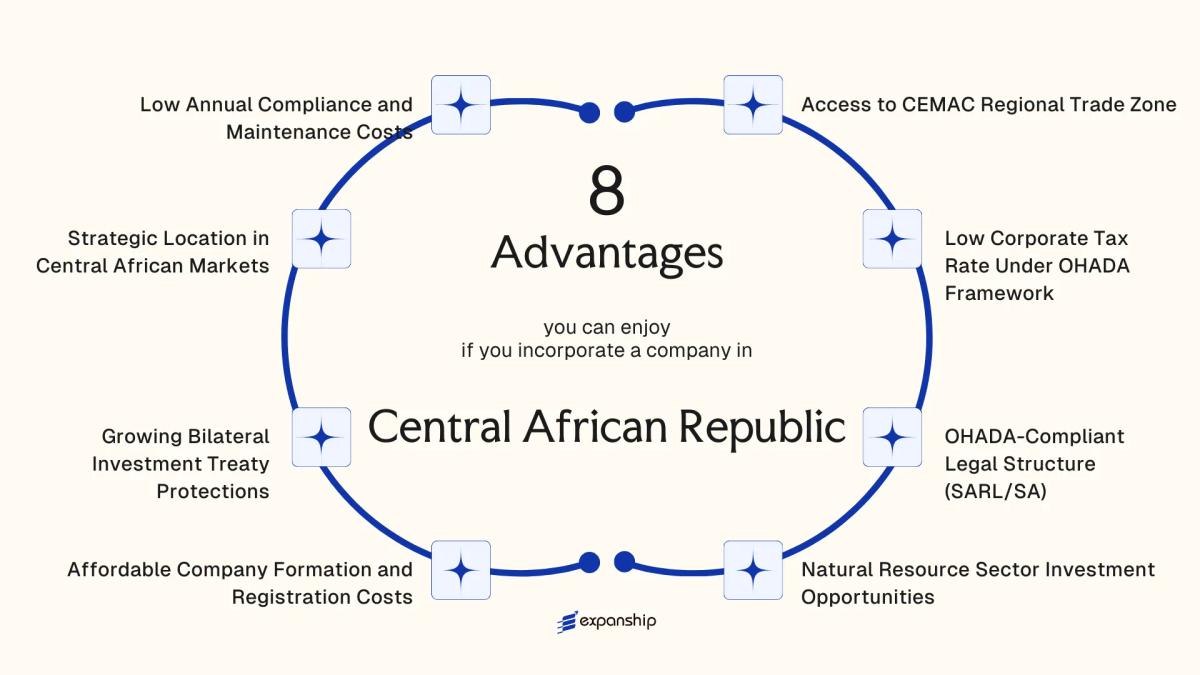
Access to CEMAC Regional Trade Zone
CEMAC trade zone benefits for CAR companies begin with a foundational geographic and legal reality: the Central African Republic is a full member of the Economic and Monetary Community of Central Africa (CEMAC), a six-nation bloc that eliminates customs duties on goods traded between member states under a common external tariff framework.
What CEMAC Membership Means in Practice
Goods produced or substantially transformed within a CEMAC member state can circulate across the bloc without attracting intra-community tariffs. For a business registered in the CAR, this translates to duty-free access to markets in Cameroon, Gabon, the Republic of Congo, Chad, and Equatorial Guinea — a combined population exceeding 60 million people.
The Regulatory Architecture Behind the Access
CEMAC's trade integration operates through the Central African Economic Union (UEAC) treaty provisions, with the BEAC serving as the monetary authority ensuring currency stability across member states through the CFA franc (XAF). A single currency across all six markets removes exchange rate risk that companies operating between non-monetary-union countries typically absorb.
Your entity gains tariff-free circulation across five additional national markets without separate trade registration in each jurisdiction.
Low Corporate Tax Rate Under OHADA Framework
CAR sits within the OHADA legal zone, a framework that harmonizes business law across 17 member states. For tax purposes, this matters because OHADA standardizes the commercial structures through which income is classified and taxed, giving foreign-owned entities a predictable legal footing before they engage with the national tax authority, the Direction Générale des Impôts et des Domaines (DGID).
The standard corporate income tax rate under CAR's Tax Code (Code Général des Impôts) is 30%. While not the lowest rate in the CEMAC bloc on paper, the effective rate for qualifying businesses can be reduced through investment incentives under the Investment Charter (Charte des Investissements), which provides tax holidays and partial exemptions during defined establishment periods.
Central African Republic corporate tax advantages under the OHADA framework become most visible when you examine what the structure actually allows:
- The OHADA Uniform Act on Commercial Companies defines the taxable entity clearly, reducing disputes over how your firm is classified for tax purposes
- The SARL form permits a single-shareholder structure, so your business does not require local partners to achieve a recognized taxable status
- Investment Charter benefits apply to registered foreign entities without requiring a domestic joint venture
- Tax holiday periods under the Charter can run for multiple years, deferring corporate tax liability during early operational phases
Your entity's eligibility for these incentives depends on meeting sector-specific investment thresholds defined in the Charter, and formal approval from the relevant investment promotion body is required before preferential rates apply.

Incorporate a Company in the Central African Republic
Set up an OHADA-compliant entity in the Central African Republic with full support from registration through tax structuring.
OHADA-Compliant Legal Structure (SARL/SA)
OHADA provides the legal foundation for both the SARL (Société à Responsabilité Limitée) and the SA (Société Anonyme) in the Central African Republic, governed by the Uniform Act on Commercial Companies and Economic Interest Groups. This shared legal architecture across all 17 OHADA member states means the rules defining shareholder liability, capital requirements, governance obligations, and director responsibilities are codified at the supranational level, not left to local legislative interpretation.
| Feature | SARL | SA |
|---|---|---|
| Minimum Share Capital | XAF 1,000,000 | XAF 10,000,000 |
| Minimum Shareholders | 1 | 1 |
| Liability | Limited to contribution | Limited to contribution |
| Share Transferability | Restricted | Freely transferable |
| Governance Body | Manager(s) | Board of Directors or sole administrator |
For a foreign business owner, the practical advantage is legal predictability. Because the SARL and SA forms are defined by a uniform supranational act, your legal counsel does not need to re-analyze a different domestic companies law each time you operate across OHADA jurisdictions. Contracts, articles of association, and governance structures drafted to OHADA standards carry recognized legal weight throughout the region.
The SARL suits smaller or closely-held operations where ownership control matters. An SA becomes relevant when your structure requires external investors, a formal board, or eventual access to capital markets. Both entity types allow full foreign ownership, and neither requires a local majority shareholder under OHADA rules.
Natural Resource Sector Investment Opportunities
Central African Republic natural resource investment opportunities are concentrated in one of Africa's least-tapped mineral belts. The country holds confirmed deposits of diamonds, gold, uranium, iron ore, and timber, with diamond extraction alone historically accounting for a significant share of formal export revenue. Under the Mining Code (Law No. 09.005), foreign-owned entities can hold mining permits and operate extraction activities on the same legal footing as domestic firms.
The Mining Code establishes permit categories ranging from artisanal authorizations to full industrial exploitation licenses, issued through the Ministry of Mines and Geology. Foreign investors registering through an OHADA-compliant entity gain direct eligibility for these permits without requiring a local ownership threshold, which removes a structural barrier common across other Sub-Saharan mining regimes.
Forestry concessions follow a separate regulatory track under the Water and Forest Code, administered by the Ministry of Waters, Forests, Hunting, and Fishing. A registered entity can apply for concession rights covering both logging and secondary timber processing.
Keep these points in mind:
- Mining permits are issued per activity type; verify the correct license category before structuring your entity
- Industrial exploitation licenses require an approved Environmental Impact Assessment filed with the Ministry
- Timber concessions carry mandatory reforestation obligations under the Water and Forest Code
- Export of rough diamonds falls under the Kimberley Process Certification Scheme, requiring compliance documentation at the point of export
Under the Mining Code, the state's automatic equity participation in large-scale mining ventures is capped, meaning private investors retain majority ownership without negotiating away control to a government entity.
Affordable Company Formation and Registration Costs
Affordable company formation costs in the Central African Republic translate directly into a lower break-even threshold for foreign investors entering the market. Under the OHADA Uniform Act on Commercial Companies, registering a Société à Responsabilité Limitée requires a minimum share capital of 100,000 XAF (approximately USD 160), one of the lower statutory minimums among OHADA member states.
Registration Fees and Administrative Costs
The Centre de Formalités des Entreprises (CFE) processes company registration, and the associated state fees remain modest relative to comparable francophone African jurisdictions. For a foreign investor, this means initial capital outlay is tied more to operational setup than to regulatory entry costs, preserving working capital from the outset.
Notarial fees apply to the drafting of articles of association and are generally calculated as a percentage of share capital, which keeps costs proportionate when capital is kept at statutory minimums. This structure rewards conservative initial capitalization for businesses testing the market before scaling.
What Low Setup Costs Mean for Foreign Investors
Low cost business registration in the CAR means your entity can be legally constituted without committing significant capital to administrative requirements alone. The OHADA framework standardizes the documentation required across member states, reducing the need for jurisdiction-specific legal drafting from scratch.
The practical outcome is a shorter runway from incorporation decision to operational status, with predictable upfront expenditure.
Plan Your Entry Into the Central African Republic
Speak with an Expanship specialist to understand the full cost structure of incorporating and maintaining a compliant entity in the CAR.
Growing Bilateral Investment Treaty Protections
Central African Republic bilateral investment treaty protections offer foreign investors a layer of legal security that sits outside the jurisdiction's domestic courts. The country is a signatory to the ICSID Convention (International Centre for Settlement of Investment Disputes), which means disputes between your business and the state can be referred to international arbitration rather than resolved solely through local judicial processes.
- ICSID membership allows foreign investors to pursue binding arbitration at the World Bank's dispute resolution body, removing dependency on national court outcomes for investment-related claims.
- CAR is a member of MIGA (Multilateral Investment Guarantee Agency), which provides political risk insurance covering expropriation, currency transfer restrictions, and breach of contract by the host government.
- The OHADA framework, which governs commercial law across 17 member states, further reinforces investor protections by establishing uniform rules on contract enforcement and business obligations that apply consistently across member jurisdictions.
- Bilateral investment treaties typically guarantee fair and equitable treatment, protection against unlawful expropriation, and free transfer of investment returns, meaning profits and capital can be repatriated without arbitrary government interference.
- For sectors operating under specific investment codes, treaty protections may interact with domestic guarantees, giving your entity a dual layer of recourse should a dispute arise.
Strategic Location in Central African Markets
Central African Republic strategic location business advantages stem from its position at the geographic center of the African continent, sharing borders with six countries: Cameroon, Chad, Sudan, South Sudan, the Democratic Republic of Congo, and the Republic of Congo. This places a registered entity within direct overland reach of both Atlantic-facing CEMAC markets and the vast DRC economy simultaneously.
For a foreign business operating in extractive industries, logistics, or trade, this translates to multi-directional market access without establishing separate legal presences in each neighboring state. A firm incorporated under CAR's OHADA framework can structure distribution or procurement operations that touch multiple national markets from a single registered address in Bangui.
The N'Djili-Bangui corridor and river routes along the Ubangi and Sangha rivers provide practical transit connections southward into the Congo Basin. These waterway networks matter particularly for bulk commodity movement, where road infrastructure across the region remains variable.
A business supplying agricultural inputs across central Africa from a Bangui-based SARL could reach an estimated combined population of over 200 million people across its six neighboring countries, without crossing into a separate regional trade bloc.
Low Annual Compliance and Maintenance Costs
Low annual compliance costs Central African Republic companies face are modest relative to many other civil law jurisdictions operating under the OHADA framework. Under the OHADA Uniform Act on Commercial Companies (Acte Uniforme relatif au droit des sociétés commerciales), annual obligations for an SARL are largely limited to financial statement preparation and filing with the Registre du Commerce et du Crédit Mobilier (RCCM). This keeps recurring expenditure predictable for a foreign-owned entity.
Annual general meetings and accounts submissions are required, but the statutory thresholds triggering mandatory external audit for smaller SARLs mean many early-stage businesses avoid that cost entirely. Your firm can therefore operate a compliant structure without the overhead that audited accounts would add.
Renewal fees at the RCCM are assessed at fixed administrative rates rather than on a percentage of capital or turnover. That structure benefits a holding or asset-light entity, where turnover-based fees would otherwise inflate maintenance costs disproportionately.
- No annual franchise tax or capital maintenance levy applies under current OHADA-harmonised rules
- Statutory accounting obligations follow OHADA's SYSCOHADA Révisé chart of accounts, which many regional accountants already apply, reducing specialist advisory fees
Mandatory external audit requirements may apply once your SARL exceeds the revenue or employee thresholds defined under the OHADA Uniform Act, so confirm your projected figures before assuming audit exemption applies.
Why Central African Republic Stands Out Among Regional Peers
Evaluating CAR against its CEMAC peers reveals a specific set of structural advantages that matter to foreign investors considering the region. Cameroon and the Republic of Congo are larger economies with higher formation and compliance costs, while Gabon carries a more expensive regulatory environment that raises the operational baseline for new entrants. CAR's positioning within this group is defined less by scale and more by cost structure, legal standardisation under OHADA, and the absence of sector-specific licensing layers that inflate setup timelines in neighbouring states.
What the comparison below captures is where CAR holds a neutral or favourable position on parameters a foreign investor would weigh before choosing a CEMAC incorporation base.
| Parameter | Central African Republic | Cameroon | Republic of Congo |
|---|---|---|---|
| OHADA Member | Yes | Yes | Yes |
| Standard Corporate Tax Rate | 30% | 33% | 28% |
| Available Entity Types (OHADA) | SARL, SA | SARL, SA | SARL, SA |
| Minimum Share Capital (SARL) | Low threshold under OHADA | Higher local requirements apply | Higher local requirements apply |
| CEMAC Trade Zone Access | Yes | Yes | Yes |
| Annual Compliance Costs | Lower relative baseline | Moderate to high | Moderate |
| Bilateral Investment Treaties | Growing treaty network | Broader treaty network | Moderate treaty network |
Compliance Services for Companies in Central African Republic
Stay current with CAR's OHADA-based reporting obligations, annual filings, and regulatory requirements through structured compliance support.
Conclusion
The benefits of incorporating in the Central African Republic are most consequential when viewed through the lens of structure, not just cost. OHADA membership gives your entity a legally portable framework recognised across 17 member states, reducing the transactional friction of operating in multiple francophone African markets. Combined with access to CEMAC's preferential trade arrangements, a firm registered here operates with a regional reach that its formation cost alone does not suggest.
OHADA's Uniform Act on Commercial Companies governs the SARL and SA structures available to foreign investors, providing statutory clarity on governance, liability, and capital requirements without dependence on domestic legislative unpredictability. For resource-sector entrants specifically, the Investment Charter and sectoral codes create a defined legal basis for capital deployment in mining and forestry concessions.
Ultimately, this jurisdiction suits businesses that are prioritising regional trade access, a structured legal framework under OHADA, and low-overhead compliance obligations over the long term. The fit is strongest for entities with operations across Central Africa or an interest in natural resource sectors covered by existing concession law. Businesses focused on high-volume consumer markets or advanced financial services infrastructure will need to assess whether those priorities align with what this market currently offers. For those whose objectives do match, the structural foundations are already in place, and the next practical step is ensuring your formation and compliance processes are executed correctly from the outset.
Start Your Central African Republic Company With Expanship Today
Expanship assists foreign investors in forming and maintaining companies in the Central African Republic, covering the full cycle from OHADA-compliant SARL or SA incorporation to ongoing filings with the Registre du Commerce et du Crédit Mobilier (RCCM). The services directly address the structural and regulatory considerations discussed throughout this blog, including CEMAC trade zone participation, investment treaty positioning, and annual compliance obligations under the OHADA Uniform Acts.
Expanship's scope of services for your entity includes:
- Preparation and legalization of incorporation documents, including statutes and notarial deeds
- Registered agent and registered office provision within the jurisdiction
- Liaison with the RCCM and other relevant government authorities for company filing and registration
- Post-incorporation compliance management, including annual reporting and renewal obligations
- Banking introduction assistance to support corporate account setup
To discuss your specific requirements, contact Expanship CAF directly.
Frequently Asked Questions (FAQ)
Under the revised OHADA Uniform Act on Commercial Companies, there is no statutory minimum share capital prescribed for an SARL, as the 2014 revision removed the previous fixed threshold. Shareholders are free to determine the amount in the articles of association, provided it is fully subscribed at the time of formation. This applies uniformly across OHADA member states, including the Central African Republic.
Registration timelines in the CAR can vary depending on the completeness of submitted documents and the current capacity of the Greffe du Tribunal de Commerce, the commercial court registry responsible for formalizing incorporation. In practice, registration through the one-stop window, known as the Centre de Formalités des Entreprises (CFE), is intended to consolidate procedures, though actual processing times can extend beyond the statutory target depending on administrative conditions on the ground. Foreign investors should account for additional time if notarization or legalization of foreign documents is required.
Yes, as a member of the Economic and Monetary Community of Central Africa (CEMAC), the CAR participates in a regional trade framework that includes, in principle, reduced tariff barriers on goods traded among member states. CEMAC member states also share the CFA franc (XAF) as a common currency, which eliminates exchange rate risk within the bloc. The practical extent of market access depends on the specific goods or services involved and any applicable sector regulations within each member state.
Corporate tax in the CAR is governed by the national tax code rather than the OHADA framework itself, as OHADA governs commercial law rather than fiscal matters. The applicable corporate income tax rate and any available exemptions or incentives under the Investment Charter or sector-specific regimes are determined by domestic legislation. You should consult the Direction Générale des Impôts et des Domaines, the national tax authority, or the current investment code to confirm the applicable rates and any preferential treatment available to qualifying entities.
If a dispute arises that falls within the scope of a bilateral investment treaty (BIT) to which the CAR is a party, the treaty's dispute resolution provisions would govern the process, typically providing access to international arbitration through bodies such as ICSID. The availability of this protection depends on whether a qualifying BIT exists between the CAR and the investor's home state, and whether the investment meets the treaty's definition of a covered investment. Treaty protections generally apply to the investor's economic interest in the entity rather than to the entity itself as a domestic legal person.
The OHADA Uniform Act on Commercial Companies does not universally mandate that a director be resident in the jurisdiction of incorporation. However, local regulatory requirements, tax registration obligations, and practical dealings with the Greffe du Tribunal de Commerce may require a locally present representative or a registered address within the country. Sector-specific licensing in industries such as mining or forestry may impose additional presence requirements beyond the baseline OHADA rules.
Legal Disclaimer
The information provided in this article is for general informational purposes only and does not constitute legal, tax, or professional advice. While we strive to ensure the accuracy and timeliness of the content, laws and regulations are subject to change, and the application of laws can vary widely based on specific facts and circumstances.
Readers should not act upon this information without seeking professional counsel tailored to their individual situation. Expanship and its authors disclaim any liability for actions taken or not taken based on the content of this article.
For specific advice regarding your business setup, compliance requirements, or any legal matters, please consult with qualified legal and tax professionals in the relevant jurisdiction.