

Key Takeaways
- Botswana's corporate tax rate of 22% sits above the rates offered by competing regional incorporation hubs, reducing its attractiveness for profit-booking structures and active trading entities.
- Foreign investors operating under the Companies Act face a mandatory local registered office requirement, adding a recurring compliance cost that offshore or nominee arrangements cannot easily eliminate.
- The Companies and Intellectual Property Authority (CIPA) administers a registration process that frequently experiences procedural delays, extending timelines beyond what foreign investors typically encounter in comparable Southern African jurisdictions.
- Restrictions on foreign land ownership and underdeveloped domestic capital markets compound financing difficulties, limiting the collateral and funding options available to foreign-owned entities conducting local operations.
Botswana operates under an evolving regulatory framework, governed primarily by the Companies Act, which the Companies and Intellectual Property Authority (CIPA) administers. The framework is moderately structured but carries practical friction points that affect foreign-owned entities more acutely than domestic ones.
The disadvantages of incorporating in Botswana span multiple operational and structural categories, from financing access to regulatory compliance burdens.
How severely these drawbacks affect your business depends significantly on the industry, the intended corporate structure, and whether operations will be conducted locally or cross-border. A holding company faces a different set of constraints than an active trading entity.
This article is most relevant to foreign investors and multinational firms looking to establish a subsidiary, branch, or locally registered company for operations within Southern Africa.
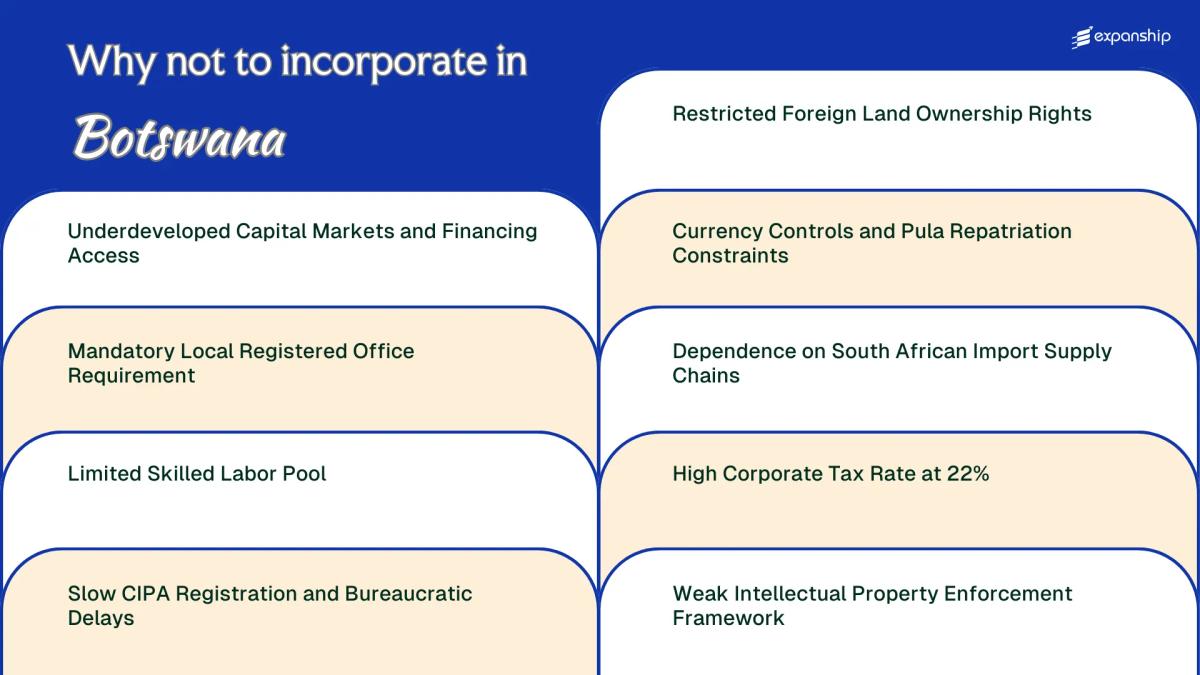
Underdeveloped Capital Markets and Financing Access
Botswana capital market limitations for businesses are a structural constraint that foreign firms frequently underestimate before entering the market. Access to institutional capital and equity financing is materially narrower here than in most comparable African jurisdictions.
Shallow Equity Markets Through the Botswana Stock Exchange
The Botswana Stock Exchange (BSE), regulated under the Securities Act of 2014, lists fewer than 50 domestic equities. For a foreign-incorporated entity seeking to raise growth capital through public markets, this depth is insufficient to generate meaningful liquidity or attract institutional participation.
Mid-sized foreign firms operating locally find that the BSE's thin trading volumes make a public listing impractical as a financing mechanism.
Limited Debt Financing and Institutional Credit Access
Commercial lending in the country is dominated by a small number of banks, with credit conditions that typically require substantial collateral from non-citizen entities. The absence of a developed corporate bond market means that debt financing options outside bank credit are largely unavailable to foreign businesses.
This forces many foreign firms into expensive short-term borrowing, constraining long-term capital allocation.
Without access to deep equity or bond markets, foreign businesses in Botswana must rely almost entirely on internal capital or offshore financing, significantly limiting their capacity to fund local expansion.
Mandatory Local Registered Office Requirement
Every company registered under the Companies Act of Botswana (Cap. 42:01) must maintain a physical registered office address within the country. This address must be operational and capable of receiving official correspondence from the Companies and Intellectual Property Authority (CIPA). For a foreign business owner without an existing physical presence, satisfying the Botswana registered office requirement restrictions means engaging a third-party registered agent or leasing local office space before operations can begin.
That dependency creates a recurring financial commitment. You cannot use a foreign address or a P.O. box, meaning the cost of compliance is structural rather than one-time.
The mandatory local address CIPA Botswana requirement generates several concrete operational burdens:
- Registered agent fees add an ongoing annual cost with no direct operational return for businesses run entirely from abroad
- Any lapse in maintaining a valid local address can expose the company to deregistration proceedings under CIPA's compliance framework
- Coordinating official correspondence through a third-party agent introduces delays in receiving regulatory notices, which can affect response deadlines
- Foreign directors unfamiliar with local providers face due diligence costs when selecting a compliant registered agent
Sole-purpose holding entities or asset-holding structures bear this cost regardless of whether they conduct any active business domestically.

Company Incorporation in Botswana
Understand the full compliance requirements before incorporating a company in Botswana, including registered office obligations under CIPA.
Limited Skilled Labor Pool
The skilled labor shortage in Botswana presents a measurable operational constraint for foreign companies that require specialized technical, managerial, or professional staff. The country's population of approximately 2.6 million is small, and the domestic pipeline of qualified graduates in fields such as engineering, financial technology, and advanced manufacturing remains thin relative to commercial demand.
Tertiary enrollment rates have improved over the past decade, but the University of Botswana and Botswana International University of Science and Technology together produce a limited annual cohort of graduates in high-demand disciplines. Your business cannot simply recruit locally if the qualified candidates do not exist in sufficient numbers.
| Metric | Detail | Implication for Foreign Firms |
|---|---|---|
| Work permit processing body | Department of Labour and Social Security | Mandatory before hiring non-citizens |
| Citizen preference obligation | Employment Act Cap. 47:01 | Foreign hires require demonstrated local unavailability |
| Citizens in managerial roles | Government expects progressive localization | Succession planning obligations apply |
| Specialist sectors with shortages | IT, finance, engineering, medicine | Reliance on expatriates unavoidable in some cases |
Hiring expatriates is the practical alternative, but the Employment Act Cap. 47:01 requires employers to demonstrate that no qualified citizen is available before a work permit is approved. That process adds recruitment timelines and administrative costs that companies in larger markets do not face.
The human capital risks of incorporating in Botswana are most acute for technology-dependent or knowledge-intensive businesses. Workforce challenges for foreign companies compound further when mid-career professionals emigrate to South Africa or the Gulf, reducing the already constrained talent pool.
Slow CIPA Registration and Bureaucratic Delays
CIPA registration delays in Botswana represent one of the more operationally disruptive challenges a foreign business will encounter during setup. The Companies and Intellectual Property Authority, which administers company incorporation under the Companies Act (Cap. 42:01), has historically struggled with processing backlogs that extend well beyond published timelines.
While CIPA operates an online registration portal, technical outages and document verification queues mean that even straightforward private company applications can stall for weeks. For a foreign business with time-sensitive market entry plans, that delay has direct costs in deferred revenue, extended legal fees, and prolonged reliance on interim structures.
Post-registration steps compound the problem. Tax registration with the Botswana Unified Revenue Service and VAT enrollment run on separate tracks, each with independent queues.
- CIPA requires certified incorporation documents before a company number is issued, with no confirmed statutory processing deadline
- Foreign directors must submit apostilled identity documentation, adding international courier time to the timeline
- Operating without a completed tax registration exposes the entity to compliance gaps even after CIPA approval
- Any errors in submitted documents require resubmission through the CIPA portal, restarting queue position
Did You Know? Botswana's company registration system only moved to a fully online process relatively recently, meaning some legacy manual processing practices still influence turnaround times at the backend.
Restricted Foreign Land Ownership Rights
Foreign land ownership restrictions in Botswana present a direct structural constraint for any entity seeking to acquire property as part of its operational or investment strategy. The legal framework creates meaningful limits on what foreign-registered businesses can hold, and the consequences extend beyond real estate into day-to-day business operations.
The Legal Basis for Ownership Restrictions
Land in Botswana falls into three categories: state land, freehold land, and tribal land. Tribal land, governed by the Tribal Land Act and administered by Land Boards, cannot be purchased outright by foreign nationals or foreign-owned companies, effectively excluding a significant portion of the country's land area from foreign acquisition. Even on freehold land, non-citizens face restrictions that require ministerial consent under the Transfer Duty Act, adding procedural delay and uncertainty to any property transaction.
Operational Consequences for Foreign-Owned Entities
Your business cannot assume that establishing a local subsidiary resolves the access problem, since a majority foreign-owned firm may still be treated as foreign for land acquisition purposes. This limits the ability to secure permanent premises, collateralise property assets for financing, or develop facilities in areas where tribal land restrictions apply.
Addressing Land and Compliance Challenges in Botswana
Understand how property restrictions and related regulatory requirements affect your corporate structure in Botswana before you commit to incorporation.
Currency Controls and Pula Repatriation Constraints
Botswana currency controls and repatriation risks present a tangible operational burden for foreign-owned entities, particularly where dividend distribution or intercompany transfers are involved. The Bank of Botswana, under the Exchange Control Act, governs all cross-border capital flows, and non-compliance carries regulatory penalties.
- Foreign firms must obtain prior approval from the Bank of Botswana before remitting profits abroad, adding administrative lead time and documentation obligations to routine treasury operations.
- The Pula is not freely convertible on international markets, meaning your business absorbs conversion costs and exchange rate exposure every time funds move across borders.
- Repatriation of loan repayments to foreign parent companies requires exchange control approval, which can delay intercompany debt servicing and disrupt group-level cash management.
- Approval conditions can include requirements to demonstrate that the remitting entity has met all local tax obligations, effectively tying repatriation to BURS clearance.
- There is no statutory guaranteed timeline for exchange control approvals, leaving your firm exposed to unpredictable processing periods.
Dependence on South African Import Supply Chains
Botswana supply chain dependency risks are structural, not incidental. The country is landlocked and relies heavily on South Africa as its primary transit corridor and import source, meaning disruptions at South African ports, border crossings, or logistics networks directly affect your business operations.
Most goods enter through the Tlokweng, Ramatlabama, or Martins Drift border posts, which are subject to delays from customs backlogs and periodic infrastructure constraints. For a manufacturing or retail operation, this creates unpredictable lead times that are difficult to hedge against contractually.
South Africa accounts for a disproportionate share of Botswana's consumer and industrial imports. Any rand depreciation, load-shedding-related production slowdowns, or South African port congestion at Durban cascades directly into your Botswana entity's cost base and inventory cycles.
- Fuel, machinery, and processed food are predominantly sourced via South African distributors
- Cross-border freight costs are compounded by SACU tariff structures and VAT reconciliation requirements
- Alternative supply routes through Zimbabwe or Zambia offer limited capacity and less reliable transit times
A hypothetical importer in Gaborone sourcing consumer goods through Durban port could face landed cost increases of 12–18% during periods of South African port congestion, based on typical Southern African freight premium estimates, before factoring in local clearing and forwarding fees.
High Corporate Tax Rate at 22%
Botswana corporate tax rate disadvantages become apparent when you place the standard 22% rate against regional and global competitors. Mauritius, for instance, applies a 15% corporate tax rate, and several African special economic zones offer rates well below 10% for qualifying entities.
Under the Income Tax Act (Cap 52:01), resident companies are taxed at 22% on taxable income. For a foreign-owned firm with significant profit margins, this rate directly reduces the capital available for reinvestment or repatriation.
Manufacturing companies may access a reduced rate of 15%, but this relief is conditional on specific activity classifications and approval. Most foreign holding structures, service businesses, and trading companies do not qualify, leaving them fully exposed to the 22% rate.
Withholding tax compounds the burden further. Dividends paid to non-resident shareholders attract an additional withholding tax, meaning the effective tax cost on distributed profits exceeds the headline 22% figure.
Before assuming your structure qualifies for any reduced rate under Botswana's Income Tax Act, confirm the activity classification directly with the Botswana Unified Revenue Service, as misclassification results in full liability at the standard 22% rate plus applicable penalties.
Weak Intellectual Property Enforcement Framework
Intellectual property enforcement problems in Botswana stem partly from limited institutional capacity. The Industrial Property Act and the Copyright and Neighbouring Rights Society of Botswana (COSBOTS) provide a legal basis for IP protection, but practical enforcement remains inconsistent.
Court proceedings involving trademark or patent disputes can be slow, and specialized IP litigation expertise within the judiciary is limited. For a foreign firm holding significant brand equity or proprietary technology, this translates directly into exposure — infringement may go unaddressed for extended periods.
Botswana is a member of the African Regional Intellectual Property Organization (ARIPO), which offers regional registration coverage, but membership does not resolve domestic enforcement gaps. Registration through ARIPO does not guarantee timely local remedies when rights are violated.
Counterfeit goods circulation, particularly in retail and informal trade, presents a tangible risk. Your business may find that stopping infringement requires private legal action with uncertain timelines and unpredictable outcomes.
Overcoming Botswana's Incorporation Challenges
Overcoming incorporation challenges in Botswana requires a structural approach grounded in the country's existing legal and regulatory framework. No single fix resolves all friction points, but several targeted measures reduce exposure across the issues covered in this blog.
- Register your entity through the CIPA portal in advance of your intended operational start date to account for documented processing delays.
- Structure financing arrangements through Development Finance Institution channels or cross-border loan facilities before incorporation, given the underdeveloped local capital markets.
- Appoint a locally resident registered office agent to satisfy the Companies Act requirement for a physical Botswana address.
- Engage a licensed local recruiter familiar with the Human Resource Development Council's skills framework to address the constrained labor pool.
- Register trademarks and patents with the Companies and Intellectual Property Authority promptly, as civil enforcement mechanisms remain limited.
- Hold Pula-denominated reserves strategically to manage repatriation constraints under Bank of Botswana foreign exchange regulations.
Mitigating risks of company formation in Botswana does not remove the structural limitations the regulatory environment imposes. Each mitigation step functions within those constraints, not around them.
Botswana Still a Viable Business Destination
Answering whether Botswana is still viable for business incorporation requires separating structural limitations from deal-breakers. The disadvantages covered in this blog are real and measurable, yet the country maintains a stable political environment, an investment-grade sovereign credit history, and one of Africa's more transparent regulatory records. For the right business profile, those foundations carry weight.
| Pro | Con |
|---|---|
| Political stability supports long-term business planning | CIPA registration delays extend the time-to-operate window |
| Low corruption levels relative to regional peers reduce operational risk | The 22% corporate tax rate reduces after-tax competitiveness compared to lower-rate jurisdictions |
| Diamond-backed fiscal reserves support macroeconomic stability | Pula repatriation constraints complicate cross-border profit distribution |
| Transparent company law under the Companies Act provides a clear legal framework | A limited skilled labor pool increases recruitment costs for technical roles |
| SADC membership supports regional trade access | Heavy reliance on South African supply chains introduces external disruption risk |
| Freehold title is available to foreign-owned companies on leasehold terms | Weak IP enforcement reduces protection for brand and technology assets |
Capital availability remains thin for early-stage foreign firms, and currency exposure to the Pula adds a layer of financial planning complexity. These factors do not disappear, but they can be anticipated and structured around with proper legal and financial planning before entry.
Corporate Compliance Services in Botswana
Maintain your Botswana company in good standing with CIPA, meet annual filing obligations, and stay current with local regulatory requirements.
Conclusion
Botswana company formation drawbacks summary points to a market with genuine structural constraints. The 22% corporate tax rate, combined with currency repatriation limitations governed by the Bank of Botswana's exchange control framework, creates measurable friction for foreign-owned entities. Weak intellectual property enforcement adds further exposure for firms holding proprietary assets. These are fixed regulatory realities, not temporary frictions. Structural improvements to CIPA processing times and capital market depth remain works in progress. Understanding exactly where these constraints apply to your specific business model determines how manageable they become in practice.
Expanship's Support for Your Botswana Expansion
From registering your entity through CIPA to maintaining ongoing compliance with the Companies Act, the administrative and regulatory obligations of doing business in Botswana carry real operational weight. Expanship Botswana company incorporation support is structured around these specific demands, helping your business manage the registration process, fulfill local office requirements, and keep pace with post-incorporation obligations without having to build that expertise in-house.
Our services cover the full scope of what your Botswana entity will require from day one and beyond.
- We prepare and submit all company registration documents directly with CIPA on your behalf.
- A registered agent and compliant local office address are provided to satisfy statutory requirements.
- We handle government filings and liaise with relevant regulatory authorities as needed.
- Ongoing compliance management keeps your firm in good standing after incorporation.
- Banking introduction assistance connects your business with appropriate local financial institutions.
- Tax registration and liaison with the Botswana Unified Revenue Service are included in our setup process.
Reach out to Expanship Botswana to discuss your incorporation requirements.
Frequently Asked Questions (FAQ)
Foreign-owned companies face significant restrictions on acquiring freehold land in Botswana, and these constraints affect almost every sector that requires owned premises rather than leased space. The Tribal Land Act and associated land board processes mean that even securing long-term usable rights over land takes considerably longer than in jurisdictions with open foreign ownership regimes. Businesses reliant on owned physical infrastructure, such as manufacturing or logistics, carry the most exposure.
A business incorporated in Botswana that depends on South African imports is structurally exposed to rand exchange rate movements, cross-border logistics disruptions, and South African regulatory changes over which it has no influence. The Limpopo border corridor handles a disproportionate volume of Botswana's goods imports, meaning any bottleneck at that crossing directly affects operational continuity. This single-corridor concentration is a real supply chain risk that companies should quantify before committing to a Botswana operating model.
The Companies and Intellectual Property Authority (CIPA) handles all company registrations in Botswana, and processing times can extend beyond official timelines due to document verification backlogs and manual review steps that have not been fully digitized. Name reservation, document submission, and certificate issuance are separate steps, and each carries its own queue. Foreign-owned entities face additional scrutiny, which compounds total turnaround time compared to domestic incorporations.
No. Botswana's Companies Act requires every registered company to maintain a physical registered office address within the country, and a foreign address does not satisfy this requirement. The registered office must be capable of receiving official correspondence and regulatory notices, which means a nominee or managed office arrangement through a local service provider is the minimum viable solution. Failure to maintain a compliant registered office can result in administrative penalties and jeopardize the company's good standing with CIPA.
Botswana's legal framework for intellectual property registration exists, but enforcement through the courts is slow and expensive relative to the scale of most disputes. A foreign company holding trademarks, patents, or proprietary software has limited practical recourse if infringement occurs, because civil litigation timelines are long and specialist IP judicial capacity is limited. For businesses where IP is a core commercial asset, this gap between registered rights and enforceable protection is a material operational risk.
Repatriating profits from Botswana as a foreign investor involves compliance with Bank of Botswana exchange control requirements, and while Botswana is not a fully closed capital account, the process adds administrative friction and approval timelines that many investors underestimate. The Pula is not freely traded on international markets, which creates conversion costs and timing exposure that do not exist in more liquid currency jurisdictions. Investors structuring dividend flows or intercompany loans should factor in these mechanics during pre-incorporation planning.
The skills shortage in Botswana is most acute in technical fields such as engineering, finance, and information technology, where local graduate supply does not meet private sector demand. Companies in services or knowledge-intensive industries are more constrained than those in extractive or lower-skill sectors, where labor supply is less of a bottleneck. Hiring expatriate workers is a partial solution, but work permit processing through the Department of Labour and Home Affairs adds time and cost to any workforce plan.
Legal Disclaimer
The information provided in this article is for general informational purposes only and does not constitute legal, tax, or professional advice. While we strive to ensure the accuracy and timeliness of the content, laws and regulations are subject to change, and the application of laws can vary widely based on specific facts and circumstances.
Readers should not act upon this information without seeking professional counsel tailored to their individual situation. Expanship and its authors disclaim any liability for actions taken or not taken based on the content of this article.
For specific advice regarding your business setup, compliance requirements, or any legal matters, please consult with qualified legal and tax professionals in the relevant jurisdiction.