

Key Takeaways
- Botswana's source-based tax system, combined with a standard corporate rate of 22% and a reduced 15% rate for IFSC-registered entities, allows foreign businesses to calculate their tax exposure with precision before committing to incorporation.
- Governed by the Companies Act of 2003 and administered through the Companies and Intellectual Property Authority, Botswana's registration framework gives foreign directors and shareholders a codified, predictable process for establishing a local entity.
- The absence of exchange controls under Botswana's liberalised Exchange Control Act framework means profits and capital can be repatriated to parent entities or foreign investors without regulatory restriction.
- Private companies incorporated in Botswana face no mandatory local ownership requirements, enabling full foreign shareholding alongside access to SADC and AGOA trade arrangements that can reduce tariff costs across regional markets.
Botswana is an independent, landlocked republic in Southern Africa, bordered by South Africa, Namibia, Zimbabwe, and Zambia. For foreign businesses evaluating the benefits of incorporating in Botswana, the starting point is the Companies and Intellectual Property Authority, the statutory body responsible for company registration and intellectual property administration. Most foreign investors register a private limited company to establish a local presence.
The country operates under a low-tax, source-based system, meaning tax liability generally attaches to income generated within its borders rather than on worldwide earnings. Foreign direct investment faces few formal restrictions at the entity level, and the government has maintained a consistent policy of openness toward foreign capital across most sectors. This article examines the key advantages that Botswana company formation offers to international businesses and investors.
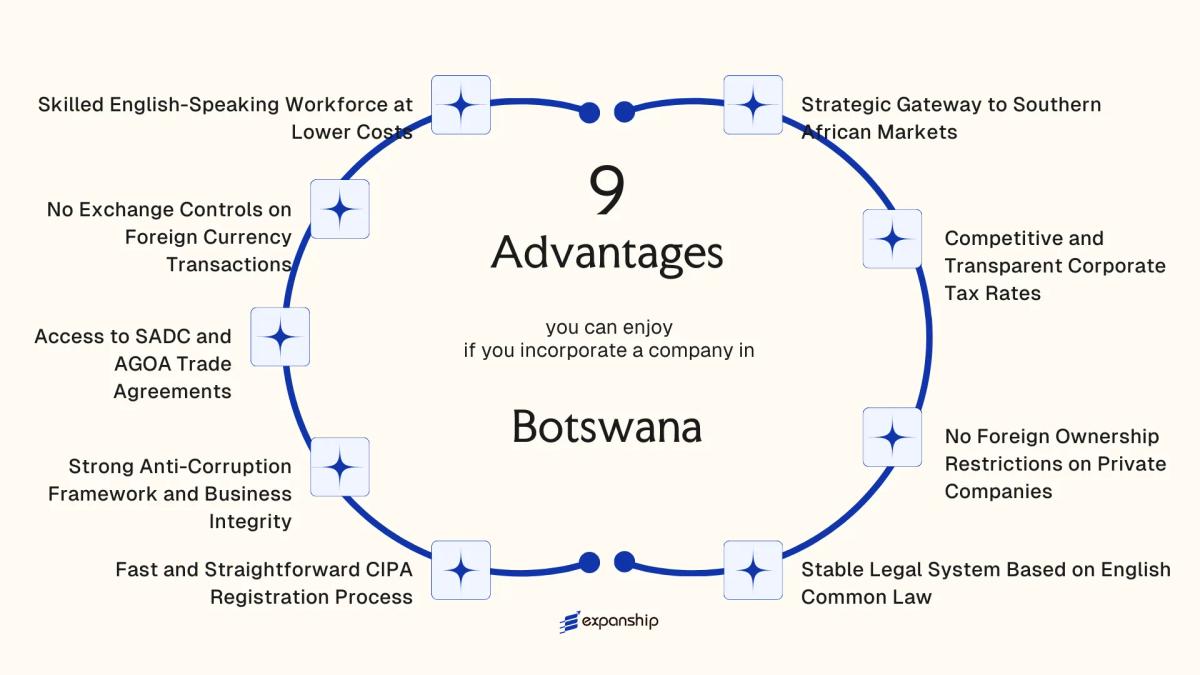
Strategic Gateway to Southern African Markets
Botswana sits at the geographic and economic centre of Southern Africa, sharing borders with South Africa, Zimbabwe, Zambia, and Namibia. This position gives a company incorporated here direct overland access to some of the continent's most active trade corridors.
Central Position Within the SADC Region
Membership in the Southern African Development Community places your business within a regional bloc of 16 countries and a combined population exceeding 380 million people. Goods produced or distributed from a Botswana-registered entity can move across SADC member states under preferential tariff arrangements, reducing the cost of regional distribution compared to operating from outside the bloc.
Gateway to South Africa's Economy
The Botswana gateway to Southern Africa markets carries particular weight given direct access to South Africa, the continent's most industrialised economy. The two countries share the Southern African Customs Union (SACU) framework, which eliminates customs duties on qualifying goods traded between member states, meaning your firm avoids the tariff friction that non-SACU entities face when entering South African markets.
A Botswana-incorporated entity can access South Africa's consumer and industrial markets tariff-free under SACU, without requiring a separate South African company structure.
Competitive and Transparent Corporate Tax Rates
Botswana's standard corporate tax rate sits at 22%, which positions the country meaningfully below many comparable African jurisdictions and well beneath the OECD average. For foreign investors assessing after-tax returns, this rate directly affects the cost of doing business and the proportion of profit available for reinvestment or repatriation.
The rate structure itself is straightforward. The Botswana Unified Revenue Service (BURS) administers corporate income tax under the Income Tax Act, and taxable income is calculated on a source basis, meaning only income generated within the country is generally subject to tax. This limits your firm's exposure compared to worldwide taxation systems where global earnings attract domestic liability.
Companies operating under the International Financial Services Centre (IFSC) framework have historically benefited from a reduced rate of 15%, applicable to qualifying cross-border financial and services activities. The practical effect is a tiered system that allows certain businesses to structure their operations at a lower effective rate.
Transparency compounds this advantage. The tax filing calendar is defined, assessments follow a standardised process, and BURS publishes guidance on obligations. Predictability in tax administration reduces compliance cost and eliminates the ambiguity that inflates effective tax burdens in less structured environments.
Key structural features that work in your favour:
- No withholding tax applies to dividends paid to resident companies, reducing friction in group structures
- Capital gains on the sale of shares in unlisted companies are taxed at an effective rate lower than the headline corporate rate
- Transfer pricing rules exist but are applied within a defined legislative framework, giving multinationals a clear basis for structuring intercompany transactions

Incorporate a Company in Botswana
Register your business in Botswana through CIPA with full compliance support from Expanship.
No Foreign Ownership Restrictions on Private Companies
Under the Companies Act of 2003, private companies incorporated in Botswana face no statutory restrictions on foreign ownership. A non-resident investor can hold 100 percent of the shares in a private limited company without requiring a local partner, government approval, or minimum domestic shareholding. This gives you full control over equity structure from the outset.
| Parameter | Rule Under Companies Act 2003 |
|---|---|
| Maximum foreign shareholding | 100% |
| Local partner requirement | None |
| Regulatory pre-approval for foreign ownership | Not required |
| Minimum share capital for foreign-owned entity | No statutory minimum |
| Applicable entity type | Private company (Pty Ltd) |
The Companies and Intellectual Property Authority (CIPA) registers private companies without applying nationality-based conditions to shareholding or directorship composition. This means your ownership structure is determined by your business needs, not by host-country political considerations.
Full ownership also has direct implications for profit distribution. Without mandatory local partners, dividend payments flow entirely to foreign shareholders, subject to applicable withholding tax rules rather than negotiated profit-sharing arrangements. For investors establishing a wholly-owned subsidiary or holding structure, this eliminates a common friction point found in markets across the African continent that maintain indigenisation or empowerment thresholds.
Sectors subject to licensing, such as financial services or telecommunications, may carry separate regulatory requirements that affect operational approvals, though these do not alter the underlying ownership rules within the Companies Act itself.
Stable Legal System Based on English Common Law
Botswana's legal system is built on English common law, a framework inherited at independence in 1966 and since developed through domestic legislation and judicial precedent. For foreign businesses, this is a concrete structural advantage: contract terms are interpreted using principles familiar to investors from the UK, Commonwealth countries, and jurisdictions that model their commercial law on English doctrine.
The Companies Act (Cap. 42:01) governs corporate formation and directors' duties using concepts that align with standard common law thinking on fiduciary obligations, shareholder rights, and corporate separation. Your contracts, dispute resolution clauses, and governance documents translate directly without requiring extensive local adaptation.
Dispute resolution operates through an independent judiciary. The High Court has jurisdiction over commercial matters, and judgments can be enforced through established procedural rules. Foreign arbitral awards are also recognisable under Botswana's accession to the New York Convention, giving cross-border commercial arrangements a reliable enforcement path.
Keep these points in mind:
- Contract law principles align with English common law precedent
- The Companies Act provides defined rules on director duties and shareholder protections
- Foreign arbitral awards are enforceable under the New York Convention
- The High Court handles commercial disputes through an independent judiciary
- Customary law applies in certain personal and family matters but does not affect commercial arrangements between registered entities
Botswana has never had a commercial court judgement overturned due to political interference, a record that distinguishes it from several of its regional peers.
Fast and Straightforward CIPA Registration Process
One of the practical Botswana CIPA registration benefits for businesses is the speed at which a company can become legally operational. The Companies and Intellectual Property Authority (CIPA) operates an online registration portal that processes private company applications without requiring physical presence in the country, which directly reduces setup costs and elapsed time for foreign founders.
Registration Timeline and What It Means for Your Business
Under the Companies Act (Cap 42:01), a private limited company can be registered within two to three business days through CIPA's online system, provided all documents are submitted correctly. For a foreign investor, that speed translates into a shorter window between commitment and revenue-generating activity, avoiding the weeks-long delays common in other Sub-Saharan jurisdictions.
A company name reservation can be completed online before full registration begins. This lets you secure your trading identity while finalizing incorporation documents, preventing name conflicts without halting the overall process.
Structural Requirements That Work in Your Favor
CIPA company registration in Botswana requires a minimum of one director and one shareholder, with no mandatory local director requirement for private companies. That structural simplicity means you can establish a fully operational entity without the added cost and coordination of appointing a resident nominee director.
The registered office address must be maintained within the country, but this is a standard compliance requirement met through a local registered agent. No minimum share capital is prescribed for private companies under the Companies Act, so you are not required to lock up capital simply to complete incorporation.
Get Guidance on Incorporating in Botswana
Speak with our team to understand the registration process, document requirements, and compliance obligations for setting up your company through CIPA.
Strong Anti-Corruption Framework and Business Integrity
Botswana's anti-corruption framework business advantages are grounded in institutional structure, not just policy statements. The Directorate on Corruption and Economic Crime (DCEC), established under the Corruption and Economic Crime Act of 1994, operates as an independent investigative and prosecutorial body with a mandate that extends to the private sector. That independence matters to foreign businesses because it signals that enforcement is not selectively applied.
- Transparency International consistently ranks Botswana among the least corrupt countries in Africa, which reduces the informal costs that erode margins in higher-risk jurisdictions — facilitation payments, opaque licensing processes, and unpredictable regulatory outcomes.
- The DCEC's mandate includes educating businesses on compliance obligations, giving your firm a structured point of contact when building internal anti-bribery controls.
- Public procurement and regulatory decisions operate under published rules, reducing the risk of arbitrary treatment that can disadvantage foreign-owned entities.
- A transparent business environment for investors also affects counterparty risk. Local partners, suppliers, and government agencies operate within the same accountability framework, lowering due diligence complexity.
- For businesses subject to home-country anti-bribery laws such as the UK Bribery Act or the US Foreign Corrupt Practices Act, operating in a jurisdiction with an active anti-corruption authority and clear enforcement history directly supports your own compliance posture.
Access to SADC and AGOA Trade Agreements
Botswana SADC and AGOA trade agreement benefits give registered companies preferential access to markets that most jurisdictions simply cannot offer through a single incorporation point. As a member of the Southern African Development Community, a firm incorporated here trades within a regional bloc of 16 member states under the SADC Trade Protocol, which eliminates or reduces tariffs on qualifying goods moving between member countries.
Under the African Growth and Opportunity Act, products manufactured or sufficiently processed in eligible sub-Saharan African countries, including Botswana, can enter the United States duty-free across more than 1,800 product categories. For a foreign-owned manufacturing or export business, this creates a direct cost advantage when targeting American buyers.
AGOA eligibility is determined at the country level by the U.S. government and is subject to periodic review against governance and trade criteria, so maintaining compliance with local regulatory standards is a practical requirement for companies seeking to use this route.
A manufacturer exporting $500,000 worth of qualifying textile goods to the U.S. under AGOA could avoid tariff costs that would otherwise reach 12–32% under standard MFN rates, representing a saving of $60,000 to $160,000 on a single shipment cycle.
No Exchange Controls on Foreign Currency Transactions
Botswana imposes no exchange controls on foreign currency transactions, meaning your business can move funds across borders without seeking prior approval from the Bank of Botswana or any other regulatory authority. This freedom directly eliminates the administrative friction that slows capital deployment in many African markets.
Foreign currency repatriation operates without restriction. Profits, dividends, loan repayments, and capital can be transferred out of the country in any major currency at any time. For a foreign-owned entity, this removes the risk of capital being trapped in the local market.
The practical consequence for your business is predictability. Treasury operations, intercompany payments, and investor distributions are not subject to permit requirements or bureaucratic queues that could delay financial planning.
Key transactional freedoms include:
- Unrestricted repatriation of dividends and profits
- No caps on foreign currency held in local bank accounts
- Freedom to invoice and settle contracts in foreign currencies
- No mandatory conversion of foreign earnings into Pula
While no exchange controls apply, transactions may still be subject to standard anti-money laundering reporting requirements under the Financial Intelligence Act, so large cross-border transfers may require supporting documentation.
Skilled English-Speaking Workforce at Lower Costs
Botswana English-speaking skilled workforce advantages are rooted in the country's education system and its colonial administrative heritage. English is an official language and the primary medium of instruction from secondary school onward, producing graduates who can operate in international business environments without language barriers or the need for translation infrastructure.
The University of Botswana, Botswana Accountancy College, and the Botswana International University of Science and Technology supply trained professionals across accounting, finance, engineering, and information technology. For a foreign company establishing regional operations, this reduces dependence on expatriate hires, which in turn lowers both salary expenditure and the administrative costs tied to work permit processing under the Botswana Citizens Economic Empowerment Policy.
Wage levels in Botswana sit below those in South Africa and many European markets. The national minimum wage framework, administered under the Employment Act (Cap 47:01), sets sector-specific rates that remain competitive for businesses seeking to staff back-office, support, or technical functions at sustainable cost points. This cost differential allows firms to allocate capital toward operations rather than compensation overhead.
Skills available locally include:
- Chartered and management accountants (ACCA and CIMA qualifications are widely held)
- Legal professionals trained in English common law
- IT and software development graduates
- Logistics and supply chain personnel with regional market experience
The Botswana Qualifications Authority regulates credential recognition, giving employers a structured way to verify the professional standing of local candidates before onboarding.
Why Botswana Stands Out Against Regional Competitors
Foreign investors evaluating southern Africa typically weigh Botswana against South Africa, Mauritius, and Namibia. South Africa offers a larger domestic market but carries significantly more administrative complexity, higher tax compliance burdens, and exchange control obligations under the Currency and Exchanges Act. Mauritius is frequently positioned as an offshore financial hub, but its treaty shopping reputation has attracted OECD scrutiny, and its substance requirements have tightened considerably. Namibia shares a stable legal tradition but has a smaller economy and less developed financial infrastructure.
What the comparison reveals is structural. The absence of exchange controls under the Exchange Control Act (now largely repealed for non-residents), a flat corporate tax rate, and CIPA's straightforward registration process together create an operating environment with fewer friction points than most regional peers, without requiring the offshore structuring that Mauritius demands to achieve similar outcomes.
| Parameter | Botswana | South Africa | Mauritius | Namibia |
|---|---|---|---|---|
| Corporate Tax Rate | 22% (standard) | 27% | 15% (GBL) | 32% |
| Exchange Controls | None for non-residents | Yes, administered by SARB | Partial | Yes |
| Foreign Ownership (Private Companies) | 100% permitted | 100% permitted | 100% permitted | 100% permitted |
| Legal System | English Common Law | Mixed (Civil and Common Law) | Mixed (Civil and Common Law) | English Common Law |
| SADC Membership | Yes | Yes | Yes | Yes |
| AGOA Eligibility | Yes | Yes | Yes | Yes |
| Corruption Perceptions Index (2023 Rank) | 45th | 83rd | 53rd | 57th |
Compliance Services for Companies in Botswana
Maintain your Botswana company's good standing with ongoing statutory filings, annual returns, and regulatory compliance support under CIPA and applicable local law.
Conclusion
Botswana presents a structurally sound case for foreign incorporation, grounded in verifiable regulatory and fiscal conditions rather than broad regional promise. The absence of exchange controls under the Exchange Control Act's liberalised framework, combined with a corporate tax rate of 22% for standard companies and 15% for those operating under the International Financial Services Centre, gives your business a clear and calculable cost structure from the outset.
Beyond taxation, registration through the Companies and Intellectual Property Authority is governed by the Companies Act of 2003, a codified framework that reduces administrative uncertainty for foreign directors and shareholders. Two benefits, in particular, distinguish this jurisdiction for internationally oriented businesses: full foreign ownership of private companies without mandatory local partner requirements, and unrestricted repatriation of profits and capital, which directly affects how you structure returns to parent entities or investors abroad.
The suitability of Botswana company formation depends on your business model, your target markets within the SADC region, and the nature of your cross-border transactions. A holding structure, a trading entity, or a financial services operation each engages differently with the available tax treaties and regulatory obligations. The advantages of Botswana business registration are real, but they yield the most value when the structure is aligned with your specific operational and legal requirements. Proper entity design, carried out with jurisdiction-specific knowledge, determines whether those structural benefits translate into measurable outcomes for your firm.
Start Your Botswana Company with Expanship Today
Botswana company formation with Expanship covers the full registration cycle under the Companies Act (Cap. 42:01), from preparing incorporation documents to filing with the Companies and Intellectual Property Authority (CIPA). The entity types, compliance timelines, and regulatory obligations examined throughout this blog each require accurate, jurisdiction-specific handling, and Expanship's service model is built around those exact requirements.
For foreign business owners, that translates into practical support at every stage of establishing and maintaining a registered presence:
- Preparation and legalization of incorporation documents, including the constitution and director consent forms
- Registered agent and registered office provision to satisfy CIPA's local address requirements
- Government filing and direct liaison with CIPA throughout the registration process
- Post-incorporation compliance management, including annual returns and directorship record maintenance
- Banking introduction assistance to support account opening with local financial institutions
- Ongoing registered office maintenance for entities requiring a continuous local footprint
Reach out to Expanship Botswana to discuss your incorporation requirements.
Frequently Asked Questions (FAQ)
The Companies and Intellectual Property Authority (CIPA) processes standard company registrations within one to three business days when all documents are submitted correctly through its online portal. The timeline assumes no name reservation disputes or missing information in the application. Delays typically arise from incomplete submissions rather than processing backlogs.
The standard corporate income tax rate is 22% for resident companies. Businesses operating within the International Financial Services Centre (IFSC) framework are taxed at a reduced rate of 15% on qualifying income. Your effective rate will depend on the nature of your business activities and whether your entity qualifies for any approved incentive structures.
No exchange controls apply to foreign currency transactions, meaning dividends, royalties, and capital proceeds can be remitted abroad without regulatory approval. This policy is established under the Exchange Control Act, which has been substantially liberalised. The absence of repatriation restrictions is particularly relevant to foreign investors managing multi-jurisdictional treasury operations.
The Companies Act (Cap. 42:01) requires that a private company appoint at least one director, but that director is not required to be a Botswana resident or citizen. A registered office address within the country is mandatory, as is the appointment of a registered agent. The directorship requirement can therefore be satisfied by a foreign national.
The legal system is grounded in English common law, which means commercial contracts are interpreted using principles familiar to investors from the United Kingdom, Commonwealth jurisdictions, and countries whose legal frameworks derive from the same tradition. The High Court has jurisdiction over commercial disputes, and Botswana is a signatory to the New York Convention on the Recognition and Enforcement of Foreign Arbitral Awards, supporting the enforceability of international arbitration outcomes. This provides a degree of predictability in commercial litigation that is not always available in the region.
As a member of the Southern African Development Community (SADC), a Botswana-registered entity can access preferential tariff treatment across the SADC Free Trade Area. Botswana also benefits from the African Growth and Opportunity Act (AGOA), which grants eligible exports duty-free access to the United States market. Eligibility for specific preferential rates depends on meeting the relevant rules of origin requirements under each agreement.
Legal Disclaimer
The information provided in this article is for general informational purposes only and does not constitute legal, tax, or professional advice. While we strive to ensure the accuracy and timeliness of the content, laws and regulations are subject to change, and the application of laws can vary widely based on specific facts and circumstances.
Readers should not act upon this information without seeking professional counsel tailored to their individual situation. Expanship and its authors disclaim any liability for actions taken or not taken based on the content of this article.
For specific advice regarding your business setup, compliance requirements, or any legal matters, please consult with qualified legal and tax professionals in the relevant jurisdiction.