

Key Takeaways
- Bulgaria's 10% flat corporate income tax rate — the lowest in the EU alongside Cyprus — means retained profits are taxed at a fraction of the rate applied in most Western European member states, directly improving the economics of operating through a Bulgarian entity.
- An OOD can be registered with a minimum share capital of just BGN 2 through the Registry Agency's Commercial Register, removing the capital barrier that restricts entry under other EU incorporation frameworks.
- Bulgaria's network of over 70 double tax treaties reduces withholding tax exposure on cross-border profit distributions, making the structure materially more efficient for international ownership chains than the headline corporate rate alone suggests.
- As an EU member state, a Bulgarian OOD or AD provides legal access to the EU Single Market, allowing the entity to operate under the same treaty-based freedoms — goods, services, capital, and persons — available to companies incorporated in larger, higher-cost member states.
Bulgaria is a member state of the European Union, situated in Southeast Europe on the eastern Balkan Peninsula, bordering the Black Sea to the east and sharing land borders with Romania, Serbia, North Macedonia, Greece, and Turkey. Understanding the benefits of incorporating in Bulgaria begins with knowing which authority governs the process: company registration falls under the jurisdiction of the Registry Agency, which maintains the Commercial Register and the Register of Non-Profit Legal Entities. Foreign nationals and foreign-owned entities face no general restrictions on establishing or owning a Bulgarian company, reflecting the country's openness to foreign direct investment under EU treaty obligations.
The most common legal vehicle chosen by international businesses is the OOD. From a tax standpoint, Bulgaria operates a low-tax regime with a flat corporate income tax rate, making it one of the more tax-efficient environments within the EU. This article examines the key advantages that company formation in Bulgaria offers to foreign investors and business owners.
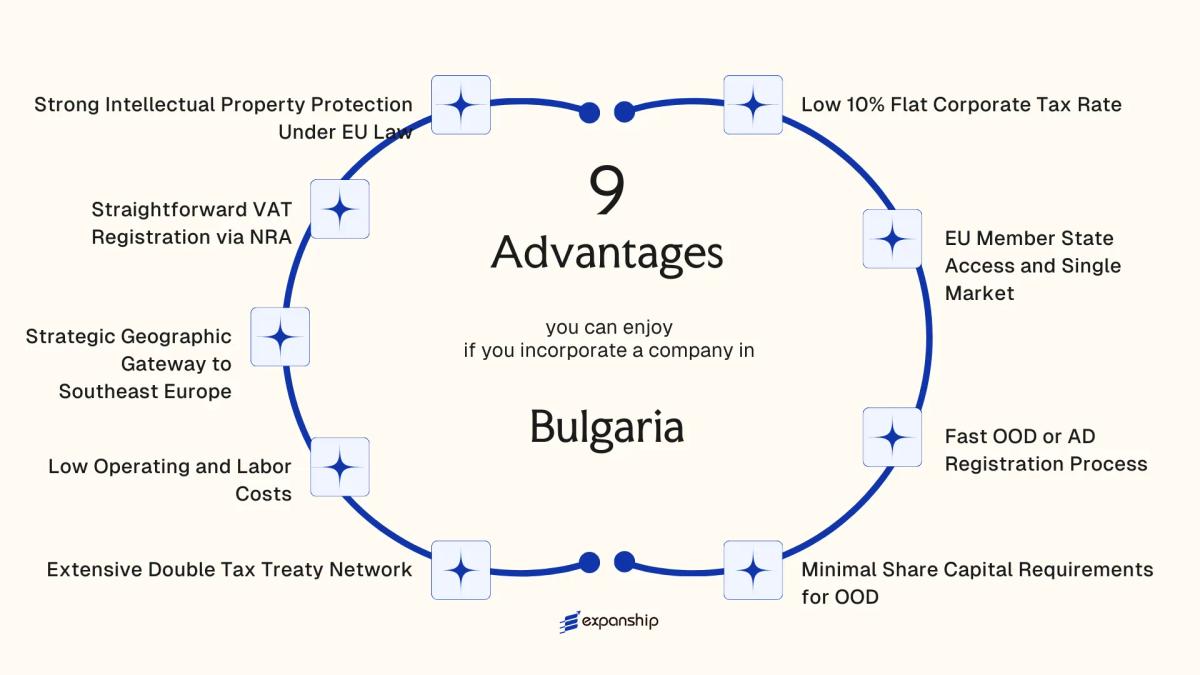
Low 10% Flat Corporate Tax Rate
Bulgaria's 10% flat corporate tax advantage is one of the most structurally significant features of the country's fiscal regime. Under the Corporate Income Tax Act (CITA), this rate applies uniformly to taxable profit, without progressive brackets or turnover-based thresholds.
What the Rate Actually Means for Your Profit
At 10%, Bulgaria holds the lowest corporate tax rate among EU member states — the EU average sits near 21%. For a foreign-owned OOD generating €500,000 in annual taxable profit, the difference in tax liability compared to operating through a German or French entity can reach six figures annually.
How the Tax Base Is Calculated
Taxable profit is determined by adjusting accounting profit under CITA rules, which align broadly with standard accrual accounting. This means your retained earnings compound faster, giving the business more capital to reinvest without requiring complex structuring to achieve tax efficiency.
At 10% flat, your Bulgarian entity retains substantially more after-tax profit than equivalent structures in most Western EU jurisdictions, without relying on special regimes or exemptions.
EU Member State Access and Single Market
Bulgaria's EU membership grants your business direct access to the European single market, a trading area covering over 450 million consumers across 27 member states. For a foreign-owned entity registered here, this access is not conditional on additional licensing or market-entry approvals in most sectors — the firm operates under the same foundational rules as any German or French counterpart.
The practical consequence is significant. A Bulgarian-registered OOD or AD can issue invoices, sign contracts, and move goods across EU borders without customs duties applying under intra-EU trade rules. Freedom of establishment under the Treaty on the Functioning of the European Union (TFEU) further allows your entity to open branches or representative offices in other member states without incorporating separately in each one.
Operating within the EU regulatory perimeter also carries structural advantages for investor credibility:
- EU accounting and auditing standards apply, making financial statements recognizable to European partners and lenders
- GDPR compliance from a single registration covers data processing operations across all member states
- Access to EU procurement frameworks opens public tender opportunities across the bloc
- Banking relationships with EU-licensed institutions become available without the friction that offshore-registered entities often encounter

Incorporate a Company in Bulgaria
Set up a Bulgarian OOD or AD with full EU single market access. Expanship manages the registration process end to end.
Fast OOD or AD Registration Process
Registering an OOD or AD in Bulgaria moves faster than in most EU member states, and that speed has direct consequences for how quickly your business can begin operating, signing contracts, and opening bank accounts. The Commercial Register, maintained by the Registry Agency under the Commercial Register and Register of Non-Profit Legal Entities Act, processes standard OOD incorporations within a few business days once documentation is complete. For time-sensitive market entries, this timeline removes a friction point that elsewhere can stretch into weeks.
| Feature | OOD | AD |
|---|---|---|
| Governing Law | Commerce Act | Commerce Act |
| Registration Body | Registry Agency | Registry Agency |
| Typical Processing Time | A few business days | Slightly longer due to prospectus requirements |
| Minimum Shareholders | 1 | 1 |
| Management Structure | Manager(s) | Board of Directors |
The Registry Agency accepts filings electronically, which means your appointed local representative can submit incorporation documents without requiring your physical presence in the country. This matters for foreign founders who cannot travel to Sofia during the formation window.
Turnaround certainty also reduces the cost of professional standby time. When formation drags on, legal and administrative fees accumulate. A defined, short registration window keeps those costs predictable from the outset, giving your business a cleaner financial start before operations even begin.
Minimal Share Capital Requirements for OOD
One of the more concrete Bulgaria OOD minimal share capital advantages is the statutory minimum: just BGN 2 (approximately EUR 1) under the Commerce Act. For context, comparable limited liability structures in Germany require EUR 25,000, and France's SAS requires EUR 1 of share capital but retains more complex governance requirements. At BGN 2, you can legally form and register a Bulgarian OOD without tying up operating funds in a statutory deposit account.
This threshold matters because it removes a common barrier to entry. Capital that would otherwise sit locked in a bank account to meet a minimum requirement stays available for actual business operations from day one.
Under the Commerce Act, capital must be fully paid up before registration. Each founder's contribution must meet the BGN 2 floor, but there is no upper limit, and contributions can be made in cash or in kind.
Keep these points in mind:
- The BGN 2 minimum applies per company, not per shareholder
- In-kind contributions require independent valuation under Article 72 of the Commerce Act
- The registered capital figure appears on your company's public registry entry with the Commercial Register
- Capital can be increased post-registration by shareholder resolution without reforming the entity
A Bulgarian OOD with BGN 2 share capital carries the same legal standing and liability protection as one incorporated with BGN 200,000.
Extensive Double Tax Treaty Network
Bulgaria's double tax treaty network benefits foreign businesses through one of the wider treaty frameworks among EU member states. As of current records, the country has concluded double taxation agreements with over 70 jurisdictions, covering major trading and investment partners across Europe, Asia, North America, and the Middle East. These treaties are governed under Bulgarian domestic tax law alongside the OECD Model Convention principles, and they directly reduce or eliminate withholding taxes on dividends, interest, and royalty payments flowing across borders.
Reduced Withholding Tax Exposure on Cross-Border Payments
Under Bulgaria's domestic tax rules, withholding tax on dividends paid to non-resident corporate shareholders is set at 5%. Treaty provisions frequently reduce this further or eliminate it entirely depending on the counterparty jurisdiction. For holding structures or businesses channeling royalty income, this matters significantly since the standard domestic withholding on royalties is 10%, and applicable DTTs can bring that rate down substantially.
Treaty Access as a Structural Planning Tool
Your entity's residency in Bulgaria grants access to these treaty benefits, which can reduce the overall tax friction on international income flows. A business routing payments between, say, a Southeast Asian supplier and a Western European client can use Bulgarian tax residency to minimize double taxation at each transaction point. Treaty eligibility typically requires that the entity meets the tax residency conditions under Bulgarian law, specifically that it is incorporated locally or has its place of effective management within the country.
Unlock Bulgaria's Tax Treaty Advantages for Your Business
Speak with Expanship's specialists to understand how Bulgaria's DTT network applies to your specific structure and cross-border income flows.
Low Operating and Labor Costs
Bulgaria low operating costs for businesses are a measurable advantage, not an abstract claim. Salary levels, office rental rates, and utility costs sit well below the EU average, which directly reduces your monthly fixed expenditure compared to operating in Western or Northern European markets.
- The average gross monthly wage in Bulgaria remains among the lowest in the EU, giving businesses access to a qualified, educated workforce at a fraction of the cost of equivalent talent in Germany, France, or the Netherlands.
- The statutory minimum wage, set by Council of Ministers decree and adjusted periodically, applies uniformly, but even skilled professionals in sectors such as IT, accounting, and engineering command salaries that are significantly lower than Western European benchmarks.
- Commercial office rental rates in Sofia and secondary cities like Plovdiv and Varna are substantially cheaper than in comparable EU capitals, reducing overhead for firms establishing a physical presence.
- Social security contributions paid by employers are set at defined statutory rates under the Social Insurance Code, and the combined employer burden is lower than in most Western EU member states, further reducing the total cost of employment.
- For a foreign-owned OOD or AD, this cost structure means your entity can maintain a genuine operational presence, with local staff and a registered office, without the capital outlay that equivalent setups require elsewhere in the EU.
Strategic Geographic Gateway to Southeast Europe
Bulgaria's strategic location in Southeast Europe places your business at a crossroads between the EU's single market and high-growth economies across the Western Balkans, Turkey, and the Black Sea region. Situated at the intersection of major trans-European transport corridors — specifically TEN-T Corridor VIII and Corridor IV — the country offers direct overland and maritime connectivity into markets that many Western European firms struggle to reach cost-effectively.
For businesses targeting Balkans market access, Sofia functions as a practical base. Serbia, North Macedonia, Greece, Turkey, and Romania are all within a few hours by road or rail, meaning regional distribution and client servicing do not require separate legal entities in each country.
The geographic advantage extends to trade facilitation. As an EU member operating under the Union Customs Code, goods processed through Bulgaria move freely within the bloc while remaining close to non-EU Balkan markets where preferential trade agreements such as CEFTA still shape commercial flows.
A company registered in Sofia can reach Istanbul (approximately 550 km), Thessaloniki (approximately 320 km), and Bucharest (approximately 400 km) without crossing more than one or two international borders, reducing both logistics costs and customs friction compared to routing through Central Europe.
Straightforward VAT Registration via NRA
One of the Bulgaria VAT registration benefits via NRA is the relatively direct process administered by the National Revenue Agency (NRA), which reduces administrative drag for foreign-owned entities entering the market.
Registration is mandatory once your firm's taxable turnover reaches BGN 100,000 in the preceding 12 months. Voluntary registration is available below that threshold, which gives your business the option to reclaim input VAT from the outset rather than waiting until the mandatory trigger is reached.
The standard VAT rate is 20%, in line with the EU's minimum rate directive. Once registered, a Bulgarian entity receives a BG-prefixed VAT number recognized across all EU member states, enabling intra-community transactions without additional validation steps.
Key practical advantages of NRA VAT registration for foreign businesses include:
- VAT numbers are valid across the EU single market immediately upon issuance
- Online filing through the NRA's e-services portal reduces in-person requirements
- Voluntary registration allows input VAT recovery before the mandatory threshold is reached
Foreign entities registering voluntarily below the BGN 100,000 threshold must demonstrate genuine economic activity in Bulgaria; registration without substantive business operations may be challenged by the NRA.
Strong Intellectual Property Protection Under EU Law
As an EU member state, Bulgaria extends the full suite of Bulgaria EU intellectual property protection benefits to businesses incorporated there. EU-wide IP instruments apply directly, including the EU Trade Mark (EUTM) regulation administered by the European Union Intellectual Property Office (EUIPO), the Community Design framework, and the Unified Patent Court system. A single EUTM registration covers all 27 member states, meaning your Bulgarian entity gains territorial protection across the entire single market without separate national filings.
EU Directives Transposed into National Law
The country has transposed core EU IP directives into domestic legislation, including the Trade Marks Act, the Copyright and Neighbouring Rights Act, and the Patent and Utility Model Act. These are administered domestically through the Patent Office of the Republic of Bulgaria (Патентно ведомство). The practical effect for a foreign-owned firm is that your IP assets sit within a harmonized legal environment, enforceable through both national courts and EU-level mechanisms.
Enforcement and Border Measures
EU Customs Regulation No. 608/2013 applies in Bulgaria, allowing customs authorities to detain goods suspected of infringing registered IP rights at the border. This matters for businesses that manufacture, distribute, or license products through Southeast European trade routes.
Software and Database Protections
Under the EU Software Directive (2009/24/EC) and Database Directive (96/9/EC), software and structured data assets created or owned by your entity receive automatic legal recognition. No separate registration is required for copyright to attach, which reduces administrative overhead for technology-focused businesses.
Why Bulgaria Stands Out Among EU Incorporation Destinations
Compared against its EU peers, Bulgaria holds a measurable structural position on several parameters that matter to foreign investors: tax rates, incorporation costs, and operating expenses. The jurisdictions chosen for this comparison, Romania, Cyprus, and Estonia, reflect realistic alternatives that businesses evaluating EU incorporation tend to weigh simultaneously. Romania shares geographic proximity and a similar cost profile; Cyprus targets offshore-adjacent structuring and holding company setups; Estonia draws attention through its digital residency program and deferred taxation model.
What the comparison clarifies is that no single metric tells the full story. The 10% flat corporate tax rate positions Bulgarian entities favourably against Cyprus's 12.5% and Estonia's distributed-profit model, where retained earnings face 0% but distributions are taxed at 20%. For businesses that intend to retain and reinvest profits, the Estonian model has a different logic entirely. However, for firms requiring predictable annual tax liability and low operational overhead, the Bulgarian framework, administered under the Corporate Income Tax Act (CITA), presents a consistently defined cost structure.
| Parameter | Bulgaria | Romania | Cyprus | Estonia |
|---|---|---|---|---|
| Corporate Tax Rate | 10% flat | 16% standard | 12.5% standard | 0% retained / 20% on distribution |
| Minimum Share Capital (LLC equivalent) | BGN 2 (~€1) | RON 200 (~€40) | €1 | €2,500 |
| EU Member State | Yes | Yes | Yes | Yes |
| Double Tax Treaties (approx.) | 70+ | 90+ | 65+ | 60+ |
| Standard VAT Rate | 20% | 19% | 19% | 22% |
Compliance Services for Companies in Bulgaria
Stay current with Bulgarian corporate filing deadlines, statutory reporting obligations, and NRA requirements through Expanship's compliance support.
Conclusion
Incorporating in Bulgaria offers a structurally sound case for foreign business owners, built on concrete regulatory and fiscal foundations rather than broad promises. The 10% flat corporate tax rate — the lowest in the EU alongside Cyprus — combined with access to the EU Single Market through a registered OOD or AD, creates a cost and market-access combination that few member states can match at this price point.
Two factors in particular distinguish the Bulgarian framework for international operators. Registering through the Commercial Register at the Registry Agency is straightforward, and the minimum share capital requirement of BGN 2 for an OOD removes a genuine barrier to entry. Set against this, the country's network of over 70 double tax treaties reduces withholding tax exposure across major trading partners, which directly affects how efficiently your business can move profits across borders.
That said, the right fit depends on your specific ownership structure, the nature of your operations, and the tax residency position of your principals. What applies cleanly to a holding entity may carry different implications for an active trading company or a firm with employees on the ground.
For businesses where the combination of low taxation, EU market access, and minimal formation costs aligns with operational goals, the regulatory environment in Bulgaria provides a clear and codified path to incorporation. The practical steps to move from decision to registration are well-defined, and the process benefits from having qualified local support to ensure compliance with both Bulgarian commercial law and NRA filing requirements from the outset.
Let Expanship Handle Your Bulgarian Company Formation
Expanship Bulgaria company formation services cover the full process of establishing an OOD or AD under the Commercial Act (Targovski zakon), from initial document preparation through registration with the Bulgarian Commercial Register held by the Registry Agency. The firm also handles ongoing obligations under the Accountancy Act and coordinates with the National Revenue Agency (NRA) on tax and VAT matters discussed throughout this blog.
Service scope includes:
- Preparation and notarization of incorporation documents, including the Memorandum of Association
- Registered agent and registered office address provision in Bulgaria
- Filing with the Registry Agency and liaison throughout the registration process
- Post-incorporation compliance management, including annual reporting and NRA submissions
- Assistance coordinating introductions to local banking institutions
- Support with VAT registration applications submitted to the NRA
Professional Bulgaria incorporation services for investors are available through advisors familiar with the Registry Agency's procedures and the NRA's filing requirements. For foreign businesses without a local presence, having an established point of contact for government correspondence reduces administrative delays and eliminates the need to manage filings remotely. Expanship Bulgarian OOD formation advantages extend beyond the registration itself to the ongoing maintenance obligations that determine whether a company remains in good standing.
Reach out to Expanship Bulgaria to discuss your incorporation requirements.
Frequently Asked Questions (FAQ)
Registration with the Bulgarian Commercial Register, maintained by the Registry Agency, generally takes between one and five business days once all documents are submitted in proper order. The timeline assumes that notarized incorporation documents, proof of paid-in share capital, and the company's articles of association are filed without deficiencies. Delays usually arise from incomplete documentation rather than procedural backlogs.
The minimum share capital for an OOD is BGN 2, equivalent to approximately EUR 1. At least one-third of each founder's contribution must be paid in before registration, with the remainder payable within two years. This capital must be deposited into a Bulgarian bank account opened in the company's name prior to filing.
Bulgaria's tax treaties can reduce or eliminate withholding tax on dividends paid to foreign parent companies, depending on the specific treaty in force between Bulgaria and the recipient's country of residence. Under domestic law, the standard withholding tax on dividends paid to non-resident entities is 5%. Where an applicable treaty sets a lower rate, or where the EU Parent-Subsidiary Directive applies, that reduced rate takes precedence.
The 10% flat corporate income tax rate under the Corporate Income Tax Act applies to the taxable profits of Bulgarian-registered entities. Certain income streams, such as dividends received from EU or EEA subsidiaries, may be exempt from corporate tax under participation exemption rules. Income derived from Bulgarian sources by non-resident entities that do not operate through a permanent establishment is subject to withholding tax rather than the standard corporate rate.
Failure to submit annual financial statements to the Bulgarian Commercial Register within the statutory deadline exposes the company and its manager to administrative fines under the Accountancy Act. Persistent non-compliance can result in escalating penalties and, in certain circumstances, may trigger compulsory deregistration proceedings. The annual accounts must also be filed with the National Revenue Agency for tax purposes, making dual compliance a firm obligation.
A newly registered Bulgarian company is not automatically enrolled for VAT. Mandatory registration with the National Revenue Agency is triggered once the firm's taxable turnover reaches BGN 100,000 within any consecutive 12-month period. Voluntary registration is available below that threshold and is commonly used by businesses that trade with VAT-registered EU counterparts and wish to recover input tax from the outset.
Legal Disclaimer
The information provided in this article is for general informational purposes only and does not constitute legal, tax, or professional advice. While we strive to ensure the accuracy and timeliness of the content, laws and regulations are subject to change, and the application of laws can vary widely based on specific facts and circumstances.
Readers should not act upon this information without seeking professional counsel tailored to their individual situation. Expanship and its authors disclaim any liability for actions taken or not taken based on the content of this article.
For specific advice regarding your business setup, compliance requirements, or any legal matters, please consult with qualified legal and tax professionals in the relevant jurisdiction.