
Key Takeaways
- Chad's membership in the OHADA legal framework gives foreign-incorporated entities access to standardised Uniform Acts that reduce interpretive uncertainty and provide a consistent basis for contract enforcement across member states.
- Foreign investors operating through a Chadian Société à Responsabilité Limitée benefit from a recognised legal structure that accommodates foreign equity ownership under the country's investment code without requiring a complex formation process.
- Bilateral investment treaties binding on Chad create enforceable protections for cross-border capital, giving foreign shareholders defined legal recourse in the event of disputes or adverse state action.
- Chad's position bordering six countries at the intersection of Saharan and sub-Saharan trade routes makes it a practical base for distribution, logistics, and resource extraction operations targeting landlocked Central African markets within the CEMAC zone.
Chad is a landlocked, independent republic in north-central Africa, bordered by six countries and positioned at the intersection of Saharan and sub-Saharan trade routes. Company registration falls under the authority of the Centre National d'Appui au Développement et à la Promotion de l'Emploi (CNAP), which administers the formal business registration process. Foreign businesses typically incorporate through a Société à Responsabilité Limitée.
The country operates under a standard corporate tax regime governed by the Code Général des Impôts, with rates and incentive structures that reflect its status as a developing economy pursuing private sector growth. On foreign ownership, Chadian law generally permits foreign nationals to hold equity in locally registered entities, and the government has taken steps through its investment code to signal openness to foreign direct investment across several priority sectors.
The benefits of incorporating in Chad are specific to its legal environment, regional positioning, and sector-driven regulatory framework. This article examines those advantages in detail.
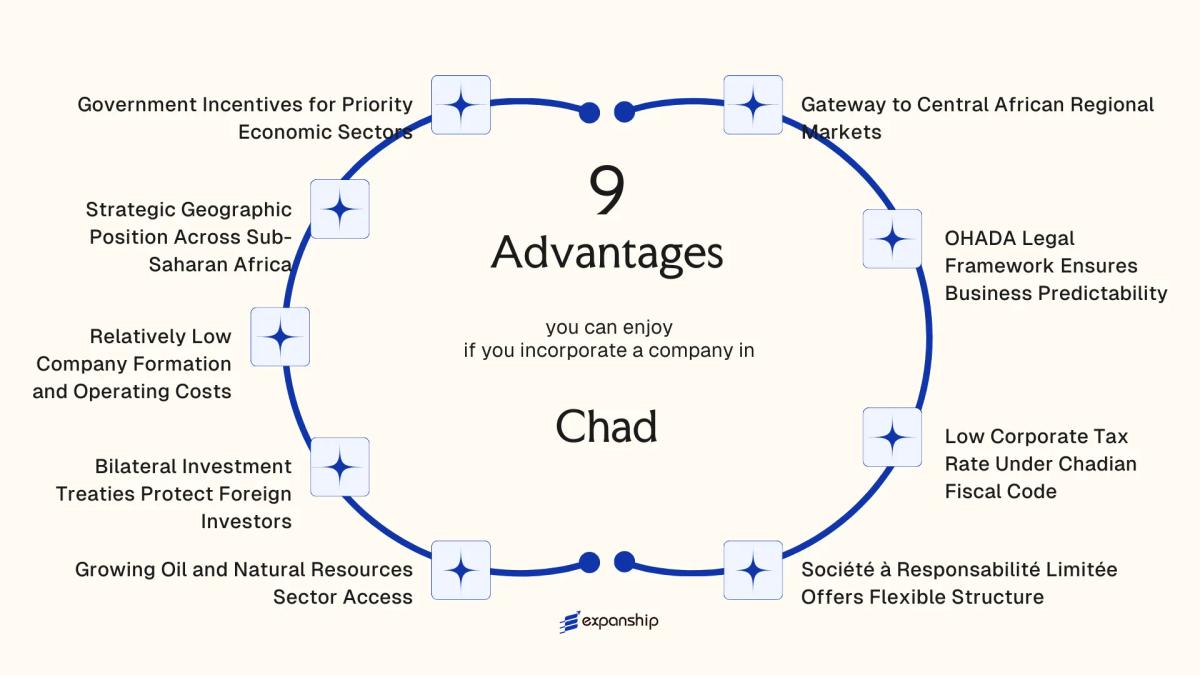
Gateway to Central African Regional Markets
Incorporating in Chad positions your business inside the six-member Central African Economic and Monetary Community, known by its French acronym CEMAC. This membership translates directly into preferential market access across Cameroon, the Central African Republic, the Republic of Congo, Equatorial Guinea, and Gabon.
CEMAC Membership as a Market Access Mechanism
A company registered in Chad operates within a monetary union that uses the CFA franc (XAF) and benefits from a common external tariff structure governing trade across member states. That shared currency eliminates intra-regional exchange rate exposure for cross-border transactions within the bloc, reducing a cost that businesses operating outside the union routinely absorb.
CEMAC's combined population exceeds 60 million people, and a single incorporated entity can distribute goods and services across member states without facing the tariff barriers that apply to firms incorporated outside the union.
Regional Regulatory Architecture
The Organisation for the Harmonisation of Business Law in Africa, known as OHADA, governs commercial law across CEMAC member states, meaning contracts and corporate structures your entity establishes in Chad carry recognisable legal weight in neighbouring jurisdictions. This cross-border legal consistency reduces the need for separate legal frameworks when expanding operations regionally.
A single Chad-registered entity can access CEMAC's common market under one currency and a shared commercial legal system.
OHADA Legal Framework Ensures Business Predictability
Chad is a member state of the Organisation pour l'Harmonisation en Afrique du Droit des Affaires (OHADA), a treaty-based legal system that unifies commercial law across 17 African nations. The OHADA legal framework benefits Chad by replacing fragmented national commercial codes with standardized Uniform Acts that govern company formation, contracts, securities, insolvency, and arbitration. For a foreign investor, this means the legal rules your business operates under are not unique to Chad alone — they are consistent, codified, and interpreted by a supranational court, the Common Court of Justice and Arbitration (CCJA) based in Abidjan.
That judicial consistency carries practical weight. Disputes involving commercial contracts can be referred to the CCJA, removing reliance on national courts where procedural unpredictability may otherwise be a concern.
Business predictability under OHADA Chad stems from several structural features of the framework:
- Uniform Acts are directly applicable without requiring national transposition, eliminating gaps between treaty text and local implementation
- The CCJA provides a single appellate jurisdiction for OHADA matters, creating consistent case law across all member states
- Contract enforcement mechanisms are defined at the supranational level, reducing exposure to jurisdiction-specific procedural variations
- Arbitration procedures under the OHADA Uniform Act on Arbitration are recognized regionally

Company Incorporation in Chad
Register your business in Chad under the OHADA legal framework with guidance from Expanship's corporate services team.
Low Corporate Tax Rate Under Chadian Fiscal Code
Under the Chadian fiscal code, the standard corporate income tax rate is set at 35% for most commercial entities. While this figure is not the lowest in Sub-Saharan Africa, the code provides a tiered structure that can reduce effective rates significantly for businesses operating in designated sectors or qualifying as small and medium enterprises under Chadian tax classification thresholds.
| Business Category | Standard CIT Rate | Notes |
|---|---|---|
| Large enterprises (general regime) | 35% | Applied to net taxable profit |
| Small and medium enterprises | Reduced flat tax basis | Subject to simplified tax regime eligibility |
| Priority sector investments | Negotiated or reduced rates | Subject to Investment Charter conditions |
| Petroleum and extractive sector | Sector-specific regime | Governed by separate fiscal arrangements |
Your entity's effective tax burden can fall well below the headline rate once applicable deductions, depreciation allowances, and sector exemptions under the Investment Charter of Chad are applied. For foreign firms structuring operations in the country, this gap between the statutory and effective rate is where the practical advantage lies.
Taxable profit is calculated after deducting allowable business expenses, meaning that a properly structured firm with legitimate operational costs in-country can reduce its taxable base substantially. The Chadian fiscal administration, the Direction Générale des Impôts, oversees compliance and applies these provisions as codified, giving your business a defined and predictable framework to work within.
Société à Responsabilité Limitée Offers Flexible Structure
The Chad SARL flexible business structure suits foreign investors who need limited liability without the complexity of a full joint-stock company. Under the OHADA Uniform Act on Commercial Companies and Economic Interest Groups, a Société à Responsabilité Limitée requires a minimum of one shareholder and one manager, making solo incorporation entirely viable. Liability is capped at each shareholder's contribution to the share capital, which means personal assets remain protected from company debts.
Minimum share capital requirements under OHADA rules are set at a modest threshold, and shares are not publicly traded, so ownership remains private. This structure gives your business direct control over profit distribution and internal governance without the disclosure obligations that apply to larger corporate forms.
The SARL also permits a single-member variant, the SARLU (Société à Responsabilité Limitée Unipersonnelle), which is governed by the same OHADA framework. Foreign nationals can hold 100% of shares, and the manager need not be a Chadian resident, reducing the administrative friction for non-resident operators.
Keep in mind while using this structure:
- The SARL cannot issue shares to the public or list on a stock exchange
- Share transfers to third parties require prior approval from existing shareholders
- At least one formally appointed manager (gérant) must be named in the articles
- Annual accounts must be deposited with the Tribunal de Commerce
A single individual can simultaneously hold the role of sole shareholder and gérant in a SARLU, effectively operating a one-person limited liability entity with no co-founders required.
Growing Oil and Natural Resources Sector Access
Chad oil sector investment advantages extend directly from the country's position as one of sub-Saharan Africa's established petroleum producers. Since the Doba Basin fields came online in 2003 via the Chad-Cameroon Pipeline, the extractive sector has remained a primary driver of government revenue and foreign capital inflow. For a business seeking natural resources sector access in Chad, this history of upstream activity translates into an existing regulatory architecture, contractor ecosystems, and infrastructure that a new entrant can work within rather than build from scratch.
Petroleum Regulatory Framework and What It Means for Your Entity
The Ministry of Petroleum and Energy oversees upstream licensing, and the national oil company SHT (Société des Hydrocarbures du Tchad) holds equity participation rights in production-sharing agreements. This structure means your firm enters a defined contractual relationship with established counterparties, reducing ambiguity over ownership rights and revenue allocation from the outset. Production-sharing agreements under Chadian petroleum law also specify cost-recovery mechanisms, which directly affects how foreign investors account for capital expenditure.
Sector Scope Beyond Crude Oil
Chad's subsoil holds uranium, gold, and natron deposits, meaning the Chad petroleum industry business benefits framework extends into broader extractive licensing. The mining sector is governed by a separate Mining Code, giving your business a distinct legal track depending on the resource target. Foreign investment in Chad's extractive industries is not confined to a single commodity, which widens the strategic rationale for establishing a local entity.
Structure Your Entry Into Chad's Extractive Sector
Speak with Expanship's team about incorporating an entity positioned to access Chad's oil and natural resources sector under the applicable regulatory frameworks.
Bilateral Investment Treaties Protect Foreign Investors
Chad bilateral investment treaties for foreign investors provide a layer of legal protection that sits outside the domestic court system, giving your business recourse through international arbitration if the state acts in breach of treaty obligations.
- Chad is a signatory to the Convention on the Settlement of Investment Disputes Between States and Nationals of Other States (ICSID Convention), administered by the World Bank. This means disputes between your firm and the Chadian state can be submitted to binding international arbitration rather than resolved solely through local courts, removing a significant source of jurisdictional risk.
- Investment protection agreements Chad has concluded include treaties with several countries, covering protections such as fair and equitable treatment, protection against expropriation without compensation, and free transfer of funds. These standards apply independently of domestic legislation.
- Chad is also a member of the Multilateral Investment Guarantee Agency (MIGA), which provides political risk insurance against non-commercial risks including expropriation, currency inconvertibility, and breach of contract by the state.
- Membership in OHADA does not replace BIT protections; both frameworks operate concurrently, meaning your entity benefits from treaty-level investment protections alongside a harmonized regional commercial law system.
Treaty coverage varies by the nationality of your investors, so confirming which specific bilateral instruments apply to your home jurisdiction before structuring your investment is advisable.
Relatively Low Company Formation and Operating Costs
Low company operating costs in Chad begin at the formation stage. Registering a Société à Responsabilité Limitée (SARL) requires a minimum share capital of XAF 100,000 (approximately USD 165), which is among the lower thresholds within the OHADA zone. For a foreign investor, this means less capital is tied up in regulatory requirements and more remains available for operational deployment.
Office rental and labor costs outside N'Djamena are considerably lower than in comparable Central African commercial hubs. This cost differential matters practically: a firm establishing a regional distribution or processing operation can maintain lower monthly overhead without sacrificing physical presence.
Government fees for company registration are processed through the Centre de Formalités des Entreprises (CFE), the single-window authority that consolidates incorporation procedures. Consolidating these steps under one body reduces the professional fees typically incurred when filings are spread across multiple agencies.
A hypothetical SARL incorporated with XAF 1,000,000 in share capital and two employees would face estimated first-year statutory costs, including registration fees, notarial charges, and social contribution filings, of roughly XAF 350,000 to XAF 500,000 (approximately USD 580 to USD 830), making initial compliance costs manageable for early-stage market entry.
Strategic Geographic Position Across Sub-Saharan Africa
Chad's strategic location in Sub-Saharan Africa places it at the intersection of five country borders — Sudan to the east, Libya to the north, the Central African Republic to the south, Cameroon and Nigeria to the southwest, and Niger to the west. For a business registered there, this translates into direct overland access to multiple distinct regional markets without requiring a secondary establishment in each.
N'Djamena functions as a transit corridor connecting Central African Economic and Monetary Community (CEMAC) member states with West African economies. Goods and services originating from a Chadian entity can move through these corridors under regional trade protocols, reducing the friction associated with cross-border commerce.
The country's position also grants proximity to landlocked neighbors that depend on Chad as a transit route, particularly for imports moving through Cameroonian ports. A firm operating here can structure supply chain or distribution functions that serve multiple national markets from a single registered base.
- Borders five countries across two regional blocs (CEMAC and ECOWAS-adjacent markets)
- Overland corridors connect to both Central and West African trade routes
- N'Djamena serves as an established transit point for goods entering landlocked neighboring states
Transit and cross-border trade advantages depend on the specific goods classification and applicable CEMAC or bilateral trade protocols, which may impose separate licensing or origin certification requirements.
Government Incentives for Priority Economic Sectors
Chad government incentives for priority sectors are codified within the national Investment Charter and administered through the Agence Nationale des Investissements et des Exportations (ANIE). Foreign businesses operating in designated priority sectors gain access to a structured package of fiscal and customs advantages that reduce the cost of establishing and running operations.
Sector-Specific Fiscal Exemptions
Businesses in agriculture, livestock, renewable energy, manufacturing, and certain infrastructure activities qualify for targeted tax reductions or exemptions under the Investment Charter. These can include exemption from corporate income tax for a fixed period during the operational phase, depending on the sector and investment volume. For a foreign firm committing capital to any of these industries, this translates directly to preserved margins during the years when returns are still developing.
Customs Duty Reductions on Qualifying Imports
Priority sector investors may benefit from reduced or suspended customs duties on equipment and raw materials imported for qualifying projects. This is particularly relevant given that most capital equipment must be sourced externally. Lower upfront import costs reduce the capital exposure your business carries before revenue generation begins.
Investment Zone Considerations
Certain incentives are tied to geographic investment zones as defined under Chadian regulatory policy. Investments directed toward less-developed interior regions may attract enhanced benefits relative to those located in N'Djamena. Eligibility conditions typically require formal approval from ANIE and a minimum investment threshold, which varies by sector classification.
- Agriculture and agro-processing
- Renewable energy infrastructure
- Manufacturing and industrial processing
- Livestock and fisheries
- Tourism development
Why Chad Stands Out Among Central African Jurisdictions
Positioned within the CEMAC zone alongside Cameroon, the Central African Republic, the Republic of Congo, Gabon, and Equatorial Guinea, Chad's competitive advantages over Central African jurisdictions become most visible when examining the structural features that directly affect foreign investors. The country's OHADA membership is a differentiating factor; while all CEMAC states share the same monetary union, not all present the same legal clarity or cost profile for entity formation and ongoing compliance. Compared to Gabon, where incorporation costs and notarial fees are significantly higher, or the Central African Republic, where institutional stability remains constrained, Chad offers a relatively lower cost base combined with a recognized legal framework under the OHADA Uniform Acts.
The CEMAC region's common external tariff also applies uniformly, but your firm's practical access to regional trade routes depends on the host country's infrastructure and geographic reach. With borders touching six countries and proximity to both Saharan and sub-Saharan trade corridors, a business registered here can access markets that a Libreville or Bangui-based entity cannot reach as efficiently overland.
| Parameter | Chad | Cameroon | Gabon |
|---|---|---|---|
| OHADA Member | Yes | Yes | Yes |
| Standard Corporate Tax Rate | 35% | 33% | 30% |
| CEMAC Monetary Union | Yes | Yes | Yes |
| Company Formation Cost (approx.) | Lower | Moderate | Higher |
| Political/Institutional Stability Index | Moderate | Moderate-High | Moderate |
| Access to Landlocked Markets | High | Moderate | Low |
Compliance Services for Companies in Chad
Maintain your Chadian entity's good standing with ongoing regulatory, tax, and statutory filing support tailored to OHADA and local fiscal requirements.
Conclusion
Incorporating in Chad presents a defined case for foreign businesses looking to access Central Africa through a jurisdiction with structural and regulatory advantages that are not incidental.
The OHADA Uniform Acts provide a standardised legal foundation that reduces interpretive uncertainty for foreign entities, while the country's bilateral investment treaties create enforceable protections for cross-border capital. These are not soft incentives. They are binding legal instruments that directly affect how your business operates and what recourse you have if disputes arise.
Access to CEMAC regional trade flows and proximity to multiple landlocked markets adds a geographic dimension that matters specifically for distribution, resource extraction, and logistics operations. A Société à Responsabilité Limitée formed under Chadian company law gives your business a locally recognised structure without requiring you to engage with a more complex formation process. The combination of a defined legal form and regional market access is what distinguishes this jurisdiction from others at a comparable stage of economic development.
Whether this fits your business depends on your industry, the legal structure you require, and your existing presence in the region. Firms operating in oil services, agriculture, or cross-border trade will find stronger alignment with what the jurisdiction offers than those in sectors with limited regulatory frameworks here. Knowing where those alignments exist, and how to formalise them within Chadian law, is where the formation process begins.
Start Your Chad Company Formation With Expanship
Chad company formation with Expanship covers the full scope of obligations that foreign investors encounter when establishing a presence under the OHADA Uniform Act on Commercial Companies. From selecting between a Société à Responsabilité Limitée and a Société Anonyme to meeting the registration requirements administered by the Registre du Commerce et du Crédit Mobilier, each step involves procedural specifics that vary from what most foreign founders have previously encountered. Expanship manages that process on your behalf, working directly with the relevant Chadian authorities to keep your incorporation on track.
Our services across the Chad corporate setup process include:
- Preparation and legalization of all incorporation documents required by the RCCM
- Provision of a registered agent and local office address for your entity
- Government filing and direct liaison with the Registre du Commerce et du Crédit Mobilier
- Post-incorporation compliance management, including annual reporting obligations
- Banking introduction assistance to support your operational setup in-country
- Ongoing registered office maintenance to satisfy statutory presence requirements
Expanship does not replace legal counsel, and for complex matters, independent legal advice remains your decision to make. What we provide is structured, jurisdiction-specific administrative support that reduces the friction between your incorporation decision and your entity becoming operational.
Reach out to Expanship Chad to discuss your business registration requirements.
Frequently Asked Questions (FAQ)
OHADA membership means that your business operates under a supranational commercial legal framework rather than solely domestic Chadian statute, which reduces the risk of unpredictable local legal interpretation. The OHADA Uniform Acts are directly applicable in all member states and cover company formation, insolvency, arbitration, and securities law. Disputes can be escalated to the OHADA Common Court of Justice and Arbitration (CCJA), providing an internationally recognized adjudication mechanism outside domestic courts.
The standard corporate income tax rate under the Chadian Fiscal Code is 35%, though companies operating in priority sectors or qualifying under the Investment Charter may be eligible for reduced rates or temporary exemptions. The applicable rate depends on the sector classification and whether your entity qualifies for any incentive regime. Confirmation of the applicable rate requires review of the current Finance Law, as rates can be adjusted through annual budget legislation.
Chad has concluded bilateral investment treaties (BITs) with several countries, and these agreements typically provide enforceable protections including guarantees against expropriation without compensation, free transfer of capital and returns, and access to international arbitration. The specific protections available to your business depend on whether a BIT exists between Chad and your home country. Where a BIT applies, disputes are generally resolved through international arbitration rather than domestic courts, which is a meaningful procedural distinction.
Chad's Investment Charter establishes a framework under which businesses in designated priority sectors can access incentives such as customs duty exemptions, tax holidays, and reduced fiscal charges during an establishment phase. The sectors typically prioritized include agriculture, manufacturing, and infrastructure, though the precise eligibility criteria are defined by the Charter and supplementary regulations. Applications for incentive status are processed through the relevant administrative authority, and approval is not automatic upon incorporation.
Formation timelines for a SARL in Chad generally range from several weeks to a few months, depending on the completeness of documentation and the processing capacity of the relevant registry. Registration is handled through the Centre de Formalités des Entreprises (CFE), which serves as a one-stop administrative body for business formalities. Delays commonly arise from notarization requirements, document apostille or legalization procedures, and the requirement to publish a formation notice in an authorized legal gazette.
Chad is a member of the Economic and Monetary Community of Central Africa (CEMAC), which encompasses six countries and operates under a common external tariff and a shared currency, the CFA franc (XAF). Incorporation in Chad gives your entity access to the CEMAC common market, which in principle allows goods to circulate among member states without internal customs duties, subject to rules of origin and sector-specific regulations. Membership in both CEMAC and OHADA creates a dual regional framework that shapes both market access and the governing legal structure for commercial activity.
Legal Disclaimer
The information provided in this article is for general informational purposes only and does not constitute legal, tax, or professional advice. While we strive to ensure the accuracy and timeliness of the content, laws and regulations are subject to change, and the application of laws can vary widely based on specific facts and circumstances.
Readers should not act upon this information without seeking professional counsel tailored to their individual situation. Expanship and its authors disclaim any liability for actions taken or not taken based on the content of this article.
For specific advice regarding your business setup, compliance requirements, or any legal matters, please consult with qualified legal and tax professionals in the relevant jurisdiction.