
Key Takeaways
- Solomon Islands' limited double taxation treaty network exposes foreign investors to a significantly higher risk of being taxed twice on the same income across multiple jurisdictions, reducing the attractiveness of cross-border structuring through the country.
- Under the Companies Act (Chapter 175), corporate governance obligations remain in a transitional state, creating compliance uncertainty for foreign entities that require predictable and modernised regulatory frameworks.
- Restricted foreign land ownership rights impose a structural constraint on businesses requiring physical premises or land-backed assets, as freehold title is constitutionally unavailable to non-citizens.
- The combination of remote geography, underdeveloped banking infrastructure, and poor digital e-government services drives operational costs materially higher than in comparable Pacific jurisdictions, compressing margins for actively trading businesses.
Solomon Islands operates under an evolving regulatory framework, where corporate governance and compliance obligations are shaped primarily by the Companies Act. The framework is neither heavily prescriptive nor fully modernised, placing it in a transitional category among Pacific island jurisdictions.
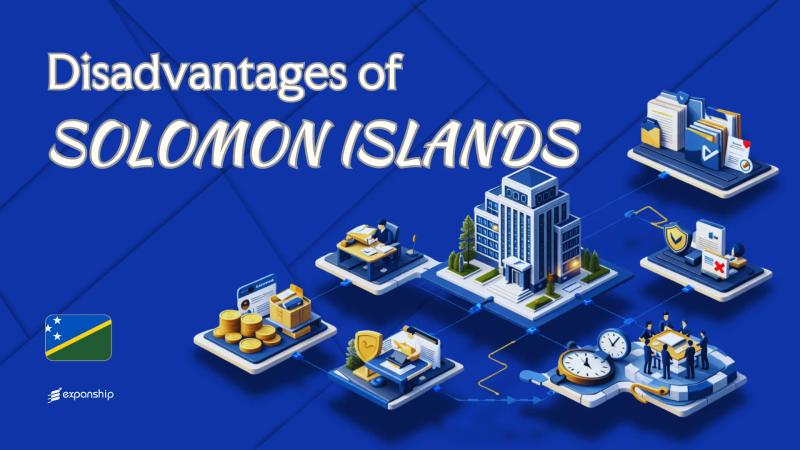
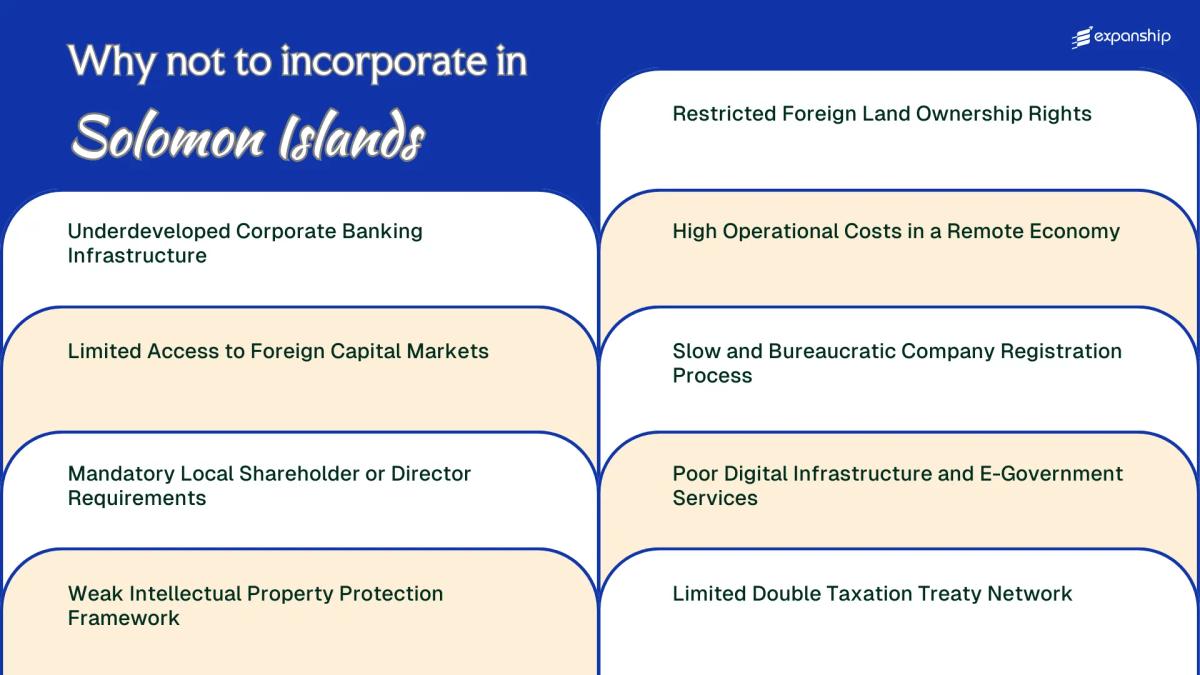
The disadvantages of incorporating in Solomon Islands span operational, financial, legal, and infrastructural categories, each of which this article examines in detail.
How significantly these drawbacks affect your business depends on the industry, the intended corporate structure, and whether operations are purely holding-based or actively trading within the islands. A foreign investor planning active commercial operations will face a different set of constraints than one establishing a passive holding entity.
This article is most relevant to foreign entrepreneurs, mid-market investors, and multinational firms evaluating the cons of registering a business in Solomon Islands for the first time.
Underdeveloped Corporate Banking Infrastructure
Solomon Islands corporate banking limitations create tangible friction for foreign-owned entities from the point of incorporation onward. The country's financial sector is small, with only a handful of licensed commercial banks operating under the Central Bank of Solomon Islands (CBSI).
Restricted Banking Access for Foreign Entities
Opening a corporate account as a foreign-owned firm is considerably more difficult than in comparable Pacific jurisdictions. Banks typically require extensive in-person documentation, local references, and extended due diligence periods, meaning your business may be operationally registered but financially inactive for weeks or months.
Transaction processing is another structural problem. International wire transfers are slow, fees are disproportionately high relative to transaction volume, and correspondent banking relationships are limited, which directly affects your ability to pay overseas suppliers or receive foreign client payments on predictable timelines.
Currency and Payment Infrastructure Gaps
The Solomon Islands dollar is non-convertible on international markets. Any business holding SBD-denominated accounts faces real constraints when converting funds or repatriating profits, adding foreign exchange costs that erode margins.
Digital payment infrastructure remains underdeveloped, and most banking services lack the API integrations or multi-currency account options that foreign firms routinely depend on for cross-border operations.
Foreign-owned companies may find themselves unable to receive or process international payments for extended periods after registration, directly disrupting early-stage business operations.
Limited Access to Foreign Capital Markets
Solomon Islands foreign capital market restrictions present a structural barrier that few foreign incorporators anticipate until they are already operational. The country has no domestic stock exchange, meaning your entity cannot list publicly or access equity capital through local markets.
Raising growth capital from international sources is equally constrained. Foreign institutional investors and development finance institutions generally require that target companies meet disclosure standards, audit requirements, and governance frameworks that most Solomon Islands-registered entities are not equipped to satisfy.
Practical burdens this creates for your business include:
- Inability to issue publicly traded shares forces reliance on private placements, which limits your investor pool and typically results in less favorable valuation terms
- Foreign lenders unfamiliar with the Companies Act 2009 often require costly legal opinions before extending credit, adding upfront professional fees
- The absence of a local capital market means you cannot use publicly listed shares as acquisition currency, restricting inorganic growth options
- Development bank financing through institutions such as the Asian Development Bank tends to favor government or quasi-government counterparties over private foreign entities
Offshore financing arrangements are legally permissible but add transactional complexity and foreign exchange friction given the limited convertibility infrastructure supporting the Solomon Islands dollar.

Company Incorporation in Solomon Islands
Understand the full compliance framework before committing to a Solomon Islands entity structure.
Mandatory Local Shareholder or Director Requirements
Solomon Islands local director and shareholder requirements create a direct constraint on the degree of control a foreign investor can retain over their company. Under the Companies Act 2009, which governs company formation and administration, certain business activities require local participation at the ownership or directorship level, limiting the structural flexibility available to offshore principals.
| Requirement Type | Restriction Applied | Practical Burden for Foreign Owner |
|---|---|---|
| Resident director | At least one director must ordinarily reside in Solomon Islands | Foreign principals cannot manage the entity remotely without appointing a local nominee |
| Local business licensing | Some regulated activities require local equity participation | Foreign investors may be forced to dilute ownership to qualify |
| Nominee arrangements | Legally permissible but unregulated | No formal statutory framework protects foreign principals from nominee default or misuse |
| Foreign Investment Board review | Required for most foreign-owned ventures | Adds an approval layer that local firms do not face |
The requirement to appoint a resident director means your firm must source, vet, and compensate a local individual, adding recurring cost without adding operational value. Because no formal nominee director registry or licensing regime exists, verifying the reliability of a local director is entirely your responsibility.
Where local equity participation is mandated, foreign ownership control limitations in Solomon Islands can reduce your shareholding below the threshold needed to pass ordinary resolutions unilaterally. This structural concession affects dividend policy, capital decisions, and exit strategy.
Weak Intellectual Property Protection Framework
Solomon Islands intellectual property protection problems stem from a legal infrastructure that has remained underdeveloped relative to most jurisdictions in the Asia-Pacific region. The country's IP regime operates under the Trade Marks Act and the Industrial Property Act, but enforcement mechanisms are limited in both capacity and reach.
Patent protection presents a particular structural gap. The Solomon Islands does not operate a domestic patent examination system, meaning proprietary technology or innovations your firm brings into the jurisdiction lack the same formal protection available in countries with established patent offices.
Trademark registration through the Intellectual Property Office is possible, yet the practical reality of enforcement is constrained by limited judicial resources and a small regulatory body with restricted capacity to pursue infringement cases.
For foreign businesses holding brand equity or proprietary processes, this creates direct exposure. Competitors or local actors can exploit your IP with limited risk of legal consequence.
- No domestic patent examination system exists; foreign patent holders cannot assume cross-border protection applies automatically.
- Trademark registration does not guarantee enforcement; infringement cases depend on judicial bandwidth.
- Licensing agreements are legally recognised but practically difficult to defend without functioning enforcement infrastructure.
- Copyright protections exist under statute but lack consistent administrative oversight.
Solomon Islands is not a member of the Madrid System for international trademark registration, meaning your international trademark portfolio does not extend here through that route.
Restricted Foreign Land Ownership Rights
Solomon Islands foreign land ownership restrictions present one of the most concrete structural barriers for foreign-incorporated entities seeking a physical operational base in the country.
The Legal Framework Behind the Restriction
Under the Land and Titles Act (Cap. 133), all land in the Solomon Islands is classified as customary, registered, or perpetual estate land, with customary land comprising an estimated 87% of the total land area. Foreign companies and non-citizens cannot acquire freehold title; at best, a foreign entity may access land through a fixed-term estate, which functions similarly to a lease and is subject to government approval and renewal uncertainty.
Practical Consequences for Foreign Business Operations
This restriction directly affects your ability to secure premises, establish infrastructure, or use land as collateral for local financing. Lease terms, approval processes, and the involvement of customary landowners introduce delays and negotiation costs that add unpredictability to operational planning.
Land ownership limitations for foreign companies in Solomon Islands are particularly acute in resource-dependent sectors such as agriculture and tourism, where land access is inseparable from the business model itself. The restricted real estate access compounds difficulties already present in remote-economy operations, making property rights challenges for businesses a significant deterrent to long-term capital commitment.
Guidance on Establishing Your Business Presence in Solomon Islands
Understanding land access constraints is essential before committing capital to Solomon Islands operations. Our team can help you assess your options within the existing legal framework.
High Operational Costs in a Remote Economy
High operational costs Solomon Islands business owners face stem directly from the country's geographic isolation across more than 900 islands, making supply chains expensive and logistical coordination structurally unreliable.
- Importing equipment, raw materials, or finished goods requires multi-leg shipping routes through regional hubs like Brisbane or Port Moresby, adding freight premiums that significantly inflate your cost base compared to mainland Pacific economies.
- Domestic inter-island transport depends heavily on small-vessel operators and light aircraft, meaning that distributing goods or deploying staff across provinces carries costs that do not exist in single-landmass jurisdictions.
- Unreliable electricity supply from the Solomon Islands Electricity Authority forces businesses to invest in diesel generators, a recurring operational expense with no equivalent regulatory remedy available.
- Skilled labour scarcity means expatriate staff are frequently necessary, triggering work permit fees under the Immigration Act and salary packages that reflect the difficulty of attracting qualified professionals to a remote posting.
- Remote economy business cost challenges are compounded by limited road infrastructure outside Guadalcanal, constraining last-mile delivery and raising overheads for any firm with physical distribution requirements.
Slow and Bureaucratic Company Registration Process
The slow company registration process in Solomon Islands presents a measurable operational obstacle for foreign entrepreneurs who need predictable timelines to plan capital deployment, staffing, and contractual commitments.
Company registration is administered through the Registrar of Companies under the Companies Act 2009. Processing times are not standardised, and delays at the registry level can extend the incorporation window well beyond what comparable Pacific jurisdictions require.
Physical document submission remains the norm, as digital filing infrastructure is underdeveloped. This means foreign applicants relying on agents or couriers face compounding delays when submissions are rejected or require correction.
The bureaucratic incorporation delays are not limited to the initial registration stage. Post-incorporation compliance filings, including annual returns, are subject to the same manual processing environment, which prolongs the firm's administrative burden throughout its existence.
Foreign-owned entities may also require additional approvals under the Foreign Investment Act, adding a regulatory layer that domestic firms do not encounter.
A foreign investor establishing a company in Solomon Islands through a local agent, accounting for document preparation, courier transit, registry processing, and foreign investment clearance, could realistically face a formation window of six to ten weeks, compared to under five business days in Singapore or Fiji.
Poor Digital Infrastructure and E-Government Services
Solomon Islands poor digital infrastructure creates a compounding operational burden that affects nearly every administrative touchpoint a foreign business owner will encounter. Fibre optic connectivity remains limited outside Honiara, and even within the capital, service reliability is inconsistent.
The Companies (Amendment) Act and related filings managed through the Financial Services Unit (FSU) are not yet supported by a fully functional online portal. This means company registration, annual returns, and compliance submissions typically require physical attendance or courier-dependent paper processes, adding both time and cost.
Internet penetration sits below 15% of the population, a figure that reflects both the archipelago's geography and chronic underinvestment in telecommunications infrastructure. For a foreign firm attempting to manage its Solomon Islands entity remotely, this creates a structural gap between expectation and operational reality.
E-government services that comparable Pacific jurisdictions have digitised, such as tax lodgements and business licence renewals, still depend on in-person processes through agencies like the Inland Revenue Division. Each offline dependency introduces additional lead time into routine compliance cycles.
- No centralised digital business registry accessible to foreign owners for real-time status checks
- Electronic signatures are not broadly accepted across government filings
- Power outages in Honiara further disrupt any digital-dependent processes
Even if your entity is managed entirely from overseas, the absence of remote-accessible e-government services means you will require a local representative physically present in Honiara to execute routine compliance filings on your behalf.
Limited Double Taxation Treaty Network
The Solomon Islands limited double taxation treaty network is minimal. The country has not concluded a broad range of bilateral tax treaties, leaving most foreign income flows unprotected from double taxation at the source country level.
For a foreign-owned entity operating cross-border, this creates a direct cost. Dividends, royalties, and service fees paid from or to jurisdictions without a treaty can be taxed twice, once locally and again in the recipient's home country, with no mechanism to offset or reduce that liability.
Tax treaty drawbacks in Solomon Islands incorporation are particularly acute for businesses with operations in major trading economies. Without treaty relief, withholding taxes imposed by counterpart jurisdictions apply at their default domestic rates rather than reduced treaty rates.
- No treaty network with major capital-exporting nations means higher effective tax costs on cross-border transactions.
- Foreign investors cannot rely on treaty tie-breaker rules for residency disputes or permanent establishment determinations.
- Access to mutual agreement procedures, which resolve cross-border tax disputes between tax authorities, is generally unavailable without a treaty framework.
Double taxation risks for Solomon Islands companies extend to dividend repatriation, where shareholders in high-tax jurisdictions face full domestic taxation with no foreign tax credit backed by a treaty obligation.
Strategies to Overcome These Challenges
Overcoming Solomon Islands incorporation challenges requires structural planning before the entity is formed, not after. The jurisdiction's regulatory gaps and infrastructure constraints reward preparation rather than reactive adjustments.
- Establish banking relationships with regional institutions such as BSP or ANZ Solomon Islands prior to incorporation to reduce account activation delays.
- Structure shareholding arrangements to satisfy local participation requirements under the Companies Act 2009 before submitting registration documents to the FSID.
- Secure contractual land access through lease agreements governed by the Land and Titles Act rather than pursuing direct ownership.
- Register intellectual property through international frameworks such as the Paris Convention, to which Solomon Islands is a signatory, rather than relying solely on domestic enforcement.
- Engage a locally resident director to satisfy regulatory requirements while maintaining operational control through a documented shareholders' agreement.
These steps operate within a legal framework that has seen limited reform in recent years. Mitigation is achievable, but the structural constraints of the Foreign Investment Act and underdeveloped e-government services remain binding conditions on day-to-day operations.
Solomon Islands Business Viability Assessment
| Pros | Cons |
|---|---|
| The Companies Act 2009 provides a recognisable common law corporate framework familiar to investors from Commonwealth jurisdictions. | Corporate banking is severely limited, with few correspondent banking relationships and restricted access to multi-currency accounts. |
| The jurisdiction offers a stable, Westminster-style legal system with an independent judiciary. | Foreign entities cannot own freehold land, which limits physical establishment and long-term asset security. |
| The Foreign Investment Act provides a formal legal channel for registering and operating foreign-owned businesses. | The double taxation treaty network is minimal, creating exposure to withholding taxes across multiple income streams. |
| Incorporation under the Companies Act 2009 does not mandate a minimum paid-up capital for most company types. | Intellectual property protections remain underdeveloped, with limited enforcement capacity against infringement. |
| The country's resource sectors offer genuine commercial opportunities tied to natural assets. | Operational costs are elevated due to import dependency, poor infrastructure, and geographic isolation. |
Any Solomon Islands business viability risks assessment must weigh these factors against the specific commercial purpose driving the incorporation decision. The jurisdiction is credible under the right circumstances, but the structural constraints documented across this blog are not incidental — they reflect systemic conditions that affect day-to-day operations.
Foreign firms with a concrete need for a Pacific presence, particularly those operating in resource extraction, fisheries, or regional trade, may find the entity viable despite the friction. For businesses that do not have a specific operational rationale tied to the islands, the combination of banking limitations, restricted land rights, and thin treaty coverage will likely outweigh the benefits of local incorporation.
Corporate Compliance Services in the Solomon Islands
Ongoing compliance obligations for Solomon Islands companies include annual returns, tax filings with the Inland Revenue Division, and adherence to the Companies Act 2009. This service covers the key requirements to keep your entity in good standing.
Conclusion
A Solomon Islands company formation drawbacks summary reflects a jurisdiction with genuine structural constraints rather than minor procedural friction. Among the most consequential limitations are the absence of meaningful double taxation treaty coverage, which exposes cross-border income to compounded tax liability, and the underdeveloped banking infrastructure, which restricts day-to-day financial operations for foreign-owned entities. Restricted foreign land ownership under the Land and Titles Act further limits how businesses can establish a physical presence. Addressing these constraints requires deliberate pre-incorporation planning and ongoing professional support from advisors with direct experience in the jurisdiction.
Expanship's Solomon Islands Business Support Services
Incorporating in the Solomon Islands places specific demands on your business that go beyond standard setup procedures. From satisfying the foreign investment approval process under the Foreign Investment Act and registering with the Solomon Islands National Provident Fund, to managing ongoing filings with the Companies Registry, the compliance obligations accumulate quickly. Expanship's Solomon Islands business support services are structured to reduce the administrative burden these requirements place on your team.
Our service scope covers the full setup and maintenance cycle for foreign entities operating in the jurisdiction.
- We prepare and submit all company registration documents with the Solomon Islands Companies Registry on your behalf.
- A registered agent and local office address are provided to satisfy statutory residency requirements.
- We handle government filings and direct liaison with relevant regulatory bodies.
- Post-incorporation compliance obligations are tracked and managed on an ongoing basis.
- Banking introduction assistance is available to support your account establishment process.
- Tax registration and coordination with the Inland Revenue Division is included in our setup support.
Reach out to Expanship Solomon Islands to discuss your incorporation requirements.
Frequently Asked Questions (FAQ)
The local director requirement applies broadly under the Companies Act 2009, which governs company formation and administration in Solomon Islands. Foreign investors setting up an entity are generally expected to appoint at least one director who is ordinarily resident in the country, though the specific application can vary depending on the business activity and licensing conditions attached to it. Failure to meet this requirement can prevent registration from being completed by the Registrar of Companies.
Operating costs in Solomon Islands are materially higher than in comparable Pacific economies like Vanuatu or Fiji, largely because the country imports the majority of its goods and relies on expensive freight logistics across dispersed island geography. Utility costs, office rental in Honiara, and expatriate staffing all carry significant premiums. These structural cost pressures cannot be easily offset by low corporate tax rates or other regulatory incentives.
Solomon Islands does not have a well-developed domestic IP enforcement mechanism, and the country's participation in international IP treaties is limited. A foreign business holding trademarks, proprietary processes, or software products has limited practical recourse if infringement occurs locally, since the courts lack substantial precedent in complex IP disputes and enforcement capacity is constrained. This makes Solomon Islands a poor choice for IP-intensive business models.
Yes, Solomon Islands has one of the thinnest treaty networks in the Pacific region, with no comprehensive double taxation agreements in force with major trading partners such as the United States, United Kingdom, or the European Union member states. By contrast, Mauritius and Singapore offer extensive treaty networks that provide measurable withholding tax relief and cross-border certainty. The absence of treaties means dividends, royalties, and service fees paid across borders are subject to withholding tax without any bilateral reduction mechanism.
Under the Land and Titles Act, all land in Solomon Islands is customary land by default, and foreigners cannot hold freehold title. Transactions that circumvent this framework are voidable, and the investor risks losing both the land and any capital invested in development. Disputes over customary ownership are common and often protracted, with cases passing through both formal courts and traditional dispute resolution processes without clear resolution timelines.
There is no established shelf company market in Solomon Islands, and using nominee arrangements does not bypass the registration requirements imposed by the Registrar of Companies under the Companies Act 2009. The registration process involves manual document filing, physical attendance in Honiara in many cases, and review periods that can extend well beyond initial estimates due to administrative backlogs. Nominee structures may add a layer of local compliance complexity rather than reducing it.
Most post-incorporation compliance filings, including annual returns and changes to company officers, must be submitted physically or via post to the Registrar of Companies, since Solomon Islands does not operate a functional online company portal comparable to those in jurisdictions like Singapore or the United Kingdom. For a foreign owner managing their entity remotely, this creates dependency on local agents for even routine filings. Delays in physical processing can result in your company falling out of good standing without timely notification.
Legal Disclaimer
The information provided in this article is for general informational purposes only and does not constitute legal, tax, or professional advice. While we strive to ensure the accuracy and timeliness of the content, laws and regulations are subject to change, and the application of laws can vary widely based on specific facts and circumstances.
Readers should not act upon this information without seeking professional counsel tailored to their individual situation. Expanship and its authors disclaim any liability for actions taken or not taken based on the content of this article.
For specific advice regarding your business setup, compliance requirements, or any legal matters, please consult with qualified legal and tax professionals in the relevant jurisdiction.