

Key Takeaways
- Rwanda's standard corporate income tax rate of 30% is complemented by reduced rates and exemptions under the Investment Code for priority and export sectors, meaning qualifying businesses can achieve a materially lower effective tax burden than the headline figure suggests.
- Registration through the Rwanda Development Board's online portal compresses what is typically a multi-week administrative process into a digitised workflow that foreign incorporators can initiate without a local presence.
- Private limited companies incorporated in Rwanda face no minimum share capital requirement, removing a common upfront financial barrier that other East African jurisdictions impose before a business can legally operate.
- Membership in the East African Community gives a Rwanda-registered entity access to a regional single market spanning multiple countries, with trade arrangements that benefit exporters and businesses structured around cross-border distribution more directly than those operating solely within the domestic market.
Rwanda is a landlocked sovereign nation in the Great Lakes region of central-eastern Africa, governed as a presidential republic with Kigali as its capital. Company registration falls under the authority of the Rwanda Development Board, which administers business incorporation through its online registry. Foreign investors most commonly establish a private limited company when entering the market.
On tax posture, the jurisdiction operates a standard corporate income tax system with defined rates and a growing network of double taxation agreements. Foreign ownership is broadly permitted across most sectors, and the government has maintained an explicit policy orientation toward attracting foreign direct investment through regulatory reforms enacted under the Companies Act and related investment legislation.
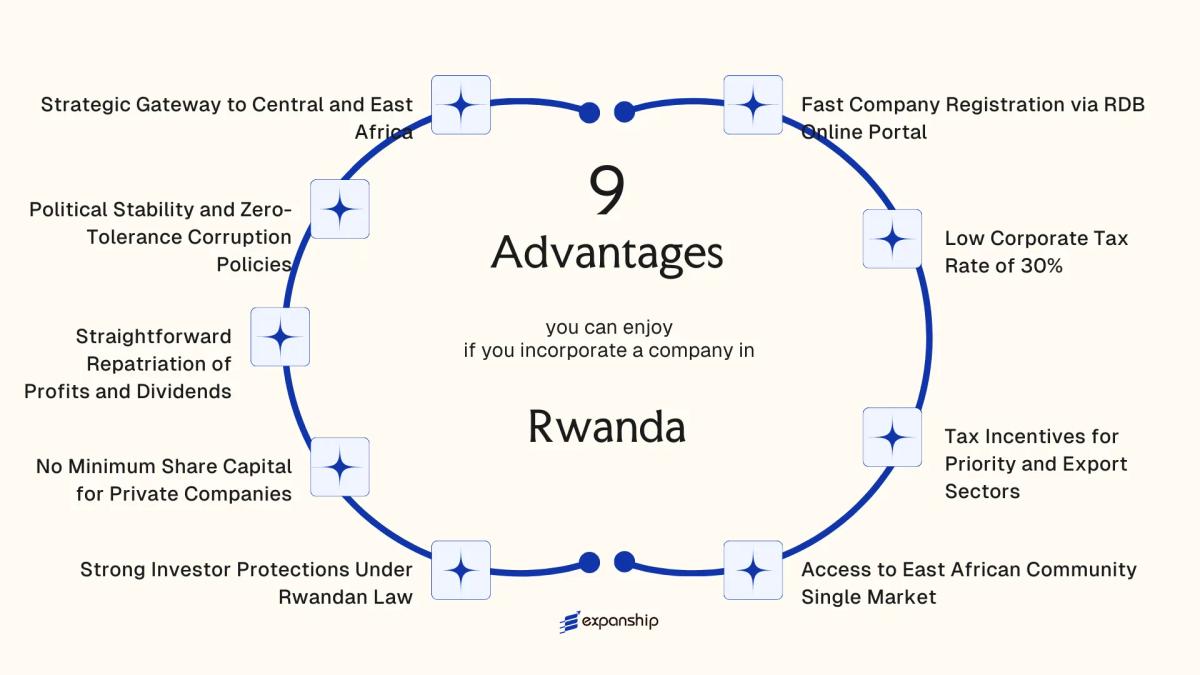
Incorporation here is open to non-resident shareholders without requirements for local equity participation in most industries, which gives international businesses meaningful structural flexibility. This article examines the concrete advantages that the benefits of incorporating in Rwanda present for foreign entrepreneurs, holding structures, and operationally active firms alike.
Fast Company Registration via RDB Online Portal
Rwanda's Development Board (RDB) operates a fully digital company registration platform that allows foreign investors to incorporate a private limited company within 24 hours. That speed has a direct practical consequence: your business can open bank accounts, sign contracts, and begin trading almost immediately upon arrival.
What the Portal Actually Delivers
The RDB online portal processes incorporation applications without requiring physical presence, meaning a non-resident director can complete registration remotely. Documents issued through the portal, including the certificate of incorporation, carry legal standing under the Companies Act 2009 as amended, which governs all registered entities in Rwanda.
Why Speed Translates to Competitive Advantage
For foreign investors, registration delays directly increase pre-revenue costs — office leases, staff on standby, and advisory fees accumulate while a company waits for legal status. Completing the entire process through a single government platform, with no intermediary agency required for standard registrations, removes a layer of administrative cost that foreign founders typically absorb in slower jurisdictions.
Your company can hold legal status within one business day of submitting your application through the RDB portal.
Low Corporate Tax Rate of 30%
Rwanda's standard corporate income tax rate sits at 30%, applied to net taxable profits earned by resident companies and permanent establishments of foreign entities. While 30% is not a low rate in absolute terms, the Rwanda corporate tax rate advantages become clearer when examined alongside what the rate applies to, how it is calculated, and the deductions available under the Income Tax Law No. 016/2018.
Taxable income is assessed on net profits after allowable deductions, which include ordinary business expenses, depreciation, and certain losses carried forward. This means your actual tax liability can be considerably lower than the headline figure suggests, depending on your cost structure and sector.
For foreign businesses, the predictability of a single, codified rate matters as much as the number itself. Rwanda does not impose a separate branch profits tax at a different rate, and the corporate income tax framework is administered by the Rwanda Revenue Authority under a relatively transparent self-assessment system.
The rate also applies uniformly, which reduces the compliance complexity that variable or tiered rate structures create in other markets:
- One flat rate means tax modelling is straightforward from the outset of incorporation
- No bracket calculations are required as profits grow during early-stage expansion
- The self-assessment mechanism gives your finance team direct control over filing timelines

Incorporate a Company in Rwanda
Set up your Rwandan company with full compliance support from registration through to post-incorporation obligations.
Tax Incentives for Priority and Export Sectors
Rwanda tax incentives for priority sectors give qualifying businesses a significantly reduced corporate income tax rate of 15%, cutting the standard 30% rate in half. This preferential rate applies to companies operating in designated priority areas under the Investment Code, administered by the Rwanda Development Board (RDB). For a foreign investor, the practical effect is a lower annual tax burden from the first year of operation, without requiring complex offshore arrangements.
Businesses registered within Special Economic Zones (SEZs) benefit from a 0% corporate income tax rate during an initial qualifying period, along with exemptions from customs duties on imported capital equipment. The Kigali Special Economic Zone (KSEZ) is the primary facility, oriented toward manufacturing, logistics, and technology firms. A company operating within the KSEZ can import machinery duty-free, which directly reduces setup costs that would otherwise be capitalized over years.
| Sector / Status | Corporate Tax Rate | Key Benefit |
|---|---|---|
| Standard registered company | 30% | Baseline rate |
| RDB-certified priority sector | 15% | Reduced rate under Investment Code |
| SEZ-registered entity | 0% (qualifying period) | Full CIT exemption + duty-free imports |
| Exporter (qualifying threshold) | Preferential rate | Tax relief tied to export revenue proportion |
Export-oriented firms that meet the revenue thresholds defined under Rwandan tax law may qualify for further preferential treatment on income derived from foreign sales. Eligibility requires formal certification through the RDB, and the incentive is tied to maintaining the qualifying activity rather than simply holding a registration status.
Access to East African Community Single Market
Rwanda EAC single market access benefits are among the most structurally significant reasons foreign investors choose to incorporate here. As a founding member of the East African Community, your business gains preferential access to a combined market of over 300 million people spanning Kenya, Uganda, Tanzania, Burundi, South Sudan, the Democratic Republic of Congo, and Somalia.
Under the EAC Customs Union Protocol, goods produced by qualifying companies move across member state borders with reduced or zero tariffs. For a foreign-owned entity registered in Rwanda, this translates directly into lower distribution costs and fewer trade barriers when supplying regional buyers or sourcing inputs from EAC partners.
The EAC Common Market Protocol also extends beyond goods. It covers the free movement of services, capital, and business persons, meaning your firm can operate commercially across member states without renegotiating market entry from scratch in each country.
Keep these points in mind:
- Your goods must meet EAC Rules of Origin requirements to qualify for preferential tariff treatment
- Service-sector benefits under the Common Market Protocol apply based on specific sector schedules
- EAC market access applies to incorporated entities, not sole traders or branches in all cases
- DRC and Somalia accession is recent; full protocol integration for these members is still phased
Rwanda's EAC membership also grants your business access to the tripartite free trade framework linking the EAC with COMESA and SADC, covering over 700 million people across 29 African states.
Strong Investor Protections Under Rwandan Law
Investor protections under Rwandan law are grounded in statute rather than administrative discretion, which gives foreign business owners a predictable legal foundation. The Rwanda Investment Code (Law No. 06/2021) codifies specific guarantees around expropriation, fair treatment, and dispute resolution, applying these protections to both domestic and foreign-owned entities without distinction.
Statutory Protections Against Expropriation
Under the Investment Code, the state may only expropriate an investment for a public interest purpose, and only with prompt, adequate compensation. Your assets cannot be nationalized without due process or payment at fair market value, a protection that is enforceable through the courts rather than dependent on diplomatic relations.
Access to International Dispute Resolution
Disputes between foreign investors and the Rwandan government are not confined to domestic courts. The Investment Code permits recourse to international arbitration, including under ICSID (the International Centre for Settlement of Investment Disputes), to which Rwanda is a signatory member. This access to a neutral international forum removes a significant risk that exists in jurisdictions where disputes can only be resolved before local courts subject to government influence.
The Rwanda Companies Act also reinforces shareholder rights at the corporate level, governing director duties, minority protections, and fiduciary obligations. Together, these instruments mean your investment operates within a defined legal framework where rights are specified, not assumed.
Understand Your Legal Protections Before Incorporating in Rwanda
Speak with an Expanship specialist to review how Rwandan investment law applies to your specific business structure and sector.
No Minimum Share Capital for Private Companies
Rwanda imposes no minimum share capital requirement for private limited companies (SARLs). Under the Companies Act (Law No. 17/2018 governing companies), founders are free to set whatever capital amount suits their operational needs at the time of incorporation. A company can be registered with a single Rwandan franc in nominal share capital if the shareholders choose.
For a foreign business owner, this matters for one direct reason: capital that would otherwise sit locked in a statutory reserve account remains deployable from day one. Many jurisdictions require founders to deposit a fixed minimum before a company can be registered or begin trading. That obligation ties up working capital during the early stage of a business, precisely when liquidity is most needed.
- No statutory minimum means your initial investment can reflect actual startup costs rather than an arbitrary compliance threshold.
- Shareholders retain full discretion over the size and structure of share issuances, which allows the ownership split to be calibrated to commercial agreements rather than forced by capital rules.
- For foreign entities testing a new market through a subsidiary, low initial capitalisation reduces the financial commitment required before revenue is confirmed.
This flexibility applies to private companies specifically. Publicly listed entities operate under separate rules through the Capital Market Authority of Rwanda.
Straightforward Repatriation of Profits and Dividends
Rwanda profit repatriation advantages for investors rest on a clear legal foundation. Under the National Bank of Rwanda's foreign exchange regulations, there are no restrictions on the transfer of dividends, profits, or capital out of the country by foreign investors. This applies to both current account and capital account transactions.
The practical implication is direct: after settling your corporate tax obligations, you can remit net profits abroad without seeking prior approval from a regulatory authority. No mandatory reinvestment requirements or lock-in periods apply to foreign-owned entities.
Transfers are conducted through licensed commercial banks operating under National Bank of Rwanda oversight, which means the process follows standardised banking procedures rather than a discretionary case-by-case review.
A foreign investor operating a company with net annual profit of USD 200,000 can remit the full post-tax amount abroad in a single transaction through any licensed Rwandan commercial bank, with no withholding requirement on the principal capital or the profit transfer itself beyond the applicable dividend withholding tax under the Income Tax Law.
Rwanda's dividend withholding tax is set at 15% under the Income Tax Law No. 016/2018. Certain preferential investment categories under the Rwanda Development Board's investment framework may qualify for reduced rates, subject to specific certification criteria.
Political Stability and Zero-Tolerance Corruption Policies
Rwanda's political stability benefits for business are well-documented and structurally reinforced. The country has maintained consistent governance continuity since the early 2000s, with policy frameworks that rarely shift without advance notice — a meaningful advantage when planning multi-year investment horizons.
Transparency International's Corruption Perceptions Index has consistently ranked Rwanda among the least corrupt countries in sub-Saharan Africa. This outcome reflects deliberate legal architecture, including the Organic Law on Prevention and Penalisation of Corruption, which imposes criminal liability on both public officials and private sector actors involved in corrupt practices.
For foreign-owned entities, the practical implications are concrete:
- Licensing and regulatory approvals are processed through the Rwanda Development Board without unofficial facilitation payments
- Contract enforcement operates through a judiciary that scores higher on independence metrics than most regional peers
- Public procurement processes follow codified rules that reduce discretionary decision-making
Predictable governance means your operating costs reflect published fees and documented timelines, not informal arrangements. That consistency lowers the risk premium attached to doing business here.
Anti-corruption protections apply equally to foreign and domestic firms, but your home country's extraterritorial laws — such as the UK Bribery Act or US FCPA — still govern your employees' conduct regardless of local compliance.
Strategic Gateway to Central and East Africa
Rwanda's position as a gateway to Central and East Africa business is a structural advantage rooted in geography and regional connectivity. Landlocked but centrally placed, the country sits at the intersection of the East African Community (EAC) and the Common Market for Eastern and Southern Africa (COMESA), giving registered entities preferential access to a combined market of over 700 million people under existing trade frameworks.
Cross-Border Reach Into Multiple Blocs
A firm incorporated in Kigali can trade under both EAC and COMESA protocols without requiring separate legal entities in each member state. This dual-bloc membership is uncommon among the region's smaller economies, and it means reduced tariff exposure and simplified customs procedures across a wide geographic footprint.
- Access to EAC single market covering Kenya, Uganda, Tanzania, Burundi, South Sudan, and the DRC
- COMESA membership extending preferential trade terms into North and Southern Africa
- Proximity to the DRC, one of Africa's largest consumer markets by population
Infrastructure Supporting Regional Operations
Kigali International Airport operates as a regional cargo and passenger hub, with RwandAir providing direct connections to over 20 African destinations. The Kigali Special Economic Zone (KSEZ) was established specifically to support businesses oriented toward export and regional distribution. For companies targeting multiple African markets from a single base, operating through KSEZ can reduce logistics overhead while maintaining a single compliance jurisdiction.
Your entity's ability to serve Central and East African markets from one registered address, under one regulatory authority, is a practical operational benefit that compound registrations across multiple jurisdictions cannot replicate as cost-effectively.
How Rwanda Stacks Up Against Regional Competitors
Among the East Africa regional business competitors most relevant to this comparison are Kenya, Tanzania, and Uganda. These three countries share EAC membership with Rwanda, target overlapping investor profiles, and are the jurisdictions foreign business owners most commonly evaluate in parallel. The comparison below focuses on parameters where Rwanda holds a neutral or measurable advantage, drawing on publicly available regulatory and institutional data.
What the table reveals is less about any single metric and more about the cumulative effect of institutional design. Rwanda's Doing Business-era rankings consistently placed it above regional peers on starting a business and contract enforcement. For foreign investors comparing Rwanda business environment vs regional peers, the combination of no minimum share capital for private companies, a single-window registration system through the Rwanda Development Board, and a documented anti-corruption institutional record creates a regulatory profile that is structurally distinct from neighbours where informal costs and multi-agency registration remain common.
| Parameter | Rwanda | Kenya | Tanzania | Uganda |
|---|---|---|---|---|
| Company registration timeline | 1 day (RDB online portal) | 1–3 days (eCitizen) | 7–14 days | 3–7 days |
| Minimum share capital (private company) | None | None | None | None |
| Corporate income tax rate | 30% | 30% | 30% | 30% |
| Transparency International CPI rank (2023) | 44th | 126th | 109th | 141st |
| EAC single market access | Yes | Yes | Yes | Yes |
| Preferential investment frameworks | Yes (ICSID signatory) | Yes | Yes | Yes |
Compliance Services for Companies in Rwanda
Maintain your Rwandan entity in good standing with ongoing compliance support, from annual filings to regulatory reporting under RDB requirements.
Conclusion
Rwanda presents a coherent case for foreign incorporation: a digitised registration process through the Rwanda Development Board, accessible profit repatriation rules, and a treaty network that connects your entity to the broader East African Community market. These structural features work together, meaning operational setup, capital movement, and market access are governed by frameworks that align rather than conflict.
That said, the benefits of incorporating in Rwanda apply unevenly depending on your business model. A firm targeting regional export markets will extract more value from EAC trade arrangements than a purely domestic-focused operation. An investor in qualifying priority sectors stands to benefit from incentives under the Investment Code that a standard private company would not access.
The fit between jurisdiction and business structure determines whether these advantages translate into measurable outcomes. For companies where the mechanics align, Rwanda company formation advantages extend well beyond the point of registration, shaping tax exposure, market reach, and operational cost over the long term. The next step is matching those mechanics to the specifics of your entity, industry, and ownership structure.
Start Your Rwanda Company Formation With Expanship Today
Expanship supports foreign investors through the full lifecycle of Rwanda company formation, from entity selection and name reservation on the Rwanda Development Board (RDB) online portal, to post-incorporation compliance under the Companies Act No. 17 of 2018. Whether your structure is a private limited company, a public company, or a branch of a foreign entity, each carries distinct registration requirements and ongoing obligations that Expanship manages directly with the RDB on your behalf.
Expanship's Rwanda business incorporation services cover each stage of the process:
- Preparation and notarization of constitutional documents, including Articles of Association
- Registered office and resident agent provision for entities without a physical presence in Kigali
- Filing and liaison with the Rwanda Development Board for company registration and post-incorporation amendments
- Ongoing compliance management, including annual returns and beneficial ownership disclosures required under Rwandan law
- Tax registration support with the Rwanda Revenue Authority (RRA)
- Banking introduction assistance to support account opening with local financial institutions
Expanship's role in Rwanda company registration services for investors is not limited to incorporation. The firm maintains active relationships with relevant regulatory contacts to manage obligations as your business structure evolves.
Reach out to Expanship Rwanda to discuss your incorporation requirements.
Frequently Asked Questions (FAQ)
Company registration through the Rwanda Development Board (RDB) online portal is typically completed within six hours for straightforward applications. The process covers name reservation, incorporation, and tax identification in a single workflow. Delays can occur if submitted documentation is incomplete or if the proposed business activity requires additional regulatory approvals.
The standard corporate income tax rate is 30% under Rwandan tax law, administered by the Rwanda Revenue Authority (RRA). Companies qualifying under priority sector or export-oriented frameworks may be eligible for preferential rates, which can be as low as 15%, subject to approval and qualifying criteria set by the RDB. The standard rate applies unless a formal incentive arrangement has been granted.
No minimum share capital is required to form a private limited company under the Companies Act No. 17 of 2009. A single share of nominal value is sufficient to satisfy the statutory incorporation requirement. This applies specifically to private companies; other entity types or sector-specific licenses may impose their own financial thresholds.
The Law No. 06/2021 governing investment promotion and facilitation provides foreign investors with protection against unlawful expropriation, guaranteeing that any compulsory acquisition must be in the public interest, non-discriminatory, and accompanied by fair compensation. Disputes between investors and the government can be referred to international arbitration under frameworks such as ICSID, where Rwanda is a signatory. These protections apply to investors who have formally registered their investment with the RDB.
Foreign investors are permitted to repatriate profits, dividends, and capital from Rwanda without restriction, provided all applicable taxes have been settled with the Rwanda Revenue Authority. The investment law framework specifically guarantees this right to registered investors. Transfers are processed through licensed commercial banks operating under the oversight of the National Bank of Rwanda.
A company registered in Rwanda gains preferential access to the East African Community (EAC) single market, which covers goods, services, capital, and labor movement across member states under the EAC Common Market Protocol. This allows qualifying businesses to trade across member states with reduced tariff barriers compared to external trade arrangements. The practical application of specific protocols can vary by product category and the trade terms established between individual member states.
Legal Disclaimer
The information provided in this article is for general informational purposes only and does not constitute legal, tax, or professional advice. While we strive to ensure the accuracy and timeliness of the content, laws and regulations are subject to change, and the application of laws can vary widely based on specific facts and circumstances.
Readers should not act upon this information without seeking professional counsel tailored to their individual situation. Expanship and its authors disclaim any liability for actions taken or not taken based on the content of this article.
For specific advice regarding your business setup, compliance requirements, or any legal matters, please consult with qualified legal and tax professionals in the relevant jurisdiction.