

Key Takeaways
- Palau's Business Entities Act imposes a mandatory local registered agent requirement that adds a recurring administrative and cost burden for foreign-incorporated entities with no physical presence in-country.
- With zero double taxation treaties in force, cross-border investors face the structural risk of being taxed on the same income in both Palau and their home jurisdiction, with no treaty mechanism available to offset that liability.
- Foreign nationals are legally prohibited from owning land in Palau, which materially limits capital investment options for businesses requiring real property as a productive or collateral asset.
- Operating exclusively within the US dollar framework means Palau-registered businesses carry indirect exposure to US monetary policy and economic cycles without any central bank mechanism at the domestic level to buffer that impact.
Palau operates under an evolving regulatory framework, shaped partly by its Compact of Free Association with the United States and its own domestic corporate legislation. The disadvantages of incorporating in Palau span structural, financial, and operational categories — each affecting foreign investors differently depending on the nature and scale of their intended business activity.
Not every drawback carries equal weight across all business types. A foreign-owned service firm faces a different set of constraints than a manufacturing operation or a fund structure, so the severity of each issue depends on your specific model.
This article is most relevant to foreign entrepreneurs and offshore investors considering a Palau-registered entity for cross-border trade, investment holding, or service delivery. Palau's corporate legal framework is governed by the Business Entities Act, which sets out the foundational rules under which registered companies must operate.
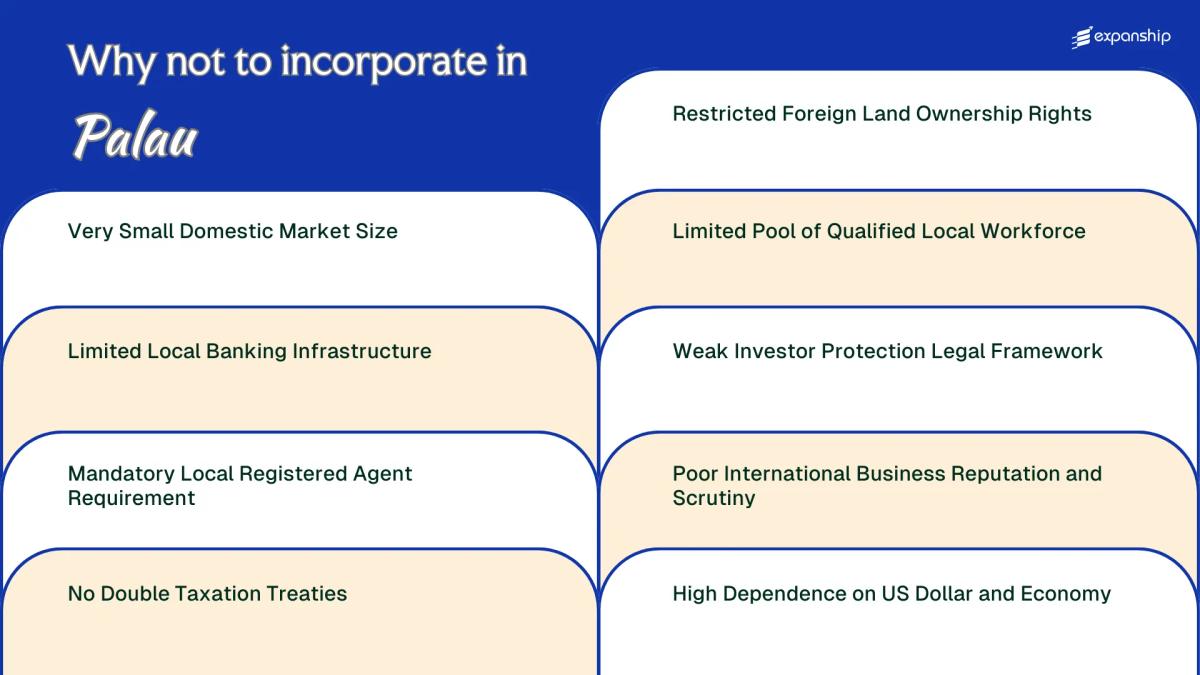
Very Small Domestic Market Size
Palau small domestic market limitations present one of the most immediate structural barriers for any foreign entity considering incorporation there. With a population of approximately 18,000 people, the addressable consumer base is among the smallest of any sovereign nation.
Scale Constraints on Revenue Generation
Domestic sales alone cannot sustain most business models in this market. Even in sectors like retail or hospitality, revenue ceilings are reached quickly given the limited consumer base, forcing firms to depend on external income streams from the outset.
Tourism accounts for a significant portion of economic activity, but visitor numbers fluctuate sharply and remain highly seasonal. A company structured primarily for domestic trade will find that market size business challenges translate directly into thin margins and constrained growth potential.
Structural Limits on Business Viability
GDP figures for Palau hover around $300 million USD, a scale that limits B2B opportunities alongside consumer-facing ones. For foreign investors anticipating local contract pipelines or partnership networks, the economy constraints mean those pipelines are structurally shallow.
A foreign business incorporated in Palau primarily targeting domestic revenue will face hard revenue ceilings that cannot be resolved through operational improvements alone.
Limited Local Banking Infrastructure
Palau banking infrastructure limitations present a concrete operational problem for foreign-owned entities. The country has a very small number of commercial banks operating domestically, with most financial services concentrated among a handful of institutions, including branches of foreign banks such as Bank of Hawaii and PBOC Bank of Palau.
Opening a business bank account there typically requires in-person procedures, physical documentation submission, and extended review timelines. For non-resident directors or shareholders, this creates immediate logistical costs.
Foreign business owners encounter friction at multiple points:
- Correspondent banking relationships are limited, meaning international wire transfers face higher fees and longer processing delays than in major financial centers
- Most local banks apply heightened due diligence to foreign-owned companies, requiring documentation that can take weeks to compile from outside the country
- Trade finance products such as letters of credit are not widely available, restricting the operational capacity of import-export oriented firms
- Online banking functionality is less developed compared to jurisdictions like Singapore or Hong Kong, reducing day-to-day account management options for remote owners
Credit facilities for foreign businesses are also difficult to obtain without local collateral or established domestic banking history. This limits working capital access in practical terms.

Company Incorporation in Palau
Understand what forming a company in Palau involves, including regulatory requirements and structural considerations for foreign business owners.
Mandatory Local Registered Agent Requirement
Incorporating in Palau requires your company to maintain a local registered agent at all times. This is a statutory obligation under Palauan corporate law, and the Palau Foreign Investment Board enforces ongoing compliance as part of the entity's registration requirements. The Palau registered agent requirement drawbacks become evident quickly for foreign-owned firms that have no pre-existing local contacts.
| Requirement | Detail | Implication for Foreign Owner |
|---|---|---|
| Registered agent location | Must be physically based in Palau | Cannot use overseas legal counsel or foreign nominee services |
| Agent continuity obligation | Agent must remain active for entity's lifespan | Any lapse in agent status risks deregistration |
| Agent responsibility | Receives official correspondence and legal notices | Foreign owner has no direct control over time-sensitive filings |
| Replacement process | Requires formal notification to authorities | Administrative delays if agent relationship breaks down |
Finding a qualified, reliable individual or firm in Palau's limited professional services market is genuinely difficult. The small pool of eligible agents means your business has minimal negotiating leverage over fees or service quality.
When an agent relationship deteriorates, replacing one requires formal procedural steps, which creates gaps in your company's compliance status. For a foreign owner managing the firm remotely, that dependency on a single in-country intermediary introduces operational risk that jurisdictions with broader professional services infrastructure simply do not impose at the same level.
No Double Taxation Treaties
Palau has not entered into any bilateral double taxation treaties with other countries. For a foreign business owner, this means income earned by your entity may be taxed in both Palau and your home country, with no treaty mechanism to offset or eliminate that overlap.
Without a treaty framework, withholding taxes on dividends, royalties, or service fees paid across borders are governed solely by domestic law in each respective country. The absence of reduced withholding rates — which treaties typically negotiate down to 5-15% — means your firm bears the full statutory rate in both jurisdictions simultaneously.
This gap directly increases the effective tax burden on cross-border transactions. Countries with active treaty networks, such as Singapore or the Netherlands, offer investors a structured way to avoid this duplication; Palau's tax law provides no equivalent relief mechanism.
The disadvantage is most acute for businesses repatriating profits or paying management fees to a foreign parent company.
- Income may be taxed fully in both Palau and your home jurisdiction with no treaty credit mechanism
- No reduced withholding rates apply to cross-border dividend or royalty payments
- Your home country's domestic tax authority will apply its own rules without any bilateral override
- Each payment type — dividends, interest, royalties — must be assessed separately under two unconnected tax codes
Palau imposes a gross revenue tax rather than a conventional corporate income tax, which means treaty relief — even if it existed — would apply differently than in most standard double taxation scenarios.
Restricted Foreign Land Ownership Rights
Palau foreign land ownership restrictions present one of the most concrete structural barriers for foreign investors. Under the Palauan Constitution, land ownership is explicitly reserved for Palauan citizens, leaving foreign entities and individuals without the right to hold title to real property.
The Constitutional Basis of the Restriction
Article XIII of the Constitution of Palau limits land ownership to citizens of the Republic, a restriction that applies regardless of how your business is structured locally. Even a duly incorporated foreign-owned entity cannot circumvent this by holding property in the company's name if beneficial ownership traces back to non-citizens.
Practical Consequences for Foreign-Owned Businesses
Your business is confined to leasehold arrangements, which introduce term limitations, renewal uncertainty, and dependency on landowner relationships that freehold ownership would otherwise eliminate. Long-term lease agreements require ongoing negotiation and carry inherent contractual risk, since you have no fallback ownership position if terms deteriorate.
This restriction directly affects real estate-dependent sectors such as hospitality, manufacturing, and retail, where site control is tied to operational viability. Capital investment in physical improvements on leased land carries heightened risk given the absence of ownership security.
Addressing Land and Property Constraints for Your Palau Business
Speak with our team about structuring your Palau operations within the boundaries of local property law and leasehold frameworks.
Limited Pool of Qualified Local Workforce
Palau's limited skilled workforce challenges are a practical constraint for any foreign business that needs to hire locally. The talent pool is structurally thin, shaped by a national population of roughly 18,000 people and significant ongoing emigration.
- You face acute shortages in technical, financial, and legal disciplines because the domestic labor market cannot produce sufficient graduates across these fields at scale.
- Sourcing qualified accounting or compliance staff locally is difficult given that the workforce skews heavily toward tourism and government sectors.
- Hiring expatriate professionals to fill skill gaps requires navigating foreign worker permit processes under Palauan immigration rules, adding time and administrative cost to your hiring cycle.
- Salary expectations for the small pool of qualified local candidates can be disproportionately high relative to the market size, compressing your operating margins.
- High outward migration of educated Palauans to the United States, facilitated by the Compact of Free Association, continuously reduces the available talent base your firm can draw from.
Weak Investor Protection Legal Framework
Palau's weak investor protection framework presents a structural risk that foreign investors rarely anticipate until a dispute arises. The country lacks a dedicated foreign investment protection law or bilateral investment treaty (BIT) network, meaning your rights as a foreign shareholder depend almost entirely on general corporate provisions under the Business Corporations Act and the broader civil code.
Minority shareholder protections are thin by international standards. There are no codified rules requiring supermajority thresholds for dilutive actions, and director fiduciary duties are not elaborated in statute with the specificity found in jurisdictions like Singapore or Delaware.
Judicial enforcement compounds this gap. The court system has limited commercial litigation capacity, and specialized commercial courts do not exist, so contract and shareholder disputes are resolved through general civil proceedings that can be slow and unpredictable.
- No BIT network to guarantee arbitration rights against the state
- No statutory derivative action mechanism clearly available to minority shareholders
- Absence of a securities regulator overseeing investor rights in private companies
A foreign investor holding a 30% stake in a Palauan entity has no guaranteed statutory right to demand financial records, block a dilutive share issuance, or compel arbitration under an international forum, leaving dispute resolution subject to local civil court discretion.
Poor International Business Reputation and Scrutiny
Palau international business reputation risks are not theoretical. The jurisdiction has historically appeared on monitoring lists maintained by intergovernmental bodies concerned with financial transparency and anti-money laundering compliance, which signals to foreign counterparties that entities incorporated there carry elevated due diligence burdens.
Correspondent banks in the US, EU, and UK routinely apply enhanced due diligence to companies from jurisdictions with limited AML oversight history. Your firm may face account refusals, delayed transfers, or outright rejection from financial institutions that treat the country of incorporation as a risk indicator independent of your business's actual activities.
Regulatory scrutiny Palau incorporated companies face extends beyond banking. Partners, suppliers, and institutional investors in major markets often require additional documentation or legal opinions before engaging with an entity from a jurisdiction perceived as having weak oversight infrastructure.
- Counterparties in regulated industries such as finance, legal services, and insurance may decline to work with your entity without costly third-party verification
- Payment processors and fintech platforms frequently flag or restrict accounts linked to lesser-known Pacific incorporation jurisdictions
Even if your business operations are fully compliant, the incorporation address alone can trigger automatic enhanced due diligence or account refusal under correspondent banking policies outside your control.
High Dependence on US Dollar and Economy
Palau US dollar dependency risks are structural, not incidental. The country adopted the US dollar as its sole legal tender under the Compact of Free Association with the United States, which means your business has no access to an independent monetary policy, no local central bank, and no currency mechanism to offset external shocks.
Any contraction in US federal spending directly reduces the financial transfers Palau receives under the Compact, which in turn compresses domestic economic activity and purchasing power.
For a foreign-incorporated entity, this creates a one-directional exposure. If US interest rates rise, credit conditions tighten locally without any buffer from a domestic monetary authority.
The US economic exposure extends to tourism receipts as well, since American visitor numbers significantly influence service-sector revenues. A business dependent on local demand has no insulation from shifts in US fiscal or monetary policy that it has no standing to influence.
Overcoming Incorporation Challenges in Palau
Overcoming incorporation challenges in Palau requires structural planning before entity formation, not reactive adjustments after registration.
- Appoint a licensed local registered agent who meets the requirements under the Business Corporations Act to satisfy the mandatory residency condition.
- Open offshore or correspondent banking relationships in advance to reduce dependence on Palau's limited domestic banking network.
- Structure operations as a foreign-owned corporation rather than seeking land title, since freehold ownership is constitutionally restricted to Palauan citizens.
- Register with the Bureau of Revenue and confirm tax obligations under the gross revenue tax regime, given the absence of bilateral double tax treaties.
- Retain legal counsel familiar with Palauan corporate law to address gaps in investor protection within the existing statutory framework.
Each of these steps operates within the jurisdiction's regulatory structure, which is administered across multiple national agencies without a unified foreign investment authority. Addressing compliance requirements individually and in sequence is the practical approach given this fragmented framework.
Palau's Overall Business Viability
Palau business viability for foreign companies is constrained by a set of structural factors that limit its appeal as a general-purpose incorporation destination. The absence of tax treaties, thin banking infrastructure, and a small domestic market are material disadvantages. That said, the jurisdiction holds legal standing as a sovereign nation with a functioning corporate registry, and for certain holding or asset-protection structures, it may warrant consideration.
| Pros | Cons |
|---|---|
| No corporate income tax on foreign-sourced income | No double taxation treaties to reduce withholding obligations abroad |
| Sovereign legal system with established corporate registry | Weak investor protection framework with limited commercial litigation precedent |
| US dollar as official currency removes exchange rate exposure | High economic dependence on the US creates external vulnerability |
| Political stability relative to other Pacific microstates | Mandatory local registered agent adds ongoing compliance cost |
| Restricted foreign land ownership limits physical business establishment | |
| Limited qualified local workforce constrains on-the-ground operations |
Palau is not a jurisdiction that suits businesses requiring active banking relationships, a local workforce, or treaty-based tax relief. Your assessment should weigh those gaps against any structural benefit the jurisdiction offers for your specific entity type.
Compliance Services for Companies in Palau
Maintain your Palau entity in good standing with the relevant regulatory and registry requirements under Palauan law.
Conclusion
A Palau company incorporation drawbacks summary comes down to a consistent set of structural limitations rather than isolated regulatory quirks. The absence of double taxation treaties exposes foreign-owned entities to unrelieved withholding on cross-border income, while restricted banking access complicates routine treasury operations. Foreign land ownership restrictions further reduce the jurisdiction's utility for asset-holding structures. These constraints, taken together, define a business environment where careful pre-incorporation analysis determines whether the entity can function as intended. Professional guidance specific to the Foreign Investment Act and the Palau National Government's regulatory requirements remains a practical prerequisite before committing to formation here.
Expanship's Palau Business Formation Services
Palau business formation services through Expanship are structured around the specific friction points this jurisdiction creates for foreign-owned entities. From satisfying the mandatory registered agent requirement under Palauan corporate law to managing post-incorporation filings with the Ministry of Finance, Expanship helps reduce the administrative load these obligations place on your business. The absence of double taxation treaties and restricted foreign land ownership rights add layers of complexity that require careful structuring from the outset.
Expanship's Palau company registration assistance covers the full formation process and beyond.
- Your company documents are prepared and filed with the relevant Palauan authorities.
- A compliant registered agent and office address are provided in-country.
- Government filings and regulatory liaison are handled on your behalf.
- Ongoing compliance obligations are managed after incorporation is complete.
- Banking introductions are facilitated to help your entity establish accounts.
- Tax registration and coordination with local authorities are included in the process.
Reach out to Expanship Palau to discuss how we can support your formation.
Frequently Asked Questions (FAQ)
Foreign-owned entities face a blanket prohibition on owning land in Palau, regardless of business structure. This restriction is grounded in Palauan constitutional law, which reserves land ownership rights exclusively for Palauan citizens. Leasing arrangements are available as a workaround, but lease terms and renewal rights introduce long-term operational uncertainty for businesses requiring fixed premises.
Failure to maintain a local registered agent means your company is not in good standing under Palauan corporate law, which can result in administrative dissolution or the inability to file documents with the relevant government office. Beyond the legal consequence, official correspondence and regulatory notices will have no valid delivery address, leaving your entity exposed to missed compliance deadlines. This requirement applies continuously, not just at the point of incorporation.
For foreign businesses, yes, Palau's banking options are notably limited compared to jurisdictions like Vanuatu or the Marshall Islands, which have developed more international banking relationships. The small number of operating commercial banks in Palau means fewer correspondent banking relationships, which directly affects your ability to conduct multi-currency transactions or receive international wire transfers efficiently. Account opening for foreign-owned entities also faces heightened scrutiny due to international anti-money laundering compliance pressures.
Registered agent fees in Palau are not regulated at a fixed statutory rate, so costs vary by provider, but annual fees for a local registered agent service generally fall in the range of a few hundred US dollars per year. Because Palau's market for corporate service providers is small, there is limited competition to drive prices down, and your options for switching agents are fewer than in larger offshore jurisdictions. This recurring cost must be factored into the total annual maintenance budget for your entity.
A Palau-registered entity can trigger enhanced due diligence requirements from foreign banks and business counterparties who associate the jurisdiction with elevated compliance risk. This reputational factor can delay account openings, reduce access to correspondent banking, and in some cases cause counterparties in regulated industries to decline business relationships altogether. The scrutiny is not hypothetical; it reflects Palau's limited presence on recognized lists of well-regulated financial centers.
Private contracts can offer some protection, but they cannot substitute for what a mature statutory framework provides. Palau lacks the depth of corporate and securities legislation found in established jurisdictions, meaning dispute resolution mechanisms, minority shareholder protections, and enforcement of judgments are less predictable. If a commercial dispute arises, you would be relying heavily on Palau's court system, which has limited capacity and no extensive body of commercial case law to draw from.
Because Palau uses the US dollar as its official currency and has no central bank of its own, your business has no local monetary policy buffer against external shocks. Any tightening of US monetary conditions or dollar liquidity constraints flows directly into Palau's economy without mitigation, affecting local costs, supplier pricing, and any domestically generated revenue your entity relies on. This is compounded by Palau's economic dependence on external aid and tourism, making the operating environment more volatile than the simple currency arrangement might suggest.
Legal Disclaimer
The information provided in this article is for general informational purposes only and does not constitute legal, tax, or professional advice. While we strive to ensure the accuracy and timeliness of the content, laws and regulations are subject to change, and the application of laws can vary widely based on specific facts and circumstances.
Readers should not act upon this information without seeking professional counsel tailored to their individual situation. Expanship and its authors disclaim any liability for actions taken or not taken based on the content of this article.
For specific advice regarding your business setup, compliance requirements, or any legal matters, please consult with qualified legal and tax professionals in the relevant jurisdiction.