
Key Takeaways
- Palestine's primary corporate legislation, Companies Law No. 12 of 1964, predates modern commercial practice and applies unevenly across West Bank and Gaza jurisdictions, creating a fragmented compliance environment that companies must navigate simultaneously under two distinct governing arrangements.
- Foreign businesses incorporating in Palestinian-administered territories face severely constrained access to international banking networks, limiting the ability to conduct cross-border transactions and integrate into global financial systems.
- The absence of a national currency means companies operating in Palestine have no monetary policy buffer, exposing them to exchange rate volatility across the multiple currencies — primarily the Israeli shekel and Jordanian dinar — used in day-to-day commercial activity.
- Structural dependence on foreign aid and donor funding as a primary driver of economic activity introduces significant budget unpredictability for businesses whose revenues or contracts are tied to public sector spending.
Palestine operates under an evolving and fragmented regulatory framework, shaped by the Palestinian Authority's civil administration in the West Bank and separate governing arrangements in Gaza. The Companies Law No. 12 of 1964, as amended, remains the primary legislation governing business registration, administered through the Companies Controller Department under the Ministry of National Economy.
The disadvantages of incorporating in Palestine span operational, financial, legal, and institutional dimensions, each examined in the sections that follow.
How severely these disadvantages affect your business depends on the industry, the intended structure, and whether operations are concentrated in the West Bank or Gaza. A manufacturing firm faces a different set of constraints than a professional services entity.
This article is most relevant to foreign investors, diaspora entrepreneurs, and internationally operating firms considering a registered presence in Palestinian-administered territories.
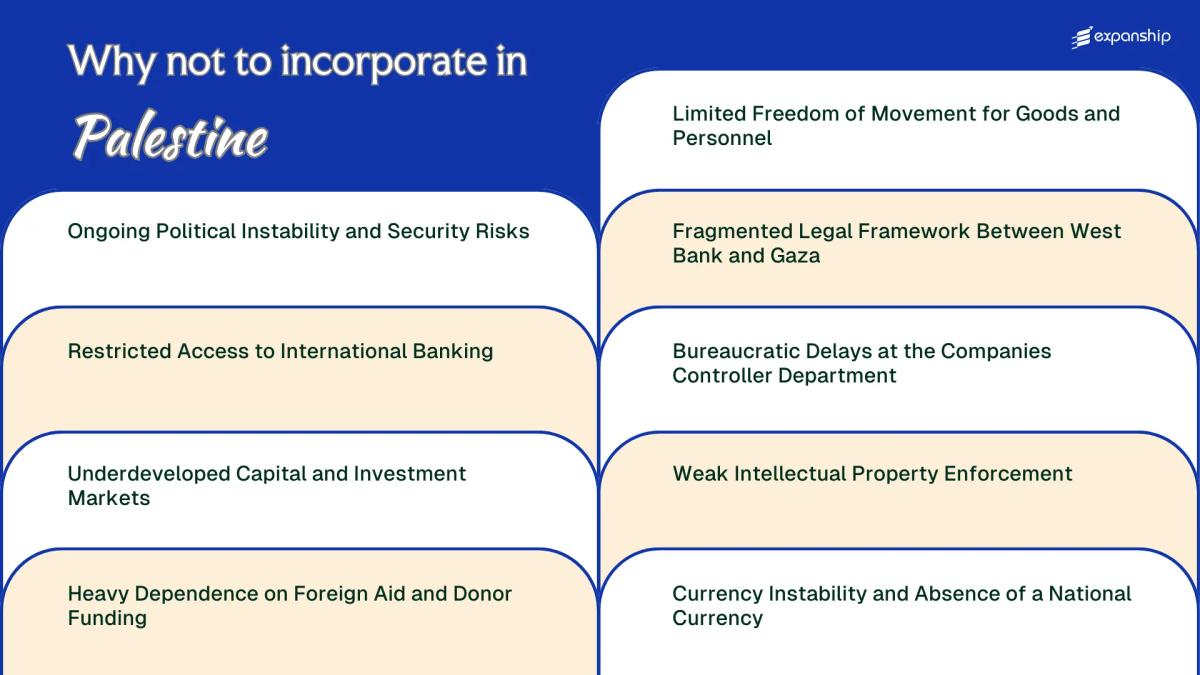
Ongoing Political Instability and Security Risks
Palestine political instability business risks are among the most consequential operational factors any foreign investor must account for before registering an entity in the territory.
Armed Conflict and Physical Security Exposure
Active armed conflict, particularly the escalation that intensified in late 2023, has caused direct destruction of commercial infrastructure across both the West Bank and Gaza. Your business premises, equipment, and supply chains carry no guaranteed protection, and insurance coverage for war-related losses is either prohibitively expensive or entirely unavailable through standard commercial providers.
Operational continuity cannot be assumed. Periods of heightened conflict have historically triggered closures, curfews, and movement restrictions imposed by Israeli military authorities under mechanisms like Area C administrative controls, effectively halting business activity without notice.
Political Fragmentation and Governance Uncertainty
The Palestinian Authority's jurisdiction is contested and administratively divided, meaning the legal environment governing your registered entity can shift based on political developments outside your control. No unified sovereign authority exists to guarantee contract enforcement or asset protection with the stability expected in most jurisdictions.
Foreign investors have no reliable legal recourse mechanism if conflict or political fragmentation disrupts operations, freezes assets, or renders contractual obligations unenforceable.
Restricted Access to International Banking
Palestine international banking restrictions stem from a combination of geopolitical isolation, correspondent banking withdrawal, and the absence of full sovereign monetary infrastructure. Your firm cannot open accounts in many international banks because those institutions face compliance exposure under U.S. and EU sanctions frameworks that treat Palestinian territories as elevated-risk jurisdictions.
Palestinian banks operate under the Palestine Monetary Authority (PMA), which functions as a de facto central bank but lacks the international standing of a sovereign monetary authority. This limits inter-bank clearing arrangements and reduces the range of correspondent relationships available to locally registered firms.
Foreign companies registered through the Companies Controller Department frequently encounter the following operational burdens:
- Transferring funds abroad requires additional documentation layers that delay settlements by weeks, directly affecting supplier payments and payroll cycles.
- Many European and U.S. banks refuse onboarding for entities with a Palestinian registered address, forcing directors to maintain accounts in third-country jurisdictions at added cost.
- Trade finance instruments such as letters of credit are difficult to arrange domestically, raising the cost and complexity of import-dependent business models.
- Currency transactions routed through Israeli banking channels are subject to additional scrutiny, creating unpredictable processing timelines.
Firms operating only within the West Bank may find local PMA-licensed banks sufficient for day-to-day transactions, but cross-border commercial activity consistently exposes these banking access challenges in Palestine.

Company Incorporation in Palestine
Understand the full structural and compliance requirements before registering a business entity in Palestine.
Underdeveloped Capital and Investment Markets
Palestine underdeveloped investment market problems stem from a stock exchange that remains structurally constrained and largely inaccessible to foreign capital. The Palestine Securities Exchange (PEX), established in 1997 and regulated by the Palestine Capital Market Authority (PCMA), lists fewer than 50 companies across all sectors. That concentration severely limits portfolio diversification, leaving your firm with few viable equity instruments and no meaningful secondary market depth.
| Constraint | Detail | Implication for Foreign Investors |
|---|---|---|
| Listed companies | Fewer than 50 | Negligible secondary market for exit strategies |
| Market capitalization | Under $4 billion USD | Insufficient scale for institutional investment mandates |
| Foreign ownership cap | Sector-specific restrictions apply | Equity stakes may be capped below operational control threshold |
| Derivatives and hedging tools | Not available on PEX | No instruments to hedge currency or market risk |
Capital market limitations extend beyond thin equity listings. Venture capital and private equity infrastructure are largely absent, meaning early-stage or growth-oriented firms cannot access locally sourced growth funding. Your business must either self-finance or rely on foreign donor-linked instruments, neither of which functions as a normal capital market mechanism.
The PCMA has issued regulations aimed at market development, but enforcement capacity and investor confidence remain constrained by the broader political environment. Foreign investment restrictions tied to sector approvals add another procedural layer, and the absence of a sovereign credit rating makes benchmarking debt instruments against regional peers structurally impossible.
Heavy Dependence on Foreign Aid and Donor Funding
Palestine foreign aid dependence business risks are structural, not incidental. The Palestinian Authority's budget has historically relied on international donors — including the EU, the United States, Arab League members, and multilateral institutions — to fund a substantial portion of public expenditure, including civil servant salaries and infrastructure.
When donor commitments shift, the immediate consequence is liquidity pressure on government operations. Delays in salary payments to public sector workers reduce consumer purchasing power, which directly contracts the market your business may depend on.
Aid flows are also politically conditioned. Following shifts in U.S. policy in 2018 and the suspension of USAID funding to the West Bank and Gaza, the Palestinian Authority faced acute fiscal shortfalls. A foreign firm operating here carries exposure to disruptions that originate entirely outside the local market.
- Budget allocations for public contracts can be suspended or reversed without notice if donor funding is withheld
- Demand-side instability is tied to public sector payroll cycles, which depend on aid disbursement timelines
- Foreign currency availability in the local market can tighten during periods of reduced aid inflow
- Procurement processes under the Palestinian Authority may stall when the Ministry of Finance faces revenue gaps
The Palestinian Authority's fiscal dependence on external aid means that a political decision made in Washington, Brussels, or Riyadh can affect your local client's ability to pay invoices within weeks.
According to IMF fiscal data, external grants and budget support have at times constituted over 30% of total Palestinian Authority revenues, a ratio that creates systemic exposure no private-sector hedge can fully offset.
Limited Freedom of Movement for Goods and Personnel
Palestine's freedom of movement restrictions for business create supply chain disruptions that are structural, not situational. For any company operating across the West Bank, access to markets, suppliers, and employees is subject to conditions largely outside your control.
The Physical Infrastructure of Restriction
Movement between Palestinian territories and Israel, Jordan, or other markets passes through a network of Israeli-controlled checkpoints, including major crossings such as Allenby Bridge and the Kerem Shalom crossing for goods. Delays at these points are unpredictable, and perishable or time-sensitive cargo faces material losses that cannot be insured away.
Permits govern the movement of Palestinian workers and, in some cases, foreign personnel affiliated with registered entities. Obtaining and renewing these permits through the Israeli Civil Administration adds an administrative layer that directly inflates your operational overhead.
Consequences for Business Operations
Goods movement limitations in the West Bank compound the effect of an already constrained internal market, since Palestinian companies cannot freely access Israeli ports or establish unobstructed transit corridors. Your logistics costs, lead times, and supplier options are all structurally narrowed compared to almost any neighbouring jurisdiction.
Gaza imposes an additional tier of restriction under the blockade regime, effectively severing commercial continuity between entities registered in both territories.
Guidance on Operating Within Palestine's Movement Constraints
Understand how checkpoint regulations, permit requirements, and crossing restrictions affect your supply chain and personnel logistics before you incorporate.
Fragmented Legal Framework Between West Bank and Gaza
Palestine's fragmented legal framework between the West Bank and Gaza creates direct operational uncertainty for any foreign business trying to establish a consistent legal footing across both territories.
- The West Bank operates primarily under a civil law structure influenced by Jordanian legislation and Palestinian Authority decrees, while Gaza functions under a separate Hamas-administered legal order, meaning a company registered through the Palestinian Authority's Companies Controller has no guaranteed legal recognition or enforcement standing in Gaza.
- Contracts governed by Palestinian Authority commercial law cannot be reliably enforced in Gaza courts, exposing your business to unrecoverable losses on transactions that cross territorial boundaries.
- Regulatory requirements for business licensing, labor law compliance, and tax obligations differ between the two territories, effectively forcing firms with operations in both areas to maintain dual compliance structures.
- No unified commercial court system exists to adjudicate cross-territorial disputes, leaving foreign investors without a predictable legal remedy when counterparties operate under a different administrative jurisdiction.
Bureaucratic Delays at the Companies Controller Department
Palestine Companies Controller Department delays are among the most operationally disruptive aspects of the incorporation process in the West Bank. The Companies Controller, operating under the Palestinian Ministry of National Economy, is the sole authority for registering commercial entities, and its processing timelines are inconsistent and difficult to predict.
Document review alone can extend weeks beyond any published timeframe, particularly when submissions require notarization, translation, or additional clearance from other government bodies. For a foreign investor working across time zones and with legal counsel on retainer, each idle week carries a direct financial cost.
The bureaucratic challenges in Palestine company registration are compounded by manual administrative processes and limited digital infrastructure within the department. Physical presence or local agent representation is often required at multiple stages, which adds logistical overhead that incorporations in neighboring Jordan, for example, do not impose to the same degree.
Hypothetical scenario: A foreign investor engaging a local agent for representation across three in-person filing visits, each requiring notarized document sets, could realistically incur USD 1,500 to USD 3,000 in agent fees and preparation costs before incorporation is confirmed, excluding government filing fees.
Weak Intellectual Property Enforcement
Palestine intellectual property enforcement risks are a genuine operational concern for any foreign firm holding trademarks, patents, or proprietary content. The Palestinian Authority's legal framework for IP is based on a mix of outdated Jordanian legislation and newer domestic provisions, but neither creates a reliable enforcement infrastructure.
The Palestinian Authority acceded to the World Intellectual Property Organization (WIPO), yet accession alone does not translate to functional enforcement. Courts lack specialist IP judges, and the procedural pathway from infringement complaint to remedy is slow and uncertain.
Trademark registration through the Companies Controller Department does not guarantee protection against counterfeiting or unauthorized use. Without consistent judicial follow-through, registration provides limited practical deterrence.
For software companies, content publishers, or branded consumer goods businesses, this gap is particularly costly. Competitors can replicate products or branding with limited fear of swift legal consequences.
- Enforcement agencies lack dedicated IP units
- Civil remedies are difficult to obtain within a predictable timeframe
- Cross-border IP violations involving Gaza fall outside West Bank judicial reach
If your business derives value from proprietary brands, technology, or content, you should not assume that Palestinian Authority IP registration alone will protect those assets against infringement in practice.
Currency Instability and Absence of a National Currency
Palestine currency instability business risks are structural, not cyclical. The Palestinian Authority has no national currency; transactions occur in Israeli New Shekel (ILS), Jordanian Dinar (JOD), or US Dollar (USD), depending on the region and counterparty.
Operating across multiple currencies without a central bank to regulate exchange rates exposes your firm to unpredictable conversion costs on every cross-border transaction. The Palestinian Monetary Authority oversees monetary policy but cannot issue currency or set interest rates independently.
For a foreign business, pricing contracts, managing payroll, and reporting financials across three currencies simultaneously creates genuine accounting complexity. Currency mismatches between receivables and payables can erode margins without any change in underlying business performance.
Donor-funded public sector contracts are frequently denominated in USD, while local suppliers may invoice in ILS, compounding the multi-currency risks incorporating in Palestine generates at the operational level.
Strategies to Overcome These Obstacles
Overcoming Palestine incorporation challenges requires structural planning rather than reactive problem-solving, given the layered political, legal, and financial constraints operating simultaneously across the territory.
- Register your company through the Companies Controller under the Palestinian Authority's Companies Law to establish a legally recognised West Bank presence before committing operational capital.
- Open accounts with banks affiliated with the Palestinian Monetary Authority to reduce correspondent banking rejection risks tied to international compliance screenings.
- Structure contracts and financial records in a recognised foreign currency, such as the USD or JOD, to mitigate exposure from the absence of a national Palestinian currency.
- File all intellectual property rights under the Palestinian Authority's applicable registration mechanisms early in the formation process, before commercial activity begins.
- Obtain all required movement coordination documentation in advance for any planned cross-border transfer of goods or personnel.
These steps address the most structurally significant barriers but do not eliminate the underlying constraints imposed by the fragmented legal environment and restricted monetary sovereignty. Mitigation is possible within limits; the jurisdictional conditions themselves remain outside any individual business's control.
Palestine's Viability as a Business Destination
Palestine's viability as a business destination is real but conditional. The disadvantages documented across this blog are structural, not peripheral, and any assessment of incorporating here must account for them honestly. That said, businesses with a specific mandate in Palestinian markets, or those funded through donor programs, do operate and maintain registered entities under Palestinian Authority jurisdiction.
| Pros | Cons |
|---|---|
| Access to a captive local market with limited foreign competition | Political instability and active security risks disrupt operations unpredictably |
| Eligibility for donor-funded contracts and development programs | Restricted access to international banking limits financial connectivity |
| Low corporate tax rate under Palestinian Authority tax law | No national currency; business is conducted in ILS, JOD, or USD without monetary sovereignty |
| Presence in a jurisdiction with an active regulatory framework through the Companies Controller Department | Fragmented legal administration between the West Bank and Gaza creates compliance inconsistencies |
| Early-mover positioning in an underdeveloped market | Bureaucratic delays at the Companies Controller Department extend registration timelines |
Intellectual property protections exist on paper but enforcement remains unreliable in practice. Businesses holding patents, trademarks, or proprietary technology face meaningful exposure without supplementary legal safeguards registered in stronger jurisdictions.
Compliance Services for Companies in Palestine
Maintain your Palestinian Authority-registered entity in good standing, from annual filings with the Companies Controller Department to ongoing regulatory obligations.
Conclusion
The cons of Palestine company incorporation extend well beyond administrative friction. Operating under the Palestinian Authority's regulatory system means your business faces structural constraints rooted in political division, restricted banking access, and the absence of a sovereign currency. These are not incidental risks. The fragmented jurisdiction between the West Bank and Gaza, combined with limited correspondent banking relationships, shapes every aspect of how a registered entity functions day to day. For businesses where continuity, capital movement, and legal predictability matter, those factors carry real weight in any formation decision.
Expanship's Palestine Business Formation Support
Expanship Palestine company formation support is structured around the specific friction points this blog has outlined, from filing with the Companies Controller Department under the Palestinian Companies Law No. 12 of 1964 to managing compliance across a jurisdiction where the legal framework differs between the West Bank and Gaza. Expanship's role is to reduce the operational weight of these obligations, not to change the underlying conditions your business will face.
Our Palestine business registration assistance covers the full incorporation lifecycle and ongoing compliance needs.
- Preparing and filing all company registration documents with the relevant Palestinian authorities
- Providing a registered agent and local office address for your entity in the West Bank
- Handling government filings and liaising directly with regulatory bodies on your behalf
- Managing post-incorporation compliance obligations as your firm's requirements evolve
- Introducing your business to banking contacts familiar with Palestinian corporate accounts
- Registering your company for tax purposes and coordinating with local fiscal authorities
Reach out to Expanship Palestine to discuss your incorporation requirements.
Frequently Asked Questions (FAQ)
It affects all registered entities, regardless of structure. Companies incorporated under the Palestinian Companies Law No. 12 of 1964, as amended, are registered with the Companies Controller Department under the Palestinian Authority, which holds no administrative jurisdiction over Gaza. Any business intending to operate across both territories faces two separate regulatory environments with no unified enforcement mechanism between them.
There is no single figure, but the cost materializes through conversion losses, hedging expenses, and pricing unpredictability. Palestine uses the Israeli New Shekel, Jordanian Dinar, and US Dollar interchangeably, with no central bank able to regulate monetary supply or exchange rates. Your firm absorbs exchange rate fluctuations on every cross-border transaction without any policy buffer to protect against sudden rate movements.
Palestine ranks among the most restricted environments globally for correspondent banking. International banks routinely de-risk from Palestinian financial institutions due to compliance concerns under US and EU counter-terrorism financing regulations, which has led major correspondent relationships to collapse over the past decade. The practical result is that your business may struggle to receive international wire transfers, open foreign currency accounts, or process payments through standard SWIFT channels.
Enforcement is weak and litigation outcomes are unpredictable. Palestine acceded to the Paris Convention and TRIPS-aligned obligations through its observer status arrangements, but the domestic judiciary lacks the specialized IP courts and technical expertise needed to adjudicate infringement cases efficiently. You may obtain a registration, but converting that registration into actionable protection against a local infringer is a slow, resource-intensive process with uncertain results.
Using a local agent can reduce administrative friction but does not eliminate delays caused by institutional bottlenecks within the Companies Controller Department itself. Processing timelines for company registration and document authentication routinely extend beyond published service standards, particularly when submissions require coordination between multiple ministries. The underlying cause is systemic capacity constraints, not procedural non-compliance, so appointing a local agent addresses process preparation but not institutional processing speed.
Aid dependency distorts the broader economy in ways that directly affect private firms. Donor funding cycles drive consumption patterns, public sector wages, and infrastructure investment, meaning that any contraction in aid disbursements, such as those seen following US funding cuts in 2018 and 2019, triggers liquidity tightening across the banking sector and reduces consumer purchasing power. A private business with no direct donor relationship still absorbs these shocks through reduced demand, tighter credit conditions, and delayed government payments if it holds any public contracts.
Legal Disclaimer
The information provided in this article is for general informational purposes only and does not constitute legal, tax, or professional advice. While we strive to ensure the accuracy and timeliness of the content, laws and regulations are subject to change, and the application of laws can vary widely based on specific facts and circumstances.
Readers should not act upon this information without seeking professional counsel tailored to their individual situation. Expanship and its authors disclaim any liability for actions taken or not taken based on the content of this article.
For specific advice regarding your business setup, compliance requirements, or any legal matters, please consult with qualified legal and tax professionals in the relevant jurisdiction.