

Key Takeaways
- Foreign investors in restricted industries must navigate the Foreign Investment Negative List, which caps foreign equity at 40% or less in sectors such as mass media, retail trade below certain thresholds, and certain professional services, directly limiting ownership and operational control.
- Under the Revised Corporation Code (Republic Act No. 11232), corporations must satisfy SEC registration requirements that involve multiple sequential steps across overlapping agencies — including the DTI, SEC, BIR, and local government units — before a business can legally operate.
- Minimum paid-in capital requirements for foreign-owned corporations, which can reach USD 200,000 for most foreign equity enterprises, create a substantial financial threshold that does not apply to domestically owned entities in the same industries.
- BIR tax registration and ongoing compliance obligations — including mandatory bookkeeping, official receipt issuance, and regular filing across multiple tax types — impose an administrative burden that is disproportionately complex relative to what foreign investors typically encounter in comparable Southeast Asian jurisdictions.
Incorporating in the Philippines places your business within a moderately regulated environment governed by multiple overlapping agencies, including the Securities and Exchange Commission (SEC), the Bureau of Internal Revenue (BIR), and the Department of Trade and Industry (DTI). The Corporation Code underpins the core legal framework for company formation and ongoing corporate governance.
The disadvantages of incorporating in the Philippines span registration procedures, ownership restrictions, capital thresholds, and compliance obligations — each addressed separately in the sections that follow.
Not every drawback applies equally across all business types. The severity of a given constraint depends heavily on your chosen corporate structure, the industry you operate in, and the proportion of foreign equity involved.
This article is most relevant to foreign investors and multinational business owners seeking to establish an operational presence or holding entity in the country, particularly those unaccustomed to civil law-influenced regulatory systems with active multi-agency oversight.
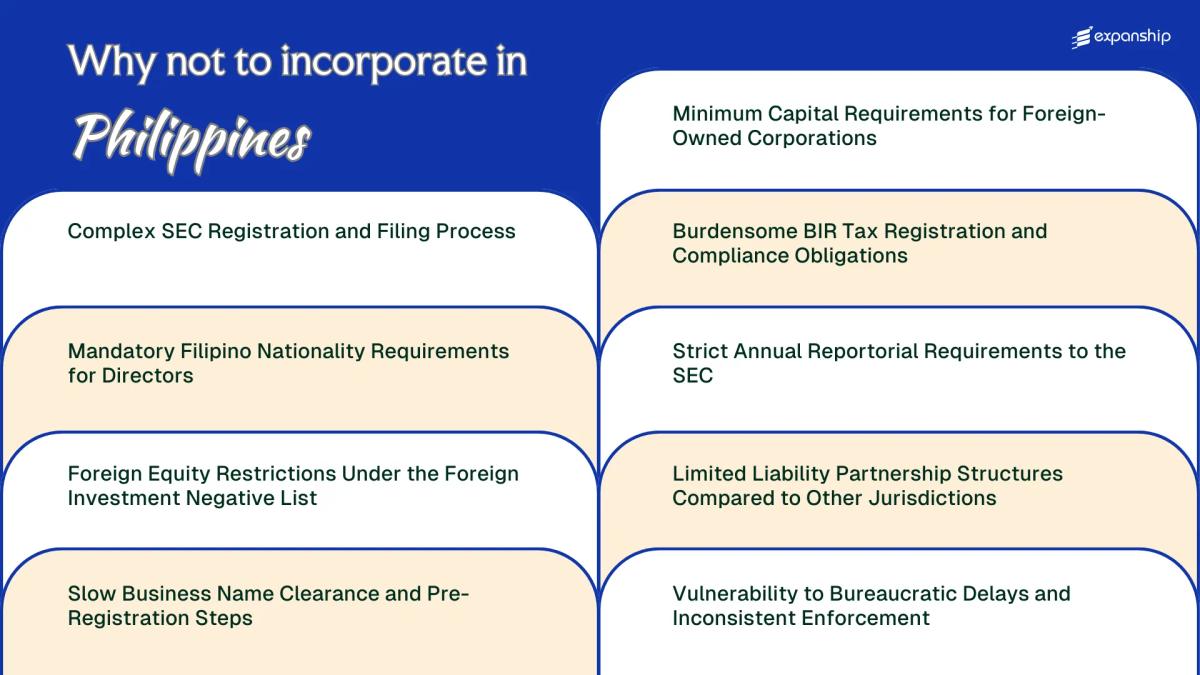
Complex SEC Registration and Filing Process
Philippines SEC registration problems begin before a single document is filed. The Securities and Exchange Commission requires incorporation applicants to complete several pre-registration steps that add time and procedural friction before the formal submission stage opens.
A Multi-Agency Process That Creates Compounding Delays
Under the Revised Corporation Code (Republic Act No. 11232), domestic and foreign corporations must register with the SEC before legally operating. The online registration system, known as the SEC Company Registration System (CRS), handles submissions, but technical issues and document deficiency notices are common occurrences that reset processing timelines. Each rejection requires resubmission with corrections, and there is no guaranteed turnaround period once a notice is issued.
Document Requirements That Compound the Administrative Load
Foreign corporations face a particularly demanding documentary burden, including authenticated articles of incorporation from the home jurisdiction, a financial statement showing sufficient inward remittances, and a resident agent appointment. These requirements are assessed individually by SEC examiners whose interpretation of sufficiency can vary, making outcomes difficult to predict across separate filings.
A single document deficiency notice from the SEC can reset your entire processing timeline, and there is no statutory deadline binding the Commission to complete its review within a fixed period.
Mandatory Filipino Nationality Requirements for Directors
The Filipino nationality requirement for directors is one of the more structurally restrictive aspects of incorporating a domestic corporation under the Revised Corporation Code (Republic Act No. 11232). At least one of your directors must be a resident of the Philippines, and in sectors subject to foreign equity caps, the majority of directors must be Filipino citizens. For a fully foreign-owned entity, this constraint shapes board composition from day one.
This isn't a bureaucratic technicality. It directly limits how much operational and governance control foreign principals can retain over their own company.
Practically, these nationality restrictions on Philippine corporations create friction across multiple levels:
- Recruiting a qualified Filipino director who meets residency requirements takes time and introduces reliance on a third party with legal authority over the entity.
- If a nominee director arrangement is used, you carry the cost of that relationship indefinitely, not just at setup.
- Board decisions requiring majority approval may be delayed or complicated if Filipino director availability becomes an issue.
- Any sector-specific citizenship threshold ties board restructuring to regulatory approval, limiting your flexibility to respond to internal changes.
The Foreign Investments Act and its implementing rules tie these director thresholds to equity classifications, meaning the burden scales with the nature of your business activity.

Company Incorporation in the Philippines
Understand the legal requirements and structure options for setting up a corporation in the Philippines.
Foreign Equity Restrictions Under the Foreign Investment Negative List
The Philippines Foreign Investment Negative List restrictions represent one of the most structurally binding constraints foreign investors encounter. Codified under Republic Act No. 7042 (the Foreign Investments Act of 1991) and updated periodically by executive order, the FINL divides restricted activities into two lists: List A, where foreign equity limits are imposed by the Philippine Constitution or specific statutes, and List B, where limits are set on grounds of national security, defense, or public health.
| Sector | Maximum Allowed Foreign Equity | Governing Basis |
|---|---|---|
| Mass media (excluding internet) | 0% | Constitution |
| Retail trade (below USD 7.5M paid-up capital) | 0% | RA 11595 |
| Private security agencies | 40% | RA 5487 |
| Advertising agencies | 30% | Constitution |
| Educational institutions | 40% | Constitution |
| Public utilities | 40% | Constitution |
A 0% foreign equity ceiling is an outright bar. Your business cannot operate in that sector regardless of structure, local partnerships, or capitalization level.
Even where partial foreign ownership is allowed, the 40% ceiling common across several sectors forces structural dependency on Filipino majority shareholders. Control over strategic decisions, profit distribution, and governance becomes contingent on your local partners rather than your own shareholding position.
List A restrictions are constitutionally entrenched, meaning no legislative amendment alone can remove them. That depth of restriction has no administrative workaround available to foreign investors.
Slow Business Name Clearance and Pre-Registration Steps
Philippines business name clearance delays begin at the first step of incorporation, before any formal filing takes place. The Securities and Exchange Commission (SEC) requires name verification and reservation through its Company Registration System (CRS), and processing times are not guaranteed, meaning your chosen name can remain in limbo while the reservation window runs down.
Name reservations under SEC rules are valid for a limited period. If your full registration is not completed within that window, the reservation lapses and you must restart the process, incurring additional fees and lost time.
The SEC name guidelines impose restrictions on names that are similar, misleading, or contrary to existing law, and rejections require a full resubmission rather than a simple amendment. For foreign-owned entities, names referencing nationalities or foreign terms can trigger additional scrutiny.
- Name reservation through the SEC CRS expires within a fixed period; failure to complete registration within that window requires re-filing
- Rejected name applications require full resubmission, not correction of a single field
- Pre-registration steps must be completed before any Articles of Incorporation can be accepted
- Foreign-sounding or nationality-referencing names face additional SEC review under naming guidelines
The SEC name reservation system does not guarantee exclusivity against phonetically similar names, only exact or near-identical textual matches, meaning a competitor could register a name that sounds identical to yours.
Minimum Capital Requirements for Foreign-Owned Corporations
Minimum capital requirements for foreign corporations in the Philippines are set significantly higher than those imposed on domestic entities, creating a financial barrier that affects market entry planning from the outset.
Statutory Thresholds Under the Foreign Investment Act
Under Republic Act No. 7042 (the Foreign Investment Act), foreign-owned corporations doing business in the Philippines generally must have a paid-up capital of at least USD 200,000. For businesses employing at least 50 direct employees or utilizing advanced technology as certified by the Department of Science and Technology, this threshold drops to USD 100,000, but that exception is narrow and not accessible to most service or trading firms.
Capital Lock-In and Its Consequences for Foreign Investors
This requirement means capital is effectively committed before your business generates any local revenue, increasing financial exposure during the startup phase. Unlike many Southeast Asian jurisdictions where minimum capital requirements are nominal or absent for certain entity types, the Philippines imposes a hard statutory floor that cannot be reduced through structuring or deferred contribution arrangements.
Support for Foreign Investors Facing Capital Barriers in the Philippines
Get clarity on paid-up capital thresholds, exemption conditions under the Foreign Investment Act, and how statutory requirements affect your incorporation timeline and structure.
Burdensome BIR Tax Registration and Compliance Obligations
BIR tax registration compliance challenges Philippines extend well beyond a one-time registration fee, imposing recurring administrative costs that many foreign business owners underestimate before entry.
- Every corporation must register with the Bureau of Internal Revenue and obtain a Certificate of Registration before commencing operations, requiring submission of the SEC Certificate of Incorporation, Articles of Incorporation, and other documents, with any missing item resetting the process.
- The BIR mandates registration of all official receipts and invoices prior to their use, and failure to use BIR-accredited receipts exposes your business to penalties under the National Internal Revenue Code.
- Monthly, quarterly, and annual filing obligations under the NIRC — including VAT returns, withholding tax remittances, and income tax returns — generate a high-frequency compliance calendar that typically requires dedicated local accounting personnel.
- The BIR's Alpha List submission requirement obligates firms to report all payees and employees annually, adding a data-intensive layer to year-end tax compliance.
Strict Annual Reportorial Requirements to the SEC
Philippines SEC annual reportorial requirements burdens fall disproportionately on foreign-owned corporations, which must submit multiple filings each year to maintain good standing with the Securities and Exchange Commission.
Every stock corporation registered with the SEC must file a General Information Sheet (GIS) within 30 days of its annual stockholders' meeting. This deadline is non-negotiable, and late submission triggers penalties that accumulate per day of non-compliance.
Beyond the GIS, corporations are required to submit audited financial statements prepared by an independent certified public accountant accredited by the SEC. For foreign-owned entities, coordinating with locally accredited auditors adds both cost and scheduling dependency that domestically managed firms typically handle more efficiently.
The SEC also requires corporations to comply with specific reportorial mandates under the Revised Corporation Code (Republic Act No. 11232). Non-filers risk being flagged for revocation of corporate registration, a consequence that can disrupt operations with little advance warning.
A foreign-owned corporation that misses its GIS filing deadline by 60 days could face cumulative SEC penalties reaching PHP 30,000 or more, depending on authorized capital stock, before any legal or professional remediation costs are added.
Limited Liability Partnership Structures Compared to Other Jurisdictions
Philippine law does not recognize a Limited Liability Partnership as a distinct legal entity. This is a direct Philippines limited liability partnership restriction that eliminates a formation option many foreign investors rely on in other markets.
Under the Revised Corporation Code (Republic Act No. 11232) and the Civil Code, your structural choices are essentially limited to a domestic corporation, a general partnership, or a limited partnership. General partnerships in the Philippines expose partners to unlimited personal liability, while limited partnerships offer some liability protection but lack the operational flexibility that an LLP structure provides in jurisdictions like Singapore, the UK, or several US states.
This structural gap has concrete consequences:
- Foreign professional service firms accustomed to LLP formation abroad must restructure their operating model entirely.
- A limited partnership here does not shield all partners from management liability the way an LLP does.
- Your liability exposure is determined by a fixed statutory framework, not by a negotiated partnership agreement.
The absence of an LLP option is not a procedural hurdle that can be resolved through workarounds at the Securities and Exchange Commission; it reflects a fundamental gap in available entity types under Philippine statute.
Foreign investors who operate as LLPs in their home jurisdiction should not assume an equivalent structure exists here — no hybrid entity offering both liability limitation and pass-through taxation in LLP form is currently recognized under Philippine law.
Vulnerability to Bureaucratic Delays and Inconsistent Enforcement
Philippines bureaucratic delays in business incorporation are well-documented, with multiple agencies involved in registration creating compounding wait times that can stretch well beyond official processing windows.
The Securities and Exchange Commission (SEC), Bureau of Internal Revenue (BIR), and local government units each operate on separate timelines. When one agency stalls, your entire registration sequence stalls with it.
Inconsistent regulatory enforcement compounds this further. Interpretation of requirements can vary between examiners and regional offices, meaning a document accepted in one transaction may be rejected in another.
- Processing timelines published by agencies rarely reflect actual turnaround times experienced by applicants.
- Local government unit (LGU) business permit requirements differ by municipality, creating unpredictability for firms operating across multiple locations.
This inconsistency is especially disruptive for foreign-owned entities, which typically require additional documentary layers. Delays at any single touchpoint postpone the firm's legal capacity to operate and generate revenue.
Overcoming Incorporation Challenges in the Philippines
Overcoming Philippines incorporation challenges requires structural preparation before engaging the SEC or any other regulatory body. The Foreign Investment Negative List, nationality requirements, and reportorial obligations all demand advance planning rather than reactive responses.
- Verify your intended business activity against the current Foreign Investment Negative List to determine permissible foreign equity thresholds before selecting a corporate structure.
- Appoint at least one Filipino national as a director to satisfy the Corporation Code's board composition requirements for entities operating in partially restricted sectors.
- Secure the minimum paid-up capital required for your ownership structure prior to submitting incorporation documents to the SEC.
- Register with the BIR within 30 days of SEC approval to avoid penalties tied to late tax registration.
- Prepare for annual General Information Sheet and audited financial statement filings with the SEC from the first full year of operations.
Each of these steps corresponds to a distinct regulatory layer that your firm must address as a formal obligation. The Philippine corporate framework does not treat procedural non-compliance as minor; enforcement consequences range from monetary penalties to suspension of corporate registration.
The Philippines as a Business Destination
| Pros | Cons |
|---|---|
| English is an official language, reducing friction in legal documentation and corporate filings | Foreign equity is capped at 0% to 40% in sectors listed under the Foreign Investment Negative List |
| A large, English-proficient workforce supports operational setup across service-oriented industries | At least 20% of a corporation's board must be composed of Filipino nationals under the Revised Corporation Code |
| The SEC's online systems have reduced some registration timelines compared to fully manual processes | Minimum paid-up capital requirements for foreign-owned firms can reach USD 200,000 in most cases |
| Geographic position within Southeast Asia provides access to regional trade routes | BIR registration and ongoing tax compliance carry multiple procedural layers that extend post-incorporation timelines |
Despite the structural barriers documented across this blog, the Philippines remains a functioning incorporation destination for foreign businesses operating in permitted sectors. The Revised Corporation Code of 2019 introduced reforms that modernised certain SEC procedures.
Inconsistent enforcement and multi-agency compliance obligations remain genuine constraints for foreign firms entering the market. Your assessment should weigh those realities against any strategic rationale for operating in this jurisdiction.
Corporate Compliance Services in the Philippines
Manage your SEC annual reportorial obligations, BIR filings, and ongoing regulatory requirements for your Philippine-registered entity.
Conclusion
The cons of Philippines company registration are real and structural. Foreign equity caps under the Foreign Investment Negative List, mandatory Filipino director requirements, and the layered compliance demands of the SEC and BIR collectively create a formation environment that requires careful advance planning. For foreign-owned entities, the 200,000 USD minimum paid-up capital threshold alone can significantly affect how a business structures its entry. These are not administrative inconveniences — they reflect deliberate regulatory policy. Understanding the full scope of these constraints before filing is what separates a well-structured Philippine entity from one that encounters avoidable delays or compliance gaps later.
Expanship's Philippines Incorporation Support
Registering a company in the Philippines means dealing with the SEC, BIR, and a foreign equity framework that penalizes the unprepared. Expanship works alongside foreign investors pursuing Philippines incorporation support by taking on the document preparation, regulatory coordination, and compliance tracking that consume time and operational capacity. Our role is to reduce that burden, not to change the rules you must follow.
Our service scope covers the full formation and post-registration cycle across these areas:
- Company registration and preparation of Articles of Incorporation, bylaws, and required SEC submission documents
- Provision of a registered agent and local office address to meet Philippine residency requirements
- Direct liaison with the SEC, BIR, and other government bodies on your behalf
- Ongoing post-incorporation compliance management, including annual reportorial obligations
- Banking introduction assistance to support your operational setup in-country
- Tax registration and coordination with the BIR for Certificate of Registration issuance
Reach out to Expanship Philippines to discuss your incorporation requirements.
Frequently Asked Questions (FAQ)
Under the Revised Corporation Code of the Philippines (Republic Act No. 11232), corporations are no longer required to have a majority of Filipino directors unless the business falls under a nationality-restricted sector. However, if your firm operates in an industry covered by the Foreign Investment Negative List or other sector-specific laws, Filipino ownership and directorship thresholds still apply and are strictly enforced by the SEC.
Failure to file required reports with the SEC, including the General Information Sheet and Audited Financial Statements, can result in monetary fines and, in repeated cases, revocation of the corporation's certificate of registration. The SEC has the authority under the Revised Corporation Code to administratively dissolve a company that has been delinquent for an extended period. Penalties accumulate per missed filing, so gaps in compliance compound quickly.
The minimum paid-up capital for a fully foreign-owned domestic corporation is generally USD 200,000, as prescribed under the Foreign Investments Act. This threshold can be reduced to USD 100,000 if the business involves advanced technology or directly employs at least 50 full-time Filipino workers. These figures apply at the time of incorporation and must be remitted and deposited in a local bank before the SEC will complete registration.
The BIR registration process is widely regarded as more document-intensive than equivalent processes in Singapore or Hong Kong, where digital systems consolidate most steps. In the Philippines, your business must register separately with the BIR after SEC approval, obtain Authority to Print official receipts, and register books of accounts, each of which involves distinct queues, fees, and documentary requirements. Non-compliance with BIR registration obligations can result in the business being unable to issue valid invoices, which creates immediate operational problems.
Exceeding the allowable foreign equity percentage in a restricted sector renders the corporate structure legally non-compliant, and the SEC can refuse to register or can revoke the registration of the entity. In practice, this means foreign investors sometimes attempt to use nominee Filipino shareholders to meet the threshold, a structure that carries its own legal risk under Philippine law and is not a recognized workaround. The consequence is not just administrative but can expose the foreign investor to loss of the entire investment with no legal recourse.
Yes, and the delays are not merely theoretical. Business name clearance must be obtained before SEC registration proceeds, and if your proposed name is flagged for similarity to an existing entity or requires additional review, the process stalls without a fixed resolution timeline. Combined with the SEC's document review period and subsequent BIR and local government unit registrations, total setup time can extend several months beyond what foreign incorporators typically anticipate based on experience in other jurisdictions.
Legal Disclaimer
The information provided in this article is for general informational purposes only and does not constitute legal, tax, or professional advice. While we strive to ensure the accuracy and timeliness of the content, laws and regulations are subject to change, and the application of laws can vary widely based on specific facts and circumstances.
Readers should not act upon this information without seeking professional counsel tailored to their individual situation. Expanship and its authors disclaim any liability for actions taken or not taken based on the content of this article.
For specific advice regarding your business setup, compliance requirements, or any legal matters, please consult with qualified legal and tax professionals in the relevant jurisdiction.