

Key Takeaways
- Under the Niue International Business Companies Act 1994, every IBC must appoint a licensed resident registered agent before incorporation can proceed, and the company cannot be legally maintained without one.
- Beneficial ownership disclosure obligations in Niue have been strengthened in line with international standards, requiring that UBO information be filed accurately with the Niue International Trust and Company Registry.
- Directors and shareholders must satisfy identity verification requirements by submitting KYC documentation as part of the registration process administered through the Niue Registry.
- Share capital and structural requirements under the Niue IBC framework vary depending on the entity type and intended business activities, meaning the applicable thresholds must be confirmed against the investor's specific incorporation profile.
Entity formation in Niue is governed by the Niue Act 1966 alongside the Niue International Business Companies Act 1994, with oversight administered through the Niue Registry. These instruments establish the legal basis under which foreign-owned structures, particularly International Business Companies, are constituted and maintained.
This article covers the structural, documentary, and compliance requirements that apply when incorporating a company in Niue, spanning areas from capital thresholds to identity verification.
Failure to satisfy Niue IBC requirements results in rejection of the registration application or, where deficiencies arise post-incorporation, potential striking off and loss of legal standing.
Requirements can vary depending on the entity type selected and the nature of the business activities intended. Your specific investor profile or industry classification may also affect which obligations apply.
This article is most relevant to foreign entrepreneurs and holding company operators considering Niue company registration as part of an offshore structuring arrangement.
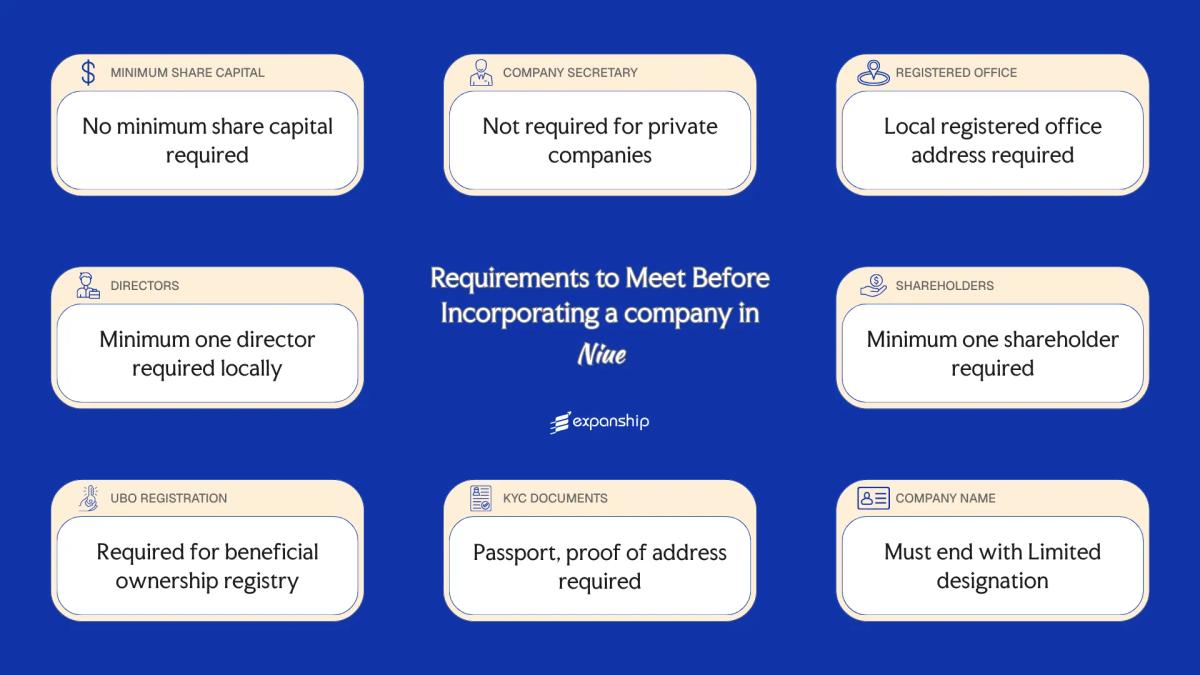
Minimum Share Capital Requirements in Niue

Under the Niue International Business Companies Act 1994, Niue share capital requirements are notably flexible. The legislation does not prescribe a statutory minimum authorized capital, and companies may be formed with shares having either par value or no par value, depending on what the memorandum of association specifies.
The Niue Island Financial Services Registry oversees company formation and reviews constitutional documents at the point of registration, but there is no requirement to deposit capital into a bank account to complete incorporation. Share capital structure is primarily a one-time drafting obligation at incorporation rather than an ongoing statutory mandate.
| Parameter | Detail |
|---|---|
| Minimum Authorized Share Capital | No statutory requirement |
| Maximum Authorized Share Capital | No statutory maximum |
| Minimum Paid-Up Capital | No statutory requirement |
| Paid-Up Requirement at Incorporation | None |
| Accepted Currency | Any currency permissible under the company's memorandum |
| Accepted Forms of Contribution | Cash or non-cash consideration, as permitted by the memorandum |
| Timeframe to Deposit Capital | No statutory timeframe |
The absence of a minimum capital requirement does not eliminate the need to define an authorized share capital structure in your memorandum of association. The Registry requires this to be documented at the time of incorporation.
Registered Agent Requirements in Niue
Under the Niue International Business Companies Act, appointing a registered agent is a mandatory requirement for all IBCs incorporated in the jurisdiction. The agent serves as the official point of contact between the company and the Niue Financial Intelligence Unit, and holds responsibility for maintaining statutory records.
Registered agent obligations in Niue include keeping the register of members and directors, forwarding official correspondence to the company, and ensuring the entity remains in good standing with relevant authorities. Your agent must also retain copies of constitutional documents on behalf of the firm.
Qualification criteria for who may serve as a registered agent:
- Must be a person or entity licensed to provide registered agent services under Niue's applicable corporate services legislation.
- Corporate entities acting as agents must be incorporated or registered within the jurisdiction.
- Individual agents must be resident in Niue and hold any required regulatory approval.
- Trust companies or corporate service providers already authorized under Niue law may qualify automatically.
- Agents must maintain a physical presence sufficient to discharge their statutory duties.

Incorporate a Company in Niue
Set up your Niue IBC with a qualified registered agent and full compliance support from day one.
Registered Office Requirements in Niue
Under the Niue International Business Companies Act 1994, every IBC registered in the jurisdiction must maintain a registered office address within Niue at all times. Failure to comply with Niue registered office requirements can result in the company being struck off the register by the Niue Chamber of Commerce, which administers corporate registrations.
- A physical address within Niue is required; a PO Box alone does not satisfy the requirement.
- Virtual office arrangements are permitted, provided the address corresponds to a physical location in Niue.
- The registered office address must be locally based; an overseas address does not qualify.
- No ownership of the premises is required, but a service agreement or lease with a licensed local provider must support the address.
- The registered office address is recorded on the public company register and is accessible to third parties.
- Any change to the registered office address must be formally notified to the Niue Chamber of Commerce; failure to update the register in a timely manner may expose the entity to administrative penalties or deregistration.
Director Requirements in Niue

Under the Niue International Business Companies Act 1994, directors of a Niue IBC assume statutory duties upon appointment, including fiduciary obligations to act in the best interests of the company and responsibilities under the firm's constitutional documents. Niue director requirements impose no residency or nationality conditions, giving foreign-owned entities significant structural flexibility.
| Parameter | Detail |
|---|---|
| Minimum Number of Directors | One director is required. |
| Maximum Number of Directors | No statutory maximum is prescribed. |
| Local/Resident Director Required | No local or resident director is required. |
| Nationality Restrictions | No nationality restrictions apply under the Niue IBC Act 1994. |
| Minimum Age Requirement | Directors must be at least 18 years of age. |
| Corporate Directors Permitted | Yes, corporate directors are permitted. |
| Director Must Be a Shareholder | No, a director is not required to hold shares in the company. |
| Publicly Listed on Registry | Director details are not publicly listed on the Niue registry. |
| Disqualification Conditions | A person who is bankrupt or has been convicted of a relevant criminal offence may be disqualified from acting as director. |
A single corporate entity can serve as the sole director of a Niue IBC, meaning a company can technically be governed without any individual human director on record.
Shareholder Requirements in Niue

Under the Niue International Business Companies Act 1994, an IBC requires a minimum of one shareholder. No statutory maximum applies, making both sole-shareholder structures and multi-member arrangements permissible.
Nationality and Residency Restrictions
Niue shareholder requirements impose no nationality or residency conditions on shareholders. Foreign nationals and non-residents may hold full ownership of an IBC without restriction.
Corporate Shareholders
Corporate entities are permitted to act as shareholders in a Niue IBC. No additional licensing or local nexus is required for a corporate body to hold shares in the company.
Shareholder Liability
Shareholder liability is limited to the amount unpaid on their shares. No general circumstances under the Niue IBC framework extend personal liability beyond that contribution, provided the corporate form is not improperly used.
Register of Shareholders
A register of shareholders must be maintained, though it is not filed with any public registry. The register is held at the registered office or with the registered agent, and must be kept current to reflect any changes in ownership.
Setting Up Ownership Structures for Your Niue IBC
Get guidance on structuring shareholder arrangements that meet the requirements under the Niue International Business Companies Act 1994.
UBO / Beneficial Ownership Disclosure Requirements in Niue
Under the Niue International Business Companies Act 1994, Niue beneficial ownership requirements are relatively limited compared to many offshore jurisdictions, with no publicly accessible UBO register mandated by statute.
Registered agents are required to collect and retain beneficial ownership information on behalf of incorporated entities, but this data is held privately rather than filed with a government authority.
- The registered agent collects identifying information on all beneficial owners at the time of incorporation.
- Beneficial ownership records are maintained at the registered agent's office within Niue.
- Records must be made available to competent authorities upon lawful request, such as during an investigation or international exchange of information.
| Parameter | Detail |
|---|---|
| Ownership Threshold for UBO Status | No statutory threshold defined |
| Filing Authority | No central government filing authority |
| Disclosure Deadline at Incorporation | No statutory deadline |
| Publicly Accessible Register | No |
| Penalties for Non-Disclosure | No statutory requirement |
| Ongoing Update Obligation | No statutory requirement |
KYC / Document Requirements in Niue

Niue KYC document requirements apply to all parties connected to an incorporation, governed by the Anti-Money Laundering Act 2007 and administered through Niue's Financial Intelligence Unit under the supervision of the Niue Financial Services Commission.
Individual / Personal Documents
- Certified copy of a valid government-issued passport or national identity card
- Proof of residential address dated within three months, such as a utility bill or bank statement
- Completed and signed KYC declaration or personal information form as required by the registered agent
- A recent passport-sized photograph may be required by certain registered agents
Corporate Documents
- Certified copy of the corporate shareholder or director entity's certificate of incorporation
- Constitutional documents, including the articles of association or equivalent instrument
- Current register of directors and register of shareholders for the corporate entity
- Proof of the corporate entity's registered office address
Source of Funds Documentation
- Bank statements covering a minimum of three to six months for the introducing party
- Audited financial statements or accountant's reference letter where bank statements are insufficient
- A written declaration describing the origin of capital may be required
Notarisation and Apostille Requirements
- Documents originating outside Niue generally require notarisation by a qualified notary public
- Apostille certification under the Hague Convention is accepted for documents from member states
- Non-English documents must be accompanied by a certified translation
Incomplete or uncertified beneficial ownership documentation is the most frequently cited reason for delays in Niue incorporation processing.
Company Name Requirements in Niue
Niue company name requirements are assessed at the point of incorporation, with proposed names reviewed for availability and suitability before registration is confirmed. Names that duplicate or closely resemble an existing registered entity are rejected.
All companies must append a legal suffix indicating limited liability, such as "Limited" or its abbreviation "Ltd." Names must be submitted in the Latin alphabet.
Certain words are restricted or prohibited outright. Terms implying government affiliation, banking, insurance, or royal connections require regulatory consent or are disallowed entirely.
Name reservation is generally available in Niue, allowing applicants to hold an approved name for a defined period prior to full incorporation. The reservation is applied for through the registry as a preliminary step.
Compliance Services for Companies in Niue
Stay on top of your ongoing compliance obligations in Niue, from annual filings to regulatory reporting.
Conclusion
Niue company incorporation requirements are defined primarily under the Niue International Business Companies Act 1994, covering everything from share capital and registered agents to director composition and beneficial ownership disclosure.
Among the most consequential requirements is the mandatory appointment of a licensed resident registered agent, without which the entity cannot be formed or maintained. UBO disclosure obligations have also tightened in alignment with international standards.
Once these requirements are understood, a foreign investor's next step is selecting a qualified local agent and assembling the necessary KYC documentation before submission to the Niue International Trust and Company Registry.
Expanship's Corporate Services for Niue Expansion
Niue corporate services requirements cover a specific set of obligations, from maintaining a licensed registered agent under the Niue Act 1994 framework to satisfying the Niue Financial Intelligence Unit's beneficial ownership reporting standards. Expanship works with you to coordinate each of these obligations directly, reducing the administrative burden of managing them across multiple local parties.
Beyond initial registration, our services cover the full incorporation and compliance cycle.
- We prepare and file all company registration documents with the relevant Niue authorities on your behalf.
- Licensed registered agent and registered office provision in Niue is arranged as part of our service.
- Our team liaises with government bodies and regulatory offices throughout the filing process.
- Post-incorporation obligations, including annual returns and ongoing compliance, are tracked and managed for your entity.
- We facilitate introductions to banking institutions suited to Niue-incorporated structures.
- Tax registration and coordination with local authorities is handled as part of your setup.
To discuss your requirements, contact Expanship Niue directly.
Frequently Asked Questions (FAQ)
Niue permits corporate directors, so a single corporate entity can serve as the sole director of your IBC without requiring an individual co-director. There is no statutory residency requirement attached to the director position, meaning neither individual nor corporate directors need to be based in Niue. This makes it straightforward to centralise management through a holding structure incorporated elsewhere.
Maintaining a licensed registered agent in Niue is a statutory requirement under the IBC framework, not an administrative formality. Failure to maintain one puts your company in breach of its ongoing compliance obligations, which can lead to administrative dissolution or loss of good standing. Regulators in Niue monitor agent appointments, and a lapsed engagement creates a direct legal gap in the company's registered presence.
Niue imposes no nationality or residency restrictions on shareholders of an IBC. A single shareholder of any nationality is sufficient to satisfy the ownership structure requirement, and that shareholder can be either an individual or a corporate entity. This unrestricted ownership model is one of the defining characteristics of the Niue IBC regime under the 1994 Act.
Standard KYC requirements for a Niue IBC include a government-issued photo ID, a recent proof of residential address, and source-of-funds documentation for each director and beneficial owner. Corporate shareholders must typically provide their certificate of incorporation, constitutional documents, and KYC files for the underlying individuals who control them. Your licensed registered agent is responsible for collecting and verifying these documents as part of their anti-money laundering obligations.
Beneficial ownership information in Niue is not publicly disclosed. It is held by the licensed registered agent and made available to competent authorities upon a lawful request, but it does not appear on any public register. This confidentiality structure is preserved under Niue's IBC legislation, provided the entity maintains full compliance with its registered agent and filing obligations.
A Niue IBC name must include a designator that signals limited liability, such as "Limited," "Corporation," "Incorporated," or their accepted abbreviations. Certain words that imply a connection to banking, insurance, government, or regulated financial activity are restricted and require prior approval or are prohibited outright. Names that are identical or deceptively similar to existing registered entities in Niue will be rejected by the registry.
Legal Disclaimer
The information provided in this article is for general informational purposes only and does not constitute legal, tax, or professional advice. While we strive to ensure the accuracy and timeliness of the content, laws and regulations are subject to change, and the application of laws can vary widely based on specific facts and circumstances.
Readers should not act upon this information without seeking professional counsel tailored to their individual situation. Expanship and its authors disclaim any liability for actions taken or not taken based on the content of this article.
For specific advice regarding your business setup, compliance requirements, or any legal matters, please consult with qualified legal and tax professionals in the relevant jurisdiction.