

Key Takeaways
- All companies incorporated in Nigeria must register under the Companies and Allied Matters Act 2020 (CAMA 2020) through the Corporate Affairs Commission (CAC), which is the sole authority responsible for company registration and post-incorporation compliance.
- Foreign-owned entities are required to complete registration with the Nigerian Investment Promotion Commission (NIPC) before commencing business operations in Nigeria.
- Every company must maintain a register of beneficial owners and submit this information to the CAC as a mandatory disclosure obligation under the Nigerian regulatory framework.
- Private limited companies, public companies, and incorporated trustees each carry distinct incorporation requirements, meaning the applicable obligations vary based on the legal structure chosen at the point of registration.
Incorporation requirements in Nigeria are governed by the Companies and Allied Matters Act (CAMA 2020), administered by the Corporate Affairs Commission (CAC), which serves as the sole regulatory body for company registration and post-incorporation compliance.
This article covers the principal categories of requirements your business must satisfy before and during the CAC registration process.
Failure to meet these requirements results in rejection of your application or, where non-compliance occurs after registration, exposure to regulatory sanctions under CAMA. Requirements differ depending on whether you are forming a private limited company, public company, or incorporated trustee, and regulated industries may carry additional obligations set by sector-specific authorities.
Foreign investors, joint venture partners, and business owners establishing a Nigerian subsidiary or branch operation will find this article most directly applicable to their situation.
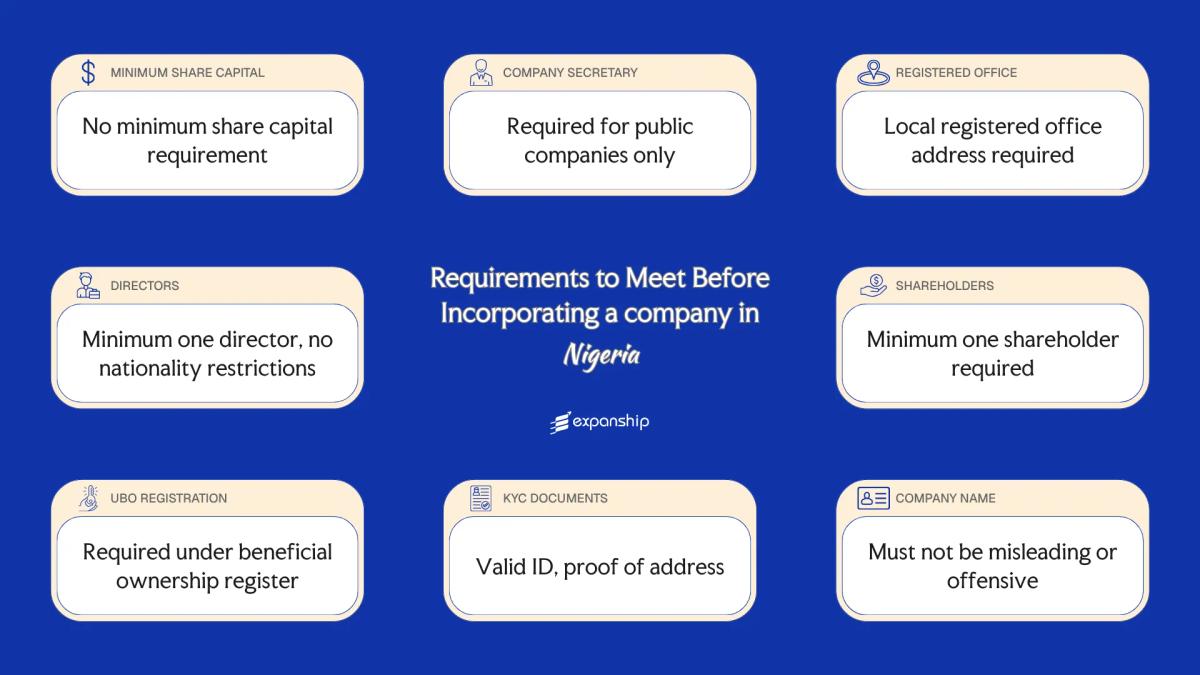
Minimum Share Capital Requirements in Nigeria

Under the Companies and Allied Matters Act (CAMA) 2020, minimum share capital requirements in Nigeria vary by company type and are enforced at the point of registration by the Corporate Affairs Commission (CAC). Nigeria operates a par value share system, meaning each share carries a nominal face value that forms the basis of the authorized share capital structure.
Authorized share capital represents the ceiling a company may issue, while paid-up capital reflects what shareholders have actually contributed. Both figures must be stated in the memorandum of association filed with the CAC at incorporation.
| Parameter | Detail |
|---|---|
| Minimum Authorized Share Capital | NGN 100,000 for private companies; NGN 2,000,000 for public companies under CAMA 2020 |
| Maximum Authorized Share Capital | No statutory maximum |
| Minimum Paid-Up Capital | At least 25% of authorized share capital must be paid up at incorporation |
| Paid-Up Requirement at Incorporation | Yes, partial payment required before CAC registration is completed |
| Accepted Currency | Nigerian Naira (NGN); foreign currency contributions must be converted |
| Accepted Forms of Contribution | Cash, tangible assets, or other property as agreed in the memorandum |
| Timeframe to Deposit Capital | Prior to or at the point of filing incorporation documents with the CAC |
Meeting the minimum authorized share capital threshold does not satisfy the paid-up requirement. At least 25% of the authorized capital must be contributed before the CAC completes registration.
Company Secretary Requirements in Nigeria
Under the Companies and Allied Matters Act (CAMA) 2020, appointing a company secretary is a mandatory requirement for public companies in Nigeria. Private companies are exempt from this obligation, though many opt to appoint one voluntarily for governance purposes.
The company secretary's Nigeria corporate secretary obligations include maintaining statutory registers, filing annual returns with the Corporate Affairs Commission (CAC), and ensuring the firm meets its disclosure requirements under CAMA. Your business's secretary also acts as the formal liaison between the board and regulatory authorities.
Qualification criteria for who may serve as company secretary in Nigeria:
- A public company must appoint a secretary with recognized professional qualifications, such as membership of the Institute of Chartered Secretaries and Administrators of Nigeria (ICSAN).
- Legal practitioners enrolled at the Nigerian Bar are eligible to serve.
- Qualified accountants holding membership of recognized professional accounting bodies in Nigeria may also serve.
- A body corporate may be appointed as secretary, provided it holds the requisite professional standing.
- A sole director of the company cannot simultaneously serve as company secretary.

Incorporate a Company in Nigeria
Set up your legal entity in Nigeria with full CAC compliance support, from name reservation to certificate of incorporation.
Registered Office Requirements in Nigeria
Registered office requirements in Nigeria are governed by the Companies and Allied Matters Act (CAMA) 2020, which mandates that every company maintain a physical address within the country where official correspondence and regulatory notices can be served. Failure to comply with this requirement can result in penalties imposed by the Corporate Affairs Commission (CAC), including fines and potential striking off the companies register.
- A physical address is required; a P.O. box alone does not satisfy the registered office requirement under CAMA 2020.
- Virtual offices are generally not accepted as a registered office address without a verifiable physical location attached.
- The address must be situated within Nigeria; foreign addresses do not meet CAC registered address requirements.
- A lease agreement or proof of ownership is typically required to verify the legitimacy of the address provided to the CAC.
- The registered office address is publicly listed on the CAC companies register and accessible for third-party searches.
- Any change of registered office must be formally notified to the CAC by filing the prescribed form, and the change takes effect only upon CAC acknowledgment.
Director Requirements in Nigeria

Under the Companies and Allied Matters Act (CAMA) 2020, director requirements for a Nigeria company include statutory duties of care, skill, and diligence, with directors personally liable for actions taken outside the scope of their authority or in breach of fiduciary obligations.
| Parameter | Detail |
|---|---|
| Minimum Number of Directors | A private company requires at least one director; a public company requires at least three directors. |
| Maximum Number of Directors | No statutory maximum is prescribed under CAMA 2020. |
| Local/Resident Director Required | No statutory requirement for a resident or Nigerian-national director in a private company. |
| Nationality Restrictions | No nationality restrictions apply under CAMA 2020. |
| Minimum Age Requirement | Directors must be at least 18 years of age. |
| Corporate Directors Permitted | Corporate directors are not permitted; only natural persons may serve as directors. |
| Director Must Be a Shareholder | No statutory requirement under CAMA 2020. |
| Publicly Listed on Registry | Director information is filed with the Corporate Affairs Commission (CAC) and is accessible on the public register. |
| Disqualification Conditions | A person may be disqualified if adjudged bankrupt, convicted of fraud, or disqualified by a court order under CAMA 2020. |
Unlike many comparable jurisdictions, Nigeria does not require a private company to appoint a local or resident director, meaning a company can be fully directed from abroad without any mandatory in-country directorial presence.
Shareholder Requirements in Nigeria

Under the Companies and Allied Matters Act (CAMA) 2020, a private limited company requires a minimum of one shareholder and permits a maximum of fifty. A single-member company structure is therefore valid, allowing sole founders to incorporate without a co-shareholder.
Nationality and Residency Restrictions
Shareholders in a Nigerian company face no statutory nationality or residency requirement — foreign nationals may hold shares without restriction under CAMA 2020. Full foreign ownership is permitted, though certain regulated sectors impose local ownership thresholds through sector-specific legislation.
Corporate Shareholders
Corporate entities may act as shareholders in a Nigerian limited liability company. The subscribing corporate body must itself be a validly incorporated legal entity, and its capacity to hold shares may be governed by its own constitutional documents.
Shareholder Liability
Liability is limited to the amount unpaid on each shareholder's shares. Piercing the corporate veil remains available to Nigerian courts in cases of fraud or where the company is used as a vehicle to evade legal obligations.
Register of Shareholders
CAMA 2020 requires every company to maintain a register of members at its registered office. This register must be updated to reflect any changes in shareholding and is accessible to members and the general public upon request, with certain filings submitted to the Corporate Affairs Commission.
Guidance on Shareholder Structuring for Your Nigerian Company
Get professional advice on meeting shareholder requirements when registering a company in Nigeria, including structuring for foreign ownership and regulatory compliance.
UBO / Beneficial Ownership Registration Requirements in Nigeria
Beneficial ownership registration Nigeria is governed by the Companies and Allied Matters Act (CAMA) 2020 and the Companies Regulations 2021, which define an ultimate beneficial owner as any individual who directly or indirectly holds at least 5% of shares or voting rights in a company.
- Identify all individuals meeting the 5% ownership or control threshold prior to incorporation.
- Record UBO details in the company's internal Register of Beneficial Owners, maintained at the registered office.
- Submit UBO information to the Corporate Affairs Commission (CAC) through the CAC's online registration portal at the point of incorporation.
- Update the register within 14 days of any change in beneficial ownership status.
| Parameter | Detail |
|---|---|
| Ownership Threshold for UBO Status | 5% of shares, voting rights, or right to appoint or remove directors |
| Filing Authority | Corporate Affairs Commission (CAC) |
| Disclosure Deadline at Incorporation | At the point of incorporation |
| Publicly Accessible Register | No; the register is not fully public but accessible to regulators |
| Penalties for Non-Disclosure | Fines under CAMA 2020; officers of the company may face personal liability |
| Ongoing Update Obligation | Within 14 days of any change in beneficial ownership |
KYC / Document Requirements in Nigeria
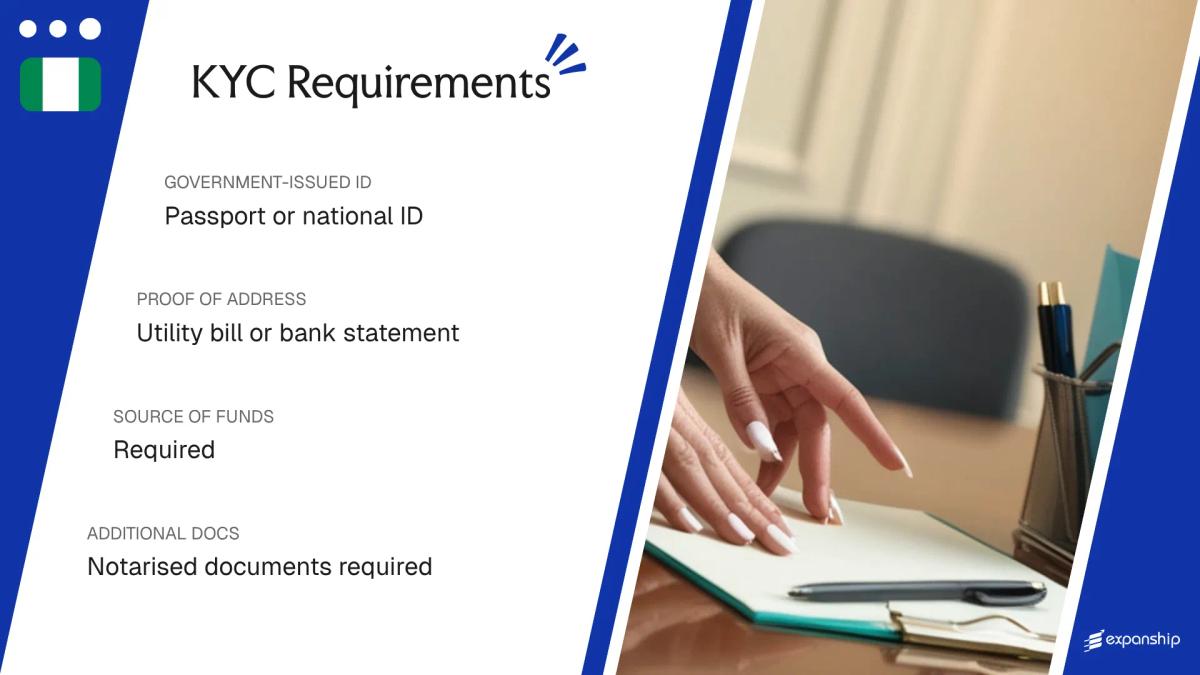
KYC document requirements Nigeria are governed primarily by the Money Laundering (Prevention and Prohibition) Act 2022, administered in coordination with the NFIU, which sets the framework that accredited registration agents and the Corporate Affairs Commission apply when verifying incorporators.
Individual / Personal Documents
- Valid government-issued photo ID (international passport, national ID card, or driver's licence)
- Recent utility bill or bank statement dated within three months, confirming residential address
- Tax Identification Number (TIN) issued by the Federal Inland Revenue Service
- Passport-sized photograph for each director, shareholder, or beneficial owner
Corporate Documents
- Certified true copy of the certificate of incorporation from the home jurisdiction
- Memorandum and Articles of Association or equivalent constitutional document
- Register of directors and register of members from the parent entity
- Proof of registered address for the corporate shareholder or director
Source of Funds Documentation
- Recent bank statements covering a minimum of three to six months
- Audited financial statements where the entity has been trading
- Board resolution or letter of explanation detailing the origin of subscribed capital
Notarisation and Apostille Requirements
- Foreign-issued documents must be notarised in the country of origin
- Documents from non-Hague Convention countries require consular legalisation rather than an apostille
- Official translations into English are required for any document in a foreign language
Submission of unnotarised foreign identity documents is one of the most frequently cited reasons for CAC incorporation application rejection.
Company Name Requirements in Nigeria
Company name requirements Nigeria follow an availability and suitability assessment conducted by the Corporate Affairs Commission (CAC) before incorporation can proceed. Proposed names are checked against the existing register to confirm they are not identical or deceptively similar to names already on record.
All registered companies must append a legal suffix indicating their entity type, such as "Limited" or "Ltd" for private companies, or "Plc" for public companies. Names must be in English or include an English translation where another language is used.
Certain words are restricted and require additional regulatory consent before the CAC will approve them. This includes terms implying government affiliation, words associated with regulated industries such as banking or insurance, and names deemed offensive or contrary to public policy.
Name reservation is available through the CAC's online portal prior to formal incorporation. A reserved name is held for a defined period, during which no other applicant can register the same name, giving your business time to complete the incorporation filing.
Compliance Services for Companies in Nigeria
Maintain good standing with the Corporate Affairs Commission and meet ongoing statutory obligations under Nigerian company law.
Conclusion
Nigeria company incorporation requirements are defined primarily by the Companies and Allied Matters Act 2020 (CAMA 2020) and administered by the Corporate Affairs Commission (CAC). The framework sets out specific conditions across share capital, directorship, company secretary qualifications, and beneficial ownership disclosure.
Among the more consequential requirements: foreign-owned entities must comply with Nigerian Investment Promotion Commission (NIPC) registration before commencing operations, and all companies must register beneficial owners in the CAC's register. Once these obligations are understood, the practical work of executing incorporation and maintaining ongoing CAC compliance begins.
Expanship's Corporate Services for Nigeria Expansion
Expanship's Nigeria company formation services are structured around the specific requirements set by the Corporate Affairs Commission, from preparing CAC-compliant incorporation documents to coordinating registered office arrangements and director disclosures. Our role is to reduce the administrative load these obligations place on your team, particularly where local procedures, filings, or regulatory timelines would otherwise demand significant internal resource.
Beyond formation, our support spans the full incorporation cycle and into ongoing compliance.
- We prepare and file all CAC registration documents on your behalf, including the memorandum and articles of association.
- A registered agent and compliant office address in Nigeria are provided where required.
- We manage government filings and liaise directly with relevant regulatory bodies throughout the process.
- Post-incorporation obligations, including annual returns, are handled through our ongoing compliance support.
- Banking introduction assistance is available to help your entity establish a local account.
- We coordinate tax registration with the Federal Inland Revenue Service and relevant state authorities.
To discuss your incorporation requirements, contact Expanship Nigeria.
Frequently Asked Questions (FAQ)
Yes, and the variation is significant. While a standard private limited company requires a minimum issued share capital of ₦100,000 under CAMA 2020, foreign-owned businesses are subject to a higher threshold under the Nigerian Investment Promotion Commission (NIPC) Act, which sets a minimum paid-up capital of $100,000 USD for foreign-incorporated entities or foreign-controlled Nigerian companies. Certain regulated sectors, such as banking and insurance, impose additional capital requirements set by their respective regulators.
Failure to file beneficial ownership information with the Corporate Affairs Commission carries financial penalties under CAMA 2020 and the Companies Regulations 2021. The company and its officers can be held liable, and continued non-compliance may result in escalating fines. The CAC has the authority to strike off non-compliant entities from the register.
The registered office must be a physical address in Nigeria where official correspondence and statutory notices can be served. A virtual office arrangement that provides only a mailing address without a verifiable physical presence does not satisfy the CAC's registered office requirement. The address must be operational and capable of receiving service of process during business hours.
The requirement differs between the two. Public companies must appoint a qualified company secretary, with qualifications defined under CAMA 2020 to include membership of the Institute of Chartered Secretaries and Administrators of Nigeria or a legal practitioner. Private companies are not required to appoint a company secretary at all under the same act, which represents a change from the previous CAMA 1990 framework.
If the CAC determines that a proposed name is identical or too similar to an existing registered entity, is misleading, or violates naming restrictions under CAMA 2020, the application will be declined and you must submit an alternative. The name reservation process requires resubmission and payment of the applicable fee again. Names that imply government affiliation or contain restricted words require additional written approval before the CAC will accept them.
Under the Companies Regulations 2021, the beneficial ownership register must reflect the individual who ultimately owns or controls the company, regardless of whether shares are held through a nominee arrangement. Nominee shareholders do not satisfy the disclosure requirement on their own; the natural person on whose behalf shares are held must be identified and registered. Failure to accurately disclose this information constitutes a breach of the CAC's beneficial ownership framework and exposes both the nominee and the company to regulatory action.
Legal Disclaimer
The information provided in this article is for general informational purposes only and does not constitute legal, tax, or professional advice. While we strive to ensure the accuracy and timeliness of the content, laws and regulations are subject to change, and the application of laws can vary widely based on specific facts and circumstances.
Readers should not act upon this information without seeking professional counsel tailored to their individual situation. Expanship and its authors disclaim any liability for actions taken or not taken based on the content of this article.
For specific advice regarding your business setup, compliance requirements, or any legal matters, please consult with qualified legal and tax professionals in the relevant jurisdiction.