

Key Takeaways
- Under the OHADA Uniform Act on Commercial Companies and Economic Interest Groups, all companies incorporated in Niger must complete RCCM registration and execute a notarized incorporation deed before the entity achieves legal operational status.
- Foreign investors must satisfy KYC documentation and beneficial ownership disclosure obligations that extend beyond the initial formation date, creating ongoing compliance duties after registration is complete.
- The Centre de Formalités des Entreprises (CFE) serves as Niger's mandatory single-window authority for business formation, meaning all incorporation filings must be processed through this body regardless of the investor's country of origin.
- Minimum share capital thresholds, director eligibility, and registered office requirements in Niger vary depending on the legal form of the entity chosen and whether the applicant is a resident or foreign national.
Niger's incorporation framework is governed by the OHADA Uniform Act on Commercial Companies and Economic Interest Groups, which applies across all OHADA member states including Niger. Company registration requirements in Niger are administered locally through the Centre de Formalités des Entreprises (CFE), which operates as the single window for business formation compliance.
This article covers the principal categories of requirements you must satisfy to legally register a company, from capital thresholds to documentation standards.
Failure to meet these requirements results in rejection of the registration application or, where an entity operates without proper formation, exposure to legal sanctions under applicable OHADA provisions. The full OHADA Uniform Act is publicly accessible for reference.
Specific requirements vary depending on the legal form of the entity, the sector of activity, and whether the investor is a resident or foreign national.
This article is most relevant to foreign investors and business owners from outside the ECOWAS region who are evaluating a formal commercial presence in Niger for the first time.
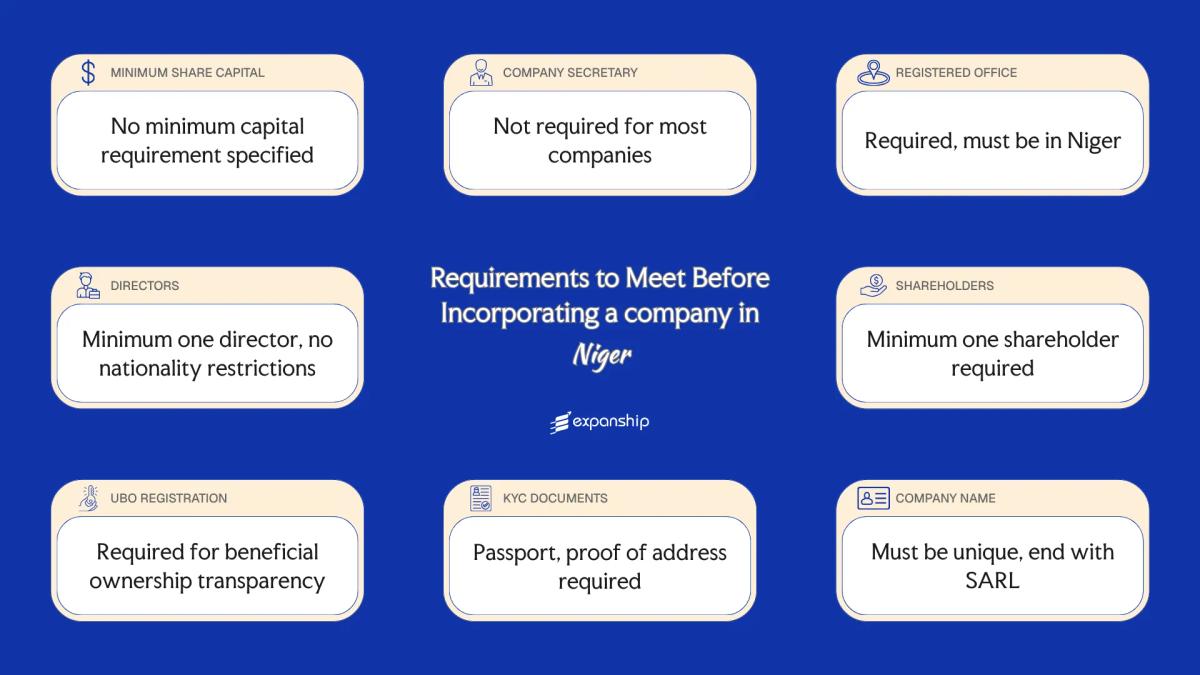
Minimum Share Capital Requirements in Niger
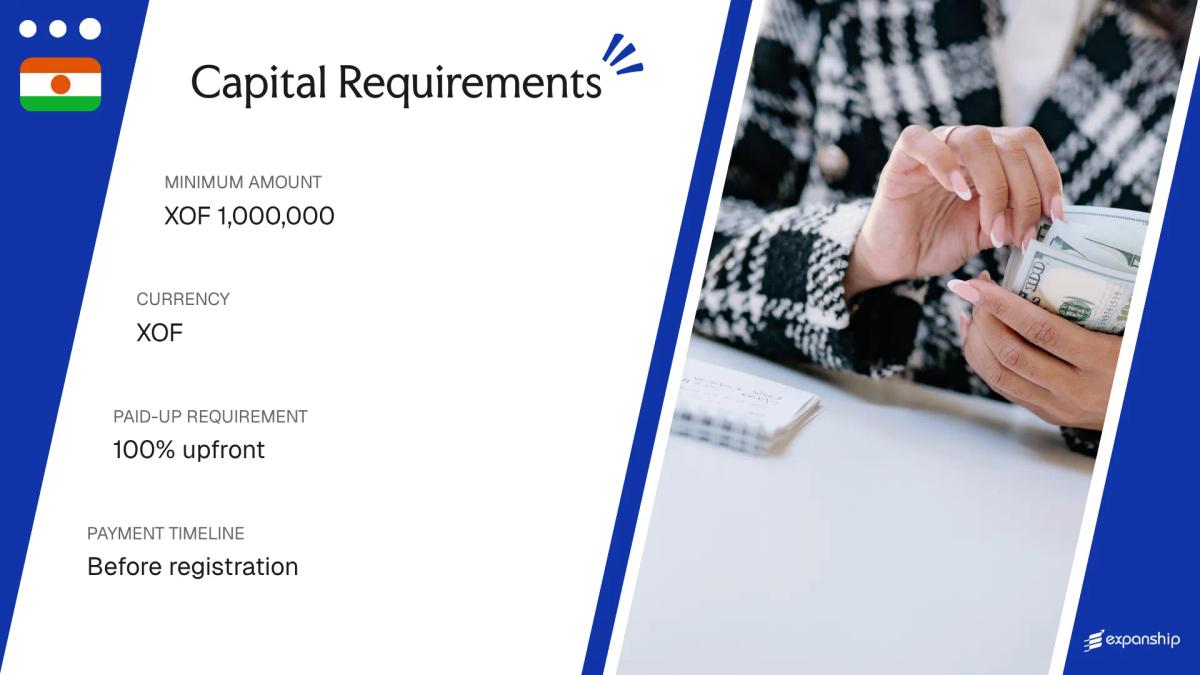
Minimum share capital requirements in Niger are governed by the OHADA Uniform Act on Commercial Companies, which applies across all OHADA member states including Niger. The applicable thresholds differ by entity type, with the Société Anonyme (SA) and the Société à Responsabilité Limitée (SARL) each subject to distinct statutory capital rules.
Capital must be deposited into a blocked bank account prior to the filing of incorporation documents with the Centre de Formalités des Entreprises (CFE), which operates under the supervision of the Chambre de Commerce et d'Industrie du Niger. The RCCM (Registre du Commerce et du Crédit Mobilier) then registers the entity once the notary confirms that capital conditions have been satisfied.
| Parameter | Detail |
|---|---|
| Minimum Authorized Share Capital | SARL: XOF 1,000,000; SA: XOF 10,000,000 |
| Maximum Authorized Share Capital | No statutory maximum |
| Minimum Paid-Up Capital | SARL: Full amount at incorporation; SA: at least one-quarter of subscribed capital |
| Paid-Up Requirement at Incorporation | SARL: 100%; SA: 25% minimum, remainder within 3 years |
| Accepted Currency | West African CFA franc (XOF) |
| Accepted Forms of Contribution | Cash (apports en numéraire) and contributions in kind (apports en nature), subject to auditor valuation for in-kind contributions |
| Timeframe to Deposit Capital | Prior to signing of the incorporation deed before a notary |
For an SA, depositing only the 25% minimum at incorporation is permitted, but the remaining subscribed capital must be called and paid within three years of registration. Failure to meet this schedule can expose directors to personal liability under the OHADA Uniform Act.
Company Secretary Requirements in Niger
Under OHADA's Uniform Act on Commercial Companies (AUDSC), Niger does not impose a standalone company secretary requirement equivalent to common law jurisdictions. The company secretary requirements Niger businesses must meet are instead embedded within the OHADA framework, which designates corporate governance responsibilities to statutory officers rather than a separate secretarial role.
For Sociétés Anonymes (SA), a board secretary function is typically exercised by the board itself or a designated director. Smaller entities such as the Société à Responsabilité Limitée (SARL) have no formal requirement to appoint a company secretary under Niger OHADA secretary rules.
Qualification criteria for those fulfilling secretarial or equivalent administrative compliance functions:
- No dedicated licensing regime exists under OHADA for a company secretary role in Niger.
- Natural persons or legal entities designated internally by the board may carry out secretarial duties.
- No statutory residency requirement applies to the individual performing this function.
- Duties include maintaining corporate records, preparing board meeting minutes, and filing statutory documents with the RCCM (Registre du Commerce et du Crédit Mobilier).
- For SAs, the person handling these functions must have capacity under OHADA civil law standards.

Incorporate a Company in Niger
Set up your legal entity in Niger with full compliance under the OHADA framework, from registration through post-incorporation obligations.
Registered Office Requirements in Niger
Registered office requirements in Niger mandate that every company maintain a physical siège social on Nigerien territory, serving as the official address for correspondence with the Organisation pour l'Harmonisation en Afrique du Droit des Affaires (OHADA) and local tax authorities. Failure to maintain a compliant legal address can result in administrative sanctions under the OHADA Uniform Act on Commercial Companies, including potential deregistration or fines imposed by the Centre de Formalités des Entreprises (CFE).
- A physical address within Niger is required; a post office box alone does not satisfy the siège social obligation.
- Virtual offices are generally not accepted as a standalone registered address under OHADA incorporation rules.
- The address must be located within Nigerien territory; a foreign address cannot serve as the registered office.
- Documentary proof of occupancy, such as a lease agreement or title deed, must be submitted at incorporation.
- The registered address is recorded in the Registre du Commerce et du Crédit Mobilier (RCCM) and is publicly accessible.
- Any change to the registered address must be formally notified to the RCCM and updated in the company's statutory documents.
Director Requirements in Niger
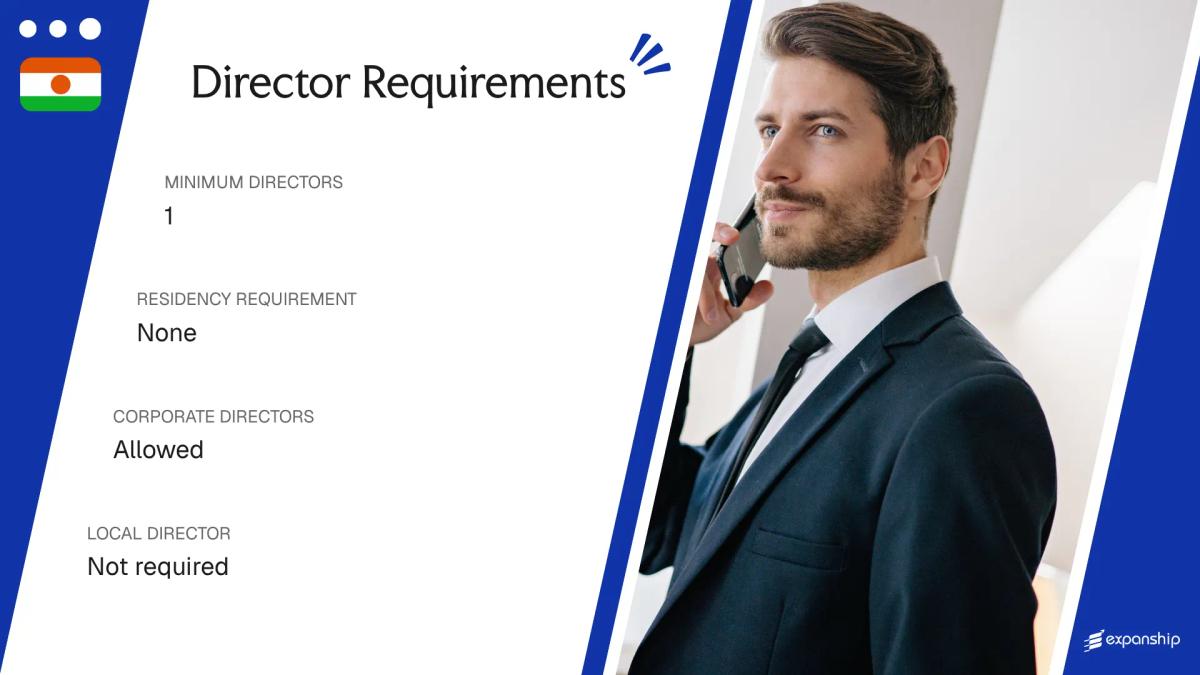
Under the OHADA Uniform Act on Commercial Companies (AUSCGIE), director requirements in Niger company structures assign statutory duties of management, loyalty, and fiduciary care to appointed officers from the moment of registration. Directors bear personal liability for acts that breach the company's articles, exceed their mandate, or violate applicable OHADA provisions.
| Parameter | Detail |
|---|---|
| Minimum Number of Directors | One gérant (manager) is required for a SARL; an SA requires a board of at least three directors. |
| Maximum Number of Directors | An SA may have no more than twelve board members under the AUSCGIE. |
| Local/Resident Director Required | No statutory residency requirement exists under OHADA rules as applied in Niger. |
| Nationality Restrictions | No nationality restrictions are imposed; foreign nationals may serve as directors. |
| Minimum Age Requirement | Directors must have reached the age of legal majority, which is 18 years under Nigerien civil law. |
| Corporate Directors Permitted | Corporate entities may not serve as gérant in a SARL; the position must be held by a natural person. |
| Director Must Be a Shareholder | No statutory requirement obligates a director to hold shares in the company. |
| Publicly Listed on Registry | Director appointments are filed with the Registre du Commerce et du Crédit Mobilier (RCCM) and are publicly accessible. |
| Disqualification Conditions | Persons subject to a judicial prohibition, bankruptcy order, or criminal conviction affecting commercial capacity are disqualified under AUSCGIE provisions. |
Despite Niger's civil law tradition, the OHADA framework permits a single individual to simultaneously hold the position of gérant and sole associate in a SARL unipersonnelle, meaning one person can legally constitute the entire corporate structure without a separate director or shareholder.
Shareholder Requirements in Niger
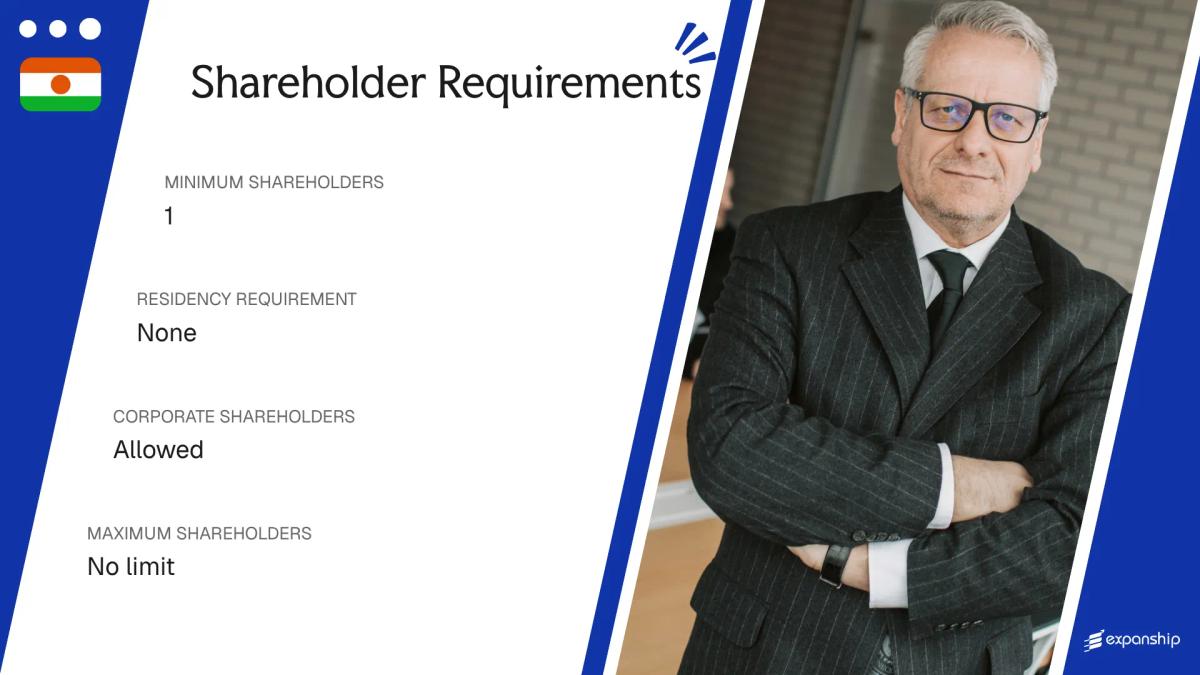
Under the OHADA Uniform Act on Commercial Companies, a Société à Responsabilité Limitée (SARL) requires a minimum of one shareholder and permits up to fifty. Meeting the shareholder requirements Niger incorporation rules demand means a single-person SARL, known as a SARLU, is a recognized structure.
Nationality and Residency Restrictions
No statutory requirement obliges shareholders to be Nigerien nationals or residents. Foreign individuals and entities may hold up to 100% of the share capital without restriction under current OHADA-aligned rules.
Corporate Shareholders
Corporate entities are permitted to act as associés in a Niger SARL. No special authorization is required solely on account of the shareholder being a legal person rather than an individual.
Shareholder Liability
Niger company shareholder rules cap each associé's liability at the amount contributed to the share capital. Personal assets remain protected unless a court establishes that corporate formalities were disregarded or fraud occurred.
Register of Shareholders
A register of associés must be maintained at the company's registered office. It is not publicly accessible, though updates are required when ownership transfers occur and certain changes must be filed with the Registre du Commerce et du Crédit Mobilier (RCCM).
Shareholder Structure Guidance for Your Niger Entity
Get tailored advice on structuring shareholding arrangements that meet OHADA and local RCCM requirements for your Niger incorporation.
UBO / Beneficial Ownership Disclosure Requirements in Niger
Beneficial ownership requirements in Niger are governed under the OHADA Uniform Act on Commercial Companies (AUDSC) and anti-money laundering obligations derived from the GIABA framework, to which Niger is a member state. A beneficial owner is generally defined as any natural person who ultimately owns or controls 25% or more of a company's shares or voting rights.
- Identify all natural persons holding 25% or more of the entity's capital or voting rights prior to registration.
- Disclose beneficial owner information to the Registre du Commerce et du Crédit Mobilier (RCCM) at the time of incorporation.
- Submit supporting documentation establishing the ownership chain for each identified beneficial owner.
- Report any changes in beneficial ownership to the RCCM within a prescribed period following the change.
| Parameter | Detail |
|---|---|
| Ownership Threshold for UBO Status | 25% of shares or voting rights |
| Filing Authority | Registre du Commerce et du Crédit Mobilier (RCCM) |
| Disclosure Deadline at Incorporation | At the time of incorporation filing |
| Publicly Accessible Register | No statutory requirement for full public access |
| Penalties for Non-Disclosure | Subject to OHADA and national AML sanctions; specific penalty amounts not codified in publicly available statutes |
| Ongoing Update Obligation | Yes; changes must be reported to the RCCM |
KYC / Document Requirements in Niger
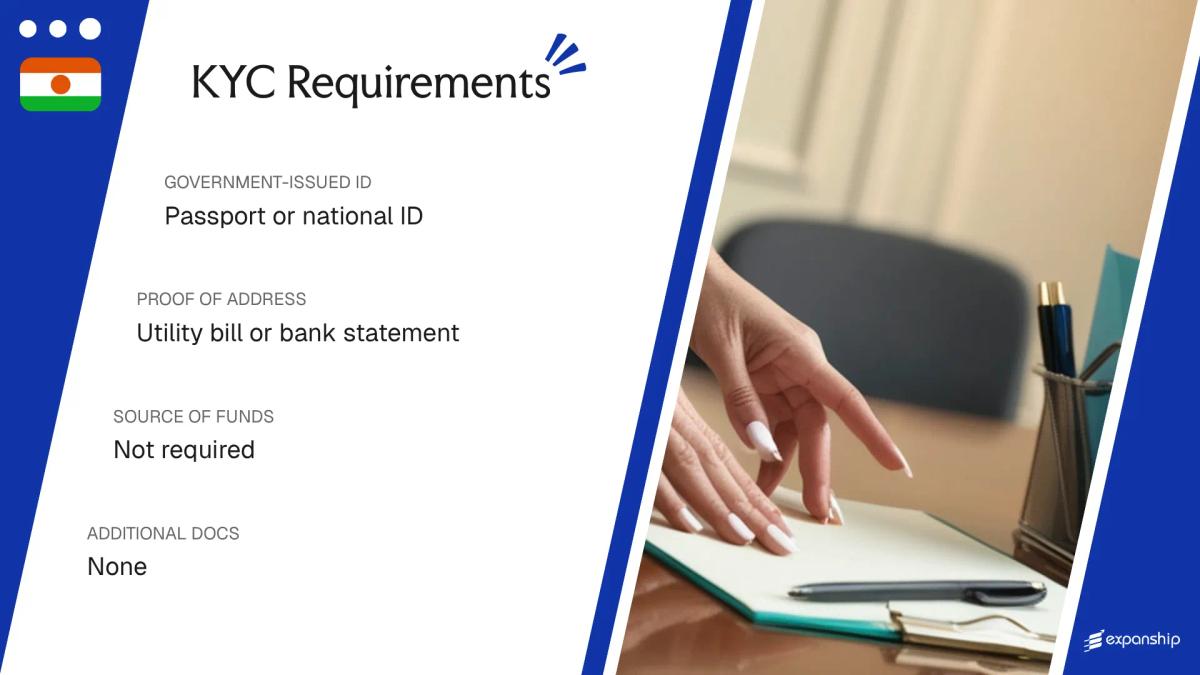
KYC requirements Niger company registration are governed by Ordonnance N° 2017-020, which established the framework for anti-money laundering and counter-terrorism financing obligations administered by the CENTIF-Niger.
Individual / Personal Documents
- Valid government-issued passport or national identity card for each individual director, shareholder, or beneficial owner
- Proof of residential address dated within three months, such as a utility bill or bank statement
- Completed and signed KYC declaration form as required by the notaire or incorporation agent
- Recent passport-sized photographs may be required depending on the filing notaire's internal procedures
Corporate Documents
- Certificate of incorporation or equivalent constitutional document for any corporate shareholder or director
- Articles of association or equivalent constitutional document, evidencing the entity's current structure
- Register of directors and register of shareholders from the corporate entity's home jurisdiction
- Proof of the corporate entity's registered office address
Source of Funds Documentation
- Bank statements covering a minimum of three months prior to incorporation
- Audited financial statements or equivalent where the contributing entity is an established business
- A written declaration of the origin of capital may be required by the receiving notaire
Notarisation and Apostille Requirements
- Foreign documents submitted for Niger RCCM filing requirements must generally be notarised in the country of origin
- Documents from non-Francophone jurisdictions require certified French translation by a sworn translator
- Apostille certification under the Hague Convention applies where the originating country is a signatory
Untranslated foreign-language documents are the most common cause of RCCM filing rejection in Niger.
Company Name Requirements in Niger
Company name requirements in Niger are assessed at the point of registration through the Centre de Formalités des Entreprises (CFE), which verifies that a proposed name is available, non-duplicative, and does not conflict with existing registered entities.
Names must be in French, reflecting Niger's official language. The chosen name must include a legal suffix indicating the entity type, such as SA (Société Anonyme) or SARL (Société à Responsabilité Limitée).
Certain words are restricted. Terms suggesting government affiliation, financial institutions, or regulated professions require prior authorisation from the relevant supervising authority before the CFE will accept the name.
Name reservation is generally available through the CFE prior to formal incorporation. The reservation period is limited, and the application is submitted alongside or ahead of the full incorporation dossier.
Compliance Services for Companies in Niger
Maintain your entity's good standing in Niger with ongoing compliance support, from annual filings to regulatory reporting.
Conclusion
Niger company incorporation requirements are governed primarily by OHADA Uniform Acts, supplemented by national-level procedures administered through the Centre de Formalités des Entreprises. Meeting the requirements covered across the preceding sections — from minimum share capital thresholds to UBO disclosure obligations and KYC documentation — defines whether your entity achieves legal standing.
Two requirements carry particular weight in practice: the RCCM registration process and the notarized incorporation deed, both of which involve specific procedural steps before your firm is recognized as operational. Beneficial ownership disclosure obligations also carry ongoing compliance implications beyond the formation date.
Once these requirements are understood, the practical work of execution begins.
Expanship's Corporate Services for Niger Expansion
Satisfying Niger's corporate requirements, from share capital deposits at a local bank to registered office maintenance and RCCM filings, involves coordination across multiple institutions and regulatory bodies. Expanship's Niger corporate services incorporation support reduces the administrative weight of managing these moving parts by handling the procedural groundwork on your behalf. Your business can stay focused on commercial priorities while the compliance requirements are addressed accurately.
Expanship offers end-to-end support across the full incorporation and post-incorporation cycle in Niger. Our services cover:
- Preparing and filing all company registration documents with the relevant authorities
- Providing a registered agent and local office address to satisfy residency requirements
- Liaising directly with government bodies and regulatory agencies on your behalf
- Managing ongoing compliance obligations after your entity is incorporated
- Facilitating introductions to banking institutions for account opening
- Handling tax registration and coordination with local fiscal authorities
To discuss how Expanship supports your Niger expansion, contact the team at Expanship Niger.
Frequently Asked Questions (FAQ)
Your company is legally required to notify the Centre de Formalités des Entreprises (CFE) and update the RCCM (Registre du Commerce et du Crédit Mobilier) with the new address. Failure to maintain a valid registered office can result in administrative complications, including difficulties receiving official correspondence and potential compliance flags during regulatory reviews. The update must be formalized through a company resolution and submitted promptly to the relevant registry.
A non-resident foreigner can serve as director, but practical compliance burdens increase significantly without local representation for regulatory filings and correspondence. Niger's regulatory framework does not impose a residency requirement for directors, though certain filings with the CFE and interactions with the Direction Générale des Impôts may require a locally accessible point of contact. This distinction between legal eligibility and operational practicality is worth factoring into your governance structure.
Non-compliance with beneficial ownership disclosure obligations, which align with OHADA standards and Niger's anti-money laundering framework, can result in fines and potential suspension of the company's legal standing. The Cellule Nigérienne de Traitement des Informations Financières (CENTIF) oversees financial intelligence and AML enforcement, and entities flagged for non-disclosure face scrutiny from that body. Repeated or deliberate non-disclosure carries escalating penalties under Niger's AML legislation.
Yes, corporate shareholders face a distinct documentation burden compared to individual shareholders. Rather than personal identification documents, a corporate shareholder must provide its certificate of incorporation, constitutional documents, and evidence of its own beneficial ownership structure. In some cases, a legalized or apostilled chain of ownership documentation is required, particularly where the corporate shareholder is registered outside Niger or the OHADA zone.
Company name approval in Niger is handled through the RCCM during the registration process administered by the CFE. The proposed name is checked for conflicts with existing registered entities, and names that imply government affiliation or regulated activity without authorization are rejected. Submitting a name that passes the RCCM check does not guarantee trademark protection, which is a separate process governed by the Organisation Africaine de la Propriété Intellectuelle (OAPI).
Legal Disclaimer
The information provided in this article is for general informational purposes only and does not constitute legal, tax, or professional advice. While we strive to ensure the accuracy and timeliness of the content, laws and regulations are subject to change, and the application of laws can vary widely based on specific facts and circumstances.
Readers should not act upon this information without seeking professional counsel tailored to their individual situation. Expanship and its authors disclaim any liability for actions taken or not taken based on the content of this article.
For specific advice regarding your business setup, compliance requirements, or any legal matters, please consult with qualified legal and tax professionals in the relevant jurisdiction.